Note P05 Revision 1 Terms read 17 October 2026
One win of £180.00, paid out three different ways, timed on a single clock
Forty-six hours, seventy-two hours and seventy-eight hours are what this note models for the same payout sent by three routes, and the ordering is not the one a reader would guess. A wallet is quickest only while the money stays in the wallet. Carried on to a current account it finishes last of the three, 6 h behind a transfer that went bank to bank without a wallet in the middle.
The win being paid £180.00 Stopping in a wallet 46 h Reaching a current account 72 h
Where a win of this size spends its wait
Advertising has been bought for every destination below. A fee reaches this site when a reader goes on to register, and no figure on this page moves one way or the other because of it.
-
01Mobile Free Spins
Betportal
Ceiling as a multiple
What lands€15.00150 spins at 10c, which is this site's figure and not the operator'sThe run17 h 30 minTurning over 525.00 at 10p means 5,250 presses, or about 48 phone sittings of 22 minutes. Timed at 10p a press and 12 seconds between presses, both of which this site assumes rather than measures.The wait to be paidNOT PUBLISHEDThis operator puts no withdrawal band in its own terms, so there is nothing honest to print here.Spins valued at this site's own 10p a spin
What lands
Spins, at a price15.00150 of them at 10c apiece, a figure belonging to this site rather than to the operatorMatch, and other creditno figure300% of three deposits, to a ceiling of €1,000. Not a sum until money of yours makes it one, so this row totals nothing and carries nothing downwardsThe run
Handed back on the spins(0.60)Each press stakes its own value and returns 96 per cent, which leaves this much with the house from the opening pressPlay-through 35x on the bonus(20.16)Taking 14.40 round 35 times over means 504.00 through the machines, of which 20.16 is the expected cost, and 17 h 30 min of pressing at the pace aboveWhat counts towards it100%Slots only, with no percentage published anywhere, so the row above assumes the whole of each stake countsWhat never clears
Limit on the winningsstated5x the bonusDeducted on the way outno figureNothing is published as a figure here, so this row removes nothingLeast that can leaveno figureNo figure is published, so nothing on this timer is pinned down by oneLeast deposit, and the rung over ityour own€20 a stage. Published in euros, so no rung is named at all: this site's ladder is a sterling oneThe window on the creditstated14 daysBiggest stake while it runsstated€5Removed outright by rulestatedNot publishedVerified before a payoutstatedDocuments before the first withdrawalNever clears€15.00Not a penny of it gets out, so the whole of what landed stands on this rowNo Great Britain licence
Licence held in Anjouan, Comoros, the company named is BetPortal Gaming Ltd, with Excite Ultra Media Ltd, quoted under ALSI-202601040-FI2.
Terms read 17 October 2026
Open the offer at Betportal, opens in a new window -
02Mobile Free Spins
WinBeast
Ceiling as a sum
What lands€50.00500 spins at 10c, which is this site's figure and not the operator'sThe run2 d 18 hTurning over 2,000.00 at 10p means 20,000 presses, or about 182 phone sittings of 22 minutes. Timed at 10p a press and 12 seconds between presses, both of which this site assumes rather than measures.The wait to be paidNOT PUBLISHEDThis operator puts no withdrawal band in its own terms, so there is nothing honest to print here.Spins valued at this site's own 10p a spin
What lands
Spins, at a price50.00500 of them at 10c apiece, a figure belonging to this site rather than to the operatorMatch, and other creditno figure50% to 100% of five deposits, each to a ceiling of €1,000, and a €650 free bet. Not a sum until money of yours makes it one, so this row totals nothing and carries nothing downwardsThe run
Handed back on the spins(2.00)Each press stakes its own value and returns 96 per cent, which leaves this much with the house from the opening pressPlay-through 40x on the bonus and the winnings from the spins(76.80)Taking 48.00 round 40 times over means 1,920.00 through the machines, of which 76.80 is the expected cost, and 2 d 18 h of pressing at the pace aboveWhat counts towards it100%Slots, titles vary by country, with no percentage published anywhere, so the row above assumes the whole of each stake countsWhat never clears
Limit on the winningsstated€100 a batch of spinsDeducted on the way outno figureNothing is published as a figure here, so this row removes nothingLeast that can leaveno figureNo figure is published, so nothing on this timer is pinned down by oneLeast deposit, and the rung over ityour own€20 a stage. Published in euros, so no rung is named at all: this site's ladder is a sterling oneThe window on the creditstated7 days, spins 1 dayBiggest stake while it runsstatedNot publishedRemoved outright by rulestatedNot publishedVerified before a payoutstatedDocuments before the first withdrawalNever clears€50.00Not a penny of it gets out, so the whole of what landed stands on this rowNo Great Britain licence
Licence held in Curaçao, no company named anywhere on the site.
Terms read 17 October 2026
Open the offer at WinBeast, opens in a new window -
03Mobile Free Spins
EliteSpin
Longest spin window
What lands£50.00500 spins at 10p, which is this site's figure and not the operator'sThe run2 d 18 hTurning over 2,000.00 at 10p means 20,000 presses, or about 182 phone sittings of 22 minutes. Timed at 10p a press and 12 seconds between presses, both of which this site assumes rather than measures.The wait to be paidNOT PUBLISHEDThis operator puts no withdrawal band in its own terms, so there is nothing honest to print here.Spins valued at this site's own 10p a spin
What lands
Spins, at a price50.00500 of them at 10p apiece, a figure belonging to this site rather than to the operatorMatch, and other creditno figure50% to 100% of five deposits, each to a ceiling of £1,000. Not a sum until money of yours makes it one, so this row totals nothing and carries nothing downwardsThe run
Handed back on the spins(2.00)Each press stakes its own value and returns 96 per cent, which leaves this much with the house from the opening pressPlay-through 40x on the bonus and the winnings from the spins(76.80)Taking 48.00 round 40 times over means 1,920.00 through the machines, of which 76.80 is the expected cost, and 2 d 18 h of pressing at the pace aboveWhat counts towards it100%Slots, with no percentage published anywhere, so the row above assumes the whole of each stake countsWhat never clears
Limit on the winningsstated5x the bonusDeducted on the way outno figureNothing is published as a figure here, so this row removes nothingLeast that can leaveno figureNo figure is published, so nothing on this timer is pinned down by oneLeast deposit, and the rung over ityour own£20 a stage. It lands square on the £20.00 rung, so none of yours is left perched on topThe window on the creditstated7 days, spins 3 daysBiggest stake while it runsstatedNot publishedRemoved outright by rulestatedNot publishedVerified before a payoutstatedDocuments before the first withdrawalNever clears£50.00Not a penny of it gets out, so the whole of what landed stands on this rowNo Great Britain licence
Licence held in Costa Rica, the company named is PrimeTier Limited.
Terms read 17 October 2026
Open the offer at EliteSpin, opens in a new window -
04Mobile Free Spins
Crown Jewelz
Multiple unpublished
What lands£15.00150 spins at 10p, which is this site's figure and not the operator'sThe runNOT TIMEDThis operator does not publish the play-through multiple in its own terms. The multiple is the one figure the clock cannot work around, so the run is left untimed.The wait to be paidNOT PUBLISHEDThis operator puts no withdrawal band in its own terms, so there is nothing honest to print here.Nothing reckoned
What lands
Spins, at a price15.00150 of them at 10p apiece, a figure belonging to this site rather than to the operatorMatch, and other creditno figure200% of the first deposit, then 150% twice, each to a ceiling of £1,000. Not a sum until money of yours makes it one, so this row totals nothing and carries nothing downwardsThe run
Play-throughno figure40x the bonus, reported rather than published by the operatorWhat counts towards itno figureSlots, with no percentage published anywhere, so the row above assumes the whole of each stake countsWhat never clears
Limit on the winningsstatedNot publishedDeducted on the way outno figureNothing is published as a figure here, so this row removes nothingLeast that can leaveno figureNo figure is published, so nothing on this timer is pinned down by oneLeast deposit, and the rung over ityour own£20. It lands square on the £20.00 rung, so none of yours is left perched on topThe window on the creditstatedNot publishedBiggest stake while it runsstatedNot publishedRemoved outright by rulestatedNot publishedVerified before a payoutstatedDocuments before the first withdrawalNever clearsNOT RECKONEDThis operator leaves the play-through multiple out of its own terms, so nothing below the fourth step can be worked out.No Great Britain licence
Licence held in Curaçao, number not verified, no company named anywhere on the site.
Terms read 17 October 2026
Open the offer at Crown Jewelz, opens in a new window
Only the middle reading comes out of arithmetic belonging to this site. The multiple laid against what lands gives the turnover asked for; dividing that by 10p a spin gives the presses; dividing those by 300 an hour gives the hours, a press on a handset being taken here at 12 seconds from the one before. Both figures are assumptions rather than measurements of anybody: nothing was played and nothing was held a stopwatch to. Anybody quicker should divide the press count by a rate of their own, which is why the presses are printed alongside the hours instead of being summarised away.
The first reading is what arrives before any condition is laid against it. Spins carry no unit of their own so one gets supplied: where an operator values its own spin that figure is used and attributed, and where it does not, this site's 10p a spin stands in and everything below moves with it. The third reading belongs to the operator entirely. It is a withdrawal band quoted from published terms, and a blank there means none was published rather than that nobody looked.
The total along the foot answers what the hours leave open, which is whether any of the running ends anywhere. It is what arrived, less whatever is still standing once the play-through has been paid for at 96 per cent return to player and once a published limit, a published deduction and a published floor beneath the least that can leave have each had a turn. It appears again in pence in the pound, the only fair way of holding a small offer up against a large one. It describes an offer rather than an evening, and where the conditions price out what arrived, a timer prints nothing getting out instead of a negative sum.
Cashiers on a handset take deposits off a row of preset buttons, so a least deposit given in pounds is raised to the next rung of the ladder used here, £10, £20, £25, £50, £75 and £100, and the timer shows what is left perched on it. That money is the reader's own and enters no sum at all. Given in euros it prints untouched, the ladder being sterling. Three words may occupy the figure column where no figure belongs. Stated is a published term that costs something while leaving no number to subtract. No figure is a term nobody has quantified, or a credit that is not a sum until money of yours makes it one. Your own is money of yours, which belongs in none of this.
None of the operators above is licensed in Great Britain, so not one duty that licence carries reaches any of them. Membership of Gamstop Online is compulsory for every online gambling company licensed in Great Britain, which means that shutting yourself out through the scheme shuts you out of none of these. The limit of ten times the bonus funds on a wagering requirement, running since 19 January 2026 under Social Responsibility Code 5.1.1, is a condition of the same licence and binds only whoever holds one. Off that licence, the Gambling Commission writes of consumers meeting unfair gaming practices, financial loss and no recourse when matters go wrong, and lists blocked payouts and withdrawal limits pitched too high to reach among the things it has seen. No account at any of them may be held by anybody under 18.
Every term on a timer is its operator's own and every timer carries the day somebody read it. The oldest of those readings is 17 October 2026. What binds a reader is an operator's full terms and never a line printed here.
1
Three exits, one sum of money, and the same four lengths
One hundred and eighty pounds is the sum this note follows from start to finish, and keeping it fixed is the whole method. Changing the route while holding the money constant is the only way to see what a route actually costs, because a comparison of two payouts of different sizes made on different days tells a reader nothing at all.
Eighteen hundred presses is that sum at ten pence apiece, six hours of pressing at the three hundred an hour this site assumes from a twelve-second press, and seventeen goes with a handset once a sitting is fixed at the twenty-two minutes assumed here. None of those three was measured. They are stated so that the money on this page has a weight in the only currency the site deals in, which is time already spent.
Four lengths make up the wait on every route below, and separating them is what the rest of the page does. How long a request is read for belongs to the desk. Whether the identity work sits in this week or in the week the account opened belongs to the desk as well. The machinery between accounts owns the moving. The calendar owns what is left, and the calendar negotiates with nobody.
Skrill and Neteller are wallets, which is to say each is an account in its own right, holding a balance that belongs to the reader and sitting between the gambling account and the bank. Trustly is not a wallet. It moves money between a reader’s own bank account and the other party with nothing parked in the middle. That single structural difference is the subject of parts two and three, and it does almost nothing at the entrance and a great deal at the exit.
Two wallets are treated as one shape here, deliberately and with the reason stated. At the exit both land money in a wallet and both therefore need a second movement before the money is in a current account. Anything that separates one from the other in practice is a matter of a particular desk’s own arrangements, and this page asserts nothing whatever about those.
Every length in this note is an assumption of this page, chosen to make the arithmetic visible and carrying no source behind it. Nothing was clocked, nothing was observed, and no desk was asked. A reader who thinks the review hold should be twelve hours rather than twenty-four can halve it and rework the four additions below in about a minute, which is the point of setting them out separately rather than quoting a total.
2
A payout into a wallet is half a payout
Two hours is what this note assumes between a desk releasing a payment and that payment appearing in a wallet, and the figure is deliberately small. A wallet movement is not a transfer between banks. It is an instruction passing between two parties who both already know who the reader is, which is why the quick figure is the believable one and why the wallet route looks so good when the story stops there.
Forty-six hours is the whole wait on that reading, being twenty-four of review hold, twenty of identity work and two of movement, all three assumed by this page. Money is now in a wallet, which is a real place and not a fiction. It can be spent where that wallet is accepted and it can be sent to somebody else who holds one.
Nought of it is in a current account, and that is the sentence the comparison turns on. A reader who wanted money for a direct debit, a card payment or a cash machine has arrived somewhere adjacent to the destination rather than at it, and the leg still outstanding is the one with a bank at the end of it.
46 assumed hours to a wallet, 78 to a bank behind it
Twenty-four hours is what this note assumes for that second leg, wallet to bank, and the assumption is four times the size of the first one for a plain structural reason. The second leg leaves the wallet’s own books and enters the system that moves money between banks, so it is a banking movement with everything that implies, where the first leg was not.
Seventy-eight hours is therefore the total on the carried-on route in the Friday case worked in part five, which is thirty-two hours more than the wallet figure and six hours more than going bank to bank from the start. The wallet did not get slower. A step was added that the other route never had, and it was added at the end, when the reader was already waiting.
One timing detail belongs to the reader rather than to anybody else, and it is the only piece of this page a reader fully controls. The second leg starts when the reader instructs it, not when the money lands. Somebody who notices the wallet credit on Sunday evening and acts on Monday morning has added the whole of Sunday night to the chain, which no desk anywhere caused.
3
What a transfer with no wallet in it inherits instead
Eighteen hours is what this note assumes for a payment travelling from the desk to a reader’s own bank account with nothing in between, and that figure sits deliberately between the two-hour wallet hop and the twenty-four-hour wallet-to-bank leg. It is one banking movement rather than none and rather than two, and the assumption is this page’s own.
Sixty-two hours is the total that produces on a quiet week, being twenty-four of hold, twenty of identity work and eighteen of movement. Set against forty-six for a wallet that is not carried on, the bank route costs sixteen hours more and finishes somewhere the money can actually be spent on anything. Set against seventy for a wallet carried on through the same quiet week, it saves eight.
Eight hours is the whole of that second difference and it is not mysterious. The wallet route splits one journey into a short hop and a long one, two plus twenty-four against eighteen in a single movement, so the splitting costs eight hours of extra machinery and the stop in the middle costs whatever the reader takes to notice it.
Inheriting the banking week is the price of going direct, and it is the one disadvantage the route cannot shed. A wallet credit can land at three in the morning on a Sunday because no bank is involved in it. A transfer to a current account cannot, and part five prices exactly that.
None of the three routes changes the review hold, which is worth repeating because it is the single most common confusion about payout speed. The hold belongs to the desk, not to the scheme. A reader who switches from one of these to another, hoping for a faster payout, has changed a leg worth between two and twenty-six assumed hours and has left the twenty-four assumed hours in front of it exactly as they were.
4
Which piece of the wait dominates on which route
Fifty-two point two per cent of the wallet-only wait is the review hold, which makes it the dominant piece on that route by a distance. Twenty-four hours out of forty-six is more than half the total, and the part that reads as the payment itself, the two-hour hop, is 4.3 per cent of it. A reader shopping between wallets on this route is choosing between variants of four per cent of their own wait.
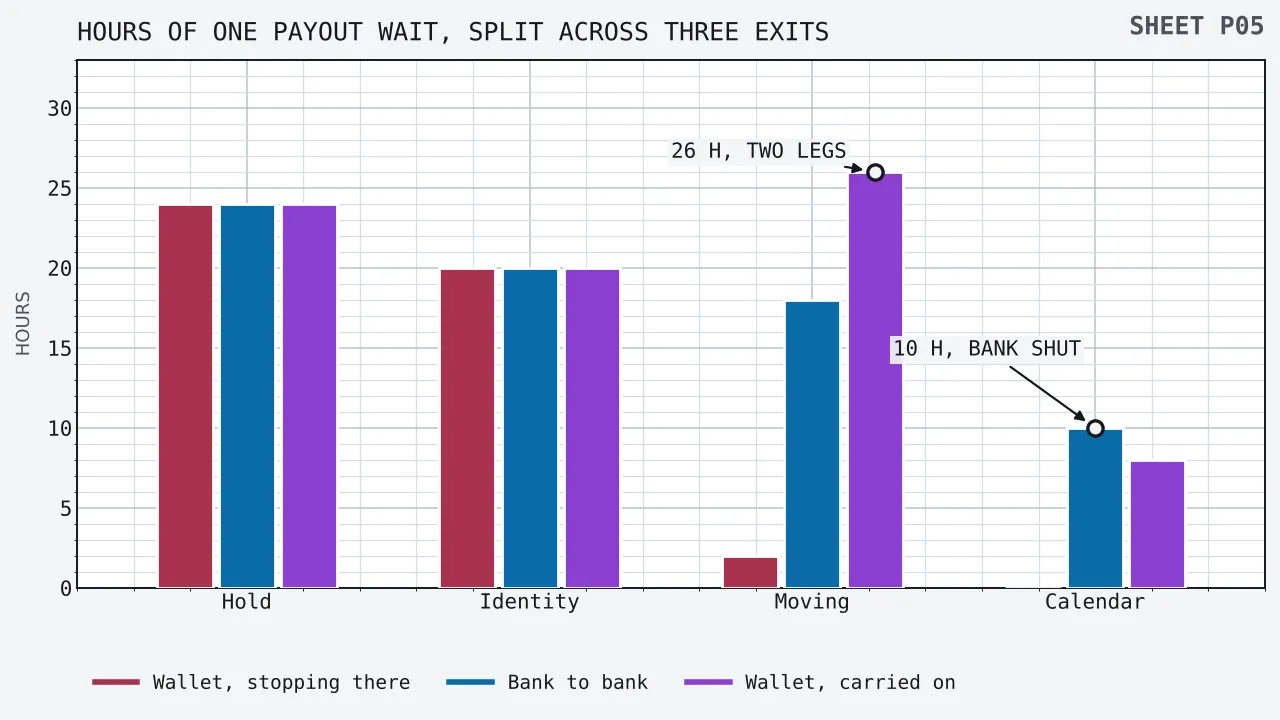
Thirty-three point three per cent of the carried-on wallet wait is the movement, twenty-six hours out of seventy-eight, and that is the only route of the three where the money actually moving is the largest single piece. Adding a leg does not merely lengthen the chain. It shifts which part of the chain a reader should be asking questions about.
| Piece of the wait | Wallet, stopping there | Bank to bank | Wallet, carried on |
|---|---|---|---|
| Request read by the desk | 24 h | 24 h | 24 h |
| Identity work left to the exit | 20 h | 20 h | 20 h |
| The money moving | 2 h | 18 h | 26 h |
| Shut calendar inserted | nil | 10 h | 8 h |
| The wait in full | 46 h | 72 h | 78 h |
| Where it ends up | A wallet | A bank account | A bank account |
Forty-four hours of the total is identical across the three columns, being the hold and the identity work added together, and that is the most useful line in the table. On the fastest route those forty-four hours are 95.7 per cent of everything. On the slowest they are 56.4 per cent. No choice of payment scheme touches a minute of them.
Two pieces separate the routes and two do not, which reduces the whole comparison to a manageable question. The movement differs, two against eighteen against twenty-six on the lengths assumed here. The shut calendar differs, because it only bites on a leg that needs a bank to be open. Everything else is the same desk doing the same work in the same order.
Thirteen point nine per cent is the calendar’s share of the bank-to-bank wait in this worked case, which is the largest share it takes anywhere on the page, and it takes it on the route that has the shortest machinery. That is the inversion worth carrying away. The more directly a route moves money, the more exposed it is to the hours in which money is not moved at all.
5
One request, timed from a Friday evening and then from a Monday
Midnight on Monday to midnight on Saturday is when a movement between banks is treated as possible here, which leaves 120 hours of each week open and 48 of them shut. That rule is this note’s own, put in to make the week visible, and no timetable anywhere was consulted for it. Every figure in this part descends from it.
Six in the evening on a Friday is the first request. The hold runs out at six on Saturday evening. The identity work finishes at two on Sunday afternoon. At that moment the three routes part company, and they part company purely on whether the next step needs a bank to be awake.
Four in the afternoon on Sunday is when the wallet-only route is finished, two hours after the identity work, because nothing in it waits for anybody to open. Forty-six hours from end to end, with the entire weekend passing unnoticed, which is the strongest thing that can be said for a wallet and this page says it plainly.
Ten hours of nothing is what the bank-to-bank route does next. Released at two on Sunday afternoon, the movement cannot begin until midnight on Monday, then takes its eighteen assumed hours, and lands at six on Monday evening. Seventy-two hours in all, of which ten were spent waiting for a week to restart.
| Route taken | Asked for Friday 18:00 | Asked for Monday 09:00 | Cost of the weekend | Where the money stops |
|---|---|---|---|---|
| Wallet, left where it lands | 46 h | 46 h | nil | A wallet |
| Bank to bank, no wallet | 72 h | 62 h | 10 h | A bank account |
| Wallet, then on to a bank | 78 h | 70 h | 8 h | A bank account |
Eight hours is the weekend’s cost on the carried-on route against ten on the direct one, and the smaller number belongs to the slower route, which looks wrong until the sequence is laid out. The wallet hop uses two of the shut hours productively, so only eight remain to be waited through before midnight on Monday. Being slow at the right moment is worth two hours here.
Nine in the morning on a Monday is the second request and it removes the calendar entirely. Forty-six, sixty-two and seventy hours are the three totals, every movement falling inside the open part of the week. The gap between the fastest and the slowest route narrows from thirty-two hours to twenty-four.
Nought changes in the ordering across the two days, which is the result that makes the table worth printing. Bank to bank beats wallet-carried-on by six hours on a Friday and by eight on a Monday, and a wallet left alone beats both on either day by refusing to finish the journey. A reader can therefore choose a route without knowing what day it will be, which is unusual on this subject.
6
An offer cancelled at the entrance by the icon chosen
Nought is what a promotion pays out to somebody who funded the account through a wallet where the terms exclude wallet payments from the offer, and the exclusion is a line of text sitting a click away from the headline. The money still arrives. The credit does not. The reader finds out at the moment they expected the credit to appear, which is after the payment has gone through and cannot be unwound.
Two choices are being made at once at that screen and only one of them is presented as a choice. The visible one is how to pay. The invisible one is whether the promotion attaches, and the two are decided by a single tap on an icon that says nothing about the second.
Ten pounds of credit is the figure the brief for this note puts on the thing lost, and part seven prices it properly from both directions. What matters here is the mechanism: the exclusion is not a penalty, not a clawback and not a dispute. It is a definition, and it is applied before anything happens, so there is nothing to appeal against.
One published fact sits squarely on this and it is worth stating exactly. On 31 July 2024 the advertising regulator ruled on an excluded way of paying that sat in the small print, and held that a condition of that weight had been given too little room. That is a regulator describing where the exclusion was printed as the fault, rather than the fact of having one.
Categories of significant condition are listed by the same regulator, and the list is the useful part for anybody standing at a cashier: who is eligible, what sum must arrive or be staked, which deadlines apply, and what the offer demands by way of odds or bet type. An excluded way of paying falls under the second of those, which is why burying it is a question of prominence rather than of drafting.
None of that binds a desk beyond the register, which is the whole reason for mentioning it. A British licensee putting a payment exclusion in small print is in trouble with an advertising code. Elsewhere the identical wording is simply the terms, read by whoever went looking and by nobody else.
7
Ten pounds and 4,000 presses, costed from both ends
Four thousand presses is what £10.00 of credit at forty times comes to, and the chain is three multiplications. Ten pounds multiplied by forty is £400.00 of staking. Four hundred pounds at ten pence a press is 4,000 presses. Four thousand presses at the twelve seconds assumed here is 13 h 20 min, which at the twenty-two minute sitting assumed here is thirty-seven goes with a handset.
Minus six pounds is what that credit is expected to be worth at the end of it. Forty times, worked on the 96p in the pound this note keeps fixed, eats 160 pence out of every hundred credited, so a face of ten pounds finishes at minus £6.00 on average. The exclusion clause, on that arithmetic, has saved the reader six pounds and thirteen hours twenty.
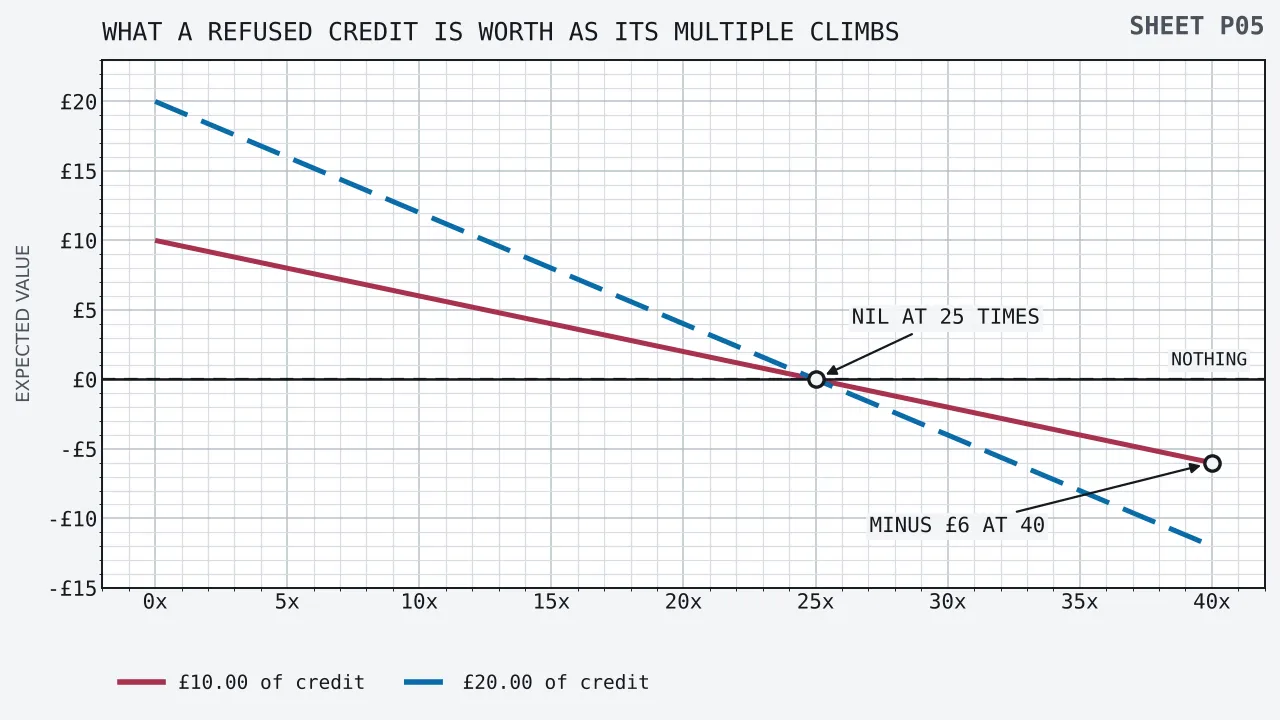
Plus six pounds is the same credit under the heaviest condition a British licence permits, and the sign is the entire finding. The ceiling a British licence allows is ten times the funds credited, set by the social responsibility code and live from 19 January 2026 right across the remote casino sector. Ten times on a ten pound face keeps sixty pence in the pound, which is six pounds, on £100.00 of staking, 1,000 presses and a run of 3 h 20 min.
Where the two answers meet is twenty-five times, one divided by a four per cent margin, and the plate draws it as a crossing. Below it a credit is worth having and an exclusion clause has cost the reader something real. Above it the clause has removed an obligation dressed as a gift, and the reader who chose the wrong icon is better off by the amount the page has just worked out.
| Worked on £10.00 of credit | At ten times | At twenty-five times | At forty times |
|---|---|---|---|
| Staking the condition wants | £100.00 | £250.00 | £400.00 |
| Presses of ten pence | 1,000 | 2,500 | 4,000 |
| Run at the assumed pace | 3 h 20 min | 8 h 20 min | 13 h 20 min |
| Goes with a handset, carried up | 10 | 23 | 37 |
| Expected at the finish | £6.00 | nil | minus £6.00 |
Thirty-seven goes with a handset is the figure to set beside the seventy-eight hours of part five, because the two are the honest sides of the same transaction. Thirteen hours and twenty minutes of pressing, spread over thirty-seven separate occasions, is what the credit asks before any of it can join the queue this page has been modelling. The payout wait is the short part.
Two readers are therefore priced quite differently by the same clause, and a page that says only that an exclusion is unfair has told neither of them anything. Somebody who would have cleared a ten times condition has lost six pounds. Somebody facing forty times has been handed back thirteen hours and twenty minutes they were about to spend losing six.
8
Why the route out cannot be swapped once the queue has started
One name has to match at the far end of every route on this page, and the matching is what makes a late swap expensive. Money leaving a gambling account is expected to land somewhere its own holder owns, so a wallet or a bank account produced at the exit brings a comparison with it, and the comparison is work.
Twenty hours is what this note assumes for identity work done at the exit, and it is the second largest of the four lengths on every route in the table. A reader who settled it at registration carries nought there instead, which takes forty-six hours to twenty-six, seventy-two to fifty-two and seventy-eight to fifty-eight.
20 assumed hours removed from all three routes at once
Forty-three point five per cent of the wallet-only wait disappears with that one change, and 27.8 per cent of the bank-to-bank wait, and 25.6 per cent of the carried-on wait. No payment scheme on this page offers a saving of that size. It is available to any reader who does the paperwork on the day they open the account rather than on the day they want paying.
Swapping routes mid-queue is the thing readers reach for when a wait goes long, and it usually costs rather than saves. The request already in the queue has to be stopped, a new destination has to be given, and the name comparison runs again against the new one. On the lengths assumed here that restarts at least the twenty hours and quite possibly the twenty-four in front of it.
Nothing on this page is advice about putting somebody else’s account at the far end, and the refusal is flat. Sending a payout to an account in another person’s name is not a route round a slow check. It is a misdescription of who the money belongs to, and where it is done deliberately it is fraud, which is a word this note uses in its ordinary sense.
One small saving does exist and it belongs in this part because nobody prints it. A reader who intends to carry a wallet credit on to a bank can nominate the bank inside the wallet before the win rather than after it, so the second leg begins with its own paperwork already done. That moves work out of the queue in exactly the way part four showed to be worth more than any choice of scheme.
9
When a wait turns into a complaint, and the clocks on that
Seventy-two hours is the bank-to-bank wait this page has modelled, and the question this part answers is what the seventy-third hour is worth. A promotion of this sort runs outside the British licence, so the clocks set out below are the ones a reader here does not get, and naming them is more use than complaining that nothing is in their place.
Eight weeks is the British ceiling on arguing about it, internal escalation included, which the regulator’s guidance traces to a social responsibility code provision. In hours that is 1,344, and set against the seventy-two modelled above it makes the remedy 18.7 times the length of the grievance. A process counted in weeks is fastened to a payout counted in days, and the ratio is the point.
Acknowledging the thing at all carries an outer limit of three working days, which falls to twenty-four hours where a licensee is open at every hour, as a remote casino is. Six months is the floor under how long the right to raise it survives. Those are the three published lengths, and between them they describe a procedure with a shape, which is exactly what is missing elsewhere.
A hundred and sixty-eight hours is the unit a reader’s own silence gets charged in. Where a licensee asks something reasonable and hears nothing back for seven days, halting the eight-week count can itself be reasonable, and the count resumes where it stopped once an answer arrives. That is the only piece of the timetable a reader moves, and it moves in one direction only.
Approval is the second duty and it separates the regimes more sharply than the hours do. Eight dispute bodies stand on the regulator’s approved list, a British licensee may use one of those and no others, and the coverage across them is not uniform, so a casino player cannot assume a given name will take the case. The closing letter has to carry what was decided, the fact that the internal route is exhausted, and how to go further.
Eight weeks turns up again in the Curaçao rulebook, as four weeks to answer extendable once by another four on written notice, with receipt acknowledged inside a week and the same six-month window in which one may be raised. So the offshore side is not a blank here, and this note declines to pretend it is.
Authorship is where the two genuinely diverge. The British regulator approves the body that hears the dispute. The Curaçao rulebook makes the route compulsory and costless to the player, with the bill falling on the operator, and in the same breath contemplates the operator setting the parameters. Two of those are named: how far the outcome binds the player, and how small a claim may be and still reach escalation.
A minimum written by one side is why the £180.00 followed here belongs in this part rather than in the abstract. A floor set by the party being complained about, under which the other party cannot climb, separates a route printed in a rulebook from a route available for this particular win on this particular Friday.
10
What to settle before the very first press
Forty-four of the modelled hours are fixed before any scheme is chosen, and that is the first thing to carry away. The hold and the identity work are the same on all three routes, so a reader optimising the payment scheme is working on between two and twenty-six hours of a wait that runs between forty-six and seventy-eight.
Twenty hours of the forty-four can be moved, and moving it is free. Settling identity on the day of registration takes it out of the queue entirely, which is a larger saving than the difference between the fastest and slowest scheme on the bank-to-bank comparison. It is also the only saving on this page that does not require choosing anything.
One question decides between a wallet and a direct transfer and it is not about speed. It is whether the money is wanted in a wallet. A reader who spends from a wallet anyway is finished at forty-six hours and the figure is honest. A reader who needs a current account is looking at seventy-two going direct against seventy-eight through a wallet, on the Friday worked here.
Six hours is the whole of that difference and it is smaller than most people expect, which is the other honest half of the comparison. The case against carrying a wallet credit on to a bank is not that it is dramatically slower. It is that it is slower, it adds a step the reader has to remember to take, and it offers nothing in return unless the wallet is somewhere the reader wanted money anyway.
Three things settle it before the first press, and the advertised payout time is not among them. Whether a deposit through a wallet cancels the promotion, because that is decided at the entrance and costs between plus six pounds and minus six pounds depending on the multiple. Where the money needs to finish, because that fixes whether the second leg exists. And when the identity work happens, which is worth twenty assumed hours on every route here and is the only part a reader can simply decide.
Questions
- Which of these three routes pays out fastest?
- A wallet, at 46 modelled hours, but only because it stops short of a bank account. Carried on to a current account the same wallet route finishes at 78 hours on the Friday worked here, which is six hours behind a transfer that went bank to bank at 72. The ordering holds on a Monday too, at 46, 70 and 62.
- Why does a wallet payout need a second leg?
- Because a wallet is an account in its own right and the money stops there. It can be spent where the wallet is accepted and sent to somebody else holding one, but it is not in a current account, so a direct debit, a card payment or a cash machine still needs one more movement. This note assumes two hours for the first leg and twenty-four for the second.
- What does Trustly do differently at the exit?
- It moves money between the reader’s own bank account and the other party with nothing parked in the middle, so there is one movement rather than two. This note assumes eighteen hours for it. The cost of going direct is that the movement needs a bank to be open, where a wallet credit can land at three on a Sunday morning because no bank is involved.
- How much of the wait does the payment scheme actually decide?
- Between two and twenty-six hours of a total running from 46 to 78, on the lengths assumed here. Forty-four hours are identical on all three routes, being 24 of review hold and 20 of identity work, which is 95.7 per cent of the fastest route and 56.4 per cent of the slowest. Switching scheme leaves every one of those 44 hours untouched.
- What does the weekend add?
- Ten hours on the bank-to-bank route and eight on the carried-on wallet route, for a request put in at six o’clock on a Friday evening. Nothing whatever on a wallet route that stops in the wallet. Movement between banks is treated here as possible only between midnight on Monday and midnight on Saturday, which is this note’s own rule rather than a published timetable.
- Why does the slower route lose less to the weekend?
- Because of where the shut hours fall in the sequence. The carried-on wallet route spends two of the shut hours usefully on its first leg, so only eight remain before the banking week restarts, where the direct route sits idle for ten. Being slow at the right moment is worth two hours in that worked case, and it does not change the ordering of the two routes.
- Can a deposit through a wallet really cancel a bonus?
- Where the terms exclude it, yes, and the exclusion applies before anything happens rather than as a penalty afterwards. A ruling of 31 July 2024 from the advertising regulator took an excluded way of paying, printed small among the rest of the terms, as a condition weighty enough that its placing was the fault. That addresses where the exclusion was put rather than the fact of having one.
- What is a cancelled £10.00 credit actually worth?
- It depends entirely on the multiple written over it. At forty times it asks £400.00 of staking, which is 4,000 presses, 13 h 20 min at the pace assumed here and thirty-seven goes with a handset, and it is expected to finish at minus £6.00. Under the ten times lid a British licence imposes it asks £100.00, runs 3 h 20 min, and is expected to finish at plus £6.00. Twenty-five times is where the two answers meet at nothing.
- So is losing the offer good or bad?
- Bad below twenty-five times and good above it, twenty-five being one divided by a four per cent margin, which is why that figure keeps appearing. A reader who would have cleared a ten times condition has lost six pounds. A reader facing forty times has been handed back 13 h 20 min they were about to spend losing the same six pounds.
- Would settling identity at registration help?
- It is the largest saving on this page and it costs nothing. Twenty assumed hours come out of every route at once, taking 46 hours to 26, 72 to 52 and 78 to 58. That is 43.5 per cent of the wallet-only wait and 27.8 per cent of the bank-to-bank wait, and no choice of payment scheme offers anything of that size.
- Is it worth switching route while a payout is already waiting?
- Usually not. The request in the queue has to be stopped, a new destination given, and the comparison of names run again against it. On the lengths assumed here that restarts at least the twenty hours of identity work and quite possibly the twenty-four hours of hold in front of it, which is more than the whole difference between the fastest and slowest scheme.
- What happens if the money simply does not arrive?
- Outside the British licence, nothing carrying a published timetable. A British licensee gets eight weeks to finish the argument, internal escalation included, which is 1,344 hours, or 18.7 times the 72-hour wait modelled here for a bank-to-bank payout. An acknowledgement has an outer limit of three working days on it, falling to twenty-four hours for a licensee open at every hour, and the window for raising one runs no shorter than six months from the incident. Only a dispute body on the regulator’s approved list may be used.