Note U05 Revision 1 Terms read 17 October 2026
Where the phrase best bitcoin casino points, and the sixty-eight hours it says nothing about
Settlement across a public network is set by the network and readable by anybody. Every other stage of a payout belongs to the business, which reports it or does not. On the model worked below that leaves 1 h open to inspection inside a delay of 69 h, so the verifiable stage amounts to 1.4 per cent and was never what held anybody up. Each duration here is assumed and declared as such; nothing was timed.
What lands 1 h checkable The run 69 h modelled The wait to be paid 48 h unpublished
What offers of this size ask in hours
Advertising has been bought for every destination below. A fee reaches this site when a reader goes on to register, and no figure on this page moves one way or the other because of it.
-
01Mobile Free Spins
Betportal
Ceiling as a multiple
What lands€15.00150 spins at 10c, which is this site's figure and not the operator'sThe run17 h 30 minTurning over 525.00 at 10p means 5,250 presses, or about 48 phone sittings of 22 minutes. Timed at 10p a press and 12 seconds between presses, both of which this site assumes rather than measures.The wait to be paidNOT PUBLISHEDThis operator puts no withdrawal band in its own terms, so there is nothing honest to print here.Spins valued at this site's own 10p a spin
What lands
Spins, at a price15.00150 of them at 10c apiece, a figure belonging to this site rather than to the operatorMatch, and other creditno figure300% of three deposits, to a ceiling of €1,000. Not a sum until money of yours makes it one, so this row totals nothing and carries nothing downwardsThe run
Handed back on the spins(0.60)Each press stakes its own value and returns 96 per cent, which leaves this much with the house from the opening pressPlay-through 35x on the bonus(20.16)Taking 14.40 round 35 times over means 504.00 through the machines, of which 20.16 is the expected cost, and 17 h 30 min of pressing at the pace aboveWhat counts towards it100%Slots only, with no percentage published anywhere, so the row above assumes the whole of each stake countsWhat never clears
Limit on the winningsstated5x the bonusDeducted on the way outno figureNothing is published as a figure here, so this row removes nothingLeast that can leaveno figureNo figure is published, so nothing on this timer is pinned down by oneLeast deposit, and the rung over ityour own€20 a stage. Published in euros, so no rung is named at all: this site's ladder is a sterling oneThe window on the creditstated14 daysBiggest stake while it runsstated€5Removed outright by rulestatedNot publishedVerified before a payoutstatedDocuments before the first withdrawalNever clears€15.00Not a penny of it gets out, so the whole of what landed stands on this rowNo Great Britain licence
Licence held in Anjouan, Comoros, the company named is BetPortal Gaming Ltd, with Excite Ultra Media Ltd, quoted under ALSI-202601040-FI2.
Terms read 17 October 2026
Open the offer at Betportal, opens in a new window -
02Mobile Free Spins
WinBeast
Ceiling as a sum
What lands€50.00500 spins at 10c, which is this site's figure and not the operator'sThe run2 d 18 hTurning over 2,000.00 at 10p means 20,000 presses, or about 182 phone sittings of 22 minutes. Timed at 10p a press and 12 seconds between presses, both of which this site assumes rather than measures.The wait to be paidNOT PUBLISHEDThis operator puts no withdrawal band in its own terms, so there is nothing honest to print here.Spins valued at this site's own 10p a spin
What lands
Spins, at a price50.00500 of them at 10c apiece, a figure belonging to this site rather than to the operatorMatch, and other creditno figure50% to 100% of five deposits, each to a ceiling of €1,000, and a €650 free bet. Not a sum until money of yours makes it one, so this row totals nothing and carries nothing downwardsThe run
Handed back on the spins(2.00)Each press stakes its own value and returns 96 per cent, which leaves this much with the house from the opening pressPlay-through 40x on the bonus and the winnings from the spins(76.80)Taking 48.00 round 40 times over means 1,920.00 through the machines, of which 76.80 is the expected cost, and 2 d 18 h of pressing at the pace aboveWhat counts towards it100%Slots, titles vary by country, with no percentage published anywhere, so the row above assumes the whole of each stake countsWhat never clears
Limit on the winningsstated€100 a batch of spinsDeducted on the way outno figureNothing is published as a figure here, so this row removes nothingLeast that can leaveno figureNo figure is published, so nothing on this timer is pinned down by oneLeast deposit, and the rung over ityour own€20 a stage. Published in euros, so no rung is named at all: this site's ladder is a sterling oneThe window on the creditstated7 days, spins 1 dayBiggest stake while it runsstatedNot publishedRemoved outright by rulestatedNot publishedVerified before a payoutstatedDocuments before the first withdrawalNever clears€50.00Not a penny of it gets out, so the whole of what landed stands on this rowNo Great Britain licence
Licence held in Curaçao, no company named anywhere on the site.
Terms read 17 October 2026
Open the offer at WinBeast, opens in a new window -
03Mobile Free Spins
EliteSpin
Longest spin window
What lands£50.00500 spins at 10p, which is this site's figure and not the operator'sThe run2 d 18 hTurning over 2,000.00 at 10p means 20,000 presses, or about 182 phone sittings of 22 minutes. Timed at 10p a press and 12 seconds between presses, both of which this site assumes rather than measures.The wait to be paidNOT PUBLISHEDThis operator puts no withdrawal band in its own terms, so there is nothing honest to print here.Spins valued at this site's own 10p a spin
What lands
Spins, at a price50.00500 of them at 10p apiece, a figure belonging to this site rather than to the operatorMatch, and other creditno figure50% to 100% of five deposits, each to a ceiling of £1,000. Not a sum until money of yours makes it one, so this row totals nothing and carries nothing downwardsThe run
Handed back on the spins(2.00)Each press stakes its own value and returns 96 per cent, which leaves this much with the house from the opening pressPlay-through 40x on the bonus and the winnings from the spins(76.80)Taking 48.00 round 40 times over means 1,920.00 through the machines, of which 76.80 is the expected cost, and 2 d 18 h of pressing at the pace aboveWhat counts towards it100%Slots, with no percentage published anywhere, so the row above assumes the whole of each stake countsWhat never clears
Limit on the winningsstated5x the bonusDeducted on the way outno figureNothing is published as a figure here, so this row removes nothingLeast that can leaveno figureNo figure is published, so nothing on this timer is pinned down by oneLeast deposit, and the rung over ityour own£20 a stage. It lands square on the £20.00 rung, so none of yours is left perched on topThe window on the creditstated7 days, spins 3 daysBiggest stake while it runsstatedNot publishedRemoved outright by rulestatedNot publishedVerified before a payoutstatedDocuments before the first withdrawalNever clears£50.00Not a penny of it gets out, so the whole of what landed stands on this rowNo Great Britain licence
Licence held in Costa Rica, the company named is PrimeTier Limited.
Terms read 17 October 2026
Open the offer at EliteSpin, opens in a new window -
04Mobile Free Spins
Crown Jewelz
Multiple unpublished
What lands£15.00150 spins at 10p, which is this site's figure and not the operator'sThe runNOT TIMEDThis operator does not publish the play-through multiple in its own terms. The multiple is the one figure the clock cannot work around, so the run is left untimed.The wait to be paidNOT PUBLISHEDThis operator puts no withdrawal band in its own terms, so there is nothing honest to print here.Nothing reckoned
What lands
Spins, at a price15.00150 of them at 10p apiece, a figure belonging to this site rather than to the operatorMatch, and other creditno figure200% of the first deposit, then 150% twice, each to a ceiling of £1,000. Not a sum until money of yours makes it one, so this row totals nothing and carries nothing downwardsThe run
Play-throughno figure40x the bonus, reported rather than published by the operatorWhat counts towards itno figureSlots, with no percentage published anywhere, so the row above assumes the whole of each stake countsWhat never clears
Limit on the winningsstatedNot publishedDeducted on the way outno figureNothing is published as a figure here, so this row removes nothingLeast that can leaveno figureNo figure is published, so nothing on this timer is pinned down by oneLeast deposit, and the rung over ityour own£20. It lands square on the £20.00 rung, so none of yours is left perched on topThe window on the creditstatedNot publishedBiggest stake while it runsstatedNot publishedRemoved outright by rulestatedNot publishedVerified before a payoutstatedDocuments before the first withdrawalNever clearsNOT RECKONEDThis operator leaves the play-through multiple out of its own terms, so nothing below the fourth step can be worked out.No Great Britain licence
Licence held in Curaçao, number not verified, no company named anywhere on the site.
Terms read 17 October 2026
Open the offer at Crown Jewelz, opens in a new window
Only the middle reading comes out of arithmetic belonging to this site. The multiple laid against what lands gives the turnover asked for; dividing that by 10p a spin gives the presses; dividing those by 300 an hour gives the hours, a press on a handset being taken here at 12 seconds from the one before. Both figures are assumptions rather than measurements of anybody: nothing was played and nothing was held a stopwatch to. Anybody quicker should divide the press count by a rate of their own, which is why the presses are printed alongside the hours instead of being summarised away.
The first reading is what arrives before any condition is laid against it. Spins carry no unit of their own so one gets supplied: where an operator values its own spin that figure is used and attributed, and where it does not, this site's 10p a spin stands in and everything below moves with it. The third reading belongs to the operator entirely. It is a withdrawal band quoted from published terms, and a blank there means none was published rather than that nobody looked.
The total along the foot answers what the hours leave open, which is whether any of the running ends anywhere. It is what arrived, less whatever is still standing once the play-through has been paid for at 96 per cent return to player and once a published limit, a published deduction and a published floor beneath the least that can leave have each had a turn. It appears again in pence in the pound, the only fair way of holding a small offer up against a large one. It describes an offer rather than an evening, and where the conditions price out what arrived, a timer prints nothing getting out instead of a negative sum.
Cashiers on a handset take deposits off a row of preset buttons, so a least deposit given in pounds is raised to the next rung of the ladder used here, £10, £20, £25, £50, £75 and £100, and the timer shows what is left perched on it. That money is the reader's own and enters no sum at all. Given in euros it prints untouched, the ladder being sterling. Three words may occupy the figure column where no figure belongs. Stated is a published term that costs something while leaving no number to subtract. No figure is a term nobody has quantified, or a credit that is not a sum until money of yours makes it one. Your own is money of yours, which belongs in none of this.
None of the operators above is licensed in Great Britain, so not one duty that licence carries reaches any of them. Membership of Gamstop Online is compulsory for every online gambling company licensed in Great Britain, which means that shutting yourself out through the scheme shuts you out of none of these. The limit of ten times the bonus funds on a wagering requirement, running since 19 January 2026 under Social Responsibility Code 5.1.1, is a condition of the same licence and binds only whoever holds one. Off that licence, the Gambling Commission writes of consumers meeting unfair gaming practices, financial loss and no recourse when matters go wrong, and lists blocked payouts and withdrawal limits pitched too high to reach among the things it has seen. No account at any of them may be held by anybody under 18.
Every term on a timer is its operator's own and every timer carries the day somebody read it. The oldest of those readings is 17 October 2026. What binds a reader is an operator's full terms and never a line printed here.
1
Four lengths in a payout, and the one that is published
A payout splits into four stages on the model this site works to, and precisely one of those stages is written somewhere a stranger may read it. The remaining three sit inside a business, and what is known about them is whatever that business decides to say. Everything in the nine parts after this one follows from that single lopsidedness.
Sixty-nine hours is the whole delay as modelled here for money paid out across a public network, and one hour of the total is the readable stage. Expressed as a share, it is 1.4 per cent. Filling the remaining 98.6 per cent are a release decision, a round of document work, and whatever either party chooses to report about them afterwards.
Assistance in reaching a cashier of that description appears nowhere in these ten parts. Trading names are absent, web addresses are absent, and acquiring, holding or sending a unit of anything goes undescribed on purpose rather than by accident. Barring gambling payments is a thing a bank may do and a thing a household connection supplier may do, each of those is a protection, and neither is argued with anywhere below.
One instruction is given in this note and part one carries it rather than part ten. A reader who put their own name on the Gamstop Online register and has now arrived at a search of this sort is meeting the very pressure that registration was taken out to hold. What helps is a telephone call to 0808 8020 133, staffed by GamCare at no cost whatever the hour. Sums occupy the nine parts after this one, and their job is to measure a trade rather than to commend one.
Two properties mark the readable stage off from the rest, and separating them now saves trouble later. One is that somebody who is party to neither side can confirm the transfer happened. The other is that its length is fixed by a network rather than by a judgement, which is why it comes out the same for whoever is waiting. Neither property attaches anywhere else in the chain.
Published, on this page, means an entry a third party may read without permission from either side and without an account anywhere. That is a narrow test and it is meant to be. A figure an operator states in its own terms counts as disclosed rather than published by that test, because checking it means asking the very party the figure describes.
2
An hour written where anybody at all may read it
One hour is what this note allows for a transfer to be accepted and treated as final on a public network, and that hour is the page’s own assumption. The sheet of regulatory fact standing behind this site records nothing whatever about any network, any confirmation interval or any charge for carriage, so there was no figure to take and none was taken. A round hour was picked because it keeps the sums legible, and a reader who prefers twenty minutes should divide every network figure below by three.
Two things follow from the entry being public and they pull in opposite directions. The cheerful one is that the transfer can be confirmed by an outsider, at any later date, with nobody’s cooperation required. The unwelcome one is that confirmation stops at the edge of the entry: it reports that a quantity moved between two addresses at a stated moment, and reports nothing about why, whether it was owed, or what ought to have moved instead.
Three hundred presses fill that assumed hour in the working currency of this site, each press costing ten pence and occupying twelve seconds, an interval the site assumes and has never measured. Staking comes to £30.00 inside it. Four pence out of every staked pound is the share the house expects, which puts the hour at £1.20.
Eighteen hours is the comparison this note uses for the same stage where money moves between bank accounts instead, taken from the payout model the rest of this site works to and carried across unchanged. Seventeen hours separates the two, and the gap is real. It is also, as parts four and five show, the smaller half of what a network rail changes about the delay.
Three minutes is what this note assumes a reader spends reading one entry on a public network, declared as a convention and not as an observation of anybody. Fifteen presses is three minutes at the interval above, worth £1.50 crossing the reels and six pence of expectation. That is the entire price of the verification this page is about, and part ten returns to what the six pence buys.
3
The shut part of the week, and what losing it returns
Two days in every seven carry no movement between banks under the rule this note adopts, which is 48 hours out of the 168 a week holds. That rule is an assumption of the model and not a published timetable. It is the only calendar the arithmetic needs, and it is the one stage of the four that disappears outright once a transfer is carried by a network instead of by institutions.
Six hours and fifty-one minutes is the average delay the shut stretch inserts, and the derivation has two steps. A release arriving inside that stretch waits for the week to open, which is nothing at its last minute and a full 48 hours at its first, so the middle of the range is 24 hours. Only 48 of every 168 releases arrive inside it at all. Multiply 24 by 48, divide by 168, and the insert is 6.857 hours, which rounds to 6 h 51 min.
One seventh of 48 is that same figure in the form part four needs, and the identity is exact rather than close. Twenty-four over 168 is one seventh, so the averaged insert is always the shut window divided by seven, whatever the shut window happens to be. A rule naming 24 shut hours would insert 3 h 26 min. A rule naming 72 would insert 10 h 17 min.
Nought is what the same rule inserts on a public network, and the nought is structural rather than generous. A network of that kind handles what reaches it in the order its own rules impose, at three in the morning on a bank holiday exactly as at eleven on a Tuesday. Nobody shuts it, nobody opens it, and there is no week for a release to land in the wrong part of.
Two thousand and fifty-seven presses is 6 h 51 min read as pressing, which puts £205.71 across the reels and £8.23 of expectation behind it at the share held fixed here. That is the whole value of the calendar’s disappearance, put into the unit every other figure on this page is put into. It is a genuine saving and a modest one, and part four sets the modest figure against the large one standing in front of it.
6 h 51 min returned by the shut week, against 48 h that no rail touches
4
Seven times that saving, standing in front of it
Forty-eight hours is what this note allows for the stage where a request sits waiting to be released, and like everything else in the model it is a round number this page chose for itself. Nothing in the fact sheet standing behind this site states a hold, that sheet forbids attaching a payout speed to a business with a name, and no citable replacement turned up. So the biggest quantity on the page rests on the least, which is uncomfortable to print and honest to admit.
Seven to one is the ratio between that hold and the saving part three priced, and it falls out of the arithmetic rather than being chosen. An averaged shut-week insert is the shut window divided by seven, and the shut window happens to be 48 hours as well. The hold is therefore exactly seven times what losing the banking calendar hands back, and the coincidence of two 48s is what makes the ratio so tidy.
Fourteen thousand four hundred presses is the hold read as pressing, putting £1,440.00 across the reels with £57.60 of expectation behind it. Against that the calendar returns 2,057 presses and £8.23. A reader who picks a rail on the strength of the calendar alone is moving £8.23 of this site’s currency while £57.60 of it stays put and stays unreadable.
Nothing about the hold is mechanical, which is why no property of any network can shorten it. It is a decision taken by somebody, or by a rule somebody wrote, about whether a particular request goes out now or later. No settlement cycle sits underneath it, no clearing arrangement and no timetable it is obliged to meet. That is exactly what makes it the stage a business could genuinely compress, and exactly what makes a claim about it uncheckable.
Twenty-four hours is a hold half the size, and the halving deserves printing because it is the largest single improvement anywhere in the model. It hands back 7,200 presses and £28.80, which is three and a half times everything a network rail returns through the calendar and the carriage leg put together. Nobody reading from outside can tell whether it has happened.
5
The same delay assembled twice, one rail against another
A delay of 92 h 51 min is what the bank-account arrangement comes to, adding 48 hours of waiting for release, 20 of document work pushed to the exit, 18 of carriage and the shut calendar’s 6 h 51 min. The network arrangement comes to 69 hours, its carriage leg standing at the assumed hour with no calendar behind it. Not one of those lengths was observed; each is an assumption and each says so wherever it appears.
| The stage | Leaving by bank account | Carried by a public network | Readable from outside | Share of the 69 h model |
|---|---|---|---|---|
| Waiting to be released | 48 h | 48 h | No, and no figure for it is published anywhere | 69.6 per cent |
| Document work left until the exit | 20 h | 20 h | No, though a reader governs when it happens | 29.0 per cent |
| Carriage of the money itself | 18 h | 1 h | Yes, by an outsider, at any later date | 1.4 per cent |
| Waiting for the week to reopen | 6 h 51 min | nil | Not applicable once the stage is absent | nil |
| The four added up | 92 h 51 min | 69 h | One stage of four | 100 per cent |
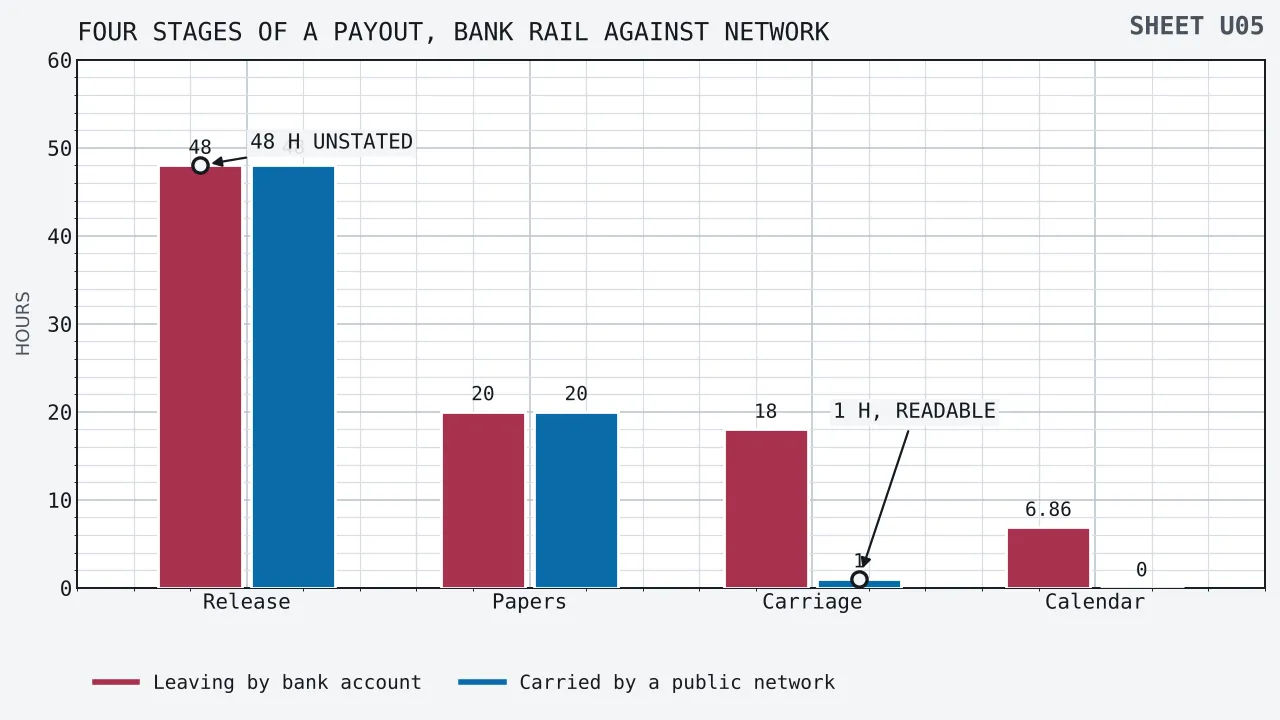
Two bars shift between those columns and neither of them is tall. The pair that stays put accounts for 68 of the 69 hours a network rail is modelled to run to. Where a drawing puts the whole distinction between two arrangements into its two shortest shapes, the drawing has made the argument better than a paragraph could.
Twenty-three hours and fifty-one minutes is the total improvement: seventeen hours come off the carriage, 6 h 51 min comes off the calendar. Set against the bank-account total that is 25.7 per cent. Set against the portion nobody can read it is nothing whatever, since neither moving piece touches the release decision or the document round.
Twenty-nine per cent against 21.5 is the share the document round takes on the two rails, and the direction of that change surprises people. Twenty hours is 21.5 per cent of 92 h 51 min and 29.0 per cent of 69 h. Shortening a chain does not shrink what is left in it; it enlarges every survivor as a fraction, so the quicker the carriage the more of the delay turns out to be paperwork.
6
A line with a price on it is not a line at a desk
Two sorts of waiting list appear in this model and telling them apart is the sharpest test on the page. One has a price: whoever offers more for carriage is taken sooner, because a network of this kind orders what it carries by what is offered, and that ordering rule is itself public. The other has no price at all, because nobody at a desk is selling a position in it.
One hour is the whole of what a priced line can give back, on the assumption adopted in part two, and the ceiling matters more than the mechanism. Shortening a stage cannot return more than the stage contains. So the largest conceivable benefit from paying for quicker carriage is 1.4 per cent of the modelled delay, and that stays true however much is offered, because the rest of the delay never touches the network.
Nothing here describes how carriage gets paid for, what it costs, or how a payer would go about offering more. A property is being reported and priced; a procedure is not being taught. That line is drawn deliberately and it is the same line drawn in part one.
Twenty hours against one hour is the comparison that follows, and it runs the opposite way from the one a search phrase of this shape implies. Document work done while an account is being opened, rather than while it is being emptied, takes 20 hours out of the same model, costs nothing, and needs nobody’s agreement. Carriage bought to the front of a line takes out one at most. Twenty to one, in favour of the free thing.
| What the delay is made of | Most it can return |
|---|---|
| Carriage, where offering more moves a payer up | 1 h |
| Document work, moved to the day an account opens | 20 h |
| The release decision, where no offer is taken | nil |
| The banking week, already absent on this rail | nil |
Nought is what the bottom two rows return to anybody, and the reasons differ. A release decision returns nothing because there is no mechanism through which a payer can touch it, priced or otherwise. The banking week returns nothing because it has gone already, and a stage that is absent cannot be improved a second time.
Three minutes of reading against 48 hours of waiting is the shape of this whole page in one line. Checking is cheap, quick and real. What it checks is the stage that was never in anybody’s way, and the stage that is in everybody’s way publishes no figure for a reader to check it against.
7
Why a word about speed cannot be a word about a business
Three words make up the phrase at the head of this note, and its opening word wants things put in order. Ordering of that kind is not something published here. No arrangement is called better than another anywhere beneath this paragraph, no trading name occurs, and the three readings in the title block report durations instead of delivering a verdict.
One hour belongs to a network that payer, payee and every other user share between them, which is the structural reason a superlative about it cannot pick anybody out. A network of that kind does not know which business asked. It applies one ordering rule to every transfer reaching it and produces the same interval for all of them, so a claim of being quickest at that stage is a claim about a facility nobody owns.
Sixty-eight hours is where a genuine difference between one arrangement and another would have to live, and every item inside it is unreadable from outside. How long a release waits is a difference. Whether document work is demanded at the exit or was settled months earlier is a difference. Whether either of those is published at all is a difference. Not one of the three can be read by somebody standing outside the business.
So the two halves of a speed claim fail in opposite ways, and setting them beside each other is more use than arguing with either. The half open to checking is identical everywhere, so checking it distinguishes nothing. The half that would distinguish something cannot be checked, so a superlative about it is a sentence with nothing underneath.
Two hundred and seven presses is 1.4 per cent of the 20,700 presses filling 69 hours at the rate modelled here, and the proportion is the whole finding. A reader who verifies a network entry has confirmed two hundred presses’ worth of a twenty thousand press delay. The confirmation is genuine, the arithmetic is simple, and the conclusion is that the verifiable part was never the part anybody was waiting for.
8
Where a licence puts the document round, and what the placing earns
Twenty hours is the document round as modelled here and the length is an assumption; where that round sits in the order of events is not. A licence condition in Great Britain stops an operator treating a request to take money out as the moment to ask for something it had every chance to ask about beforehand. One opening is written into the condition and it is narrow: material that some other legal duty compels the operator to collect at precisely that point.
Ahead of a first deposit, the same condition puts three statements on the licensee. Which papers or other material it might call for is the first. At what stage such a call could come is the second. By what means a customer hands any of it over is the third. Taking reasonable steps to keep accurate what it already holds about who a customer is sits alongside those three.
Timing is also what the regulator presses on in the guidance it writes for players. Material gathered against money laundering belongs near the beginning of a relationship and not at the moment somebody reaches for a balance. Proof of age and of identity cannot be set as a toll on taking money out where the chance to ask arose and passed earlier. Documents of three kinds appear there as illustrations: a passport, a licence to drive, and a bill sent to the household. Choosing among them is left to the business, the Commission having declined to name one.
May be in breach is how that guidance describes an operator that stalls a payout because identity information is short, and the hedge travels with any fair quotation of it. Two dates belong beside it as well. That page first appeared on 23 September 2020, its last revision carries 13 April 2022, and it is the oldest thing cited anywhere in this note, so the wording in force is the condition’s rather than the guidance page’s.
Six thousand presses is 20 hours in the currency used throughout, worth £600.00 crossing the reels and £24.00 of expectation, and that is the size of what the placing rule governs. Inside the licence the round gets pushed to the front, where it cannot stand between anybody and money they already regard as theirs. The rule does not make the work shorter. It makes the work happen at a moment when nothing is queued behind it.
9
Which stages stop being checkable once the licence goes
Carrying no Great Britain licence is the position of a cashier that answers to a phrase of this shape, and on a note about verification the losses worth itemising are the ones that made a stage readable to begin with. Put a question to each stage about who may read it and the answers separate. Part eight set out three duties about the document round and one about a public register, and this part asks what each of them was doing.
Could the demand have come earlier? Inside the licence that question has an answer with consequences, because a request to take money out may not be converted into the pretext for asking something that could reasonably have been asked before. Outside it the question has no forum and no consequence, so the 20 hours in part five’s table may arrive at the exit as routine rather than as an exception.
Was the shape of the round disclosed before the money went in? Inside the licence the material that might be called for, the stage at which the call could come and the means of handing it over all have to be set out ahead of a first deposit. Outside it none of that is owed, so a stage worth 6,000 presses has no published shape for a reader to hold against whatever actually happens.
Was the material sought at the start? Inside the licence the regulator tells players it ought to be, and stalling a payout for want of it may put an operator in breach. Outside it, promptness is a preference. And can a reader click into a register, find the licence, and satisfy themselves that the permitted activities and the web addresses on the entry correspond to the site in front of them? Inside the licence yes, on an instruction the regulator publishes, carrying 20 September 2020 as its publication and 23 August 2021 as its latest change. Outside it there is no entry to click into.
Nought of that means the offshore side publishes nothing, and writing it that way would be wrong in the other direction. Six items are required at the foot of a licensed website by the Curaçao rulebook this network read, and describing their kinds carries the point better than reciting them. Two identify the holder, by trading entity and by where it is registered. Two identify the permission, by number and by a statement of who supervises it. One is a graphic mark the regulator issues. The last is a pair of links, one to the policy itself and one to help with addiction, the examples named for that being GamCare, Gamblers Anonymous and Gambleaware.
Every one of those six is a statement made by the party it describes, which is what makes the next sentence the sharpest thing on this page about checking a footer. When the sheet behind this site was compiled, the Curaçao authority’s own portal for online gaming was reported by that authority as being offline. A mark and a number are checkable only against something that answers, and a note about verification owes its reader the occasions when the thing to verify against did not.
10
One hour verified, sixty-eight taken on trust
One hour in sixty-nine is what this note leaves a reader holding, and it is a proportion rather than a complaint. The network entry is real, it is public, and three minutes of reading settles it beyond argument. What gets settled is 1.4 per cent of the delay the model describes, while the other 98.6 per cent is reported by the party the report is about.
Forty-eight hours against 6 h 51 min is the comparison part four priced, and the seven to one ratio is the most useful single thing in it. What a reader gains by moving off a banking calendar is 2,057 presses of this site’s currency. What remains in front of them, unmoved and unpublished, is 14,400. Both figures rest on assumptions declared at the point they were made, and none of this was observed.
Twenty hours is the one length a reader can shift without anybody’s agreement, and it dwarfs the hour that money spent on carriage might buy. Settling the document round when an account opens rather than when it is emptied is free, available tonight, and worth twenty times the best case for the priced line in part six. Nobody advertises it, because it is not a feature of anything.
A superlative about speed is therefore a sentence about the wrong 1.4 per cent, however it is phrased. The stage it can honestly describe belongs to a network shared by everyone on it. The stages that decide the answer belong to a business and are published nowhere, so a reader weighing one promise against another is weighing two assertions and not two figures.
Anybody who has read this far in the hope of finding a route round a registration they made for themselves should close the sums and ring 0808 8020 133 instead. GamCare runs the National Gambling Helpline behind that number, charges nothing for it, and keeps it open around the clock on any date in the year, over the phone, in a chat window or by message. Worry about somebody else under the same roof counts every bit as much. Nothing else in these ten parts is recommended to anybody.
Questions
- What does the phrase best bitcoin casino actually describe?
- A gambling business that takes payment and pays out across a public network, prices balances in a unit that network carries, and operates outside the British licensing regime. Its opening word wants an ordering, and orderings of that kind are not published on this site. No business of that sort is named here, no link points at one, and no route to one gets described.
- Which part of a payout can a reader actually verify?
- The carriage of the money, and nothing beyond it. A transfer written into a public network can be confirmed by an outsider, at any later date, with nobody’s cooperation required. On the model worked here that stage is one assumed hour inside a delay of sixty-nine hours, which comes to 1.4 per cent. A release decision and a round of document work fill the other 98.6 per cent, and both are reported by the business or not at all.
- How is the sixty-nine hours put together?
- Forty-eight hours waiting to be released, twenty hours of document work left until the exit, one hour of carriage across a public network, and no shut calendar whatever. Each of those lengths is an assumption made by this page and each is declared at the point it is used. The same stages with money leaving by bank account total 92 h 51 min, adding 48 and 20 and 18 to a calendar insert of 6 h 51 min.
- What does losing the banking week actually save?
- Six hours and fifty-one minutes on average, worked from a single assumed rule: that 48 hours in every 168 carry no movement between banks. A release arriving inside that stretch waits between nothing and a full 48 hours, so the middle of the range is 24, and 48 releases in every 168 meet it, giving 24 times 48 over 168, or 6.857 hours. Read as pressing at ten pence that is 2,057 presses, £205.71 across the reels and £8.23 of expectation.
- How does that saving compare with the wait nobody publishes?
- It comes to one seventh of it. An averaged insert is always the shut window over seven, and the shut window here is 48 hours, the same length as the assumed wait for release, so the ratio works out at exactly seven to one. In pressing that is 2,057 presses handed back against 14,400 left untouched, or £8.23 of expectation against £57.60.
- Why can a superlative about speed not be about the business?
- Because the only stage open to checking belongs to a network shared by everyone using it, which applies one ordering rule to every transfer reaching it and has no idea which business asked. A claim of being quickest at that stage is a claim about a facility nobody owns. Whatever genuinely separates one arrangement from another sits inside the sixty-eight hours no outsider can read.
- Does paying more for carriage shorten the wait?
- It can shorten one stage of it, and a stage never gives back more than it contains. The ordering rule on a public network is itself public: what gets offered for carriage decides position. On this page’s assumption that stage runs to one hour, so the largest conceivable gain is 1.4 per cent of the modelled delay, however much is offered. This note reports the property and prices it, and sets out no procedure for doing anything with it.
- What is the largest saving a reader can take alone?
- Twenty hours, by settling the document round when an account opens instead of when it is emptied. That amounts to 6,000 presses at ten pence, £600.00 crossing the reels and £24.00 of expectation, it costs nothing, and it needs nobody’s agreement. Weighed against the single hour that buying quicker carriage could return at best, the ratio stands at twenty to one in favour of the free option.
- What does a Great Britain licence require about the document round?
- That a request to take money out is not treated as the moment to ask for something the operator had every chance to ask about beforehand, with one narrow opening for material another legal duty compels it to collect then. Ahead of a first deposit the licensee has to state which papers it might call for, at what stage such a call could come, and by what means a customer hands them over. The regulator tells players that material gathered against money laundering belongs near the beginning of a relationship and not at the moment somebody reaches for a balance, and that an operator stalling a payout because identity information is short may be in breach.
- Where does a reader go who is genuinely after a route round an exclusion?
- To 0808 8020 133, having closed the sums. GamCare runs the National Gambling Helpline behind that number, charges nothing for it, and keeps it open at any hour on any date in the year, over the phone, in a chat window or by message, and worry about somebody else under the same roof counts every bit as much. TalkBanStop comes from GamCare as well, and it draws the helpline, software that blocks gambling sites and the national scheme into one route. Lengthening a live registration by six further months, by twelve or by sixty is possible without waiting for it to lapse.