Mobile free spins, priced in minutes: the hours, sittings and pounds behind an offer
A phone session is spent in minutes. Adverts are written in spin counts and wagering multiples, and those numbers do not say how long the evening lasts. On the pace used here, 150 spins is about 30 min of tapping. A £25 credit with a 40× clause is £1,000 to stake: 10,000 presses, 33 h 20 min and about 91 short phone sittings. This site prints those missing figures beside the advertised one, so the time cost is visible before anyone starts.
- 18+
- Reading time of the whole page: 20 min read
- Updated November 2026
- How the minutes are counted
Five offers for your phone
These five links are paid placements: this site is owed a fee when a reader opens an account, and the order below reflects that.
-
 Albion
£4,000
700 FS
700% up to £4,000 + 700 FS
Claim bonus
18+ · Offshore licence, verify on register
Details
- Licence
- Offshore licence, verify on register
- Also listed
- Monday Reload: 50 Free Spins
- MidWeek Reload: 50% Bonus up to £500
- Payments listed
- Visa · Mastercard · Muchbetter · Apple Pay · Revolut · Trustly · ecoPayz · Paysafecard · BTC · ETH · LTC · USDT
The wording above is the operator's own and can change. Read the full terms on the operator's site before you deposit.
-
 Tweedbet
£14,000
470 FS
Casino Welcome Pack 470% up to £14,000 + 470 FS
Claim bonus
18+ · Offshore licence, verify on register
Details
- Licence
- Offshore licence, verify on register
- Also listed
- Crypto Welcome Bonus 110% up to 1,300 USDT + 110 FS
- VIP Welcome Pack 770% up to £13,000
- Payments listed
- Visa · Mastercard · Maestro · Apple Pay · Revolut · Trustly · ecoPayz · Paysafecard · Bank transfer · Bitcoin · Ethereum · Litecoin · Tether
The wording above is the operator's own and can change. Read the full terms on the operator's site before you deposit.
-
 Winbeast
€5,000
500 FS
Welcome pack €5,000 + 500 FS + €650 free bet
Claim bonus
18+ · Offshore licence, verify on register
Details
- Licence
- Offshore licence, verify on register
- Also listed
- Fortune Wheel unleash wild rewards on €40+ deposits with code FORTUNE
- Beast Boost Monday: use code BOOST1 with a deposit €20, 40% up to €300
- Payments listed
- ecoPayz · Tether · Trustly · VISA
The wording above is the operator's own and can change. Read the full terms on the operator's site before you deposit.
-
 Night Luck
€6,400
280 FS
Casino welcome bonus 805% up to €6,400 + 280 FS
Claim bonus
18+ · Offshore licence, verify on register
Details
- Licence
- Offshore licence, verify on register
- Also listed
- Crypto welcome bonus 140% up to 1,600 USDT + 140 FS
- VIP welcome pack 800% up to €14,500
- Payments listed
- VISA · Trustly · Tether · Paysafecard · NETELLER
The wording above is the operator's own and can change. Read the full terms on the operator's site before you deposit.
One worked example: four figures a banner leaves out
Reading time: 3 min
Every page here uses the same conversion. An advert gives a count or a multiple. A reader needs minutes. The shortest way to see the method is to run it once on a figure this market prints all the time.
Take £25 of bonus credit with a 40× wagering requirement. That is £1,000 that has to be staked. At 10p a spin, that is 10,000 spins. At the 12 seconds this site assumes per spin, a modelling pace and not a stopwatch reading, those spins fill 33 h 20 min. Divided into phone sittings of twenty-two minutes they come to ninety-one, which at two sittings a day is forty-six days of turning up.
| Step | How it is worked out | Result |
|---|---|---|
| Credit | The sum a banner says it is handing over | £25.00 |
| Staking owed | Credit multiplied by the clause | £1,000.00 |
| Presses | Staking divided by one press of ten pence | 10,000 |
| Time at the handset | Presses at the twelve seconds assumed | 33 h 20 min |
| Sittings | 110 presses to a sitting, carried upward | 91 |
| Days at two sittings | Sittings halved and carried upward | 46 |
| Expected cost of the staking | Four pence out of each pound crossed | £40.00 |
Nothing in that column is difficult and nothing in it is anywhere on the banner. The smaller conversion is just as plain: a hundred and fifty spins at ten pence is the handout itself, and at twelve assumed seconds a press that is thirty minutes of tapping, which is an episode of something on the television and not a project.
Two further figures fall out of the same column without any extra work. Ninety-one sittings is forty-six days of picking a handset up twice over, which is six and a half weeks of somebody's actual life. And £40.00 at the foot of the column is the expected cost of sending that staking over a reel, sixty per cent more than the credit that started the whole thing.
Reading position: Minute 2 of 20
Set the two beside each other and the shape of this market appears. What is handed over is measured in minutes. What is fastened to whatever it produces is measured in days, and nothing obliges the two to belong to the same offer, which is how a banner comes to print both in one line while they measure nothing alike. Converting each into minutes on its own account is the single most useful thing this site can do for a reader, and no banner does either half of it.
What one hour costs before a win or a loss
Reading time: 2 min
Once an hour has a price, every duration on the site becomes money. Twelve seconds a spin puts 300 spins in an hour. At 10p each, that is £30.00 staked in that hour, whether the session feels busy or slow.
£30.00 of staking an hour, on an interval adopted for modelling and never once measured
Staking is not spending, which is the distinction most of this market lives in. Of every pound crossed, ninety-six pence is expected to come back and four pence is not. Four pence of £30.00 is £1.20, so an hour of pressing carries an expected bill of one pound twenty, and one press carries 0.4 of a penny.
Multiply that hourly figure by the conversion in part one and the two agree exactly. Thirty-three hours and twenty minutes at £1.20 an hour is £40.00, which is the same £40.00 the staking column produced. Two routes to one number is the check this site runs on itself, and every page is built so the check can be made.
Reading position: Minute 3 of 20
None of it forecasts an evening. Results on a ten pence press are spread very wide, and plenty of people stop with money standing. An expected figure earns its place for one narrow reason: it is the only quantity that exists before the first press, which makes it the only one a decision can be taken on.
Adverts count spins. A phone spends minutes
Reading time: 2 min
The missing number is not hidden. It was never printed. A banner uses counts, multiples and percentages. None of those is a unit of time. A handset is used in minutes. The two only meet if someone states a pace.
Nothing converts between the two without a stated pace. A spin count says nothing about hours until somebody says how long a press takes. A multiple says nothing about money until somebody says what a press is worth. So the quantities a reader actually has to live with cannot be read off any advertisement, however honest it is, and the only way to get at them is to supply the missing figures and declare them.
Reading position: Minute 4 of 20
Two units do the converting here and they are chosen for different reasons. The hour is the accounting unit, because money for an hour is a price that can be set beside another price. The sitting is the living unit, because nobody spends thirty-three hours at a handset in one go, and a figure that will not fit a diary is a figure nobody acts on. Ninety-one sittings is the form of the conversion in part one that actually changes a decision.
Reading position: Minute 5 of 20
That is the whole method. Every page here takes a printed quantity, adds the stated pace, and prints the duration that falls out. Where a page carries a duration and never says which pace produced it, the page is doing arithmetic in the dark, and that is the failure this site was built to avoid.
Reading position: Minute 5 of 20
One consequence runs through everything. Because the pace is declared rather than measured, a reader who disagrees with it can rescale the whole site in one division. Anybody who presses every six seconds halves every hour printed anywhere here. Anybody slower doubles them. The figures are not claims about a person; they are claims about arithmetic, and the inputs are on the table where they can be argued with.
Seven questions, one section each
Reading time: 2 min
An offer has several clocks in it: how long before the first spin, how fast the spins go, how many evenings the wagering wants, and how long a withdrawal sits. Each section answers one of those questions. Start from the question, not from the brand name.
| The section | The question it answers | The reader it is for |
|---|---|---|
| The wait to start | How long between wanting the offer and holding it, and what the delay costs | Somebody deciding whether to join at all |
| How fast it burns | The pace of play set against the size of the pile | Somebody holding a count of spins and no idea what it means |
| The clearing run | What a play-through comes to in pounds and in minutes | Somebody facing a multiple over a matched payment |
| The deadline | Every window in the terms, and what is forfeited at the end of one | Somebody with a date on a sheet and work still to do |
| The payout wait | How long money takes to arrive once it has been asked for | Somebody who has finished and is waiting |
| Over the long run | What repetition does to a figure that looked tolerable once | Somebody doing this more than occasionally |
| Time you do not get back | The clocks that stop existing where the offer sits outside the licence | Somebody weighing an offshore account |
Six of the seven price a duration a reader can watch going past. The seventh prices durations nobody experiences, which are the obligations somebody else carries while an account is open, and it is the only part of the site where the quantity being measured is an absence.
What a section page does not do is repeat the pages beneath it. Each works one general result through and then says which of its own workings answers which case, so a reader holding a particular sheet is handed to the right page in a line rather than left guessing from a list of titles.
Reading position: Minute 7 of 20
Each section opens on a page that works its own arithmetic once in full, so the pages beneath it do not have to. Reading the section page first is usually quicker than reading three of the pages under it.
Six fixed inputs, two of them assumptions
Reading time: 2 min
The same six inputs are used on every page so the comparisons stay fair. A spin costs 10p. Ninety-six pence is expected back from every pound staked. Where a sheet prints a wagering multiple, the default here is 40×. A staked pound counts as a pound. One spin takes 12 seconds. One phone sitting lasts 22 minutes, which is 110 spins.
The last two are this site's own and they are assumptions, not findings. Nothing was observed at a lobby, no clock was started, and wherever one of the pair carries a figure the sentence beside it says so. The other four are stated conventions as well, and a reader with a term sheet in front of them should substitute whatever it actually says.
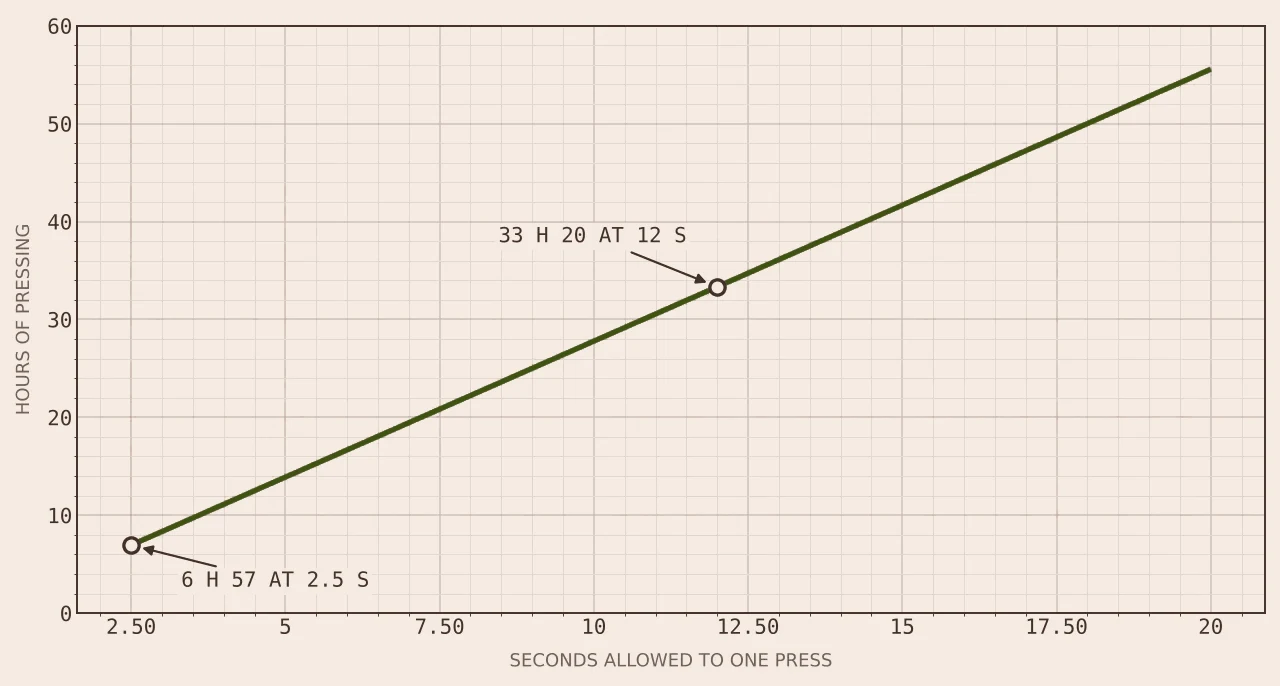
Reading the line sideways is the point of printing it. At the left-hand end sits the shortest interval any licensed reel game may run at, and even there the clause asks 6 h 57 min, which is a working day of unbroken pressing by a machine rather than a person. At twenty seconds a press the same clause asks 55 h 33 min. The gap between the ends is 48 h 36 min, all of it produced by one assumption, which is exactly why the assumption is printed rather than buried.
Every figure on the site is rebuilt from those inputs, and the method is written out in full in one place, with the formulae, the rounding rules and a plain statement of which two inputs are adopted rather than found.
What this site does not claim
Reading time: 2 min
A page about time can sound like someone stood over a phone with a stopwatch. That did not happen. No account was opened for these pages, no reel was spun, and no payout was timed. The figures are a model, not a diary of play.
What there is instead is a model: declared inputs, arithmetic applied to them, and a sentence carrying the assumption wherever a duration appears. That is a weaker claim than a measurement and it is an honest one, and it has the advantage that anybody can redo it with different inputs in a minute.
Nor is anything scored. Nothing here carries a mark, a star or a grade, and no judgement is dressed up as a figure. Where this site has an opinion it is an opinion about arithmetic, and the arithmetic is printed so the opinion can be checked against it.
Reading position: Minute 9 of 20
Regulatory facts come from one sheet of sourced claims, and that sheet refuses several things a page here might have liked to say. It records that no primary source fixes what a single free spin is worth in money, so this site never states such a value as a rule. It records that nobody has settled in public whether the winnings off a free spin are themselves bonus funds, which is the quantity the licensed ceiling on a multiple is written about, so this site declines to say either way. Gaps are printed as gaps.
Reading position: Minute 10 of 20
One more absence is worth naming. Nothing here is a recommendation to take an offer, and no page concludes that a reader should. A page can say what an arrangement costs in hours and what it is expected to cost in pounds, and that is the end of what arithmetic is entitled to say.
There is also a line this site will not cross for any reason. Nothing on it helps anybody back into something they have deliberately closed off, and the refusal holds for a national registration, for a bar a bank has set, for a network restriction and for every step of a document check.
The same offer under a Great Britain licence
Reading time: 3 min
The worked example above describes offers from businesses that do not hold a Great Britain licence. The useful comparison is to run the same sum under the cap a British licence would impose, then subtract.
One rule does nearly all the work. Bonus funds may not carry a wagering requirement above ten times their own value, a prohibition live since 19 January 2026, with machine technology and software licences left outside it. Put ten where part one put forty and £25 of credit owes £250.00 across a reel rather than £1,000.00: 2,500 presses, 8 h 20 min and twenty-three sittings. Three quarters of the evening disappears, and the expected bill falls from £40.00 to £10.00.
Reading position: Minute 11 of 20
A second rule explains why the unit on this site is a press at all. A licensed gambling system has to make the customer commit to each game cycle individually, so nothing may run the reels on anybody's behalf while they watch. The single exception the guidance allows is a poker table posting its blinds without being asked. That is the reason 10,000 presses means ten thousand deliberate human acts, and the reason a count of presses is a meaningful measure of an evening rather than a measure of a machine's throughput.
Reading position: Minute 12 of 20
A third rule reaches the ninety-six per cent itself. A licensed game owes the customer, in advance of any commitment, enough to judge what the chances are, and the standard sets out several ways of discharging that: by explaining the mechanism and the allocation of prizes, by printing the margin kept, by printing the share paid back, or by printing the likelihood of the events that pay. Any single one will do, which is why nobody should say a licensed reel is obliged to show a percentage. Outside the British licence not even that choice is owed.
Reading position: Minute 12 of 20
Claiming there is no protection anywhere else would be as inaccurate as claiming there is plenty. A rulebook does exist on the offshore side, with a complaints timetable in it that costs the player nothing. What a reader actually gives up is narrower and sharper, and the section on the clocks that stop existing sets it out duty by duty. What goes missing most plainly is the national scheme for self-exclusion. Its edge sits exactly where the licence sits and not where the scheme would like, so one registration covers the whole licensed side and nothing at all beyond it.
Who pays for this site
Reading time: 2 min
Some links pay this site if a reader opens an account after following them. That is ordinary in this trade, and it is also where a conflict would hide, so it is stated here rather than left for a reader to discover later.
It does not touch the arithmetic, because the arithmetic has no room for it. Twelve seconds is twelve seconds, 10,000 presses is 10,000 presses, and £1.20 an hour is what four pence in the pound comes to at three hundred presses. Nothing in the chain has a slot where a commercial preference could be inserted without the sum stopping working.
Reading position: Minute 13 of 20
Nor does it touch what the pages say about the offers. Prose here describes the kind of arrangement rather than any particular one, never points at what the ranking is printing today, and never attributes a term to a business by name. That is partly discipline and partly self-interest: a page written against a live offer is wrong within the month, and nobody rereads a hundred pages to find the stale sentence.
Reading position: Minute 13 of 20
Two things the payment does change are worth admitting. It decides that this site exists at all, and it decides that the subject is offers rather than something else. Neither is concealed by the arithmetic, and anybody who thinks that settles the matter should weigh the figures against another source rather than against an assurance given here.
The full account of the arrangement sits on its own page, alongside what this site is and who writes it.
Where to start, given whatever is already on the screen
Reading time: 2 min
Most people arrive with something specific in front of them. Three starting points cover almost all of it.
Where the thing on the screen is a count of spins and nothing else, the conversion wanted is the one in part one run backwards from the count. The section on pace does it for every size of headline in a single column, and the gradient it finds holds at five spins and at a thousand. Where a percentage sits beside a payment instead, the section on the clearing run is the one, because those two numerals multiply and nothing else enters the sum.
Reading position: Minute 14 of 20
Where the pressure is a date rather than a quantity, start at the section on windows, which works out the largest credit a period of a given length can finish and finds the boundary beyond which diligence is irrelevant. Where the account is open and the money is standing, the section on getting paid takes the wait apart into its lengths. Where the joining itself is the obstacle, the section on the doorway prices it, and the finding is that the price does not move when the offer does.
Reading position: Minute 15 of 20
Where the question is not one offer but the habit, the section on repetition is the one to read, since a figure that looks survivable once behaves differently fifty times over. And where the offer sits outside the register, the section on what stops existing is the place to go before anything else, not least because it carries the support route in full.
Reading position: Minute 15 of 20
One reading order works for almost anybody. Convert the thing in front of you into minutes first, then look at the window set over it, then look at the wait that follows it. A figure surviving all three is rare, and finding out which of the three kills a particular offer takes about five minutes.
Anybody who wants the machinery rather than an answer should start at the page where the method is written out, which is also the page to argue with. Change the interval there and every hour on every other page moves with it.
Questions
Reading time: 5 min
- What does this site actually do?
- It converts the parts of a gambling offer into minutes and then prices the minutes. A banner carries counts, multiples and percentages, none of which is a duration, and a phone is spent in duration and nothing else. So every page takes the printed quantity, adds a stated pace, and prints the hours that fall out. The site models and computes. It plays nothing and times nothing.
- How long is a forty times clause on twenty-five pounds?
- Thirty-three hours and twenty minutes. Forty times £25 is £1,000.00 that has to cross a reel, which at ten pence a press is 10,000 presses, and at the twelve seconds this site allows for a press that comes to 33 h 20 min. Counted in sittings of twenty-two minutes it is ninety-one of them, which at two a day is forty-six days. The interval is assumed here and was never timed.
- How long is a hundred and fifty spins?
- About half an hour. A hundred and fifty presses at twelve assumed seconds each is 1,800 seconds, so the handout itself occupies thirty minutes. That is the part of the arrangement that is given away. The clause written over whatever those spins produce is the part measured in days, and the two are routinely printed in the same sentence as though they were comparable quantities.
- What does an hour of this cost?
- Thirty pounds of staking and one pound twenty of expected cost. Twelve seconds to a press puts three hundred presses in an hour, which sends £30.00 across a reel. Ninety-six pence of each pound crossed is expected back and four pence is not, so the hour carries £1.20 and one press carries 0.4 of a penny. Staking and spending are different quantities and most of this market lives in the gap.
- Where do the twelve seconds come from?
- From this site, and from nothing anybody observed. It is a modelling convention adopted for a person holding a handset, not a measurement of anybody, and every sentence carrying it says so. The shortest a licensed reel game may take before coming round again is 2.5 seconds, which is a floor on the machine rather than a description of a player. Anybody preferring a different interval rescales every hour on the site in one division.
- Which section should I read first?
- Whichever matches the thing in front of you. A bare count of spins points at the section on pace. A percentage beside a payment points at the section on the clearing run. A date on a sheet points at the section on windows. Money standing and unpaid points at the section on getting paid. An offer outside the British register points at the section on the clocks that stop existing.
- Is any of this measured?
- None of it. No account was opened, no reel was spun, no payment was requested and no payout was received. Every duration is produced by arithmetic from inputs that are printed on the page carrying it, which is a weaker claim than a measurement and an honest one. It also means anybody can redo the whole thing with their own inputs in about a minute.
- Do the offers hold a British licence?
- No. Offers of the sort converted here are run from businesses holding no Great Britain licence. The sharpest single consequence for the arithmetic is that nothing caps the multiple. Inside the licence a requirement written over bonus funds stops at ten times their value, in force from 19 January 2026, and at ten the same £25 owes £250.00 and 8 h 20 min rather than the £1,000.00 that produces 33 h 20 min.
- Must a licensed game print the percentage it returns?
- Not necessarily, and the point is routinely got wrong. In advance of any commitment a licensed game owes the customer enough to judge what the chances are, and the standard allows several ways of discharging that: explaining the mechanism and how prizes are shared out, printing the margin kept, printing the share paid back, or printing the likelihood of the events that pay. Any single one will do. The ninety-six used throughout is a figure chosen on this site and required by no rule.
- Does this site make money from the links?
- Yes, and the arrangement is set out on its own page. Following a link and going on to open an account may produce a payment to this site. It cannot reach the arithmetic, which has no slot for a preference, and it does not reach what the pages say, because the prose describes the kind of arrangement rather than any particular one and never sources a term to a business by name.
- What will this site not help with?
- Getting back into anything somebody has deliberately closed off. That holds for a registration with the national scheme, for anything a bank has barred, for a restriction running on a network and for each step of a document check. The section on the clocks that stop existing carries the support route in full, and the helpline number is free and answers whatever the hour.