Note B03 Revision 1 Terms read 17 October 2026
40 free spins no deposit, where the withdrawal floor decides more than the hours
Eight minutes is all the pressing a reader is handed, and £3.84 is what the forty presses expect to leave behind them. The forty times clause on that balance runs 5 h 7 min at the twelve seconds a press this site assumes, which is fourteen sittings and short enough to look reasonable. What the hours cannot fix is the figure a cashier sets as its smallest permitted withdrawal, and this note prices the gap between the two.
What lands 8 min The run 5 h 7 min The wait to be paid 48 h band
What offers of this size ask in hours
Advertising has been bought for every destination below. A fee reaches this site when a reader goes on to register, and no figure on this page moves one way or the other because of it.
-
01Mobile Free Spins
Betportal
Ceiling as a multiple
What lands€15.00150 spins at 10c, which is this site's figure and not the operator'sThe run17 h 30 minTurning over 525.00 at 10p means 5,250 presses, or about 48 phone sittings of 22 minutes. Timed at 10p a press and 12 seconds between presses, both of which this site assumes rather than measures.The wait to be paidNOT PUBLISHEDThis operator puts no withdrawal band in its own terms, so there is nothing honest to print here.Spins valued at this site's own 10p a spin
What lands
Spins, at a price15.00150 of them at 10c apiece, a figure belonging to this site rather than to the operatorMatch, and other creditno figure300% of three deposits, to a ceiling of €1,000. Not a sum until money of yours makes it one, so this row totals nothing and carries nothing downwardsThe run
Handed back on the spins(0.60)Each press stakes its own value and returns 96 per cent, which leaves this much with the house from the opening pressPlay-through 35x on the bonus(20.16)Taking 14.40 round 35 times over means 504.00 through the machines, of which 20.16 is the expected cost, and 17 h 30 min of pressing at the pace aboveWhat counts towards it100%Slots only, with no percentage published anywhere, so the row above assumes the whole of each stake countsWhat never clears
Limit on the winningsstated5x the bonusDeducted on the way outno figureNothing is published as a figure here, so this row removes nothingLeast that can leaveno figureNo figure is published, so nothing on this timer is pinned down by oneLeast deposit, and the rung over ityour own€20 a stage. Published in euros, so no rung is named at all: this site's ladder is a sterling oneThe window on the creditstated14 daysBiggest stake while it runsstated€5Removed outright by rulestatedNot publishedVerified before a payoutstatedDocuments before the first withdrawalNever clears€15.00Not a penny of it gets out, so the whole of what landed stands on this rowNo Great Britain licence
Licence held in Anjouan, Comoros, the company named is BetPortal Gaming Ltd, with Excite Ultra Media Ltd, quoted under ALSI-202601040-FI2.
Terms read 17 October 2026
Open the offer at Betportal, opens in a new window -
02Mobile Free Spins
WinBeast
Ceiling as a sum
What lands€50.00500 spins at 10c, which is this site's figure and not the operator'sThe run2 d 18 hTurning over 2,000.00 at 10p means 20,000 presses, or about 182 phone sittings of 22 minutes. Timed at 10p a press and 12 seconds between presses, both of which this site assumes rather than measures.The wait to be paidNOT PUBLISHEDThis operator puts no withdrawal band in its own terms, so there is nothing honest to print here.Spins valued at this site's own 10p a spin
What lands
Spins, at a price50.00500 of them at 10c apiece, a figure belonging to this site rather than to the operatorMatch, and other creditno figure50% to 100% of five deposits, each to a ceiling of €1,000, and a €650 free bet. Not a sum until money of yours makes it one, so this row totals nothing and carries nothing downwardsThe run
Handed back on the spins(2.00)Each press stakes its own value and returns 96 per cent, which leaves this much with the house from the opening pressPlay-through 40x on the bonus and the winnings from the spins(76.80)Taking 48.00 round 40 times over means 1,920.00 through the machines, of which 76.80 is the expected cost, and 2 d 18 h of pressing at the pace aboveWhat counts towards it100%Slots, titles vary by country, with no percentage published anywhere, so the row above assumes the whole of each stake countsWhat never clears
Limit on the winningsstated€100 a batch of spinsDeducted on the way outno figureNothing is published as a figure here, so this row removes nothingLeast that can leaveno figureNo figure is published, so nothing on this timer is pinned down by oneLeast deposit, and the rung over ityour own€20 a stage. Published in euros, so no rung is named at all: this site's ladder is a sterling oneThe window on the creditstated7 days, spins 1 dayBiggest stake while it runsstatedNot publishedRemoved outright by rulestatedNot publishedVerified before a payoutstatedDocuments before the first withdrawalNever clears€50.00Not a penny of it gets out, so the whole of what landed stands on this rowNo Great Britain licence
Licence held in Curaçao, no company named anywhere on the site.
Terms read 17 October 2026
Open the offer at WinBeast, opens in a new window -
03Mobile Free Spins
EliteSpin
Longest spin window
What lands£50.00500 spins at 10p, which is this site's figure and not the operator'sThe run2 d 18 hTurning over 2,000.00 at 10p means 20,000 presses, or about 182 phone sittings of 22 minutes. Timed at 10p a press and 12 seconds between presses, both of which this site assumes rather than measures.The wait to be paidNOT PUBLISHEDThis operator puts no withdrawal band in its own terms, so there is nothing honest to print here.Spins valued at this site's own 10p a spin
What lands
Spins, at a price50.00500 of them at 10p apiece, a figure belonging to this site rather than to the operatorMatch, and other creditno figure50% to 100% of five deposits, each to a ceiling of £1,000. Not a sum until money of yours makes it one, so this row totals nothing and carries nothing downwardsThe run
Handed back on the spins(2.00)Each press stakes its own value and returns 96 per cent, which leaves this much with the house from the opening pressPlay-through 40x on the bonus and the winnings from the spins(76.80)Taking 48.00 round 40 times over means 1,920.00 through the machines, of which 76.80 is the expected cost, and 2 d 18 h of pressing at the pace aboveWhat counts towards it100%Slots, with no percentage published anywhere, so the row above assumes the whole of each stake countsWhat never clears
Limit on the winningsstated5x the bonusDeducted on the way outno figureNothing is published as a figure here, so this row removes nothingLeast that can leaveno figureNo figure is published, so nothing on this timer is pinned down by oneLeast deposit, and the rung over ityour own£20 a stage. It lands square on the £20.00 rung, so none of yours is left perched on topThe window on the creditstated7 days, spins 3 daysBiggest stake while it runsstatedNot publishedRemoved outright by rulestatedNot publishedVerified before a payoutstatedDocuments before the first withdrawalNever clears£50.00Not a penny of it gets out, so the whole of what landed stands on this rowNo Great Britain licence
Licence held in Costa Rica, the company named is PrimeTier Limited.
Terms read 17 October 2026
Open the offer at EliteSpin, opens in a new window -
04Mobile Free Spins
Crown Jewelz
Multiple unpublished
What lands£15.00150 spins at 10p, which is this site's figure and not the operator'sThe runNOT TIMEDThis operator does not publish the play-through multiple in its own terms. The multiple is the one figure the clock cannot work around, so the run is left untimed.The wait to be paidNOT PUBLISHEDThis operator puts no withdrawal band in its own terms, so there is nothing honest to print here.Nothing reckoned
What lands
Spins, at a price15.00150 of them at 10p apiece, a figure belonging to this site rather than to the operatorMatch, and other creditno figure200% of the first deposit, then 150% twice, each to a ceiling of £1,000. Not a sum until money of yours makes it one, so this row totals nothing and carries nothing downwardsThe run
Play-throughno figure40x the bonus, reported rather than published by the operatorWhat counts towards itno figureSlots, with no percentage published anywhere, so the row above assumes the whole of each stake countsWhat never clears
Limit on the winningsstatedNot publishedDeducted on the way outno figureNothing is published as a figure here, so this row removes nothingLeast that can leaveno figureNo figure is published, so nothing on this timer is pinned down by oneLeast deposit, and the rung over ityour own£20. It lands square on the £20.00 rung, so none of yours is left perched on topThe window on the creditstatedNot publishedBiggest stake while it runsstatedNot publishedRemoved outright by rulestatedNot publishedVerified before a payoutstatedDocuments before the first withdrawalNever clearsNOT RECKONEDThis operator leaves the play-through multiple out of its own terms, so nothing below the fourth step can be worked out.No Great Britain licence
Licence held in Curaçao, number not verified, no company named anywhere on the site.
Terms read 17 October 2026
Open the offer at Crown Jewelz, opens in a new window
Only the middle reading comes out of arithmetic belonging to this site. The multiple laid against what lands gives the turnover asked for; dividing that by 10p a spin gives the presses; dividing those by 300 an hour gives the hours, a press on a handset being taken here at 12 seconds from the one before. Both figures are assumptions rather than measurements of anybody: nothing was played and nothing was held a stopwatch to. Anybody quicker should divide the press count by a rate of their own, which is why the presses are printed alongside the hours instead of being summarised away.
The first reading is what arrives before any condition is laid against it. Spins carry no unit of their own so one gets supplied: where an operator values its own spin that figure is used and attributed, and where it does not, this site's 10p a spin stands in and everything below moves with it. The third reading belongs to the operator entirely. It is a withdrawal band quoted from published terms, and a blank there means none was published rather than that nobody looked.
The total along the foot answers what the hours leave open, which is whether any of the running ends anywhere. It is what arrived, less whatever is still standing once the play-through has been paid for at 96 per cent return to player and once a published limit, a published deduction and a published floor beneath the least that can leave have each had a turn. It appears again in pence in the pound, the only fair way of holding a small offer up against a large one. It describes an offer rather than an evening, and where the conditions price out what arrived, a timer prints nothing getting out instead of a negative sum.
Cashiers on a handset take deposits off a row of preset buttons, so a least deposit given in pounds is raised to the next rung of the ladder used here, £10, £20, £25, £50, £75 and £100, and the timer shows what is left perched on it. That money is the reader's own and enters no sum at all. Given in euros it prints untouched, the ladder being sterling. Three words may occupy the figure column where no figure belongs. Stated is a published term that costs something while leaving no number to subtract. No figure is a term nobody has quantified, or a credit that is not a sum until money of yours makes it one. Your own is money of yours, which belongs in none of this.
None of the operators above is licensed in Great Britain, so not one duty that licence carries reaches any of them. Membership of Gamstop Online is compulsory for every online gambling company licensed in Great Britain, which means that shutting yourself out through the scheme shuts you out of none of these. The limit of ten times the bonus funds on a wagering requirement, running since 19 January 2026 under Social Responsibility Code 5.1.1, is a condition of the same licence and binds only whoever holds one. Off that licence, the Gambling Commission writes of consumers meeting unfair gaming practices, financial loss and no recourse when matters go wrong, and lists blocked payouts and withdrawal limits pitched too high to reach among the things it has seen. No account at any of them may be held by anybody under 18.
Every term on a timer is its operator's own and every timer carries the day somebody read it. The oldest of those readings is 17 October 2026. What binds a reader is an operator's full terms and never a line printed here.
1
Eight minutes of pressing, and the £3.84 behind it
£4.00 is the whole of what forty presses stake at 10p apiece, and every figure further down this note follows from how small that sum is. Ten pence is taken as the denomination because a spin credited for nothing is almost always issued at it, and the denomination is the offer’s choice rather than the player’s.
Sixteen pence of the £4.00 stays with the house at a return of ninety-six per cent, leaving £3.84 as the balance forty presses expect to build. Spendable money it is not. A credit won off free spins lands as bonus funds on an arrangement of this shape, and the wagering clause fastens itself to those funds rather than to the £4.00 of staking that produced them.
Four hundred and eighty seconds is what the forty presses consume where twelve seconds is allowed to each, and 480 seconds is eight minutes. Held against the twenty-two minutes this site counts as one sitting with a handset, eight minutes is a little over a third of one, so the banner has delivered everything it undertook before the first sitting is even finished. Twelve seconds is an assumption this site adopts and not a rate anybody has watched.
| The line | Figure |
|---|---|
| Presses credited | 40 |
| Staked at 10p apiece | £4.00 |
| Kept by the house at a 96 per cent return | £0.16 |
| Balance the forty expect to build | £3.84 |
| Seconds consumed, twelve to a press | 480 |
| Which reads as | 8 min |
| Share of one 22-minute sitting | 36% |
Forty results is a very small sample, and £3.84 is the average across all possible sets of forty rather than a forecast of one set. Most runs of forty presses on a volatile reel finish under £3.84 and a few finish at many times it, which is exactly why a page can price the average and can price nothing else. The spread matters again in part four, where it becomes the only route over a payout threshold.
Press number forty is where the unconditional part of this offer stops. A balance of £3.84 exists from that instant, a clause of forty times exists, an expiry has started counting, and none of the three was mentioned on the banner. Every quantity printed below is worked from three stated inputs and not from a watch: 10p staked on a press, ninety-six pence coming back out of each hundred, and a gap of twelve seconds before the thumb moves again.
2
The smallest withdrawal a cashier allows, against £3.84
Ten pounds and twenty pounds are the two payout thresholds priced throughout this note, and they are priced as arithmetic rather than reported as a market pattern, because no regulator publishes a minimum and no survey of what cashiers set could be sourced for this site. A cashier writes its own smallest permitted withdrawal into its banking page, and whatever figure it writes there applies to a £3.84 balance exactly as it applies to a £400 one.
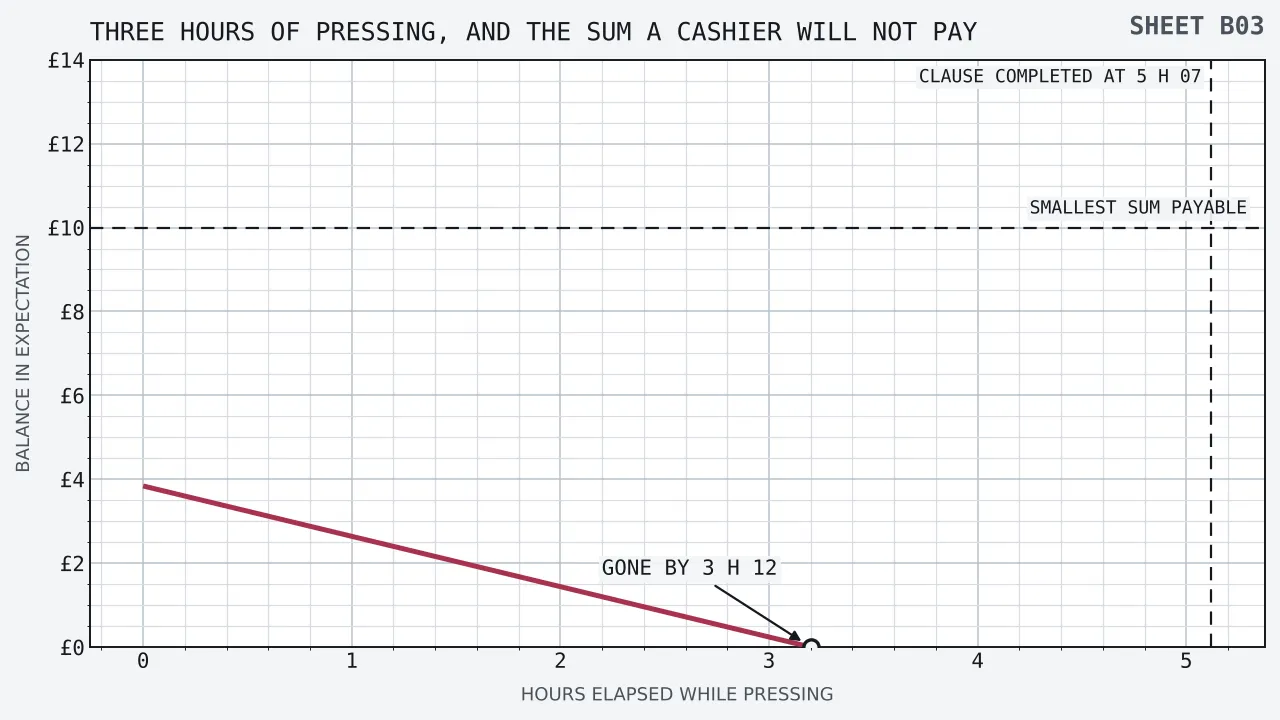
Six pounds and sixteen pence is the distance from £3.84 to a £10 threshold. Put as a multiple rather than a gap, the balance has to finish the clause at 2.6 times the size it started, and a £20 threshold asks for 5.2 times. Neither figure is a wagering condition, neither appears on a banner, and neither can be reached by pressing longer, because turnover does not add to a balance and a clause is satisfied by staking rather than by winning.
Six pounds and fourteen pence is what the forty times clause is expected to cost, being four pence out of each pound of the £153.60 it sends across the reels. Set the two sums side by side and the shape of this offer is visible in a single line: the expected cost of finishing the clause, £6.14, and the amount by which the balance falls short of a £10 payout threshold, £6.16, are the same sum to within two pence. A reader is being asked to spend, on average, the exact quantity of money they would have needed to win.
£6.16 short of a £10 threshold, on a balance of £3.84
Offers of this kind hold no Great Britain licence. The threshold therefore sits wholly inside the gift of the business that wrote it, and on a small pile that is a sharper loss than any of the general ones. Three rules would stand over that single figure if the offer sat inside the British licence. Deposits come back out uncapped. Any rationing of how much or how many has to be reasonable before it binds anybody. And a licensed cashier is pushed the other way entirely, towards a route out smooth enough that the option of cancelling a payout request is itself forbidden. None of that travels with an offer off the register. One figure on a banking page takes its place, written by the same party that wrote the forty, and £3.84 is stranded whole beneath it whatever the reels do.
Three endings are available to this offer and a threshold is in the way of all three. The balance can run out before £153.60 has crossed, which is what the arithmetic expects. The clause can be satisfied with something standing that is under the threshold, in which case a reader watches a figure in an account they are not permitted to request. Or the clause can be satisfied with more than the threshold standing, which is the outlier, and only then does the payout wait described in part eight begin at all.
Twenty-six times the balance is where a maximum win clause would sit if a sheet set one at £100.00, and that distance is the point. On a larger pile the win cap prices the best evening the terms allow. At forty spins it is so far above the arithmetic that it governs nothing, while the figure at the other end of the same banking page governs everything and is the one nobody reads.
3
Forty presses handed over, 1,536 presses owed
Forty multiplied by £3.84 comes to £153.60, and a standard clause wants the whole of that over the reels first; only then does the balance become something a reader is permitted to ask for. Split £153.60 into 10p pieces and 1,536 of them come out. Allow twelve seconds to each piece and the total is 18,432 seconds, which is 307.2 minutes, which is 5 h 7 min. Divide 307.2 minutes by a twenty-two minute sitting and 13.96 appears, so fourteen separate occasions with a phone is what the clause comes to once the part sitting is counted as a whole one.
Thirty-eight point four presses fall due for every single one credited, which is 1,536 set against 40. Read as a rate of exchange it is plainer still: a press given away now is bought with 38.4 presses of staking afterwards, and the staking comes out of the very balance the gift helped to build. Nothing in that exchange is concealed, and nothing in it is printed either.
1,536 presses owed on a balance handed over in 40
Fourteen sittings is the figure that makes this offer look reasonable, and the look is not false. One sitting a day finishes the clause inside a fortnight. Two sittings a day finishes it inside a week. Against the day and a half of pressing that a larger pile demands, five hours and seven minutes is genuinely modest, and a reader who enjoys the pressing has lost little by spending it. The argument of this note is not that the hours are long. It is that the hours are the part a reader can see.
Eleven pounds of turnover is what one twenty-two minute sitting puts across at 10p and twelve seconds, since a sitting holds 110 presses. Four per cent of £11.00 is 44p, so each sitting is expected to take 44p off the balance, and fourteen of them take rather more than the balance holds. That is the whole mechanism of the clause expressed at the scale a reader actually experiences it: a shade under half of one pound gone per pick-up of the phone, against a balance of £3.84 and a threshold at £10.00.
Two pence a minute is that same drain at a finer grain. Five presses a minute at the assumed pace is 50p of turnover a minute, four per cent of which is 2p, and £3.84 feeds a drain of 2p a minute for 192 minutes before there is nothing left to take. The clause asks for 307.2 minutes, which is 115 minutes longer than the balance can pay for.
4
The multiple that empties the balance, and the one that would not
Take four pence as the house’s cut from each pound crossed. It takes twenty-five crossings to give the whole balance away, so a condition set at twenty-five times is break-even by construction, and every multiple past it is a loss written into the terms.
Ninety-six pounds is where that boundary falls on £3.84, which is 960 presses and 3 h 12 min at the assumed pace, or nine sittings. A reader meeting a twenty-five times clause arrives after three hours and twelve minutes expecting to hold nothing whatever. The forty times clause costed here carries them one hour and fifty-five minutes further at that same assumed pace, and the extra time moves a reader from nothing to less than nothing.
| Clause | Staking it sets | Presses of 10p | Run at twelve seconds | Sittings | Expected to be standing |
|---|---|---|---|---|---|
| Ten times, the British ceiling | £38.40 | 384 | 1 h 17 min | 4 | £2.30 |
| Twenty times | £76.80 | 768 | 2 h 34 min | 7 | £0.77 |
| Twenty-five times, the boundary | £96.00 | 960 | 3 h 12 min | 9 | £0.00 |
| Thirty times | £115.20 | 1,152 | 3 h 50 min | 11 | minus £0.77 |
| Thirty-five times | £134.40 | 1,344 | 4 h 29 min | 13 | minus £1.54 |
| Forty times, costed here | £153.60 | 1,536 | 5 h 7 min | 14 | minus £2.30 |
| Forty-five times | £172.80 | 1,728 | 5 h 46 min | 16 | minus £3.07 |
Two pounds and thirty pence is the best row in that table, and it is the row this page turns on. Ten times is the hardest condition a British licence permits over bonus funds, so the top line is the friendliest clause a reader could meet anywhere on the regulated side of the market. It leaves £2.30 expected to be standing after four sittings. Against a £10.00 payout threshold, £2.30 is £7.70 short. Against a £20.00 one it is £17.70 short. Run the same comparison down every row and the finding holds without exception: no multiple on the ladder produces, on average, a sum a cashier would let out of the building.
Seventy-seven pence is as near as the twenty times row comes to rescuing the pile, and it rescues nothing. The reason is structural rather than unlucky. A payout threshold is a fixed number of pounds while a balance is a multiple of a very small one, so the smaller the pile, the larger the multiple needed to reach the threshold, and the clause works in the opposite direction by shaving the balance as the pressing goes on. Expectation never carries a £3.84 balance to £10.00. Only a long tail does.
Two things want keeping apart at this point. An expectation averages everybody who begins and forecasts nobody’s evening, so a minority of readers will satisfy the clause holding real money and will get it out. The average remains the only measure available before anybody has pressed anything, and on a pile this small the average and the threshold never come within six pounds of each other.
Three hundred and seven pounds and twenty pence is the staking the same clause wants where a term sheet credits only half of each pound towards it on the games the spins are tied to. That doubles the presses to 3,072 and, at the pace assumed throughout, the run to 10 h 14 min, or twenty-eight sittings. Nothing in that doubling moves the balance, the threshold or the expected standing by a single penny. A credit fraction buys more hours against the same £3.84, which is the clearest illustration this page can give that hours are not what the arrangement is short of.
5
Why a stake ceiling binds nothing at this size
Five pounds is the most a British licensed slot may accept for one spin from a player aged twenty-five or over, and £3.84 is less than that. The whole pile comes to 77 per cent of one permitted press. That comparison explains the offer better than any hour count does: the balance a clause of 40 times hangs on would not fund one maximum stake, and a term sheet on the offshore side generally pegs its own ceiling somewhere near the same figure.
£153.60 may be sent over at whatever denomination a sheet tolerates, and the clock divides by precisely the factor the stake is multiplied by. The balance does not divide. Press at 40p and £3.84 covers nine goes before the money to stake has run out; press at £1.60 and it covers two. Ninety-six presses is what the clause wants at that denomination, so in all but a handful of cases the balance finishes long before the condition does.
| Staked a press | Presses needed | Run at the assumed pace | Presses the £3.84 covers | What it does to the spread |
|---|---|---|---|---|
| 10p | 1,536 | 5 h 7 min | 38 | Narrow, and the arithmetic grinds |
| 20p | 768 | 2 h 34 min | 19 | Wider, with fewer results to carry it |
| 40p | 384 | 1 h 17 min | 9 | Most sets end at nothing early |
| 80p | 192 | 38 min | 4 | Four presses is not a run at all |
| £1.60 | 96 | 19 min | 2 | One sitting decides the lot |
Minus £2.30 is the expected standing on every row of that table, top to bottom, because no stake term appears anywhere in the expression that produces it. Nothing is given up in expectation by moving between the rows and nothing is gained by it. Denomination governs the spread and the clock, and governs neither the balance nor the threshold. Where a heavier press does change something is in how many results a thin balance gets before it reaches zero, and on a pile of £3.84 the answer is already small at 10p.
A single press over the ceiling a sheet sets while bonus money is live is enough to have a balance cancelled, and the cancellation reaches back across every press made before it. At this size the ceiling is barely reachable in the first place, which removes one of the two usual ways a reader loses a run and leaves the expiry in part seven as the other.
Ninth of April 2025 is when the £5.00 limit on a single slots game cycle began under a British licence, with 21 May 2025 for the £2.00 limit applying below the age of twenty-five, both dates taken from the Commission’s own guidance on the instrument. Neither limit reaches roulette or any other casino game, and neither reaches a cashier outside the British register. The relevance of the pair to this page is narrow but real: they are the only published figures anywhere in the arithmetic above, and every other ceiling and floor priced on this page is a commercial choice with no rule behind it.
6
What five hours and seven minutes are resting on
Twelve seconds carries all 307.2 minutes above it, and a figure doing that much work deserves to be set against the alternatives rather than left standing. The arithmetic is linear and a reader can redo it mentally: the press count of 1,536 is fixed by the multiple and the denomination, so halving the seconds halves the hours and nothing else moves at all.
| Seconds to a press | Presses in an hour | Run on 1,536 | Sittings | Who presses at it |
|---|---|---|---|---|
| 2.5 | 1,440 | 1 h 4 min | 3 | No thumb; it is the British floor on pace |
| 6 | 600 | 2 h 34 min | 7 | Quick, animation off, nothing else running |
| 9 | 400 | 3 h 50 min | 11 | Settled attention, often a larger screen |
| 12 | 300 | 5 h 7 min | 14 | The handset rate this note works from |
| 20 | 180 | 8 h 32 min | 24 | Half attending, messages coming in |
The Commission’s technical standard 14D fixes two and a half seconds as the shortest gap allowed between slot cycles. Nothing in it shortens a session; what it stops is a lobby turning a long play-through into a quick one.
One hour and four minutes is what that floor permits for 1,536 presses, and the figure is worth printing because it closes an argument rather than opening one. On a larger pile the gap between the regulated floor and a handset rate decides whether a clause can be met inside a day at all. At forty spins the clause fits inside a day at every rate in the table, including the slowest, so pace is not what stands between a reader and the money. Seven hours and twenty-eight minutes separate the top row from the bottom, and the expected standing is minus £2.30 in both.
Two quantities come through all five rows without moving. One is 1,536, answerable to the clause and the denomination alone. The other is the threshold in part two, which has no relationship to speed of any kind. A reader who presses twice as fast arrives twice as soon at a balance that is still £6.16 short of a £10.00 withdrawal, and the only thing the extra speed has bought is the evening back.
7
A short run set against the clock stamped on it
Five hours and seven minutes, at the twelve seconds assumed here, leaves eighteen hours and fifty-three minutes of a day unused, so a one-day expiry on a pile this size is not the arithmetic impossibility it becomes further up the range. It still takes 21 per cent of the twenty-four hours, and it still takes fourteen separate pick-ups of a phone. A reader given one day is being asked for a fifth of it rather than being told outright that the thing cannot be done.
Forty-four minutes a day is what a seven-day clock asks, which is two sittings. Twenty-two minutes a day is what a fourteen-day clock asks, which is one sitting and almost exactly what a phone absorbs in ordinary use anyway. Those two rows are the reason a pile this size reads as the reasonable end of the market, and the reading survives examination in a way it does not on a larger pile.
| Expiry stamped on the balance | Pressing wanted daily | Sittings daily | Whether a person gets there |
|---|---|---|---|
| One day | 5 h 7 min | 14 | Possible, at a fifth of the day |
| Three days | 1 h 42 min | 5 | An evening on each of the three |
| Seven days | 44 min | 2 | Comfortable, with no day dropped |
| Fourteen days | 22 min | 1 | One pick-up of the phone a day |
| Thirty days | 10 min | 1 | Below what a phone takes anyway |
Twenty-four hours is also a common life for the credited spins themselves, as distinct from the balance they build, and eight minutes of pressing fits inside that without effort. The two clocks are separate and a reader should read them as separate: one governs when the forty presses have to be used, the other governs when the balance they produce has to be cleared, and the second is the one with 1,536 presses hanging off it.
Nought pounds is what a part-finished clause pays, and on a short run that is a sharper point than it looks. A reader on a seven-day clock who misses two evenings out of seven has not lost two sevenths of anything. On the common form of these terms the balance and everything the pressing added to it are swept away together when the expiry arrives, from 1,535 presses as surely as from none.
Two losses land together where an expiry catches a balance above zero and under the payout threshold, and only one of them is visible. Money disappears, which a reader watches happen. Hours disappear with it, and those were beyond recovery from the start, since a balance under the threshold was no more requestable on the final day of the window than on the first. An expiry on a small pile mostly confiscates something that was already out of reach.
8
What a Great Britain licence does about a payout threshold
Three hours and fifty minutes is the discount a British licence would apply to this run, and on a page of durations that is the plainest way to price one. Ten times is the ceiling a wagering clause may reach over bonus funds, written into code 5.1.1 of the social responsibility provisions at its third limb and binding on licensees since 19 January 2026. Ten times £3.84 is £38.40, or 384 presses and 1 h 17 min at the assumed pace, set against the 5 h 7 min a forty times clause produces.
Four duties over money leaving an account come with the same licence, and this is the subset that bears on somebody holding £3.84. Deposits come back out uncapped, a term rationing them to a fixed sum a day being published by the regulator as the sort it forbids. Where a cashier does ration the size or the count of payments, reasonableness is the standard it has to meet. A customer may not be offered the button that takes a payout request back. Identity gets settled before press number one instead of at the cashier’s desk, the age check reaching bonus play and demonstration builds with it, and nothing a licensee ought to have wanted sooner may be turned into a reason for holding the money.
One caution belongs beside that list, because the first duty is easy to overstate. It is about money a customer paid in, and nothing was paid in here, so no British rule reads across and strikes out a £10.00 minimum on an arrangement of this shape. What the four duties do establish is narrower and still worth having: under a licence the terms on which money leaves are a regulated subject, with a standard of reasonableness over them and a regulator obliged to receive a complaint about them. Off the register they are a commercial setting on a banking page.
Twenty-first of October 2025 is the date of a post on the regulator’s own blog, written under the name of its enforcement and intelligence director, and it names the two failure modes this page is about. Payouts stopped outright is the first. Withdrawal thresholds pitched at a level a customer has no practical way of reaching is the second, recorded there as something seen on sites running without a British licence. That is the argument in sourced form, published by the regulator rather than asserted by a guide, and it is why a threshold earns a reading before a multiple does.
The licence requires a complaint to be receivable for six months from the incident, with a no-charge referral to an approved adjudicator after the operator’s own stage. Away from the register, both of those disappear.
Three pounds and eighty-four pence is also too small to argue about, and that is not a figure of speech. Curaçao publishes a complaints framework, and a reader told that nowhere offshore answers a grievance has been misled: six months is the window there too, four weeks is the answering time with four more available on written notice, and the dispute route costs the player nothing because the operator carries the bill. The terms of that route are left to the operator, a minimum claim value for escalation named among them. So one party fixes the smallest sum that may be withdrawn and the smallest sum that may be escalated, and £3.84 sits under any plausible setting of either. Neither threshold counts the 5 h 7 min spent arriving at the balance.
One registration with Gamstop Online reaches every online gambling business licensed in Great Britain, membership being a condition of the licence since March 2020, with a daily check of the whole customer base required from the April after. The scheme states its own limit plainly, which is that it cannot keep anybody away from a business that does not take part in it. Nothing on this page assists with reaching such a business, and the same refusal covers a gambling block set by a bank and a bar set on a network.
Two minutes with the public register is the check this whole section reduces to, and a reader can make it before pressing anything at all. A British licence puts its holder on a register where the permitted activities and the domain names are listed, so a site can be read against its own entry. Where no British licence exists there is no entry to read, and the payout threshold, the wagering multiple and the expiry are known only from the page that publishes them.
9
Who eight minutes suits once the floor is in the sum
Eight minutes of free pressing is a straightforwardly good thing to be given, and this note has not argued otherwise at any point. The pressing costs nothing, it is over inside one sitting, and whatever it builds is real until a clause is applied to it. A reader who would have spent that eight minutes on a phone regardless has gained the whole of it.
Five hours and seven minutes, at the pace this note assumes, is the price of turning that gift into money, and it is a defensible price for somebody who enjoys the pressing. Fourteen sittings over a fortnight is one pick-up of a phone a day, which is not a second job and not a lost week. Anybody reading this page as a warning about the hours has read it wrong: by the standards of this market, the hours on a pile this small are mild.
Six pounds and sixteen pence is the figure that decides the offer, and it is the one figure a banner never carries. A balance of £3.84 has to finish at 2.6 times its own size to clear a £10.00 threshold, at 5.2 times to clear a £20.00 one, and the clause between the two points is expected to subtract £6.14 rather than add anything. The offer is not a bad use of an evening. It is an arrangement whose stated purpose, the withdrawal of money, is outside the reach of its own arithmetic.
Three lines settle whether any small pile is worth starting, and the order they are read in matters more than usual. The smallest permitted withdrawal comes first, because a threshold above the expected standing makes every other figure decorative. The multiple comes second, because at twenty-five the last of the balance has gone into the staking. The expiry comes third, because an hour count that fits inside its window is the one thing a forty spin pile reliably has. A reader who checks them in that order will reject most offers at the first line and will have spent a minute doing it.
Thirty-eight point four presses owed for each one credited is the ratio to carry away, and £6.16 is the gap to carry away with it. Eight minutes of handout, five hours and seven minutes of clause, a balance that is expected to be gone before the clause ends, and a payout threshold that the balance could not have reached even if it survived whole. The banner prints the first number in that sequence.
Questions
- What does it take in hours to clear 40 free spins with no deposit?
- Five hours and seven minutes of pressing, plus the eight minutes the credited spins themselves occupy. Forty times a balance of £3.84 puts £153.60 over the reels, which is 1,536 presses of 10p and 5 h 7 min where twelve seconds goes to a press. Rounded up against a twenty-two minute sitting it comes to fourteen pick-ups of a phone. Neither the pace nor the sitting length was measured; both are stated assumptions.
- What are forty free spins worth before any condition applies?
- Forty presses at 10p stake £4.00 in total. At a ninety-six per cent return 16p stays with the house and £3.84 is the balance expected to be built. That £3.84 arrives as bonus funds rather than as money, and the wagering clause attaches to the £3.84 and not to the £4.00 of staking that produced it.
- Why does a minimum withdrawal matter more than the hours on a pile this small?
- Because £3.84 has to finish at 2.6 times its own size to clear a £10.00 threshold and at 5.2 times to clear a £20.00 one, while the clause between the two points is expected to subtract £6.14. The hours are mild at this count, five hours and seven minutes at the assumed pace, and no quantity of them adds to a balance. A threshold above the expected standing makes the rest of the term sheet decorative.
- Would a ten times clause make the £3.84 withdrawable?
- No, and that is the finding worth keeping. Ten times is the hardest wagering clause a British licence permits over bonus funds, and on £3.84 it asks £38.40 of staking, which is 384 presses and 1 h 17 min at the pace assumed here. The expected standing at the end is £2.30, which is £7.70 under a £10.00 threshold and £17.70 under a £20.00 one. Every multiple on the ladder falls short on average.
- Can a heavier stake get the balance over a payout threshold?
- It widens the spread without touching the expectation, which stays at minus £2.30 because no stake term appears in the expression that produces it. Staking at 40p leaves the £3.84 covering nine presses and at £1.60 covering two, so most runs finish at nothing very early. A term sheet caps the denomination anyway, usually near £5.00, which is more than the whole balance.
- What happens if the expiry arrives while the balance is under the threshold?
- On the common form of these terms the balance goes, and everything the pressing added to it goes with it, from 1,535 presses as surely as from none. The quieter loss is the hours: a balance under the threshold was no more requestable on the final day of the window than on the first, so those hours were beyond recovery before the clock ran out on them.
- How much of the five hours would a Great Britain licence remove?
- Three hours and fifty minutes of it. Ten times is the ceiling a wagering clause may reach over bonus funds, written into code 5.1.1 of the social responsibility provisions at its third limb and binding since 19 January 2026. Staking of £38.40 would stand in place of £153.60, and 384 presses and 1 h 17 min in place of 1,536 presses and 5 h 7 min. Offers of this kind hold no Great Britain licence and no such ceiling reaches them.
- Does pressing faster change anything other than the clock?
- Nothing whatever. At six seconds a press the 1,536 presses take 2 h 34 min, at nine seconds 3 h 50 min and at twenty seconds 8 h 32 min, while the press count stays where the multiple and the denomination put it. The expected standing stays at minus £2.30 because no term for speed appears in it, and the payout threshold is unmoved by speed as well.
- Is a pile of forty spins worth taking at all?
- Eight minutes of pressing given away is worth having, and fourteen sittings of twenty-two assumed minutes spread over a fortnight is a mild price for somebody who enjoys the pressing. It is a poor way to pursue money: £3.84 is £6.16 under a £10.00 withdrawal threshold, the clause is expected to subtract £6.14 rather than add, and the smallest sum a cashier will release is set by the same party that set the multiple.