Note B12 Revision 1 Terms read 17 October 2026
Pragmatic slots, and the nine minutes a bought feature would save
Ninety-eight to one is the ratio this note prices. A purchased feature costing a hundred times the stake puts £10.00 over the reels in one press, so £460.80 of play-through would finish in 47 presses and 9 min 24 s rather than 4,608 presses and 15 h 22 min at the twelve seconds a press this site assumes. A term sheet closes that route for as long as bonus funds are live, which leaves the long version and the wide spread that comes with it.
What lands £11.52 The run 15 h 22 min The wait to be paid 9 min 24 s denied
What offers of this size ask in hours
Advertising has been bought for every destination below. A fee reaches this site when a reader goes on to register, and no figure on this page moves one way or the other because of it.
-
01Mobile Free Spins
Betportal
Ceiling as a multiple
What lands€15.00150 spins at 10c, which is this site's figure and not the operator'sThe run17 h 30 minTurning over 525.00 at 10p means 5,250 presses, or about 48 phone sittings of 22 minutes. Timed at 10p a press and 12 seconds between presses, both of which this site assumes rather than measures.The wait to be paidNOT PUBLISHEDThis operator puts no withdrawal band in its own terms, so there is nothing honest to print here.Spins valued at this site's own 10p a spin
What lands
Spins, at a price15.00150 of them at 10c apiece, a figure belonging to this site rather than to the operatorMatch, and other creditno figure300% of three deposits, to a ceiling of €1,000. Not a sum until money of yours makes it one, so this row totals nothing and carries nothing downwardsThe run
Handed back on the spins(0.60)Each press stakes its own value and returns 96 per cent, which leaves this much with the house from the opening pressPlay-through 35x on the bonus(20.16)Taking 14.40 round 35 times over means 504.00 through the machines, of which 20.16 is the expected cost, and 17 h 30 min of pressing at the pace aboveWhat counts towards it100%Slots only, with no percentage published anywhere, so the row above assumes the whole of each stake countsWhat never clears
Limit on the winningsstated5x the bonusDeducted on the way outno figureNothing is published as a figure here, so this row removes nothingLeast that can leaveno figureNo figure is published, so nothing on this timer is pinned down by oneLeast deposit, and the rung over ityour own€20 a stage. Published in euros, so no rung is named at all: this site's ladder is a sterling oneThe window on the creditstated14 daysBiggest stake while it runsstated€5Removed outright by rulestatedNot publishedVerified before a payoutstatedDocuments before the first withdrawalNever clears€15.00Not a penny of it gets out, so the whole of what landed stands on this rowNo Great Britain licence
Licence held in Anjouan, Comoros, the company named is BetPortal Gaming Ltd, with Excite Ultra Media Ltd, quoted under ALSI-202601040-FI2.
Terms read 17 October 2026
Open the offer at Betportal, opens in a new window -
02Mobile Free Spins
WinBeast
Ceiling as a sum
What lands€50.00500 spins at 10c, which is this site's figure and not the operator'sThe run2 d 18 hTurning over 2,000.00 at 10p means 20,000 presses, or about 182 phone sittings of 22 minutes. Timed at 10p a press and 12 seconds between presses, both of which this site assumes rather than measures.The wait to be paidNOT PUBLISHEDThis operator puts no withdrawal band in its own terms, so there is nothing honest to print here.Spins valued at this site's own 10p a spin
What lands
Spins, at a price50.00500 of them at 10c apiece, a figure belonging to this site rather than to the operatorMatch, and other creditno figure50% to 100% of five deposits, each to a ceiling of €1,000, and a €650 free bet. Not a sum until money of yours makes it one, so this row totals nothing and carries nothing downwardsThe run
Handed back on the spins(2.00)Each press stakes its own value and returns 96 per cent, which leaves this much with the house from the opening pressPlay-through 40x on the bonus and the winnings from the spins(76.80)Taking 48.00 round 40 times over means 1,920.00 through the machines, of which 76.80 is the expected cost, and 2 d 18 h of pressing at the pace aboveWhat counts towards it100%Slots, titles vary by country, with no percentage published anywhere, so the row above assumes the whole of each stake countsWhat never clears
Limit on the winningsstated€100 a batch of spinsDeducted on the way outno figureNothing is published as a figure here, so this row removes nothingLeast that can leaveno figureNo figure is published, so nothing on this timer is pinned down by oneLeast deposit, and the rung over ityour own€20 a stage. Published in euros, so no rung is named at all: this site's ladder is a sterling oneThe window on the creditstated7 days, spins 1 dayBiggest stake while it runsstatedNot publishedRemoved outright by rulestatedNot publishedVerified before a payoutstatedDocuments before the first withdrawalNever clears€50.00Not a penny of it gets out, so the whole of what landed stands on this rowNo Great Britain licence
Licence held in Curaçao, no company named anywhere on the site.
Terms read 17 October 2026
Open the offer at WinBeast, opens in a new window -
03Mobile Free Spins
EliteSpin
Longest spin window
What lands£50.00500 spins at 10p, which is this site's figure and not the operator'sThe run2 d 18 hTurning over 2,000.00 at 10p means 20,000 presses, or about 182 phone sittings of 22 minutes. Timed at 10p a press and 12 seconds between presses, both of which this site assumes rather than measures.The wait to be paidNOT PUBLISHEDThis operator puts no withdrawal band in its own terms, so there is nothing honest to print here.Spins valued at this site's own 10p a spin
What lands
Spins, at a price50.00500 of them at 10p apiece, a figure belonging to this site rather than to the operatorMatch, and other creditno figure50% to 100% of five deposits, each to a ceiling of £1,000. Not a sum until money of yours makes it one, so this row totals nothing and carries nothing downwardsThe run
Handed back on the spins(2.00)Each press stakes its own value and returns 96 per cent, which leaves this much with the house from the opening pressPlay-through 40x on the bonus and the winnings from the spins(76.80)Taking 48.00 round 40 times over means 1,920.00 through the machines, of which 76.80 is the expected cost, and 2 d 18 h of pressing at the pace aboveWhat counts towards it100%Slots, with no percentage published anywhere, so the row above assumes the whole of each stake countsWhat never clears
Limit on the winningsstated5x the bonusDeducted on the way outno figureNothing is published as a figure here, so this row removes nothingLeast that can leaveno figureNo figure is published, so nothing on this timer is pinned down by oneLeast deposit, and the rung over ityour own£20 a stage. It lands square on the £20.00 rung, so none of yours is left perched on topThe window on the creditstated7 days, spins 3 daysBiggest stake while it runsstatedNot publishedRemoved outright by rulestatedNot publishedVerified before a payoutstatedDocuments before the first withdrawalNever clears£50.00Not a penny of it gets out, so the whole of what landed stands on this rowNo Great Britain licence
Licence held in Costa Rica, the company named is PrimeTier Limited.
Terms read 17 October 2026
Open the offer at EliteSpin, opens in a new window -
04Mobile Free Spins
Crown Jewelz
Multiple unpublished
What lands£15.00150 spins at 10p, which is this site's figure and not the operator'sThe runNOT TIMEDThis operator does not publish the play-through multiple in its own terms. The multiple is the one figure the clock cannot work around, so the run is left untimed.The wait to be paidNOT PUBLISHEDThis operator puts no withdrawal band in its own terms, so there is nothing honest to print here.Nothing reckoned
What lands
Spins, at a price15.00150 of them at 10p apiece, a figure belonging to this site rather than to the operatorMatch, and other creditno figure200% of the first deposit, then 150% twice, each to a ceiling of £1,000. Not a sum until money of yours makes it one, so this row totals nothing and carries nothing downwardsThe run
Play-throughno figure40x the bonus, reported rather than published by the operatorWhat counts towards itno figureSlots, with no percentage published anywhere, so the row above assumes the whole of each stake countsWhat never clears
Limit on the winningsstatedNot publishedDeducted on the way outno figureNothing is published as a figure here, so this row removes nothingLeast that can leaveno figureNo figure is published, so nothing on this timer is pinned down by oneLeast deposit, and the rung over ityour own£20. It lands square on the £20.00 rung, so none of yours is left perched on topThe window on the creditstatedNot publishedBiggest stake while it runsstatedNot publishedRemoved outright by rulestatedNot publishedVerified before a payoutstatedDocuments before the first withdrawalNever clearsNOT RECKONEDThis operator leaves the play-through multiple out of its own terms, so nothing below the fourth step can be worked out.No Great Britain licence
Licence held in Curaçao, number not verified, no company named anywhere on the site.
Terms read 17 October 2026
Open the offer at Crown Jewelz, opens in a new window
Only the middle reading comes out of arithmetic belonging to this site. The multiple laid against what lands gives the turnover asked for; dividing that by 10p a spin gives the presses; dividing those by 300 an hour gives the hours, a press on a handset being taken here at 12 seconds from the one before. Both figures are assumptions rather than measurements of anybody: nothing was played and nothing was held a stopwatch to. Anybody quicker should divide the press count by a rate of their own, which is why the presses are printed alongside the hours instead of being summarised away.
The first reading is what arrives before any condition is laid against it. Spins carry no unit of their own so one gets supplied: where an operator values its own spin that figure is used and attributed, and where it does not, this site's 10p a spin stands in and everything below moves with it. The third reading belongs to the operator entirely. It is a withdrawal band quoted from published terms, and a blank there means none was published rather than that nobody looked.
The total along the foot answers what the hours leave open, which is whether any of the running ends anywhere. It is what arrived, less whatever is still standing once the play-through has been paid for at 96 per cent return to player and once a published limit, a published deduction and a published floor beneath the least that can leave have each had a turn. It appears again in pence in the pound, the only fair way of holding a small offer up against a large one. It describes an offer rather than an evening, and where the conditions price out what arrived, a timer prints nothing getting out instead of a negative sum.
Cashiers on a handset take deposits off a row of preset buttons, so a least deposit given in pounds is raised to the next rung of the ladder used here, £10, £20, £25, £50, £75 and £100, and the timer shows what is left perched on it. That money is the reader's own and enters no sum at all. Given in euros it prints untouched, the ladder being sterling. Three words may occupy the figure column where no figure belongs. Stated is a published term that costs something while leaving no number to subtract. No figure is a term nobody has quantified, or a credit that is not a sum until money of yours makes it one. Your own is money of yours, which belongs in none of this.
None of the operators above is licensed in Great Britain, so not one duty that licence carries reaches any of them. Membership of Gamstop Online is compulsory for every online gambling company licensed in Great Britain, which means that shutting yourself out through the scheme shuts you out of none of these. The limit of ten times the bonus funds on a wagering requirement, running since 19 January 2026 under Social Responsibility Code 5.1.1, is a condition of the same licence and binds only whoever holds one. Off that licence, the Gambling Commission writes of consumers meeting unfair gaming practices, financial loss and no recourse when matters go wrong, and lists blocked payouts and withdrawal limits pitched too high to reach among the things it has seen. No account at any of them may be held by anybody under 18.
Every term on a timer is its operator's own and every timer carries the day somebody read it. The oldest of those readings is 17 October 2026. What binds a reader is an operator's full terms and never a line printed here.
1
What the search is reaching for, and what goes unnamed here
One phrase, pragmatic slots, brings readers to a page like this one, and the phrase is reaching for a kind of game rather than for a company. No maker of games, no cashier and no individual reel is named anywhere below. What is named is the construction: a reel of wide outcomes whose return arrives mostly through a feature, with the feature available for immediate purchase at a multiple of the ordinary stake.
Two properties define that construction for a page about duration, and both of them move a clock. Buying the feature compresses a quantity of staking into a single press, which shortens any obligation measured in money. A wide distribution of outcomes lengthens some runs and cuts most of them short, which changes how far through an obligation a reader is likely to get. Expectation does not move at all, and section five shows why that is the uncomfortable part rather than the reassuring one.
Eleven pounds fifty-two is the residue this note works from throughout, so that its figures line up with the rest of the site. It is what 120 presses of ten pence are expected to leave at a ninety-six per cent return, and a forty times condition over it asks £460.80 across the reels. Any other residue scales every figure below in proportion, since nothing here depends on the size of the pile.
Two modelling choices carry every duration below, and choices is the honest word for them rather than findings: one game cycle charged at twelve seconds, and twenty-two minutes to a pick-up of the handset. Nobody was observed, nothing was recorded against a watch, and a reader whose own rhythm differs should scale the minutes and leave the press counts alone.
Four per cent is the margin assumed on every reel discussed here, high-variance or otherwise, because a return to player figure describes the long-run average and carries no information about how lumpily that average arrives. Two builds paying ninety-six per cent, one in frequent small returns and one in rare large ones, cost an identical 0.4p for every ten pence staked.
2
One press at £10.00, and the hundred it stands in for
Ten pounds is what a feature priced at a hundred times the stake costs where the stake is ten pence, and the whole of this note follows from that single line. The purchase is a stake. It goes over the reels as staking, it counts as turnover exactly like any other stake, and it resolves inside one game cycle of twelve seconds on the modelled interval.
One hundred presses of ordinary play is what that one press replaces in money terms, and 1,200 seconds is what those hundred presses would otherwise occupy. Twenty minutes of thumb work therefore collapses into twelve seconds. Stated as a rate of substitution, the purchase runs at a hundred times the turnover for one hundredth of the time, which is the steepest exchange of that kind this site has had cause to price.
| What is measured | Ordinary press | Purchased feature |
|---|---|---|
| Staked in one game cycle | £0.10 | £10.00 |
| Seconds that cycle occupies | 12 | 12 |
| Turnover a minute, pace as modelled | £0.50 | £50.00 |
| Turnover an hour | £30.00 | £3,000.00 |
| Expected margin a press | £0.004 | £0.40 |
| Expected margin an hour | £1.20 | £120.00 |
| Presses £11.52 can fund outright | 115 | 1 |
One hundred and twenty pounds an hour is the expected margin on a purchased run, set against £1.20 an hour at the ordinary stake, and the bottom two rows of that table are the two halves of the same fact. A reader spending at a hundred times the rate is losing at a hundred times the rate. Nothing about the construction alters the four pence in the pound; it alters only how many pounds go past in a minute.
One is the number of purchases a residue of £11.52 can actually pay for, and that figure deserves its own sentence. Ten pounds leaves £1.52 behind, which buys fifteen ordinary presses and no second feature. A route advertised as the quick way through a condition therefore gives a reader exactly one attempt at it, where the ordinary stake gives 115 attempts before the same residue could be emptied without a single return.
£50.00 of turnover a minute against 50p at the ordinary stake
3
Nine minutes twenty-four seconds against fifteen hours twenty-two
Forty-six point nought eight purchases is what £460.80 of required staking divides into at £10.00 each, and a part purchase cannot be made, so 47 is the count. Forty-seven presses at twelve seconds apiece come to 564 seconds, which is 9 min 24 s. The last purchase overshoots the requirement by £9.20, which costs 37p in expected margin and is the cheapest rounding error on this site.
Four thousand six hundred and eight presses is the same £460.80 sent over at ten pence, and 55,296 seconds is what they occupy, which is 15 h 22 min, which is 42 pick-ups of a handset once the part sitting rounds up. One obligation, two routes, and the second runs 98 times longer than the first.
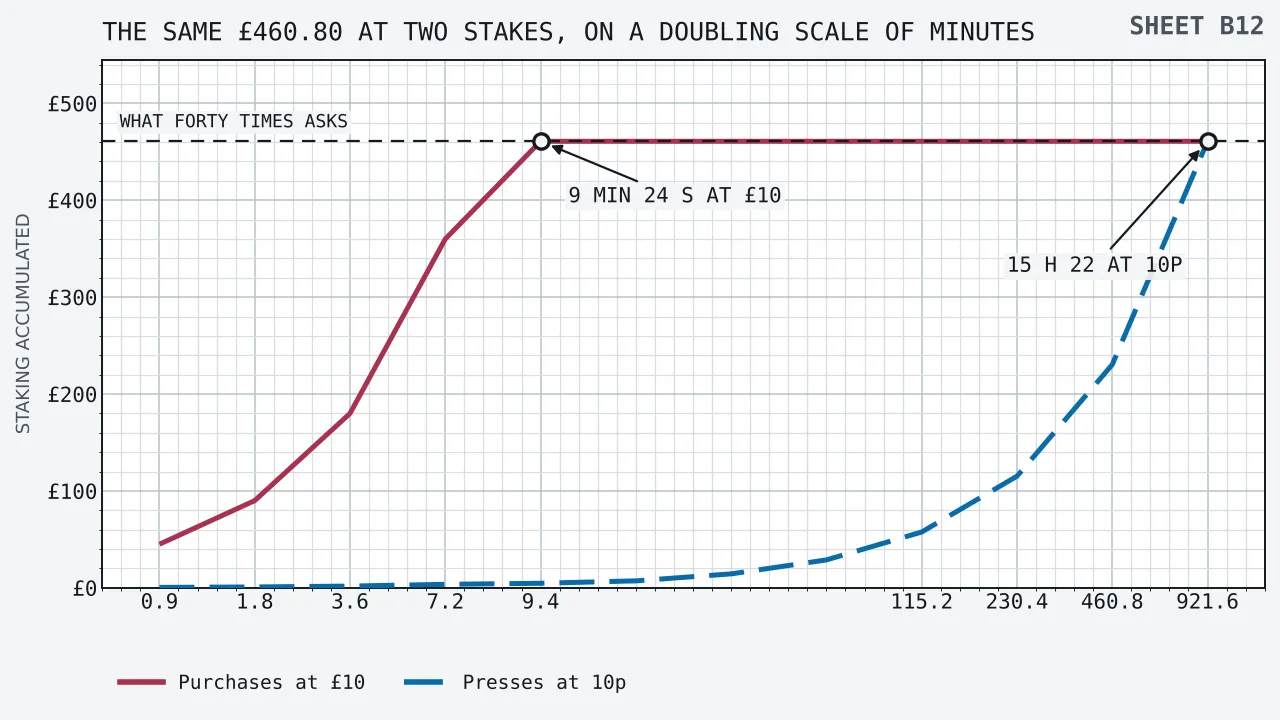
Nought point one two seconds a press is what the ordinary route would need to finish inside the same 9 min 24 s, and that figure disposes of speed as an answer. Two point five seconds is the interval a slot here owes the previous cycle before the next may begin, which leaves the ordinary route twenty times too slow to be squeezed by pressing harder. A purchase does not go faster. It carries more money per cycle, which is a different thing entirely and the only thing that actually shortens an obligation measured in pounds.
Fourteen hours and fifty-eight minutes would be saved on this one condition, which is forty fewer pick-ups of a handset, and a reader meeting the arithmetic for the first time will reasonably ask why anybody presses at ten pence at all. Section four answers that, and the answer lives in a document rather than on a reel.
Nine minutes twenty-four seconds is also under half of one sitting, which makes the comparison vivid in the unit this site uses everywhere. Forty-two pick-ups against 0.43 of one. The same £460.80 either way, the same expected position of minus £6.91 at the end of it either way, and the only quantity that moves is time.
4
Why the short route shuts the moment bonus funds are live
Two clauses close it, and they usually sit in the general bonus rules rather than beside the headline. The first disallows purchasing a feature at all while a play-through condition is running. The second caps what may be staked in one game cycle while bonus funds are in play, at a figure far under £10.00. Either on its own removes the nine minutes, and a sheet carrying both removes it twice.
Nothing in a lobby announces which of them applies, which is the practical difficulty. A purchase button sits on the reel whether or not the terms permit pressing it, because the button belongs to the game and the condition belongs to the account. A reader who presses it can find the condition voided rather than advanced, and a voided condition returns nought regardless of how many presses preceded it.
| The clause | Where it usually sits | What it costs in time | What pressing anyway can cost |
|---|---|---|---|
| No purchased features while a condition runs | General bonus rules | 15 h 13 min | The condition voided, the residue gone |
| A ceiling on the stake in one cycle | General bonus rules | 15 h 13 min | The press rejected, or the residue gone |
| Particular reels excluded from the condition | The offer’s own page | Turnover not counted | Staking that advances nothing |
| A reduced contribution on some reels | A weighting schedule | Doubles the run at 50 per cent | Hours added without notice |
Fifteen hours and thirteen minutes is what the first two rows cost, being the 15 h 22 min of the long route less the 9 min 24 s of the short one. That is the price of a clause nobody reads, expressed in the unit a reader actually spends. Set beside a residue of £11.52, it is also £1.31 of face per hour of extra thumb work demanded.
Five pounds is the most that may be staked in one game cycle on a licensed British slot by a player of twenty-five or over, and two pounds is the most for a player between eighteen and twenty-four. Those limits are slots-only and were made by statutory instrument on 25 February 2025, the instrument itself giving a formula of six weeks after making rather than a date; the calendar dates published by the regulator are 9 April 2025 for the five pounds and 21 May 2025 for the two.
Fifty pence is therefore the largest ordinary stake a hundred times purchase can be built on under the British ceiling for an adult of twenty-five or over, since a hundred times anything above 5p breaches the five pound limit in a single cycle. For a player between eighteen and twenty-four the corresponding base is 2p. A licensed build does not forbid the construction. It caps the price, and capping the price is the same as capping how much of an obligation one press can discharge.
Ninety-three purchases at five pounds each is what £460.80 needs under that ceiling, which is 18 min 36 s at the modelled interval. Four minutes forty-eight seconds is the equivalent figure where the condition is the ten times a British licence permits over bonus funds, being £115.20 and 24 purchases. Both are still far under fifteen hours, which is the point worth holding on to: the stake ceiling slows the short route and the bonus rules abolish it.
5
A wider spread, and the far end of a long condition
Nought is the amount by which variance moves expectation, and that is the first thing to settle. Expectation after a condition comes out of three quantities only, those being the residue, the multiple and the four-pence margin, and spread is not among them. Minus £6.91 is the answer on £11.52 at forty times whether the reel pays in dribbles or in thunderclaps.
Press 2,880 is where an average balance arrives at nothing, the residue shedding 0.4p on every cycle, and that arrival falls 9 h 36 min inside a condition wanting 15 h 22 min. Every reader who finishes a forty times condition has therefore run above the house rate for the whole distance. That is not a remark about luck. It is arithmetic, and it is the hinge of this section.
Four hundred and forty-nine pounds twenty-eight is what the reels must hand back across the run for a reader to reach press 4,608 with the residue intact, being £460.80 of staking less the £11.52 started with. Divide £449.28 by £460.80 and 97.5 per cent appears. A ninety-six per cent build must therefore deliver one and a half points above its own figure over 4,608 results before anybody sees the end of the condition.
97.5 per cent required of a build modelled at 96
Six pounds ninety-one is that same requirement stated as a deviation: the run has to finish £6.91 above where expectation puts it. Deviations are what spread supplies and nothing else supplies them. A build paying almost exactly its average on every press would run the residue down to nothing at press 2,880 with something close to certainty, and a reader on it would never reach the end of a forty times condition at all. Width is the only reason the far end is reachable.
One hundred and fifteen presses is the other edge of the same spread, being what £11.52 funds at ten pence where nothing comes back, and 23 minutes is what those 115 presses occupy. Two and a half per cent of the condition is as far as that run gets. So a wide build offers a short path to nothing and a narrow path to the end, and the ordinary outcome sits far nearer the first than the second.
| Where a run stops | Presses made | Thumb work at the modelled pace | Share of the condition done | What has to happen |
|---|---|---|---|---|
| Nothing returns at all | 115 | 23 min | 2.5% | The feature never arrives |
| The build pays its own average | 2,880 | 9 h 36 min | 62.5% | Returns land as the figure predicts |
| The condition is satisfied | 4,608 | 15 h 22 min | 100% | Returns run 1.5 points over the figure |
Sixty-two point five per cent is the row in the middle of that table and the one a reader should carry away, because it is the ordinary outcome rather than the unlucky one. A build behaving exactly as advertised leaves a reader five hours forty-six minutes short of the end, holding nothing, having pressed 2,880 times. Nothing has gone wrong at that point. The condition was simply set past the distance the residue could travel.
One press is the whole distribution on the purchased route, which is why section two put it in a table rather than a footnote. A residue of £11.52 funds a single £10.00 cycle, so the run is settled by one result instead of by thousands. Twenty-nine purchases, or 5 min 48 s, is where the average balance would reach nothing if the purchases could be funded, and they cannot be. The construction that would collapse the clock also collapses the number of chances to one.
6
The same ladder counted in purchases rather than presses
With ninety-six pence coming back per pound, four stay behind. Twenty-five rounds of that deduction consume a balance entirely, which sets the break-even play-through at twenty-five and turns every multiple beyond it into a cost rather than a condition.
Twenty-nine purchases is where that boundary sits on £11.52, being £288.00 of staking at £10.00 a cycle, and 5 min 48 s is what 29 cycles occupy on the modelled interval. The identical boundary is 2,880 ordinary presses and 9 h 36 min. Same money, same expectation, same point of exhaustion, and a difference in elapsed time of 9 h 30 min.
| The multiple applied | Staking it fixes | Purchases at £10.00 | Buying time | Ordinary presses | Pressing time | Standing afterwards |
|---|---|---|---|---|---|---|
| Ten times, all a British licence permits | £115.20 | 12 | 2 min 24 s | 1,152 | 3 h 50 min | £6.91 standing |
| Twenty times, well inside the balance point | £230.40 | 24 | 4 min 48 s | 2,304 | 7 h 41 min | £2.30 standing |
| Twenty-five times, where it balances | £288.00 | 29 | 5 min 48 s | 2,880 | 9 h 36 min | nothing standing |
| Thirty times, five past balance | £345.60 | 35 | 7 min | 3,456 | 11 h 31 min | minus £2.30 standing |
| Forty times, the figure costed here | £460.80 | 47 | 9 min 24 s | 4,608 | 15 h 22 min | minus £6.91 standing |
| Fifty times, at twice the balance point | £576.00 | 58 | 11 min 36 s | 5,760 | 19 h 12 min | minus £11.52 standing |
Nine minutes and twelve seconds separates the first buying row from the last, against 15 h 22 min separating the first pressing row from the last. Multiples that reshape an evening on one route are a coffee break on the other. The final column takes no notice of either, because the expected position depends on the money crossed and never on the minutes taken to cross it.
Two minutes twenty-four seconds is the top buying row, and the discomfort in this table concentrates there. A ten times condition, the most a British licence allows over bonus funds, would be discharged in twelve purchases and under two and a half minutes if purchases counted. They do not count, on either side of the register, because the bonus rules that bar them are written by the operator rather than by any regulator. That is the rare case on this site of a restriction nobody is obliged to impose being imposed everywhere.
Four hundred and sixty pounds eighty of staking is also, read from the other end, what a reader hands the reels in order to be allowed to ask for £11.52. Ratio aside, the elapsed time is what a reader actually feels, and the two routes differ in that dimension by two orders of magnitude while agreeing to the penny on everything else.
7
Six design rules that each cost a build some speed
Six requirements in the British technical standards act on elapsed time instead of on the sums involved, and reading them as clock rules is the useful way round here. Each one removes a mechanism that would otherwise let a lobby compress a long condition or disguise how slowly a residue is draining.
| What the rule removes | How it is written | What it would otherwise do to a run |
|---|---|---|
| Unattended repetition | Commitment to each game cycle falls on the customer separately, across gaming and bingo | Turns 4,608 decisions into one instruction |
| Speed controls | No facility for a customer to reduce the time before the result shows, which rules out slam stop, quick spin and turbo alike | Cuts the interval and the hours with it |
| Holding the control down | Releasing and depressing the start control is always necessary before a fresh cycle | Makes a long press into a long run |
| Several games at once | No functionality facilitating simultaneous play, in casino other than peer-to-peer poker | Multiplies turnover per minute without a bigger stake |
| Fanfare where nothing was actually won | Win effects are not permitted where what comes back fails to beat what went in | Hides a draining balance behind noise |
| Manufactured near misses | No design that misleads about the likelihood of results, and no losing outcome swapped for a different losing outcome | Makes a run feel closer to its end than it is |
Four thousand six hundred and eight separate decisions is what the first row of that table turns a forty times condition into, since commitment happens cycle by cycle and never in bulk. The only carve-out written into that requirement concerns posting blinds automatically in peer-to-peer poker, which has nothing to do with reels. A reader working through this obligation is pressing deliberately 4,608 times, and the 15 h 22 min is 4,608 acts rather than one long wait.
Two seconds of extra animation on a build would add 9,216 seconds to the same obligation, which is 2 h 34 min and seven further pick-ups of a handset, with the residue, the multiple and the expected position all untouched. That sensitivity is why the second and third rows matter. A build cannot be sped up by the player, so whatever the build does per cycle is what the condition costs in evenings.
One rule in that list carries a carve-out worth stating precisely, because it bears on purchased features. Lifting the bar on shortening a result is allowed for bonus and feature rounds that take no further stake. A purchase is the opposite case, being a stake in its own right, so nothing in that exemption reaches it.
Ninety-six per cent is a figure a licensed build may or may not print, and the point is often misstated. What has to be easily available before anybody commits is material letting a customer judge their prospects, and the standard puts four possibilities in the alternative: a description of the rules with how a winner comes to be one, or the margin the house holds, or the percentage given back, or the odds on the events that pay. A build satisfying it by one of the other three owes nobody a percentage.
8
A reel somebody recognises is not a licence
Twentieth of January 2025 carries a warning notice from the regulator here, and its subject is precisely the inference this page’s search phrase invites. Games supplied by licensed businesses have been found running on sites holding no licence at all. The notice records what such sites may be missing, naming inadequate controls over social responsibility and money laundering, and leaving customers exposed to fraud, to problems with the privacy of their data, and to unfair practices. It also records that such sites frequently go after vulnerable customers, people registered with the national self-exclusion scheme among them.
Four point seven five million pounds is the sum a supplier of casino games settled on 23 July 2026, once the regulator had traced its titles onto six websites holding no licence of their own and standing open to consumers here, with large volumes of visits recorded between December 2023 and November 2024. What was found against it was a failure to assess the risk of money laundering properly, a failure of the controls meant to keep its titles away from British players by way of businesses with no licence, and a failure over customer due diligence. One thing is all a reader needs from that case: the reel was genuine and the site was not licensed.
Holding no Great Britain licence is where offers of this kind stand, and on a note about a class of game the loss that bites is a loss of inference. Recognising the mechanic, the maths panel and the purchase button tells a reader nothing whatever about who is holding the account, what the terms will be construed to mean, or whether the figures the panel prints have been examined by anybody. Every other page on this site loses a duty. This one loses the ability to read a licence off a familiar screen.
Five pounds, two pounds, 2.5 seconds, no unattended repetition, no speed control, no fanfare where nothing was actually won: the Curaçao rulebook consulted for this site holds none of them. What it does hold runs from age checks and access to information through self-assessment tools, the tracking of behaviour, player-led cooling off and self-exclusion, limits on deposits, the training of staff and partners, and general principles about marketing. Not one line of it describes how a reel must behave. An absence of a whole category is what that is, rather than a difference of degree.
Ten times, and no further, is where a British licence stops a wagering condition over bonus funds. Four things are forbidden to a licensee offering an incentive by the social responsibility code, and that ceiling is the third of them; the provision is numbered 5.1.1 and has bound licensees from the nineteenth of January 2026. Curaçao’s rulebook sets no equivalent at any level. Its entire treatment of incentives runs to two obligations: communicate bonuses and promotions transparently with clear terms, and refrain from encouraging excessive gambling through aggressive promotion. Forty times is not forbidden there, and the 15 h 22 min it buys is not a number anybody is obliged to print.
One registration with Gamstop Online reaches the whole of the licensed online side here, the coverage following from the licence and not from any decision of the business. What the scheme says about its own limit is that services from organisations outside it are beyond its help. This note gives no assistance in locating such a business, and the same refusal applies to a gambling bar placed by a bank or a network.
9
Who this kind of reel suits once the hours are counted
Minus £6.91 is the expected position on £11.52 at forty times whichever reel a reader picks, and that invariance is the first conclusion. Volatility is not a strategy. A wide build and a narrow build at the same return percentage and the same multiple produce the same expectation to the penny, and anybody choosing between them is choosing a shape of experience rather than a size of outcome.
Two things the wide build does change are worth paying for or avoiding, depending on what a reader wants. It raises the chance of actually reaching the end of a condition set beyond the mean, because only a deviation gets anybody there. It also raises the chance of being finished inside 23 minutes with nothing. Those two are the same property seen from either end, and no build offers one without the other.
Nine minutes twenty-four seconds is the figure to remember and not to count on. It is what a condition would cost if the quickest mechanism in the lobby were allowed to discharge it, and the ordinary construction of a term sheet is to disallow exactly that. A reader should price the 15 h 22 min, treat the short route as unavailable, and be pleasantly surprised on the rare sheet that says otherwise in writing.
Three lines decide it before a single press, and all three are in documents rather than on reels. Whether purchased features count towards the condition. What ceiling applies to a stake in one cycle while the condition runs. Which reels are excluded or weighted, since a fifty per cent contribution turns 15 h 22 min into 30 h 44 min and 84 pick-ups of a handset without changing the residue by a penny.
Ninety-eight to one, finally, is the ratio between the two routes and it is fixed by the purchase multiple alone. A feature priced at fifty times the stake would run at 49 to 1, one at two hundred times at 196 to 1, and the elapsed time falls in exact proportion while the £460.80, the 97.5 per cent needed to finish and the minus £6.91 at the close all stand exactly where they were.
Questions
- What kind of game is a search for pragmatic slots usually after?
- A reel of wide outcomes whose return arrives mostly through a feature, with that feature available to buy outright for a multiple of the ordinary stake. This note treats the phrase as a description of that construction and names no maker, no cashier and no individual title, because the construction is what has consequences for a clock.
- How much turnover does a bought feature put over the reels?
- At a hundred times the stake on a ten pence base, £10.00 in one game cycle. That is a hundred ordinary presses of staking inside twelve seconds at the interval modelled here, so turnover runs at £50.00 a minute instead of 50p. Expected margin rises in exactly the same proportion, from £1.20 an hour to £120.00 an hour.
- How quickly would a forty times condition clear through purchases?
- Nine minutes and twenty-four seconds. A residue of £11.52 at forty times sets £460.80 of staking, which is 46.08 purchases at £10.00 and so 47 in practice, and 47 game cycles at twelve seconds apiece come to 564 seconds. The same £460.80 at ten pence a press is 4,608 presses and 15 h 22 min, which is 98 times longer.
- Can a condition be cleared that way in practice?
- Usually not. Two clauses stand in the way, and both sit in the general bonus rules rather than beside the headline: one disallowing purchased features while a condition runs, and one capping the stake in a single game cycle at a figure well under £10.00. Pressing the button anyway can void the condition, and a voided condition returns nothing however many presses came first.
- Does a higher-variance reel change the expected outcome?
- No. Expectation rests on the residue, the multiple and the four-pence margin and on nothing else, spread included, so minus £6.91 is the answer on £11.52 at forty times for any build returning ninety-six per cent. What a wide build alters is the distribution of durations around that figure.
- Why does variance decide whether a long condition is ever finished?
- Because the end sits beyond the mean. A residue of £11.52 runs out at press 2,880 on average, which is 9 h 36 min into a condition wanting 4,608 presses and 15 h 22 min. Reaching the end needs returns of 97.5 per cent across the run against a build modelled at 96, a deviation of £6.91, and spread is the only thing that supplies deviations.
- What would a British stake limit do to a purchased feature?
- It would cap the price rather than ban the mechanism. Five pounds is the most a player of twenty-five or over may stake in one game cycle on a licensed British slot and two pounds the most for a player of eighteen to twenty-four, so a purchase at a hundred times the stake implies a base of 5p or 2p. Those limits reach slots alone, and the dates the regulator publishes for them are 9 April 2025 and, for the lower figure, 21 May 2025.
- Does a familiar reel mean the site carrying it holds a licence?
- No, and the inference that fails is the one this page’s search phrase invites. Titles from licensed suppliers have been found operating where no licence is held, which a notice published by the regulator here on 20 January 2025 puts on record, along with thin controls over social responsibility and over the laundering of money, and customers left open to fraud, to trouble with the privacy of their data and to unfair practices. On 23 July 2026 a games supplier settled at £4.75m, six websites with no licence of their own having been found carrying its titles within reach of players here.
- How much does a reduced contribution add to the run?
- At fifty per cent it doubles everything measured in time. The condition still asks £460.80 of credited turnover, but £921.60 has to be staked to credit it, which is 9,216 presses, 30 h 44 min at the modelled interval and 84 pick-ups of a handset. The residue stays at £11.52 and the expected position stays at minus £6.91, so the hours are the only thing the schedule moves.