Note B16 Revision 1 Terms read 17 October 2026
Big bass slots, and the two clocks a feature round puts in one game
Thirty-one minutes of feature sit on top of 15 h 21 min 36 s of base game, where a trigger arrives about once in 150 presses and runs a modelled minute. Three point three per cent of the clock carries forty per cent of the money on the split assumed here, which puts a 16.2 per cent chance on the pile dying before the first feature ever lands.
What lands £11.52 The run 15 h 52 min 36 s The wait to be paid 48 h
What offers of this size ask in hours
Advertising has been bought for every destination below. A fee reaches this site when a reader goes on to register, and no figure on this page moves one way or the other because of it.
-
01Mobile Free Spins
Betportal
Ceiling as a multiple
What lands€15.00150 spins at 10c, which is this site's figure and not the operator'sThe run17 h 30 minTurning over 525.00 at 10p means 5,250 presses, or about 48 phone sittings of 22 minutes. Timed at 10p a press and 12 seconds between presses, both of which this site assumes rather than measures.The wait to be paidNOT PUBLISHEDThis operator puts no withdrawal band in its own terms, so there is nothing honest to print here.Spins valued at this site's own 10p a spin
What lands
Spins, at a price15.00150 of them at 10c apiece, a figure belonging to this site rather than to the operatorMatch, and other creditno figure300% of three deposits, to a ceiling of €1,000. Not a sum until money of yours makes it one, so this row totals nothing and carries nothing downwardsThe run
Handed back on the spins(0.60)Each press stakes its own value and returns 96 per cent, which leaves this much with the house from the opening pressPlay-through 35x on the bonus(20.16)Taking 14.40 round 35 times over means 504.00 through the machines, of which 20.16 is the expected cost, and 17 h 30 min of pressing at the pace aboveWhat counts towards it100%Slots only, with no percentage published anywhere, so the row above assumes the whole of each stake countsWhat never clears
Limit on the winningsstated5x the bonusDeducted on the way outno figureNothing is published as a figure here, so this row removes nothingLeast that can leaveno figureNo figure is published, so nothing on this timer is pinned down by oneLeast deposit, and the rung over ityour own€20 a stage. Published in euros, so no rung is named at all: this site's ladder is a sterling oneThe window on the creditstated14 daysBiggest stake while it runsstated€5Removed outright by rulestatedNot publishedVerified before a payoutstatedDocuments before the first withdrawalNever clears€15.00Not a penny of it gets out, so the whole of what landed stands on this rowNo Great Britain licence
Licence held in Anjouan, Comoros, the company named is BetPortal Gaming Ltd, with Excite Ultra Media Ltd, quoted under ALSI-202601040-FI2.
Terms read 17 October 2026
Open the offer at Betportal, opens in a new window -
02Mobile Free Spins
WinBeast
Ceiling as a sum
What lands€50.00500 spins at 10c, which is this site's figure and not the operator'sThe run2 d 18 hTurning over 2,000.00 at 10p means 20,000 presses, or about 182 phone sittings of 22 minutes. Timed at 10p a press and 12 seconds between presses, both of which this site assumes rather than measures.The wait to be paidNOT PUBLISHEDThis operator puts no withdrawal band in its own terms, so there is nothing honest to print here.Spins valued at this site's own 10p a spin
What lands
Spins, at a price50.00500 of them at 10c apiece, a figure belonging to this site rather than to the operatorMatch, and other creditno figure50% to 100% of five deposits, each to a ceiling of €1,000, and a €650 free bet. Not a sum until money of yours makes it one, so this row totals nothing and carries nothing downwardsThe run
Handed back on the spins(2.00)Each press stakes its own value and returns 96 per cent, which leaves this much with the house from the opening pressPlay-through 40x on the bonus and the winnings from the spins(76.80)Taking 48.00 round 40 times over means 1,920.00 through the machines, of which 76.80 is the expected cost, and 2 d 18 h of pressing at the pace aboveWhat counts towards it100%Slots, titles vary by country, with no percentage published anywhere, so the row above assumes the whole of each stake countsWhat never clears
Limit on the winningsstated€100 a batch of spinsDeducted on the way outno figureNothing is published as a figure here, so this row removes nothingLeast that can leaveno figureNo figure is published, so nothing on this timer is pinned down by oneLeast deposit, and the rung over ityour own€20 a stage. Published in euros, so no rung is named at all: this site's ladder is a sterling oneThe window on the creditstated7 days, spins 1 dayBiggest stake while it runsstatedNot publishedRemoved outright by rulestatedNot publishedVerified before a payoutstatedDocuments before the first withdrawalNever clears€50.00Not a penny of it gets out, so the whole of what landed stands on this rowNo Great Britain licence
Licence held in Curaçao, no company named anywhere on the site.
Terms read 17 October 2026
Open the offer at WinBeast, opens in a new window -
03Mobile Free Spins
EliteSpin
Longest spin window
What lands£50.00500 spins at 10p, which is this site's figure and not the operator'sThe run2 d 18 hTurning over 2,000.00 at 10p means 20,000 presses, or about 182 phone sittings of 22 minutes. Timed at 10p a press and 12 seconds between presses, both of which this site assumes rather than measures.The wait to be paidNOT PUBLISHEDThis operator puts no withdrawal band in its own terms, so there is nothing honest to print here.Spins valued at this site's own 10p a spin
What lands
Spins, at a price50.00500 of them at 10p apiece, a figure belonging to this site rather than to the operatorMatch, and other creditno figure50% to 100% of five deposits, each to a ceiling of £1,000. Not a sum until money of yours makes it one, so this row totals nothing and carries nothing downwardsThe run
Handed back on the spins(2.00)Each press stakes its own value and returns 96 per cent, which leaves this much with the house from the opening pressPlay-through 40x on the bonus and the winnings from the spins(76.80)Taking 48.00 round 40 times over means 1,920.00 through the machines, of which 76.80 is the expected cost, and 2 d 18 h of pressing at the pace aboveWhat counts towards it100%Slots, with no percentage published anywhere, so the row above assumes the whole of each stake countsWhat never clears
Limit on the winningsstated5x the bonusDeducted on the way outno figureNothing is published as a figure here, so this row removes nothingLeast that can leaveno figureNo figure is published, so nothing on this timer is pinned down by oneLeast deposit, and the rung over ityour own£20 a stage. It lands square on the £20.00 rung, so none of yours is left perched on topThe window on the creditstated7 days, spins 3 daysBiggest stake while it runsstatedNot publishedRemoved outright by rulestatedNot publishedVerified before a payoutstatedDocuments before the first withdrawalNever clears£50.00Not a penny of it gets out, so the whole of what landed stands on this rowNo Great Britain licence
Licence held in Costa Rica, the company named is PrimeTier Limited.
Terms read 17 October 2026
Open the offer at EliteSpin, opens in a new window -
04Mobile Free Spins
Crown Jewelz
Multiple unpublished
What lands£15.00150 spins at 10p, which is this site's figure and not the operator'sThe runNOT TIMEDThis operator does not publish the play-through multiple in its own terms. The multiple is the one figure the clock cannot work around, so the run is left untimed.The wait to be paidNOT PUBLISHEDThis operator puts no withdrawal band in its own terms, so there is nothing honest to print here.Nothing reckoned
What lands
Spins, at a price15.00150 of them at 10p apiece, a figure belonging to this site rather than to the operatorMatch, and other creditno figure200% of the first deposit, then 150% twice, each to a ceiling of £1,000. Not a sum until money of yours makes it one, so this row totals nothing and carries nothing downwardsThe run
Play-throughno figure40x the bonus, reported rather than published by the operatorWhat counts towards itno figureSlots, with no percentage published anywhere, so the row above assumes the whole of each stake countsWhat never clears
Limit on the winningsstatedNot publishedDeducted on the way outno figureNothing is published as a figure here, so this row removes nothingLeast that can leaveno figureNo figure is published, so nothing on this timer is pinned down by oneLeast deposit, and the rung over ityour own£20. It lands square on the £20.00 rung, so none of yours is left perched on topThe window on the creditstatedNot publishedBiggest stake while it runsstatedNot publishedRemoved outright by rulestatedNot publishedVerified before a payoutstatedDocuments before the first withdrawalNever clearsNOT RECKONEDThis operator leaves the play-through multiple out of its own terms, so nothing below the fourth step can be worked out.No Great Britain licence
Licence held in Curaçao, number not verified, no company named anywhere on the site.
Terms read 17 October 2026
Open the offer at Crown Jewelz, opens in a new window
Only the middle reading comes out of arithmetic belonging to this site. The multiple laid against what lands gives the turnover asked for; dividing that by 10p a spin gives the presses; dividing those by 300 an hour gives the hours, a press on a handset being taken here at 12 seconds from the one before. Both figures are assumptions rather than measurements of anybody: nothing was played and nothing was held a stopwatch to. Anybody quicker should divide the press count by a rate of their own, which is why the presses are printed alongside the hours instead of being summarised away.
The first reading is what arrives before any condition is laid against it. Spins carry no unit of their own so one gets supplied: where an operator values its own spin that figure is used and attributed, and where it does not, this site's 10p a spin stands in and everything below moves with it. The third reading belongs to the operator entirely. It is a withdrawal band quoted from published terms, and a blank there means none was published rather than that nobody looked.
The total along the foot answers what the hours leave open, which is whether any of the running ends anywhere. It is what arrived, less whatever is still standing once the play-through has been paid for at 96 per cent return to player and once a published limit, a published deduction and a published floor beneath the least that can leave have each had a turn. It appears again in pence in the pound, the only fair way of holding a small offer up against a large one. It describes an offer rather than an evening, and where the conditions price out what arrived, a timer prints nothing getting out instead of a negative sum.
Cashiers on a handset take deposits off a row of preset buttons, so a least deposit given in pounds is raised to the next rung of the ladder used here, £10, £20, £25, £50, £75 and £100, and the timer shows what is left perched on it. That money is the reader's own and enters no sum at all. Given in euros it prints untouched, the ladder being sterling. Three words may occupy the figure column where no figure belongs. Stated is a published term that costs something while leaving no number to subtract. No figure is a term nobody has quantified, or a credit that is not a sum until money of yours makes it one. Your own is money of yours, which belongs in none of this.
None of the operators above is licensed in Great Britain, so not one duty that licence carries reaches any of them. Membership of Gamstop Online is compulsory for every online gambling company licensed in Great Britain, which means that shutting yourself out through the scheme shuts you out of none of these. The limit of ten times the bonus funds on a wagering requirement, running since 19 January 2026 under Social Responsibility Code 5.1.1, is a condition of the same licence and binds only whoever holds one. Off that licence, the Gambling Commission writes of consumers meeting unfair gaming practices, financial loss and no recourse when matters go wrong, and lists blocked payouts and withdrawal limits pitched too high to reach among the things it has seen. No account at any of them may be held by anybody under 18.
Every term on a timer is its operator's own and every timer carries the day somebody read it. The oldest of those readings is 17 October 2026. What binds a reader is an operator's full terms and never a line printed here.
1
A mechanic rather than a name, and nothing named below
Four words in a search box are what bring most readers to a note of this sort, and big bass slots is a phrase reaching for a construction rather than for a company. Nothing gets named below: not a release, not a studio, not a cashier, not an individual game. What gets priced instead is the mechanic the phrase is pointing at, because the mechanic is what owns the clock and the clock is what nobody prints.
One construction covers the family: a long base game punctuated by a much longer feature round, with the feature collecting symbols and applying a multiplier to what it has collected. Base play is cheap in seconds and thin in return. A feature is expensive in seconds and fat in return. Both are true of the same build at the same moment, and the rest of this note comes out of that.
Three assumptions carry the arithmetic below and each is this note’s own, stated here so a reader can replace it and redo the sums. A feature arrives about once in 150 presses. A feature takes a modelled sixty seconds from trigger to credit. Forty per cent of a build’s total return comes back through the feature and the remaining sixty through base play.
None of those three is published by any source this site treats as authoritative. No regulator prints a trigger frequency, a feature duration or a split of return between modes, and nothing in the offer terms for a pile of spins prints them either. Choosing them openly and showing the working is the only honest way to price a construction of this shape, and every table below is linear in whichever figure it varies.
Eleven pounds fifty-two is the balance everything is worked against, that being the residue 120 presses of 10p expect to leave on a build handing back ninety-six pence per pound staked. Forty times that balance asks £460.80 across the reels, and a 10p stake divides that sum into 4,608 presses. Where both figures come from is set out in detail at slots free spins, and repeating it would crowd out the mechanic this page exists for.
| Quantity | Taken as | Whose figure it is |
|---|---|---|
| Stake on a press | 10p | The house assumption across this site |
| Return across both modes | 96p in the pound | The house assumption across this site |
| Seconds a base press occupies | 12 | This site’s modelled interval, not a measurement |
| One sitting | 22 min | This site’s assumed length for a phone sitting |
| Presses between features | 150 | This note’s own assumption, unpublished anywhere |
| Seconds a feature round occupies | 60 | This note’s own assumption, unpublished anywhere |
| Share of return inside the feature | 40% | This note’s own assumption, unpublished anywhere |
Nothing here was observed, and that sentence carries more weight in this note than in most of them. A duration attached to a feature sounds measured in a way a wagering multiple never does. Every second below is computed from the three figures in the table and from the two the site declares, and a reader who thinks a feature runs for ninety seconds rather than sixty should scale the feature column by half as much again.
2
Two clocks in one game, and an average that hides both
Twelve point four seconds is the average length of a press on the assumptions above, and no press on this build ever takes 12.4 seconds. Two durations occur. A base press takes the twelve seconds this site models, and a press that triggers takes those twelve plus a modelled sixty, which is seventy-two. The average is a figure describing neither event.
Two hundred and ninety presses an hour is that average restated, against the 300 an hour this site works from elsewhere. Ten presses an hour is the whole visible effect, which is why the average is such a poor instrument here. What it conceals is that 0.67 per cent of presses take six times as long as the rest and pay something like sixty times as much.
| What is counted | Base mode | Feature mode |
|---|---|---|
| Presses over the condition | 4,577 | 31 |
| Seconds one of them occupies | 12 | 72 |
| Time the mode takes up | 15 h 15 min 24 s | 37 min 12 s |
| Share of the clock | 96.1% | 3.9% |
| Expected return carried | £265.42 | £176.95 |
| Share of the return | 60% | 40% |
| Rate it comes back at | 57.6p in the pound | £5.76 a trigger |
Fifty-seven point six pence in the pound is the figure in the last row that deserves a reader’s attention, and it is the base game taken on its own. Sixty per cent of a ninety-six per cent return, spread across every press, leaves the long mode paying back a little over half of what crosses it. A build advertised at ninety-six per cent is a fifty-seven pence build for 96.1 per cent of the time somebody spends on it.
Five pounds seventy-six is the other half of the same statement, being the average payment a feature makes on these assumptions, which is 57.6 times a 10p stake. The symmetry of those two numbers is a coincidence of the forty per cent split and nothing deeper. What is not a coincidence is their relationship: the thinner the long mode, the fatter the rare one, and the two are tied by subtraction.
Nought point six seven per cent of presses are features, 31 out of 4,608, and that fraction is the whole reason an average misleads here. An average is a good summary of a quantity that clusters. Where a quantity has two modes and one of them is reached once in 150 attempts, the average describes the long run and says nothing about any evening inside it.
3
Thirty-one minutes of feature laid over fifteen hours of base
Fifteen hours twenty-one minutes thirty-six seconds is the base clock, being 4,608 presses at the twelve seconds this site models, which is 55,296 seconds. Thirty point seven two is 4,608 divided by 150, so about 31 features arrive across the condition. Thirty-one minutes is 31 features at the modelled sixty seconds apiece.
Fifteen hours fifty-two minutes thirty-six seconds is the two added together, which is 57,156 modelled seconds. Forty-four sittings of twenty-two minutes is that total converted into the unit this note counts in, with a part sitting rounded up. Forty-two sittings is what the base clock alone would have come to, so the feature costs two sittings and not one.
| Presses between features | Features over 4,608 | Feature time added | The condition then runs | What one feature pays |
|---|---|---|---|---|
| 100 | 47 | 47 min | 16 h 8 min 36 s | £3.84 |
| 125 | 37 | 37 min | 15 h 58 min 36 s | £4.80 |
| 150 | 31 | 31 min | 15 h 52 min 36 s | £5.76 |
| 200 | 24 | 24 min | 15 h 45 min 36 s | £7.68 |
| 250 | 19 | 19 min | 15 h 40 min 36 s | £9.60 |
| 300 | 16 | 16 min | 15 h 37 min 36 s | £11.52 |
Thirty-one minutes separates the top row of that table from the bottom, 16 h 8 min 36 s against 15 h 37 min 36 s, which is three per cent of the condition and nothing worth arguing about. Rarity barely touches the clock. What it does to the last column is a tripling, £3.84 against £11.52, and what it does in part five is larger still.
Three per cent is therefore the right answer to the question most readers would ask first, which is how much a feature round lengthens a clearing run. It lengthens it by about half an hour in sixteen. A reader who priced this condition from the base clock alone would be two sittings out across a fortnight of evenings, and no more than that.
31 minutes of feature inside 15 h 52 min 36 s of condition
Two sittings is nonetheless a real cost, and it arrives in an unusual shape. The feature does not spread itself evenly through the run. It lands 31 times, a minute at a go, and those minutes are the only ones in the whole condition during which a reader is not pressing anything at all. Part seven returns to what that does to the pace arithmetic.
4
Where forty per cent of the return actually sits
Eighteen pounds forty-three is what a condition of this length hands the house, being four pence off each pound of £460.80, while the balance standing behind it comes to £11.52. Level pegging between the two needs £288.00 of turnover, twenty-five fours making one hundred, and forty times stands 1.6 times past that meeting point.
Six pounds ninety-one is the distance, and it is the expected position when a condition of this shape closes. Nothing about a feature round alters it. A multiplier concentrates where the money comes back and changes nothing whatever about how much of it does.
Four hundred and forty-two pounds thirty-seven is the total expected to come back across £460.80 of staking at ninety-six pence in the pound. Two hundred and sixty-five pounds forty-two of that arrives through base play, spread over 4,577 presses in dribbles. One hundred and seventy-six pounds ninety-five arrives in 31 payments averaging £5.76, and arrives in 31 minutes.
Twelve to one is the concentration that describes, 40 per cent of the money inside 3.3 per cent of the clock, counting the feature rounds alone rather than the presses that start them. Nothing else on this site compresses value like that. A reader is paying for fifteen and a half hours of pressing in order to be present for half an hour of it.
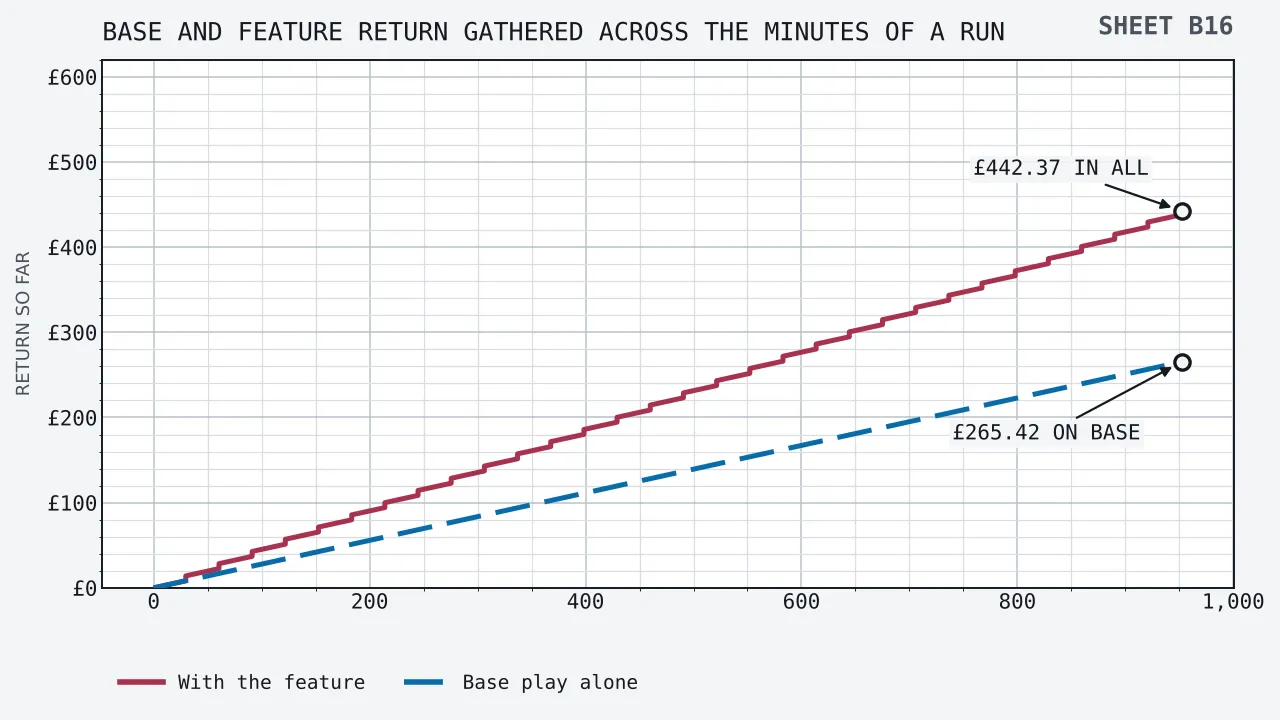
Thirty-one risers is what the picture shows, and their height is the argument. A reader on the shallow line alone recovers £265.42 of £460.80 staked, which is a loss of £195.38 before the risers are counted. Adding them brings the recovery to £442.37 and the loss to £18.43. Everything standing between those two outcomes happens 31 times in fifteen and a half hours.
Thirty minutes is the average gap between risers at the modelled interval, 150 presses at twelve seconds, and it is a figure worth holding beside this site’s sitting of twenty-two minutes. One expected feature per thirty minutes against a sitting of twenty-two means the modal sitting contains no feature at all, and part six puts a probability on that.
5
Two hundred and seventy-two presses, and a one in six
Two hundred and seventy-two is the number of presses a balance of £11.52 funds when the feature never arrives, and it is the figure this whole note turns on. Base play returning 57.6p in the pound takes 4.24p out of every 10p press. Dividing £11.52 by 4.24p gives 271.7, and a part press rounds upward as everything does here.
Fifty-four minutes twenty-four seconds is what 272 presses occupy at the modelled interval, which is three sittings. Three sittings is the whole life of the balance for a reader whose feature does not land, against the 44 sittings a condition of forty times asks for. Five point nine per cent of the distance is as far as that reader gets.
Sixteen point two per cent is the chance of exactly that, on a trigger rate of one in 150 and the split assumed here. The working is one line: the chance of missing on a single press is 149 over 150, and 272 presses of missing is that fraction raised to the 272nd power. About one reader in 6.2 therefore watches the balance go without ever seeing the thing the build is built around.
| Presses between features | What one feature pays | Presses the balance funds | Chance none arrives first | That is about |
|---|---|---|---|---|
| 100 | £3.84 | 272 | 6.5% | 1 in 15.4 |
| 125 | £4.80 | 272 | 11.3% | 1 in 8.9 |
| 150 | £5.76 | 272 | 16.2% | 1 in 6.2 |
| 200 | £7.68 | 272 | 25.6% | 1 in 3.9 |
| 250 | £9.60 | 272 | 33.6% | 1 in 3.0 |
| 300 | £11.52 | 272 | 40.3% | 1 in 2.5 |
Two hundred and seventy-two stands unchanged down the third column, and the reason is worth a sentence. Holding the feature’s share of the return at forty per cent fixes what base play gives back, so the balance travels the same distance whatever the trigger rate is. Rarity does not shorten the money. It only lengthens the wait, and the last two columns are what the lengthening costs.
Forty point three per cent is the bottom row, at one feature in 300 presses, and two readers in five never reach one. Six point five per cent is the top row at one in a hundred. Six times the risk of a blank run therefore sits between two trigger rates that no document anywhere publishes and that a reader cannot tell apart by looking.
| Share inside the feature | Base game gives back | Presses the balance funds | Time that buys | Chance none arrives first |
|---|---|---|---|---|
| 20% | 76.8p | 497 | 1 h 39 min 24 s | 3.6% |
| 30% | 67.2p | 352 | 1 h 10 min 24 s | 9.5% |
| 40% | 57.6p | 272 | 54 min 24 s | 16.2% |
| 50% | 48.0p | 222 | 44 min 24 s | 22.7% |
| 60% | 38.4p | 188 | 37 min 36 s | 28.4% |
| 70% | 28.8p | 162 | 32 min 24 s | 33.8% |
Twenty-eight point eight pence in the pound is the foot of the second column, where seven tenths of the return hides in the feature, and a base game at that rate takes 7.12p out of every press. One hundred and sixty-two presses is all a balance of £11.52 survives there, which is 32 min 24 s and two sittings. One reader in three finishes those two sittings having seen nothing.
Three point six per cent against 33.8 per cent is the span of the last column, a factor of nine between a mildly concentrated build and a heavily concentrated one. Both would be described in the same four words in a search box. Neither publishes the split anywhere a reader could find it, which makes the span a property of the market rather than a choice anybody gets to make.
6
What rarity does to an evening rather than to an average
One hundred and six presses is a sitting on this build, 1,320 seconds divided by the 12.4-second average, against 110 on a build with no feature at all. Four presses a sitting is what the feature costs in throughput, which over 44 sittings is 176 presses. That is the dullest consequence of the mechanic and the only one an average pace captures.
Forty-nine point two per cent is the interesting one, being the chance that a single sitting of 106 presses contains no feature at all. Roughly every other sitting on this build is a sitting in which nothing happens, in the sense that the mode carrying forty per cent of the money is never entered. The reader still stakes £10.60 in it.
| Sittings in a row | Presses | Chance none of them triggers |
|---|---|---|
| 1 | 106 | 49.2% |
| 2 | 212 | 24.2% |
| 3 | 318 | 11.9% |
| 4 | 424 | 5.9% |
| 5 | 530 | 2.9% |
Twenty-four point two per cent is the two-sitting row, and it is where the arithmetic of part five and the arithmetic of this part meet. Two dry sittings cost a reader £8.99 of a £11.52 balance, which is 78 per cent of it, in forty-four minutes. A quarter of all readers are in that position after two sittings, and nothing has gone wrong for any of them.
Two point nine per cent is the five-sitting row, which looks reassuringly small until it is read the right way round. Five sittings is 530 presses, and 530 presses is nearly twice what a balance of £11.52 funds without a feature. A reader cannot actually reach the five-sitting row on this balance, because the money runs out at 272 presses in the third.
Three sittings is therefore the real horizon, and 11.9 per cent is the chance of sitting through all three without a trigger. Part five sharpens that to 16.2 per cent by stopping at press 272, where the money ends, rather than at the close of a third sitting. Both say the same thing in different units: a blank run on a build of this construction is routine rather than freakish.
Nought is the amount by which any of this changes what is expected. Concentration moves outcomes around without moving their average, which is why part four found minus £6.91 whatever the feature does. What concentration changes is how many readers get nothing at all and how few get a great deal, and a long condition is settled by exactly that distinction.
7
Seventy-two seconds in a cycle, and no rule broken by it
Seventy-two seconds is what one triggering press occupies, twelve of base and a modelled sixty of feature, and that is 28.8 times the shortest gap a licensed slot is allowed to leave between one game cycle and the next. Nothing in that ratio is a breach. The rule sets a minimum and never a maximum, so a long cycle is as compliant as a short one.
Twelve seconds, the interval this site models for a base press, sits 4.8 times above the same floor, so an ordinary press on this build has four fifths of its length available to be shortened before any limit is reached. A feature press has 69.5 seconds of that slack. Neither mode is anywhere near the boundary, which is the point: the boundary binds machine speed rather than build design.
Three hours forty-three minutes is what the whole condition would run if every one of the 4,608 presses took the shortest permitted gap and the feature kept its modelled minute, being 11,520 seconds of pressing plus 1,860 of feature. Thirty-one minutes is unchanged in that total, because a floor on cycle starts says nothing about how long a cycle lasts.
Thirteen point nine per cent is what the feature’s share of the clock becomes in that compressed version, against 3.3 per cent at the interval modelled here. Speeding up the base game does not dilute the feature. It concentrates the clock into it, and a build where the long mode is cheap in seconds is a build where the rare mode owns proportionally more of the evening.
| Seconds a base press | Base clock | Feature time | Condition in total | Feature share of it |
|---|---|---|---|---|
| 2.5, the floor | 3 h 12 min | 31 min | 3 h 43 min | 13.9% |
| 6 | 7 h 40 min 48 s | 31 min | 8 h 11 min 48 s | 6.3% |
| 9 | 11 h 31 min 12 s | 31 min | 12 h 2 min 12 s | 4.3% |
| 12, modelled here | 15 h 21 min 36 s | 31 min | 15 h 52 min 36 s | 3.3% |
| 18 | 23 h 2 min 24 s | 31 min | 23 h 33 min 24 s | 2.2% |
Thirty-one minutes stands unmoved down the third column of that table, and that invariance is the most useful thing in this part. Feature time is a property of the build’s own animation and of how often the trigger lands, and it is untouched by how briskly a thumb works between triggers. Everything else in the table is at the mercy of an assumption.
Nineteen hours fifty minutes twenty-four seconds separates the first row from the last, 3 h 43 min against 23 h 33 min 24 s, on one balance and one multiple. Thirty-eight times the half hour that the whole trigger-rate table moved in part three is what that span amounts to. A reader cannot tell from a lobby tile which row they stand in: the feature plays out visibly in front of them, and the base interval, which decides thirty-eight times as much, is printed nowhere.
8
Three duties drafted with a feature round in mind
Three requirements in the British rulebook were drafted with a bonus round plainly in view, and none of the three travels. Where an arrangement of this construction is run, no Great Britain licence is behind it, which is an unusual shape of loss: on most notes here a general duty goes missing, and these three name the very mode carrying forty per cent of the money.
Potential prizes and payouts, or else the means by which they get calculated or determined, have to be easily available to a customer before anything is committed. Means of calculation is the operative phrase on a build like this, because the multiplier and the collecting rule are the calculation, and £176.95 of the £442.37 expected back comes through them. Absent that duty the schedule is published only if somebody feels like publishing it.
Freezing is the second of the three. Odds, rules and payouts hold still once play has begun, with the guidance treating as unacceptable any clause that lets an operator rewrite the rules at will. Its one named exception is a bonus round the customer has been properly told about. Licensed treatment of a feature is therefore permissive and conditional at once: it may move the state of play, provided the customer was told what it does.
Shortening the wait for a result is forbidden to a licensed build, with a turbo, a quick spin and a slam stop all named in the guidance, and the same guidance carves out bonus and feature games where no further stake is being wagered. One mode is therefore allowed to be hurried, and it is the mode holding most of the money. That carve-out exists because the regulator was looking at this construction when the rule was drafted.
| What a collect-and-multiply round raises | Required of a licensed build | Curaçao’s own rulebook, as opened for this sheet |
|---|---|---|
| How the round’s prizes get calculated | Easily available before anything is committed | No requirement of the kind appears |
| Rules moving part way through | Frozen, with a described bonus round the exception | Unaddressed throughout |
| Hurrying a result along | Barred, with feature play carved out of the bar | No limit on speed is set at all |
| A ceiling over the multiple | Ten times at the outside, a ceiling dated 19 January 2026 | No equivalent exists in the document |
| A return at or under the stake being celebrated | Not permitted, in sound or in animation | Absent from the policy |
Three hours fifty-eight minutes twenty-four seconds is what the fourth row of that table would buy, ten times £11.52 being £115.20, which is 1,152 presses and about eight features. Eleven sittings is that in this site’s unit, against 44 at forty times. Thirty-three sittings of somebody’s fortnight is the worth of one line in one code provision, and no line anywhere offshore does the same job.
Two obligations is the entirety of what the offshore rulebook opened for this network has to say about incentives: that the terms be clear and put plainly to the customer, and that promotion not be pitched so hard it drives excessive play. Neither touches a game’s own mechanics. A trigger rate, a multiplier schedule and a split of return between modes are all outside anything that document asks for.
Thirty-one events in forty-four sittings is what a dispute on this build would be about, and that rarity is what makes the complaint route matter more here than on a page about ordinary presses. A reader who believes a feature paid wrongly is disputing one occurrence out of thirty-one, with the record of it held entirely by the other party.
Three things a final decision must carry under a British licence are worth setting out for that reason. It has to explain the decision reached. It has to say in terms that the operator’s own process has now ended. And it has to set out the route onward to an adjudicating body independent of the operator. Away from the register a letter saying the feature behaved correctly is simply where the matter stops.
Eight bodies stand on the approved list the regulator here publishes, and a licensee may use only a body from it, which is the part that does the work. Coverage across sectors is not uniform on that list, so which body is reachable depends on what is being complained about. An unlicensed cashier picks its own adjudicator, writes the terms of the referral, or offers neither.
9
Four things to establish before the first press
Four questions come out of the parts above, and none of them is about luck or about picking well between arrangements. Each asks which of the two clocks in this construction is going to decide the evening, and the answer is nearly always the rare one.
First, the information panel. Whatever a build publishes about how its feature is triggered and how the collected symbols turn into a payment is the only document that addresses the mode holding most of the money. Reading it costs a few minutes against the 44 sittings a forty times condition asks for, which is the best exchange rate available anywhere on this page.
Second, the base rate. Fifty-seven point six pence in the pound is what base play gives back on the forty per cent split assumed here, and 28.8p is what it gives back at seventy per cent. A reader who can establish roughly how much of a build’s return lives in its feature has established how long their balance survives without one, which is the only number that decides whether they ever see it.
Third, the arithmetic of the dry run. Two hundred and seventy-two presses, 54 min 24 s and three sittings is the life of a £11.52 balance with no feature, and 16.2 per cent is the chance of exactly that. Those figures do not depend on luck improving or on anything being unfair. They fall straight out of the three assumptions set down in part one.
Fourth, the window. Seven days on a 4,608-press condition is 659 presses a day, which is 2 h 16 min 14 s and seven sittings daily at the pace modelled here. Fourteen days is 330 a day and four sittings. Thirty days is 154 a day and two sittings, and only that last row describes something a person with a job completes.
Fifteen hours fifty-two minutes thirty-six seconds, 44 sittings, 31 minutes of feature and a 16.2 per cent chance of never reaching one is this note in four figures. A reader who keeps only their order keeps most of the value: the condition is long, the feature barely lengthens it, the feature holds most of the money, and a sixth of readers never get to it at all.
Questions
- What does the search phrase actually describe?
- A construction rather than a product: a long base game punctuated by a much longer feature round, where symbols are collected and a multiplier is applied to what has been collected. No title, no maker of games and no cashier is named on this page, because the thing worth pricing is the mechanic. Base play is cheap in seconds and thin in return, and a feature is expensive in seconds and fat in return, and every figure here follows from both being true at once.
- How long does a feature round add to a clearing run?
- Thirty-one minutes on a 4,608-press condition, which is about three per cent of it. A trigger arriving once in 150 presses gives 30.72 features, rounded to 31, and a modelled sixty seconds each makes 1,860 seconds. At the twelve seconds this site models for a base press the base clock is 15 h 21 min 36 s, so the whole condition runs 15 h 52 min 36 s, which is 44 sittings against 42 for the base alone.
- Why does the average pace mislead on a build like this?
- Because no press takes the average. Twelve point four seconds is the mean on the assumptions used here, and the two durations that actually occur are twelve seconds for a base press and seventy-two for one that triggers. Nought point six seven per cent of presses take six times as long as the rest and pay something like sixty times as much, so the mean describes the long run and says nothing about any evening inside it.
- How much of the money sits in the feature?
- Forty per cent on the split this note assumes, which is £176.95 of the £442.37 expected back across £460.80 of staking. That money arrives in 31 payments averaging £5.76, which is 57.6 times a 10p stake, and it arrives inside 31 minutes of a fifteen and a half hour condition. Base play carries the other £265.42 and gives back 57.6p in the pound, so the long mode returns a little over half of what crosses it.
- How long does the balance last if no feature arrives?
- Two hundred and seventy-two presses. Base play at 57.6p in the pound takes 4.24p out of each 10p press, and £11.52 divided by 4.24p is 271.7, rounded up as everything here is. That is 54 min 24 s at the modelled interval and three sittings, against the 44 sittings a forty times condition asks for, so a reader in that position covers 5.9 per cent of the distance.
- What is the chance of never triggering one?
- Sixteen point two per cent at a trigger rate of one in 150, which is about one reader in 6.2. The working is the chance of missing on a single press, 149 over 150, raised to the power of the 272 presses a balance funds. At one in 300 the figure is 40.3 per cent and at one in a hundred it is 6.5 per cent, and no document anywhere publishes which of those rates a given build is running.
- Does a rarer feature shorten how far the balance goes?
- No, and that is worth being clear about. Holding the feature’s share of return at forty per cent fixes what base play gives back, so the balance funds 272 presses whatever the trigger rate is. Rarity lengthens the wait without shortening the money, which is why the chance of a blank run moves from 6.5 per cent to 40.3 per cent across the rates tabled while the press count stays put.
- How often is a whole sitting empty?
- About half the time. A sitting holds 106 presses on this build, being 1,320 seconds over the 12.4-second average, and the chance that none of them triggers is 49.2 per cent. Two sittings in a row untriggered is 24.2 per cent, and those two cost £8.99 of a £11.52 balance, which is 78 per cent of it, in forty-four minutes with nothing having gone wrong.
- Is a seventy-two second cycle against the rules?
- No. The limit on slot pace is a floor under how soon a cycle may restart and not a ceiling on how long one lasts, so seventy-two seconds, which is 28.8 times that floor, breaches nothing. Pressed at the shortest permitted gap throughout, the whole condition would run 3 h 43 min, of which the 31 minutes of feature is unchanged, and the feature’s share of the clock would rise from 3.3 per cent to 13.9.
- What is lost where no Great Britain licence applies?
- Three requirements written with a bonus round in view. How prizes are calculated must be easily available before anything is committed; rules, payouts and probabilities may not move during play, with a properly described bonus round as the stated exception; and hurrying a result is barred except in feature play where no further stake is wagered. The offshore rulebook opened for this network says two things about incentives and nothing about a game’s mechanics, and a final decision there carries none of the duties a licensed one does to explain itself, declare the process closed and name an approved adjudicating body.