Note U09 Revision 1 Terms read 17 October 2026
Crypto casino no deposit bonus terms, and a quantity of work that cannot be read off them
Agreeing to a multiple is agreeing to an amount of pressing, and the amount is only knowable if the thing the multiple is counted in holds still. Ten pounds at forty times is 4,000 presses, £400.00 of staking and 13 h 20 min at twelve assumed seconds apiece, ending at minus £6.00 in expectation. Move the unit a fifth and the same clause becomes 4,800 presses and 16 h 0 min, or 3,200 presses and 10 h 40 min, with the direction that reads as good news being the one that enlarges the shortfall.
What lands £10.00 The run as agreed 13 h 20 min After an assumed fifth 16 h 0 min
What offers of this size ask in hours
Advertising has been bought for every destination below. A fee reaches this site when a reader goes on to register, and no figure on this page moves one way or the other because of it.
-
01Mobile Free Spins
Betportal
Ceiling as a multiple
What lands€15.00150 spins at 10c, which is this site's figure and not the operator'sThe run17 h 30 minTurning over 525.00 at 10p means 5,250 presses, or about 48 phone sittings of 22 minutes. Timed at 10p a press and 12 seconds between presses, both of which this site assumes rather than measures.The wait to be paidNOT PUBLISHEDThis operator puts no withdrawal band in its own terms, so there is nothing honest to print here.Spins valued at this site's own 10p a spin
What lands
Spins, at a price15.00150 of them at 10c apiece, a figure belonging to this site rather than to the operatorMatch, and other creditno figure300% of three deposits, to a ceiling of €1,000. Not a sum until money of yours makes it one, so this row totals nothing and carries nothing downwardsThe run
Handed back on the spins(0.60)Each press stakes its own value and returns 96 per cent, which leaves this much with the house from the opening pressPlay-through 35x on the bonus(20.16)Taking 14.40 round 35 times over means 504.00 through the machines, of which 20.16 is the expected cost, and 17 h 30 min of pressing at the pace aboveWhat counts towards it100%Slots only, with no percentage published anywhere, so the row above assumes the whole of each stake countsWhat never clears
Limit on the winningsstated5x the bonusDeducted on the way outno figureNothing is published as a figure here, so this row removes nothingLeast that can leaveno figureNo figure is published, so nothing on this timer is pinned down by oneLeast deposit, and the rung over ityour own€20 a stage. Published in euros, so no rung is named at all: this site's ladder is a sterling oneThe window on the creditstated14 daysBiggest stake while it runsstated€5Removed outright by rulestatedNot publishedVerified before a payoutstatedDocuments before the first withdrawalNever clears€15.00Not a penny of it gets out, so the whole of what landed stands on this rowNo Great Britain licence
Licence held in Anjouan, Comoros, the company named is BetPortal Gaming Ltd, with Excite Ultra Media Ltd, quoted under ALSI-202601040-FI2.
Terms read 17 October 2026
Open the offer at Betportal, opens in a new window -
02Mobile Free Spins
WinBeast
Ceiling as a sum
What lands€50.00500 spins at 10c, which is this site's figure and not the operator'sThe run2 d 18 hTurning over 2,000.00 at 10p means 20,000 presses, or about 182 phone sittings of 22 minutes. Timed at 10p a press and 12 seconds between presses, both of which this site assumes rather than measures.The wait to be paidNOT PUBLISHEDThis operator puts no withdrawal band in its own terms, so there is nothing honest to print here.Spins valued at this site's own 10p a spin
What lands
Spins, at a price50.00500 of them at 10c apiece, a figure belonging to this site rather than to the operatorMatch, and other creditno figure50% to 100% of five deposits, each to a ceiling of €1,000, and a €650 free bet. Not a sum until money of yours makes it one, so this row totals nothing and carries nothing downwardsThe run
Handed back on the spins(2.00)Each press stakes its own value and returns 96 per cent, which leaves this much with the house from the opening pressPlay-through 40x on the bonus and the winnings from the spins(76.80)Taking 48.00 round 40 times over means 1,920.00 through the machines, of which 76.80 is the expected cost, and 2 d 18 h of pressing at the pace aboveWhat counts towards it100%Slots, titles vary by country, with no percentage published anywhere, so the row above assumes the whole of each stake countsWhat never clears
Limit on the winningsstated€100 a batch of spinsDeducted on the way outno figureNothing is published as a figure here, so this row removes nothingLeast that can leaveno figureNo figure is published, so nothing on this timer is pinned down by oneLeast deposit, and the rung over ityour own€20 a stage. Published in euros, so no rung is named at all: this site's ladder is a sterling oneThe window on the creditstated7 days, spins 1 dayBiggest stake while it runsstatedNot publishedRemoved outright by rulestatedNot publishedVerified before a payoutstatedDocuments before the first withdrawalNever clears€50.00Not a penny of it gets out, so the whole of what landed stands on this rowNo Great Britain licence
Licence held in Curaçao, no company named anywhere on the site.
Terms read 17 October 2026
Open the offer at WinBeast, opens in a new window -
03Mobile Free Spins
EliteSpin
Longest spin window
What lands£50.00500 spins at 10p, which is this site's figure and not the operator'sThe run2 d 18 hTurning over 2,000.00 at 10p means 20,000 presses, or about 182 phone sittings of 22 minutes. Timed at 10p a press and 12 seconds between presses, both of which this site assumes rather than measures.The wait to be paidNOT PUBLISHEDThis operator puts no withdrawal band in its own terms, so there is nothing honest to print here.Spins valued at this site's own 10p a spin
What lands
Spins, at a price50.00500 of them at 10p apiece, a figure belonging to this site rather than to the operatorMatch, and other creditno figure50% to 100% of five deposits, each to a ceiling of £1,000. Not a sum until money of yours makes it one, so this row totals nothing and carries nothing downwardsThe run
Handed back on the spins(2.00)Each press stakes its own value and returns 96 per cent, which leaves this much with the house from the opening pressPlay-through 40x on the bonus and the winnings from the spins(76.80)Taking 48.00 round 40 times over means 1,920.00 through the machines, of which 76.80 is the expected cost, and 2 d 18 h of pressing at the pace aboveWhat counts towards it100%Slots, with no percentage published anywhere, so the row above assumes the whole of each stake countsWhat never clears
Limit on the winningsstated5x the bonusDeducted on the way outno figureNothing is published as a figure here, so this row removes nothingLeast that can leaveno figureNo figure is published, so nothing on this timer is pinned down by oneLeast deposit, and the rung over ityour own£20 a stage. It lands square on the £20.00 rung, so none of yours is left perched on topThe window on the creditstated7 days, spins 3 daysBiggest stake while it runsstatedNot publishedRemoved outright by rulestatedNot publishedVerified before a payoutstatedDocuments before the first withdrawalNever clears£50.00Not a penny of it gets out, so the whole of what landed stands on this rowNo Great Britain licence
Licence held in Costa Rica, the company named is PrimeTier Limited.
Terms read 17 October 2026
Open the offer at EliteSpin, opens in a new window -
04Mobile Free Spins
Crown Jewelz
Multiple unpublished
What lands£15.00150 spins at 10p, which is this site's figure and not the operator'sThe runNOT TIMEDThis operator does not publish the play-through multiple in its own terms. The multiple is the one figure the clock cannot work around, so the run is left untimed.The wait to be paidNOT PUBLISHEDThis operator puts no withdrawal band in its own terms, so there is nothing honest to print here.Nothing reckoned
What lands
Spins, at a price15.00150 of them at 10p apiece, a figure belonging to this site rather than to the operatorMatch, and other creditno figure200% of the first deposit, then 150% twice, each to a ceiling of £1,000. Not a sum until money of yours makes it one, so this row totals nothing and carries nothing downwardsThe run
Play-throughno figure40x the bonus, reported rather than published by the operatorWhat counts towards itno figureSlots, with no percentage published anywhere, so the row above assumes the whole of each stake countsWhat never clears
Limit on the winningsstatedNot publishedDeducted on the way outno figureNothing is published as a figure here, so this row removes nothingLeast that can leaveno figureNo figure is published, so nothing on this timer is pinned down by oneLeast deposit, and the rung over ityour own£20. It lands square on the £20.00 rung, so none of yours is left perched on topThe window on the creditstatedNot publishedBiggest stake while it runsstatedNot publishedRemoved outright by rulestatedNot publishedVerified before a payoutstatedDocuments before the first withdrawalNever clearsNOT RECKONEDThis operator leaves the play-through multiple out of its own terms, so nothing below the fourth step can be worked out.No Great Britain licence
Licence held in Curaçao, number not verified, no company named anywhere on the site.
Terms read 17 October 2026
Open the offer at Crown Jewelz, opens in a new window
Only the middle reading comes out of arithmetic belonging to this site. The multiple laid against what lands gives the turnover asked for; dividing that by 10p a spin gives the presses; dividing those by 300 an hour gives the hours, a press on a handset being taken here at 12 seconds from the one before. Both figures are assumptions rather than measurements of anybody: nothing was played and nothing was held a stopwatch to. Anybody quicker should divide the press count by a rate of their own, which is why the presses are printed alongside the hours instead of being summarised away.
The first reading is what arrives before any condition is laid against it. Spins carry no unit of their own so one gets supplied: where an operator values its own spin that figure is used and attributed, and where it does not, this site's 10p a spin stands in and everything below moves with it. The third reading belongs to the operator entirely. It is a withdrawal band quoted from published terms, and a blank there means none was published rather than that nobody looked.
The total along the foot answers what the hours leave open, which is whether any of the running ends anywhere. It is what arrived, less whatever is still standing once the play-through has been paid for at 96 per cent return to player and once a published limit, a published deduction and a published floor beneath the least that can leave have each had a turn. It appears again in pence in the pound, the only fair way of holding a small offer up against a large one. It describes an offer rather than an evening, and where the conditions price out what arrived, a timer prints nothing getting out instead of a negative sum.
Cashiers on a handset take deposits off a row of preset buttons, so a least deposit given in pounds is raised to the next rung of the ladder used here, £10, £20, £25, £50, £75 and £100, and the timer shows what is left perched on it. That money is the reader's own and enters no sum at all. Given in euros it prints untouched, the ladder being sterling. Three words may occupy the figure column where no figure belongs. Stated is a published term that costs something while leaving no number to subtract. No figure is a term nobody has quantified, or a credit that is not a sum until money of yours makes it one. Your own is money of yours, which belongs in none of this.
None of the operators above is licensed in Great Britain, so not one duty that licence carries reaches any of them. Membership of Gamstop Online is compulsory for every online gambling company licensed in Great Britain, which means that shutting yourself out through the scheme shuts you out of none of these. The limit of ten times the bonus funds on a wagering requirement, running since 19 January 2026 under Social Responsibility Code 5.1.1, is a condition of the same licence and binds only whoever holds one. Off that licence, the Gambling Commission writes of consumers meeting unfair gaming practices, financial loss and no recourse when matters go wrong, and lists blocked payouts and withdrawal limits pitched too high to reach among the things it has seen. No account at any of them may be held by anybody under 18.
Every term on a timer is its operator's own and every timer carries the day somebody read it. The oldest of those readings is 17 October 2026. What binds a reader is an operator's full terms and never a line printed here.
1
Agreeing to a quantity nobody present can state
Accepting a play-through is accepting a volume of work, and that is true whatever the offer is called. The volume is fixed by two things only: the multiple written in the clause, and the size of the credit the multiple is applied to. Where the credit is counted in pounds, both are known at the moment of acceptance and the work can be converted into presses, hours and evenings before anybody taps anything.
Counting the credit in something that moves breaks that, and breaks it in a particular way worth stating precisely. The multiple stays put. The credit does not, so the pound value of the work does not, and the reader therefore agrees to a quantity that will be settled afterwards by something neither party to the agreement controls. Nobody is hiding the figure. The figure does not exist yet.
Reaching a business of that description is not something these ten parts assist with, and more is being withheld than may be obvious. Neither a name nor a web address appears. Sign-up paperwork, handsets, household connections, and the whole business of getting hold of a unit, keeping one, sending one or turning one into money, were struck off before a figure was worked. A bank halting gambling payments is protecting somebody, and so is whoever supplies a household’s connection doing the same, and neither is argued with in a line of this.
One recommendation gets made here and this is where it sits. A reader carrying a Gamstop Online registration who arrived through a search of roughly this shape has met the precise difficulty the registration was arranged to absorb, and the next step worth taking is a call, at no charge, to 0808 8020 133, where GamCare keeps the National Gambling Helpline staffed with no closing time on any date. The other nine parts are arithmetic, and arithmetic sizes a thing rather than deciding it.
Twenty per cent is the movement assumed wherever this page needs one, declared as an assumption in each sentence carrying a figure from it. Nothing was observed, nothing was modelled from a market and nothing was taken from a source, no claim about a unit, a network or a price appearing anywhere in the material this site may build on. The figure is round so that the sums stay legible. Preferring ten per cent means halving every movement below; preferring forty means doubling.
2
The clause as it reads on the evening it is taken
Ten pounds of credit at a multiple of forty is the worked example, and at the opening price its figures are all available. Four hundred pounds has to cross the reels. Ten pence a press turns that into 4,000 of them. An assumed interval of twelve seconds, never once put to a watch here, spreads 4,000 presses over 13 h 20 min. Each sitting is twenty-two assumed minutes carrying 110 presses, making the clause thirty-seven sittings long.
Minus six pounds is the credit’s worth in expectation once that clause is attached, and two steps get there. Fourpence in each staked pound is the share a return of 96 per cent leaves behind, which across the staking comes to an expected £16.00. Set the expected cost against £10.00 of credit and the holder ends £6.00 down.
Twenty-five is where that subtraction lands on nothing, one divided by four per cent, and the whole page swings around it. Underneath that multiple a credit is worth something in expectation. Landing exactly on it makes the credit worth nothing at all. Going over it turns the credit from an asset into a reason to stake, and forty times is a long way over.
| What the clause comes to | At the opening price |
|---|---|
| Credit, read in pounds on the night | £10.00 |
| Staking the multiple requires | £400.00 |
| Presses of ten pence that supplies | 4,000 |
| Pressing at twelve assumed seconds | 13 h 20 min |
| Nights at one assumed sitting of 22 minutes | 37 |
| Expected cost of the staking | £16.00 |
| What the credit is expected to leave | minus £6.00 |
Every row of that table is a conversion rather than a claim, which matters for what follows. Nothing in it depends on which business is offering anything, on what a cashier does, or on any term beyond the multiple and the stake. Give this note a multiple and a stake and it will give back the other five rows, and the only input capable of moving them afterwards is the one the next part introduces.
Four thousand is the figure to carry forward, a press count being the only quantity here that is not somebody’s opinion. Hours come out of it solely through a pace this site assumes and never measured, and evenings come out of the hours solely through an assumed rhythm. Readers with thumbs quicker than twelve seconds can shorten each duration below and leave the press counts untouched.
3
The same clause after an assumed move, in both directions
One clause and five prices is what the table below holds, with the credit counted in a unit rather than in pounds, so that a move in the unit carries the whole clause with it. Ten units of credit stay ten units throughout. What changes is what ten units fetches, and therefore what four hundred units of staking amounts to in a currency a reader buys bread in.
| Movement assumed while the clause is worked | Credit in pounds | Presses of ten pence | Staking asked | Pressing | Nights at one sitting | Expected to leave |
|---|---|---|---|---|---|---|
| Down two fifths | £6.00 | 2,400 | £240.00 | 8 h 0 min | 22 nights | minus £3.60 |
| Down one fifth | £8.00 | 3,200 | £320.00 | 10 h 40 min | 30 nights | minus £4.80 |
| None at all | £10.00 | 4,000 | £400.00 | 13 h 20 min | 37 nights | minus £6.00 |
| Up one fifth | £12.00 | 4,800 | £480.00 | 16 h 0 min | 44 nights | minus £7.20 |
| Up two fifths | £14.00 | 5,600 | £560.00 | 18 h 40 min | 51 nights | minus £8.40 |
Two thousand four hundred against 5,600 is the span across that table, and it is a factor of 2.33 between the lightest row and the heaviest. Eight hours against 18 h 40 min is the same span in pressing. Twenty-two evenings against fifty-one is the same span again in this site’s own rhythm, which is a difference of nearly a month of nights, attached to a clause whose wording never changed by one character.
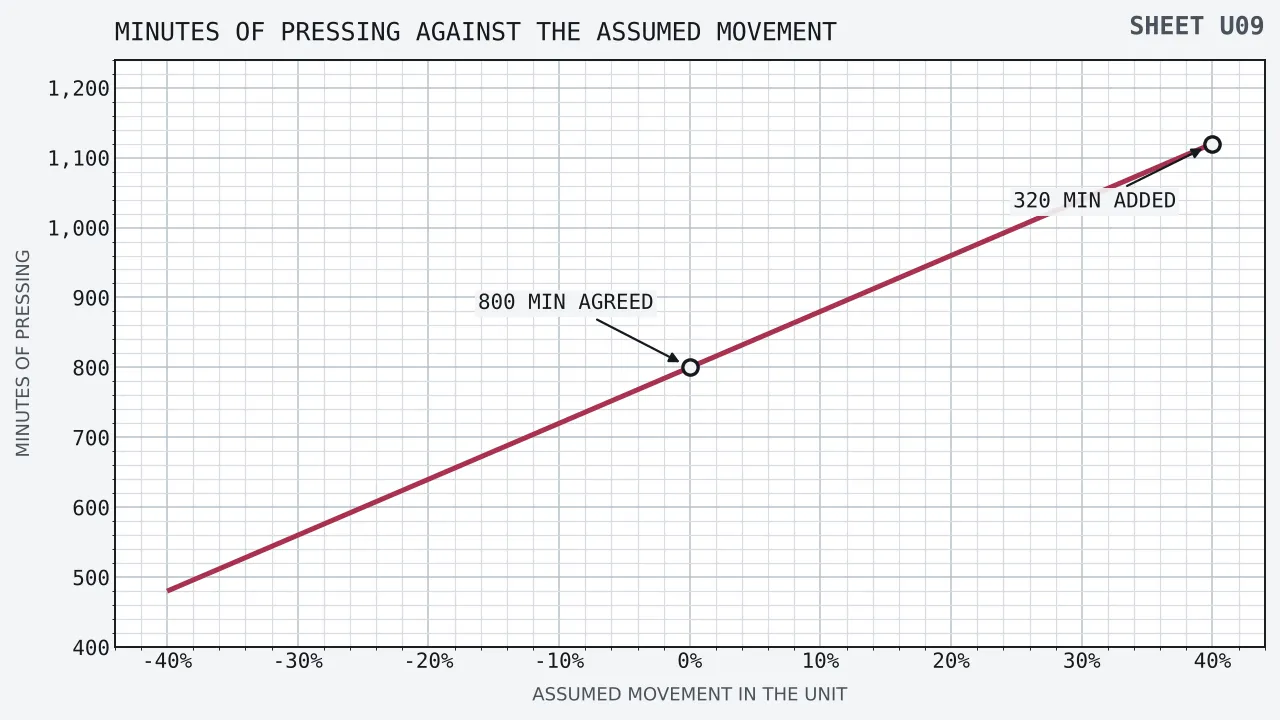
Straight is the shape of that line and the straightness is the whole of the mechanism. A multiple is a multiplication, so a credit worth a fifth more produces staking a fifth larger, presses a fifth more numerous and pressing a fifth longer. Eight hundred minutes is the agreed reading at the middle of the line. One hundred and sixty minutes is what each twenty per cent of movement adds or removes, and a reader can slide along it in either direction without any further arithmetic.
Nothing on that drawing says which way the line gets read on any particular evening, and the omission is deliberate rather than coy. A movement has a size and a direction, and this note assumes a size and declines to assume a direction, because assuming one would be a forecast and forecasting is not something an arithmetic page is entitled to do. What it can say is that both directions are drawn, and that part four shows they are not mirror images once the expectation is included.
800 minutes agreed against 1,120 minutes after an assumed two fifths
4
Why the direction that looks favourable costs more
Rising is the direction a holder would normally welcome, and on a clause of this shape it is the expensive one. Minus £7.20 sits in the row where the unit gains a fifth, against minus £4.80 where it loses a fifth, so the favourable-looking move enlarges the expected shortfall by half as much again as the unfavourable one reduces it. Two pounds forty separates each of those from the agreed reading of minus £6.00.
Multiplication is the reason and one line carries it. An expected outcome here is the credit multiplied by a factor the multiple and the return settle between them, and forty times against a 96 per cent return makes that factor minus 0.6. A bigger credit multiplied by a negative factor yields a bigger negative. Growth in the credit is therefore growth in the loss, in precisely the proportion by which it grew.
Twenty-five is where the sign of that factor turns over, and stating this plainly is the honest half of the finding. At ten times the factor is plus 0.6, so a credit worth a fifth more is worth £7.20 in expectation rather than £6.00, and there a rising unit is genuinely good news. The clause being priced here sits at forty, on the far side of twenty-five, which is the only reason the same movement arrives with the opposite sign.
Symmetry survives in the press counts and dies in the consequences, and that is the second half of the finding, the half nobody prints. Eight hundred presses are added by an assumed rise of a fifth and 800 are removed by an assumed fall, so the work moves by the same amount either way. What the extra work can do is push a clause past a period somebody else set. What the saved work can do is finish early, which banks nothing whatever, because a play-through pays no bonus for being quick.
Twenty-six minutes and forty seconds a night is what 4,000 presses asks of a reader given thirty evenings to finish in, that period being this page’s own assumption and declared as one. Thirty-two minutes a night is what the same thirty evenings ask after an assumed rise of a fifth, being 4,800 presses divided thirty ways and converted at the pace this site assumes. A fixed period does not stretch when an obligation does, so the whole of the movement lands on the nightly demand.
Five minutes and twenty seconds a night is the difference between those two, and it is the quietest figure on this page. Nobody experiences it as a term of a contract. It arrives as a sense that the thing is taking longer than it should, on evenings when the person has no way of checking what it was supposed to take, because the figure they would check against was never written down anywhere.
5
A finishing line that moves while somebody walks at it
Walking at a fixed rate toward a line that moves is the plainest picture of this clause, and the drawing below is that picture with numbers on it. One hundred and ten presses a night is the rate, being one sitting of twenty-two assumed minutes, and the line is wherever the obligation happens to sit on the evening the reader gets there.
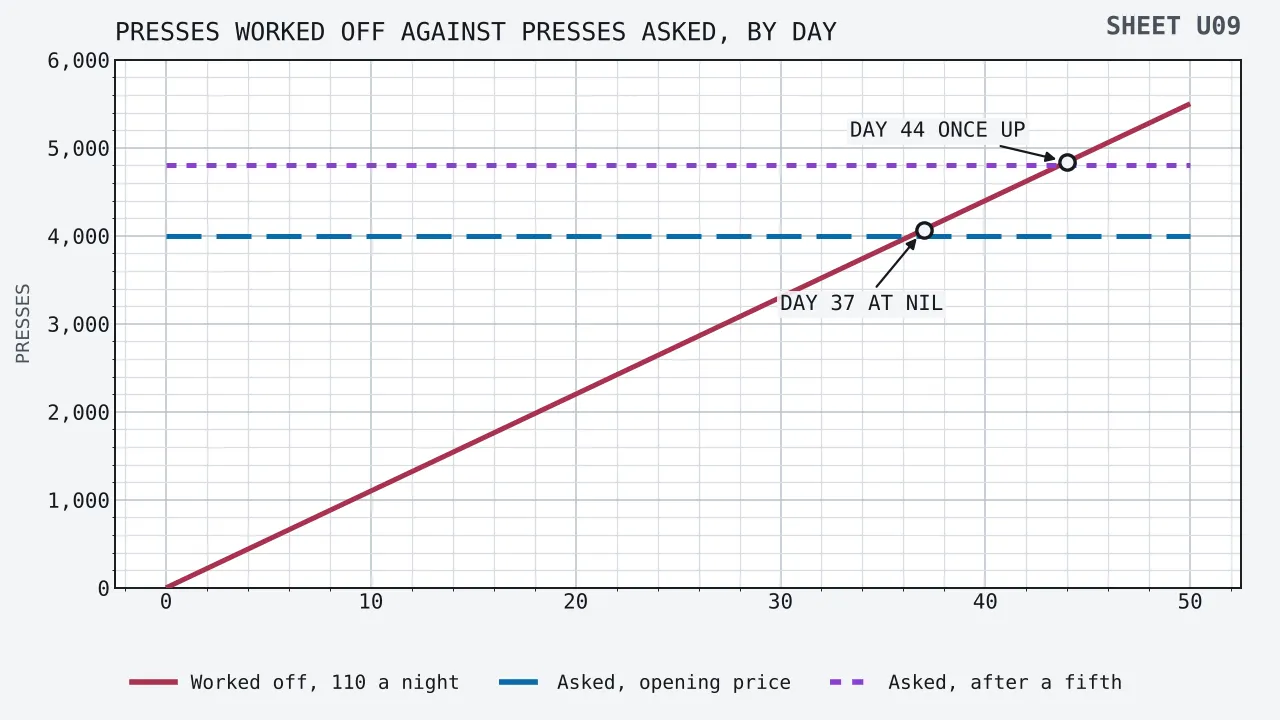
Day thirty-seven is where the climb reaches the lower of the two flat lines, and day forty-four is where it reaches the upper. Seven evenings is the gap, which is a week of a person’s nights added to a clause by a movement of a fifth in something the clause is counted in. Seven evenings is also 154 minutes of pressing and £77.00 of further staking, which the house expects to cost £3.08.
Flat is the right shape for both of those lines over the period drawn, and the simplification is declared here rather than smuggled. A price that moves does not jump once and then hold, so a truer drawing would have the upper line wandering across the fifty days. What the two flat lines show is the position as it stands at two prices, which is the comparison the reader actually faces, since they are working off whatever the obligation is on the night they press.
Nought is what the climbing line does differently in either case, and that is the point the drawing exists to make. The reader’s own effort is the one quantity in the picture that behaves exactly as agreed: 110 presses, every evening, at the assumed rhythm. All of the uncertainty sits in the horizontal lines, which is to say in the half of the arrangement the reader was never given a figure for.
Fifty-one evenings is where the heaviest row of part three would put the crossing, at an assumed rise of two fifths, and twenty-two evenings is where the lightest would. Those two sit twenty-nine evenings apart. Somebody beginning on the first of a month finishes either three weeks into it or most of the way through the next one, on identical wording, identical effort and an identical multiple.
6
The shortest the work can be, and what shifts that too
Ten thousand seconds is the least 4,000 presses can occupy where a British licence governs the game, two and a half of them being the minimum a licence of that sort puts under one press. On a clock, 10,000 seconds reads 2 h 46 min 40 s. Twelve thousand seconds, which reads 3 h 20 min, is the equivalent for 4,800 presses after an assumed rise of a fifth, so even the hard minimum under the clause shifts when the unit shifts.
Four point eight times separates that minimum from the 13 h 20 min this site’s own assumed pace produces, and printing the pair keeps the page honest. An interval of twelve seconds is a convention standing in for how somebody really handles a phone, glances, pauses and small decisions included. The legal minimum describes nobody’s evening, and no page here has ever suggested that it does.
Nought is what that minimum does outside the licence, and the consequence runs opposite to what a reader might expect. With no such rule standing over the game, those 4,000 presses may arrive in whatever period the software permits, so the hours drop and the money does not. Staking of £400.00 stays £400.00 at any pace at all, and an expected cost of £16.00 reads the same whether the work takes thirteen hours or three.
Speed therefore reduces the only cost a reader can feel while leaving the cost that actually matters exactly where it was. That is worth stating as plainly as possible, because the opposite belief is the natural one: a clause that finishes quickly feels cheaper, and on these figures it is cheaper only in the currency of evenings. The pounds do not notice the clock.
Thirteen hours and twenty minutes against 2 h 46 min 40 s is the span inside which every duration on this page sits, and a reader can place themselves in it without any help from this note. Nothing here was timed, and the two ends of that span are a declared convention at one end and an arithmetic floor at the other. What does not move between them is 4,000, £400.00 and £16.00.
7
No sum in, no sum owed, and what is left to judge by
Two numbers are what a person ordinarily uses to size a commitment, and an offer of this shape supplies neither. The first is the sum handed over, which on an offer asking for no payment is nought by design. The second is the sum owed, which on a clause counted in a moving unit is unavailable, not because anybody withheld it but because, as part one set out, it is not yet a number.
Dangerous is the plain word for that combination and this note is not going to reach for a softer one. Every brake that normally slows an opening down is attached to a payment: the card, the balance, the moment of reaching for an instrument, the small internal argument about whether the amount is worth it. Remove the payment and all of those come off together, and what is left to judge by is a figure that does not exist.
Friction in the general case belongs to another note in this section, which prices the removal of a payment stage across offers of every description. What is argued here is narrower and sits wholly inside this page’s subject: an offer costing nothing to accept, whose obligation cannot be read at the moment of acceptance, carrying no Great Britain licence and with it none of the duties in part nine about what a person is told beforehand.
Four thousand presses is what gets agreed to in that state, or 4,800, or 2,400, and the reader has no means of knowing which until well into the work. Thirty-seven evenings is the agreed reading, or fifty-one, or twenty-two. Those spans are a month apart at the extremes, and the commitment to whichever of them turns up was made in the few seconds it takes to accept an offer that asked for nothing.
Nought pounds in and £16.00 of expected cost out is the shape of the exchange at the agreed reading, with the £16.00 arriving in instalments of 0.4 pence a press across thirty-seven nights. A reader who could see that pair of figures at the moment of acceptance would be making a decision. A reader who can see only the first half of it is doing something else, and the second half is the half that moves.
8
Thirty-seven comparisons that would have happened
Thirty-seven days is how long a clause of this size runs at one sitting a night. It is equally the number of occasions on which a British licensed cashier, over the same stretch, owes a check of its entire customer list against the national register, that check falling due daily at worst. Both thirty-sevens cover identical calendar days, and that is what makes them worth setting together.
Nought is the figure on the other side, and the reason is structural rather than a matter of anybody being careless. Belonging to the national scheme is tied to the Great Britain licence and to nothing else, so a firm without one keeps no copy of the register and owes no check of anything. A first check never occurs, and with no first there is no interval between checks for anybody to measure.
One hundred and eighty-two days of registration converts to 4,368 hours, and the clause priced here runs across 888 of them. A fifth of a registration, near enough, is therefore what a single clause of this size takes up, and the running count of checks across the whole six months stays at nought where a licensed firm would have reached 182.
A day is the longest a registration goes unchecked inside the licence, which is the reason the protection works on nights when the person is managing nothing at all. One evening’s decision gets enforced by other people on every evening after it. No offer, no unit and no payment arrangement can manufacture that, a duty on a company not being a property of a thing.
Nothing in this part is a reason to think an offer asking for no payment is harmless where a registration is not involved, and the limitation deserves its own sentence. The comparison measures one protection against one engagement. What it shows is that the single feature making this kind of offer easy to accept is the same feature that gets it past the only arrangement built to stop somebody who has already decided to stop.
9
What a player has to be told, and at which moment
Offers reached through a phrase of this kind sit outside the British licence, and on a note about an unmeasurable obligation the duties worth itemising are the ones about what a person is told and when. Four of them bear on the figures above. None of them appears in the offshore rulebook opened for this network, which carries genuine requirements elsewhere and none of these.
First comes a duty owed before anybody commits: material letting a person judge their chances sensibly must be easy to get at by then. The standard sets out alternatives rather than a bundle, separated throughout by the conjunction or. An account of the mechanism, taking in how winners get picked and prizes allotted, is one. The margin retained by the house is another. So is the percentage flowing back to players. So are the odds on winning events arising. One alone discharges the duty, which is why it overstates the rule to say a licensed game has to print a figure for the return.
Second come the rules. An explanation of whichever rules apply must be easy to get at beforehand, must be accurate, must stretch far enough to cover the lot, and must be made comprehensible so far as reasonable steps can manage. During play, whatever shows a customer where the game has got to belongs on the screen.
Third, and nearest to this page’s subject, two live figures belong in front of the customer and have to move as the position moves: the net amount gone, and the time spent getting there. That one arrived on 17 January 2025. Live is the operative word. A reader labouring at a clause whose size was never stated could at least watch two quantities nobody disputes.
Fourth, a product is barred from four kinds of push: at chasing a loss back, at a stake raised, at a ceiling the person had set for themselves, and at play continuing once a wish to finish has been signalled. Its guidance adds two particulars. Money going back into a product needs the customer’s choice on each occasion. And a departure, once chosen, is not to be reversed by enticement, with free play named as the sort of thing that would do the enticing.
Nought of those four duties reaches a firm holding no licence here, and the fourth is the one that stings on this page in particular. Free play aimed at a person who has stopped is identified within the licensed market as a thing not to do. Beyond it, that same offer is the product, and the obligation folded inside it is the quantity nine parts of this note have gone about measuring.
10
An amount of work nobody wrote down, priced in evenings
Four thousand presses is the figure a reader believes they are agreeing to, if they convert the clause at all, and 2,400 to 5,600 is the range this page’s assumed movements put around it. Eight hours to 18 h 40 min is the same range in pressing. Twenty-two evenings to fifty-one is the same range in nights, and the width of it is the finding: more than a month of a person’s evenings, with no term altered and no figure misstated by anybody.
Minus £3.60 to minus £8.40 is the matching range in expectation, and the direction of it is the part that surprises. A unit gaining ground enlarges the shortfall, because at forty times the credit is multiplied by a negative factor, and a bigger credit times a negative factor is a bigger loss. Below twenty-five the sign turns and the same movement helps. The clause decides which, and the clause was written by one side.
Thirty-seven against nought is where the second half of the note finishes. Across the thirty-seven evenings one clause of this size occupies, a licensed cashier would have compared its customer list against the national register thirty-seven times, and a business outside that licence compares it no times at all. An offer asking for no payment is the one that reaches a person fastest, and speed is precisely what that cycle exists to take out of the decision.
Nothing above instructs any particular reader about any particular offer, and the restraint is chosen rather than evasive. Clauses are what get priced here, never people. The sayable thing is narrow: an obligation whose size cannot be stated is no better a bargain than one whose size can, and describing it honestly means giving a range with the assumptions standing next to it.
Readers arriving here with an exclusion of their own at the back of the mind should spend the next few minutes on something other than arithmetic, and that something is 0808 8020 133. That is free, it is picked up by GamCare whatever the hour where the reader is sitting, and it works by telephone, in chat or in writing. Worry about another member of a household earns the same welcome there as worry about one’s own nights, and the call is the only thing recommended anywhere in these ten parts.
Questions
- What makes a crypto casino no deposit bonus different from any other credit?
- The play-through is counted in a unit that moves, so the pound value of the work changes while the work is being done. Ten units at forty times is four hundred units of staking whatever happens, but four hundred units is £320.00 on one reading and £480.00 on another, which is 3,200 presses against 4,800 and 10 h 40 min against 16 h 0 min at the twelve seconds a press assumed throughout. The quantity agreed to is therefore settled after the agreement rather than during it.
- How much work does the clause ask for at the opening price?
- Four hundred pounds across the reels against £10.00 of credit, which ten pence a press turns into 4,000 of them. Twelve assumed seconds apiece puts that at 13 h 20 min, and sittings of twenty-two assumed minutes holding 110 presses make it thirty-seven nights. Fourpence in each staked pound, the share a 96 per cent return leaves behind, gives an expected £16.00, so the credit ends £6.00 down. Pace and sitting alike are conventions this site declares, and neither was measured.
- Why does a rising unit make the position worse rather than better?
- Because at forty times a negative factor is doing the multiplying. One minus the multiple times four per cent gives minus 0.6 at that multiple, so a credit worth a fifth more produces a shortfall a fifth larger: minus £7.20 in place of minus £6.00, against minus £4.80 where the unit sheds a fifth. Under twenty-five times the factor turns positive and a rising unit genuinely helps, which is the honest other half of the point.
- Is the movement symmetrical in the amount of work?
- In the press counts it is. An assumed rise of a fifth adds 800 presses and an assumed fall of a fifth removes 800. In consequence it is not, because extra work can carry a clause past a period somebody else fixed while saved work only finishes sooner, and finishing sooner banks nothing, a play-through paying no premium for speed. Given thirty evenings, an assumption declared here, 4,000 presses needs 26 min 40 s a night and 4,800 needs 32 minutes.
- What movement does this page assume, and where does it come from?
- Twenty per cent, as a round figure settled on this page and taken from nowhere else, since no claim about any unit, any network or any price appears in the material this site is permitted to build on. It is declared as an assumption in every sentence carrying a figure from it. A reader who prefers ten per cent should halve every movement figure here, and a reader who prefers forty should double them, which the five rows of part three make straightforward.
- When is the clause finished at one sitting an evening?
- On day thirty-seven at the opening price and on day forty-four after an assumed rise of a fifth, working at 110 presses a night. Seven evenings separate those, which is 154 minutes of further pressing and £77.00 of further staking, expected to cost £3.08. At the extremes of part three the crossing falls on day twenty-two and on day fifty-one, twenty-nine evenings apart on identical wording and identical effort.
- How quickly could the work be done at the fastest permitted pace?
- Under a British licence the minimum beneath a single press is two and a half seconds, so 4,000 of them cannot be squeezed under 10,000 seconds, which on a clock reads 2 h 46 min 40 s, and 4,800 cannot go under 12,000 seconds, reading 3 h 20 min. Beyond that licence no such minimum stands, so identical presses may arrive in whatever period the software permits. Hours drop and nothing else does: staking of £400.00 and an expected cost of £16.00 read the same at any pace.
- Why is an offer that asks for no payment the dangerous shape outside the licence?
- Because every brake that normally slows an opening down is attached to a payment, and removing the payment removes all of them together. The version that matters on this page is narrower than the general case, which another note in this section prices: here the obligation created is counted in a moving unit, so neither of the two numbers a person sizes a commitment by is available. Nothing is handed over, and what is owed is not yet a figure.
- What would have happened in the same period inside the licensed market?
- Over the thirty-seven evenings a clause of this size runs, a British licensed firm owes at least thirty-seven checks of its entire customer list against the national register, one falling due daily at worst. Past the licence the figure is nought, membership of the scheme being tied to the licence alone, so no copy of the register is kept and no first check ever takes place. Over a full registration of 182 days, which is 4,368 hours, the two counts are 182 and nothing.
- What is a player told, inside the licence, before committing?
- Material letting a person judge their chances sensibly must be easy to get at beforehand, and the standard gives alternatives rather than a bundle, separated by the conjunction or: an account of the mechanism, taking in how winners get picked and prizes allotted; or the margin retained by the house; or the percentage flowing back; or the odds on winning events arising. Rules must be reachable, accurate and complete, with the state of a running game on the screen. Two live figures, the net amount gone and the time spent getting there, must move in front of the customer as the position moves, a requirement dating from 17 January 2025.
- Is there a rule about offering free play to somebody who has stopped?
- Inside the licence there is. Four kinds of push are barred: at chasing a loss back, at a stake raised, at a ceiling the person had set for themselves, and at play continuing once a wish to finish has been signalled. The guidance adds that a departure, once chosen, is not to be reversed by enticement, naming free play as the sort of thing that would do the enticing. Beyond that licence the free play is the product rather than the thing the rule warns against.
- Where can somebody get help with this tonight?
- On 0808 8020 133, at no charge, from GamCare, which keeps the National Gambling Helpline open on every hour of every date, by telephone, in chat or in writing. Worry about another member of a household earns the same welcome there as worry about one’s own nights. TalkBanStop is GamCare’s too, bringing three things together: that helpline, software for blocking, and the national scheme a person registers with.