Note B11 Revision 1 Terms read 17 October 2026
120 free spins for real money, and the two runs those words could be naming
Twelve pounds crosses the reels when 120 presses go at 10p, and £11.52 is the residue a ninety-six per cent return leaves behind them. Taken at face value the phrase says that residue is cash, which would end the matter at 24 min. Taken as bonus credit with forty times attached, the identical £11.52 becomes £460.80 of staking and 15 h 22 min of thumb work. This note measures the distance between the two readings and says which wording decides it.
What lands 24 min The run 15 h 22 min The wait to be paid After 4,608 presses
What offers of this size ask in hours
Advertising has been bought for every destination below. A fee reaches this site when a reader goes on to register, and no figure on this page moves one way or the other because of it.
-
01Mobile Free Spins
Betportal
Ceiling as a multiple
What lands€15.00150 spins at 10c, which is this site's figure and not the operator'sThe run17 h 30 minTurning over 525.00 at 10p means 5,250 presses, or about 48 phone sittings of 22 minutes. Timed at 10p a press and 12 seconds between presses, both of which this site assumes rather than measures.The wait to be paidNOT PUBLISHEDThis operator puts no withdrawal band in its own terms, so there is nothing honest to print here.Spins valued at this site's own 10p a spin
What lands
Spins, at a price15.00150 of them at 10c apiece, a figure belonging to this site rather than to the operatorMatch, and other creditno figure300% of three deposits, to a ceiling of €1,000. Not a sum until money of yours makes it one, so this row totals nothing and carries nothing downwardsThe run
Handed back on the spins(0.60)Each press stakes its own value and returns 96 per cent, which leaves this much with the house from the opening pressPlay-through 35x on the bonus(20.16)Taking 14.40 round 35 times over means 504.00 through the machines, of which 20.16 is the expected cost, and 17 h 30 min of pressing at the pace aboveWhat counts towards it100%Slots only, with no percentage published anywhere, so the row above assumes the whole of each stake countsWhat never clears
Limit on the winningsstated5x the bonusDeducted on the way outno figureNothing is published as a figure here, so this row removes nothingLeast that can leaveno figureNo figure is published, so nothing on this timer is pinned down by oneLeast deposit, and the rung over ityour own€20 a stage. Published in euros, so no rung is named at all: this site's ladder is a sterling oneThe window on the creditstated14 daysBiggest stake while it runsstated€5Removed outright by rulestatedNot publishedVerified before a payoutstatedDocuments before the first withdrawalNever clears€15.00Not a penny of it gets out, so the whole of what landed stands on this rowNo Great Britain licence
Licence held in Anjouan, Comoros, the company named is BetPortal Gaming Ltd, with Excite Ultra Media Ltd, quoted under ALSI-202601040-FI2.
Terms read 17 October 2026
Open the offer at Betportal, opens in a new window -
02Mobile Free Spins
WinBeast
Ceiling as a sum
What lands€50.00500 spins at 10c, which is this site's figure and not the operator'sThe run2 d 18 hTurning over 2,000.00 at 10p means 20,000 presses, or about 182 phone sittings of 22 minutes. Timed at 10p a press and 12 seconds between presses, both of which this site assumes rather than measures.The wait to be paidNOT PUBLISHEDThis operator puts no withdrawal band in its own terms, so there is nothing honest to print here.Spins valued at this site's own 10p a spin
What lands
Spins, at a price50.00500 of them at 10c apiece, a figure belonging to this site rather than to the operatorMatch, and other creditno figure50% to 100% of five deposits, each to a ceiling of €1,000, and a €650 free bet. Not a sum until money of yours makes it one, so this row totals nothing and carries nothing downwardsThe run
Handed back on the spins(2.00)Each press stakes its own value and returns 96 per cent, which leaves this much with the house from the opening pressPlay-through 40x on the bonus and the winnings from the spins(76.80)Taking 48.00 round 40 times over means 1,920.00 through the machines, of which 76.80 is the expected cost, and 2 d 18 h of pressing at the pace aboveWhat counts towards it100%Slots, titles vary by country, with no percentage published anywhere, so the row above assumes the whole of each stake countsWhat never clears
Limit on the winningsstated€100 a batch of spinsDeducted on the way outno figureNothing is published as a figure here, so this row removes nothingLeast that can leaveno figureNo figure is published, so nothing on this timer is pinned down by oneLeast deposit, and the rung over ityour own€20 a stage. Published in euros, so no rung is named at all: this site's ladder is a sterling oneThe window on the creditstated7 days, spins 1 dayBiggest stake while it runsstatedNot publishedRemoved outright by rulestatedNot publishedVerified before a payoutstatedDocuments before the first withdrawalNever clears€50.00Not a penny of it gets out, so the whole of what landed stands on this rowNo Great Britain licence
Licence held in Curaçao, no company named anywhere on the site.
Terms read 17 October 2026
Open the offer at WinBeast, opens in a new window -
03Mobile Free Spins
EliteSpin
Longest spin window
What lands£50.00500 spins at 10p, which is this site's figure and not the operator'sThe run2 d 18 hTurning over 2,000.00 at 10p means 20,000 presses, or about 182 phone sittings of 22 minutes. Timed at 10p a press and 12 seconds between presses, both of which this site assumes rather than measures.The wait to be paidNOT PUBLISHEDThis operator puts no withdrawal band in its own terms, so there is nothing honest to print here.Spins valued at this site's own 10p a spin
What lands
Spins, at a price50.00500 of them at 10p apiece, a figure belonging to this site rather than to the operatorMatch, and other creditno figure50% to 100% of five deposits, each to a ceiling of £1,000. Not a sum until money of yours makes it one, so this row totals nothing and carries nothing downwardsThe run
Handed back on the spins(2.00)Each press stakes its own value and returns 96 per cent, which leaves this much with the house from the opening pressPlay-through 40x on the bonus and the winnings from the spins(76.80)Taking 48.00 round 40 times over means 1,920.00 through the machines, of which 76.80 is the expected cost, and 2 d 18 h of pressing at the pace aboveWhat counts towards it100%Slots, with no percentage published anywhere, so the row above assumes the whole of each stake countsWhat never clears
Limit on the winningsstated5x the bonusDeducted on the way outno figureNothing is published as a figure here, so this row removes nothingLeast that can leaveno figureNo figure is published, so nothing on this timer is pinned down by oneLeast deposit, and the rung over ityour own£20 a stage. It lands square on the £20.00 rung, so none of yours is left perched on topThe window on the creditstated7 days, spins 3 daysBiggest stake while it runsstatedNot publishedRemoved outright by rulestatedNot publishedVerified before a payoutstatedDocuments before the first withdrawalNever clears£50.00Not a penny of it gets out, so the whole of what landed stands on this rowNo Great Britain licence
Licence held in Costa Rica, the company named is PrimeTier Limited.
Terms read 17 October 2026
Open the offer at EliteSpin, opens in a new window -
04Mobile Free Spins
Crown Jewelz
Multiple unpublished
What lands£15.00150 spins at 10p, which is this site's figure and not the operator'sThe runNOT TIMEDThis operator does not publish the play-through multiple in its own terms. The multiple is the one figure the clock cannot work around, so the run is left untimed.The wait to be paidNOT PUBLISHEDThis operator puts no withdrawal band in its own terms, so there is nothing honest to print here.Nothing reckoned
What lands
Spins, at a price15.00150 of them at 10p apiece, a figure belonging to this site rather than to the operatorMatch, and other creditno figure200% of the first deposit, then 150% twice, each to a ceiling of £1,000. Not a sum until money of yours makes it one, so this row totals nothing and carries nothing downwardsThe run
Play-throughno figure40x the bonus, reported rather than published by the operatorWhat counts towards itno figureSlots, with no percentage published anywhere, so the row above assumes the whole of each stake countsWhat never clears
Limit on the winningsstatedNot publishedDeducted on the way outno figureNothing is published as a figure here, so this row removes nothingLeast that can leaveno figureNo figure is published, so nothing on this timer is pinned down by oneLeast deposit, and the rung over ityour own£20. It lands square on the £20.00 rung, so none of yours is left perched on topThe window on the creditstatedNot publishedBiggest stake while it runsstatedNot publishedRemoved outright by rulestatedNot publishedVerified before a payoutstatedDocuments before the first withdrawalNever clearsNOT RECKONEDThis operator leaves the play-through multiple out of its own terms, so nothing below the fourth step can be worked out.No Great Britain licence
Licence held in Curaçao, number not verified, no company named anywhere on the site.
Terms read 17 October 2026
Open the offer at Crown Jewelz, opens in a new window
Only the middle reading comes out of arithmetic belonging to this site. The multiple laid against what lands gives the turnover asked for; dividing that by 10p a spin gives the presses; dividing those by 300 an hour gives the hours, a press on a handset being taken here at 12 seconds from the one before. Both figures are assumptions rather than measurements of anybody: nothing was played and nothing was held a stopwatch to. Anybody quicker should divide the press count by a rate of their own, which is why the presses are printed alongside the hours instead of being summarised away.
The first reading is what arrives before any condition is laid against it. Spins carry no unit of their own so one gets supplied: where an operator values its own spin that figure is used and attributed, and where it does not, this site's 10p a spin stands in and everything below moves with it. The third reading belongs to the operator entirely. It is a withdrawal band quoted from published terms, and a blank there means none was published rather than that nobody looked.
The total along the foot answers what the hours leave open, which is whether any of the running ends anywhere. It is what arrived, less whatever is still standing once the play-through has been paid for at 96 per cent return to player and once a published limit, a published deduction and a published floor beneath the least that can leave have each had a turn. It appears again in pence in the pound, the only fair way of holding a small offer up against a large one. It describes an offer rather than an evening, and where the conditions price out what arrived, a timer prints nothing getting out instead of a negative sum.
Cashiers on a handset take deposits off a row of preset buttons, so a least deposit given in pounds is raised to the next rung of the ladder used here, £10, £20, £25, £50, £75 and £100, and the timer shows what is left perched on it. That money is the reader's own and enters no sum at all. Given in euros it prints untouched, the ladder being sterling. Three words may occupy the figure column where no figure belongs. Stated is a published term that costs something while leaving no number to subtract. No figure is a term nobody has quantified, or a credit that is not a sum until money of yours makes it one. Your own is money of yours, which belongs in none of this.
None of the operators above is licensed in Great Britain, so not one duty that licence carries reaches any of them. Membership of Gamstop Online is compulsory for every online gambling company licensed in Great Britain, which means that shutting yourself out through the scheme shuts you out of none of these. The limit of ten times the bonus funds on a wagering requirement, running since 19 January 2026 under Social Responsibility Code 5.1.1, is a condition of the same licence and binds only whoever holds one. Off that licence, the Gambling Commission writes of consumers meeting unfair gaming practices, financial loss and no recourse when matters go wrong, and lists blocked payouts and withdrawal limits pitched too high to reach among the things it has seen. No account at any of them may be held by anybody under 18.
Every term on a timer is its operator's own and every timer carries the day somebody read it. The oldest of those readings is 17 October 2026. What binds a reader is an operator's full terms and never a line printed here.
1
Two quantities the same three words could be naming
Two readings of one banner stand 38.4 apart as a ratio, and producing that ratio is the whole business of this note. Twenty-four minutes of pressing is what the generous reading comes to. Fifteen hours and twenty-two minutes of pressing is what the ordinary reading comes to. Neither the count, nor the denomination, nor the return differs between them. Three words do all of the work.
Four hundred and sixty pounds eighty is the staking the longer reading demands, and the shorter reading demands none whatever. That is an unusually clean fork for a page of this site to be looking at. Most arrangements here are argued over by degrees, with a multiple here and a window there moving a figure by a third. A residue that either is cash or is not cash moves the figure by a factor of thirty-eight.
Three readings are available for the phrase rather than two, and the third is the one most often meant. First, that the pressing happens on a live build rather than a practice one, which is a statement about the game and not about the money. Second, that whatever the presses leave behind arrives in a cash balance with no condition fastened to it. Third, that the words are doing promotional work and settle nothing at all. Section six takes the first apart and section five takes the second.
Two declared assumptions carry every duration printed below: an interval of twelve seconds from press to press, and a handset sitting of twenty-two minutes. Both belong to this site rather than to anybody holding a watch over a thumb. Nothing here was timed. Substitute a different interval and every minute figure moves in proportion, which section seven shows in a single column.
Nought is the number of operators, makers of games and cashiers named anywhere on this note, and that is deliberate rather than coy. What a phrase means in a term sheet is settled by the sentence under it, which changes whenever somebody decides it should. The arithmetic of each reading does not change, so the arithmetic is what this page publishes.
2
Twenty-four minutes of pressing, and the £11.52 behind it
Twelve pounds exactly is what 120 presses stake at a denomination of ten pence, and ten pence is where a press issued at no charge is pegged across this bracket. Nothing in a lobby lifts or lowers that peg. A count on a banner multiplies a denomination somebody else has already chosen.
Forty-eight pence is the margin a ninety-six per cent return holds back from £12.00, which leaves £11.52 as the residue the 120 presses are expected to build. Expected is the operative word. Any single run of 120 results lands wide of that figure in either direction, and £11.52 is the mean over every run of 120 that could happen rather than a forecast of one of them.
One thousand four hundred and forty seconds is the span of 120 presses once twelve seconds goes against each of them, and 1,440 seconds reads as 24 min. Held up to a sitting of twenty-two minutes, the length adopted here for one handset pick-up, 24 minutes rounds upward into two of them, the second lasting two minutes. Interval and sitting alike are modelling choices declared on this site, not observations of anybody.
| The line | Figure |
|---|---|
| Presses credited | 120 |
| Staking at ten pence a press | £12.00 |
| Margin withheld at a 96 per cent return | £0.48 |
| Residue the 120 are expected to build | £11.52 |
| Seconds occupied, twelve to a press | 1,440 |
| Stated as minutes | 24 |
| Pick-ups of 22 minutes, rounded up | 2 |
Forty-eight pence is also the entire cost of the handout to whoever issued it, and naming that figure early keeps the rest of the note honest. Not £12.00, which is staking that returns to the house as fast as it leaves. Not £11.52, which is a number in a wallet somewhere. Forty-eight pence of margin, met by somebody other than the reader, buys 24 minutes of reels. Everything argued below concerns what is attached to the £11.52 afterwards.
Nine point six pence is what each of the 120 presses is worth in residue, being £11.52 divided by the count, and twelve seconds is what each costs in attention. Hold those two unit figures still. Section four multiplies them by the obligation that the longer reading bolts on, and the unit figures are what make the multiplication legible.
3
One residue costed under each reading in turn
Zero presses of further staking is what the cash reading asks for, and that is the whole of its description. A residue of £11.52 sitting in a withdrawable balance can be requested the moment the 120th press resolves. The only clocks left are the ones every payment carries: a document round where identity has not been settled, and whatever a payment route takes to move money. No multiple, no window on the wallet, no forfeiture for stopping.
Twenty-eight pounds eighty an hour is what the cash reading pays, which is £11.52 earned across 24 minutes of modelled pressing. That hourly figure is the most attractive number this site has ever had cause to print, and it is attractive precisely because the reading producing it is the one a term sheet rarely supports. Print it, and then read section five before believing it.
Four hundred and sixty pounds eighty is the staking the credit reading demands, forty being applied to the £11.52 rather than to the £12.00 underneath it. Cut £460.80 into ten-pence pieces and 4,608 of them appear. Charge twelve seconds to each and 55,296 seconds follow, which is 921.6 minutes, which is 15 h 22 min. Divide 921.6 by twenty-two and 41.9 appears, and a part sitting counts whole here, so the condition lands at 42 occasions with a handset.
4,608 presses owed against 120 credited
Six pounds ninety-one is where the credit reading is expected to finish, and the sign in front of it is negative. Forty multiples of a four-pence margin come to 160 per cent of the residue, so £11.52 is expected to shed £18.43 of margin across £460.80 of staking and end up £6.91 under water. A reader does not merely fail to keep the £11.52. They are expected to be pressing for several hours after it has gone.
Two thousand eight hundred and eighty presses is as far as £11.52 can itself pay, each press costing the residue 0.4p in expectation. Nine hours and thirty-six minutes is what those 2,880 presses occupy at the modelled interval. The condition wants 4,608. One thousand seven hundred and twenty-eight presses, or 5 h 46 min of thumb work, are owed on a wallet that the margin has, in expectation, already taken.
Forty-five pence an hour is the credit reading stated in the same unit as the cash reading, and the sign is the only interesting thing about it. Minus £6.91 spread over 15.36 hours of modelled pressing comes to minus 45p for every hour given to it. Set beside plus £28.80 an hour, the two readings of one banner are sixty-four times apart and on opposite sides of nothing.
4
Fourteen hours fifty-eight minutes of difference, and £18.43
Eight hundred and ninety-seven point six minutes is the arithmetic difference between the two runs, which is 14 h 58 min, which is forty more pick-ups of a phone. A reader choosing between those is not choosing between a good arrangement and a slightly worse one. They are choosing between an evening interrupted for twenty-four minutes and the better part of two working days.
| What is being counted | Winnings as cash | Winnings as credit at 40x |
|---|---|---|
| Presses credited | 120 | 120 |
| Residue they are expected to build | £11.52 | £11.52 |
| Staking demanded afterwards | nil | £460.80 |
| Further presses of 10p | nil | 4,608 |
| Pressing in all, pace as modelled | 24 min | 15 h 46 min |
| Pick-ups of 22 minutes | 2 | 44 |
| Expected when the pressing stops | £11.52 | minus £6.91 |
| Expected per hour of attention | £28.80 | minus £0.45 |
Eighteen pounds forty-three is the gap in expectation, being £11.52 kept against £6.91 lost, and it is worth stating as one number because a banner never states it at all. A count of 120 appears in large type. A multiple appears in small type if it appears. The difference the two of them make together is £18.43 and almost sixteen hours, and that composite figure has no home anywhere on a promotional page.
Thirty-eight point four presses of obligation ride on each credited press under the longer reading, which is 4,608 divided by 120. Stated in minutes, every credited press carries 7 min 41 s of future thumb work behind it at the modelled interval. A press worth 9.6p of residue therefore costs 7.68 minutes to release, and that per-unit statement is the honest form of the banner.
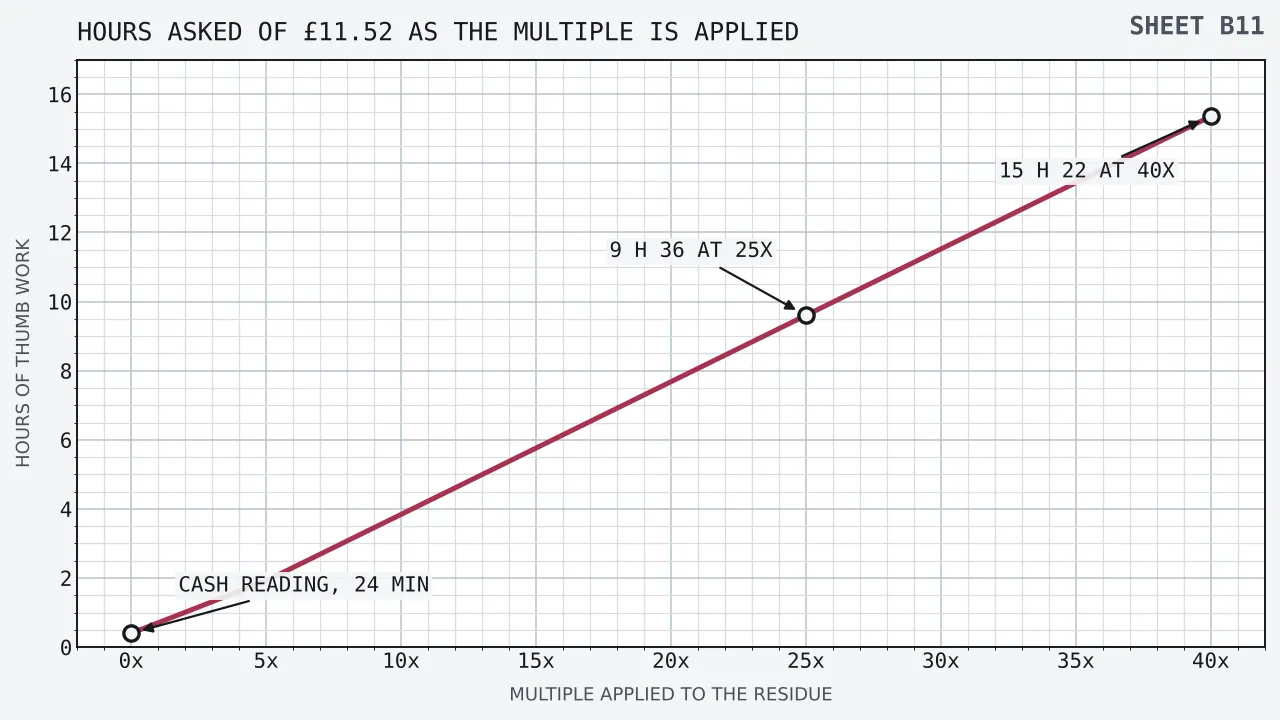
Nought on that horizontal scale is where the whole argument sits. Every other point on the line is a condition of some size, and the line is straight because presses owed rise in exact step with the multiple. Moving from nought to forty adds 14 h 58 min and subtracts £18.43 of expectation, and a reader cannot tell from a banner which end of the line they are standing at.
0.3125 seconds is the interval 4,608 presses would need to fit inside the 24 minutes of credited pressing, and the figure is worth producing because it closes a tempting line of thought. Speed cannot collapse the longer reading into the shorter one. A British build may not begin a fresh slot cycle under 2.5 seconds after the last, eight times over the interval that sum demands, so no permitted rate of play brings the two readings together.
5
Sentences a term sheet would carry if the short run were real
Four sentences would have to be present, and their absence is more informative than anything a banner prints. The first says where the residue lands, naming a cash or withdrawable balance rather than a bonus one. The second says the residue carries no wagering requirement, stated as a requirement of nought rather than left unmentioned. The third says no ceiling converts the residue to a smaller sum. The fourth says the residue has no expiry clock of its own.
Only the first is routinely printed, which is the pattern worth carrying away. A sheet will often say plainly where a credit lands, because that is a mechanical fact a cashier has to state anyway. Silence about the other three is no promise concerning them. A requirement nobody mentions is still whatever the general bonus rules say it is, and the general bonus rules are a separate document on a separate page.
| The line looked for | Reading it supports if present | Cost of its absence |
|---|---|---|
| Where the residue is credited | Cash, if a withdrawable balance is named | Decides everything |
| The multiple over that residue | Cash, only where nought is written out | 15 h 22 min |
| A ceiling on what converts | Cash, where none is stated | Caps the £11.52 |
| A clock on the residue itself | Cash, where the balance never lapses | Forfeits the lot |
Three days is a representative life for a residue of this shape, and a clock on the wallet interacts with the multiple in a way the two lines never state together. Fifteen hours twenty-two minutes spread across three days is 5 h 7 min of pressing daily, which is fourteen pick-ups of a phone every day for three days running. Spread across seven days it is 2 h 12 min daily. Across thirty days it is 31 minutes daily, which is the first setting a working reader could actually meet.
Nothing is what a part-finished condition returns, which is the ordinary construction and the reason the window and the multiple have to be read as one line rather than two. Stop at press 4,607 and the position matches stopping at press one. Fifteen hours of modelled thumb work is written off at the same instant, and the sheet that sets the window is the sheet that set the multiple.
Eligibility, the staking demanded, the time allowed for claiming or using the thing, and which bets or odds qualify: those are what the advertising regulator counts as significant conditions in a gambling promotion. Its rule is that omitting an applicable significant condition is not open to an advertiser where the omission would be apt to mislead, so each one has to be communicated with prominence and in plain terms. One click is roughly where the full terms behind an online advertisement are expected to sit, rather than down in small print or behind a buried link. Prominence carries a stated consequence on the regulator’s side here: a promotion whose significant conditions are not given enough of it will be read as misleading.
Free is itself a regulated word, and the rule behind it bears on any phrase promising real money. An offer is not to be labelled free where qualifying for it means the customer must put money of theirs at stake, and the familiar coupling of risk with its own negation belongs nowhere unless a player’s funds are truly safe from loss. A residue sitting behind £460.80 of staking is not a sum anybody has been handed.
6
Where the words only separate a live build from a practice one
Two builds of the same reel exist in most lobbies, and the commoner meaning of the phrase distinguishes one from the other rather than saying anything about a wallet. A practice build spins with counters that are not money and pays nothing whatever. A live build stakes real currency and can pay. Presses granted on the second are presses for real money in the plainest possible sense, and that sense sits perfectly happily beside a forty times condition over everything they build.
One hundred and twenty presses on a practice build are worth nothing at all, so the distinction is not empty. It is simply much smaller than a reader hoping for cash takes it to be. Confirming that presses run on a live build confirms that the £11.52 can exist. It says not one word about whether the £11.52 can be asked for.
Seventh of May 2019 is when the age and identity rules here began reaching practice builds alongside live ones. The announcement bears 7 February 2019 as its own date and prints only a day and a month for commencement, so the year is read off the announcement rather than stated in it. What the rules require is verification before gambling at all, bonus play and a free bet inside that, with the age check completed before anybody reaches the no-prize builds a licensee hosts. On the licensed side, then, the difference between the two builds decides nothing about who may open either one.
Three minutes with a game’s own information panel settles more than the phrase does, and a British licence puts something there to find. Easily available is where a game’s explanatory material belongs before a customer commits anything, and what counts as that material comes as a choice: an account of the game’s workings together with the way winners and prizes are settled, or else the house margin, or else the percentage returned to players, or else how probable the winning events are. Disjunction is what binds that list together, so a printed percentage is one route to compliance and never the compulsory one.
Ninety-six per cent is the figure this note computes from throughout, and naming the rule above makes clear what that figure is and is not. It is an assumption adopted across this site so that pages agree with one another, and it sits close to the average theoretical return the guidance describes. It is not a reading taken from any particular build, and a reader working with a build publishing a different percentage should rerun the margin line and leave every press count where it stands.
Four pence in the pound is all the return assumption does in the arithmetic here, and press counts take no notice of it whatever. Move the return to 94 per cent and the margin becomes six pence, the residue falls to £11.28 and the expected position at forty times worsens, while 4,608 presses holds at 4,608, the multiple and the ten-pence denomination between them having settled it.
7
The multiple at which £11.52 is spent exactly
At ninety-six pence back in the pound the house keeps four. Twenty-five fours make a pound, so a play-through of twenty-five is exactly the point at which the balance is consumed. Anything lower leaves a residue at the foot; anything higher finishes the balance before the condition.
Two hundred and eighty-eight pounds is where that boundary falls on £11.52. Count it out in ten-pence pieces and 2,880 appear, filling 9 h 36 min on the modelled interval, or 27 pick-ups once the fraction rounds up. Press 2,880 is also the press at which section three ran the wallet dry, both being one moment counted twice over. At forty times a reader travels 5 h 46 min beyond it, and those hours shift an expectation from nothing to minus £6.91.
| The multiple applied | Presses at ten pence | Turnover it fixes | Pick-ups of 22 minutes | Thumb work, pace as modelled | Expected when it ends |
|---|---|---|---|---|---|
| Nought, the cash reading | nil | nil | nil | nil | £11.52 |
| Ten times, the ceiling under a British licence | 1,152 | £115.20 | 11 | 3 h 50 min | £6.91 |
| Twenty times | 2,304 | £230.40 | 21 | 7 h 41 min | £2.30 |
| Twenty-five times, the boundary | 2,880 | £288.00 | 27 | 9 h 36 min | £0.00 |
| Thirty times | 3,456 | £345.60 | 32 | 11 h 31 min | minus £2.30 |
| Thirty-five times | 4,032 | £403.20 | 37 | 13 h 26 min | minus £4.61 |
| Forty times, costed throughout here | 4,608 | £460.80 | 42 | 15 h 22 min | minus £6.91 |
| Fifty times, twice the boundary | 5,760 | £576.00 | 53 | 19 h 12 min | minus £11.52 |
Nineteen hours and twelve minutes is the whole height of that ladder, first row to last, worked on one residue, one denomination and one return. No reel behaves differently between them. A line in a document does the lot, and the line sits further from a reader’s eye than the count it modifies.
Eleven pounds fifty-two appears twice in the ladder with its sign reversed, at the head as what the cash reading keeps and at the foot as what fifty times is expected to take. Fifty times is where the arithmetic runs out of things to describe, the residue being all there was to lose, and a reader reaching that row has pressed for 19 h 12 min to arrive at an expectation of nothing.
Six point nine one occurs twice as well, with a plus at ten times and a minus at forty. Ten times is as high as a play-through condition may be set over bonus funds on the licensed side here, a ceiling social responsibility code 5.1.1 imposes in the third of its four prohibitions and binding since 19 January 2026. The distance between those two rows is £13.82 of expectation and 11 h 32 min of pressing, and no part of that distance is a property of any game.
Seventy-two minutes is what the whole table does if the modelled interval is wrong by a tenth. Every duration in the thumb-work column scales straight with the seconds charged to a press, so a reader who believes six seconds describes them better should halve each figure, and one who dawdles at twenty should multiply by five thirds. Not a single press count and not a single expected position moves, because neither contains a term for time.
8
Who holds a printed sentence to the meaning it carries
One hundred and seventy thousand pounds was charged on 3 July 2025 against an operator over the drafting of a bonus rule, and the case belongs on this page more than on any other here, because the subject is what a printed phrase commits anybody to. The offending line kept back a discretion, exercisable by the operator, to shut an account or take winnings away. The finding went against the condition requiring business to be done fairly and openly, on the footing that drafting of that construction lacks transparency and can leave consumers unfairly treated. Alongside the money the operator was put under an obligation to buy in an outside audit covering the controls it keeps over money laundering and over safer gambling.
One thing that case does not establish is worth stating, since this page turns on wording. The published outcome is that an operator paid a penalty; it is not that the clause was struck out. A reader meeting a discretionary forfeiture line should understand that the regulator here has treated drafting of that shape as a breach, and should not conclude the words are void wherever they appear.
Four limbs of licence condition 7.1.1 stand behind that outcome, and they are the duties a page about phrasing ought to name. Unfairness in the consumer-rights sense is barred from the terms gambling is offered on and from the notices beside them, and a licensee is bound by whatever it has written. Transparency in that same sense is required, with the contract terms kept somewhere easily reachable. Alterations must clear both tests again, and a material one has to be notified before it bites. A fourth limb bars unfair commercial practices at any point in dealings with consumers.
Outside the British licensing regime is where offers of this kind sit, and the loss that bites on a page about wording is a particular one. The sentence dividing 24 minutes from 15 h 22 min is drafted by one party, read by that party and enforced by that party. No register entry carries the permitted activities and the domain names against which a publisher could be checked. The penalty described above reaches the licensed side and stops there, so a clause earning a fine here earns nothing at all off the register.
A customer of a licensed operator can still raise a problem six months after it happened, and once the operator’s own procedure is exhausted an approved adjudicator has to be available at no cost. Neither duty crosses to the offshore side.
Eleven pounds fifty-two is the size of the thing in dispute if the two readings are ever argued over, and the size is the difficulty. Anybody told that no grievance is answered offshore has been misinformed: the Curaçao framework allows half a year from the incident for lodging one, wants the answer out in four weeks, extendable just the once to eight where the player is told in writing, and puts the cost of the dispute route on the operator so that it reaches the player free. That same operator is left to fix the route’s parameters, a floor on claim value before anything may be escalated among the things it may set. So one hand writes the phrase, the condition and the threshold under which no argument about either will be heard.
Twenty-four hours is the longest a licensee here may leave its customer list unchecked against Gamstop Online, scheme membership having been attached to the licence from March 2020 onward. Where the scheme’s reach stops is stated by the scheme itself: a business taking no part in it is a business it has no power over. No help with finding one appears on this note, and the same refusal covers a gambling bar set by a bank or by a network.
9
Which of the two readings to price before pressing
Fifteen hours twenty-two minutes is the figure to assume, and the reason is not cynicism. It is that the cash reading requires four separate sentences to be present and the credit reading requires only silence. A reader who prices the longer run and then finds the shorter one has had a pleasant surprise worth £18.43. A reader who prices the shorter run and finds the longer one has committed forty pick-ups of a phone to an arrangement they thought was over.
Twenty-four minutes is still a real thing and nothing above says otherwise. The pressing costs nothing, it fits inside two sittings, and the residue it raises is real money right up to the moment a clause attaches. Somebody treating the 120 presses as twenty-four minutes of free entertainment, expecting to keep nothing and stopping when the count runs out, has taken the only version of this arrangement that reliably ends well.
Three questions settle it before a form is filled in, and all three are answerable in a document rather than by pressing anything. Where does the residue land, in a cash balance or a bonus one. What multiple attaches to it, stated as a figure rather than implied by silence. How long the residue lives, since 15 h 22 min inside a three-day window is 5 h 7 min a day and inside a thirty-day window is 31 minutes a day.
Nine point six pence of residue and 7 min 41 s of obligation is what each credited press carries under the longer reading, and that pairing is the sentence to take away. A banner printing 120 is printing the smaller half of a two-part quantity. The larger half is 4,608, it never appears anywhere, and the three words at the head of the banner are the only hint that anybody has considered which of the two a reader will assume.
Thirty-eight point four to one, finally, is a proportion fixed by two numbers and nothing else: a forty times multiple and a ninety-six per cent return. It holds at any count. Sixty spins would owe 2,304 presses, 240 would owe 9,216, and the hours track the count in exact proportion while the hourly expectation of minus 45p does not move at all. Counting presses is the only way to see that, which is why this note counts them.
Questions
- Before any condition, what does a pile of 120 free spins for real money raise?
- Twelve pounds of staking, being 120 presses at ten pence. A ninety-six per cent return holds back forty-eight pence of that, so £11.52 is the residue the presses are expected to build. The pressing itself occupies 1,440 seconds, which is 24 minutes at the twelve seconds a press modelled here, and that interval is a declared assumption rather than a measurement.
- Does the phrase mean the winnings are cash rather than bonus credit?
- Not on its own. Three readings are available: that the presses run on a live build rather than a practice one, that the residue lands in a withdrawable balance with nothing attached, or that the words are promotional and settle nothing. Only the second produces the 24-minute run, and it needs four sentences in the terms to support it rather than silence.
- How long does a forty times condition on £11.52 take?
- Fifteen hours and twenty-two minutes of pressing. Forty applied to £11.52 asks £460.80 over the reels, which is 4,608 presses of ten pence, which is 55,296 seconds at the twelve-second interval modelled here. Divided by a twenty-two minute sitting and rounded up, that is 42 occasions with a handset, and the sitting length is this site’s own assumption.
- How large is the difference between the two readings?
- Fourteen hours and fifty-eight minutes of pressing and £18.43 of expectation. The cash reading keeps £11.52 after 24 minutes, which works out at £28.80 an hour. The credit reading is expected to finish at minus £6.91 after 15 h 46 min of total pressing, which works out at minus 45p an hour. Both hourly figures rest on the assumed interval.
- Which lines in the terms decide which reading applies?
- Four of them. Where the residue is credited, whether a wagering multiple attaches and at what figure, whether a ceiling converts the residue to a smaller sum, and whether the residue carries a clock of its own. The first is usually printed because a cashier has to state it anyway. Silence about the other three is no promise concerning them, since the general bonus rules still apply.
- Can pressing faster close the gap between the two runs?
- No. Fitting 4,608 presses inside 24 minutes would need one press every 0.3125 seconds, and a British build may not begin a fresh slot cycle under 2.5 seconds after the last, eight times over that interval. Rate of play changes how many evenings a condition takes and changes neither the press count nor the expected position, because neither contains a term for time.
- What would a Great Britain licence do to this arithmetic?
- It would cap the multiple at ten over bonus funds, that ceiling being the third of the four things social responsibility code 5.1.1 forbids and binding since 19 January 2026. Ten applied to £11.52 asks £115.20 over the reels, which is 1,152 presses and 3 h 50 min at the modelled pace, with £6.91 expected to be standing at the end instead of £6.91 expected to have gone.
- Is there a Great Britain licence behind offers of this kind?
- There is not, and on a page about wording the loss that bites is that one party drafts the sentence, reads it and enforces it. No register entry carries the permitted activities and domain names to check a publisher against. On the licensed side a penalty of £170,000 was charged on 3 July 2025 against an operator whose bonus rules left it a free hand to shut an account down or hold back the winnings in it, and an outcome of that kind exists only where a licence does.