Note P07 Revision 1 Terms read 17 October 2026
The pause before anything is sent, which is the longest part of a payout and the one no rail can shorten
Before a payment reaches a card scheme at all, an operator looks at it, and that look is the part nobody documents. Against a rail and a calendar fixed at 14 h on the assumptions below, a 72-hour pause is 84 per cent of the entire wait, and the money inside it is money a cashier can still hand back to the balance it came from.
Rail and calendar 14 h A 72-hour pause, as a share 84% Ceiling on what it can cost £90 £56.21
What a cashier of this kind asks in hours
Advertising has been bought for every destination below. A fee reaches this site when a reader goes on to register, and no figure on this page moves one way or the other because of it.
-
01Mobile Free Spins
Betportal
Ceiling as a multiple
What lands€15.00150 spins at 10c, which is this site's figure and not the operator'sThe run17 h 30 minTurning over 525.00 at 10p means 5,250 presses, or about 48 phone sittings of 22 minutes. Timed at 10p a press and 12 seconds between presses, both of which this site assumes rather than measures.The wait to be paidNOT PUBLISHEDThis operator puts no withdrawal band in its own terms, so there is nothing honest to print here.Spins valued at this site's own 10p a spin
What lands
Spins, at a price15.00150 of them at 10c apiece, a figure belonging to this site rather than to the operatorMatch, and other creditno figure300% of three deposits, to a ceiling of €1,000. Not a sum until money of yours makes it one, so this row totals nothing and carries nothing downwardsThe run
Handed back on the spins(0.60)Each press stakes its own value and returns 96 per cent, which leaves this much with the house from the opening pressPlay-through 35x on the bonus(20.16)Taking 14.40 round 35 times over means 504.00 through the machines, of which 20.16 is the expected cost, and 17 h 30 min of pressing at the pace aboveWhat counts towards it100%Slots only, with no percentage published anywhere, so the row above assumes the whole of each stake countsWhat never clears
Limit on the winningsstated5x the bonusDeducted on the way outno figureNothing is published as a figure here, so this row removes nothingLeast that can leaveno figureNo figure is published, so nothing on this timer is pinned down by oneLeast deposit, and the rung over ityour own€20 a stage. Published in euros, so no rung is named at all: this site's ladder is a sterling oneThe window on the creditstated14 daysBiggest stake while it runsstated€5Removed outright by rulestatedNot publishedVerified before a payoutstatedDocuments before the first withdrawalNever clears€15.00Not a penny of it gets out, so the whole of what landed stands on this rowNo Great Britain licence
Licence held in Anjouan, Comoros, the company named is BetPortal Gaming Ltd, with Excite Ultra Media Ltd, quoted under ALSI-202601040-FI2.
Terms read 17 October 2026
Open the offer at Betportal, opens in a new window -
02Mobile Free Spins
WinBeast
Ceiling as a sum
What lands€50.00500 spins at 10c, which is this site's figure and not the operator'sThe run2 d 18 hTurning over 2,000.00 at 10p means 20,000 presses, or about 182 phone sittings of 22 minutes. Timed at 10p a press and 12 seconds between presses, both of which this site assumes rather than measures.The wait to be paidNOT PUBLISHEDThis operator puts no withdrawal band in its own terms, so there is nothing honest to print here.Spins valued at this site's own 10p a spin
What lands
Spins, at a price50.00500 of them at 10c apiece, a figure belonging to this site rather than to the operatorMatch, and other creditno figure50% to 100% of five deposits, each to a ceiling of €1,000, and a €650 free bet. Not a sum until money of yours makes it one, so this row totals nothing and carries nothing downwardsThe run
Handed back on the spins(2.00)Each press stakes its own value and returns 96 per cent, which leaves this much with the house from the opening pressPlay-through 40x on the bonus and the winnings from the spins(76.80)Taking 48.00 round 40 times over means 1,920.00 through the machines, of which 76.80 is the expected cost, and 2 d 18 h of pressing at the pace aboveWhat counts towards it100%Slots, titles vary by country, with no percentage published anywhere, so the row above assumes the whole of each stake countsWhat never clears
Limit on the winningsstated€100 a batch of spinsDeducted on the way outno figureNothing is published as a figure here, so this row removes nothingLeast that can leaveno figureNo figure is published, so nothing on this timer is pinned down by oneLeast deposit, and the rung over ityour own€20 a stage. Published in euros, so no rung is named at all: this site's ladder is a sterling oneThe window on the creditstated7 days, spins 1 dayBiggest stake while it runsstatedNot publishedRemoved outright by rulestatedNot publishedVerified before a payoutstatedDocuments before the first withdrawalNever clears€50.00Not a penny of it gets out, so the whole of what landed stands on this rowNo Great Britain licence
Licence held in Curaçao, no company named anywhere on the site.
Terms read 17 October 2026
Open the offer at WinBeast, opens in a new window -
03Mobile Free Spins
EliteSpin
Longest spin window
What lands£50.00500 spins at 10p, which is this site's figure and not the operator'sThe run2 d 18 hTurning over 2,000.00 at 10p means 20,000 presses, or about 182 phone sittings of 22 minutes. Timed at 10p a press and 12 seconds between presses, both of which this site assumes rather than measures.The wait to be paidNOT PUBLISHEDThis operator puts no withdrawal band in its own terms, so there is nothing honest to print here.Spins valued at this site's own 10p a spin
What lands
Spins, at a price50.00500 of them at 10p apiece, a figure belonging to this site rather than to the operatorMatch, and other creditno figure50% to 100% of five deposits, each to a ceiling of £1,000. Not a sum until money of yours makes it one, so this row totals nothing and carries nothing downwardsThe run
Handed back on the spins(2.00)Each press stakes its own value and returns 96 per cent, which leaves this much with the house from the opening pressPlay-through 40x on the bonus and the winnings from the spins(76.80)Taking 48.00 round 40 times over means 1,920.00 through the machines, of which 76.80 is the expected cost, and 2 d 18 h of pressing at the pace aboveWhat counts towards it100%Slots, with no percentage published anywhere, so the row above assumes the whole of each stake countsWhat never clears
Limit on the winningsstated5x the bonusDeducted on the way outno figureNothing is published as a figure here, so this row removes nothingLeast that can leaveno figureNo figure is published, so nothing on this timer is pinned down by oneLeast deposit, and the rung over ityour own£20 a stage. It lands square on the £20.00 rung, so none of yours is left perched on topThe window on the creditstated7 days, spins 3 daysBiggest stake while it runsstatedNot publishedRemoved outright by rulestatedNot publishedVerified before a payoutstatedDocuments before the first withdrawalNever clears£50.00Not a penny of it gets out, so the whole of what landed stands on this rowNo Great Britain licence
Licence held in Costa Rica, the company named is PrimeTier Limited.
Terms read 17 October 2026
Open the offer at EliteSpin, opens in a new window -
04Mobile Free Spins
Crown Jewelz
Multiple unpublished
What lands£15.00150 spins at 10p, which is this site's figure and not the operator'sThe runNOT TIMEDThis operator does not publish the play-through multiple in its own terms. The multiple is the one figure the clock cannot work around, so the run is left untimed.The wait to be paidNOT PUBLISHEDThis operator puts no withdrawal band in its own terms, so there is nothing honest to print here.Nothing reckoned
What lands
Spins, at a price15.00150 of them at 10p apiece, a figure belonging to this site rather than to the operatorMatch, and other creditno figure200% of the first deposit, then 150% twice, each to a ceiling of £1,000. Not a sum until money of yours makes it one, so this row totals nothing and carries nothing downwardsThe run
Play-throughno figure40x the bonus, reported rather than published by the operatorWhat counts towards itno figureSlots, with no percentage published anywhere, so the row above assumes the whole of each stake countsWhat never clears
Limit on the winningsstatedNot publishedDeducted on the way outno figureNothing is published as a figure here, so this row removes nothingLeast that can leaveno figureNo figure is published, so nothing on this timer is pinned down by oneLeast deposit, and the rung over ityour own£20. It lands square on the £20.00 rung, so none of yours is left perched on topThe window on the creditstatedNot publishedBiggest stake while it runsstatedNot publishedRemoved outright by rulestatedNot publishedVerified before a payoutstatedDocuments before the first withdrawalNever clearsNOT RECKONEDThis operator leaves the play-through multiple out of its own terms, so nothing below the fourth step can be worked out.No Great Britain licence
Licence held in Curaçao, number not verified, no company named anywhere on the site.
Terms read 17 October 2026
Open the offer at Crown Jewelz, opens in a new window
Only the middle reading comes out of arithmetic belonging to this site. The multiple laid against what lands gives the turnover asked for; dividing that by 10p a spin gives the presses; dividing those by 300 an hour gives the hours, a press on a handset being taken here at 12 seconds from the one before. Both figures are assumptions rather than measurements of anybody: nothing was played and nothing was held a stopwatch to. Anybody quicker should divide the press count by a rate of their own, which is why the presses are printed alongside the hours instead of being summarised away.
The first reading is what arrives before any condition is laid against it. Spins carry no unit of their own so one gets supplied: where an operator values its own spin that figure is used and attributed, and where it does not, this site's 10p a spin stands in and everything below moves with it. The third reading belongs to the operator entirely. It is a withdrawal band quoted from published terms, and a blank there means none was published rather than that nobody looked.
The total along the foot answers what the hours leave open, which is whether any of the running ends anywhere. It is what arrived, less whatever is still standing once the play-through has been paid for at 96 per cent return to player and once a published limit, a published deduction and a published floor beneath the least that can leave have each had a turn. It appears again in pence in the pound, the only fair way of holding a small offer up against a large one. It describes an offer rather than an evening, and where the conditions price out what arrived, a timer prints nothing getting out instead of a negative sum.
Cashiers on a handset take deposits off a row of preset buttons, so a least deposit given in pounds is raised to the next rung of the ladder used here, £10, £20, £25, £50, £75 and £100, and the timer shows what is left perched on it. That money is the reader's own and enters no sum at all. Given in euros it prints untouched, the ladder being sterling. Three words may occupy the figure column where no figure belongs. Stated is a published term that costs something while leaving no number to subtract. No figure is a term nobody has quantified, or a credit that is not a sum until money of yours makes it one. Your own is money of yours, which belongs in none of this.
None of the operators above is licensed in Great Britain, so not one duty that licence carries reaches any of them. Membership of Gamstop Online is compulsory for every online gambling company licensed in Great Britain, which means that shutting yourself out through the scheme shuts you out of none of these. The limit of ten times the bonus funds on a wagering requirement, running since 19 January 2026 under Social Responsibility Code 5.1.1, is a condition of the same licence and binds only whoever holds one. Off that licence, the Gambling Commission writes of consumers meeting unfair gaming practices, financial loss and no recourse when matters go wrong, and lists blocked payouts and withdrawal limits pitched too high to reach among the things it has seen. No account at any of them may be held by anybody under 18.
Every term on a timer is its operator's own and every timer carries the day somebody read it. The oldest of those readings is 17 October 2026. What binds a reader is an operator's full terms and never a line printed here.
1
What a published band of hours is actually timing
A band of hours printed beside the word withdrawal is almost never a statement about a payment network. It is a statement about how long somebody intends to look at a request before releasing it, and the looking is the part of the chain with no published rules, no scheme behind it and no outside party able to hurry it.
Fourteen hours is what this note allows for everything that happens after the look ends: the rail moving value, and whatever stretch of calendar the move has to wait out. That figure is a working supposition and not a measurement, and it is held fixed throughout so that the pause can be varied against it and the effect read off cleanly.
| Part of the chain | Inside a quoted band | Who could shorten it |
|---|---|---|
| The look before release | Usually yes, and usually all of it | The operator alone |
| A document round, where one runs | Rarely, and rarely said so | The customer, by filing early |
| Value moving along the rail | Sometimes, sometimes not | Nobody, at half an hour |
| Hours nothing is open for | Almost never | The calendar |
Twenty-four hours of width is what a band running from one day to two actually offers, and the width is worth pricing on its own. Ninety pounds held across that width, valued at this note’s annual four per cent for idle cash, comes to 0.99 pence. So the uncertainty in a band is worth a penny as money and something much larger as exposure, which part five works out.
Anybody searching for a mastercard casino is typically after the rail, and the rail is the quick part of all of this. The scheme moves value in a short enough time to be uninteresting. What makes a payout long is the decision before it, and a card scheme has no say in when that decision happens.
2
Twelve, 24, 48 and 72 against one unchanging rail
Setting four lengths of pause against the same 14 hours shows the shape of the problem in one view, and the shape is that the variable part swamps the fixed part almost immediately. Twelve hours is shorter than the rail and the calendar combined. Twenty-four is longer. Everything above that is a landslide.
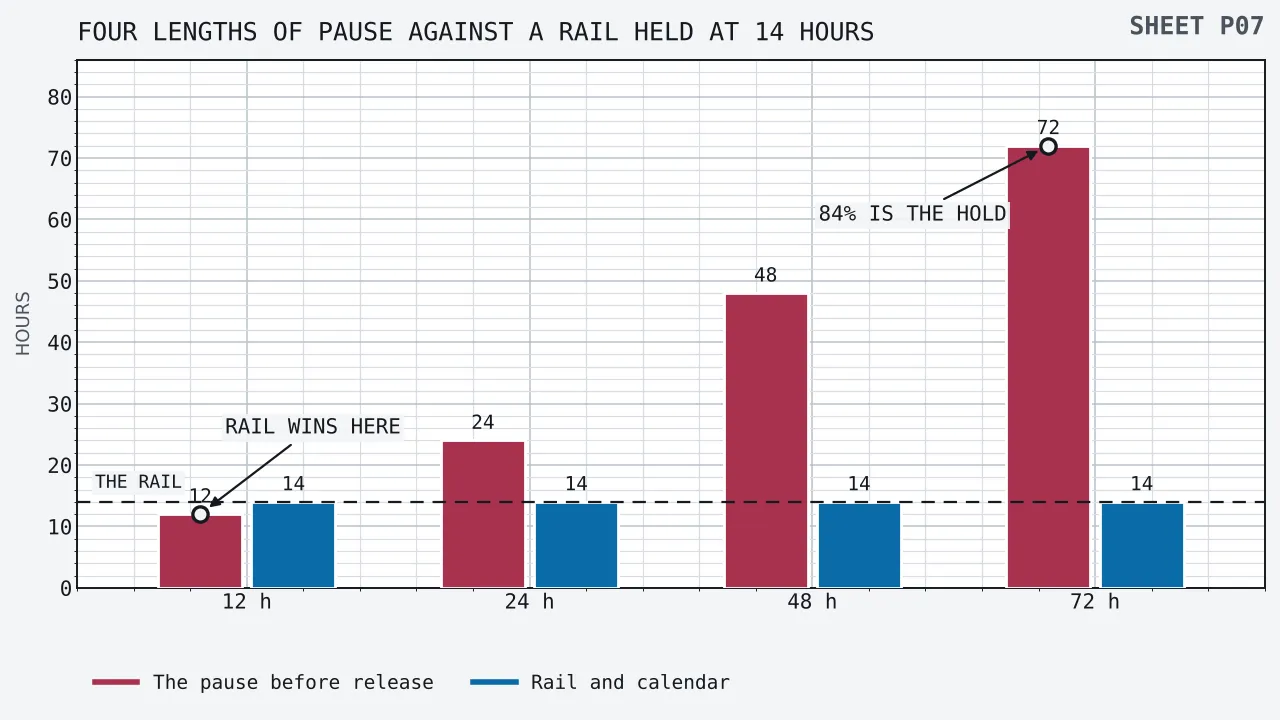
Twenty-six, 38, 62 and 86 hours are the four totals, and the gaps between them are 12, 24 and 24. Every hour of difference comes from the first bar of each pair. The second bar never moves, because a rail does not know how long a request sat before it arrived and would not behave differently if it did.
Forty-six per cent, 63.2, 77.4 and 83.7 are the shares of each total that belong to the pause. A reader comparing payment routes is choosing between differences inside the shrinking remainder, and by the fourth pair that remainder is one sixth of the answer.
Six times is the span of the first bar across the four pairs, 72 against 12, while the second bar has a span of one. If a page about a payment rail could print only one sentence, the honest one would be that the rail is the part of this chart that does not vary.
3
Fourteen hours is where one part becomes the whole
There is an exact point at which the pause stops being one item in a list and starts being the answer, and on this model it is 14 hours, because that is where the pause equals everything else put together. Below it the rail and the calendar decide. Above it they are a rounding adjustment.
| Length of the pause | Rail and calendar | Total wait | Pause as a share | What halving the rail would save |
|---|---|---|---|---|
| 12 hours | 14 h | 26 h | 46.2% | 7 hours, or 26.9 per cent |
| 24 hours | 14 h | 38 h | 63.2% | 7 hours, or 18.4 per cent |
| 48 hours | 14 h | 62 h | 77.4% | 7 hours, or 11.3 per cent |
| 72 hours | 14 h | 86 h | 83.7% | 7 hours, or 8.1 per cent |
Column five answers a question readers put constantly, and it is the reason the table has five columns rather than four. Finding a route that halves the rail is worth 7 hours, and 7 hours is 26.9 per cent of the answer where the pause is short and 8.1 per cent where it is long. The better the rail, the less the rail matters, because a quick rail only ever competes against a pause it cannot touch.
Twenty-four hours added to a pause is worth 24 hours added to a total, with no discount and no interaction, because the two quantities are in series rather than in parallel. Nothing about a faster rail absorbs a longer pause. The arithmetic of a queue of one is addition and nothing cleverer.
Sixty hours is the figure that makes the point unanswerable. Take the 72-hour case at 86 hours in total and abolish the rail and the calendar entirely, which no route can do, and the answer is 72 hours. Take the same case and abolish the pause, which a cashier could do by deciding to, and the answer is 14. One of those two possibilities is imaginary and the other is a policy.
4
A request that can still be taken back
A pause has a second property that has nothing to do with duration, and on a payout page it is the more serious of the two. Money inside a pause has left a balance in appearance only. Where a cashier offers to cancel the request and put the sum back where it was, the whole pause is a stretch in which the win remains stakeable.
Under a Great Britain licence that offer is not permitted. One line of the technical standard on product design settles it: a cancellation option over a request to be paid is nothing a consumer may be handed. Its guidance adds that funds already asked for should not then be available to fund a deposit, and that a business ought to be taking friction out of the withdrawing rather than putting it in.
Two different things are being prevented by that line and both matter here. One is the simple reversal, where a button marked cancel returns the money to a playable balance. The other is the indirect route, where the sum is technically pending but is still available to fund a deposit, which arrives at the same destination by a longer road.
Nought hours of exposure is what a licensed pause therefore carries, however long it runs. A 72-hour wait at a licensed business is 72 hours of impatience and no hours at all of risk to the sum, because the sum cannot come back. That is a sharper protection than it sounds, and it is invisible until the day somebody is bored at hour 50.
Where a cashier operates outside the British licence nothing of the kind binds it, and the pause and the cancel button commonly arrive together. A 24-hour pause with a reversal offer attached is not a 24-hour wait. It is a 24-hour invitation, and the next part prices it.
5
Pricing the hours in which money is still reachable
Ninety pounds is the win this page prices and three hours is how long it takes to stake it once through at ten pence a press, since £90 is 900 presses and 900 presses at 300 an hour is three hours. One full pass through the reels is therefore the natural unit for measuring what a reversible pause exposes.
Eight passes fit inside 24 hours, sixteen inside 48 and twenty-four inside 72. Each pass is expected to return 96 pence in the pound, so the sum after n passes is £90 multiplied by 0.96 raised to the power n, which is the compounding this site uses everywhere and the reason a multiple of 25 takes a credit whole.
| Length of the pause | Passes that fit | Expected residue | Expected loss | At three sittings instead |
|---|---|---|---|---|
| 24 hours | 8 | £64.93 | £25.07 | £1.32 |
| 48 hours | 16 | £46.84 | £43.16 | £1.32 |
| 72 hours | 24 | £33.79 | £56.21 | £1.32 |
Fifty-six pounds and twenty-one pence is a ceiling and not a prediction, and saying so plainly is the difference between arithmetic and scaremongering. It assumes somebody presses continuously for three days, which nobody does, and it is the largest number the model can produce rather than the likeliest.
One pound thirty-two is the other end and it is the realistic one. Three sittings of the 22 minutes this site conventionally allows comes to 66 minutes, which is 330 presses putting £33.00 across the reels, and at 96 pence returned in the pound the expected shortfall is £1.32. The figure is the same in all three rows because it depends on how much somebody plays rather than on how long the pause runs.
£1.32 at three sittings against a ceiling of £56.21, a span of 42.6 to one on the same £90
Forty-two point six to one is the span, and the honest reading of it is that the exposure in a reversible pause is not a cost anybody suffers automatically. It is a cost available to be suffered, and what decides where inside the span somebody lands is nothing but how often the phone comes out while the money is nominally gone.
Ninety-nine hundredths of a penny was what the same 24 hours were worth in part one when counted as interest. One pound thirty-two is what they are worth when counted as play at three sittings. A hundred and thirty-three times the difference, between two valuations of the identical day, and only one of the two appears on any cashier page.
6
The only hours inside the pause anybody can remove
Six hours is what this page allows for the stretch of a pause spent waiting on a customer rather than on an operator, where identity was not settled before play, and it is the only stretch in the whole chain that responds to anything a reader does. The rest of the pause is somebody else’s decision and the rail is nobody’s.
Under a Great Britain licence that six hours should not exist on the far side at all. A name goes on file, so does an address, so does a date of birth, and all three are checked before a first press is possible. The regulator has confirmed that the requirement bites on play an incentive funded and on games offering no prize. The question belongs at registration.
Nor may it be reopened at the exit. Information a licensee had every chance to collect at the start cannot be demanded instead at the moment somebody asks to be paid, and the regulator’s player guidance wants material gathered for money-laundering purposes collected without anybody waiting for a balance request. Where a payout sticks because such information is missing, that guidance says condition 17 may have been breached.
Eighty-six hours becoming 92 is what six hours of late paperwork does to the 72-hour case, which is a seven per cent increase and the smallest effect on this page. That is worth saying because it cuts against the obvious conclusion. Where the pause is already long, the paperwork is not what is hurting.
Twenty-six hours becoming 32 is the same six hours against the shortest case, which is 23 per cent. So the document round matters most exactly where the pause matters least, and a reader who has settled their papers has bought a useful improvement at the quick end and almost nothing at the slow one.
7
A pause counted in days lands where days land
A pause quoted in whole days has an arithmetic property worth noticing: it finishes at the same hour of the day it started. A pause beginning at six in the evening ends at six in the evening, two days later or three, and six in the evening is outside the hours during which most things can be despatched.
Six on a Friday evening is the worked case. Forty-eight hours of pause carries it to six on Sunday evening, at which point the 14 hours of rail and calendar cannot begin until nine on Monday morning, 15 hours further on. Sixty-two hours becomes 77, and the extra 15 belongs to nothing in the chain.
Fifteen hours is therefore what an evening request costs over an afternoon one, on the same pause and the same rail, with the difference produced by where a whole number of days lands. A pause quoted in hours rather than days would not do this, and most are quoted in days.
Twenty-four per cent is the same 15 hours against the 62 it is added to, which makes the hour of day a bigger lever than halving the rail would be. Halving the rail saves 7 hours at that pause length. Moving the request to an afternoon saves 15. The cheaper lever is the larger one, which is the usual result on this site.
This part names an arithmetic property of whole days and nothing more. No suggestion about timing is intended by it. It is set down because a reader holding two quoted bands side by side has no way of seeing the effect, and because the hours it moves are larger than the hours any comparison between rails would move.
8
Nothing behind the pause once the register ends
Every figure above assumes the pause ends. The characteristic failure of a payout is not that it takes 86 hours instead of 38, but that the pause has no end written anywhere and nobody is obliged to supply one, and a page about waiting should say what that looks like when it happens.
Two payout failures have been named by the regulator in its own published writing on sites trading beyond the British licence. Payouts blocked outright is the first. The second is a withdrawal floor pitched where nobody is going to reach it, which arrives at the identical outcome by arithmetic rather than by refusal. Its broader sentence puts unfair gaming practices, money lost and an absence of anywhere to turn into the same list.
Read the second of those against this page’s own sums and it becomes concrete. A win of £90 against a withdrawal floor pitched above it is not a payout taking 86 hours. It is a balance that cannot be requested at all, and a pause of infinite length described in terms that mention no pause.
Set beside that, the single line forbidding a licensed system to offer a cancellation is the duty whose absence this page has been pricing all along. Out beyond the register the reversal offer is permitted, so a 72-hour pause carries up to £56.21 of exposure on a £90 win rather than nought, and the exposure grows with the very delay a reader is already annoyed about.
A cashier running this arrangement sits outside the British licence, and the three things lost on a payout page are therefore these: no rule stops the sum being handed back to a playable balance while it waits, no rule caps how long the waiting runs, and the regulator that publishes those rules has said it is not an ombudsman and cannot retrieve anybody’s money. The hours are the visible part. The absent line about cancellation is the expensive part.
9
One figure worth asking a cashier for
First, the pause is the answer and the rail is a detail. At 14 hours of rail and calendar, a pause of 12, 24, 48 or 72 hours accounts for 46.2, 63.2, 77.4 and 83.7 per cent of the whole wait, and halving the rail buys 7 hours in every one of those cases.
Second, the figure to ask for is the pause on its own, separated from everything else. A band that mixes the look, the rail and the calendar into one range cannot be compared with anything, because two cashiers quoting the same band may be describing an 8-hour pause and a 70-hour one.
Third, a reversible pause is not a wait but an exposure, and on £90 it runs from £1.32 at three sittings to a ceiling of £56.21 if somebody presses through all 24 passes a 72-hour pause allows. The ceiling will not happen. The span of 42.6 to one is the thing to understand before deciding whether a cancel button is a convenience.
Fourth, six hours of late paperwork costs 23 per cent on a short pause and seven per cent on a long one, so filing papers early is worth most to the reader with the least to complain about. It still costs nothing, which keeps it the best trade on the page.
Fifth, a pause quoted in whole days finishes at the hour it started, and an evening start can add 15 hours to a 62-hour chain for no reason anybody could name. That is more than twice what the fastest rail in the world would save at the same pause length, and it is free to avoid.
Questions
- What is a cashier actually measuring when it quotes a payout time?
- Almost always the pause before release, which is the stretch during which somebody looks at the request and decides. The rail is short and fairly uninteresting, and the calendar is rarely mentioned at all. On the model used here the rail and the calendar together are 14 hours, held fixed so that pauses of 12, 24, 48 and 72 hours can be set against them. Both quantities are working suppositions and neither was observed.
- How much of a payout wait is the pause?
- Between 46.2 and 83.7 per cent on this model, rising as the pause lengthens. The four totals are 26, 38, 62 and 86 hours, and the entire difference between them comes from the pause, since the rail does not know how long a request sat before reaching it. Fourteen hours is the crossover point: below it the rail and the calendar decide the answer, above it they are a rounding adjustment.
- Would a faster payment route help?
- By seven hours, on these figures, and seven hours is 26.9 per cent of the answer where the pause is twelve hours and 8.1 per cent where it is seventy-two. The better the rail, the less the rail matters, because a quick rail only ever competes against a pause it cannot touch. The two quantities sit in series, so nothing about a faster rail absorbs a longer pause.
- Can a pending withdrawal be cancelled?
- Not at a business licensed in Great Britain. One line of the technical standard on product design settles it: a cancellation option over a request to be paid is nothing a consumer may be handed. Its guidance adds that funds already asked for should not then be available to fund a deposit, and that a business ought to be taking friction out of the withdrawing rather than putting it in. Outside that licence the offer is permitted and commonly appears.
- Why does being able to cancel cost anything?
- Because a sum that can come back to a playable balance has not really gone anywhere, so the whole pause becomes a stretch in which the win is still stakeable. Ninety pounds is 900 presses at ten pence and three hours at 300 presses an hour, so one full pass takes three hours and a 72-hour pause holds twenty-four of them. At 96 pence returned in the pound, twenty-four passes leave £33.79 of the £90.
- Is that £56 loss likely?
- No, and the number is a ceiling rather than a forecast. It assumes somebody presses continuously for three days. Three sittings of the 22 minutes this site conventionally allows comes to 330 presses putting £33.00 across the reels, with an expected shortfall of £1.32 at 96 pence returned in the pound, which is the realistic end and is the same figure whatever the pause length, because it depends on how much is played rather than on how long the waiting runs. The span between the two is 42.6 to one.
- Does sending identity documents early shorten the pause?
- It removes the part of the pause that is waiting on the customer, which this note puts at six hours. That is 23 per cent of the shortest case here and seven per cent of the longest, so it helps most where there was least to complain about. Under a Great Britain licence the question belongs at registration anyway: a name on file, an address on file, a date of birth on file, all three checked before a first press is possible, with incentive-funded play and prizeless games alike covered.
- Can a payout request be made the trigger for a document demand?
- Not where a licensee had every chance to collect it at the start. The regulator’s player guidance wants material gathered for money-laundering purposes collected without anybody waiting for a balance request, and where a payout sticks because such information is missing, that guidance says condition 17 may have been breached. It is the licence that carries that rule, and nothing else does.
- Why does the hour of day matter if the pause is measured in days?
- Because a whole number of days finishes at the hour it began. A 48-hour pause starting at six on a Friday evening ends at six on Sunday evening, and the 14 hours of rail and calendar then cannot start until nine on Monday morning, 15 hours later, so 62 hours becomes 77. Fifteen hours is 24 per cent of the chain and more than twice what halving the rail would save.
- What goes wrong with payouts at sites outside the British licence?
- Two patterns are named by the regulator. Payouts blocked outright is the first. The second is a withdrawal floor pitched where nobody is going to reach it, which arrives at the identical outcome by arithmetic rather than by refusal. Its broader wording puts unfair gaming practices, money lost and an absence of anywhere to turn into one list. A £90 win under a floor pitched above £90 is not a slow payout. It is a pause with no end and no mention of a pause.