Note B15 Revision 1 Terms read 17 October 2026
Mobile slots, and the four clocks a handset adds to a condition
One hundred and ten presses is a sitting, being twenty-two minutes at the twelve seconds a press this site assumes, and a forty times condition over £9.60 runs to 3,840 presses, which is 35 sittings and 12 h 48 min before anything interrupts it. Breaks, reconnections, recharging and a term sheet twenty screens deep are the four costs a desk does not levy, and together they carry the same condition to 15 h 12 min and 42 sittings.
What lands £9.60 The run 12 h 48 to 15 h 12 The wait to be paid 48 h
What offers of this size ask in hours
Advertising has been bought for every destination below. A fee reaches this site when a reader goes on to register, and no figure on this page moves one way or the other because of it.
-
01Mobile Free Spins
Betportal
Ceiling as a multiple
What lands€15.00150 spins at 10c, which is this site's figure and not the operator'sThe run17 h 30 minTurning over 525.00 at 10p means 5,250 presses, or about 48 phone sittings of 22 minutes. Timed at 10p a press and 12 seconds between presses, both of which this site assumes rather than measures.The wait to be paidNOT PUBLISHEDThis operator puts no withdrawal band in its own terms, so there is nothing honest to print here.Spins valued at this site's own 10p a spin
What lands
Spins, at a price15.00150 of them at 10c apiece, a figure belonging to this site rather than to the operatorMatch, and other creditno figure300% of three deposits, to a ceiling of €1,000. Not a sum until money of yours makes it one, so this row totals nothing and carries nothing downwardsThe run
Handed back on the spins(0.60)Each press stakes its own value and returns 96 per cent, which leaves this much with the house from the opening pressPlay-through 35x on the bonus(20.16)Taking 14.40 round 35 times over means 504.00 through the machines, of which 20.16 is the expected cost, and 17 h 30 min of pressing at the pace aboveWhat counts towards it100%Slots only, with no percentage published anywhere, so the row above assumes the whole of each stake countsWhat never clears
Limit on the winningsstated5x the bonusDeducted on the way outno figureNothing is published as a figure here, so this row removes nothingLeast that can leaveno figureNo figure is published, so nothing on this timer is pinned down by oneLeast deposit, and the rung over ityour own€20 a stage. Published in euros, so no rung is named at all: this site's ladder is a sterling oneThe window on the creditstated14 daysBiggest stake while it runsstated€5Removed outright by rulestatedNot publishedVerified before a payoutstatedDocuments before the first withdrawalNever clears€15.00Not a penny of it gets out, so the whole of what landed stands on this rowNo Great Britain licence
Licence held in Anjouan, Comoros, the company named is BetPortal Gaming Ltd, with Excite Ultra Media Ltd, quoted under ALSI-202601040-FI2.
Terms read 17 October 2026
Open the offer at Betportal, opens in a new window -
02Mobile Free Spins
WinBeast
Ceiling as a sum
What lands€50.00500 spins at 10c, which is this site's figure and not the operator'sThe run2 d 18 hTurning over 2,000.00 at 10p means 20,000 presses, or about 182 phone sittings of 22 minutes. Timed at 10p a press and 12 seconds between presses, both of which this site assumes rather than measures.The wait to be paidNOT PUBLISHEDThis operator puts no withdrawal band in its own terms, so there is nothing honest to print here.Spins valued at this site's own 10p a spin
What lands
Spins, at a price50.00500 of them at 10c apiece, a figure belonging to this site rather than to the operatorMatch, and other creditno figure50% to 100% of five deposits, each to a ceiling of €1,000, and a €650 free bet. Not a sum until money of yours makes it one, so this row totals nothing and carries nothing downwardsThe run
Handed back on the spins(2.00)Each press stakes its own value and returns 96 per cent, which leaves this much with the house from the opening pressPlay-through 40x on the bonus and the winnings from the spins(76.80)Taking 48.00 round 40 times over means 1,920.00 through the machines, of which 76.80 is the expected cost, and 2 d 18 h of pressing at the pace aboveWhat counts towards it100%Slots, titles vary by country, with no percentage published anywhere, so the row above assumes the whole of each stake countsWhat never clears
Limit on the winningsstated€100 a batch of spinsDeducted on the way outno figureNothing is published as a figure here, so this row removes nothingLeast that can leaveno figureNo figure is published, so nothing on this timer is pinned down by oneLeast deposit, and the rung over ityour own€20 a stage. Published in euros, so no rung is named at all: this site's ladder is a sterling oneThe window on the creditstated7 days, spins 1 dayBiggest stake while it runsstatedNot publishedRemoved outright by rulestatedNot publishedVerified before a payoutstatedDocuments before the first withdrawalNever clears€50.00Not a penny of it gets out, so the whole of what landed stands on this rowNo Great Britain licence
Licence held in Curaçao, no company named anywhere on the site.
Terms read 17 October 2026
Open the offer at WinBeast, opens in a new window -
03Mobile Free Spins
EliteSpin
Longest spin window
What lands£50.00500 spins at 10p, which is this site's figure and not the operator'sThe run2 d 18 hTurning over 2,000.00 at 10p means 20,000 presses, or about 182 phone sittings of 22 minutes. Timed at 10p a press and 12 seconds between presses, both of which this site assumes rather than measures.The wait to be paidNOT PUBLISHEDThis operator puts no withdrawal band in its own terms, so there is nothing honest to print here.Spins valued at this site's own 10p a spin
What lands
Spins, at a price50.00500 of them at 10p apiece, a figure belonging to this site rather than to the operatorMatch, and other creditno figure50% to 100% of five deposits, each to a ceiling of £1,000. Not a sum until money of yours makes it one, so this row totals nothing and carries nothing downwardsThe run
Handed back on the spins(2.00)Each press stakes its own value and returns 96 per cent, which leaves this much with the house from the opening pressPlay-through 40x on the bonus and the winnings from the spins(76.80)Taking 48.00 round 40 times over means 1,920.00 through the machines, of which 76.80 is the expected cost, and 2 d 18 h of pressing at the pace aboveWhat counts towards it100%Slots, with no percentage published anywhere, so the row above assumes the whole of each stake countsWhat never clears
Limit on the winningsstated5x the bonusDeducted on the way outno figureNothing is published as a figure here, so this row removes nothingLeast that can leaveno figureNo figure is published, so nothing on this timer is pinned down by oneLeast deposit, and the rung over ityour own£20 a stage. It lands square on the £20.00 rung, so none of yours is left perched on topThe window on the creditstated7 days, spins 3 daysBiggest stake while it runsstatedNot publishedRemoved outright by rulestatedNot publishedVerified before a payoutstatedDocuments before the first withdrawalNever clears£50.00Not a penny of it gets out, so the whole of what landed stands on this rowNo Great Britain licence
Licence held in Costa Rica, the company named is PrimeTier Limited.
Terms read 17 October 2026
Open the offer at EliteSpin, opens in a new window -
04Mobile Free Spins
Crown Jewelz
Multiple unpublished
What lands£15.00150 spins at 10p, which is this site's figure and not the operator'sThe runNOT TIMEDThis operator does not publish the play-through multiple in its own terms. The multiple is the one figure the clock cannot work around, so the run is left untimed.The wait to be paidNOT PUBLISHEDThis operator puts no withdrawal band in its own terms, so there is nothing honest to print here.Nothing reckoned
What lands
Spins, at a price15.00150 of them at 10p apiece, a figure belonging to this site rather than to the operatorMatch, and other creditno figure200% of the first deposit, then 150% twice, each to a ceiling of £1,000. Not a sum until money of yours makes it one, so this row totals nothing and carries nothing downwardsThe run
Play-throughno figure40x the bonus, reported rather than published by the operatorWhat counts towards itno figureSlots, with no percentage published anywhere, so the row above assumes the whole of each stake countsWhat never clears
Limit on the winningsstatedNot publishedDeducted on the way outno figureNothing is published as a figure here, so this row removes nothingLeast that can leaveno figureNo figure is published, so nothing on this timer is pinned down by oneLeast deposit, and the rung over ityour own£20. It lands square on the £20.00 rung, so none of yours is left perched on topThe window on the creditstatedNot publishedBiggest stake while it runsstatedNot publishedRemoved outright by rulestatedNot publishedVerified before a payoutstatedDocuments before the first withdrawalNever clearsNOT RECKONEDThis operator leaves the play-through multiple out of its own terms, so nothing below the fourth step can be worked out.No Great Britain licence
Licence held in Curaçao, number not verified, no company named anywhere on the site.
Terms read 17 October 2026
Open the offer at Crown Jewelz, opens in a new window
Only the middle reading comes out of arithmetic belonging to this site. The multiple laid against what lands gives the turnover asked for; dividing that by 10p a spin gives the presses; dividing those by 300 an hour gives the hours, a press on a handset being taken here at 12 seconds from the one before. Both figures are assumptions rather than measurements of anybody: nothing was played and nothing was held a stopwatch to. Anybody quicker should divide the press count by a rate of their own, which is why the presses are printed alongside the hours instead of being summarised away.
The first reading is what arrives before any condition is laid against it. Spins carry no unit of their own so one gets supplied: where an operator values its own spin that figure is used and attributed, and where it does not, this site's 10p a spin stands in and everything below moves with it. The third reading belongs to the operator entirely. It is a withdrawal band quoted from published terms, and a blank there means none was published rather than that nobody looked.
The total along the foot answers what the hours leave open, which is whether any of the running ends anywhere. It is what arrived, less whatever is still standing once the play-through has been paid for at 96 per cent return to player and once a published limit, a published deduction and a published floor beneath the least that can leave have each had a turn. It appears again in pence in the pound, the only fair way of holding a small offer up against a large one. It describes an offer rather than an evening, and where the conditions price out what arrived, a timer prints nothing getting out instead of a negative sum.
Cashiers on a handset take deposits off a row of preset buttons, so a least deposit given in pounds is raised to the next rung of the ladder used here, £10, £20, £25, £50, £75 and £100, and the timer shows what is left perched on it. That money is the reader's own and enters no sum at all. Given in euros it prints untouched, the ladder being sterling. Three words may occupy the figure column where no figure belongs. Stated is a published term that costs something while leaving no number to subtract. No figure is a term nobody has quantified, or a credit that is not a sum until money of yours makes it one. Your own is money of yours, which belongs in none of this.
None of the operators above is licensed in Great Britain, so not one duty that licence carries reaches any of them. Membership of Gamstop Online is compulsory for every online gambling company licensed in Great Britain, which means that shutting yourself out through the scheme shuts you out of none of these. The limit of ten times the bonus funds on a wagering requirement, running since 19 January 2026 under Social Responsibility Code 5.1.1, is a condition of the same licence and binds only whoever holds one. Off that licence, the Gambling Commission writes of consumers meeting unfair gaming practices, financial loss and no recourse when matters go wrong, and lists blocked payouts and withdrawal limits pitched too high to reach among the things it has seen. No account at any of them may be held by anybody under 18.
Every term on a timer is its operator's own and every timer carries the day somebody read it. The oldest of those readings is 17 October 2026. What binds a reader is an operator's full terms and never a line printed here.
1
One hundred and ten presses, and the unit a handset imposes
One hundred and ten is the press count in a sitting, arrived at by dividing twenty-two minutes by the twelve seconds a press this site assumes, and the whole of this note is built on that single quotient. Neither number came off a stopwatch. Twenty-two minutes is this site’s declared length for one phone sitting and twelve seconds is its declared interval, and every duration below says so wherever it rests on either.
Twenty-two minutes is not a measure of stamina, and that distinction is where mobile slots part company with the same games on a desk. A sitting ends when something ends it. A call arrives, a train reaches a platform, a notification covers the reels, a queue moves forward. None of those events has anything to do with how long a person wanted to keep pressing, which is why the sitting on this site is a handset fact rather than an appetite.
Nine pounds sixty is the balance every figure below is worked against, that being what a hundred 10p presses leave standing on a build returning ninety-six pence in the pound. Deriving it belongs to the companion note on slots free spins and the build that owns the residue, and repeating the derivation would waste the half of this page a handset actually needs.
Forty applied to £9.60 asks £384.00 across the reels, and ten pence a press turns that sum into 3,840 presses and 46,080 seconds at the interval modelled throughout. Twelve hours forty-eight minutes is 46,080 seconds stated in hours. Thirty-five sittings is the same quantity in the unit a handset imposes, part sittings rounding upward as they do throughout.
Fifteen pounds thirty-six is the margin that staking surrenders, four pence leaving on each of 384 pounds, and the balance being asked to cover it is worth £9.60. Parity between those two arrives at £240.00 of turnover, which is twenty-five times the balance and the only multiple at which the two quantities match. Forty times stands sixty per cent beyond parity, and £5.76 is the gap it opens.
| Quantity | Figure | Where it comes from |
|---|---|---|
| Balance to be cleared | £9.60 | A hundred 10p presses at ninety-six pence back |
| Staking a forty times clause fixes | £384.00 | Forty applied to the balance |
| Presses that comes to at 10p | 3,840 | Division, and nothing assumed |
| Seconds those presses occupy | 46,080 | The twelve-second interval assumed here |
| Hours that amounts to | 12 h 48 min | The same assumption restated |
| Sittings of 22 minutes | 35 | Both of this site’s assumptions together |
| Margin the staking gives up | £15.36 | Four pence on each pound crossed |
Twelve hours forty-eight minutes, worked at the interval this site assumes, is the number a reader carries away from a page about a desk, and it is the number this note treats as a floor rather than an answer. Four further clocks run on a handset and on nothing else. Parts two to five put a figure against each, and part eight sets out what nobody is obliged to do about any of them once an offer sits outside the British register.
Thirty-five sittings of the assumed twenty-two minutes, spread across a fortnight, is roughly two and a half a day, which sounds like an ordinary amount of phone use. Squeezed into one week the same count becomes five sittings a day, which part seven prices. The count never changes. What changes is how many separate occasions a handset divides it into, and every division has a cost attached.
110 presses to a sitting, 35 sittings to a condition
2
Thirty-five restarts priced into one condition
Thirty-five is the restart count a 12 h 48 min run produces where something interrupts it every twenty-two minutes, and the derivation is one division: 46,080 modelled seconds over 1,320. A restart is not a pause. It is an application coming back from the background, a lobby redrawing itself, and a particular game being found again among however many a cashier lists.
One interruption every twenty-two minutes is the rate this site already assumes implicitly, because that is what fixes a sitting at twenty-two minutes in the first place. Stating it as a rate rather than as a length makes it arguable, which is the point. A reader whose phone is quiet for an hour at a time should use the sixty-minute row below and will find the whole effect shrinks by a factor of 2.7.
| Gap between interruptions | Restarts over 3,840 presses | Lost at 40 s a restart | The condition then runs | Sittings |
|---|---|---|---|---|
| 8 minutes | 96 | 1 h 4 min | 13 h 52 min | 38 |
| 11 minutes | 70 | 46 min 40 s | 13 h 34 min 40 s | 38 |
| 22 minutes | 35 | 23 min 20 s | 13 h 11 min 20 s | 36 |
| 35 minutes | 22 | 14 min 40 s | 13 h 2 min 40 s | 36 |
| 60 minutes | 13 | 8 min 40 s | 12 h 56 min 40 s | 36 |
Twenty-three minutes and twenty seconds is the middle row of that table, and it buys the reader nothing whatever. Not one press happens inside it. Set against a sitting of twenty-two minutes, those lost seconds are an entire extra occasion on which a handset has to be picked up, so the sitting count moves from thirty-five to thirty-six on the strength of overhead alone.
Ninety-six restarts is the eight-minute row, and eight minutes between interruptions is an ordinary description of a commute rather than an extreme one. One hour and four minutes disappears at that rate into application resumes. Thirteen hours fifty-two minutes is where the condition lands on the modelled interval, which is 38 sittings, and three of those sittings exist only because the phone kept being put down.
Two point seven is the ratio between the eight-minute row and the sixty-minute row, 96 restarts against 13, and it is worth knowing which end of that ratio a reader is at before a condition is accepted rather than afterwards. Nobody chooses their own interruption rate. A commuter on a connecting service and somebody at home on a quiet evening are running the same arithmetic at different speeds.
Nought presses are lost to an interruption itself, and that is the distinction this part turns on. A condition is counted in presses, not in minutes, so being interrupted never costs a reader any of the 3,840. What it costs is the surrounding time, which is the thing a window in a term sheet measures and the thing part seven converts into a forfeiture.
3
What reopening an app costs in seconds and in evenings
Forty seconds is the restart cost modelled in the table above, and it is this note’s own figure rather than anybody’s measurement. Three things fill it: an application waking or reloading, a lobby drawing its tiles, and one game being located among them. Readers who think forty seconds generous should take the fifteen-second row below, and readers on a crowded lobby should take ninety.
Thirty-five restarts held constant, the cost per restart moves the condition across a span of just over an hour, and the table sets out six points on it. Nothing in the money changes. The balance stays £9.60, the staking stays £384.00, the margin stays £15.36, and the expected position at the close stays minus £5.76 at every row.
| Seconds a restart | Lost over the run | The condition then runs | Sittings | What that cost describes |
|---|---|---|---|---|
| 15 | 8 min 45 s | 12 h 56 min 45 s | 36 | An application still resident, the game already open |
| 25 | 14 min 35 s | 13 h 2 min 35 s | 36 | A quick wake, one tap back to the reels |
| 40 | 23 min 20 s | 13 h 11 min 20 s | 36 | A reload, a lobby, a game found again |
| 60 | 35 min | 13 h 23 min | 37 | A browser session, a sign-in, a search box |
| 90 | 52 min 30 s | 13 h 40 min 30 s | 38 | A slow connection and a long tile list |
| 120 | 1 h 10 min | 13 h 58 min | 39 | A reload that wants the password again |
Two hours twenty-four minutes is the worst combination the two tables between them permit, being 96 restarts at ninety seconds apiece. Fifteen hours twelve minutes is where the condition arrives on that pairing, against the 12 h 48 min a desk gives at the modelled interval with nothing to interrupt it. Forty-two sittings against thirty-five is the same statement in the handset’s own unit, and seven sittings have appeared out of furniture.
Eighteen point eight per cent is that overhead as a share of the underlying run, 144 modelled minutes over 768. A reader pricing an offer from a count of spins has not accounted for it, because nothing in the offer mentions it and nothing in the terms describes it. It is a property of the device, and it is the first of the four this note is about.
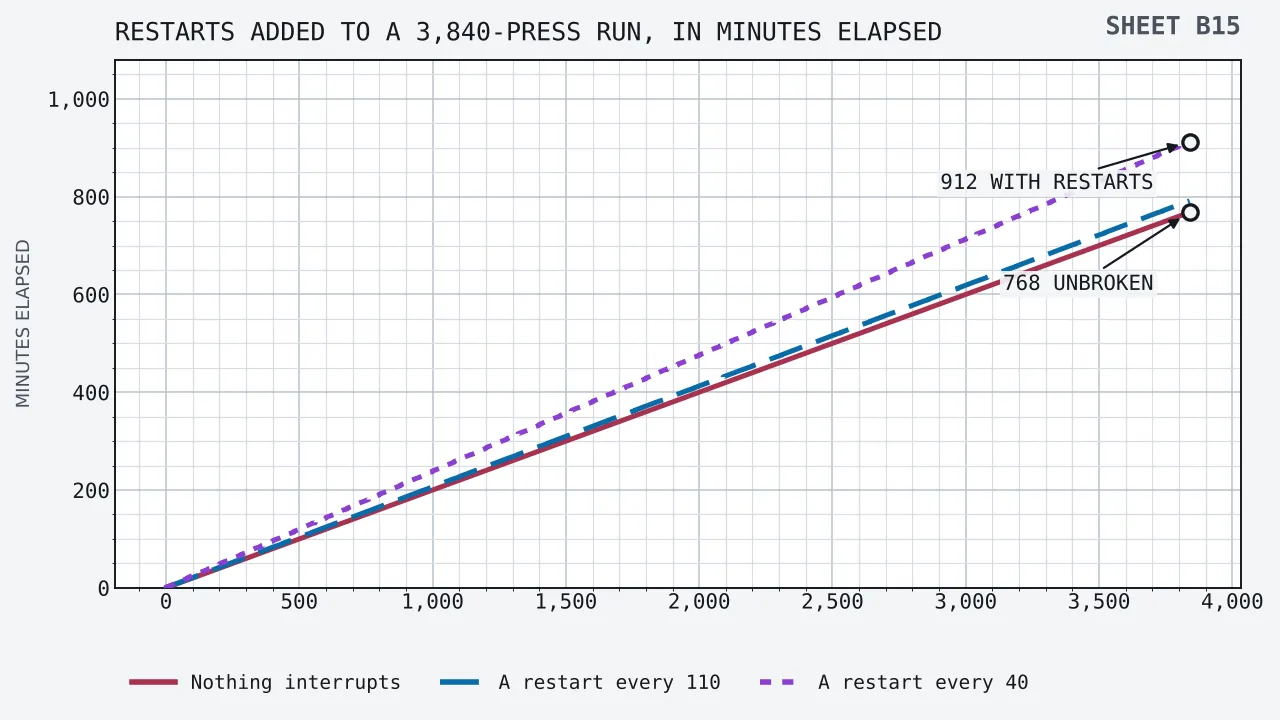
Upright segments are where the whole argument of this part sits, and the picture shows why. Minutes climb the vertical and presses run along the horizontal, so a pause rises without moving sideways at all: time passing with the condition exactly where it was. A window in a term sheet counts those segments. A play-through does not, which means the two clocks in an offer measure different things and only one of them pauses when a handset goes into a pocket.
4
A connection that goes while a result is settling
Twenty drops is what a failure rate of one press in two hundred produces across 3,840 presses, and the figure is small enough to be worth stating precisely. A drop here means a connection going between the press and the picture, which on a handset moving between a mobile network and a building’s own signal is an ordinary rather than a remarkable event.
One result exists per press and it is settled on the operator’s side, which is the reassuring half of this part. A game cycle under the British technical standards is defined as running until every pound staked or won has been lost, delivered or made available, with the start control back in service, so the cycle is written round the settling of the money rather than round the state of a screen. Reconnecting therefore recovers a decided outcome.
Twenty-five seconds is what recovering it is modelled to cost, and the stake is not among the casualties. What a drop takes is the interval between losing the picture and getting it back, which is overhead of exactly the kind part three priced. The arithmetic below is this note’s own throughout, and no source anywhere publishes how often connections actually fail during play.
| Presses between drops | Drops over the run | Lost at 25 s each | Stake forfeited | Presses forfeited |
|---|---|---|---|---|
| 500 | 8 | 3 min 20 s | £0.00 | 0 |
| 200 | 20 | 8 min 20 s | £0.00 | 0 |
| 100 | 39 | 16 min 15 s | £0.00 | 0 |
| 50 | 77 | 32 min 5 s | £0.00 | 0 |
Zero in two columns of that table is the finding, and it is a genuinely good one. A dropped connection does not spend ten pence twice and does not consume one of the 3,840. The press either happened or it did not, and whichever it was survives in the account rather than on the glass. Readers who assume otherwise tend to press again on reconnecting, which does consume one.
Thirty-two minutes is the bottom row, at one drop in every fifty presses, and that is an hour and a half of a reader’s month gone to a signal. Added to 96 restarts at ninety seconds the two overheads reach 2 h 56 min 5 s, which carries the condition to 15 h 44 min 5 s and 43 sittings. Both quantities are modelled from the rates stated and neither was observed.
Two things make the recovered minute worse than the figures suggest, and both belong to the device. A reconnection usually lands a reader back in a lobby rather than back at the reels, so a drop frequently carries a restart with it and the two costs combine. And a result discovered on return, rather than watched, is a result nobody can describe afterwards, which part eight turns into a complaint that cannot be evidenced.
5
The battery as a second ceiling over a long run
One thousand two hundred presses is what a four-hour charge holds at the assumed interval, four hours being 14,400 seconds and twelve seconds being the modelled length of a press. One hundred and twenty pounds of staking is what those presses send across, which is 31.2 per cent of the £384.00 a forty times condition wants. Three point two charges is the whole condition.
Four hours of continuous screen-on play per full charge is an assumption of this note and of nothing else, stated here so that a reader can substitute their own handset’s figure and redo the division. Every row below is linear in that number. A screen held bright on a slot lobby for hours is among the heavier things a phone does, and no primary source this site works from publishes a drain rate.
| Screen-on hours a charge | Presses it holds | Staking that sends | Share of £384.00 | Charges the condition needs |
|---|---|---|---|---|
| 2 h 30 min | 750 | £75.00 | 19.5% | 6 |
| 3 h | 900 | £90.00 | 23.4% | 5 |
| 4 h | 1,200 | £120.00 | 31.2% | 4 |
| 5 h | 1,500 | £150.00 | 39.1% | 3 |
| 6 h | 1,800 | £180.00 | 46.9% | 3 |
Eleven sittings is a four-hour charge counted the handset’s way, 240 minutes over the assumed twenty-two, and that is the quantity worth holding on to. A reader cannot do thirty-five sittings on one charge whatever else is true. The run is bounded from one end by the window a term sheet sets and from the other by how often a cable is within reach, and neither bound appears in a count of spins.
Three point seven five seconds a press is the rate at which 3,840 presses would fit inside a single four-hour charge, and that rate is on the permitted side of the floor under licensed slot pace by 1.25 seconds. Nothing forbids it. What forbids it is a thumb, because 3.75 seconds a press means pressing continuously for four hours with no sitting, no interruption and no reload.
Five thousand seven hundred and sixty is the press ceiling on a four-hour charge, 14,400 seconds divided by the shortest gap a licensed slot cycle may leave behind it. One and a half conditions is what 5,760 presses amount to here. Even the regulated limit on speed therefore leaves the charge binding before the clause does, at any pace a thumb could sustain.
Seven point five seconds a press is the rate that fits the whole condition inside an eight-hour day, and that one clears the floor with five seconds to spare. Twenty-two sittings of the assumed length back to back is what it describes, plus two recharges in the middle of them. Stating a condition as an eight-hour working day rather than as 3,840 spins is the single most useful translation on this page.
One charge is 1,200 presses, 31.2 per cent of the clause
6
Four screens on a desk, twenty in one hand
Four thousand four hundred words is the length this note assumes for a bonus term sheet of the ordinary kind, and the assumption is stated because everything in this part scales from it. Readers with a shorter sheet should divide. The structure of the finding survives any plausible length, because the ratio between a desktop pane and a handset pane does not move with the word count.
One thousand one hundred words is what a desktop pane shows at a readable size, which makes 4,400 words four screenfuls and three swipes. Two hundred and twenty words is the handset equivalent, which makes the same sheet twenty screenfuls and nineteen swipes. Five times as many screens carry exactly the same text, and the text has not changed at all.
| What is counted | On a desk | In one hand |
|---|---|---|
| Words to a pane | 1,100 | 220 |
| Panes for 4,400 words | 4 | 20 |
| Swipes or scrolls to the end | 3 | 19 |
| Share of the sheet in view at once | 25.0% | 5.0% |
| Minutes to read it at 200 words a minute | 22 | 22 |
| Sittings that reading fills | 1 | 1 |
Twenty-two minutes is the reading time on the last line but one, and it is identical in both columns because reading speed does not care about a pane. Twenty minutes is what a hundred free presses occupy at the modelled interval. So the sheet governing a handout takes two minutes longer to read than the handout takes to spend, which is the plainest statement of the problem this page can offer.
Five per cent of the sheet is visible at any moment on a handset against twenty-five per cent on a desk, and that difference does the real damage rather than the swipe count. A reader scanning for one condition on a desk has a quarter of the document in peripheral view. The same reader in a queue has a twentieth, and has to hold the other nineteen twentieths in memory.
Forty words is the combined length of the two sentences that matter most, those being a maximum stake while a balance is live and a window inside which it must be cleared. Nought point nine per cent of 4,400 words is what forty words amount to. One or two panes out of twenty is where they fall, and a reader who swipes through five panes before starting has seen a quarter of the sheet and has a one in four chance of having passed them, assuming they fall anywhere at random.
Nineteen swipes against three is also a measure of how easily a reader stops. Each swipe is a decision to continue, and a document asking for nineteen of them before the end gets abandoned at a rate no four-screen document does. Nothing in that is a criticism of readers. It is a property of a pane four inches high, and it applies to bus timetables as much as to bonus terms.
7
Two conditions a thumb tends to meet late
Two conditions account for most of the surprises in this corner of the market, and part six explains why: both are single sentences buried in a document that is twenty panes long on the device nearly everybody uses. A ceiling on the stake is the first. A window on the clearing run is the second. Each is priced below in the unit this site counts in.
Ten pence is the stake every figure on this page assumes, and a maximum-stake clause bites only where a reader goes above it. Twenty pence a press halves the count to 1,920, which is 6 h 24 min and eighteen sittings saved. Fifty pence cuts it to 768 presses and 2 h 33 min 36 s. Both are tempting precisely because the handset puts a stake stepper beside the spin control, within a thumb’s reach.
Nought is what either shortcut is worth where a clause caps the stake while a balance is live, because the usual consequence of exceeding a ceiling is forfeiture of the balance and of everything built on it. Six hours twenty-four minutes of apparent saving is therefore 6 h 24 min of modelled pressing thrown away, together with the hours already spent before it. A thumb slip has no undo.
| Window on the clearing run | Presses a day | Minutes a day | Sittings a day | Restarts a day at 22 min |
|---|---|---|---|---|
| 24 hours | 3,840 | 768 | 35 | 35 |
| 3 days | 1,280 | 256 | 12 | 12 |
| 7 days | 549 | 109.8 | 5 | 5 |
| 14 days | 275 | 55 | 3 | 3 |
| 30 days | 128 | 25.6 | 2 | 2 |
Thirty-five sittings in one day is the top row, and it disposes of a twenty-four hour window without further argument. Twelve hours forty-eight minutes of modelled pressing inside a calendar day means more than three recharges while playing and no interruption long enough to matter. Nobody completes that, and a clause setting it is a clause that expects nobody to.
Five sittings a day for seven days is the seven-day row, which is 1 h 49 min 48 s of pressing every day for a week. That is the row most readers are actually looking at, and it is the one where the overheads in parts two to five compound: five restarts a day, one recharge every other day, and a sitting lost to furniture roughly every third day.
Twenty-five minutes thirty-six seconds a day is the thirty-day row, and it is the one row here that an ordinary working week would accommodate without rearrangement. Two sittings a day is the load. A window of a month on this balance is therefore the difference between a condition and a decoration, and it is one sentence in a document nineteen swipes deep.
8
What the missing licence takes off a handset in particular
Three duties go missing once an arrangement sits beyond the register, and each of the three is about what a pane has to carry. No Great Britain licence sits behind one of this sort, so not a single duty binds whoever is running it. Every note on this site forfeits something different, and these are the forfeitures a four-inch screen feels directly.
First comes the state of a game while it is running. Enough has to be put on view, during play, for its current standing to be intelligible to the customer, and that is exactly the material a dropped connection wipes and a reconnection has to rebuild. Twenty reconnections across a condition was the modelled figure in part four. Away from the register, telling a returning reader anything at all is optional.
Second comes running more than one game at a time. Functionality facilitating that is barred from a licensed build outright, with the guidance naming screens divided in two, screens used in parallel, and any arrangement of games assembled so they can go at once. A phone looks like the device where such a rule has nothing to do. It has: two panes will sit side by side, a lobby will nest one game inside another, and 3,840 presses taken in pairs is a wholly different fortnight.
Third comes the sheet, all 4,400 modelled words of it. Fairness and transparency are both demanded of a licensee’s contract terms, each measured by the yardstick the Consumer Rights Act 2015 lays down, and the words themselves have to sit where a customer reaches them without effort, while a change of substance owes the customer notice ahead of the day it bites. Reaching them without effort is a measurable idea on a handset, and part six measured it at twenty panes and nineteen swipes.
| What a four-inch pane is asked to carry | British licence in force | Curaçao policy, the offshore document for this sheet |
|---|---|---|
| The standing of a game part way through | On view as play proceeds, in terms a customer can follow | Nothing of the kind is written down |
| A second game running alongside the first | Barred, with divided and parallel screens both named | Unaddressed throughout |
| Terms a reader can actually reach | Transparent, reachable, and changes notified in advance | Clear wording for an incentive, and no rule on access |
| A ceiling over the multiple | Ten is the ceiling, in force since 19 January 2026 | Uncapped, with no figure set anywhere |
Ten times would make this a different page, and the last row of that table is where the clock shows it. Ninety-six pounds is ten applied to £9.60, which buys 960 presses, and 960 presses occupy 3 h 12 min on the modelled interval, or nine sittings. Forty times is 35 sittings before any overhead and 42 after the worst of it. Twenty-six sittings is what one line of one code provision is worth to a handset.
Ombudsman is the word the regulator here uses for what it is not, and that single disclaimer settles what a complaint about a dropped press is worth. Resolving complaints over gambling transactions falls outside its powers, and the two examples it offers are a withdrawal gone wrong and a game failing technically. Customer accounts are shut to it as well, so what occurred inside one is not something it can examine. A reconnection that fails is a game failing technically.
Six months is nonetheless the shortest period a licensed business may leave open for a complaint about an incident, counted from the incident, and speed may be encouraged while a shorter window may not be imposed by contract. One hundred and eighty-three days against 35 sittings is the comparison worth drawing: the period for raising a dropped press outlasts the whole condition about five times over.
Nothing in the previous two paragraphs survives the crossing. An arrangement run beyond the British register leaves a reader whatever route its own pages happen to publish, no minimum period at all, and a regulator here that was never going to settle the transaction anyway. Taking both of those together is the honest position: what goes is procedural rather than magical, and it is still the whole of the difference.
Membership of Gamstop Online is fastened to the British licence itself, which is how the scheme reaches an operator at all, and the scheme is candid about where that reach ends: a business standing clear of the arrangement is not one anybody’s registration can hold them back from. Treat that edge as a measure of the protection. Nothing on this page points towards a way round it, and the same refusal extends to a gambling bar set by a bank and to one set across a network.
9
Five things worth settling before the evening starts
Five questions follow from the parts above, and each has an answer a reader can find before pressing anything. None of them is about luck and none is about choosing well between offers. They are about knowing which of the four handset clocks is going to bind first, because one of them always does.
First, the window. Thirty days on this balance is two sittings a day and seven days is five, and the difference between those two rows is the difference between an arrangement somebody finishes and an arrangement nobody does. Finding that sentence costs a few of the nineteen swipes. Not finding it costs 12 h 48 min of modelled pressing with nothing at the end.
Second, the maximum stake while a balance is live. Twenty pence a press looks like a way of halving an evening and is a way of forfeiting one where a ceiling sits at ten. The stepper is beside the spin control on a handset, which makes this the condition most easily breached by accident and the one with the least forgiving consequence.
Third, the interruption rate, which is the only one of the five a reader already knows. Eight minutes between interruptions costs 96 restarts and 1 h 4 min at the cost modelled here. Sixty minutes costs 13 restarts and 8 min 40 s. Nobody needs a document to work out which of those two describes their own week.
Fourth, the charge. One thousand two hundred presses on a four-hour charge means the condition spans at least four separate charging cycles, so a run cannot be planned as a single evening however long the evening is. A reader who intends to clear 3,840 presses is planning a fortnight of phone use, and ought to decide that deliberately rather than discover it at press 1,200.
Fifth, where the money actually ends up. Minus £5.76 is the expected position at the close of a forty times condition over £9.60, being the £15.36 of margin the staking surrenders set against the £9.60 that has to pay it. Fifteen hours twelve minutes of modelled pressing at the worst of the overheads buys that outcome, and no arrangement of the four clocks improves it.
Twelve hours forty-eight minutes, 15 h 12 min, 22 minutes of reading and four charges is the whole of this note in four spans. A reader who remembers only the order has most of the value: the clause is the smallest of them, the handset adds a fifth as much again, the document costs a sitting of its own, and the battery decides how any of it gets spread.
Questions
- How many presses fit into one phone sitting?
- One hundred and ten, being twenty-two minutes divided by twelve seconds. Both of those are assumptions this site declares rather than measurements: twenty-two minutes is the length it takes one phone sitting to be, and twelve seconds is the interval it models a press at. A reader whose own sitting runs to fifteen minutes should use 75 presses and redo every division below, all of which are linear.
- Why is a sitting treated as a property of the handset?
- Because what ends it is usually an event rather than a decision. A call, a notification covering the reels, a train reaching a platform or a queue moving forward all finish a sitting irrespective of how long somebody intended to keep going. That makes the twenty-two minutes a statement about the device and its surroundings, and it is why the restart arithmetic belongs on this page and not on a page about a desk.
- How many restarts does one clearing run contain?
- Thirty-five, where something interrupts every twenty-two minutes, that being 46,080 modelled seconds divided by 1,320. At eight minutes between interruptions it is 96 and at sixty minutes it is 13. A restart costs an application waking, a lobby redrawing and one game being found again, modelled here at forty seconds, which comes to 23 min 20 s across the run and adds a whole sitting to the count.
- Does a dropped connection cost the stake?
- No. The result for a press is settled on the operator’s side, and under the British technical standards a game cycle is defined as running until all money staked or won has been lost, delivered or made available with the start control back in service. The cycle is therefore written round the settling of the money rather than round the state of a screen. What a drop costs is the minute, modelled here at twenty-five seconds, and twenty drops at one press in two hundred come to 8 min 20 s.
- How much of a condition fits into one battery charge?
- One thousand two hundred presses, on a modelled four hours of continuous screen-on play per charge, which is £120.00 of staking and 31.2 per cent of the £384.00 a forty times clause wants. Three point two charges covers the whole run. The four hours is an assumption of this note alone, so a reader should substitute whatever their own handset manages and redo the division.
- Could a reader finish inside one charge by pressing faster?
- Three point seven five seconds a press is what that would take, and the floor under licensed slot pace permits it with 1.25 seconds to spare. What rules it out is a thumb rather than a rule, because it means four hours of continuous pressing with no sitting and no reload. A four-hour charge could hold at most 5,760 presses even at the quickest restart a licensed cycle allows, which is one and a half conditions.
- Why does a small screen make the terms harder to use?
- Because the same sheet occupies five times as many panes. Four thousand four hundred words is four screenfuls and three scrolls on a desk, and twenty screenfuls and nineteen swipes in one hand. Five per cent of the document is in view at any moment rather than twenty-five, so a reader scanning for one line has nineteen twentieths of it held in memory instead of a quarter of it in peripheral view.
- Which two conditions get met by surprise most often?
- A ceiling on the stake while a balance is live, and a window on the clearing run. Together they run to about forty words, which is nought point nine per cent of a 4,400-word sheet and falls in one or two panes out of twenty. The stake stepper sits beside the spin control on a handset, so the first is the easiest to breach by accident, and breaching it usually forfeits the balance and every hour spent on it.
- What does a window of seven days actually ask for?
- Five hundred and forty-nine presses a day for a week, which is 1 h 49 min 48 s of modelled pressing daily and five sittings. A window of thirty days asks 128 presses a day, 25 min 36 s and two sittings, and a window of twenty-four hours asks the entire 3,840 presses, 12 h 48 min and thirty-five sittings in one calendar day, with more than three recharges inside it.
- Where does a licence stand on arrangements of this sort, and what does a phone give up?
- No Great Britain licence stands behind them, and the duties worth naming are the three concerned with what a pane has to carry. A licensed build must keep the standing of a game on view while play proceeds, must not offer functionality facilitating two games at once, and must keep its contract terms transparent and reachable with any change of substance notified in advance. Ombudsman is also the word the regulator here uses for what it is not, and a game failing technically sits among its own examples of a complaint beyond its powers, so what goes is the six-month window and the route behind it rather than an adjudication that never existed.