Note L06 Revision 1 Terms read 17 October 2026
A dealt round is the smallest thing a person can buy, and its length is set by somebody else
At five pounds a round on the sixty second round this page assumes, an hour holds sixty rounds, stakes £300.00 and is expected to retain £12.00. Stretch the round to two minutes and the hour costs half as much, while matching that first hour again needs twenty pounds a round. Both readings are right and they point in opposite directions.
Staked in an hour at £5.00 £300.00 The round assumed here 60 s Expected margin a year £3,212.00
Table credits of this kind, costed in hours
Advertising has been bought for every destination below. A fee reaches this site when a reader goes on to register, and no figure on this page moves one way or the other because of it.
-
01Mobile Free Spins
Betportal
Ceiling as a multiple
What lands€15.00150 spins at 10c, which is this site's figure and not the operator'sThe run17 h 30 minTurning over 525.00 at 10p means 5,250 presses, or about 48 phone sittings of 22 minutes. Timed at 10p a press and 12 seconds between presses, both of which this site assumes rather than measures.The wait to be paidNOT PUBLISHEDThis operator puts no withdrawal band in its own terms, so there is nothing honest to print here.Spins valued at this site's own 10p a spin
What lands
Spins, at a price15.00150 of them at 10c apiece, a figure belonging to this site rather than to the operatorMatch, and other creditno figure300% of three deposits, to a ceiling of €1,000. Not a sum until money of yours makes it one, so this row totals nothing and carries nothing downwardsThe run
Handed back on the spins(0.60)Each press stakes its own value and returns 96 per cent, which leaves this much with the house from the opening pressPlay-through 35x on the bonus(20.16)Taking 14.40 round 35 times over means 504.00 through the machines, of which 20.16 is the expected cost, and 17 h 30 min of pressing at the pace aboveWhat counts towards it100%Slots only, with no percentage published anywhere, so the row above assumes the whole of each stake countsWhat never clears
Limit on the winningsstated5x the bonusDeducted on the way outno figureNothing is published as a figure here, so this row removes nothingLeast that can leaveno figureNo figure is published, so nothing on this timer is pinned down by oneLeast deposit, and the rung over ityour own€20 a stage. Published in euros, so no rung is named at all: this site's ladder is a sterling oneThe window on the creditstated14 daysBiggest stake while it runsstated€5Removed outright by rulestatedNot publishedVerified before a payoutstatedDocuments before the first withdrawalNever clears€15.00Not a penny of it gets out, so the whole of what landed stands on this rowNo Great Britain licence
Licence held in Anjouan, Comoros, the company named is BetPortal Gaming Ltd, with Excite Ultra Media Ltd, quoted under ALSI-202601040-FI2.
Terms read 17 October 2026
Open the offer at Betportal, opens in a new window -
02Mobile Free Spins
WinBeast
Ceiling as a sum
What lands€50.00500 spins at 10c, which is this site's figure and not the operator'sThe run2 d 18 hTurning over 2,000.00 at 10p means 20,000 presses, or about 182 phone sittings of 22 minutes. Timed at 10p a press and 12 seconds between presses, both of which this site assumes rather than measures.The wait to be paidNOT PUBLISHEDThis operator puts no withdrawal band in its own terms, so there is nothing honest to print here.Spins valued at this site's own 10p a spin
What lands
Spins, at a price50.00500 of them at 10c apiece, a figure belonging to this site rather than to the operatorMatch, and other creditno figure50% to 100% of five deposits, each to a ceiling of €1,000, and a €650 free bet. Not a sum until money of yours makes it one, so this row totals nothing and carries nothing downwardsThe run
Handed back on the spins(2.00)Each press stakes its own value and returns 96 per cent, which leaves this much with the house from the opening pressPlay-through 40x on the bonus and the winnings from the spins(76.80)Taking 48.00 round 40 times over means 1,920.00 through the machines, of which 76.80 is the expected cost, and 2 d 18 h of pressing at the pace aboveWhat counts towards it100%Slots, titles vary by country, with no percentage published anywhere, so the row above assumes the whole of each stake countsWhat never clears
Limit on the winningsstated€100 a batch of spinsDeducted on the way outno figureNothing is published as a figure here, so this row removes nothingLeast that can leaveno figureNo figure is published, so nothing on this timer is pinned down by oneLeast deposit, and the rung over ityour own€20 a stage. Published in euros, so no rung is named at all: this site's ladder is a sterling oneThe window on the creditstated7 days, spins 1 dayBiggest stake while it runsstatedNot publishedRemoved outright by rulestatedNot publishedVerified before a payoutstatedDocuments before the first withdrawalNever clears€50.00Not a penny of it gets out, so the whole of what landed stands on this rowNo Great Britain licence
Licence held in Curaçao, no company named anywhere on the site.
Terms read 17 October 2026
Open the offer at WinBeast, opens in a new window -
03Mobile Free Spins
EliteSpin
Longest spin window
What lands£50.00500 spins at 10p, which is this site's figure and not the operator'sThe run2 d 18 hTurning over 2,000.00 at 10p means 20,000 presses, or about 182 phone sittings of 22 minutes. Timed at 10p a press and 12 seconds between presses, both of which this site assumes rather than measures.The wait to be paidNOT PUBLISHEDThis operator puts no withdrawal band in its own terms, so there is nothing honest to print here.Spins valued at this site's own 10p a spin
What lands
Spins, at a price50.00500 of them at 10p apiece, a figure belonging to this site rather than to the operatorMatch, and other creditno figure50% to 100% of five deposits, each to a ceiling of £1,000. Not a sum until money of yours makes it one, so this row totals nothing and carries nothing downwardsThe run
Handed back on the spins(2.00)Each press stakes its own value and returns 96 per cent, which leaves this much with the house from the opening pressPlay-through 40x on the bonus and the winnings from the spins(76.80)Taking 48.00 round 40 times over means 1,920.00 through the machines, of which 76.80 is the expected cost, and 2 d 18 h of pressing at the pace aboveWhat counts towards it100%Slots, with no percentage published anywhere, so the row above assumes the whole of each stake countsWhat never clears
Limit on the winningsstated5x the bonusDeducted on the way outno figureNothing is published as a figure here, so this row removes nothingLeast that can leaveno figureNo figure is published, so nothing on this timer is pinned down by oneLeast deposit, and the rung over ityour own£20 a stage. It lands square on the £20.00 rung, so none of yours is left perched on topThe window on the creditstated7 days, spins 3 daysBiggest stake while it runsstatedNot publishedRemoved outright by rulestatedNot publishedVerified before a payoutstatedDocuments before the first withdrawalNever clears£50.00Not a penny of it gets out, so the whole of what landed stands on this rowNo Great Britain licence
Licence held in Costa Rica, the company named is PrimeTier Limited.
Terms read 17 October 2026
Open the offer at EliteSpin, opens in a new window -
04Mobile Free Spins
Crown Jewelz
Multiple unpublished
What lands£15.00150 spins at 10p, which is this site's figure and not the operator'sThe runNOT TIMEDThis operator does not publish the play-through multiple in its own terms. The multiple is the one figure the clock cannot work around, so the run is left untimed.The wait to be paidNOT PUBLISHEDThis operator puts no withdrawal band in its own terms, so there is nothing honest to print here.Nothing reckoned
What lands
Spins, at a price15.00150 of them at 10p apiece, a figure belonging to this site rather than to the operatorMatch, and other creditno figure200% of the first deposit, then 150% twice, each to a ceiling of £1,000. Not a sum until money of yours makes it one, so this row totals nothing and carries nothing downwardsThe run
Play-throughno figure40x the bonus, reported rather than published by the operatorWhat counts towards itno figureSlots, with no percentage published anywhere, so the row above assumes the whole of each stake countsWhat never clears
Limit on the winningsstatedNot publishedDeducted on the way outno figureNothing is published as a figure here, so this row removes nothingLeast that can leaveno figureNo figure is published, so nothing on this timer is pinned down by oneLeast deposit, and the rung over ityour own£20. It lands square on the £20.00 rung, so none of yours is left perched on topThe window on the creditstatedNot publishedBiggest stake while it runsstatedNot publishedRemoved outright by rulestatedNot publishedVerified before a payoutstatedDocuments before the first withdrawalNever clearsNOT RECKONEDThis operator leaves the play-through multiple out of its own terms, so nothing below the fourth step can be worked out.No Great Britain licence
Licence held in Curaçao, number not verified, no company named anywhere on the site.
Terms read 17 October 2026
Open the offer at Crown Jewelz, opens in a new window
Only the middle reading comes out of arithmetic belonging to this site. The multiple laid against what lands gives the turnover asked for; dividing that by 10p a spin gives the presses; dividing those by 300 an hour gives the hours, a press on a handset being taken here at 12 seconds from the one before. Both figures are assumptions rather than measurements of anybody: nothing was played and nothing was held a stopwatch to. Anybody quicker should divide the press count by a rate of their own, which is why the presses are printed alongside the hours instead of being summarised away.
The first reading is what arrives before any condition is laid against it. Spins carry no unit of their own so one gets supplied: where an operator values its own spin that figure is used and attributed, and where it does not, this site's 10p a spin stands in and everything below moves with it. The third reading belongs to the operator entirely. It is a withdrawal band quoted from published terms, and a blank there means none was published rather than that nobody looked.
The total along the foot answers what the hours leave open, which is whether any of the running ends anywhere. It is what arrived, less whatever is still standing once the play-through has been paid for at 96 per cent return to player and once a published limit, a published deduction and a published floor beneath the least that can leave have each had a turn. It appears again in pence in the pound, the only fair way of holding a small offer up against a large one. It describes an offer rather than an evening, and where the conditions price out what arrived, a timer prints nothing getting out instead of a negative sum.
Cashiers on a handset take deposits off a row of preset buttons, so a least deposit given in pounds is raised to the next rung of the ladder used here, £10, £20, £25, £50, £75 and £100, and the timer shows what is left perched on it. That money is the reader's own and enters no sum at all. Given in euros it prints untouched, the ladder being sterling. Three words may occupy the figure column where no figure belongs. Stated is a published term that costs something while leaving no number to subtract. No figure is a term nobody has quantified, or a credit that is not a sum until money of yours makes it one. Your own is money of yours, which belongs in none of this.
None of the operators above is licensed in Great Britain, so not one duty that licence carries reaches any of them. Membership of Gamstop Online is compulsory for every online gambling company licensed in Great Britain, which means that shutting yourself out through the scheme shuts you out of none of these. The limit of ten times the bonus funds on a wagering requirement, running since 19 January 2026 under Social Responsibility Code 5.1.1, is a condition of the same licence and binds only whoever holds one. Off that licence, the Gambling Commission writes of consumers meeting unfair gaming practices, financial loss and no recourse when matters go wrong, and lists blocked payouts and withdrawal limits pitched too high to reach among the things it has seen. No account at any of them may be held by anybody under 18.
Every term on a timer is its operator's own and every timer carries the day somebody read it. The oldest of those readings is 17 October 2026. What binds a reader is an operator's full terms and never a line printed here.
1
The unit a dealt game sells, and why nobody can halve it
Pricing a reel starts from a press, because a press is the whole transaction: money goes on, a result arrives, the next one waits for a thumb. Pricing a dealt table starts from a round, and a round is a different object in one respect that governs everything below. Its length is a property of the table rather than a property of the person at it.
Bets open, bets close, the dealing happens, the result is paid, bets open again. A person can decline to stake on any given round and can leave between rounds, but once money is down the round runs to its end at whatever pace the table runs at. No amount of attention shortens it and no amount of hesitation lengthens it.
This page therefore assumes a round of sixty seconds as its working case, and compares it against four others at thirty, forty-five, ninety and a hundred and twenty seconds. Not one of those five was observed anywhere. Each is set down here to give the sums a backbone, and any sentence carrying a figure drawn from one of them names which.
A called room is the other product on this site where somebody else owns the clock, and the two are not the same arrangement. A room publishes a timetable and a person decides which games on it to join. A table sets the length of the thing being bought, so the decision is whether to be in a round and not when the next one starts.
Granularity is the first consequence and the plainest. On a reel at ten pence the smallest purchase is ten pence occupying the twelve assumed seconds this site gives a press. At a table of sixty seconds with five pounds down, the smallest purchase is £5.00 occupying a whole minute. One unit of the second product is fifty times the money and five times the time.
Second consequence: the hour’s bill is a multiplication the player only half controls. Rounds in an hour come from the table. Pounds on a round come from the person. Multiply the two and the staking appears, so a reader choosing a table has chosen one of the two terms before placing a single bet, usually without noticing that a choice was made.
Take the working case through. Sixty seconds a round gives sixty rounds in an hour. Five pounds on each is £300.00 of staking. Ninety-six per cent being the return this site works to, four pence out of every crossed pound stays behind, so the hour is expected to cost £12.00 and one round carries twenty pence of it.
2
Five round lengths priced at one stake
Hold the stake still at five pounds and move only the length of the round. Nothing else in the arrangement shifts: the same money rides on each deal, the same proportion is retained, the same person sits in the same chair. What changes is how many chargeable events sixty minutes contains.
| Seconds in one round | Rounds inside an hour | Staked across that hour | Margin expected across it | Margin expected on one round | Rounds in a sitting of 22 assumed minutes |
|---|---|---|---|---|---|
| Thirty | 120 | £600.00 | £24.00 | 20p | 44 |
| Forty-five | 80 | £400.00 | £16.00 | 20p | 29 |
| Sixty | 60 | £300.00 | £12.00 | 20p | 22 |
| Ninety | 40 | £200.00 | £8.00 | 20p | 14 |
| A hundred and twenty | 30 | £150.00 | £6.00 | 20p | 11 |
Column five standing still through all five rows is the first half of this page’s argument. Twenty pence is retained from a five pound bet whether the deal takes half a minute or two minutes, because the retained share answers to the money crossing and not to the clock. A slow table is not a kinder table per bet.
Column four falling by three quarters down the same five rows is the second half. Twenty-four pounds an hour at the brisk end, six pounds an hour at the slow end, out of the identical five pound bet. An hour at the half minute table costs what four hours at the two minute table cost, and nobody at either has done anything different.
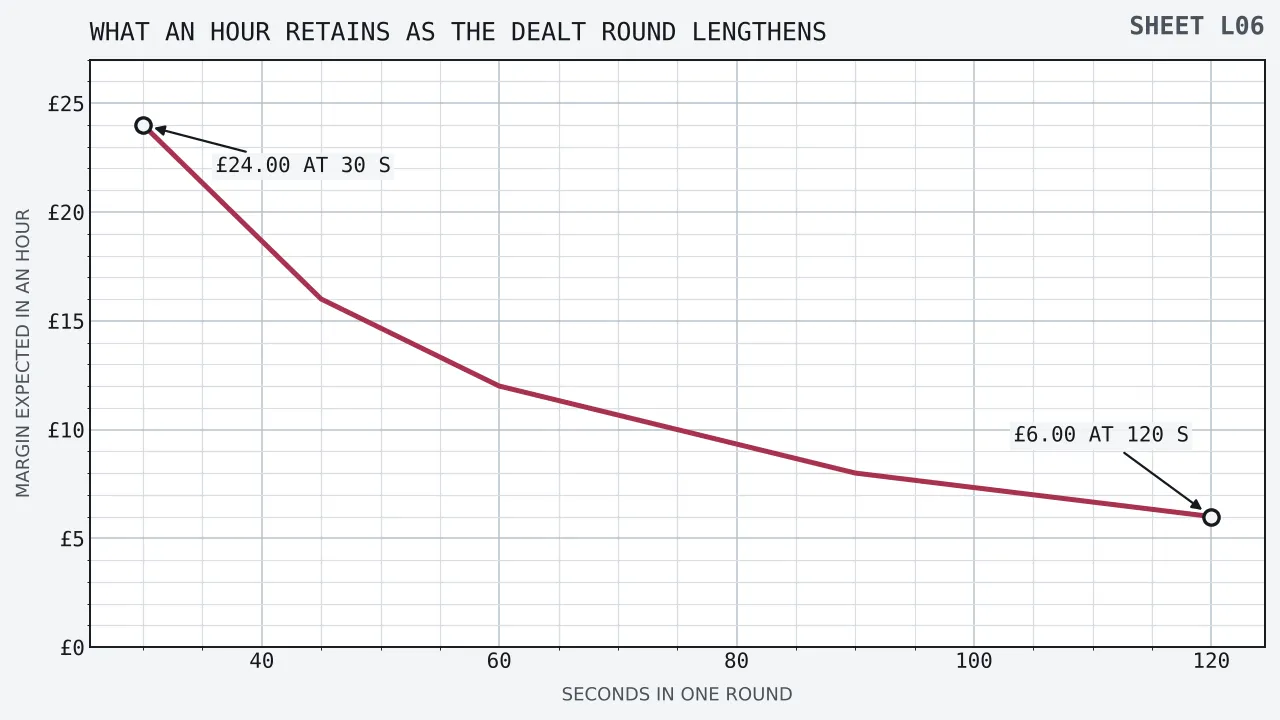
The last column puts the same curve into the unit this site measures evenings in. Twenty-two minutes is the pick-up of a handset assumed throughout, and it holds forty-four rounds at the half minute table and eleven at the two minute one. Those two sittings cost £8.80 and £2.20 in expectation, against the 44p a reel sitting of a hundred and ten presses of ten pence is modelled to cost.
Eleven rounds is a short evening by any reading, and it is the cheapest row in the table. Forty-four rounds is four times as much play for four times the money, in the same twenty-two minutes. Whether that is good value depends entirely on whether a reader counts rounds or counts minutes, which is the question part three has to settle.
3
Cheaper by the hour, dearer by the round, and both at once
Part two held the stake still. Hold the hour still instead and the table inverts. Suppose a reader has decided what an hour of this may cost them, and suppose the figure is twenty-four pounds of expected margin, which is £600.00 of staking at the four pence retained in every pound. The question becomes what may ride on a round to reach exactly that.
| Seconds in one round | Rounds inside an hour | Stake that fills the hour | Margin expected on one round | How the round reads against the half minute table |
|---|---|---|---|---|
| Thirty | 120 | £5.00 | 20p | The row everything else is measured from |
| Forty-five | 80 | £7.50 | 30p | Half as dear again |
| Sixty | 60 | £10.00 | 40p | Twice as dear |
| Ninety | 40 | £15.00 | 60p | Three times as dear |
| A hundred and twenty | 30 | £20.00 | 80p | Four times as dear |
Put the pair of tables alongside one another and the disagreement is total. On the first, the two minute table is a quarter the price of the half minute one. On the second, the two minute table charges four times as much per round. Neither is a trick and neither is wrong. They hold different quantities fixed, and the quantity a reader holds fixed in their own head decides which answer they get.
Somebody rationing an evening by the clock is on the first table. They have two hours and a five pound bet, and the long round is the cheap one: £12.00 of expected margin across the evening rather than £48.00. For them the dealer’s slowness is a discount that arrives without being asked for.
Somebody rationing by the count of rounds is on the second. They want sixty hands or sixty wheels before bed, and at a long round sixty of them take two hours rather than thirty minutes. If the evening cannot stretch, the only way to buy sixty rounds’ worth of action is to put more on each one, and the table says exactly how much more.
£20.00 a round, to make a two minute table cost what a half minute one costs
Both habits exist and the second is commoner than the first, because a round is what a person experiences and an hour is what a bank statement records. A reader who thinks in rounds will migrate upwards in stake at a slow table without ever deciding to spend more, since each individual increase is a response to a table that feels like it is giving them too little.
Which is the mechanism this page exists to name. A slow table does not reduce spending; it reduces the rate at which a given stake spends, and leaves the stake free to rise to fill the gap. The reduction is real only for somebody who leaves the stake alone, and leaving the stake alone is a decision nobody is prompted to make.
4
Pence a second, the figure that settles the disagreement
One quantity reconciles the two readings and it is stake divided by round length. Call it pence a second. It is what the arrangement actually charges for occupying a person’s time, it is indifferent to which product is being played, and it collapses every table and every reel on this site onto one scale.
Five pounds on a sixty second round is 8.333 pence a second. Ten pence riding on a press of the twelve assumed seconds is 0.833 pence a second. The dealt table is ten times the reel, and that single ratio predicts every comparison below without needing either product’s name.
| What is being played | On one event | Seconds it occupies | Pence a second | Staked an hour | Margin expected an hour |
|---|---|---|---|---|---|
| A reel at the assumed press | 10p | 12 | 0.833p | £30.00 | £1.20 |
| A table at two minutes a round | £1.00 | 120 | 0.833p | £30.00 | £1.20 |
| A table at two minutes a round | £5.00 | 120 | 4.167p | £150.00 | £6.00 |
| A table at a minute a round | £5.00 | 60 | 8.333p | £300.00 | £12.00 |
| A table at half a minute a round | £5.00 | 30 | 16.667p | £600.00 | £24.00 |
| A table at a minute a round | £20.00 | 60 | 33.333p | £1,200.00 | £48.00 |
Rows one and two are the finding worth taking away from the whole page. A pound on a two minute round and ten pence on a twelve second press are the identical arrangement: 0.833 pence a second, £30.00 of staking an hour, £1.20 of expected margin an hour. One of them looks like a careful evening at a table and the other looks like idling with a phone, and the bill is the same to the penny.
Everything else on the table is that row multiplied. Five pounds on the same two minute round is five times the pence a second and five times the hour. Shortening that round to one minute doubles it again; shortening to thirty seconds doubles it once more. Stake and interval are interchangeable in exactly the proportion they appear in the division.
0.833 pence a second, where a dealt table meets a reel
Which gives a reader a test they can run before sitting down, and it needs no tables. Divide the planned stake by the length of a round in seconds. Four pence a second puts £144.00 of staking through an hour for £5.76 retained in expectation. Eight pence a second doubles both to £288.00 and £11.52, and sixteen doubles them again to £576.00 and £23.04. Those are arithmetic rather than advice, and they hold for any product that has a stake and an interval.
Nothing in this part depends on which game is dealt. A wheel, a shoe and a wheel of a different sort all price identically under the division, because the division uses only money and seconds. That is why this page never argues from the game and always argues from the round.
5
A five second floor the dealer never comes close to
British rules do set a minimum interval on casino games that are not slots, and working out what that permits is more instructive than reciting it. Five seconds have to elapse between a game starting and the earliest point at which a further cycle may begin. Slots are governed by a separate figure, and peer-to-peer poker is carved out of this one. The date the Commission’s updates page attaches is 17 January 2025.
Turn it into a ceiling. Sixty minutes divided by five seconds is seven hundred and twenty rounds, which is the fastest an hour of a dealt casino game may lawfully run. At five pounds a round that hour would stake £3,600.00 and retain an expected £144.00. At twenty pounds a round it would stake £14,400.00 and retain £576.00.
Now hold those against the working case. Sixty seconds a round is sixty rounds an hour, which is a twelfth of what the rule permits. Even the briskest table priced on this page, at thirty seconds a round, reaches a hundred and twenty rounds, which is a sixth of the ceiling. The rule is nowhere near the thing that limits a dealt table.
What limits it is a person dealing. Cards have to be shuffled and shown, a wheel has to come to rest, bets have to be taken from everybody at the table and settled to everybody at the table. Those operations take as long as they take, and they are an order of magnitude slower than the floor any rule sets.
Compare the two floors and the asymmetry is the point. A reel may not restart inside two and a half seconds, so its lawful ceiling is 1,440 presses an hour, four pence a second at ten pence a press, £144.00 of staking an hour and £5.76 of expected margin. The non-slot floor is twice as long, giving half the events, yet the dealt product costs far more an hour because the money on one event is fifty times larger.
Which is the reason a floor on pace is a weak instrument at a dealt table. Doubling the minimum interval halves the events and leaves the stake untouched, and the stake at a table is where the money is. On the working case a reader would have to see the round stretched from sixty seconds to ten minutes before the hour fell to what a reel costs at ten pence.
One honest consequence of that: the slowness of a dealt table is not a protection anybody designed. It is an artefact of a person doing the work, and it would disappear entirely if the work were done by software, at which point only the two and a half or five second floors would be left standing, and those permit 1,440 and 720 events an hour respectively.
6
What the per-spin ceiling does not reach
Part three put twenty pounds on a round without remark, and it is worth saying plainly that nothing in the British stake rules forbids it. What may ride on one game cycle is capped by those rules at five pounds for a player of twenty-five or more and at two for one under that age, and they were fixed to every licence authorising a remote casino by an instrument dated the twenty-fifth of February 2025.
Reach is the part that matters here. An online slots game is what the instrument governs, meaning a casino game played online and built on reels: text or imagery shifting through reel representations, or through whatever stands in their place, until an arrangement lands that settles a prize or some other advantage. The Commission’s guidance confines these limits to online slots and says they leave the rest of the casino alone, roulette and blackjack being the two games it names.
So a dealt table sits outside the ceiling even inside the British licence. Every figure in part three is lawful here: a £10.00 round, a £15.00 round, a £20.00 round. The same twenty pounds may not ride on a licensed reel at all, by anybody, at any age, which means the two products diverge by a factor of four at their legal extremes before anything about the clock is considered.
| The product | Whether the per-spin ceiling reaches it | Most that may ride on one event | Shortest lawful interval | Most an hour may stake | Margin expected in that hour |
|---|---|---|---|---|---|
| A licensed reel, player of twenty-five or more | Yes | £5.00 | 2.5 s | £7,200.00 | £288.00 |
| A licensed reel, player under twenty-five | Yes | £2.00 | 2.5 s | £2,880.00 | £115.20 |
| A licensed dealt table, any age over eighteen | No | No figure in the rules | 5 s | No figure in the rules | No figure in the rules |
| The same table at the round assumed here | No | £20.00 as drawn in part three | 60 s assumed | £1,200.00 | £48.00 |
Row three carrying no figures in four of its columns is the honest answer and the uncomfortable one. There is no published maximum on what may ride on a dealt round at a British licensed table, so there is no published maximum on what such an hour may cost. What there is instead is the five second floor, and part five showed that the floor sits a dozen times above where a dealer actually operates.
Row four is what the arithmetic of this page produces in that space. Twenty pounds a round on the assumed sixty second round is £1,200.00 of staking an hour and £48.00 of expected margin, which is four times what the brisk thirty second table charges at five pounds and forty times what a reel charges at ten pence.
None of which makes the reel the safer product in general. It makes the ceiling a product-specific instrument that was aimed at reels and that leaves dealt games where it found them. A reader who has absorbed the five pound figure from coverage of slots and carries it to a table has imported a protection that does not travel with them.
7
Four tables at once, and the hour that does not lengthen
Everything so far assumed one table. The dealer’s pace is the brake on this product, so the obvious way round the brake is to sit at more than one table and let the brakes run in parallel. The arithmetic of that is brutally simple and worth putting before anybody tries it.
Two tables of sixty seconds, five pounds riding on each round, is a hundred and twenty rounds an hour, £600.00 crossing the felt and £24.00 retained in expectation. Four tables is two hundred and forty rounds, £1,200.00 crossing and £48.00 retained. The hour has not got any longer and no round has got any shorter. The only thing that changed is how many of them were running inside the same sixty minutes.
| Tables running together | Rounds inside an hour | Staked across that hour | Margin expected across it | Pence a second | Margin expected across a modelled year |
|---|---|---|---|---|---|
| One | 60 | £300.00 | £12.00 | 8.333p | £3,212.00 |
| Two | 120 | £600.00 | £24.00 | 16.667p | £6,424.00 |
| Three | 180 | £900.00 | £36.00 | 25p | £9,636.00 |
| Four | 240 | £1,200.00 | £48.00 | 33.333p | £12,848.00 |
British rules close this route on a licensed build, and they close it twice. A licensed system is forbidden to supply anything that makes play at several games together possible, with the guidance reaching split screens, multiple screens and any combining of games that lets them run side by side. Casino games are inside that scope and peer-to-peer poker is outside it.
A second rule took effect on 17 January 2025, forbidding anything the operator builds that lets a customer run more than one product at the same moment, and the release announcing it illustrated the point with tables of roulette and blackjack. Both rules bear on the table above with unusual directness, because this is the one product where the brake is a human being and the only way past a human being is to employ several of them at once.
Where no Great Britain licence is held neither rule applies, and the fourth row becomes available to anybody who wants it. Twelve thousand eight hundred and forty-eight pounds of expected margin across a modelled year, out of 267 h 40 min of sitting, is four times the single table figure for the same evenings, the same stake and the same dealer speed.
Worth naming is what the reader experiences while that happens, because it is the opposite of what the figures say. Four slow tables feel like one busy one. The pauses fill in, the attention is continuous, and nothing about the pace of any individual round changes. The quadrupling is invisible precisely because the brake it defeats was never visible either.
8
Twelve months of dealing weighed against twelve months of reels
Repetition is what this section prices, so the working case gets run to a year. The habit modelled is the site’s own: two sittings a day, each of the twenty-two minutes assumed for one pick-up of a handset, every day. That is seven hundred and thirty sittings and 267 h 40 min in the chair.
At the assumed sixty second round and five pounds on each, those hours hold sixteen thousand and sixty rounds. Staking comes to £80,300.00 and the expected margin to £3,212.00. Those identical hours hold eighty thousand three hundred presses on a reel of ten pence, £8,030.00 of staking and £321.20 retained in expectation. Exactly ten times, which is the pence a second ratio from part four reappearing.
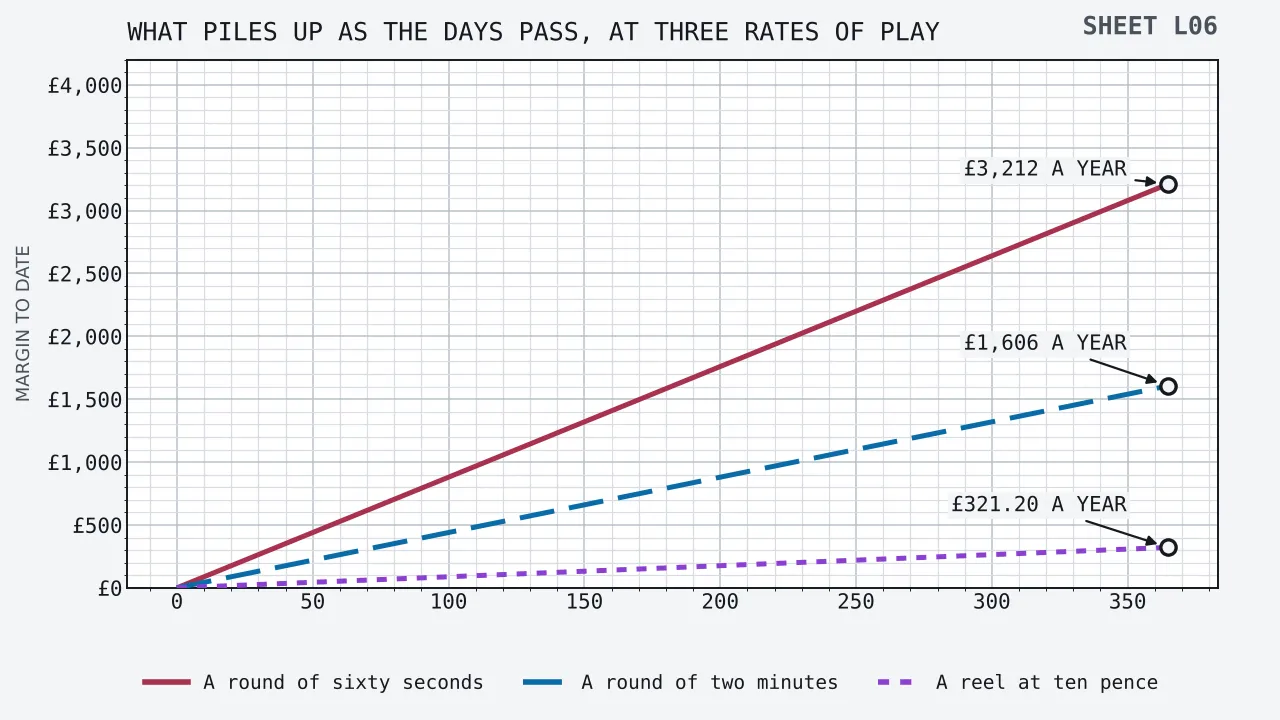
Now take the other comparison, which is the one a reader is more likely to want. Hold the money still instead of the hours. Give a person the reel year’s £8,030.00 of staking and send them to the assumed table at five pounds a round. That buys 1,606 rounds, which at sixty seconds each is 1,606 minutes, being 26 h 46 min.
So the same money buys a tenth of the hours, and costs the identical £321.20 in expectation, because the expected cost answers to turnover and the turnover was fixed at £8,030.00 before anybody sat down. Ten times the money for the same hours, or a tenth of the hours for the same money, and no third option.
| What is held still | The arrangement | Hours | Staked | Rounds or presses | Margin expected |
|---|---|---|---|---|---|
| The hours | Reel at ten pence a press | 267 h 40 min | £8,030.00 | 80,300 | £321.20 |
| The hours | Table at two minutes, one pound a round | 267 h 40 min | £8,030.00 | 8,030 | £321.20 |
| The hours | Table at two minutes, five pounds a round | 267 h 40 min | £40,150.00 | 8,030 | £1,606.00 |
| The hours | Table at a minute, five pounds a round | 267 h 40 min | £80,300.00 | 16,060 | £3,212.00 |
| The money | Table at a minute, five pounds a round | 26 h 46 min | £8,030.00 | 1,606 | £321.20 |
| The money | Table at two minutes, five pounds a round | 53 h 32 min | £8,030.00 | 1,606 | £321.20 |
Row two is the one to sit with. A pound a round on a two minute table, run for the whole of the modelled year, produces figures identical to a reel at ten pence across the hours, the staking and the expected margin alike. Only the count of events differs, 8,030 against 80,300, and the reader at the table had a tenth as many results for exactly the same money.
Row five answers the question most readers actually have, which is how long a given sum lasts at a table rather than what a year costs. Eight thousand and thirty pounds of staking at five pounds a round is 26 h 46 min of sitting, which at two pick-ups of twenty-two assumed minutes a day runs for thirty-six days and a bit. The same staking at a reel ran for a year.
Nothing in the table forecasts what happens to one person. An expectation averages across everybody repeating the same behaviour, and one year’s results scatter widely about it. What the expectation fixes reliably is the order of magnitude, and the order of magnitude between row one and row four is ten.
9
Duties written over the interval and over the stake
Tables of this kind are frequently offered from an operation holding no Great Britain licence, and the duties that fall away are, on this page’s subject, duties about time and about how many clocks may run at once. Three have already been computed against rather than asserted, and they are gathered here with what their absence is worth in pounds.
The interval first. Under a British licence, no casino game outside the slot category may begin a further cycle inside five seconds, peer-to-peer poker aside, and 17 January 2025 is the date carried for it on the Commission’s updates page. Part five turned it into 720 rounds an hour and £144.00 of expected margin at five pounds a round.
What the absence of that floor is worth is therefore bounded and small for a dealt game, because a dealer is twelve times slower than the floor. It is not small for anything on a table that is dealt by software rather than by a person, and a page that treats a studio feed and a generated result as the same product gets this exactly backwards.
Which is the distinction to carry away from this part. A floor on the interval protects against a machine, and a machine is not what sets the pace at a staffed table. The duty that protects against a staffed table is the one in the next paragraph, because it is the only one addressing how many staffed tables may run at a person simultaneously.
The multiple-game duty second. Nothing a licensed system supplies may make play at several games together possible, the guidance naming split screens, multiple screens and any combining of games that lets them run side by side, and a companion rule dated 17 January 2025 forbids operator-built features for running more than one product at a time. Part seven priced its absence: four tables rather than one is £12,848.00 of expected margin across a modelled year against £3,212.00.
Nine thousand six hundred and thirty-six pounds is the difference those two rules are worth across the year on this page’s assumptions, and it arrives without one extra minute of sitting. That is the sharpest single figure here, and it is sharper than anything the stake rules could produce, because the stake rules do not reach this product at all.
The stake third, and it is a duty by its absence rather than its presence. The five pound and two pound ceilings are slots rules, so a British licensed table is not capped and an unlicensed one is not capped either. The licence therefore makes no difference whatever to what may ride on one dealt round, which is worth stating because a reader may reasonably assume otherwise.
Taken together, what the licence buys at a dealt table is an interval the dealer already exceeds, a bar on running several tables at a person, and nothing at all about the size of a bet. A reader weighing a build holding no Great Britain licence should price the middle item at £9,636.00 a year on these assumptions and should not expect the other two to do any work.
10
Which of the two readings to carry into a second year
Two readings were set running in part three and they have to be settled. By the hour a long round is cheap: £6.00 of expected margin at two minutes against £24.00 at thirty seconds, with five pounds riding on each. By the round a long one is dear, since matching that brisk hour from a two minute table takes twenty pounds a round and eighty pence of expected margin on each.
Part four settled them, and the settlement is a division. Pence a second is what the arrangement charges for occupying a life, and it is stake over interval. Everything else on this page is that quotient multiplied by a count of seconds: 3,600 of them in an hour, 1,320 in a sitting of twenty-two assumed minutes, 963,600 in the modelled year.
Which reading a reader should carry depends on nothing about tables and everything about habits. Somebody who plays until a fixed hour arrives should use the hourly reading and should prefer the long round. Somebody who plays until a fixed number of rounds has gone by should use the per-round reading, and for them the long round is a trap that raises the stake.
Three figures summarise the whole note. Twenty pence is retained from a five pound round whatever the table. 8.333 pence a second is what the assumed working case charges, ten times a reel at ten pence. And £3,212.00 is what a year of two twenty-two minute sittings a day comes to at that rate, against £321.20 at the reel.
One last comparison closes it, because it is the one nobody makes. A pound on a two minute round and ten pence on a twelve second press are the same product priced identically, and the first of them looks careful while the second looks idle. What distinguishes a cheap habit from an expensive one is not the game, the room, the dealer or the studio. It is a quotient, and it can be worked out in advance on the back of a receipt.
Questions
- How much does an hour at a live table cost?
- Three hundred pounds of staking and £12.00 of expected margin on the working case this page assumes, which is a round of sixty seconds with five pounds riding on it. Sixty rounds fill the hour, and the ninety-six per cent this site returns leaves four pence of each crossed pound behind. Shorten the round to thirty seconds and the hour becomes £600.00 and £24.00; stretch it to two minutes and it becomes £150.00 and £6.00.
- Is a slower table cheaper?
- By the hour yes, by the round no, and the two answers hold different things still. With five pounds on every round, a two minute table retains £6.00 an hour against £24.00 at a half minute table. Hold the hour’s cost at £24.00 instead and the two minute table needs twenty pounds a round to reach it, where the half minute table needs five, so the slower round costs four times as much each time it is played.
- What decides how fast a live casino round goes?
- The table, not the person at it. Bets open, bets close, the dealing happens and the result is settled, and once money is down the round runs to its end at the table’s own pace. Where a reel waits for a thumb, so that its hourly bill tracks the tapping, a dealt round cannot be divided, which makes it the shortest stretch of time anybody may purchase at a table.
- What is the minimum time between rounds under British rules?
- Five seconds have to elapse between a game starting and the earliest point a further cycle may begin, across casino games outside the slot category, peer-to-peer poker being carved out. 17 January 2025 is the date the Commission’s updates page attaches. That permits seven hundred and twenty rounds an hour, which is twelve times the sixty rounds an assumed minute-long round produces, so the floor is nowhere near what limits a staffed table.
- Does the per-spin stake ceiling reach a dealt table?
- No. The five pound and two pound ceilings were fixed to every licence authorising a remote casino by an instrument dated the twenty-fifth of February 2025, and an online slots game is what they govern, that being a casino game played online and built on reels. The Commission’s guidance confines them to online slots and says the rest of the casino is left alone, roulette and blackjack being the two games named, so no published maximum governs what rides on a dealt round.
- How does a live table compare with slots over a year?
- Ten to one on this page’s assumptions. A pair of sittings daily, each of twenty-two assumed minutes, comes to seven hundred and thirty of them and 267 h 40 min. At a minute-long round with five pounds on each that is sixteen thousand and sixty rounds, £80,300.00 of staking and £3,212.00 of expected margin. Those same hours at ten pence a press are eighty thousand three hundred presses, £8,030.00 staked and £321.20 retained in expectation.
- How long does a fixed sum last at a live table?
- Twenty-six hours and forty-six minutes for £8,030.00 of staking, at five pounds a round on the assumed minute-long round, which is 1,606 rounds of sixty seconds. Run at two pick-ups of twenty-two assumed minutes a day that is thirty-six days and a bit. The identical staking at a reel of ten pence a press lasts the whole modelled year, and both cost the same £321.20 in expectation because turnover decides the cost.
- Is there a figure that compares a table with a reel directly?
- Pence a second, which is the stake divided by the length of one event. Ten pence on the twelve second press assumed here is 0.833 pence a second, which fills an hour with £30.00 of staking for an expected £1.20. One pound on a two minute round is the identical 0.833 pence a second and the identical hourly pair. Five pounds on a minute-long round is 8.333 pence a second, ten times both.
- What happens when somebody plays several live tables at once?
- The hour multiplies while the clock stands still. Two tables of sixty seconds at five pounds a round is a hundred and twenty rounds an hour, £600.00 crossing the felt and £24.00 retained in expectation; four tables is two hundred and forty rounds, £1,200.00 crossing and £48.00 retained. Across the modelled year of 267 h 40 min that is £12,848.00 of expected margin against £3,212.00 for a single table, from the same evenings and the same stake.
- Does a British licence stop several tables running at once?
- Yes, twice over. A licensed gambling system may not offer functionality facilitating play at several games at the same time, the guidance naming split-screen and multi-screen arrangements and any combination of games enabling simultaneous play, and that requirement covers casino games while excluding peer-to-peer poker. A companion rule dated 17 January 2025 forbids operator-built features for running more than one product at a time, illustrated in the announcement by tables of roulette and blackjack.
- What does a table holding no Great Britain licence actually cost?
- Nine thousand six hundred and thirty-six pounds a year on this page’s assumptions, almost all of it from one duty. The interval floor is worth little at a staffed table, because a dealer runs about twelve times slower than the five seconds the rule permits. The stake ceilings do not reach the product at all, so the licence changes nothing about bet size. What it changes is the bar on running several tables at a person, and four tables rather than one is £12,848.00 of expected margin across a modelled year against £3,212.00.
- Which reading should a player use when choosing a table?
- Whichever matches how they stop. Somebody who plays until a fixed hour arrives should read the hourly figures and prefer the longer round, since five pounds a round costs £6.00 an hour at two minutes against £24.00 at thirty seconds. Somebody who plays until a fixed number of rounds has gone by should read the per-round figures, because for them a long round invites a larger stake and twenty pounds a round at two minutes costs the same £24.00 an hour.