Note U04 Revision 1 Terms read 17 October 2026
Paying a cashier in chain units, and the two clocks that stop being yours
Every conventional way of paying leaves a period afterwards in which the payer may ask for the money back. A transfer along a public chain leaves nought hours of it, for anybody, at any time. The second loss is quieter: a balance priced in a unit that moves is exposed on every hour of the calendar rather than every hour of pressing, and a 13 h 20 min clause stretched across evenings is exposed for 888 of them.
What lands £10.00 The run 13 h 20 min The wait to be paid Nought hours back
What offers of this size ask in hours
Advertising has been bought for every destination below. A fee reaches this site when a reader goes on to register, and no figure on this page moves one way or the other because of it.
-
01Mobile Free Spins
Betportal
Ceiling as a multiple
What lands€15.00150 spins at 10c, which is this site's figure and not the operator'sThe run17 h 30 minTurning over 525.00 at 10p means 5,250 presses, or about 48 phone sittings of 22 minutes. Timed at 10p a press and 12 seconds between presses, both of which this site assumes rather than measures.The wait to be paidNOT PUBLISHEDThis operator puts no withdrawal band in its own terms, so there is nothing honest to print here.Spins valued at this site's own 10p a spin
What lands
Spins, at a price15.00150 of them at 10c apiece, a figure belonging to this site rather than to the operatorMatch, and other creditno figure300% of three deposits, to a ceiling of €1,000. Not a sum until money of yours makes it one, so this row totals nothing and carries nothing downwardsThe run
Handed back on the spins(0.60)Each press stakes its own value and returns 96 per cent, which leaves this much with the house from the opening pressPlay-through 35x on the bonus(20.16)Taking 14.40 round 35 times over means 504.00 through the machines, of which 20.16 is the expected cost, and 17 h 30 min of pressing at the pace aboveWhat counts towards it100%Slots only, with no percentage published anywhere, so the row above assumes the whole of each stake countsWhat never clears
Limit on the winningsstated5x the bonusDeducted on the way outno figureNothing is published as a figure here, so this row removes nothingLeast that can leaveno figureNo figure is published, so nothing on this timer is pinned down by oneLeast deposit, and the rung over ityour own€20 a stage. Published in euros, so no rung is named at all: this site's ladder is a sterling oneThe window on the creditstated14 daysBiggest stake while it runsstated€5Removed outright by rulestatedNot publishedVerified before a payoutstatedDocuments before the first withdrawalNever clears€15.00Not a penny of it gets out, so the whole of what landed stands on this rowNo Great Britain licence
Licence held in Anjouan, Comoros, the company named is BetPortal Gaming Ltd, with Excite Ultra Media Ltd, quoted under ALSI-202601040-FI2.
Terms read 17 October 2026
Open the offer at Betportal, opens in a new window -
02Mobile Free Spins
WinBeast
Ceiling as a sum
What lands€50.00500 spins at 10c, which is this site's figure and not the operator'sThe run2 d 18 hTurning over 2,000.00 at 10p means 20,000 presses, or about 182 phone sittings of 22 minutes. Timed at 10p a press and 12 seconds between presses, both of which this site assumes rather than measures.The wait to be paidNOT PUBLISHEDThis operator puts no withdrawal band in its own terms, so there is nothing honest to print here.Spins valued at this site's own 10p a spin
What lands
Spins, at a price50.00500 of them at 10c apiece, a figure belonging to this site rather than to the operatorMatch, and other creditno figure50% to 100% of five deposits, each to a ceiling of €1,000, and a €650 free bet. Not a sum until money of yours makes it one, so this row totals nothing and carries nothing downwardsThe run
Handed back on the spins(2.00)Each press stakes its own value and returns 96 per cent, which leaves this much with the house from the opening pressPlay-through 40x on the bonus and the winnings from the spins(76.80)Taking 48.00 round 40 times over means 1,920.00 through the machines, of which 76.80 is the expected cost, and 2 d 18 h of pressing at the pace aboveWhat counts towards it100%Slots, titles vary by country, with no percentage published anywhere, so the row above assumes the whole of each stake countsWhat never clears
Limit on the winningsstated€100 a batch of spinsDeducted on the way outno figureNothing is published as a figure here, so this row removes nothingLeast that can leaveno figureNo figure is published, so nothing on this timer is pinned down by oneLeast deposit, and the rung over ityour own€20 a stage. Published in euros, so no rung is named at all: this site's ladder is a sterling oneThe window on the creditstated7 days, spins 1 dayBiggest stake while it runsstatedNot publishedRemoved outright by rulestatedNot publishedVerified before a payoutstatedDocuments before the first withdrawalNever clears€50.00Not a penny of it gets out, so the whole of what landed stands on this rowNo Great Britain licence
Licence held in Curaçao, no company named anywhere on the site.
Terms read 17 October 2026
Open the offer at WinBeast, opens in a new window -
03Mobile Free Spins
EliteSpin
Longest spin window
What lands£50.00500 spins at 10p, which is this site's figure and not the operator'sThe run2 d 18 hTurning over 2,000.00 at 10p means 20,000 presses, or about 182 phone sittings of 22 minutes. Timed at 10p a press and 12 seconds between presses, both of which this site assumes rather than measures.The wait to be paidNOT PUBLISHEDThis operator puts no withdrawal band in its own terms, so there is nothing honest to print here.Spins valued at this site's own 10p a spin
What lands
Spins, at a price50.00500 of them at 10p apiece, a figure belonging to this site rather than to the operatorMatch, and other creditno figure50% to 100% of five deposits, each to a ceiling of £1,000. Not a sum until money of yours makes it one, so this row totals nothing and carries nothing downwardsThe run
Handed back on the spins(2.00)Each press stakes its own value and returns 96 per cent, which leaves this much with the house from the opening pressPlay-through 40x on the bonus and the winnings from the spins(76.80)Taking 48.00 round 40 times over means 1,920.00 through the machines, of which 76.80 is the expected cost, and 2 d 18 h of pressing at the pace aboveWhat counts towards it100%Slots, with no percentage published anywhere, so the row above assumes the whole of each stake countsWhat never clears
Limit on the winningsstated5x the bonusDeducted on the way outno figureNothing is published as a figure here, so this row removes nothingLeast that can leaveno figureNo figure is published, so nothing on this timer is pinned down by oneLeast deposit, and the rung over ityour own£20 a stage. It lands square on the £20.00 rung, so none of yours is left perched on topThe window on the creditstated7 days, spins 3 daysBiggest stake while it runsstatedNot publishedRemoved outright by rulestatedNot publishedVerified before a payoutstatedDocuments before the first withdrawalNever clears£50.00Not a penny of it gets out, so the whole of what landed stands on this rowNo Great Britain licence
Licence held in Costa Rica, the company named is PrimeTier Limited.
Terms read 17 October 2026
Open the offer at EliteSpin, opens in a new window -
04Mobile Free Spins
Crown Jewelz
Multiple unpublished
What lands£15.00150 spins at 10p, which is this site's figure and not the operator'sThe runNOT TIMEDThis operator does not publish the play-through multiple in its own terms. The multiple is the one figure the clock cannot work around, so the run is left untimed.The wait to be paidNOT PUBLISHEDThis operator puts no withdrawal band in its own terms, so there is nothing honest to print here.Nothing reckoned
What lands
Spins, at a price15.00150 of them at 10p apiece, a figure belonging to this site rather than to the operatorMatch, and other creditno figure200% of the first deposit, then 150% twice, each to a ceiling of £1,000. Not a sum until money of yours makes it one, so this row totals nothing and carries nothing downwardsThe run
Play-throughno figure40x the bonus, reported rather than published by the operatorWhat counts towards itno figureSlots, with no percentage published anywhere, so the row above assumes the whole of each stake countsWhat never clears
Limit on the winningsstatedNot publishedDeducted on the way outno figureNothing is published as a figure here, so this row removes nothingLeast that can leaveno figureNo figure is published, so nothing on this timer is pinned down by oneLeast deposit, and the rung over ityour own£20. It lands square on the £20.00 rung, so none of yours is left perched on topThe window on the creditstatedNot publishedBiggest stake while it runsstatedNot publishedRemoved outright by rulestatedNot publishedVerified before a payoutstatedDocuments before the first withdrawalNever clearsNOT RECKONEDThis operator leaves the play-through multiple out of its own terms, so nothing below the fourth step can be worked out.No Great Britain licence
Licence held in Curaçao, number not verified, no company named anywhere on the site.
Terms read 17 October 2026
Open the offer at Crown Jewelz, opens in a new window
Only the middle reading comes out of arithmetic belonging to this site. The multiple laid against what lands gives the turnover asked for; dividing that by 10p a spin gives the presses; dividing those by 300 an hour gives the hours, a press on a handset being taken here at 12 seconds from the one before. Both figures are assumptions rather than measurements of anybody: nothing was played and nothing was held a stopwatch to. Anybody quicker should divide the press count by a rate of their own, which is why the presses are printed alongside the hours instead of being summarised away.
The first reading is what arrives before any condition is laid against it. Spins carry no unit of their own so one gets supplied: where an operator values its own spin that figure is used and attributed, and where it does not, this site's 10p a spin stands in and everything below moves with it. The third reading belongs to the operator entirely. It is a withdrawal band quoted from published terms, and a blank there means none was published rather than that nobody looked.
The total along the foot answers what the hours leave open, which is whether any of the running ends anywhere. It is what arrived, less whatever is still standing once the play-through has been paid for at 96 per cent return to player and once a published limit, a published deduction and a published floor beneath the least that can leave have each had a turn. It appears again in pence in the pound, the only fair way of holding a small offer up against a large one. It describes an offer rather than an evening, and where the conditions price out what arrived, a timer prints nothing getting out instead of a negative sum.
Cashiers on a handset take deposits off a row of preset buttons, so a least deposit given in pounds is raised to the next rung of the ladder used here, £10, £20, £25, £50, £75 and £100, and the timer shows what is left perched on it. That money is the reader's own and enters no sum at all. Given in euros it prints untouched, the ladder being sterling. Three words may occupy the figure column where no figure belongs. Stated is a published term that costs something while leaving no number to subtract. No figure is a term nobody has quantified, or a credit that is not a sum until money of yours makes it one. Your own is money of yours, which belongs in none of this.
None of the operators above is licensed in Great Britain, so not one duty that licence carries reaches any of them. Membership of Gamstop Online is compulsory for every online gambling company licensed in Great Britain, which means that shutting yourself out through the scheme shuts you out of none of these. The limit of ten times the bonus funds on a wagering requirement, running since 19 January 2026 under Social Responsibility Code 5.1.1, is a condition of the same licence and binds only whoever holds one. Off that licence, the Gambling Commission writes of consumers meeting unfair gaming practices, financial loss and no recourse when matters go wrong, and lists blocked payouts and withdrawal limits pitched too high to reach among the things it has seen. No account at any of them may be held by anybody under 18.
Every term on a timer is its operator's own and every timer carries the day somebody read it. The oldest of those readings is 17 October 2026. What binds a reader is an operator's full terms and never a line printed here.
1
Three ways money moves, and only two of them look back
Payment is the whole subject of this note, and the property being priced is not speed. It is whether anything at all can be done about a payment once it has gone. Two of the three arrangements described below leave a period in which the payer may start an argument. The third leaves none, and leaves none deliberately, because irreversibility is the feature its engineering was built to deliver.
Reaching a gambling business of any description is something these ten parts do not assist with. No business is named, no address is printed, and no route to one is sketched. Documents, handsets, the way a household connection is arranged, and the question of how anybody comes by a unit of anything, are all missing, and were settled as missing before a word was drafted. Where a bank halts gambling payments it is protecting somebody, and so is a connection supplier doing the same thing, so neither gets a sentence here explaining itself away.
A single instruction appears in these ten parts and this paragraph carries it. Anybody registered with Gamstop Online who has arrived at a phrase of this shape has run into the exact difficulty a registration is there to hold, and the step that helps is a telephone call. GamCare staffs 0808 8020 133 around the clock and charges nothing for it. Sums fill the remaining nine parts, and they are there to put a size on what gets traded away.
Two quantities carry the note. The first is a window, being the period after a payment during which the payer may ask for it to be undone. The second is a movement, being the amount a unit’s price shifts against the pound while a balance sits in it. Parts two to four price the first. Parts five to seven price the second. Both are losses of time rather than losses of money, which is why they sit in this section of the site rather than anywhere else on it.
Fifty pence of the reader’s attention is worth spending on one definition before the sums begin. A window is not a refund. It is the period during which asking is possible at all, and asking may fail. A rail that holds a window open for 2,880 hours has promised nothing by doing so, and a rail that holds one open for nought hours has settled the question in advance.
Chain units and the networks carrying them are named on this page because they are the subject. Nothing here describes how to obtain one, hold one, move one or turn one back into pounds, and the omission is not an oversight. The subject is what a payment arrangement does to a clock, and that can be set out in full without a single step of a procedure appearing anywhere in it.
2
A payment that can still be argued with, counted in hours
Two thousand eight hundred and eighty hours is what this note puts on a card payment, being a window of 120 days, and the figure is the page’s own round assumption rather than anything published. The sheet of regulatory fact behind this site carries no claim about a card scheme’s dispute period, so no figure was available to take, and inventing a precise one would be worse than declaring a blunt one.
Seven hundred and twenty hours is the assumed equivalent for a transfer sent between bank accounts, being 30 days, and it is assumed on the same basis and for the same reason. What a sending bank will attempt, and with what success, is a matter between two institutions. The period during which a payer may raise the matter at all is what is being measured, and 30 days is this note’s own round figure for it.
Nought hours is the third entry, and it is the only one on the table that is not an assumption. A transfer written into a public chain is settled by the network that carries it, and no party to that network holds a power to unwind an entry once it has been accepted. There is no scheme behind it, no sending institution standing between the payer and the payee, and no procedure to invoke. The figure is nought at hour one and nought at hour ten thousand.
| How the money moved | Window assumed by this note | Hours it stays open | Who may begin the argument | Clearing runs it spans |
|---|---|---|---|---|
| Paid by card | 120 days, this page’s own figure | 2,880 | The payer, through the scheme behind the card | 216 |
| Sent between bank accounts | 30 days, this page’s own figure | 720 | The payer, by asking the sending institution | 54 |
| Written into a public chain | No such period exists | 0 | Nobody, at any hour, by any procedure | 0 |
Two hundred and sixteen is the right-hand figure in the top row and it is the one worth holding. A clearing run on this site is the 13 h 20 min a 40 times play-through on a £10 credit takes where a press costs ten pence and occupies the twelve seconds assumed throughout. The assumed card window is 216 of those laid end to end. The assumed transfer window is 54 of them. The chain rail is nought of them, which is not a short period but the absence of one.
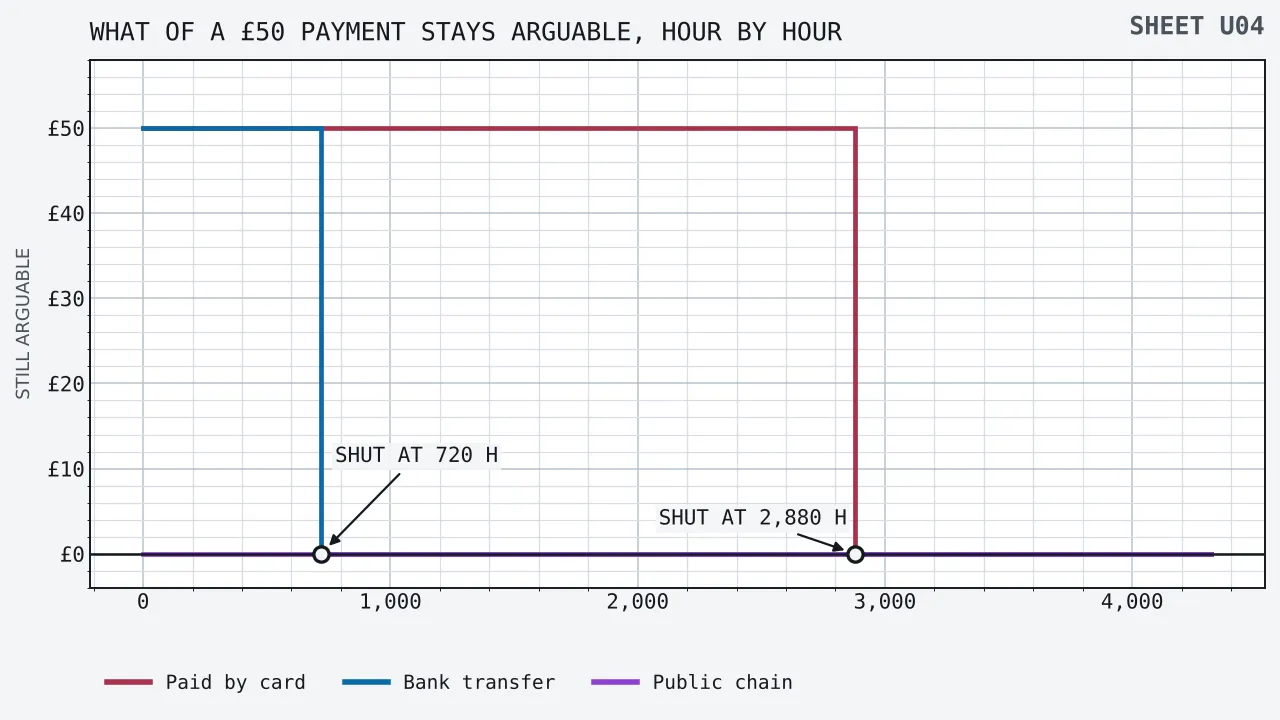
Both drops on that drawing are vertical and that shape is accurate. A window does not taper. It is open, and then on a stated day it is shut, and nothing about the merits of the argument changes at the moment it shuts. The flat line along the bottom never had a drop to make, and a reader who takes one thing from the plate should take the difference between a line that falls and a line that was never raised.
Seventy-two hours is a figure worth putting beside those three, because it is the period in which a reader usually decides that something has gone wrong. A deposit that does not arrive, a balance that reads oddly, a credit applied at a multiple nobody mentioned: all of that surfaces within days. Both assumed windows are still wide open at hour 72. The third was shut before the reader had finished reading the confirmation.
3
Two deposits in a hundred, and what the hours come to
Two in a hundred is the dispute rate this note assumes, and it is declared here as the page’s own figure because no primary source behind this site publishes one. A rate is needed because a window has no value to somebody who never wants to use it, and the honest way to price an option nobody may exercise is to multiply it by how often it gets exercised.
Fifty pounds is the deposit this note prices, chosen because it is large enough to argue about and small enough to be ordinary. A hundred deposits of that size put £5,000.00 through a cashier. At the assumed rate, two of them become money the payer wants back, which is £100.00 of argument across the whole span of a hundred deposits.
| What the count covers | Figure |
|---|---|
| Deposits of £50 put through a cashier | 100 |
| Money moved in total | £5,000.00 |
| Disputed at the assumed rate of two in a hundred | 2 |
| Money the payer would want to ask about | £100.00 |
| Hours that £100.00 stays askable, card window assumed | 2,880 |
| Hours that £100.00 stays askable, transfer window assumed | 720 |
| Hours that £100.00 stays askable along a chain | 0 |
| The same £100.00 turned into pressing at twelve seconds | 3 h 20 min |
| Expected cost of that pressing where the return is 96 per cent | £4.00 |
One pound per deposit is the same thing said without the hundred, and it is the form that survives any argument about the rate. Two per cent of £50 is £1.00 of askable money riding on every deposit made. Ten presses is what £1.00 buys at ten pence, which is two minutes of pressing at the assumed twelve seconds. So each deposit carries two minutes of argument along a rail that has a window, and nought minutes along one that does not.
Pounds multiplied by the hours they stay askable is a measure this note invents for one paragraph, because it is the only way to show both halves of the loss at once. A single disputed £50 is worth 144,000 pound-hours on the assumed card window and 36,000 on the assumed transfer window. On a chain transfer it is nought, and the nought comes from the second factor rather than the first. The money is real. The hours attached to it are not there.
2,880 assumed hours in which to ask, against nought hours in which to ask
Nothing in that comparison needs the rate to be two per cent. Halve it to one in a hundred and each deposit carries 50p of askable money, which is five presses and one minute. Quadruple it to eight in a hundred and each deposit carries £4.00, which is forty presses and eight minutes. The chain column is nought at every rate anybody could defend, because the rate multiplies a window of nought hours and nought multiplied by anything is unchanged.
Fourpence of each pound staked is the share this site holds fixed, and it supplies the sanity check on the whole part. The £100.00 of askable money across a hundred deposits is twenty-five times the £4.00 the same money would be expected to cost in play at that share. Losing the ability to ask is therefore not a rounding error against the cost of the gambling. It is a larger quantity than the gambling, measured across the same set of deposits.
4
One rule about credit, and the reason it exists at all
Fourteenth of April 2020 is the date from which a licensed British cashier could no longer take a gambling payment on borrowed plastic, and the condition that says so occupies two sentences. The second of them shuts a side door, since a credit-card settlement routed through a money service business before it lands is caught as well. Count the licence types reached and the scope is wider than the headline suggests. Remote licences all fall inside, the ancillary betting and lottery kinds among them, and three non-remote kinds follow, being general betting, pool betting and acting as an intermediary.
Borrowed money is what that rule is about, and seeing it clearly matters before the comparison that follows. The condition does not regulate a plastic rectangle. It regulates the arrangement in which somebody gambles with funds they do not yet have and settles the bill later, and it bars that arrangement from a licensed cashier outright.
Three properties travel with a card payment and the prohibition detaches only one of them. Credit is the detached one. The dispute window surveyed in part two is the second, and it survives, because a debit card sits inside the same scheme arrangement. The identity of a named institution standing between the payer and the payee is the third, and it survives too. A British licence therefore removes the borrowing and keeps the window, which is close to the opposite of what a chain rail does.
Nought of those three properties is present on a chain transfer, and the third absence is the one nobody mentions. No institution stands in the middle. That is usually described as the point of the arrangement, and as a description it is accurate. What follows from it arithmetically is that there is nobody to write to, which is why part two’s third row reads nought rather than reading slowly.
Payment facilities themselves can be taken away from a business trading without a British licence, and the regulator lists that among the consequences in its own guidance to players, naming one of the large card schemes as its example of the sort of organisation that might do the taking. Read as a clock, that is a period of unknown length ending at a moment nobody publishes. A reader holding a balance at such a business is inside that period whether or not they know the period exists.
A rule barring a cashier from accepting one payment method is not advice about which method to use, and nothing in this part is offered as advice of that sort. It is cited because the existence of the rule tells a reader something precise about the licensed side: that somebody decided which payment arrangements may stand behind a bet, and wrote the decision down with a date on it. Where no licence is held, nobody decided and nothing is written down.
5
Pressing time and calendar time, running at different speeds
Thirteen hours and twenty minutes is the clearing run this site models for a £10 credit at a multiple of forty, and every figure in it comes from the house assumptions. Ten pence a press and forty times £10 is £400.00 of staking. Four thousand presses supply that at ten pence each. Twelve seconds a press, which this site assumes and has never measured, puts those presses at 13 h 20 min and at thirty-seven sittings, a sitting here being the twenty-two minutes this site takes one turn on a handset to run.
Eight hundred and eighty-eight hours is the same clause measured on the other clock, and the distance separating those two readings is what parts six and seven are about. Thirty-seven sittings at one sitting an evening occupy thirty-seven evenings, which is thirty-seven days, which is 888 hours of calendar. The pressing clock reads 13 h 20 min. The wall clock reads 888 h. One clause, two durations, differing by a factor of 66.6.
Where a balance is denominated in pounds, only the first clock matters, and that is why no other page on this site has needed the second. A pound in a balance is a pound tomorrow. The house share accrues against staking, staking happens only while somebody is pressing, and the hours between sittings cost nothing at all.
Two per cent a day is the movement this note assumes for a unit whose price is not fixed against the pound, declared here as the page’s own figure and declared again every time it carries one below. Price movement is not a thing the fact sheet behind this site records anywhere, so nothing was taken from it. Two per cent is a round, modest number chosen to make the arithmetic legible, and a reader who prefers one per cent should halve every movement figure on this page while a reader who prefers four should double it.
Square roots are the second assumption and they need stating plainly. A price that wanders does not drift in one direction, so multiplying a daily movement by the number of days overstates it badly. The convention used here is that the typical size of a move across a span of days is the daily figure multiplied by the square root of the number of days, which is the ordinary way of handling a quantity that wanders. That too is this page’s own convention and not a finding about any market.
Twelve point one seven per cent is what those two assumptions give across the thirty-seven days the clause occupies, being two per cent multiplied by the square root of thirty-seven. One point four nine per cent is what they give across 13 h 20 min pressed straight through, that span being 0.5556 of a day. Eight times is roughly the gap between them, and the only thing that changed is how the same four thousand presses were spread out.
6
Where a moving price overtakes a fixed margin
Sixteen pounds leaves the balance across one complete clearing run, fourpence being retained from each of the 400 pounds staked, and that total does not shift when the clause is stretched. Fixity is the useful property here. However the four thousand presses are spread, the margin takes £16.00 of them, so £16.00 is a fixed post against which the other quantity can be measured.
One thousand four hundred and forty pounds is the balance at which an assumed two per cent day comes to £1.20, matching the expected cost of one pressing hour at ten pence across three hundred presses. That comparison is deliberately crude, taking the day’s movement spread flat across its twenty-four hours. Below that balance the margin is the bigger of the two per hour. Above it the price is.
Two hundred and ninety-four pounds is the same crossing under the wandering convention, where an hour’s typical move is two per cent multiplied by the square root of one twenty-fourth, which is 0.41 per cent. A balance of about £294 moves by £1.20 in a typical hour on that reading. The two crossings differ by a factor of about five, and printing both is more honest than picking one, because the choice of convention is this page’s and not a fact about anything.
| How the four thousand presses are spread | Calendar hours | Typical move at the assumed 2 per cent | Balance where the move equals £16.00 |
|---|---|---|---|
| Straight through, with no gaps | 13 h 20 min | 1.49 per cent | £1,073.30 |
| Four long evenings | 96 | 4.00 per cent | £400.00 |
| Sixteen evenings | 384 | 8.00 per cent | £200.00 |
| Thirty-seven evenings, one sitting apiece | 888 | 12.17 per cent | £131.52 |
| Ninety days of occasional sittings | 2,160 | 18.97 per cent | £84.33 |
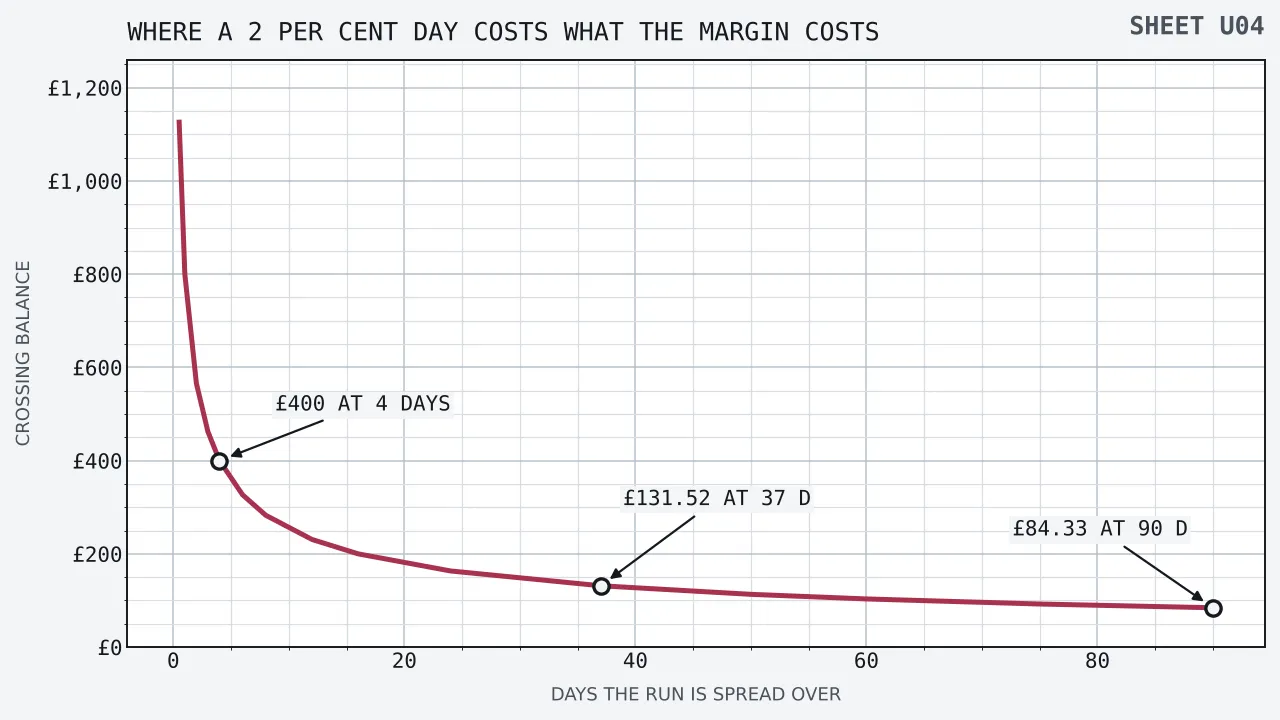
Downwards is the only direction that curve travels and the reason is worth one sentence. Stretching a play-through over more evenings leaves the margin’s bill exactly where it was and lengthens the exposure of the balance, so the balance at which the two meet has to fall. A reader who plays a little at a time is not reducing the cost of the clause. They are keeping the first cost constant and adding a second one.
One hundred and thirty-one pounds fifty-two is the figure in the row that matches this site’s own model of how a phone gets used. Thirty-seven sittings of twenty-two minutes, at one sitting an evening, is the rhythm assumed everywhere here and never observed. On that rhythm, any balance above about £132 is exposed to more movement than margin across the clause, on the page’s own assumption of two per cent a day.
Nought of this says which way the price goes, and the omission is the point rather than a gap. Upward and downward are equally available to a movement, and every percentage above measures size with direction left out. What the margin does is different in kind: it is one-directional, it is 4p in every pound staked, and it does not have a good day. Adding a symmetrical second variable to a one-directional first one widens the range of outcomes without improving the middle of it.
Three hundred pounds against eighty-four pounds is the span of the crossing across ordinary reader behaviour, and it shows how little the exact assumption matters. At the fast end, somebody clearing in a few long nights only meets the crossing at a few hundred pounds. At the slow end, somebody clearing across a quarter meets it below a hundred. Neither reader is doing anything unusual, and both have a second cost running that nobody printed in the terms.
7
Forty times, with nothing standing over the multiple
Nineteenth of January 2026 is the date from which a British licensee may no longer set a play-through above ten times whatever bonus funds were credited, the ceiling standing as limb three of the social responsibility code provision that governs incentives. Its definition is narrow: wagers totalling a stated value have to be laid before funds turn withdrawable. Two licence types are excluded and every other one is caught, which puts a remote casino inside the ceiling without argument.
Sixty times is the figure the regulator produced when setting out what the ceiling was there to fix, and the sixty is its number rather than one worked up here. Nothing publishable anywhere on this site’s fact sheet gives a distribution of multiples beyond the licensed market, so this note states none. What it can do is convert multiples into hours, which is arithmetic and needs no source.
| The multiple attached | Pressing it asks for | Presses of 10p | Staking it requires | Expected worth of the credit |
|---|---|---|---|---|
| Ten times, a British ceiling since 2026 | 3 h 20 min | 1,000 | £100.00 | £6.00 |
| Twenty-five times, where expectation is nil | 8 h 20 min | 2,500 | £250.00 | £0.00 |
| Forty times | 13 h 20 min | 4,000 | £400.00 | minus £6.00 |
| Fifty times | 16 h 40 min | 5,000 | £500.00 | minus £10.00 |
| Sixty times, quoted by the regulator | 20 h 0 min | 6,000 | £600.00 | minus £14.00 |
Twenty-five is where a credit’s expected worth lands on nothing, that multiple being one divided by the fourpence share and not a matter of judgement. Underneath it a credit is worth something in expectation. At it the credit is worth nothing. Over it the arithmetic turns negative, which means the staking required is expected to consume more than the credit was ever worth.
Sixteen hours and forty minutes separates row one of that table from row five, and the span is what a ceiling on the multiple buys once the buying is counted in pressing. Both rows describe the same £10. One asks for 1,000 presses and leaves £6.00 standing in expectation. The other asks for 6,000 presses and leaves a shortfall of £14.00, which is to say the credit has become a reason to stake rather than a thing with a value.
Movement rides on top of every row in that table once the balance is priced in a unit that shifts, and this is where the two halves of the note meet. The sixty-times row occupies 20 hours of pressing, which at one sitting an evening is fifty-five evenings and 1,320 hours of calendar. On the page’s own assumption of two per cent a day, the typical move across fifty-five days is 14.83 per cent, which on a £100 balance is £14.83 against the £24.00 the margin expects from £600.00 of staking.
One incentive may not mix gambling products under the same provision, and three carve-outs ride with the ban that most readers would not predict. Two products of one type together are allowed, and the illustration given is a scratchcard beside a raffle. Betting and casino may share a single email, where marketing consent was given for each of them. And a credit spendable across whichever product the customer picks escapes the ban entirely.
8
What an incentive owes the person it is offered to
Clear, transparent and fair is what the same code provision demands of an incentive’s terms, and the duty bites as soon as anything of value is dangled in front of a customer or a possible one. Money, goods, a service or any other advantage all count. Easy access to those terms is owed to everybody the thing is put in front of. Read against the arithmetic above, that is a duty to publish the multiple before anybody starts counting presses.
Three figures decide whether a credit is worth taking and all three are terms rather than outcomes. The multiple is the first. The stake the play-through will be done at is the second, because it sets the press count and therefore the hours. The period the whole thing has to be finished inside is the third. A reader holding those three can build every row of the table in part seven without assistance.
£170,000 is the money penalty attached to a discretionary clause sitting in one operator’s rules for bonuses on new casino promotions, published against 3 July 2025, and it is the sharpest item on this site’s fact sheet about what an incentive’s terms may say. That clause kept a discretion for the operator alone: close the account down, or withhold what had been won. The regulator’s finding was that the fair and open dealing condition had been breached. Transparency is what such a clause lacks, and unfair results for consumers are what it may produce, in the regulator’s own summary. An independent third-party audit followed, covering anti-money-laundering controls and safer gambling controls alike.
Nothing follows from that about whether a clause of the kind is void, and the distinction is worth printing. A penalty landed on one operator. No contract anywhere had a term removed from it. What a reader may take away is narrower, and it is that a clause built that way has a named condition behind it and a published figure attached to having used one, inside the licensed market and nowhere else.
Four thousand presses is what a forfeiture clause puts at stake on the worked example here, and the conversion is the useful one. Somebody who has pressed through a 40 times clause has given it 13 h 20 min, at the twelve assumed seconds for each of 4,000 presses, spread over thirty-seven evenings, and the question a discretionary clause raises is whether any of that pressing bought anything. At the share this site works to, those presses were expected to cost £16.00. A clause permitting forfeiture at somebody’s discretion prices the remainder at whatever that somebody decides.
Bonuses occupy two sentences of the offshore rulebook this network read, and reporting them accurately beats pretending the document is blank. Transparency in the communicating is the first, with terms that are clear attached to it. A bar on using aggressive promotion to push excessive gambling is the second. There is no ceiling on a multiple anywhere in it, no rule about mixing products, and nothing matching what the advertising regulator calls a significant condition.
9
Four duties that do not travel with a private key
Which of the duties priced above survives the trip to a business with no Great Britain licence behind it? Not one. Credit cannot be ruled out of a cashier’s payment arrangements, because nobody ruled it out. Terms on an incentive need not be plain, open, fair or easy to find. Ten times is a ceiling on nothing, so the lower rows of part seven’s table are out of bounds nowhere. And one incentive may hold as many kinds of gambling as somebody cares to put in it.
Four absences, each with a clock inside it, is the form that loss takes on a page about payment. The first absence has no commencement date, because no date was set. The second has no deadline for publication, because publication was never required. The third has no ceiling in hours, because ten times is 3 h 20 min of pressing and nothing caps what may stand above it. The fourth has no boundary at all between one product and another.
Nought wagering cap, nought stake cap and nought minimum game cycle appear anywhere in the Curaçao responsible gaming policy this network opened, and the absence is sourced rather than assumed. That policy is a real document with real requirements in it, several of them stricter than their British counterparts. On the specific question of what a credit may ask of a player before money becomes withdrawable, it is silent, and silence is what part seven’s arithmetic is measuring.
Payment systems themselves are the one outside force the regulator names, and it is worth separating from the duties above because it is not a duty. A business trading without a British licence may lose its payment facilities, withdrawn by one of the large organisations running those systems, which the regulator’s guidance to players states in terms. That is not a protection a reader can invoke. It is a period of unknown length ending at a moment nobody announces, and a balance held at such a business is inside it.
Two things stay true wherever the cashier sits, and both run against the loose claim that offshore means outside everything. Providing gambling facilities unlicensed is a statutory offence aimed at the provider, and the Act builds no matching offence for the person taking part. Remote gaming duty attaches by where the player ordinarily lives and not by where a licence was granted, so money staked from Great Britain sits inside the British charge whatever the cashier holds. Neither of those is a protection, and confusing either with one is the commonest mistake made about this market.
10
Both windows shut, and what remains to argue with
Nought hours is the figure to leave this note holding, and it belongs to a property rather than to a policy. A payment written into a public chain cannot be unwound by the payer, by the payee, by a scheme or by an institution, at hour one or at hour ten thousand. Every other figure on this page is an assumption that a reader may move. That one is not.
Two thousand eight hundred and eighty assumed hours against nought is the plainest form of the first loss, and 216 clearing runs against nought is the same thing in this site’s own unit. Neither comparison promises that an argument would have succeeded. Both measure whether an argument was available to be started, which is a prior question and the only one a payment arrangement can settle.
Sixty-six point six is the second loss in one number, being the ratio between the 888 calendar hours a clearing run occupies at one sitting an evening and the 13 h 20 min of pressing inside it. A balance denominated in pounds is idle for the difference. A balance denominated in a unit that moves is exposed for all of it, on the two per cent daily figure this page assumes and declares.
One hundred and thirty-one pounds fifty-two is where those two costs meet on the rhythm this site models, and the figure deserves one closing observation. It is not a large balance. Anybody who has cleared a credit of any size has held more than that at some point in the run, which means the second cost was the larger of the two for part of almost every clause. Nobody prints it, because nobody is required to, and because it is not a charge anybody collects.
Anybody who reached part ten while hunting for a route around an exclusion of their own should set the arithmetic aside and dial 0808 8020 133. That line is GamCare’s National Gambling Helpline, free to call, and staffed through every hour of every date in the year, by telephone, in live chat or by message. Somebody worried about another member of the household has the same claim on it as somebody worried about their own evenings. That call is the only action urged anywhere in these ten parts.
Questions
- What is a crypto casino, put plainly?
- A gambling business that takes payment in chain units rather than in pounds, prices balances in those units, and sits outside the Great Britain licensing regime, because that regime brings duties about payment methods and incentive terms which such an arrangement does not carry. This note names no such business, prints no address, and sets out no route to one. What it does is price two clocks a payer loses by moving money that way.
- Can a payment made along a public chain be reversed?
- No, and the answer is nought hours rather than a short period. A transfer written into a public chain is settled by the network carrying it, with no scheme standing behind it and no sending institution in the middle, so there is no procedure for anybody to invoke and nobody to invoke it against. That is a property of the engineering rather than a policy anybody chose, and it reads the same at hour one as at hour ten thousand.
- How long do the other payment arrangements stay arguable?
- This page assumes 120 days for a card payment, which is 2,880 hours, and 30 days for a transfer between bank accounts, which is 720 hours. Both are the page’s own round figures, declared as assumptions, because the sheet of regulatory fact behind this site carries no claim about either period. Measured in clearing runs of 13 h 20 min those windows are 216 and 54 respectively, against nought along a chain.
- What is a lost dispute window worth in money?
- On this page’s assumed rate of two deposits in every hundred, each £50 deposit carries £1.00 of money the payer would want to ask about, which is ten presses or two minutes of pressing at ten pence and the twelve seconds a press assumed throughout. Across a hundred such deposits that is £100.00 of askable money, against £4.00 of expected cost had the same sum been staked instead, four pence coming off each pound of it. The dispute rate is this note’s own figure and nothing was observed.
- Why does a price that moves cost a player time as well as money?
- Because the house share accrues only while somebody is pressing, and a price moves on every hour of the calendar. A 40 times clause on a £10 credit asks £400.00 across the reels: 4,000 presses in all, and 13 h 20 min once each one is given the twelve assumed seconds. Spread at one 22-minute sitting an evening, that becomes thirty-seven evenings and 888 hours. The pressing clock and the wall clock differ by a factor of 66.6, and only the second governs how long a balance is exposed.
- At what balance does the price movement cost more than the margin?
- About £131.52 on the rhythm this site models, where 4,000 presses are spread across thirty-seven evenings. The margin takes a fixed £16.00 from £400.00 of staking whatever the schedule, while an assumed daily movement of 2 per cent gives a typical move of 12.17 per cent across thirty-seven days under the square-root convention this page adopts. Both the 2 per cent and the convention are the page’s own assumptions, declared, and halving the daily figure doubles the crossing balance.
- Does stretching a play-through over more evenings reduce the cost?
- No. It leaves the margin’s bill exactly where it was and lengthens the exposure of the balance, so it keeps the first cost constant and adds a second. Pressed straight through, the crossing balance sits at £1,073.30; across four long evenings at £400.00; across sixteen evenings at £200.00; across ninety days at £84.33. Every one of those figures rests on this page’s assumed 2 per cent daily movement and on nothing observed.
- What does the British credit rule actually prohibit?
- Taking payment for gambling on a credit card, from 14 April 2020 onwards. A settlement that travels by way of a money service business on its road to the licensee falls under the same condition. Scope is wide: every remote licence, the ancillary betting and lottery kinds included, plus three non-remote kinds, being general betting, pool betting and acting as an intermediary. The rule is about borrowed money rather than about a particular piece of plastic, and a debit card keeps the scheme dispute arrangement the prohibition leaves untouched.
- Is there a ceiling on the multiple attached to a credit?
- Inside the British licence there is one. The ceiling is ten times whatever was credited as bonus funds, which on a £10 credit is £100.00 of required staking, and the date it began to bind is 19 January 2026. It stands first among the four things that code provision forbids. Two licence types fall outside its reach and every other one is inside. Ten times on a £10 credit asks £100.00 across the reels, or 1,000 presses, which twelve seconds a press puts at 3 h 20 min. Sixty times is the figure the regulator reached for in describing what the ceiling was fixing, and on the same conversion that is 6,000 presses and twenty hours.
- What happened to the operator fined over a bonus clause?
- A money penalty of £170,000 was published against 3 July 2025 over a discretionary clause in that operator’s rules for bonuses on new casino promotions, which kept for the operator a discretion to close the account or withhold the winnings. The regulator’s finding was that the fair and open dealing condition had been breached, with transparency named as the thing such a clause lacks and unfair results for consumers as the thing it may produce, and required an independent third-party audit of anti-money-laundering controls and safer gambling controls. A penalty landed on an operator there, and no contract had a term struck out of it.
- Does the offshore rulebook cap a wagering requirement?
- It does not. The Curaçao responsible gaming policy this network opened gives bonuses two sentences, asking that they be communicated transparently on terms that are clear, and barring aggressive promotion of the sort that pushes excessive gambling. It sets no ceiling on a wagering multiple, none on a stake, and none on how quickly a game cycle may come round. That document does carry genuine requirements, several stricter than their British counterparts, so calling it empty would be inaccurate.
- What should a reader do who came here hunting for a route around an exclusion?
- Dial 0808 8020 133. GamCare picks up the National Gambling Helpline there at no cost, through every hour of every date in the year, by telephone, in live chat or by message, and somebody worried about another member of the household has the same claim on it as somebody worried about their own evenings. TalkBanStop is GamCare’s too, setting that helpline alongside blocking software and the national self-exclusion scheme. A period already under way can be extended, the choices being another six months, another year or another five, rather than left to lapse.