Standing page Revision 1 Reviewed 17 October 2026
How a duration is worked out here, input by input, with each one priced
Nine quantities produce every hour printed on this site and six of them were settled by decision rather than by observation. Give a press twelve seconds and a sitting twenty-two minutes, and a £25 credit at forty times becomes £1,000.00 of required staking, 10,000 presses, 33 h 20 min and 91 sittings. Part four hands anybody who disputes the pace the substitution to make instead.
Staking the clause asks £1,000.00 The run at 12 seconds 33 h 20 min Sittings of 22 minutes 91
1
Nine quantities, their values, and which of them were decided
Nine rows hold the whole apparatus and only three of them are arithmetic. The other six are choices: a stake, a return, a multiple, a weighting, an interval between presses and a length for one sitting. Each appears below at its value, so that a reader rejecting one can see which figures shift.
Nothing in the table was observed. No handset was held for this site and no interval was counted off against a clock face.
| The quantity | Value used | How it got that value |
|---|---|---|
| Stake on one press | 10p | Chosen, held still sitewide |
| Return to player | 96 per cent | Chosen, a reel game’s working figure |
| Play-through multiple | 40 times | Chosen for this end of the market |
| Game weighting | 1 | Chosen, so a staked pound counts a pound |
| Seconds a press, handset | 12 | Assumed, never observed |
| Seconds a press, left running | 9 | Assumed, never observed |
| Presses an hour at twelve seconds | 300 | Computed |
| Length of one sitting | 22 min | Assumed, never observed |
| Presses in one sitting | 110 | Computed |
Three hundred an hour carries most of the weight, and it is one division: 3,600 seconds parcelled out twelve at a time. Every duration here hangs on that quotient and on how many presses a clause demands.
2
Two expressions, set out so that anybody can run them again
Two expressions do the work. The first prices a credit; the second turns it into elapsed hours.
Expectation on a credit, in pounds, runs: E = B × (1 − W × (1 − RTP) ÷ g).
Pressing, in hours, runs: T = (B × W) ÷ (s × r), with s the stake on one press and r the presses an hour.
Four pence in every staked pound is what the first reduces to once 96 per cent goes in and a weighting of 1 leaves the divisor idle. Each unit of the multiple eats 4 per cent of the credit, so 25 units eat all of it. Hence the break-even multiple of 25, and hence a negative answer beyond it.
Forty times on a £25 credit gives E = £25 × (1 − 1.6), or minus £15.00. An expectation on a credit is not a forecast for one evening, and holding those apart is most of the care this site takes.
Weighting divides because a game contributing under a pound in the pound raises the staking a requirement needs. Fixed at 1 it leaves the working, which flatters the figures: anything under 1 lengthens every run below.
3
One clause carried the whole way, from £25 to 46 days
Twenty-five pounds at forty times is the case this site keeps returning to, and five steps carry it from clause to calendar. Staking first: B multiplied by W is £25 × 40, so £1,000.00 goes across the reels before the credit belongs to the reader.
Ten thousand presses is that staking at 10p apiece. Thirty-three and a third hours is those presses at 300 an hour, printed as 33 h 20 min. Ninety-one is 2,000 minutes shared into sittings of 22, rounded upward because a part sitting is still sat through. Forty-six days is 91 sittings taken two to a day.
Forty pounds is the expected price of the run, 4 per cent of the £1,000.00, and it belongs beside the £25.00 that began everything. A credit worth less than the expected price of meeting its own condition is worth minus £15.00, which is the figure part two reached by the other route.
33 h 20 min of pressing behind four characters of clause
One pound twenty an hour is the same statement in a smaller unit. Three hundred presses of 10p send £30.00 across the reels each hour, and 4 per cent of that stays behind. Every other hourly and yearly figure here is £1.20 multiplied out.
4
Four paces, and the substitution to make if ours is wrong
Twelve seconds is a guess, so showing what the guess is worth is the honest move. Below, the same 10,000 presses at four intervals: anybody quicker or slower reads off their own row.
| Seconds a press | Presses an hour | The run | Sittings of 22 min | Days at two a day | Expected price |
|---|---|---|---|---|---|
| Nine | 400 | 25 h 0 min | 69 | 35 | £40.00 |
| Twelve, the figure used here | 300 | 33 h 20 min | 91 | 46 | £40.00 |
| Twenty | 180 | 55 h 33 min | 152 | 76 | £40.00 |
| Thirty | 120 | 83 h 20 min | 228 | 114 | £40.00 |
Forty pounds stands unmoved down the final column, which is the most instructive thing on this page. Pace governs the clock and leaves the price alone, since price follows how much goes across the reels. Halving the interval buys back hours and no money whatever.
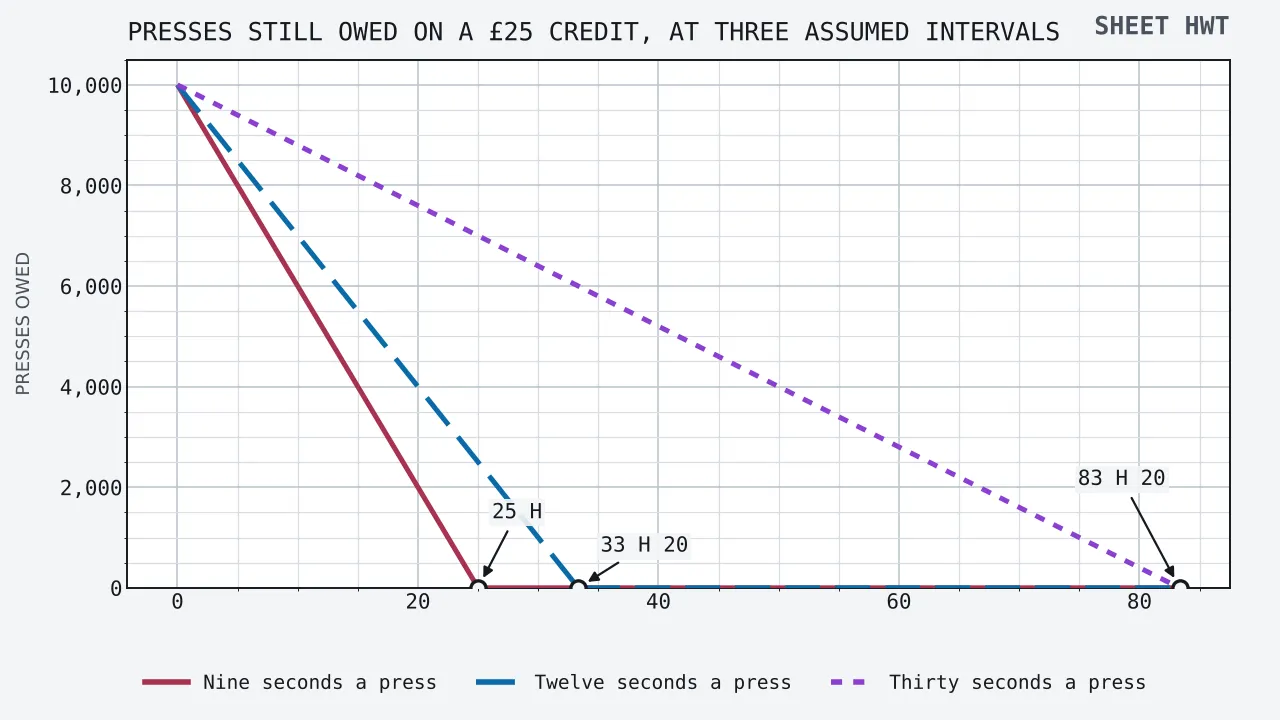
Three straight lines of three slopes is the entire drawing, and the straightness is the claim. Nothing modelled here tires, pauses over a message or stops for the night. Part six prices that gap.
5
The single input any rulebook would pin down
2.5 seconds is the shortest a reel game’s cycle may run under a British licence, and it is the only one of these nine inputs any rulebook fixes. Set 10,000 presses against it and the run squeezes to 25,000 seconds, or 6 h 56 min 40 s of unbroken pressing: a floor beneath the duration, not a forecast.
Offers of the kind priced on this site are run without a Great Britain licence, and pace is where that bites here. A minimum cycle reaches no such business, so twelve seconds sits where a rule would otherwise have sat.
Five seconds is the matching floor for casino games that are not reel games, peer-to-peer poker excepted, in force from 17 January 2025. Neither floor attaches to the convention above, which is slower than both.
6
Where the model is wrong, printed before anybody finds it
Four things an actual evening does are absent from the arithmetic. Bonus rounds hold the reels for minutes together. Fingers quicken and slow. Connections drop. A credit can run out before its condition is met, ending a run early and badly.
Variance is the largest absence and the hardest to draw. 96 per cent is a proportion over a long run rather than a per-press outcome, so £40.00 on 10,000 presses is a centre and not a result. Short runs scatter widely about it, both ways, which is why no page here prints what a reader finishes holding.
Four clauses sit outside the model: a cap on the stake while a credit is live, a cap on what it can win, a date on which it expires, and a weighting under 1. The first three cut a run short and the last extends it.
7
Sourced, computed or chosen: every figure into one bin
Three bins take every number here. A sourced figure comes from a primary document, with that document’s date. A computed figure is arithmetic on part one. A chosen figure is a convention, and its sentence says so.
Sourced here: the 2.5-second minimum cycle for reel games, the five-second minimum for other casino games with its 17 January 2025 commencement, and the point that neither binds a business outside the British licence. Computed here: 300 an hour, 110 to a sitting, £1,000.00 of required staking, 10,000 presses of 10p, then 33 h 20 min, 91 sittings, £40.00 and minus £15.00.
Chosen, and arguable: 10p, 96 per cent, forty times, a weighting of 1, twelve seconds and 22 minutes. Six conventions, no readings off any device, and a table in part four for the one carrying most.
Questions
- Did anybody press a button to get these timings?
- No. Twelve seconds a press and 22 minutes a sitting are conventions this site declares, and nothing on it was watched in operation. Every hour here is those conventions multiplied against a count of presses.
- Why does 25 keep appearing as a multiple?
- Because 96 per cent back leaves 4p of each staked pound behind, and 25 lots of 4 per cent is a whole credit. Under 25 the expectation is positive, at 25 nought, beyond 25 negative before anybody presses anything.
- Does pressing more quickly change anything?
- It changes the clock and leaves the money alone. At nine seconds the same 10,000 presses take 25 h 0 min rather than 33 h 20 min, or 69 sittings rather than 91. The expected £40.00 follows the staking, not the speed.
- Where does £1,000.00 come from on a £25 credit?
- From £25 multiplied by a play-through multiple of 40, at a weighting of 1. At 10p a press that is 10,000 presses, and at 300 an hour it is 33 h 20 min.
- Is 22 minutes a claim about how long I play?
- It is not. It is a reporting unit, so a long run arrives as a quantity a reader recognises rather than as bare hours, and 91 is 2,000 minutes over 22, rounded upward. Sitting for 44 minutes halves every sitting count here.
- What could this model get badly wrong?
- Anything describing one evening instead of a long run. 96 per cent is a proportion across many thousands of presses, so £40.00 on 10,000 of them is a centre and not an outcome. Stake caps, expiry dates and weightings sit outside the sums.