Note D12 Revision 1 Terms read 17 October 2026
20 free spins no deposit, four minutes of play, and a deadline of a single day
Twenty presses at 10p commit £2.00, return an expected £1.92 and take four minutes. The clause fastened to that £1.92 runs 2 h 33 min 36 s, and the window over it is routinely the shortest on any ladder. Smallest money, tightest clock, which is the wrong way round.
Pressing owed 2 h 33 min Window modelled 24 h Last moment to begin 21 h 26 min
Short windows, costed against the work inside them
Advertising has been bought for every destination below. A fee reaches this site when a reader goes on to register, and no figure on this page moves one way or the other because of it.
-
01Mobile Free Spins
Betportal
Ceiling as a multiple
What lands€15.00150 spins at 10c, which is this site's figure and not the operator'sThe run17 h 30 minTurning over 525.00 at 10p means 5,250 presses, or about 48 phone sittings of 22 minutes. Timed at 10p a press and 12 seconds between presses, both of which this site assumes rather than measures.The wait to be paidNOT PUBLISHEDThis operator puts no withdrawal band in its own terms, so there is nothing honest to print here.Spins valued at this site's own 10p a spin
What lands
Spins, at a price15.00150 of them at 10c apiece, a figure belonging to this site rather than to the operatorMatch, and other creditno figure300% of three deposits, to a ceiling of €1,000. Not a sum until money of yours makes it one, so this row totals nothing and carries nothing downwardsThe run
Handed back on the spins(0.60)Each press stakes its own value and returns 96 per cent, which leaves this much with the house from the opening pressPlay-through 35x on the bonus(20.16)Taking 14.40 round 35 times over means 504.00 through the machines, of which 20.16 is the expected cost, and 17 h 30 min of pressing at the pace aboveWhat counts towards it100%Slots only, with no percentage published anywhere, so the row above assumes the whole of each stake countsWhat never clears
Limit on the winningsstated5x the bonusDeducted on the way outno figureNothing is published as a figure here, so this row removes nothingLeast that can leaveno figureNo figure is published, so nothing on this timer is pinned down by oneLeast deposit, and the rung over ityour own€20 a stage. Published in euros, so no rung is named at all: this site's ladder is a sterling oneThe window on the creditstated14 daysBiggest stake while it runsstated€5Removed outright by rulestatedNot publishedVerified before a payoutstatedDocuments before the first withdrawalNever clears€15.00Not a penny of it gets out, so the whole of what landed stands on this rowNo Great Britain licence
Licence held in Anjouan, Comoros, the company named is BetPortal Gaming Ltd, with Excite Ultra Media Ltd, quoted under ALSI-202601040-FI2.
Terms read 17 October 2026
Open the offer at Betportal, opens in a new window -
02Mobile Free Spins
WinBeast
Ceiling as a sum
What lands€50.00500 spins at 10c, which is this site's figure and not the operator'sThe run2 d 18 hTurning over 2,000.00 at 10p means 20,000 presses, or about 182 phone sittings of 22 minutes. Timed at 10p a press and 12 seconds between presses, both of which this site assumes rather than measures.The wait to be paidNOT PUBLISHEDThis operator puts no withdrawal band in its own terms, so there is nothing honest to print here.Spins valued at this site's own 10p a spin
What lands
Spins, at a price50.00500 of them at 10c apiece, a figure belonging to this site rather than to the operatorMatch, and other creditno figure50% to 100% of five deposits, each to a ceiling of €1,000, and a €650 free bet. Not a sum until money of yours makes it one, so this row totals nothing and carries nothing downwardsThe run
Handed back on the spins(2.00)Each press stakes its own value and returns 96 per cent, which leaves this much with the house from the opening pressPlay-through 40x on the bonus and the winnings from the spins(76.80)Taking 48.00 round 40 times over means 1,920.00 through the machines, of which 76.80 is the expected cost, and 2 d 18 h of pressing at the pace aboveWhat counts towards it100%Slots, titles vary by country, with no percentage published anywhere, so the row above assumes the whole of each stake countsWhat never clears
Limit on the winningsstated€100 a batch of spinsDeducted on the way outno figureNothing is published as a figure here, so this row removes nothingLeast that can leaveno figureNo figure is published, so nothing on this timer is pinned down by oneLeast deposit, and the rung over ityour own€20 a stage. Published in euros, so no rung is named at all: this site's ladder is a sterling oneThe window on the creditstated7 days, spins 1 dayBiggest stake while it runsstatedNot publishedRemoved outright by rulestatedNot publishedVerified before a payoutstatedDocuments before the first withdrawalNever clears€50.00Not a penny of it gets out, so the whole of what landed stands on this rowNo Great Britain licence
Licence held in Curaçao, no company named anywhere on the site.
Terms read 17 October 2026
Open the offer at WinBeast, opens in a new window -
03Mobile Free Spins
EliteSpin
Longest spin window
What lands£50.00500 spins at 10p, which is this site's figure and not the operator'sThe run2 d 18 hTurning over 2,000.00 at 10p means 20,000 presses, or about 182 phone sittings of 22 minutes. Timed at 10p a press and 12 seconds between presses, both of which this site assumes rather than measures.The wait to be paidNOT PUBLISHEDThis operator puts no withdrawal band in its own terms, so there is nothing honest to print here.Spins valued at this site's own 10p a spin
What lands
Spins, at a price50.00500 of them at 10p apiece, a figure belonging to this site rather than to the operatorMatch, and other creditno figure50% to 100% of five deposits, each to a ceiling of £1,000. Not a sum until money of yours makes it one, so this row totals nothing and carries nothing downwardsThe run
Handed back on the spins(2.00)Each press stakes its own value and returns 96 per cent, which leaves this much with the house from the opening pressPlay-through 40x on the bonus and the winnings from the spins(76.80)Taking 48.00 round 40 times over means 1,920.00 through the machines, of which 76.80 is the expected cost, and 2 d 18 h of pressing at the pace aboveWhat counts towards it100%Slots, with no percentage published anywhere, so the row above assumes the whole of each stake countsWhat never clears
Limit on the winningsstated5x the bonusDeducted on the way outno figureNothing is published as a figure here, so this row removes nothingLeast that can leaveno figureNo figure is published, so nothing on this timer is pinned down by oneLeast deposit, and the rung over ityour own£20 a stage. It lands square on the £20.00 rung, so none of yours is left perched on topThe window on the creditstated7 days, spins 3 daysBiggest stake while it runsstatedNot publishedRemoved outright by rulestatedNot publishedVerified before a payoutstatedDocuments before the first withdrawalNever clears£50.00Not a penny of it gets out, so the whole of what landed stands on this rowNo Great Britain licence
Licence held in Costa Rica, the company named is PrimeTier Limited.
Terms read 17 October 2026
Open the offer at EliteSpin, opens in a new window -
04Mobile Free Spins
Crown Jewelz
Multiple unpublished
What lands£15.00150 spins at 10p, which is this site's figure and not the operator'sThe runNOT TIMEDThis operator does not publish the play-through multiple in its own terms. The multiple is the one figure the clock cannot work around, so the run is left untimed.The wait to be paidNOT PUBLISHEDThis operator puts no withdrawal band in its own terms, so there is nothing honest to print here.Nothing reckoned
What lands
Spins, at a price15.00150 of them at 10p apiece, a figure belonging to this site rather than to the operatorMatch, and other creditno figure200% of the first deposit, then 150% twice, each to a ceiling of £1,000. Not a sum until money of yours makes it one, so this row totals nothing and carries nothing downwardsThe run
Play-throughno figure40x the bonus, reported rather than published by the operatorWhat counts towards itno figureSlots, with no percentage published anywhere, so the row above assumes the whole of each stake countsWhat never clears
Limit on the winningsstatedNot publishedDeducted on the way outno figureNothing is published as a figure here, so this row removes nothingLeast that can leaveno figureNo figure is published, so nothing on this timer is pinned down by oneLeast deposit, and the rung over ityour own£20. It lands square on the £20.00 rung, so none of yours is left perched on topThe window on the creditstatedNot publishedBiggest stake while it runsstatedNot publishedRemoved outright by rulestatedNot publishedVerified before a payoutstatedDocuments before the first withdrawalNever clearsNOT RECKONEDThis operator leaves the play-through multiple out of its own terms, so nothing below the fourth step can be worked out.No Great Britain licence
Licence held in Curaçao, number not verified, no company named anywhere on the site.
Terms read 17 October 2026
Open the offer at Crown Jewelz, opens in a new window
Only the middle reading comes out of arithmetic belonging to this site. The multiple laid against what lands gives the turnover asked for; dividing that by 10p a spin gives the presses; dividing those by 300 an hour gives the hours, a press on a handset being taken here at 12 seconds from the one before. Both figures are assumptions rather than measurements of anybody: nothing was played and nothing was held a stopwatch to. Anybody quicker should divide the press count by a rate of their own, which is why the presses are printed alongside the hours instead of being summarised away.
The first reading is what arrives before any condition is laid against it. Spins carry no unit of their own so one gets supplied: where an operator values its own spin that figure is used and attributed, and where it does not, this site's 10p a spin stands in and everything below moves with it. The third reading belongs to the operator entirely. It is a withdrawal band quoted from published terms, and a blank there means none was published rather than that nobody looked.
The total along the foot answers what the hours leave open, which is whether any of the running ends anywhere. It is what arrived, less whatever is still standing once the play-through has been paid for at 96 per cent return to player and once a published limit, a published deduction and a published floor beneath the least that can leave have each had a turn. It appears again in pence in the pound, the only fair way of holding a small offer up against a large one. It describes an offer rather than an evening, and where the conditions price out what arrived, a timer prints nothing getting out instead of a negative sum.
Cashiers on a handset take deposits off a row of preset buttons, so a least deposit given in pounds is raised to the next rung of the ladder used here, £10, £20, £25, £50, £75 and £100, and the timer shows what is left perched on it. That money is the reader's own and enters no sum at all. Given in euros it prints untouched, the ladder being sterling. Three words may occupy the figure column where no figure belongs. Stated is a published term that costs something while leaving no number to subtract. No figure is a term nobody has quantified, or a credit that is not a sum until money of yours makes it one. Your own is money of yours, which belongs in none of this.
None of the operators above is licensed in Great Britain, so not one duty that licence carries reaches any of them. Membership of Gamstop Online is compulsory for every online gambling company licensed in Great Britain, which means that shutting yourself out through the scheme shuts you out of none of these. The limit of ten times the bonus funds on a wagering requirement, running since 19 January 2026 under Social Responsibility Code 5.1.1, is a condition of the same licence and binds only whoever holds one. Off that licence, the Gambling Commission writes of consumers meeting unfair gaming practices, financial loss and no recourse when matters go wrong, and lists blocked payouts and withdrawal limits pitched too high to reach among the things it has seen. No account at any of them may be held by anybody under 18.
Every term on a timer is its operator's own and every timer carries the day somebody read it. The oldest of those readings is 17 October 2026. What binds a reader is an operator's full terms and never a line printed here.
1
Four minutes, and the £1.92 they are expected to leave
Two pounds is what twenty presses of 10p send over the reels, and it is the smallest sum on this site still carrying a full set of conditions behind it. Two hundred and forty seconds is how long they run at twelve seconds to a press, an interval assumed here and clocked on nobody, and 240 seconds is four minutes.
Eight pence of the £2.00 is the house margin where ninety-six pence returns against each pound staked, so £1.92 is what the twenty presses are expected to leave behind. Every term in the sheet attaches to that £1.92, and nothing attaches to the £2.00, because the £2.00 was never the reader’s in any sense a cashier recognises.
Four minutes is comfortably inside one sitting, a sitting running the twenty-two assumed minutes used across this site. Eighteen of those minutes are still free when the twentieth press settles. There is no page on this site where the advertised part of an offer is smaller, and the gap between the advertised part and the rest is the entire subject here.
| Quantity | Reading |
|---|---|
| Presses given | 20 |
| Across the reels at 10p each | £2.00 |
| Margin where 96 pence returns | £0.08 |
| Expected to be standing | £1.92 |
| Seconds at the assumed interval | 240 |
| Share of one assumed sitting | 0.18 |
Eighteen hundredths of a sitting is everything the banner promises to hand over. A reader can collect it between a kettle going on and the tea being poured. Whether anything survives that four minutes is settled in the next eight parts, and the deciding quantity turns out to be a date rather than a multiple.
Spins of this size come from businesses with no Great Britain licence. Where the deadline is twenty-four hours, the duties worth naming are those a licence runs on a clock of comparable length. Part eight sets three of them out. None of them changes the four minutes. All of them change what happens around the four minutes.
2
Seven hundred and sixty-eight presses owed on twenty given
Seventy-six pounds eighty is forty times £1.92, and that is the staking a clause of the usual shape demands before any of the residue can be requested. Broken into 10p pieces that is 768 presses.
Nine thousand two hundred and sixteen seconds is what 768 presses consume at the twelve assumed seconds apiece, which is 2 h 33 min 36 s. Divide by 110, which is what a sitting of twenty-two assumed minutes holds, and the answer is 6.98, so seven sittings covers it with the last one filled almost exactly. That tidiness is a coincidence of the figures and nothing more.
The two halves stand at 38.4 to one, 2 h 33 min 36 s of obligation against four minutes of handout, and every rung of this ladder produces the identical figure at forty times and ninety-six pence back. Size of pile has no part in it. The multiple and the return do all the work.
| Quantity | Given | Owed |
|---|---|---|
| Presses | 20 | 768 |
| Over the reels | £2.00 | £76.80 |
| Minutes at the assumed interval | 4 | 153.6 |
| Sittings of twenty-two minutes | 1 | 7 |
One pound fifteen is the expected standing at the end of the 768, carrying a minus in front of it. Forty withdrawals of four pence from a pound add up to £1.60 against every pound of residue, which overshoots the pound by 60p, so each pound of the £1.92 runs 60p backwards and the close reads minus £1.15.
768 presses owed on a pile handed over in 20
Three pounds and seven pence is what the house expects to take across the whole run, four pence of each pound of the £76.80 turnover. The gift was £1.92 of that. The remainder comes out of a reader who started with nothing and will finish, on average, £1.15 behind where they began, having given up 2 h 33 min 36 s for the privilege.
3
Where a one-day window stops being able to hold it
Twenty-four hours is the window this page models over a pile of this size, stated as an assumption of the page rather than read off any sheet. Against it the clause of 2 h 33 min 36 s occupies 10.67 per cent of the calendar, which sounds like ample room and is the first of three misleading denominators.
Sixteen hours is the second denominator, being a waking day, and against that the clause wants 16 per cent. Four hours is the third, being what an ordinary evening leaves once work, travel, food and everything else are out of it, and against that the clause wants 64 per cent. The same 768 presses read as a tenth of a day, a sixth of a waking day or two thirds of an evening, depending only on what is being divided into.
Twenty-one hours twenty-six minutes and twenty-four seconds is the useful figure, and it is the last moment at which somebody could begin and still finish. Subtract 2 h 33 min 36 s from twenty-four hours and that is what remains. Any start after it is a start that cannot be completed, however willing the reader and however uninterrupted the evening.
Three lengths on this page belong to the page and not to any sheet: the window of twenty-four hours, the waking day of sixteen and the free evening of four. The first can be swapped for whatever the terms say and every division below runs again. The other two are there because a day divided three ways gives three very different readings of the same 2 h 33 min 36 s.
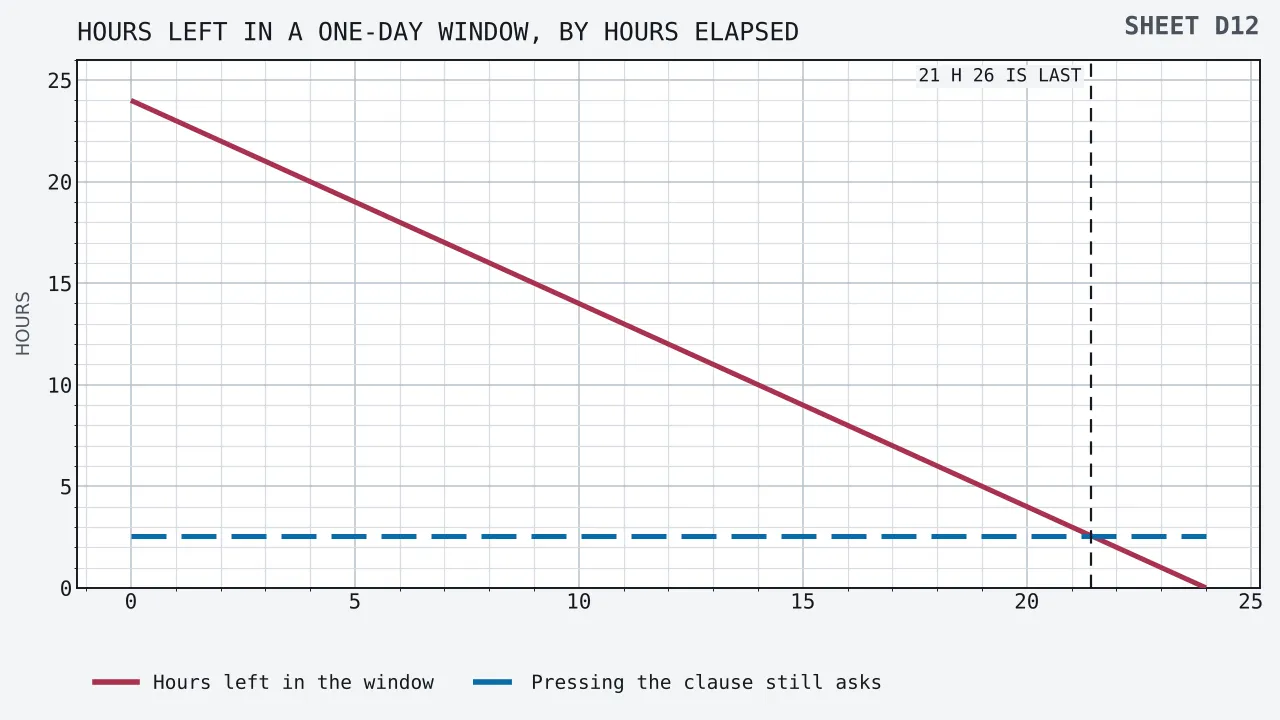
Nothing to the right of that crossing is recoverable, and the shape of the plate is the reason a short window is harsher than its length suggests. A window does not run out gradually. It runs out at a single instant, and for the last 2 h 33 min 36 s before that instant it is already over for anybody who has not begun.
Seven sittings inside one calendar day is what finishing actually asks, each of twenty-two assumed minutes, which is seven separate occasions of picking the handset up with nothing else happening. Most days do not contain seven such occasions. A day that does is a day given over to the thing.
Forty-eight hours as a window halves every pressure here without altering one press. The crossing moves out to 45 h 26 min 24 s, the clause falls to 5.33 per cent of the calendar, and seven sittings have two days to fall into rather than one. One line in a sheet, and nothing else on this page moves.
4
A document check measured against the clock it runs inside
Ten minutes is what this page allows for joining, covering the form, the address, the birth date and a confirmation, and it is an assumption rather than a measurement. That cost sits in front of the four minutes and is trivial against twenty-four hours, at 0.69 per cent of the window.
A document check is the part that is not trivial, because its length is decided elsewhere. Where it returns in minutes it costs nothing. Where it returns the following morning it has eaten most of the window, and the reader learns which of those happened only by waiting. This page prices the wait at five lengths and treats every one of them as an assumption.
| Wait assumed on the check | Share of a one-day window | Hours left of that day | Clause still fits | Share of a seven-day window |
|---|---|---|---|---|
| Ten minutes | 0.7 per cent | 23 h 50 min | Yes | 0.1 per cent |
| Two hours | 8.3 per cent | 22 h | Yes | 1.2 per cent |
| Six hours | 25.0 per cent | 18 h | Yes | 3.6 per cent |
| Twelve hours | 50.0 per cent | 12 h | Yes | 7.1 per cent |
| Twenty-two hours | 91.7 per cent | 2 h | No | 13.1 per cent |
Column two set beside column five is this page’s argument reduced to two numbers. A six-hour wait is a quarter of a one-day window and 3.6 per cent of a seven-day one. The wait has not changed. The thing it is divided into has, by a factor of seven, and every fixed cost in the process behaves the same way.
Row five is where the arrangement breaks. A check returning after twenty-two hours leaves two hours, the clause wants 2 h 33 min 36 s, and the shortfall is 33 minutes and 36 seconds of pressing that there is no longer room for. Nothing the reader did caused that, and nothing the reader can do repairs it.
Thirty-three minutes and thirty-six seconds is therefore worth stating as a quantity of its own. It is the amount by which a twenty-two hour wait overshoots a twenty-four hour window, on a clause of 768 presses, and it is the exact distance between an offer that works and an offer that does not. Neither figure behind it is published anywhere a reader can see before they begin.
5
Why the smallest offer carries the hardest deadline
Four minutes of play is the smallest handout costed on this site, and twenty-four hours is among the shortest windows written over anything. Those two travel together, and the pairing runs opposite to what a reader drafting the terms would have chosen.
Six hours of document check is the clearest illustration, because that cost is identical whatever the pile is. Against the clause on twenty presses it is 2.34 times the whole pressing obligation. Against the clause on 150 presses, which runs 19 h 12 min, it is 0.31 times it. The same wait is seven and a half times heavier on the smaller offer, measured in the only unit that matters, which is the work it displaces.
| Pile | Residue | Clause at forty times | Six hours as a multiple of it | Six hours in a modelled window |
|---|---|---|---|---|
| Twenty presses | £1.92 | 2 h 33 min 36 s | 2.34 | 25.0 per cent of a day |
| Thirty presses | £2.88 | 3 h 50 min 24 s | 1.56 | 25.0 per cent of a day |
| A hundred and fifty presses | £14.40 | 19 h 12 min | 0.31 | 3.6 per cent of a week |
Nought about that table is a claim concerning what any particular sheet sets. The window lengths are this page’s assumptions, chosen to show the shape. What the shape says is sound regardless: joining, waiting and being checked take the same length of time for £1.92 as for £14.40, and whichever window they are set against is shortest where the money is smallest.
Four minutes against six hours is the sharpest form of it. The advertised experience is ninety times shorter than one plausible administrative wait in front of it. A reader is not really being offered four minutes of spins. They are being offered an errand, with four minutes of spins at the end, and a clock that started when the errand did.
Two pounds of face value is what all of this is organised around, and that is the last inversion worth printing. The smaller the sum, the less sense it makes to spend an evening on the paperwork, and the shorter the window in which the paperwork has to be done. Effort and reward move in opposite directions, and the deadline pushes them further apart.
6
What press 767 is worth, and what press 768 is worth
Nought is what press 767 is worth and the residue is what press 768 is worth, and the entire page could be written out of that one sentence. A clause part met pays nothing. There is no proportion anywhere in the arrangement, which is why a deadline on it is so much more expensive than its length suggests.
Six sittings out of seven is 660 presses, which is 85.9 per cent of the obligation and 2 h 12 min of somebody’s day. At the end of a twenty-four hour window that reader holds exactly what a reader who never claimed the offer holds. One hundred and eight presses stand between the two of them, which is 21 minutes 36 seconds.
| Where the day ended | Presses made | Clause discharged | Time surrendered | Paid |
|---|---|---|---|---|
| Two sittings managed | 220 | 28.6 per cent | 44 min | Nothing |
| Four sittings managed | 440 | 57.3 per cent | 1 h 28 min | Nothing |
| Six sittings managed | 660 | 85.9 per cent | 2 h 12 min | Nothing |
| Seven sittings managed | 768 | 100 per cent | 2 h 33 min 36 s | Whatever is standing |
Twenty-one minutes and thirty-six seconds separating row three from row four is the cheapest-looking cliff on this site and one of the steepest. It is less than one sitting. It falls at the end of a day during which the reader has already done six of them. And a single interruption inside that last stretch moves them from the bottom row to the row above it, where the payment reads £0.00.
Winnings accumulated on the way go in the same motion, which is the half of a forfeit that readers do not expect. A balance of £9.00 at press 700 is not £9.00. It becomes money at press 768 and nothing at midnight, and the two possibilities are separated by 13 minutes 36 seconds of pressing.
Nothing about any of this depends on how the presses went. A generous sequence lifts the balance and removes not one press from the 768, because the clause counts what crosses the reels rather than what comes back over them. Luck cannot shorten a deadline, and on a window this tight that is the property doing the damage.
7
Eight pence an hour of window, priced out
Eight pence an hour is what the window is worth at face value, £1.92 of residue spread across the twenty-four hours a reader is given to deal with it. That is the rate at which the offer pays for occupying a day of somebody’s attention, and it is worth setting down because no sheet ever expresses it that way.
Against the work rather than the calendar the rate is seventy-five pence an hour, £1.92 over the 2 h 33 min 36 s the clause asks. That figure is the best possible reading, because it treats the residue as though it were collectable in full, and the arithmetic says it is not.
Forty-five pence an hour is the honest reading, and it carries a minus. Expected loss of £1.15 over 2 h 33 min 36 s gives exactly that, and that rate recurs on any residue carrying forty times at ninety-six pence back, because 60p of expected loss per pound always arrives with 1.3333 hours of pressing attached.
| What is divided by what | Rate |
|---|---|
| Residue over the window granted | £0.08 an hour |
| Residue over the pressing demanded | £0.75 an hour |
| Expected close over the pressing demanded | minus £0.45 an hour |
| Expected close over the window granted | minus £0.05 an hour |
Row one and row three are the two a reader should hold together. The offer occupies a day and hands over, at the very best, eight pence for each hour of it. The work inside that day is expected to cost forty-five pence for each hour spent on it. Both statements are about the same £1.92 and neither appears beside the headline.
Nineteen pounds twenty would be the residue on a pile ten times the size, and the rates in rows two, three and four would not move at all, because every one of them is a ratio with the residue on both sides. Only row one moves, and it moves because a larger pile usually comes with a longer window. Rate per hour of work is a property of the multiple. Rate per hour of window is a property of the drafting.
8
Another clock that runs every twenty-four hours
Piles of this size are issued without a Great Britain licence behind them. A neat coincidence is worth using on a page about a one-day deadline. A twenty-four hour interval already exists on the licensed side of the market, and it runs in the opposite direction, on behalf of the reader rather than against them.
Whether a business belongs to the national self-exclusion scheme is decided by its licence rather than by its own choice. A Great Britain licence to take bets online carries compulsory membership with it, which is why the register and the scheme are one question asked twice. A business standing outside the register stands outside the scheme by the same motion.
Checking is where the twenty-four hours comes in. April 2020 brought the sweep: every account a licensed operator holds has to be put past the scheme not less often than once a day. Set beside the window modelled on this page, that is one sweep for each window: the same interval in which a reader is expected to find 768 presses is the interval in which the licensed market re-tests every account it holds.
One 24 h window for 768 presses, one 24 h sweep of a customer list
The scheme says plainly what it cannot do, and that statement is the one most worth reading here. Its reach stops at the businesses participating, and it cannot hold anybody back from what a non-participating organisation offers. A registration is a protection with an edge, and the edge is drawn exactly where the British licence stops.
Messages are the third clock, because an offer with a one-day window has to reach a reader quickly to be worth anything. Informed and specific consent is needed before online gambling is marketed directly, and one consent does not cover the lot: a reader agrees per product and per route of contact. The requirement has run since 1 May 2025, the date having been moved back from one in January of the same year. What a short window does is make unsolicited contact valuable, and the consent rule is what stands between the two on the licensed side.
Nought of those three reaches a business off the register. The arithmetic above is untouched: 768 presses, 2 h 33 min 36 s, an expected minus £1.15. What changes is that the only twenty-four hour clock left running is the one counting down against the reader.
9
What four minutes have already committed
First, the handout is four minutes and the obligation is 2 h 33 min 36 s, which is 38.4 minutes owed for each minute given. The pile is the smallest on this ladder and the exchange rate matches the largest exactly, since that ratio is produced by the multiple and the return and takes no notice of how many spins there are.
Second, a day is not as roomy as it reads. The clause is 10.67 per cent of a calendar day, 16 per cent of a waking one and 64 per cent of an ordinary free evening, and the last moment at which somebody can begin and still finish falls at 21 h 26 min 24 s. After that instant the window is over for anybody who has not started, while still appearing to be open.
Third, the fixed costs do not shrink with the offer. A six-hour document check is 2.34 times the whole pressing obligation on twenty presses and 0.31 times it on a hundred and fifty. A wait of twenty-two hours leaves two hours against a clause wanting 2 h 33 min 36 s, and the 33 minutes 36 seconds of overshoot is the distance between an offer that works and one that does not.
Fourth, nothing partial is paid. Six sittings out of seven is 85.9 per cent of the obligation, 2 h 12 min of a day, and £0.00 at the stroke of the deadline. The last 108 presses are 21 minutes 36 seconds and they carry the entire value of the exercise.
Seven hundred and sixty-eight is the figure to hold on to, and what it counts is deliberate acts rather than pounds. In return for £2.00 of advertised spins that is the ask, inside a day, for an expected close of minus £1.15 and a best reading of eight pence for each hour the window runs. The sum in the banner has one digit before the decimal point. The thing behind it has three.
Questions
- How long do 20 free spins actually take?
- Four minutes, where a press is given twelve assumed seconds and nobody has been clocked. Twenty presses of 10p send £2.00 over the reels and are expected to leave £1.92 behind where ninety-six pence returns against each pound staked. That is 0.18 of a sitting, a sitting running the twenty-two assumed minutes used across this site, so eighteen of its minutes remain free when the twentieth press settles.
- What does the wagering clause on £1.92 come to?
- Forty times £1.92 is £76.80 of staking, and at 10p apiece that is 768 presses. They run 9,216 seconds on the assumed interval, which is 2 h 33 min 36 s, and seven sittings once 6.98 is carried up. The close is expected at minus £1.15, forty withdrawals of four pence from a pound coming to £1.60 and overshooting the pound by 60p.
- Is a 24-hour window long enough for that?
- Arithmetically yes and practically seldom. The clause takes 10.67 per cent of a calendar day, 16 per cent of a waking one and 64 per cent of the four hours an ordinary evening leaves free. Finishing wants seven separate sittings inside one day with nothing else happening in them. The last moment at which a reader can begin and still finish is 21 h 26 min 24 s into the window, and every start after that cannot be completed however willing they are.
- What does a document check do to the window?
- It takes a share of the window that nobody can predict in advance. A wait of six hours is a quarter of a one-day window and 3.6 per cent of a seven-day one, which is the same wait divided into something seven times larger. A wait of twenty-two hours leaves two hours, against a clause asking 2 h 33 min 36 s, so the shortfall is 33 minutes 36 seconds of pressing there is no longer room for. All of those lengths are assumptions of this page.
- Why is the deadline tightest on the smallest offer?
- Because joining, waiting and being checked take the same length of time whatever the pile is, while the window gets shorter as the pile gets smaller. Six hours of document check is 2.34 times the whole pressing obligation on twenty presses and 0.31 times it on a hundred and fifty. The advertised four minutes is ninety times shorter than that one plausible wait in front of it, so what is really on offer is an errand with four minutes of spins at the end of it.
- What is a part-finished clause worth at the deadline?
- Nothing, the same as a clause never begun. Six sittings out of seven is 660 presses and 85.9 per cent of the obligation, 2 h 12 min of a day given over, and it pays nothing at all. The 108 presses between that reader and the finish are 21 minutes 36 seconds. Whatever balance was accumulated goes in the same motion, so £9.00 showing at press 700 turns into money at press 768 and into nothing at midnight.
- What is the offer worth per hour?
- Three readings, and only the last is honest. Against the window granted, £1.92 across twenty-four hours is eight pence an hour. Against the pressing demanded, £1.92 across 2 h 33 min 36 s is seventy-five pence an hour, which assumes the residue is collectable in full. Against the same pressing, an expected close of minus £1.15 is minus forty-five pence an hour, and that rate recurs on any residue carrying forty times at ninety-six pence back.
- Would a longer window change the arithmetic?
- It changes none of the presses and all of the pressure. At forty-eight hours the clause falls to 5.33 per cent of the calendar, the last moment to begin moves out to 45 h 26 min 24 s, and the seven sittings have two days to fall into instead of one. Not one of the 768 presses disappears and the expected close stays at minus £1.15. The window is a line in a sheet that costs the party writing it nothing at all.
- What protection does a British licence attach to this kind of offer?
- Three things bear on a page about a day. Belonging to the national self-exclusion scheme follows from holding the licence rather than from a site’s own choice, so a business outside the register falls outside the scheme by the same motion. Since April 2020 every account a licensed operator holds has to be put past that scheme not less often than once a day, which is one sweep for every window of the length modelled here. And a licensee marketing gambling directly online needs consent that is informed and specific, agreed per product and per route of contact, under a rule running from 1 May 2025.
- What should be settled before four minutes are accepted?
- How long the window runs, first, because at twenty-four hours the last moment to begin is 21 h 26 min 24 s and at forty-eight it is 45 h 26 min 24 s. What the document check is likely to take, second, since a wait of twenty-two hours makes the clause impossible while a wait of two hours barely registers. And the multiple, third, because it decides whether 768 presses are owed at all on a residue of £1.92.