Note W10 Revision 1 Terms read 17 October 2026
Five pounds as a floor, and why the smallest figure on a cashier page is the only kind thing on it
A minimum payment is a floor under the smallest error available. Nobody can mislay less than the floor in one movement, so the figure printed beside the word minimum is the finest resolution at which a decision to stop can be acted on. Five pounds sets that resolution at 50 presses and 10 minutes of reel. Nothing published in Great Britain says what the figure has to be.
A fiver, staked once 10 min The floor that fills an evening £11.00 A fiver, played out 4 h 10 min
What a floor of this size asks in minutes
Advertising has been bought for every destination below. A fee reaches this site when a reader goes on to register, and no figure on this page moves one way or the other because of it.
-
01Mobile Free Spins
Betportal
Ceiling as a multiple
What lands€15.00150 spins at 10c, which is this site's figure and not the operator'sThe run17 h 30 minTurning over 525.00 at 10p means 5,250 presses, or about 48 phone sittings of 22 minutes. Timed at 10p a press and 12 seconds between presses, both of which this site assumes rather than measures.The wait to be paidNOT PUBLISHEDThis operator puts no withdrawal band in its own terms, so there is nothing honest to print here.Spins valued at this site's own 10p a spin
What lands
Spins, at a price15.00150 of them at 10c apiece, a figure belonging to this site rather than to the operatorMatch, and other creditno figure300% of three deposits, to a ceiling of €1,000. Not a sum until money of yours makes it one, so this row totals nothing and carries nothing downwardsThe run
Handed back on the spins(0.60)Each press stakes its own value and returns 96 per cent, which leaves this much with the house from the opening pressPlay-through 35x on the bonus(20.16)Taking 14.40 round 35 times over means 504.00 through the machines, of which 20.16 is the expected cost, and 17 h 30 min of pressing at the pace aboveWhat counts towards it100%Slots only, with no percentage published anywhere, so the row above assumes the whole of each stake countsWhat never clears
Limit on the winningsstated5x the bonusDeducted on the way outno figureNothing is published as a figure here, so this row removes nothingLeast that can leaveno figureNo figure is published, so nothing on this timer is pinned down by oneLeast deposit, and the rung over ityour own€20 a stage. Published in euros, so no rung is named at all: this site's ladder is a sterling oneThe window on the creditstated14 daysBiggest stake while it runsstated€5Removed outright by rulestatedNot publishedVerified before a payoutstatedDocuments before the first withdrawalNever clears€15.00Not a penny of it gets out, so the whole of what landed stands on this rowNo Great Britain licence
Licence held in Anjouan, Comoros, the company named is BetPortal Gaming Ltd, with Excite Ultra Media Ltd, quoted under ALSI-202601040-FI2.
Terms read 17 October 2026
Open the offer at Betportal, opens in a new window -
02Mobile Free Spins
WinBeast
Ceiling as a sum
What lands€50.00500 spins at 10c, which is this site's figure and not the operator'sThe run2 d 18 hTurning over 2,000.00 at 10p means 20,000 presses, or about 182 phone sittings of 22 minutes. Timed at 10p a press and 12 seconds between presses, both of which this site assumes rather than measures.The wait to be paidNOT PUBLISHEDThis operator puts no withdrawal band in its own terms, so there is nothing honest to print here.Spins valued at this site's own 10p a spin
What lands
Spins, at a price50.00500 of them at 10c apiece, a figure belonging to this site rather than to the operatorMatch, and other creditno figure50% to 100% of five deposits, each to a ceiling of €1,000, and a €650 free bet. Not a sum until money of yours makes it one, so this row totals nothing and carries nothing downwardsThe run
Handed back on the spins(2.00)Each press stakes its own value and returns 96 per cent, which leaves this much with the house from the opening pressPlay-through 40x on the bonus and the winnings from the spins(76.80)Taking 48.00 round 40 times over means 1,920.00 through the machines, of which 76.80 is the expected cost, and 2 d 18 h of pressing at the pace aboveWhat counts towards it100%Slots, titles vary by country, with no percentage published anywhere, so the row above assumes the whole of each stake countsWhat never clears
Limit on the winningsstated€100 a batch of spinsDeducted on the way outno figureNothing is published as a figure here, so this row removes nothingLeast that can leaveno figureNo figure is published, so nothing on this timer is pinned down by oneLeast deposit, and the rung over ityour own€20 a stage. Published in euros, so no rung is named at all: this site's ladder is a sterling oneThe window on the creditstated7 days, spins 1 dayBiggest stake while it runsstatedNot publishedRemoved outright by rulestatedNot publishedVerified before a payoutstatedDocuments before the first withdrawalNever clears€50.00Not a penny of it gets out, so the whole of what landed stands on this rowNo Great Britain licence
Licence held in Curaçao, no company named anywhere on the site.
Terms read 17 October 2026
Open the offer at WinBeast, opens in a new window -
03Mobile Free Spins
EliteSpin
Longest spin window
What lands£50.00500 spins at 10p, which is this site's figure and not the operator'sThe run2 d 18 hTurning over 2,000.00 at 10p means 20,000 presses, or about 182 phone sittings of 22 minutes. Timed at 10p a press and 12 seconds between presses, both of which this site assumes rather than measures.The wait to be paidNOT PUBLISHEDThis operator puts no withdrawal band in its own terms, so there is nothing honest to print here.Spins valued at this site's own 10p a spin
What lands
Spins, at a price50.00500 of them at 10p apiece, a figure belonging to this site rather than to the operatorMatch, and other creditno figure50% to 100% of five deposits, each to a ceiling of £1,000. Not a sum until money of yours makes it one, so this row totals nothing and carries nothing downwardsThe run
Handed back on the spins(2.00)Each press stakes its own value and returns 96 per cent, which leaves this much with the house from the opening pressPlay-through 40x on the bonus and the winnings from the spins(76.80)Taking 48.00 round 40 times over means 1,920.00 through the machines, of which 76.80 is the expected cost, and 2 d 18 h of pressing at the pace aboveWhat counts towards it100%Slots, with no percentage published anywhere, so the row above assumes the whole of each stake countsWhat never clears
Limit on the winningsstated5x the bonusDeducted on the way outno figureNothing is published as a figure here, so this row removes nothingLeast that can leaveno figureNo figure is published, so nothing on this timer is pinned down by oneLeast deposit, and the rung over ityour own£20 a stage. It lands square on the £20.00 rung, so none of yours is left perched on topThe window on the creditstated7 days, spins 3 daysBiggest stake while it runsstatedNot publishedRemoved outright by rulestatedNot publishedVerified before a payoutstatedDocuments before the first withdrawalNever clears£50.00Not a penny of it gets out, so the whole of what landed stands on this rowNo Great Britain licence
Licence held in Costa Rica, the company named is PrimeTier Limited.
Terms read 17 October 2026
Open the offer at EliteSpin, opens in a new window -
04Mobile Free Spins
Crown Jewelz
Multiple unpublished
What lands£15.00150 spins at 10p, which is this site's figure and not the operator'sThe runNOT TIMEDThis operator does not publish the play-through multiple in its own terms. The multiple is the one figure the clock cannot work around, so the run is left untimed.The wait to be paidNOT PUBLISHEDThis operator puts no withdrawal band in its own terms, so there is nothing honest to print here.Nothing reckoned
What lands
Spins, at a price15.00150 of them at 10p apiece, a figure belonging to this site rather than to the operatorMatch, and other creditno figure200% of the first deposit, then 150% twice, each to a ceiling of £1,000. Not a sum until money of yours makes it one, so this row totals nothing and carries nothing downwardsThe run
Play-throughno figure40x the bonus, reported rather than published by the operatorWhat counts towards itno figureSlots, with no percentage published anywhere, so the row above assumes the whole of each stake countsWhat never clears
Limit on the winningsstatedNot publishedDeducted on the way outno figureNothing is published as a figure here, so this row removes nothingLeast that can leaveno figureNo figure is published, so nothing on this timer is pinned down by oneLeast deposit, and the rung over ityour own£20. It lands square on the £20.00 rung, so none of yours is left perched on topThe window on the creditstatedNot publishedBiggest stake while it runsstatedNot publishedRemoved outright by rulestatedNot publishedVerified before a payoutstatedDocuments before the first withdrawalNever clearsNOT RECKONEDThis operator leaves the play-through multiple out of its own terms, so nothing below the fourth step can be worked out.No Great Britain licence
Licence held in Curaçao, number not verified, no company named anywhere on the site.
Terms read 17 October 2026
Open the offer at Crown Jewelz, opens in a new window
Only the middle reading comes out of arithmetic belonging to this site. The multiple laid against what lands gives the turnover asked for; dividing that by 10p a spin gives the presses; dividing those by 300 an hour gives the hours, a press on a handset being taken here at 12 seconds from the one before. Both figures are assumptions rather than measurements of anybody: nothing was played and nothing was held a stopwatch to. Anybody quicker should divide the press count by a rate of their own, which is why the presses are printed alongside the hours instead of being summarised away.
The first reading is what arrives before any condition is laid against it. Spins carry no unit of their own so one gets supplied: where an operator values its own spin that figure is used and attributed, and where it does not, this site's 10p a spin stands in and everything below moves with it. The third reading belongs to the operator entirely. It is a withdrawal band quoted from published terms, and a blank there means none was published rather than that nobody looked.
The total along the foot answers what the hours leave open, which is whether any of the running ends anywhere. It is what arrived, less whatever is still standing once the play-through has been paid for at 96 per cent return to player and once a published limit, a published deduction and a published floor beneath the least that can leave have each had a turn. It appears again in pence in the pound, the only fair way of holding a small offer up against a large one. It describes an offer rather than an evening, and where the conditions price out what arrived, a timer prints nothing getting out instead of a negative sum.
Cashiers on a handset take deposits off a row of preset buttons, so a least deposit given in pounds is raised to the next rung of the ladder used here, £10, £20, £25, £50, £75 and £100, and the timer shows what is left perched on it. That money is the reader's own and enters no sum at all. Given in euros it prints untouched, the ladder being sterling. Three words may occupy the figure column where no figure belongs. Stated is a published term that costs something while leaving no number to subtract. No figure is a term nobody has quantified, or a credit that is not a sum until money of yours makes it one. Your own is money of yours, which belongs in none of this.
None of the operators above is licensed in Great Britain, so not one duty that licence carries reaches any of them. Membership of Gamstop Online is compulsory for every online gambling company licensed in Great Britain, which means that shutting yourself out through the scheme shuts you out of none of these. The limit of ten times the bonus funds on a wagering requirement, running since 19 January 2026 under Social Responsibility Code 5.1.1, is a condition of the same licence and binds only whoever holds one. Off that licence, the Gambling Commission writes of consumers meeting unfair gaming practices, financial loss and no recourse when matters go wrong, and lists blocked payouts and withdrawal limits pitched too high to reach among the things it has seen. No account at any of them may be held by anybody under 18.
Every term on a timer is its operator's own and every timer carries the day somebody read it. The oldest of those readings is 17 October 2026. What binds a reader is an operator's full terms and never a line printed here.
1
Five pounds, and the three lengths it turns into
Two minutes is what a single pound buys at a stake of ten pence, ten presses taken at twelve seconds apiece, that interval being a convention of this site rather than anything observed. Every length on this page is built from that one conversion. Five pounds is ten minutes, a tenner is twenty, and twenty pounds is forty.
Ten minutes is therefore the first reading of a fiver, 50 presses on a single pass through the reels. Twenty pence is what those 50 presses are expected to cost where 96 pence of each pound returns. Both figures are small enough to be unremarkable, and the unremarkableness is the point of the first reading.
Four hours and ten minutes is the second reading, which is what the identical fiver comes to once winnings are allowed to fund the next press. Twelve hundred and fifty presses is the count, a thousand pence divided by the four tenths of a penny a ten-pence press is expected to shed. Twelve evenings covers it at the sitting this site conventionally puts at twenty-two minutes, carried up from 11.36.
Twelve seconds is the third reading and the strangest of the three. A licensed online slot may take a stake as large as £5 on one game cycle from a player of twenty-five or over, so a fiver at the heaviest permitted stake is a single press. The smallest payment many a cashier will accept and the largest stake a licensed reel may take are the same number, which means the floor and the ceiling touch at exactly one press.
A fiver runs from 12 seconds to 4 h 10 min, a spread of 1,250 to one
One thousand two hundred and fifty to one is the distance between the shortest and the longest of those three, 15,000 seconds against twelve. Nothing in the payment changes across that range. What changes is the stake chosen and whether the money is allowed to come back and go out again, and a cashier page announces neither of those while announcing the floor in bold.
Searches for non gamstop casinos with £5 deposit are searches for the lowest rung on a particular ladder, which is a reasonable thing to look for. The remaining seven parts take the rung seriously, because a low one really is protective, and then set out precisely how little it protects against and who decides where it sits.
2
A floor is not a limit, and only one of the pair is written down
Two quantities are easily muddled on a cashier page and they run in opposite directions. A limit is a ceiling the customer chooses, fixing how much may go in across a stretch of time. A floor is a minimum the business chooses, fixing how little may go in at one movement. One protects by capping a total. The other protects, where it protects at all, by making the unit of commitment small.
Nought published British rule fixes a floor, and that absence has been checked rather than assumed. No requirement states a minimum payment, names who settles it, or compels anybody to explain the figure they picked. It is a commercial decision taken by whoever writes the cashier page, which is why it varies and why it can move overnight without anything being breached.
Three obligations do attach to the ceiling under a British licence, and the contrast is the whole of this part. A limit must stand as the default choice on a licensed system rather than as one option among several. Declining one calls for a deliberate act by the customer, with confirmation of that refusal received before anybody moves on to pay in or play. Where a customer has no limit already, a prompt to revisit the question is owed at least yearly.
| The quantity | Who sets it | What a British rule says |
|---|---|---|
| A ceiling on what goes in over a period | The customer | Must be offered, prompted and made the default |
| A floor on one payment | The business | Nothing published at all |
| A ceiling on one stake at a slot | Parliament | £5 at twenty-five and over, £2 beneath that age |
| A ceiling on what comes back out | Nobody may set one | Prohibited over a deposit balance |
Six months is a further interval worth naming beside those rows, being the longest gap a licensed system may leave between prompts to review one’s own account and transaction history, where the account has seen activity across the preceding twelve months. A reader may also ask for reminders more often. Nothing of that kind is owed by a business that took its licence somewhere the British register does not reach.
Registration with Gamstop Online is not something these eight parts will help anybody undo, work around or step past, and the refusal is unconditional. No sign-up wording, no choice of payment route and no technique of any sort for arriving at a barred account is written down in these parts. Presenting another person’s documents to a business is fraud and is named as such here. A gambling bar placed by a bank deserves the same respect. Where the urge is to look for a way round a registration, 0808 8020 133 is the number that answers, free of charge and in confidence, at any hour.
3
The other five pounds, which caps a single press
Five pounds turns up twice across this subject, and the two uses are unrelated to each other. One is a floor under a payment and is published by nobody. The other is a ceiling over a single game cycle at an online slot, and it comes from regulations made on 25 February 2025, under which a stake on any one game cycle may not pass £5 where the player has turned twenty-five, or £2 where they have not.
Two commencement dates exist and both are the regulator’s guidance speaking, since the instrument gives a formula where a calendar was wanted. Nine April 2025 is when the five-pound ceiling began. Twenty-one May 2025 is when the two-pound one did, six weeks later, with a flat cap of five pounds covering everybody in between. The caps reach online slots and leave other casino games alone, roulette and blackjack among them.
| Stake a press | Presses a fiver buys | Reel time at the supposed interval | Expected cost of that pass | Where the stake comes from |
|---|---|---|---|---|
| 10p | 50 | 10 min | £0.20 | This site’s working figure |
| 50p | 10 | 2 min | £0.20 | A common lobby step |
| £2.00 | 2 | 24 s | £0.16 | The British ceiling under twenty-five |
| £5.00 | 1 | 12 s | £0.20 | The British ceiling at twenty-five and over |
Twenty pence runs down the fourth column almost unchanged, and that constancy is the least intuitive thing on this page. Expected cost tracks the money put across the reels and not the number of presses it is cut into, so a fiver staked in one go and a fiver staked fifty times over cost the same on average. What the stake changes is the duration and the variance, which are the two things a reader actually experiences.
One pound is stranded in the £2.00 row, since two presses take four pounds and the remaining pound will not fund a third at that stake. Stranding of that kind is an ordinary consequence of a floor meeting a stake that does not divide into it, and it is the first hint that a floor is a unit of account rather than a sum of money.
Nought of either ceiling binds a business sitting outside the Great Britain licence, and that point is worth making precisely rather than loosely. Each cap rides on a remote casino operating licence as a condition, reaching licences granted before the regulations existed. A business that holds no such licence has nothing for the condition to attach to, so the stake a reader meets is whatever a lobby offers.
4
The smallest error a cashier is willing to sell
Four pounds ninety-nine is the largest sum a five-pound floor can force past an intention, and that single sentence is the honest case for a low one. A reader who meant to stop at £13.00 and faces a floor of £5 lands on £15.00, two pounds beyond the intention. The same reader at a floor of £20 is already seven pounds past it on the first movement, with nothing smaller available.
Ten minutes is the same overshoot measured the way this site measures everything. Forty nine presses is £4.90 at ten pence, occupying 9 min 48 s on the interval supposed throughout. A floor of £20 puts the worst overshoot at £19.99, which is 199 presses and 39 min 48 s, and that is four evenings’ worth of difference in what a single unwanted movement costs.
| The floor | Worst overshoot | Stopping points inside £20.00 |
|---|---|---|
| £1.00 | £0.99 | 20 |
| £3.00 | £2.99 | 6 |
| £5.00 | £4.99 | 4 |
| £10.00 | £9.99 | 2 |
| £20.00 | £19.99 | 1 |
Four stopping points is what a fiver gives a reader inside twenty pounds, against one at a twenty-pound floor. A stopping point is a moment at which walking away costs nothing extra, and the count of them is the plainest measure of what a floor is worth. Twenty such points exist at a one-pound floor, which is why the very low floors are the genuinely protective ones and why they are also the rarest.
Nought of this depends on anybody behaving badly, which is what makes it the strongest argument on the page. A floor forces rounding, rounding always goes upward, and upward is towards the business. No intention is required by anyone for a floor to cost a reader the difference between what they meant to spend and the next multiple above it.
Twenty pence against eighty pence is the expected cost of that same comparison, being four per cent of the £5.00 movement and four per cent of the £20.00 one. Small figures, and deliberately so. The case for a low floor is not that it saves a reader money on one evening. It is that the unit in which commitments are made is the unit in which mistakes are made.
5
Where each floor lands against one evening
Eleven pounds is the floor that would exactly fill one sitting, dividing twenty-two conventional minutes by the two minutes a pound buys at ten pence. Nobody sets a floor at £11.00, which is the small joke underneath this part and also its point: the figure is chosen against a cashier’s commercial reasoning and not against anybody’s evening.
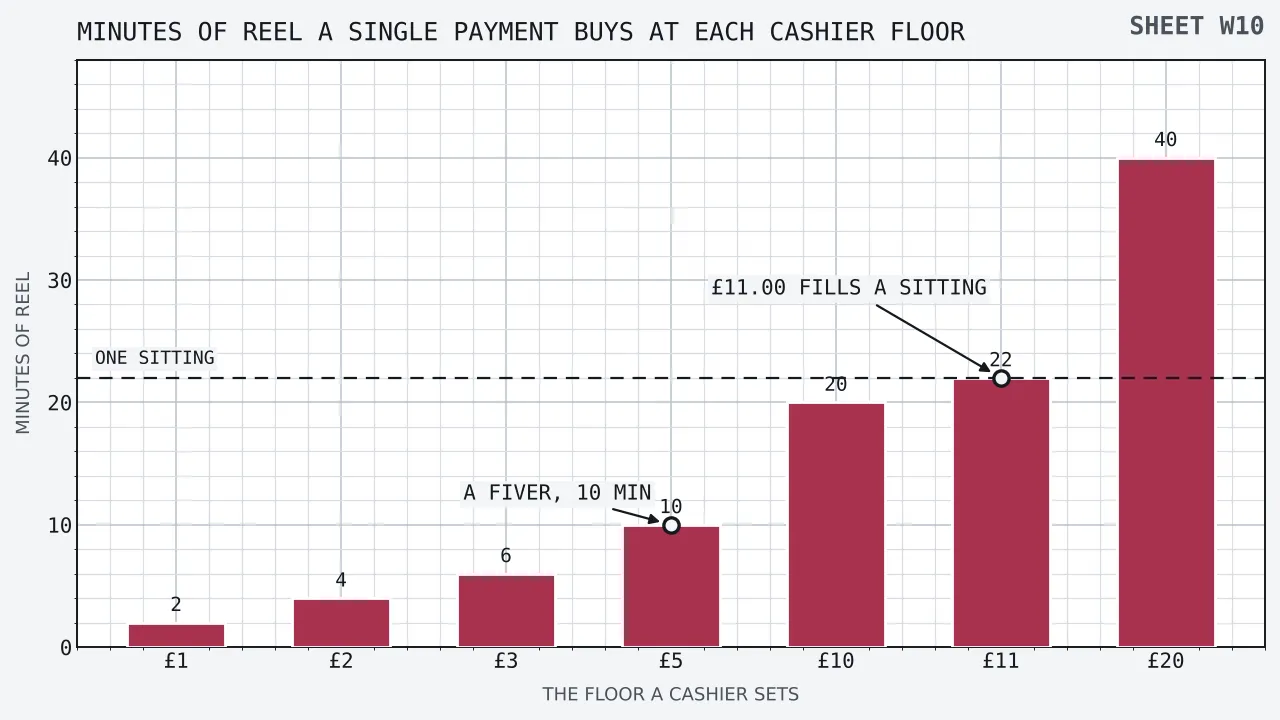
Ten minutes against twenty-two is where a fiver sits, which is under half an evening. Two point two fivers is what one sitting absorbs at a single pass, and a fraction of that shape is the mechanism by which a second payment happens before anybody has stood up. The floor is below the evening, and the evening finishes the money rather than the money finishing the evening.
Twenty minutes is where a tenner sits, two minutes short of the same rule, which makes a ten-pound floor the one that most nearly matches a sitting without exceeding it. Forty minutes is where twenty pounds sits, which is nearly two evenings bought in one movement. Between those two the trade is visible without further argument: a bigger floor buys more evening and costs more to be wrong about.
Nought of the drawing changes if a reader presses faster, and the arithmetic settles that without reaching for any rulebook. Taking a fiver through its full 1,250 presses inside one sitting of twenty-two conventional minutes would want a press every 1.06 seconds held steadily, which is quicker than a reel built to a Great Britain licence is allowed to turn over. The twelve evenings come out of the count of presses, not out of the speed of any thumb.
6
The case against a low floor, which is repetition
Two point two is the figure that runs against everything part four established, and a note that buried it would not be worth reading. A floor below the length of a sitting is a floor that gets used more than once in a sitting, so the protection bought by a small unit is partly handed back by the frequency with which the unit is repeated.
Three fivers inside one evening comes to fifteen pounds and thirty minutes of reel, which overruns a twenty-two minute sitting by eight minutes and overruns a tenner by five pounds. Nothing stops the third payment except a decision, and the third payment is precisely the one a low floor makes easy. That is the honest shape of the objection.
| Payments made | Sum committed | Reel time at a single pass | Against a conventional sitting |
|---|---|---|---|
| One | £5.00 | 10 min | Twelve minutes short |
| Two | £10.00 | 20 min | Two minutes short |
| Three | £15.00 | 30 min | Eight minutes over |
| Four | £20.00 | 40 min | Eighteen minutes over |
Two readings of the same evening pull in opposite directions and both are true at once. A reader who makes one payment and stops has lost at most a fiver and bought the finest resolution on offer. A reader who makes four has committed twenty pounds in steps so small that not one of them felt like a decision, and arrives at exactly the sum a twenty-pound floor would have taken in one movement.
One difference survives that symmetry and it is the one worth holding on to. The reader at the twenty-pound floor committed twenty pounds while intending to commit something smaller. The reader at the five-pound floor committed twenty pounds in four separate acts, each of which could have been the last. Four chances to stop is not nothing, and it is the entire protective content of a low floor.
Nought of that content survives if a cashier remembers a card and makes the next payment a single tap, which is the practical caveat. The protection lives in the friction, and friction is a design choice belonging to the business rather than to the floor. A low figure with no friction behind it is a low figure and nothing more.
7
Protections set desk by desk rather than once for everybody
One pattern links everything in these eight parts and it is the right way to state what a reader gives up outside the Great Britain licence. A floor is set by a single business for its own customers. So, out here, is almost every other protection worth having, and a protection set desk by desk has to be set again at the next desk.
Four periods are on offer at registration with Gamstop Online, a half-year, a single year, a stretch of five, and five that renew themselves unless somebody stops them, and one registration covers every business licensed in Great Britain at once. Ending a registration early is not on offer, because its minimum period runs out first or not at all. Afterwards it takes a call to the scheme’s own contact centre, followed by a cooling-off stretch of 24 hours at the least, through which the exclusion stays live.
Seven years is the tail after a deactivation, during which operators continue to be told that the person was previously self-excluded, although they are not obliged during that tail to keep the person out. Those intervals are long by design, and length is the feature rather than a side effect. A protection a person can cancel in an evening is a protection against very little.
One year is the shortest self-exclusion the Curaçao policy requires an operator to offer, with three years, five, ten and a lifetime beyond that, and no revocation open to the player once it has been confirmed and before it runs out. Harder than the British minimum of six months, in other words. Scope rather than length is the difference that bites: the exclusion runs across one operator and all its domains, while the policy’s own remedy for every other website is encouragement, the player being urged to shut themselves out at each of them separately.
Nought cross-operator register exists to make that encouragement unnecessary, and the British scheme states its own boundary in the same terms. It assists with the gambling services of businesses that take part, and it cannot keep anybody away from services run by organisations that do not. Taking part is what a Great Britain licence requires, so a business beyond that licence falls outside the scheme by definition rather than by inclination.
Twelve hundred and fifty presses is where all this returns to a fiver. Committing to each game cycle individually is required of a licensed system, which is the rule that forbids autoplay in online gaming, so a licensed fiver played to exhaustion is 1,250 separate deliberate acts. Off the licence nothing requires that, and a run of 1,250 presses can be handed to a feature rather than to a thumb, which removes the last of the friction this page has been pricing.
8
Decisions already taken on the reader’s behalf
First, the resolution of every future decision to stop has been fixed before a reader arrives. Five pounds sets it at 50 presses and 10 supposed minutes. Twenty pounds sets it at 200 presses and 40. Neither figure was chosen with an evening in mind, and £11.00 is the one that would have been.
Second, the worst single overshoot has been fixed at a penny under the floor. Four pounds ninety-nine is a tolerable number to be wrong by and nineteen pounds ninety-nine is not, and the gap between those two is the entire measurable benefit of a lower rung. It is a real benefit and it is smaller than the word minimum suggests.
Third, the number of times the floor is likely to be used in one evening has been fixed too, by the relationship between the floor and the length of a sitting. Two point two fivers fill the twenty-two minutes this site conventionally allows for one. A floor beneath that length invites repetition, and repetition is where a low floor gives back what it gave.
Fourth, the stake is not fixed at all, and that is the input doing the most damage quietly. The identical fiver is twelve seconds at the heaviest stake a licensed reel may take from an adult of twenty-five or over, and 10 minutes at the ten pence this site works in. Off the register neither ceiling applies, so the spread runs wider than either figure.
Four hours and ten minutes is the figure to leave with, because it is the one a cashier page never prints beside its minimum. A fiver carried all the way to exhaustion against four pence in the pound is 1,250 presses and twelve evenings, on a press interval conventional throughout these parts and a sitting length of the same kind. The floor describes the first ten minutes of that, and the floor is the only part of it printed in bold.
Questions
- How much play does a £5 deposit buy?
- Fifty presses and ten minutes at a stake of ten pence, each press given twelve seconds by a convention this site adopts and has never put to a watch. Recycled to exhaustion against four pence in each pound, the same fiver reaches 1,250 presses occupying 4 h 10 min, twelve evenings at the twenty-two minutes conventionally allowed for one.
- Is there a rule saying how small a deposit a site must accept?
- None has been published on the British side, and no figure unsupported by a source will be invented. Whoever writes the cashier page owns the floor, so it varies from business to business and can move without anything being breached. What is written down concerns the ceiling a customer may set over money paid in, and that duty travels with the licence.
- What is the difference between a deposit floor and a deposit limit?
- Direction and authorship. A limit is a ceiling the customer chooses over a stretch of time, and a licensed system has to offer one, prompt for it and treat setting it as the default, with a deliberate act needed to decline. A floor is a minimum the business chooses for a single movement, and nothing published says what it should be.
- Is a lower minimum deposit actually safer?
- In one measurable respect, yes. The worst a floor can force past an intention is a penny under the floor itself, so £4.99 at a fiver against £19.99 at twenty pounds. Inside £20.00 a five-pound floor leaves four moments at which walking away costs nothing extra, where a twenty-pound floor leaves one. That is the whole protective content, and it is real.
- What is the argument against a low floor?
- Repetition, and it is a serious one. Ten minutes of reel is under half the twenty-two minute sitting this site works with, so one sitting absorbs 2.2 fivers at a single pass. Four payments of five pounds arrive at the same twenty pounds a single larger movement would have taken, in steps small enough that none of them felt like a decision.
- Why does £5 appear as a stake limit as well?
- Because two unrelated figures share a number. Regulations made on 25 February 2025 put a ceiling over the stake one individual may place on any single game cycle at a reel-based online game, £5 where the player has turned twenty-five and £2 where they have not. Commencement fell on 9 April 2025 where the larger ceiling is concerned, and on 21 May 2025 for the smaller, according to the regulator’s guidance, which also confirms that slots alone are reached, roulette and blackjack being left alone.
- What is £11.00 doing in these figures?
- It is the floor that would exactly fill one evening, and no cashier sets it. A pound buys ten presses and two minutes at ten pence, so twenty-two minutes of sitting wants eleven pounds. A fiver falls twelve minutes short of an evening and a tenner falls two minutes short, which is why a second payment tends to happen before anybody has stood up.
- Does a small deposit keep anybody below the notice of Gamstop Online?
- The size of a payment has nothing to do with it, because the licence rather than the sum decides how far the scheme reaches. It assists with the gambling services of businesses that take part and cannot keep anybody away from services run by organisations that do not. Ending a registration early is not available, the minimum period having to run out first, and anybody feeling the pull to look for a route round one can reach free confidential help on 0808 8020 133, dialled at whatever hour suits.
- What should be checked before picking the smallest payment on offer?
- The stake the lobby will put a press at, first of all, since the identical fiver is twelve seconds at £5 a press and ten minutes at ten pence. Then whether the cashier remembers a card, because the protection in a low floor lives entirely in the friction of making each payment. Then the multiple over any bonus, since a four per cent edge repeated twenty-five times has taken a credit whole.