Note D07 Revision 1 Terms read 17 October 2026
Two hundred spins that arrive twenty at a time, and the ten separate days somebody has to turn up on
Two hundred presses at ten pence stake £20.00 and are expected to return £19.20, which is forty minutes of pressing at the twelve seconds this note allows a press, call it two sittings. Released twenty a day it becomes 10 visits instead, four minutes apiece, and every day skipped costs £1.92 of the expectation with no way back to it.
In hand on day one 20 spins Visits the schedule asks 10 Expected on full attendance £19.20
What a release of this size asks in visits
Advertising has been bought for every destination below. A fee reaches this site when a reader goes on to register, and no figure on this page moves one way or the other because of it.
-
01Mobile Free Spins
Betportal
Ceiling as a multiple
What lands€15.00150 spins at 10c, which is this site's figure and not the operator'sThe run17 h 30 minTurning over 525.00 at 10p means 5,250 presses, or about 48 phone sittings of 22 minutes. Timed at 10p a press and 12 seconds between presses, both of which this site assumes rather than measures.The wait to be paidNOT PUBLISHEDThis operator puts no withdrawal band in its own terms, so there is nothing honest to print here.Spins valued at this site's own 10p a spin
What lands
Spins, at a price15.00150 of them at 10c apiece, a figure belonging to this site rather than to the operatorMatch, and other creditno figure300% of three deposits, to a ceiling of €1,000. Not a sum until money of yours makes it one, so this row totals nothing and carries nothing downwardsThe run
Handed back on the spins(0.60)Each press stakes its own value and returns 96 per cent, which leaves this much with the house from the opening pressPlay-through 35x on the bonus(20.16)Taking 14.40 round 35 times over means 504.00 through the machines, of which 20.16 is the expected cost, and 17 h 30 min of pressing at the pace aboveWhat counts towards it100%Slots only, with no percentage published anywhere, so the row above assumes the whole of each stake countsWhat never clears
Limit on the winningsstated5x the bonusDeducted on the way outno figureNothing is published as a figure here, so this row removes nothingLeast that can leaveno figureNo figure is published, so nothing on this timer is pinned down by oneLeast deposit, and the rung over ityour own€20 a stage. Published in euros, so no rung is named at all: this site's ladder is a sterling oneThe window on the creditstated14 daysBiggest stake while it runsstated€5Removed outright by rulestatedNot publishedVerified before a payoutstatedDocuments before the first withdrawalNever clears€15.00Not a penny of it gets out, so the whole of what landed stands on this rowNo Great Britain licence
Licence held in Anjouan, Comoros, the company named is BetPortal Gaming Ltd, with Excite Ultra Media Ltd, quoted under ALSI-202601040-FI2.
Terms read 17 October 2026
Open the offer at Betportal, opens in a new window -
02Mobile Free Spins
WinBeast
Ceiling as a sum
What lands€50.00500 spins at 10c, which is this site's figure and not the operator'sThe run2 d 18 hTurning over 2,000.00 at 10p means 20,000 presses, or about 182 phone sittings of 22 minutes. Timed at 10p a press and 12 seconds between presses, both of which this site assumes rather than measures.The wait to be paidNOT PUBLISHEDThis operator puts no withdrawal band in its own terms, so there is nothing honest to print here.Spins valued at this site's own 10p a spin
What lands
Spins, at a price50.00500 of them at 10c apiece, a figure belonging to this site rather than to the operatorMatch, and other creditno figure50% to 100% of five deposits, each to a ceiling of €1,000, and a €650 free bet. Not a sum until money of yours makes it one, so this row totals nothing and carries nothing downwardsThe run
Handed back on the spins(2.00)Each press stakes its own value and returns 96 per cent, which leaves this much with the house from the opening pressPlay-through 40x on the bonus and the winnings from the spins(76.80)Taking 48.00 round 40 times over means 1,920.00 through the machines, of which 76.80 is the expected cost, and 2 d 18 h of pressing at the pace aboveWhat counts towards it100%Slots, titles vary by country, with no percentage published anywhere, so the row above assumes the whole of each stake countsWhat never clears
Limit on the winningsstated€100 a batch of spinsDeducted on the way outno figureNothing is published as a figure here, so this row removes nothingLeast that can leaveno figureNo figure is published, so nothing on this timer is pinned down by oneLeast deposit, and the rung over ityour own€20 a stage. Published in euros, so no rung is named at all: this site's ladder is a sterling oneThe window on the creditstated7 days, spins 1 dayBiggest stake while it runsstatedNot publishedRemoved outright by rulestatedNot publishedVerified before a payoutstatedDocuments before the first withdrawalNever clears€50.00Not a penny of it gets out, so the whole of what landed stands on this rowNo Great Britain licence
Licence held in Curaçao, no company named anywhere on the site.
Terms read 17 October 2026
Open the offer at WinBeast, opens in a new window -
03Mobile Free Spins
EliteSpin
Longest spin window
What lands£50.00500 spins at 10p, which is this site's figure and not the operator'sThe run2 d 18 hTurning over 2,000.00 at 10p means 20,000 presses, or about 182 phone sittings of 22 minutes. Timed at 10p a press and 12 seconds between presses, both of which this site assumes rather than measures.The wait to be paidNOT PUBLISHEDThis operator puts no withdrawal band in its own terms, so there is nothing honest to print here.Spins valued at this site's own 10p a spin
What lands
Spins, at a price50.00500 of them at 10p apiece, a figure belonging to this site rather than to the operatorMatch, and other creditno figure50% to 100% of five deposits, each to a ceiling of £1,000. Not a sum until money of yours makes it one, so this row totals nothing and carries nothing downwardsThe run
Handed back on the spins(2.00)Each press stakes its own value and returns 96 per cent, which leaves this much with the house from the opening pressPlay-through 40x on the bonus and the winnings from the spins(76.80)Taking 48.00 round 40 times over means 1,920.00 through the machines, of which 76.80 is the expected cost, and 2 d 18 h of pressing at the pace aboveWhat counts towards it100%Slots, with no percentage published anywhere, so the row above assumes the whole of each stake countsWhat never clears
Limit on the winningsstated5x the bonusDeducted on the way outno figureNothing is published as a figure here, so this row removes nothingLeast that can leaveno figureNo figure is published, so nothing on this timer is pinned down by oneLeast deposit, and the rung over ityour own£20 a stage. It lands square on the £20.00 rung, so none of yours is left perched on topThe window on the creditstated7 days, spins 3 daysBiggest stake while it runsstatedNot publishedRemoved outright by rulestatedNot publishedVerified before a payoutstatedDocuments before the first withdrawalNever clears£50.00Not a penny of it gets out, so the whole of what landed stands on this rowNo Great Britain licence
Licence held in Costa Rica, the company named is PrimeTier Limited.
Terms read 17 October 2026
Open the offer at EliteSpin, opens in a new window -
04Mobile Free Spins
Crown Jewelz
Multiple unpublished
What lands£15.00150 spins at 10p, which is this site's figure and not the operator'sThe runNOT TIMEDThis operator does not publish the play-through multiple in its own terms. The multiple is the one figure the clock cannot work around, so the run is left untimed.The wait to be paidNOT PUBLISHEDThis operator puts no withdrawal band in its own terms, so there is nothing honest to print here.Nothing reckoned
What lands
Spins, at a price15.00150 of them at 10p apiece, a figure belonging to this site rather than to the operatorMatch, and other creditno figure200% of the first deposit, then 150% twice, each to a ceiling of £1,000. Not a sum until money of yours makes it one, so this row totals nothing and carries nothing downwardsThe run
Play-throughno figure40x the bonus, reported rather than published by the operatorWhat counts towards itno figureSlots, with no percentage published anywhere, so the row above assumes the whole of each stake countsWhat never clears
Limit on the winningsstatedNot publishedDeducted on the way outno figureNothing is published as a figure here, so this row removes nothingLeast that can leaveno figureNo figure is published, so nothing on this timer is pinned down by oneLeast deposit, and the rung over ityour own£20. It lands square on the £20.00 rung, so none of yours is left perched on topThe window on the creditstatedNot publishedBiggest stake while it runsstatedNot publishedRemoved outright by rulestatedNot publishedVerified before a payoutstatedDocuments before the first withdrawalNever clearsNOT RECKONEDThis operator leaves the play-through multiple out of its own terms, so nothing below the fourth step can be worked out.No Great Britain licence
Licence held in Curaçao, number not verified, no company named anywhere on the site.
Terms read 17 October 2026
Open the offer at Crown Jewelz, opens in a new window
Only the middle reading comes out of arithmetic belonging to this site. The multiple laid against what lands gives the turnover asked for; dividing that by 10p a spin gives the presses; dividing those by 300 an hour gives the hours, a press on a handset being taken here at 12 seconds from the one before. Both figures are assumptions rather than measurements of anybody: nothing was played and nothing was held a stopwatch to. Anybody quicker should divide the press count by a rate of their own, which is why the presses are printed alongside the hours instead of being summarised away.
The first reading is what arrives before any condition is laid against it. Spins carry no unit of their own so one gets supplied: where an operator values its own spin that figure is used and attributed, and where it does not, this site's 10p a spin stands in and everything below moves with it. The third reading belongs to the operator entirely. It is a withdrawal band quoted from published terms, and a blank there means none was published rather than that nobody looked.
The total along the foot answers what the hours leave open, which is whether any of the running ends anywhere. It is what arrived, less whatever is still standing once the play-through has been paid for at 96 per cent return to player and once a published limit, a published deduction and a published floor beneath the least that can leave have each had a turn. It appears again in pence in the pound, the only fair way of holding a small offer up against a large one. It describes an offer rather than an evening, and where the conditions price out what arrived, a timer prints nothing getting out instead of a negative sum.
Cashiers on a handset take deposits off a row of preset buttons, so a least deposit given in pounds is raised to the next rung of the ladder used here, £10, £20, £25, £50, £75 and £100, and the timer shows what is left perched on it. That money is the reader's own and enters no sum at all. Given in euros it prints untouched, the ladder being sterling. Three words may occupy the figure column where no figure belongs. Stated is a published term that costs something while leaving no number to subtract. No figure is a term nobody has quantified, or a credit that is not a sum until money of yours makes it one. Your own is money of yours, which belongs in none of this.
None of the operators above is licensed in Great Britain, so not one duty that licence carries reaches any of them. Membership of Gamstop Online is compulsory for every online gambling company licensed in Great Britain, which means that shutting yourself out through the scheme shuts you out of none of these. The limit of ten times the bonus funds on a wagering requirement, running since 19 January 2026 under Social Responsibility Code 5.1.1, is a condition of the same licence and binds only whoever holds one. Off that licence, the Gambling Commission writes of consumers meeting unfair gaming practices, financial loss and no recourse when matters go wrong, and lists blocked payouts and withdrawal limits pitched too high to reach among the things it has seen. No account at any of them may be held by anybody under 18.
Every term on a timer is its operator's own and every timer carries the day somebody read it. The oldest of those readings is 17 October 2026. What binds a reader is an operator's full terms and never a line printed here.
1
A headline that exists only as a total
Twenty is the number a reader holds on the first evening. Two hundred is the number on the banner. Both are true, and the distance between them is a release schedule nobody advertises, under which the larger figure is a sum across days rather than a quantity in an account.
Nineteen pounds twenty is what the full two hundred is expected to return. Two hundred presses at ten pence carry £20.00 over the reels, and eighty pence is what the house is expected to keep, four pence in each pound at the ninety-six per cent this note assumes of a reel carrying no published figure. Against a payment of £10.00 that expectation is 1.92 times the money paid in, which is why the arrangement is worth examining rather than dismissing.
Forty minutes is the pressing. Two hundred presses, each allowed twelve seconds by this note, come to 2,400 seconds, and set against an occasion allowed twenty-two minutes here that is 1.82 sittings, carried up to two. Both intervals are conventions of this note, adopted so that a count can be turned into a duration at all, and neither was observed anywhere.
Ten days is the release this page models, twenty presses arriving on each of them, declared here as this note’s own model because no British rule governs how an incentive may be scheduled and nothing published describes a standard shape. Fourteen days is the printed window the model sits inside, adopted on the same basis.
Two sittings of pressing, served across ten separate days
Five times is the multiplier the schedule applies, and it does not apply to the money. Two sittings of pressing become ten visits. The forty minutes does not grow, the £19.20 does not shrink while attendance holds, and what changes is the number of separate occasions on which a person has to decide to open a lobby. That number is the subject of this note.
2
Twenty presses, four minutes, and a tenth of the number
Four minutes is one instalment. Twenty presses at the allowed twelve seconds come to 240 seconds, which is 18.2 per cent of the twenty-two minute occasion this note works with. A reader opening the lobby for an instalment is opening it for less than a fifth of a sitting, and then closing it again.
Two pounds is what an instalment stakes and £1.92 is what it is expected to return, eight pence staying behind. Ten instalments of £1.92 make the £19.20, and the arithmetic is linear throughout because expectation does not care how a count is cut into pieces.
| What is being counted | One instalment | All ten together |
|---|---|---|
| Presses | 20 | 200 |
| Staking at ten pence | £2.00 | £20.00 |
| Expected back | £1.92 | £19.20 |
| Pressing at the allowed interval | 4 min | 40 min |
One tenth is the share of the headline standing in the account on the first evening, and it is worth saying in pounds as well as in presses. Twenty presses is £1.92 of expectation, which is 19.2 per cent of the £10.00 paid in. A reader who gave a tenner and expected to be handed something worth roughly twice it has, on the first night, about a fifth of their own payment back in prospect.
Nought point two eight per cent is what one instalment asks of one day. Four minutes inside the 1,440 a day contains is a vanishing requirement, and the smallness is the whole difficulty. Nobody fails to find four minutes. People fail to remember that four minutes is owed, which is a different failure with a far higher rate.
3
Ten visits where two sittings would have done
Two is the honest count of sittings in forty minutes of pressing. Ten is the count of visits a daily release requires. Those two numbers measure different things, and only the second decides whether the £19.20 ever reaches anybody.
Eight extra openings of a lobby is the cost of the schedule, and the cost is paid in attention rather than in money or in minutes. Each opening carries a sign-in, a wait for the lobby, a look at what is there and a decision to press. None of that appears in the forty minutes, because the forty minutes counts presses and nothing else.
10 openings for 40 min of pressing, against 2 for the same pressing
Four minutes against twenty-two is the mismatch that makes a release schedule profitable to run. An instalment is too small to fill a sitting, so a reader who opens the lobby for it is overwhelmingly likely to stay past it, and whatever they do with the remaining eighteen minutes is funded from somewhere other than the instalment. The schedule is not a way of handing over two hundred presses. It is a way of producing ten arrivals.
Nothing in that observation requires anybody to behave badly, and it is not a claim about intent. A four minute instalment inside a twenty-two minute habit is simply the arithmetic of the design, and the arithmetic works the same whoever wrote it. A reader who treats each instalment as a four minute errand and leaves is taking exactly what was offered and nothing beside it.
Ten visits over ten days is also ten chances to miss, and part five prices that. Under a release of this shape the probability of collecting everything is not the probability of wanting to. It is the probability of turning up ten times running, which anybody who has kept a daily habit for a week and a half can estimate better than this page can.
4
Two release shapes, and the risk each concentrates
Two shapes cover most of what a schedule can do, and they fail in opposite ways. This note models both, names them plainly as models of its own, and prices each, since choosing between them matters rather more than any argument about how many spins there are.
A daily lapse is the first shape. Twenty presses arrive each morning and go at the same hour the next day, so each instalment has 24 hours and nothing accumulates. Ten visits are compulsory, each missed day is final, and the whole arrangement is finished by the close of the tenth day.
A single closing date is the second. Twenty presses arrive each morning and stay, everything lapsing together at the end of the printed fortnight. One visit on the final day can take all two hundred, so nothing is compulsory until that day, and then everything is.
| What is being compared | A daily lapse | A single closing date |
|---|---|---|
| Life given to one instalment | 24 hours, the same for all ten | From 336 hours down to 120 |
| Instalment life summed across ten | 240 hours, which is ten days | 2,280 hours, which is 95 days |
| Visits a reader must make | Ten, one on each release day | One, if it lands before the close |
| Cost of missing a Tuesday | £1.92, gone for good | Nothing, while the close is ahead |
| Cost of missing the final day | £1.92, the same as any other | Whatever has not yet been pressed |
| Pressing demanded on one day | 4 min, every day for ten | Up to 40 min, all in one go |
Nine and a half times is the ratio between the two totals in row two. Two thousand two hundred and eighty hours of instalment life against 240 is what the second shape hands a reader, and the generosity is real. What it buys, though, is one large failure mode in place of ten small ones, and the two are not equally easy to insure against.
Forty minutes on one evening is row six, and it is the part a reader planning to leave everything to the close should sit with. Two sittings back to back, after a fortnight of intending to get round to it, on an evening that has to be the right one. The daily shape asks for four minutes ten times and the closing shape asks for forty minutes once, and neither is the easy option it looks like from the other side.
Where a sheet is silent about which shape applies, the silence favours whoever wrote it. A reader assuming accumulation under a daily lapse loses £1.92 a day without being told. A reader assuming a daily lapse under a single closing date merely turns up more often than necessary. Only one of those mistakes has a price, which is a reason to find the answer before the first press and not after the third.
5
What a skipped day removes, priced against the payment
One pound ninety-two is the price of one skipped day under a daily lapse, and the figure is best held against the payment rather than against the headline. Against the £10.00 paid in, £1.92 is 19.2 per cent, so a single forgotten Tuesday costs very nearly a fifth of the money that bought the arrangement.
| Days attended | Presses used | Pressing at the allowed interval | Expected back | Set against the £10.00 paid in | Short of £19.20 by |
|---|---|---|---|---|---|
| All ten | 200 | 40 min | £19.20 | Ahead by £9.20 | £0.00 |
| Nine of them | 180 | 36 min | £17.28 | Ahead by £7.28 | £1.92 |
| Eight | 160 | 32 min | £15.36 | Ahead by £5.36 | £3.84 |
| Seven | 140 | 28 min | £13.44 | Ahead by £3.44 | £5.76 |
| Five | 100 | 20 min | £9.60 | Short by £0.40 | £9.60 |
| Three | 60 | 12 min | £5.76 | Short by £4.24 | £13.44 |
| The first only | 20 | 4 min | £1.92 | Short by £8.08 | £17.28 |
Column five is the column a reader should read first, because it answers the only question the payment raises. Five days of ten is where the expectation falls below the tenner that bought it, by forty pence, and everything beneath that row is an arrangement in which the payment was not recovered in expectation.
Half attendance is therefore the break-even line, and half attendance across ten consecutive days is not a demanding standard. It is also not a safe one, because the days a reader misses are not drawn at random from the ten. They cluster at the end, when the novelty has gone, which is precisely where the next part finds the instalments with the least room left.
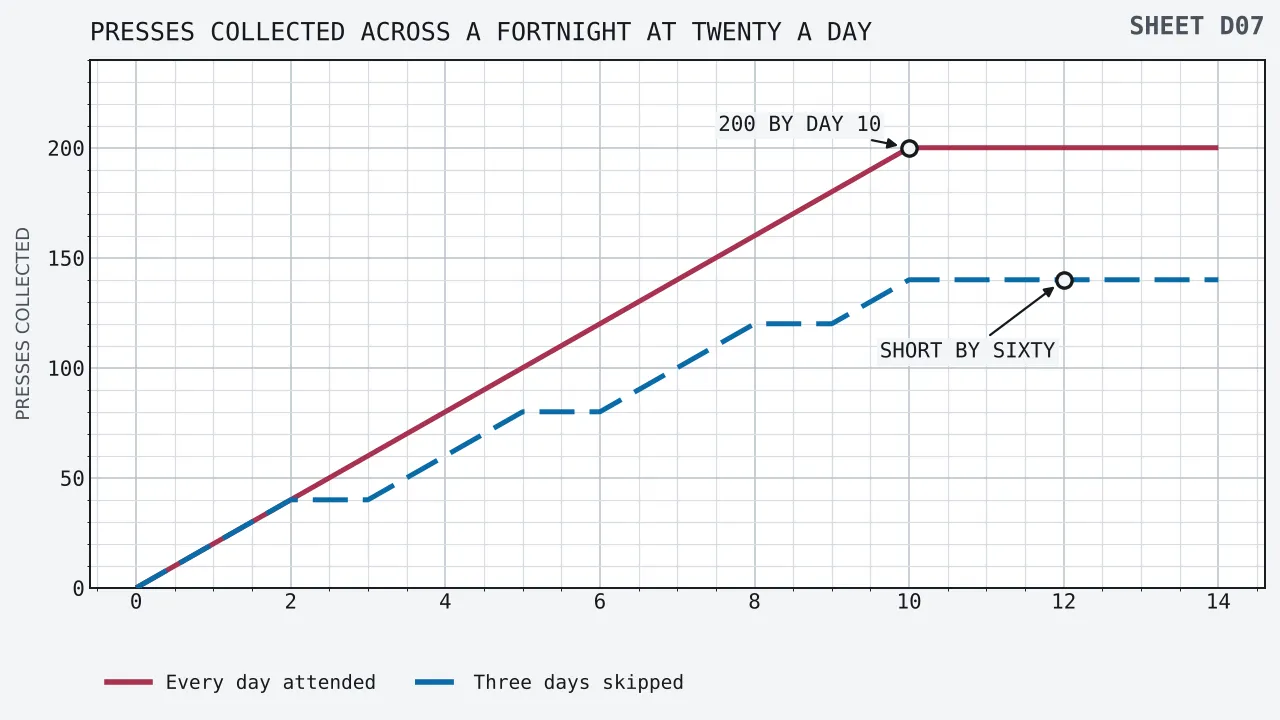
Three flat stretches are the whole story of the lower line. Each one is a day on which nothing was collected, 20 presses and £1.92 lost at that moment, and the line never recovers the height because a lapsed instalment is not reissued. Sixty presses short at the close is £5.76 of expectation and twelve minutes of pressing that never happened.
Two hundred against a hundred and forty is a thirty per cent shortfall produced by missing three of the ten days, which sounds proportionate and is. The part that is not proportionate is what it does to the payment: £13.44 expected against £10.00 paid in, where full attendance gave £19.20, so three quiet evenings took two thirds of the margin the arrangement was offering.
6
Why the final instalment has the least room behind it
Three hundred and thirty-six hours is what the first instalment gets under a single closing date, and 120 hours is what the tenth gets. Both are generous, and the ratio between them is 2.8 to one. A reader collecting on the last afternoon has been given fourteen days to deal with the first twenty presses and five to deal with the last twenty.
Twenty-four hours is what every instalment gets under a daily lapse, and the equality is only apparent. The tenth instalment arrives after nine previous arrivals have worn the novelty off, on a day when the account is familiar and the reminder is one of ten rather than the first of its kind, and that makes it the likeliest of the ten to be left alone.
| Instalment | Lands at hour | Hours left under a closing date | Hours left under a daily lapse |
|---|---|---|---|
| The first | 0 | 336 | 24 |
| The fourth | 72 | 264 | 24 |
| The seventh | 144 | 192 | 24 |
| The tenth | 216 | 120 | 24 |
Twenty-four hours running down the fourth column is the figure to weigh against four minutes of pressing. An instalment needs 0.28 per cent of the time it is given, so the constraint has nothing to do with duration and everything to do with the reader being in the right frame of mind once inside a twenty-four hour period, ten times running.
Ninety-five days is the second column added up, against ten days for the fourth, and it is the clearest statement of what a closing date is worth. Two thousand two hundred and eighty hours of instalment life against 240 hours, for the same two hundred presses, decided by one sentence about when things lapse.
One hundred and twenty hours on the last instalment is still five days, and five days is ample for four minutes of pressing. The warning in this part is not that the last instalment is tight. It is that the last instalment is the smallest in room, the latest in the sequence and the least likely to be remembered, and those three facts compound rather than cancel.
7
Four days of a printed fortnight with nothing in them
Ninety-six hours of the printed window hold nothing at all under a daily lapse, and the gap sits at the end where nobody looks for it. Releases run from hour nought to hour 216, the last instalment dies at hour 240, and the window printed on the sheet runs to hour 336.
Twenty-eight and a half per cent of the fortnight is therefore decorative. Ninety-six hours over 336 is 28.6 per cent, during which a reader believes an arrangement is live, the account says a promotion is running, and there is nothing in it that can be pressed.
336 h printed, 240 h usable, 96 h of window holding nothing
Ten days is the real length of an arrangement built this way, and a reader planning around fourteen has planned around a number that describes the sheet rather than the spins. The difference matters at exactly one moment, which is when somebody decides there is still time and there is not.
Nought is the number of extra presses the final four days can produce, and that is worth separating from the question of whether money can still be moved. A balance built from earlier instalments may well have its own clock, running on its own length, and that clock is a separate clause in a separate paragraph. The two are not the same date and a sheet rarely puts them in the same sentence.
Fourteen days is nonetheless the figure a reader will remember, because it is the figure printed largest. Any arrangement that releases on a schedule has at least two lengths in it, the release and the window, and where the release finishes first the window is the longer and more comforting of the two and also the less true.
8
A check a licence repeats on every day of a release
A release organised this way stands outside the British licence. Where a page is about being asked back ten times, the duty worth naming is the one that gets repeated at the same interval, because a repeated invitation and a repeated check are the two halves of the same clock and only one of them crosses the register. Losses of other sorts are costed on other notes.
Every twenty-four hours is the interval at which a British licence requires the entire customer base to be matched against the national self-exclusion register, a duty running since April 2020, with scheme membership itself written into the licence from March 2020. Ten release days is ten such tests. A printed fortnight is fourteen of them.
Twenty-four hours is also the length of one instalment under the first shape modelled here, and the coincidence is the sharpest thing on this page. Two clocks of identical length run over a release, one inviting a person back each morning and one re-asking each morning whether that person has decided to stop. Beyond the register the first clock runs and the second does not exist.
| Over the ten release days | How often | Times across the release | Whether it travels off the register |
|---|---|---|---|
| An instalment arriving | Daily | 10 | Yes, since the schedule is the product |
| A list tested against the scheme | Daily | 10 | No, the duty rides on the licence |
| The same test across a fortnight | Daily | 14 | No, for the same reason |
| A payment of £10.00 repeated | Varies | Up to 15 a month | Partly, as the next paragraphs set out |
Fifteen payments of ten pounds reach £150.00 in a month, and that figure is the live threshold for the lighter sort of financial check on the British side. The threshold opened at five hundred pounds of monthly net deposit on 30 August 2024, and a cut to one hundred and fifty followed on 28 February 2025. A reader paying a tenner in fifteen times inside a month therefore crosses it on the licensed side and crosses nothing whatever elsewhere.
Ten release days is well inside a month, which is why the threshold belongs on a page about schedules rather than on a page about single payments. An arrangement that trains a daily visit is an arrangement that makes the next payment easy, and the arithmetic of fifteen tenners is the arithmetic of a fortnight repeated.
The heavier assessments have not left the pilot stage, nobody is affected by them while that stays true, and the regulator’s own statement is that a credit rating goes untouched by the lighter checks and by the pilot alike. Those qualifications belong here because a page naming a check should say precisely how far it has got, and this one has got as far as a threshold and no further.
The self-exclusion scheme states its own boundary plainly, and it is the limit a reader should carry away from this part. Its reach stops at the operators taking part, and whatever is run by organisations outside the scheme lies beyond anything it is able to do. A release schedule run beyond the register is precisely such a service, and the daily arrival it generates is the thing the daily check exists to interrupt.
9
Who a schedule of ten visits actually suits
Nineteen pounds twenty against ten pounds paid in is a genuinely favourable expectation by the standards of anything else on this site, and a page that buried that under warnings would be dishonest. No play-through sits over it, the forty minutes is real pressing rather than a clearing obligation, and full attendance leaves a reader £9.20 ahead in expectation.
Ten visits is the whole of the price, and the people it suits are the people who already open the same application daily for some other reason. For them an instalment is four minutes added to an existing habit. For everybody else it is a new habit built on purpose, and the arithmetic of a new habit is a question about the reader rather than about the arrangement.
Five days is the number to hold on to from part five. Below half attendance the expectation drops under the payment that bought it, and the margin disappears into evenings that were spent on other things. Anybody who cannot honestly promise five openings in ten days is looking at an arrangement whose expectation is less than their own tenner.
Two questions settle the sheet before the payment goes in, and neither is about the count of presses. Whether instalments accumulate or lapse each day, since that one sentence is worth 2,040 hours of instalment life. And when the release actually finishes, as against when the window on the page says the promotion ends, because those are different dates and only the earlier one governs pressing.
Nobody should take a schedule as a reason to pay in repeatedly. Fifteen payments of a tenner inside a month is £150.00, which the arithmetic of this page reaches without anybody intending it, and the expectation on each separate arrangement is small while the count of accounts and payments is not. One tenner, ten visits and a diary is the version of this that stands up.
Questions
- Are 200 free spins given all at once?
- Commonly not. This note models a release of twenty presses a day across ten days, labelled as its own model because no British rule governs how an incentive is scheduled. On that model a reader holds a tenth of the headline on the first evening, which is twenty presses, four minutes of pressing at the twelve seconds allowed here and £1.92 of expectation.
- What are 200 free spins expected to return?
- Nineteen pounds twenty, on full attendance. Two hundred presses at ten pence carry £20.00 over the reels, and eighty pence is what the house is expected to keep, four pence in each pound at the ninety-six per cent this note assumes of a reel carrying no published figure. Against a payment of £10.00 that is 1.92 times the money paid in.
- What does the pressing on two hundred spins come to?
- Forty minutes of pressing, being 2,400 seconds once each of the two hundred is allowed twelve seconds by this note. Against an occasion allowed twenty-two minutes here that is 1.82 sittings and carries to two. Spread twenty a day it becomes ten visits of four minutes each, and the pressing total does not change.
- What does missing a day cost?
- One pound ninety-two, where instalments lapse daily, and there is no way back to it. That is twenty presses, four minutes of pressing and 19.2 per cent of the £10.00 paid in. Missing three days of the ten leaves 140 presses, £13.44 expected and a shortfall of £5.76, which is two thirds of the margin the arrangement was offering over the payment.
- How many days can be missed before the deposit is not recovered?
- Five of the ten. Attendance on five days uses 100 presses and gives £9.60 of expectation, which sits forty pence under the £10.00 paid in. Every row below half attendance is an arrangement whose expected return no longer covers the payment that bought it, and the missed days tend to cluster at the end rather than spread evenly.
- Which instalment has the least time behind it?
- The last, under either shape. Where everything lapses on one closing date the first instalment gets 336 hours and the tenth gets 120, a ratio of 2.8 to one. Where instalments lapse daily all ten get 24 hours, and the tenth is still the one most likely to go unused because it arrives after nine previous arrivals have worn the novelty off.
- Does the printed window match the release?
- Not where instalments lapse daily. Releases run from hour nought to hour 216, the final instalment dies at hour 240, and a printed fortnight runs to hour 336. That leaves 96 hours, 28.6 per cent of the window, during which the account says a promotion is running and nothing in it can be pressed.
- What protection is lost on a release run offshore?
- A check that would otherwise repeat at the same interval as the invitation. A release organised this way stands outside the British licence, which has required the whole customer base to be matched against the national self-exclusion register at twenty-four hour intervals since April 2020, with scheme membership written into the licence from March 2020. Ten release days is ten such tests and a printed fortnight is fourteen. The scheme states its own boundary too: its reach stops at participating operators, and anything run by an organisation outside it lies beyond what the scheme is able to do.
- Is there a point at which repeated deposits trigger a check?
- On the licensed side, yes, and the arithmetic is fifteen tenners. The lighter financial check begins where net deposits pass a monthly figure, one that opened at five hundred pounds on 30 August 2024 and was cut to one hundred and fifty on 28 February 2025, and fifteen payments of £10.00 reach £150.00 inside a month. The heavier assessments have not left the pilot stage, nobody is affected while that stays true, and the regulator’s own statement is that a credit rating goes untouched by either.
- Is a daily release better or worse than a single closing date?
- It trades one large failure for ten small ones. A daily lapse gives each instalment 24 hours, 240 hours across the ten, and demands ten visits. A single closing date gives the ten instalments 2,280 hours between them, which is 95 days, and demands one visit that has to happen. Four minutes ten times and forty minutes once are both harder than they look from the other side.