Note D09 Revision 1 Terms read 17 October 2026
Five pounds credited at midnight, a document queue until Thursday, and a seventy-two hour clock that started without the reader
A period on a credit is almost always counted from the instant the credit posts, not from the instant somebody first presses anything. On the slow end of the band this note posits for registration and an identity check, that difference is 48 h 46 min of a seventy-two hour period, or 67.7 per cent of it, consumed before press number one. The clause itself is only 6 h 40 min.
What lands £5.00 The run 6 h 40 min Gone before press one 48 h 46
Small credits, with the hours each one asks
Advertising has been bought for every destination below. A fee reaches this site when a reader goes on to register, and no figure on this page moves one way or the other because of it.
-
01Mobile Free Spins
Betportal
Ceiling as a multiple
What lands€15.00150 spins at 10c, which is this site's figure and not the operator'sThe run17 h 30 minTurning over 525.00 at 10p means 5,250 presses, or about 48 phone sittings of 22 minutes. Timed at 10p a press and 12 seconds between presses, both of which this site assumes rather than measures.The wait to be paidNOT PUBLISHEDThis operator puts no withdrawal band in its own terms, so there is nothing honest to print here.Spins valued at this site's own 10p a spin
What lands
Spins, at a price15.00150 of them at 10c apiece, a figure belonging to this site rather than to the operatorMatch, and other creditno figure300% of three deposits, to a ceiling of €1,000. Not a sum until money of yours makes it one, so this row totals nothing and carries nothing downwardsThe run
Handed back on the spins(0.60)Each press stakes its own value and returns 96 per cent, which leaves this much with the house from the opening pressPlay-through 35x on the bonus(20.16)Taking 14.40 round 35 times over means 504.00 through the machines, of which 20.16 is the expected cost, and 17 h 30 min of pressing at the pace aboveWhat counts towards it100%Slots only, with no percentage published anywhere, so the row above assumes the whole of each stake countsWhat never clears
Limit on the winningsstated5x the bonusDeducted on the way outno figureNothing is published as a figure here, so this row removes nothingLeast that can leaveno figureNo figure is published, so nothing on this timer is pinned down by oneLeast deposit, and the rung over ityour own€20 a stage. Published in euros, so no rung is named at all: this site's ladder is a sterling oneThe window on the creditstated14 daysBiggest stake while it runsstated€5Removed outright by rulestatedNot publishedVerified before a payoutstatedDocuments before the first withdrawalNever clears€15.00Not a penny of it gets out, so the whole of what landed stands on this rowNo Great Britain licence
Licence held in Anjouan, Comoros, the company named is BetPortal Gaming Ltd, with Excite Ultra Media Ltd, quoted under ALSI-202601040-FI2.
Terms read 17 October 2026
Open the offer at Betportal, opens in a new window -
02Mobile Free Spins
WinBeast
Ceiling as a sum
What lands€50.00500 spins at 10c, which is this site's figure and not the operator'sThe run2 d 18 hTurning over 2,000.00 at 10p means 20,000 presses, or about 182 phone sittings of 22 minutes. Timed at 10p a press and 12 seconds between presses, both of which this site assumes rather than measures.The wait to be paidNOT PUBLISHEDThis operator puts no withdrawal band in its own terms, so there is nothing honest to print here.Spins valued at this site's own 10p a spin
What lands
Spins, at a price50.00500 of them at 10c apiece, a figure belonging to this site rather than to the operatorMatch, and other creditno figure50% to 100% of five deposits, each to a ceiling of €1,000, and a €650 free bet. Not a sum until money of yours makes it one, so this row totals nothing and carries nothing downwardsThe run
Handed back on the spins(2.00)Each press stakes its own value and returns 96 per cent, which leaves this much with the house from the opening pressPlay-through 40x on the bonus and the winnings from the spins(76.80)Taking 48.00 round 40 times over means 1,920.00 through the machines, of which 76.80 is the expected cost, and 2 d 18 h of pressing at the pace aboveWhat counts towards it100%Slots, titles vary by country, with no percentage published anywhere, so the row above assumes the whole of each stake countsWhat never clears
Limit on the winningsstated€100 a batch of spinsDeducted on the way outno figureNothing is published as a figure here, so this row removes nothingLeast that can leaveno figureNo figure is published, so nothing on this timer is pinned down by oneLeast deposit, and the rung over ityour own€20 a stage. Published in euros, so no rung is named at all: this site's ladder is a sterling oneThe window on the creditstated7 days, spins 1 dayBiggest stake while it runsstatedNot publishedRemoved outright by rulestatedNot publishedVerified before a payoutstatedDocuments before the first withdrawalNever clears€50.00Not a penny of it gets out, so the whole of what landed stands on this rowNo Great Britain licence
Licence held in Curaçao, no company named anywhere on the site.
Terms read 17 October 2026
Open the offer at WinBeast, opens in a new window -
03Mobile Free Spins
EliteSpin
Longest spin window
What lands£50.00500 spins at 10p, which is this site's figure and not the operator'sThe run2 d 18 hTurning over 2,000.00 at 10p means 20,000 presses, or about 182 phone sittings of 22 minutes. Timed at 10p a press and 12 seconds between presses, both of which this site assumes rather than measures.The wait to be paidNOT PUBLISHEDThis operator puts no withdrawal band in its own terms, so there is nothing honest to print here.Spins valued at this site's own 10p a spin
What lands
Spins, at a price50.00500 of them at 10p apiece, a figure belonging to this site rather than to the operatorMatch, and other creditno figure50% to 100% of five deposits, each to a ceiling of £1,000. Not a sum until money of yours makes it one, so this row totals nothing and carries nothing downwardsThe run
Handed back on the spins(2.00)Each press stakes its own value and returns 96 per cent, which leaves this much with the house from the opening pressPlay-through 40x on the bonus and the winnings from the spins(76.80)Taking 48.00 round 40 times over means 1,920.00 through the machines, of which 76.80 is the expected cost, and 2 d 18 h of pressing at the pace aboveWhat counts towards it100%Slots, with no percentage published anywhere, so the row above assumes the whole of each stake countsWhat never clears
Limit on the winningsstated5x the bonusDeducted on the way outno figureNothing is published as a figure here, so this row removes nothingLeast that can leaveno figureNo figure is published, so nothing on this timer is pinned down by oneLeast deposit, and the rung over ityour own£20 a stage. It lands square on the £20.00 rung, so none of yours is left perched on topThe window on the creditstated7 days, spins 3 daysBiggest stake while it runsstatedNot publishedRemoved outright by rulestatedNot publishedVerified before a payoutstatedDocuments before the first withdrawalNever clears£50.00Not a penny of it gets out, so the whole of what landed stands on this rowNo Great Britain licence
Licence held in Costa Rica, the company named is PrimeTier Limited.
Terms read 17 October 2026
Open the offer at EliteSpin, opens in a new window -
04Mobile Free Spins
Crown Jewelz
Multiple unpublished
What lands£15.00150 spins at 10p, which is this site's figure and not the operator'sThe runNOT TIMEDThis operator does not publish the play-through multiple in its own terms. The multiple is the one figure the clock cannot work around, so the run is left untimed.The wait to be paidNOT PUBLISHEDThis operator puts no withdrawal band in its own terms, so there is nothing honest to print here.Nothing reckoned
What lands
Spins, at a price15.00150 of them at 10p apiece, a figure belonging to this site rather than to the operatorMatch, and other creditno figure200% of the first deposit, then 150% twice, each to a ceiling of £1,000. Not a sum until money of yours makes it one, so this row totals nothing and carries nothing downwardsThe run
Play-throughno figure40x the bonus, reported rather than published by the operatorWhat counts towards itno figureSlots, with no percentage published anywhere, so the row above assumes the whole of each stake countsWhat never clears
Limit on the winningsstatedNot publishedDeducted on the way outno figureNothing is published as a figure here, so this row removes nothingLeast that can leaveno figureNo figure is published, so nothing on this timer is pinned down by oneLeast deposit, and the rung over ityour own£20. It lands square on the £20.00 rung, so none of yours is left perched on topThe window on the creditstatedNot publishedBiggest stake while it runsstatedNot publishedRemoved outright by rulestatedNot publishedVerified before a payoutstatedDocuments before the first withdrawalNever clearsNOT RECKONEDThis operator leaves the play-through multiple out of its own terms, so nothing below the fourth step can be worked out.No Great Britain licence
Licence held in Curaçao, number not verified, no company named anywhere on the site.
Terms read 17 October 2026
Open the offer at Crown Jewelz, opens in a new window
Only the middle reading comes out of arithmetic belonging to this site. The multiple laid against what lands gives the turnover asked for; dividing that by 10p a spin gives the presses; dividing those by 300 an hour gives the hours, a press on a handset being taken here at 12 seconds from the one before. Both figures are assumptions rather than measurements of anybody: nothing was played and nothing was held a stopwatch to. Anybody quicker should divide the press count by a rate of their own, which is why the presses are printed alongside the hours instead of being summarised away.
The first reading is what arrives before any condition is laid against it. Spins carry no unit of their own so one gets supplied: where an operator values its own spin that figure is used and attributed, and where it does not, this site's 10p a spin stands in and everything below moves with it. The third reading belongs to the operator entirely. It is a withdrawal band quoted from published terms, and a blank there means none was published rather than that nobody looked.
The total along the foot answers what the hours leave open, which is whether any of the running ends anywhere. It is what arrived, less whatever is still standing once the play-through has been paid for at 96 per cent return to player and once a published limit, a published deduction and a published floor beneath the least that can leave have each had a turn. It appears again in pence in the pound, the only fair way of holding a small offer up against a large one. It describes an offer rather than an evening, and where the conditions price out what arrived, a timer prints nothing getting out instead of a negative sum.
Cashiers on a handset take deposits off a row of preset buttons, so a least deposit given in pounds is raised to the next rung of the ladder used here, £10, £20, £25, £50, £75 and £100, and the timer shows what is left perched on it. That money is the reader's own and enters no sum at all. Given in euros it prints untouched, the ladder being sterling. Three words may occupy the figure column where no figure belongs. Stated is a published term that costs something while leaving no number to subtract. No figure is a term nobody has quantified, or a credit that is not a sum until money of yours makes it one. Your own is money of yours, which belongs in none of this.
None of the operators above is licensed in Great Britain, so not one duty that licence carries reaches any of them. Membership of Gamstop Online is compulsory for every online gambling company licensed in Great Britain, which means that shutting yourself out through the scheme shuts you out of none of these. The limit of ten times the bonus funds on a wagering requirement, running since 19 January 2026 under Social Responsibility Code 5.1.1, is a condition of the same licence and binds only whoever holds one. Off that licence, the Gambling Commission writes of consumers meeting unfair gaming practices, financial loss and no recourse when matters go wrong, and lists blocked payouts and withdrawal limits pitched too high to reach among the things it has seen. No account at any of them may be held by anybody under 18.
Every term on a timer is its operator's own and every timer carries the day somebody read it. The oldest of those readings is 17 October 2026. What binds a reader is an operator's full terms and never a line printed here.
1
Which event sets a clock going, and which one does not
Every period in this market has a trigger, and the trigger is almost never an act of the reader’s. A sheet will say the credit is valid for a stated number of hours from issue, from crediting, from the moment it is applied to the account. All of those name something the other party does. Very few name the first press, and the difference between the two framings is the subject of this note.
Start with the obligation so that the comparison has a size. Five pounds with forty times written over it sends £200.00 over the reels, and a ten pence press cuts that into 2,000 presses. At the twelve seconds this site posits for one press, and has never measured, that is 24,000 seconds, being 400 minutes, or 6 h 40 min. Split into sittings of twenty-two posited minutes it is 18.18 and therefore 19 of them. Expected close on the credit is minus £3.00.
Six hours and forty minutes inside seventy-two hours looks like an easy fit, and on the raw clock it is: 400 minutes inside 4,320 is 9.3 per cent. What that calculation assumes is that all 4,320 minutes belong to the reader from the start. They do not. An unknown slice at the front belongs to a registration form and to a queue, and a further slice is simply not awake.
| What the credit turns into | Quantity |
|---|---|
| Staking the multiple asks for | £200.00 |
| Presses at ten pence apiece | 2,000 |
| Minutes, at the interval posited | 400 |
| The same reading on a clock face | 6 h 40 min |
| Sittings of twenty-two posited minutes | 19 |
| Minutes those sittings book | 418 |
| Expected close on the credit | minus £3.00 |
Row six matters more than row three and the two are easy to confuse. Four hundred minutes is the pressing. Four hundred and eighteen is what nineteen sittings book out of a diary, because a sitting that holds forty presses still occupies its full twenty-two minutes of somebody’s evening. The figure a period has to accommodate is 418 rather than 400.
No British licence governs a desk of this sort, and what that removes on a page about sequence is a set of rules about sequence. Where identity sits relative to play, what a customer is told about it in advance, and when a credit may be handed to somebody who has not yet been checked, are all settled under a British licence and settled nowhere a reader can consult otherwise. Part eight works through them.
2
Five movements before a first press, costed in minutes
Between deciding and pressing there are five distinct movements, and only three of them belong to the reader. Each needs a figure if the overlap is to be priced, and no figure of that kind is published by anybody. So the figures below are this note’s own, offered as a plausible band rather than as an observation, and every sentence that leans on one says so.
| The movement | Whose minutes these are | At the quick end, posited | At the slow end, posited |
|---|---|---|---|
| Typing the registration form | The reader’s | 5 min | 5 min |
| Confirming an address by a link | The reader’s, then a pause | 3 min | 3 min |
| Photographing and sending two documents | The reader’s | 8 min | 8 min |
| Somebody looking at those documents | The desk’s | 60 min | 2,880 min |
| Posting the credit once it clears | The desk’s | 30 min | 30 min |
| All five added together | Mixed | 106 min | 2,926 min |
Sixteen minutes of that total is typing and photographing, and it is identical at both ends of the band because a reader fills a form at the speed a reader fills a form. Everything else is somebody else’s queue. At the quick end the queue is 90 minutes and at the slow end it is 2,910, which is a ratio of better than thirty-two to one on a quantity the reader has no influence over at all.
One hour forty-six minutes is the quick total and forty-eight hours forty-six minutes is the slow one. Both are written as elapsed time rather than as effort, which is the right unit here, because a period is consumed by elapsed time whether anybody is doing anything or not. A reader asleep during the review is spending the period at exactly the rate of a reader watching the inbox.
Two days of review is deliberately chosen as the slow end rather than as a worst case. Longer is entirely possible where a document is rejected and resubmitted, and this note does not model a resubmission because it has no honest basis for how often one happens. What the band is for is bracketing, and the bracket is wide enough to show the shape of the problem without pretending to precision it has not got.
3
The single wait nobody on the reader’s side controls
Row four of that table is the whole of the variance and it deserves separating out. A reader can fill a form faster. A reader can photograph a passport on the first attempt. A reader cannot make somebody at the other end look at the file, and there is no published commitment anywhere in this corner of the market about how long that takes.
What makes it bite is that the review sits inside the period rather than before it. The sequence that produces this is common and unremarkable: an account is opened, the credit is applied straight away as a reward for opening it, the period begins at that instant, and the identity check is then run before anything may be staked or withdrawn. The reader holds a credit with a clock on it and no permission to use it yet.
Three variations on that sequence change the arithmetic entirely and a sheet will rarely say which applies. Where the check happens before the credit is applied, the queue is outside the period and costs nothing. Where it happens after the credit and before play, the whole queue comes out of the period, which is the case costed here. Where it happens only at the point of asking to be paid, the period is unaffected and the delay lands somewhere else entirely.
Nothing in this note is about getting past a check. The check is the thing establishing that an account belongs to an adult who is who they say they are, and the honest treatment of it is to put a figure on how long it takes and show where that figure lands against a clock. A reader who finds the queue intolerable has a decision to make about the offer, not about the queue.
Worth noticing is the direction of the incentive. A period counted from issue, with the check inside it, means a slow review shortens the usable period rather than extending the deadline. Nothing in the arrangement obliges the clock to pause while the file sits in a queue, and nothing publishes how long a queue is, so the two facts compound rather than cancelling.
4
Seventy-two hours with forty-eight of them already spent
Seventy-two hours is 4,320 minutes. Take 106 off it at the quick end and 4,214 remain, which is 70 h 14 min and 97.5 per cent of the period intact. Take 2,926 off it at the slow end and 1,394 min remain, which is 23 h 14 min and 32.3 per cent of the period. The same offer, the same sheet and the same reader produce those two positions, and only the queue differs.
Hold 418 minutes of booked sittings against each. Against 4,214 minutes it is 9.9 per cent, which is comfortable. Against 1,394 minutes it is 30.0 per cent, which means very nearly a third of every remaining minute, awake or not, has to be spent pressing. That is the honest statement of what a slow check does to a short period.
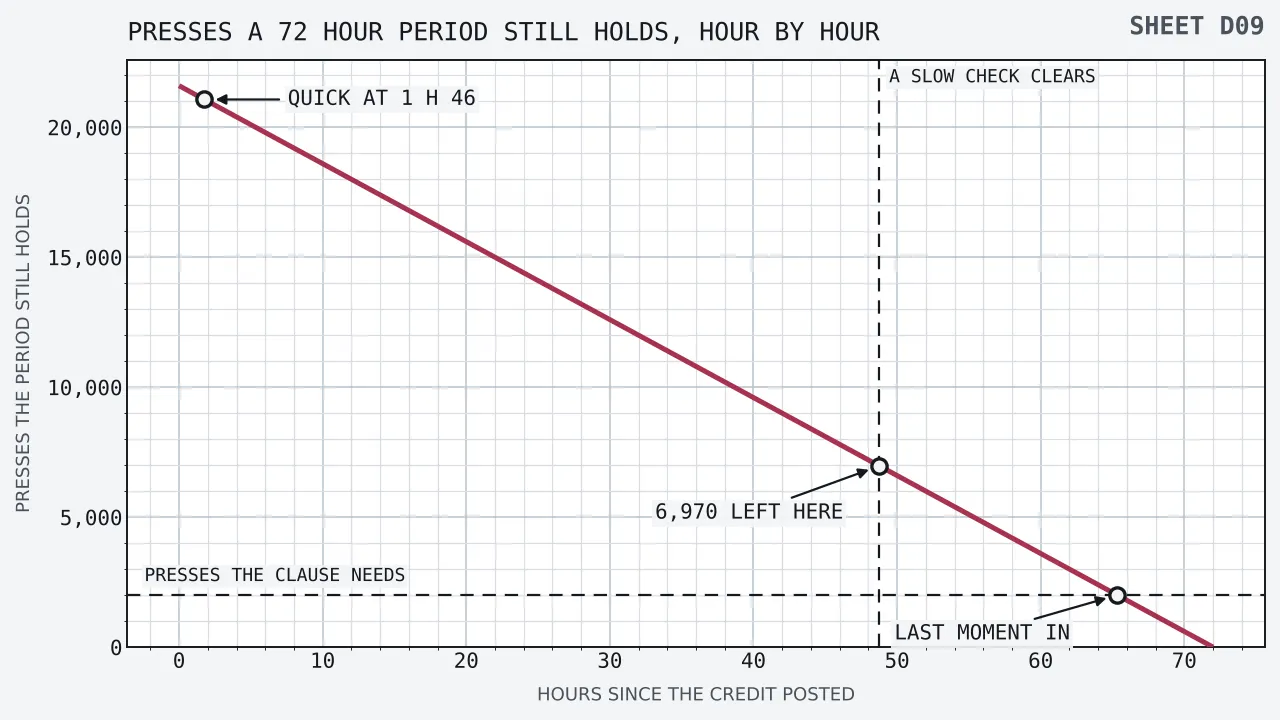
Reading the plate as capacity rather than as a plan is the right way to take it. The falling line is what the period could carry if a person pressed continuously, which nobody does, so the line is a ceiling and not a forecast. Its value is that it shows where the ceiling drops below the requirement, and that happens at 65 h 20 min, which is 6 h 40 min before the period ends.
So a first press beginning later than 65 h 20 min cannot finish even at the fiction of continuous pressing. A slow check clearing at 48 h 46 min leaves 6,970 presses of ceiling, which is three and a half times the requirement, and a reader looking only at that figure would conclude there was plenty of room. Parts six and seven explain why the ceiling is the wrong quantity to look at.
2,926 of 4,320 minutes gone before press one
Reversing the question is instructive. If the period ran from the first press rather than from the posting of the credit, the slow case would lose nothing at all: 2,000 presses inside 72 hours from whenever the reader began. The 2,926 minutes are therefore created entirely by the choice of trigger, and that choice is one line on a sheet.
5
A day and two days, where a credit dies inside the check
Seventy-two hours survives the slow end of the band. Shorter periods, which are common on credits of this size, do not. Running the same two totals against four period lengths settles which arrangements are viable and which are arithmetic that cannot close.
| Period as printed | Minutes it contains | Left after a quick check | Left after a slow check | Whether 418 booked minutes fit |
|---|---|---|---|---|
| Twenty-four hours | 1,440 | 1,334 | Expired first | Quick yes, slow no |
| Forty-eight hours | 2,880 | 2,774 | Expired by 46 min | Quick yes, slow no |
| Seventy-two hours | 4,320 | 4,214 | 1,394 | Yes at both ends |
| Seven days | 10,080 | 9,974 | 7,154 | Yes at both ends |
Row two is the sharpest line on this page. A forty-eight hour period against a forty-eight hour review expires forty-six minutes before the reader is permitted to begin, and the forty-six minutes are the three movements of typing plus the half hour of posting. The credit was never available to be used, and no failure of diligence on anybody’s part produced that result.
Row one does the same thing more brutally. Twenty-four hours is 1,440 minutes and the slow queue is 2,926, so the period is spent twice over before it opens. Even a twelve hour review leaves 704 minutes, which is 11 h 44 min, into which 418 booked minutes is 59.4 per cent of everything remaining including the night.
Rows three and four work at both ends, and row four works comfortably, which points at the practical answer. A seven day period leaves 7,154 minutes after the slow queue, and 418 minutes inside 7,154 is 5.8 per cent. Nothing about the clause changed between row one and row four. Only the trigger’s generosity did.
One qualification keeps the table honest. These rows assume the period is not paused while the check runs, which is the common arrangement and not a universal one. A sheet that stops the clock during a review turns every row into the quick column, and a reader who can find that sentence in the terms has found the single most valuable line on the page.
6
What an hour of waiting is worth, counted in presses
Putting a price on the queue needs a conversion rather than an opinion. An hour of period, at the posited interval, holds 300 presses. At ten pence each those 300 presses move £30.00, and moving £30.00 discharges seventy-five pence of a credit where the multiple is forty. So one hour of waiting consumes 75p of capacity to clear a credit.
| How long the review runs | Presses the period loses | Staking those would have carried | Credit that would have discharged |
|---|---|---|---|
| One hour | 300 | £30.00 | 75p |
| Six hours | 1,800 | £180.00 | £4.50 |
| Twelve hours | 3,600 | £360.00 | £9.00 |
| Twenty-four hours | 7,200 | £720.00 | £18.00 |
| Forty-eight hours | 14,400 | £1,440.00 | £36.00 |
Row two is the one to set against the headline. Six hours in a queue removes capacity that would have cleared £4.50 of credit, which is nine tenths of the five pounds the offer is named after. The queue does not have to be long to be worth more than the thing being queued for.
Row five says the same thing four times over. Forty-eight hours of review removes capacity worth £36.00 of credit, seven times the face of the offer. Read across the whole table, the period as printed carries 21,600 presses of ceiling, which is £2,160.00 of staking and £54.00 of credit, so a seventy-two hour period is nominally big enough for a credit ten times the size of this one.
Which is exactly why the ceiling is the wrong quantity. Nobody presses for seventy-two consecutive hours, so the ceiling overstates the period by an enormous factor, and a page that reasoned from it would conclude that no deadline in this market ever binds anything. The useful figure is not 21,600 presses of ceiling but 418 minutes of booked sittings, and part seven puts that against what a human day actually contains.
The conversion does have one honest use, and it is comparative. Because the rate is fixed at seventy-five pence an hour, a reader can price any delay anywhere in the arrangement in the same unit. An hour spent waiting on a document, an hour spent asleep and an hour spent at work all cost the same seventy-five pence of clearing capacity, and the offer makes no distinction between the three.
7
Sleep and a working day taken out of what is left
What remains after the slow queue is 1,394 minutes, and almost none of that is available either. A stretch of 23 h 14 min contains a night and most of a working day, and neither can be spent on a handset. This note posits eight hours of sleep and eight hours at work or school inside it, which takes 960 minutes off and leaves 434 min.
Four hundred and thirty-four minutes against 418 booked minutes is 96.3 per cent occupancy. Every spare minute of the day after the documents cleared, bar sixteen, has to go on this credit if the clause is to be discharged before the period shuts. That is not a deadline somebody misses through carelessness. It is a deadline that wants a day off work.
| What the minutes went on | Minutes at the slow end | Share of the 4,320 | Who decides how long it takes |
|---|---|---|---|
| Typing, photographing, confirming | 16 | 0.4% | The reader |
| The review and the posting | 2,910 | 67.4% | The desk |
| Sleep inside what was left | 480 | 11.1% | Nobody, posited here |
| Work or school inside what was left | 480 | 11.1% | An employer, posited here |
| Left for a handset | 434 | 10.0% | The reader, if nothing else intrudes |
Ten per cent is the figure to carry away from that table. On the slow end of the band, a seventy-two hour period yields about a tenth of itself as time a person could actually spend pressing, and the clause wants 418 of those 434 minutes. The other ninety per cent went to a queue, to sleep and to the working day, in that order of size.
Running the same table at the quick end of the band turns it around completely. One hour forty-six minutes of queue leaves 4,214 minutes, of which two nights and two working days remove roughly 1,920, leaving about 2,294 minutes for a handset. Four hundred and eighteen inside 2,294 is 18.2 per cent, which is an evening and a half across three days and perfectly ordinary.
Every number in both readings is this note’s own and none of them was observed. Eight hours of sleep is a convention, eight hours of work is a convention, and the one hour to forty-eight hour review band is a posited bracket rather than a measurement. What survives the choice of conventions is the ordering: the queue is the largest single item on the list, and the only item of the three that no reader can plan around.
8
Rules about when a check happens and what is said beforehand
No British licence governs a desk of this sort, and on a page about sequence the duties to name are the ones fixing where an identity check sits in the order of events and what a customer is told about it in advance. Three of them bear directly on the 2,926 minutes costed above.
First, the advance notice. A British licensee has to tell a customer, before that customer can put money in, which papers or other particulars could be asked for, at what stage the asking might come, and by what route they should go in. Read against part two, that duty converts an unknown queue into a known one: a reader who knows the list in advance can have the photographs ready and spend the eight minutes before the clock starts rather than after it.
Second, the ordering. Under the British scheme the check comes before any play rather than before any payout, and it reaches play on bonus money as surely as play on a customer’s own. The announcement of those rules records that an operator had, until then, been given three days in which to finish an age check, and that the replacement arrangement took effect on 7 May 2019. Seventy-two hours is the length of the period this note has spent eight parts pricing, which makes the comparison unusually direct.
The Commission’s consumer guide on identity dates from 23 September 2020 and was last revised on 13 April 2022, and a page leaning on it should say so, because the current wording of the duty sits in the licence condition rather than in the guide. Nothing in either document says how long a check should take, which is why the band in part two is posited here rather than cited.
Third, what happens where a rulebook puts the check later. A Curaçao licence holder need only satisfy itself at registration that the player is not a minor, through a date of birth and such other confirmation as is available, with the full check against papers hung on milestones that come later in the money-laundering and customer-knowledge regime, and pulled forward only where age is in doubt. That is a defensible scheme and it produces exactly the sequence costed here, in which a credit and its clock arrive before the check rather than after it.
Setting the two orderings side by side gives the loss its size. Under the British ordering the queue falls outside the period, because nothing is credited to an unverified account in the first place. Under the later ordering the queue falls inside it. On the slow end of the posited band that is a difference of 2,926 minutes, which this page’s own conversion prices at £36.58 of clearing capacity against a credit of five pounds.
So the thing forgone here is not the check itself, which belongs in both schemes and should. It is the guarantee about where the check sits relative to the clock, plus the advance notice that would let the eight minutes of photographing happen on the reader’s time instead of the period’s.
9
Two things worth settling before a form is opened
Two sentences on a sheet decide whether a five pound credit is a real offer or a formality, and neither is the sum or the multiple. The first is what starts the clock. The second is whether the clock pauses while a check runs. Everything costed above is a consequence of those two answers and of nothing else on the page.
Where the clock starts at the first press, the arithmetic is trivial: 2,000 presses, 6 h 40 min, nineteen sittings, and seventy-two hours is ample. Where it starts at issue and does not pause, the slow end of the posited band leaves 434 usable minutes against 418 booked ones, and the offer becomes a thing that has to be finished in a single evening after a day at work.
For the reader who wants a rule of thumb rather than a table, the conversion is seventy-five pence of credit for every hour of period, so a credit of five pounds wants six hours and forty minutes of genuine availability and a period long enough to contain it after the queue. Seven days contains it at both ends of the band. Twenty-four hours contains it at neither.
One practical step costs nothing and saves the most. Find out which documents are wanted before registering, and have them photographed and to hand. That removes eight of the sixteen minutes of the reader’s own contribution from inside the period, which is small, and more usefully it removes the chance of a rejected file and a second trip through the longest item on the ledger.
Sequence is where this note started and it is the thing to carry away. A clock that begins when somebody else does something is not a deadline the reader is being asked to meet. It is a deadline the reader is being handed partway through, and on the slow end of the band the part already spent is two thirds of it.
Questions
- When does the clock on a free £5 no deposit credit actually start?
- Almost always when the credit is applied to the account, not when the reader first presses anything. Sheets in this market word it as valid from issue, from crediting or from the moment it reaches the balance, all of which name an act of the other party. Where the period runs from the first press instead, nothing in this note’s arithmetic bites at all.
- How long is the wagering on a five pound credit?
- Six hours and forty minutes of pressing. The multiple moves £200.00 over the reels, which a ten pence stake turns into 2,000 presses; twelve seconds apiece, posited here and never recorded, makes 24,000 seconds. In sittings of twenty-two posited minutes it is nineteen, which book 418 minutes of a diary rather than the 400 the pressing itself takes.
- How much of a seventy-two hour window goes before the first press?
- Between 106 minutes and 2,926 minutes on the band posited here. The quick end is five minutes of form, three of confirming an address, eight of photographing documents, an hour of review and half an hour of posting. The slow end replaces the hour of review with forty-eight. Against 4,320 minutes that is 2.5 per cent at one end and 67.7 per cent at the other.
- Can a bonus expire while identity documents are still being checked?
- Yes, and on shorter periods it is the ordinary outcome. A forty-eight hour period against the forty-eight hour review posited here runs out forty-six minutes before the reader is permitted to begin, those forty-six minutes being the typing and the posting of the credit. A twenty-four hour period is spent twice over before it opens. Nothing in either case is a failure of diligence.
- What is an hour of waiting actually worth?
- Seventy-five pence of credit. An hour at the posited interval holds 300 presses, which is £30.00 of staking, and £30.00 of staking discharges seventy-five pence under a forty times clause. So six hours in a queue removes capacity worth £4.50, which is nine tenths of a five pound credit, and forty-eight hours removes £36.00 of it.
- How much usable time is left after a slow check on a three day window?
- About 434 minutes. The slow queue leaves 1,394 minutes, which is 23 h 14 min, and this note posits eight hours of sleep and eight hours of work or school inside that stretch, taking off 960. Nineteen sittings book 418 minutes, so 96.3 per cent of what remains has to go on the credit. Every one of those figures is posited here rather than observed.
- Does the window usually pause while the documents are reviewed?
- Not in the common arrangement, and a sheet rarely says either way. Where a period is paused during a review, every row of the arithmetic collapses to the quick column and the queue costs nothing. A reader who can locate that sentence in the terms has found the most valuable line on the page, and its absence should be read as the clock continuing to run.
- Does a credit of this kind hold a British licence, and what does the sequence cost?
- No British licence governs a desk of this sort, and what goes with it are rules about where a check sits in the order of events. A British licensee has to say, before any money goes in, what papers could be asked for, at what stage, and by what route they go in, and the check itself precedes any play at all, including play on bonus money. The announcement of those rules records that an operator had until then been given three days to finish an age check, with the replacement taking effect on 7 May 2019. A Curaçao licence holder need only satisfy itself at registration that the player is of age, with the full check against papers hung on milestones that arrive later, which puts the queue inside the period rather than before it.
- Why is the window’s capacity in presses not the useful figure?
- Because it assumes continuous pressing, which nobody does. Seventy-two hours at the posited interval holds 21,600 presses, being £2,160.00 of staking and £54.00 of credit, so on capacity alone the period would suit a credit ten times this size. The binding quantity is 418 booked minutes against whatever a person genuinely has free, and on the slow end of the band that comes to 434 minutes.
- What is worth doing before registering for an offer with a short deadline?
- Find out which documents are wanted and photograph them first. That takes eight of the sixteen minutes of the reader’s own contribution out of the period, and more usefully it reduces the chance of a rejected file and a second pass through the longest item on the ledger. Then read for two sentences: what starts the clock, and whether it pauses during a check.