Credit card casino: a rail that closed on 14 April 2020, and the detour in days
Paying for gambling with borrowed money has been shut off on the British side since a licence condition took effect in April 2020, so the subject here is not a route but the cost of its absence. Modelled on the assumptions set out below, the substitute costs anything from 30 min to 120 h before a first press, a spread of 240 to one decided by what is already in a pocket.
- 18+
- Reading time of the whole page: 20 min read
- Updated November 2026
- How the minutes are counted
Five offers for your phone
These five links are paid placements: this site is owed a fee when a reader opens an account, and the order below reflects that.
-
 Albion
£4,000
700 FS
700% up to £4,000 + 700 FS
Claim bonus
18+ · Offshore licence, verify on register
Details
- Licence
- Offshore licence, verify on register
- Also listed
- Monday Reload: 50 Free Spins
- MidWeek Reload: 50% Bonus up to £500
- Payments listed
- Visa · Mastercard · Muchbetter · Apple Pay · Revolut · Trustly · ecoPayz · Paysafecard · BTC · ETH · LTC · USDT
The wording above is the operator's own and can change. Read the full terms on the operator's site before you deposit.
-
 Tweedbet
£14,000
470 FS
Casino Welcome Pack 470% up to £14,000 + 470 FS
Claim bonus
18+ · Offshore licence, verify on register
Details
- Licence
- Offshore licence, verify on register
- Also listed
- Crypto Welcome Bonus 110% up to 1,300 USDT + 110 FS
- VIP Welcome Pack 770% up to £13,000
- Payments listed
- Visa · Mastercard · Maestro · Apple Pay · Revolut · Trustly · ecoPayz · Paysafecard · Bank transfer · Bitcoin · Ethereum · Litecoin · Tether
The wording above is the operator's own and can change. Read the full terms on the operator's site before you deposit.
-
 Elite Spin
€/£5,000
500 FS
Welcome bonus get €/£5,000 + 500 FS
Claim bonus
18+ · Offshore licence, verify on register
Details
- Licence
- Offshore licence, verify on register
- Also listed
- Elite lootboxes unlock surprise rewards up to €/£20,000 or 500 FS
- Summer festival by BGaming is here. Win €80,000
- Payments listed
- MasterCard · Litecoin · Tether · Ethereum · VISA
The wording above is the operator's own and can change. Read the full terms on the operator's site before you deposit.
-
 Winbeast
€5,000
500 FS
Welcome pack €5,000 + 500 FS + €650 free bet
Claim bonus
18+ · Offshore licence, verify on register
Details
- Licence
- Offshore licence, verify on register
- Also listed
- Fortune Wheel unleash wild rewards on €40+ deposits with code FORTUNE
- Beast Boost Monday: use code BOOST1 with a deposit €20, 40% up to €300
- Payments listed
- ecoPayz · Tether · Trustly · VISA
The wording above is the operator's own and can change. Read the full terms on the operator's site before you deposit.
-
 Night Luck
€6,400
280 FS
Casino welcome bonus 805% up to €6,400 + 280 FS
Claim bonus
18+ · Offshore licence, verify on register
Details
- Licence
- Offshore licence, verify on register
- Also listed
- Crypto welcome bonus 140% up to 1,600 USDT + 140 FS
- VIP welcome pack 800% up to €14,500
- Payments listed
- VISA · Trustly · Tether · Paysafecard · NETELLER
The wording above is the operator's own and can change. Read the full terms on the operator's site before you deposit.
A condition, a date, and a rail that closed on it
Reading time: 2 min
Two sentences and one date are the whole of the British position. The condition is numbered 6.1.2, the date is 14 April 2020, and between them they put borrowed money off the stake side of a licensed account. Paying on credit is barred; so is routing the identical payment in through what the rulebook calls a money service business.
Its reach covers every remote licence, so a reader on a handset in an online casino lobby is looking at a screen where no licence that lobby could hold would escape it. Three kinds of licence do sit outside the condition, and not one of them is a licence to run a casino. Betting licences off the internet are caught as well.
Reading position: Minute 1 of 20
So this page prices an absence rather than a route, which makes it the odd one in a section about queues. There is no clearing window to work out, because there is no rail to clear on. What there is instead is a detour: a reader who arrived expecting to use one instrument has to open or reach for another before anything can begin, and that detour has a length in hours.
Reading position: Minute 2 of 20
Three quantities make up the rest of this note. The hours before a first press under each substitute. The hours between asking to be paid and being paid, which the substitute barely changes. And the part of both that no choice of instrument touches at all, which turns out to be the largest part of either.
Reading position: Minute 2 of 20
Nothing below is a measurement. Every hour quoted is a supposition adopted to make the arithmetic work, and each one is named where it is used. The dates and the condition are sourced; the durations are this page's own and were put to no watch.
One look at a cashier settles the licence question
Reading time: 2 min
Here is the sharpest consequence of a one-sentence rule, and it is worth more to a reader than anything else on this page. A site that still takes a credit card for gambling is, by that fact alone, not operating inside the British licence. No other check on this whole site is as quick or as certain.
The logic has two branches and both end in the same place. Either the business holds no Great Britain licence, in which case condition 6.1.2 never bound it and the instrument is accepted because nothing forbids it. Or it holds one and is accepting a payment the condition forbids. A reader does not need to know which branch applies, because the question a payout page cares about is answered either way.
Reading position: Minute 3 of 20
Thirty seconds is roughly what the test costs, which is the time it takes to read the row of accepted instruments on a cashier screen. Compare that with the other checks a reader is told to make: finding the licensed status on a page, clicking through to the register, and matching the activities and the domain names against the entry found. Those are worth doing and they are not a thirty-second job.
One row of a cashier screen, read in about 30 s, answers a question the register takes several minutes to settle
Two cautions keep the test honest. It runs one way only: a lobby that declines credit cards has told a reader nothing, since declining them is what every licensed business does and what plenty of unlicensed ones do as well. And the test says nothing about whether a payout will arrive, only about which rulebook the business is answering to while the money waits.
Fourteen April 2020 is the date to keep attached to the condition, because a page that cites the rule without it cannot show which version of the rulebook it read. The ban is old enough now that a cashier offering the instrument is not behind the times. It is somewhere else entirely.
What a substitute costs before a first press
Reading time: 3 min
Four substitutes cover most of what a reader actually reaches for, and they differ from each other by more than two orders of magnitude in the only dimension this site measures. Half an hour at the quick end. Five days at the slow one. The sum of money involved does not enter into it.
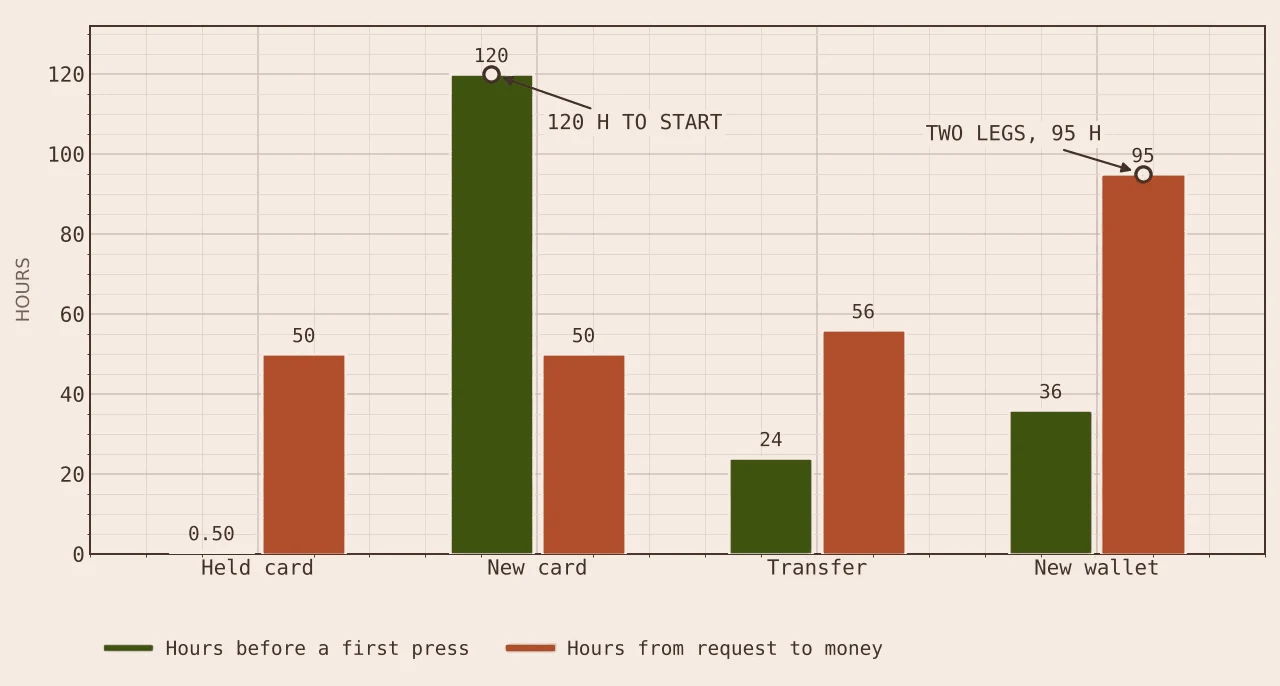
Half an hour is what a debit card already in a pocket costs, and most of that half hour is registration rather than payment. One hundred and twenty hours is what a debit card ordered from a bank costs, five days being this note's figure for a card arriving in the post. Twenty-four hours covers arranging a transfer from a bank, and 36 covers opening a wallet and funding it before it can be used.
Three and a half thousand per cent is the difference between the two ends of that range, which is a silly way to write it and a useful way to feel it. The useful way to state it is that the detour is free for a reader holding a debit card and costs a working week for a reader who is not.
Reading position: Minute 5 of 20
Six hours is a figure worth putting beside the five days, because it shows what the wait is being compared against. A credit of £25 carrying a play-through of forty times sets up £1,000 of staking, and ten pence a press turns that into 10,000 presses. Squeezing 10,000 presses into six hours would want a press every 2.16 seconds, which is quicker than the floor a Great Britain licence puts under a slot, so six hours is off the table however briskly a thumb moves.
Reading position: Minute 5 of 20
Those same 10,000 presses do come to 33 hours and 20 minutes at twelve seconds apiece, that being the handset interval this site supposes throughout and has measured on nobody. So the slow detour, at 120 hours, is 3.6 times the length of the pressing the offer itself demands. The queue to get in is longer than the work once inside.
Two hundred and forty to one, and what sets it
Reading time: 2 min
Two hundred and forty is 120 divided by 0.5, and it is the entire spread of the detour expressed as a ratio. Nothing about the offer produces it. Nothing about the operator produces it. It is produced by whether a reader already holds a piece of plastic that is not the barred one.
240 to 1 between the fastest and slowest detour, decided before a reader reached the page
Three pence and three tenths is what the slow detour is worth as money, taking a £60 sum and valuing 120 hours of it at the four per cent a year this page adopts for cash sitting still. Five days of life, three pence of money. That gap between the two valuations is the honest reason this site measures in hours and not in pounds.
One hundred and sixty-eight hours is a week, so a 120-hour detour eats 71 per cent of a seven-day window if one is running over the offer while the detour is being walked. Twenty-four hours of detour eats 14 per cent of the same window and half an hour eats three tenths of one per cent. The instrument in a pocket decides how much of a deadline survives the queue to reach it.
Reading position: Minute 7 of 20
A reader whose only card draws on credit faces the longest version of all of this, and the honest thing to say is that the five days are the rule doing its job rather than a defect in it. Borrowed money was removed from the stake side deliberately. The detour is the shape that removal takes when somebody meets it.
Nought is what the ban costs on the way out, which is the part most readers assume is affected and is not. A payout does not travel back along a credit card at a British licensed business, because no payment came in along one, so there is nothing for a closed-loop rule to send home. The absence of the rail is felt entirely at the entrance.
The same substitution measured on the way back
Reading time: 2 min
Hours before a press are only half of the question, and the half readers ask about less. The other half is what each substitute does to the wait at the far end, and the answer is that it barely does anything, which is itself the finding.
| What is reached for instead | Hours before a press | Hours from request to money | Both ends | Entrance as a share |
|---|---|---|---|---|
| A debit card already held | 0.5 h | 50 h | 50.5 h | 1 per cent |
| A debit card ordered now | 120 h | 50 h | 170 h | 71 per cent |
| A transfer arranged from a bank | 24 h | 56 h | 80 h | 30 per cent |
| A wallet opened and funded now | 36 h | 95 h | 131 h | 27 per cent |
Fifty hours against 95 is the only interesting movement in the third column, and it comes from a wallet running the payout in two separate legs rather than one. The other three sit within six hours of each other on the way out, because the thing dominating them is not the rail. It is the review that happens before the rail is touched, and that review is the same review whichever instrument is on file.
Seventy-one per cent in the last column is the row worth staring at. For a reader who has to order a card, the entrance accounts for most of the whole journey, and the payout everybody worries about is the minority share. For a reader with the card already, the entrance is one per cent and the payout is the whole story.
Reading position: Minute 9 of 20
One hundred and seventy hours against 50.5 is the same pair of readers compared end to end, a difference of 119.5 hours produced by one object. Neither reader chose differently. Neither read a different set of terms. The arithmetic separates them by five days before either of them has pressed anything.
Reading position: Minute 9 of 20
Choosing the entrance is also choosing the exit, since payments out are commonly confined to the instrument that funded the account, and the two-leg case in the last row is worked through on its own page rather than here. The point that belongs here is narrower: the barred instrument is not one of the options at either end, so the comparison a reader should be making is between the substitutes and not between a substitute and the thing they came for.
Nothing a reader chooses touches the longest part
Reading time: 2 min
Twenty-four hours is this note's figure for the pause while a request is looked at before any payment is released, and it reads 24 hours under each of the substitutes alike. That is not a coincidence or a simplification. A review looks at an account, and an account does not change its character because a different card number is stored against it.
| Part of the wait | Does the instrument change it | Range across the four |
|---|---|---|
| The pause before release | No | 24 h flat |
| The document round, where one runs | No | 48 h flat |
| Value moving along the rail | Yes | 2 h to 47 h |
| Hours nothing is open for | Only through timing | 0 h to 48 h |
Forty-eight per cent is the review's share of a 50-hour payout on the quickest substitute, and 25 per cent of a 95-hour one on the slowest. The share falls as the rail gets slower, which is the only sense in which the instrument matters, and it matters by making the fixed part look smaller rather than by making it shorter.
Seventy-two hours is what the same payout becomes if the pause is set at 48 rather than 24, on an otherwise identical debit card route, and 96 if it is set at 72. Doubling the one part a reader cannot see doubles the answer. Changing the instrument, which is the part a reader spends the decision on, moves 2 hours into 47 at the extreme and nothing at all in the ordinary case.
Reading position: Minute 11 of 20
Where a cashier sits outside the Great Britain licence the pause is whatever its operator decides it is, and it can be a different length on Tuesday from the length it was on Monday without any rule being touched. That is the real asymmetry on this page. The fast part is published and the slow part is not, and the slow part is the one that decides the answer.
A document round indifferent to which rail was used
Reading time: 2 min
A round of document checking is put at 48 hours on this page, counted from the request for papers through to their acceptance, and what it fastens on is the account and not the instrument. Swapping one piece of plastic for another has changed nothing such a round takes any interest in.
On the British side the round is supposed to be over already. Three items go on file and get checked before play starts: a name, a postal address and a birth date. The regulator has said in terms that this holds for play paid for out of an incentive, and holds for games carrying no prize at all. Starting is what the check conditions, not finishing.
Reading position: Minute 12 of 20
Something useful for an instrument follows from the same condition. Before any money can go in, 17.1.1 makes a licensee spell out the documents it might want, the moment at which it might want them, and the way they ought to be sent. A reader at a licensed business therefore knows the paperwork position before picking between the substitutes, and can price the detour with that in hand.
Reading position: Minute 12 of 20
One hundred and eighteen hours is what the debit card route becomes when a 48-hour round lands on the far side instead: 0.5 before a press, then 50 plus 48 after the request. That is the same instrument, the same rail, and two and a half times the wait, with the difference produced by the hour at which a question was asked.
Reading position: Minute 12 of 20
Nought hours is the alternative, and it costs a form filled in before playing rather than after winning. Of everything on this page that a reader controls, that is worth more than the entire choice between the four substitutes on the way in, because 48 hours saved at the exit beats 23.5 hours saved at the entrance.
Who answers when the money does not come
Reading time: 2 min
Suppose the 50 hours become 500. The account shows a payout as processing, nobody answers, and a reader starts looking for somebody with authority. The first instinct is to write to the regulator, and the regulator has published exactly what happens next.
Its own sentence is five words long: "We are not an ombudsman." What that rules out arrives in three parts on the same published page. Getting a customer's money back is not something it is empowered to do. A quarrel over one gambling transaction, a payout that will not move or a game that went wrong, falls outside what it can decide. An account cannot be opened and inspected by it, the accounts not being its to open. Taking the matter to the gambling business itself, first of all, is the step it directs a player towards.
Reading position: Minute 13 of 20
Read that against a business beyond the register and the loss is specific rather than general. Complaining to the business first is the published route, and when the business is the one holding the money and answering to a regulator that never hears from British players, the first step is also the last step. There is no second instance behind it that a British reader can reach.
Reading position: Minute 14 of 20
One lever does exist and the regulator names it. Writing for players about businesses trading without its licence, it says the major payment systems organisations may withdraw a business's payment facilities, and the organisation it names by way of example is Mastercard. That is a sourced statement about what can happen to an unlicensed business, and the actor in it is a card scheme rather than a regulator or an ombudsman.
Reading position: Minute 14 of 20
Which is the quiet reason this page's test in part two matters so much. A reader who establishes, in 30 seconds, that a lobby is taking an instrument the British rulebook forbids has established at the same moment that the published recourse route does not reach it. A 50-hour wait and a 500-hour wait look identical for the first 50 hours, and the difference between them is not a payment rail. It is whether anybody is obliged to answer at hour 51.
What an absence is worth, in hours and in pence
Reading time: 2 min
First, the barred instrument costs nothing at the exit and everything it costs is at the entrance. Half an hour where a debit card is already held, 120 hours where one has to be ordered, and the 240 to one between those two is decided by a reader's pocket rather than by any term anybody published.
Second, three pence and three tenths is what 120 hours of a £60 sum is worth when valued at four per cent annually, so the detour runs expensive in calendar and negligible in money. Any page pricing it in pounds has priced the wrong thing. Five days is the unit it costs in.
Third, the substitute does not change the payout, because 24 of the 50 hours belong to a review that is looking at an account and not at a card. Two hours of rail against 47 is the widest the instrument can move anything, and it only gets that wide when a second leg is involved.
Reading position: Minute 15 of 20
Fourth, the 48 hours a late document round adds at the exit is larger than the 23.5 hours the best substitute saves at the entrance, so a reader optimising the wrong end is giving up twice what they gain. Filing papers before playing is worth more than every other choice on this page combined.
Fifth, a lobby still taking the barred instrument has answered the only question this site can answer in 30 seconds, and the answer is that none of the British duties apply to it. The pause is whatever its operator says, the recourse is its own complaints desk, and the regulator has published, in its own five words, that an ombudsman is not what it is.
Questions
Reading time: 5 min
- Is a credit card allowed at a British online casino?
- No. Two sentences and one date settle it: the condition is numbered 6.1.2, the date is 14 April 2020, and between them they put borrowed money off the stake side of a licensed account. Paying on credit is barred, and so is routing the identical payment in through what the rulebook calls a money service business. The reach covers every remote licence, and betting licences off the internet besides, so no licence an online casino lobby could hold escapes it.
- What does it mean if a site still accepts one?
- That the business is not operating inside the British licence, and it is the quickest test on this site to run. Either it holds no Great Britain licence, so the condition never bound it, or it holds one and is taking a payment the condition forbids. Both branches end in the same place for anybody waiting to be paid. The test runs one way only: declining credit cards proves nothing, because that is what every licensed business does.
- How long does the detour round the ban actually take?
- Between half an hour and 120 hours on the suppositions used here, and nothing about the offer decides which. A debit card already held costs about 30 minutes, most of it registration. A debit card ordered from a bank costs five days. Arranging a transfer costs about 24 hours and opening and funding a wallet about 36. None of those figures was observed; each is a working assumption named where it is used.
- Does the ban make payouts slower?
- Not at the exit, which is the part most people expect to be affected. A payout does not travel back along a credit card at a licensed business, because no payment came in along one, so a closed-loop rule has nothing to send home. The cost of the absence sits entirely at the entrance, and on the slowest substitute it is 71 per cent of the whole journey from arriving to being paid.
- Which part of a payout does choosing a different instrument actually move?
- The smallest part. On the model here the pause before release is 24 hours whatever is on file, a document round is 48 hours whatever is on file, and the rail itself ranges from 2 hours to 47. So the instrument moves between four and nine per cent of a 50-hour wait in the ordinary case. Doubling the pause from 24 hours to 48 adds more than every instrument choice on this page put together.
- Why is five days of waiting worth only three pence?
- Because money has very little time value at the sums involved. Holding sixty pounds for 120 hours, valued at the four per cent a year this page works with, comes to 3.3 pence. That is the whole of the financial cost, and it is why the detour is priced here in days rather than in pounds. The expensive thing about a delay is the delay.
- Can the regulator get a stuck payout released?
- It says plainly that it cannot, in five published words: an ombudsman is not what it is. Getting a customer's money back is not something it is empowered to do, a quarrel over one stuck payout falls outside what it can decide, and an account cannot be opened and inspected by it. The step it directs a player towards is the gambling business itself, first of all, and that step has nothing behind it where the business answers to no British register.
- Is there anything that can act against an unlicensed site?
- One thing is named in the regulator's own guidance for players. Where a business trades without its licence, the major payment systems organisations may withdraw that business's payment facilities, and the organisation given as the example is Mastercard. The actor is a card scheme rather than a regulator, and nothing in the sentence promises an individual their money back. It describes a consequence for a business, not a remedy for a customer.
- How fast could a play-through be cleared if the detour had not happened?
- Not as fast as the five days might make a reader hope. A £25 credit at forty times sets up £1,000 of staking, and ten pence a press turns that into 10,000 presses occupying 33 hours 20 minutes at the twelve-second handset interval this site supposes. Compressing those presses into six hours would need one every 2.16 seconds, which is quicker than the floor a Great Britain licence puts under a slot, so the 120-hour detour is 3.6 times the pressing the offer demands and the pressing cannot be hurried to close the gap.
- What should be settled before picking a substitute?
- Whether the papers have gone in, because 48 hours saved at the exit beats 23.5 hours saved at the entrance and it costs nothing but filling a form in early. After that, whether a second leg is involved, since a route that pays in two hops runs 95 hours against 50 on the model used here. The instrument itself is the last thing to worry about and the first thing most readers worry about.