Bingo no deposit bonus: the expiry is a calendar and the pace belongs to the caller
Reels answer to a thumb and a called game does not, so the window on bingo credit is spent at a rate somebody else publishes. On the room modelled here a £10.00 credit at forty times wants 500 separate calls and 41 h 40 min of room time, and because the doors shut overnight the soonest it can possibly be finished is 61 h 40 min after it lands.
- 18+
- Reading time of the whole page: 27 min read
- Updated November 2026
- How the minutes are counted
Five offers for your phone
These five links are paid placements: this site is owed a fee when a reader opens an account, and the order below reflects that.
-
 Albion
£4,000
700 FS
700% up to £4,000 + 700 FS
Claim bonus
18+ · Offshore licence, verify on register
Details
- Licence
- Offshore licence, verify on register
- Also listed
- Monday Reload: 50 Free Spins
- MidWeek Reload: 50% Bonus up to £500
- Payments listed
- Visa · Mastercard · Muchbetter · Apple Pay · Revolut · Trustly · ecoPayz · Paysafecard · BTC · ETH · LTC · USDT
The wording above is the operator's own and can change. Read the full terms on the operator's site before you deposit.
-
 Tweedbet
£14,000
470 FS
Casino Welcome Pack 470% up to £14,000 + 470 FS
Claim bonus
18+ · Offshore licence, verify on register
Details
- Licence
- Offshore licence, verify on register
- Also listed
- Crypto Welcome Bonus 110% up to 1,300 USDT + 110 FS
- VIP Welcome Pack 770% up to £13,000
- Payments listed
- Visa · Mastercard · Maestro · Apple Pay · Revolut · Trustly · ecoPayz · Paysafecard · Bank transfer · Bitcoin · Ethereum · Litecoin · Tether
The wording above is the operator's own and can change. Read the full terms on the operator's site before you deposit.
-
 Elite Spin
€/£5,000
500 FS
Welcome bonus get €/£5,000 + 500 FS
Claim bonus
18+ · Offshore licence, verify on register
Details
- Licence
- Offshore licence, verify on register
- Also listed
- Elite lootboxes unlock surprise rewards up to €/£20,000 or 500 FS
- Summer festival by BGaming is here. Win €80,000
- Payments listed
- MasterCard · Litecoin · Tether · Ethereum · VISA
The wording above is the operator's own and can change. Read the full terms on the operator's site before you deposit.
-
 Winbeast
€5,000
500 FS
Welcome pack €5,000 + 500 FS + €650 free bet
Claim bonus
18+ · Offshore licence, verify on register
Details
- Licence
- Offshore licence, verify on register
- Also listed
- Fortune Wheel unleash wild rewards on €40+ deposits with code FORTUNE
- Beast Boost Monday: use code BOOST1 with a deposit €20, 40% up to €300
- Payments listed
- ecoPayz · Tether · Trustly · VISA
The wording above is the operator's own and can change. Read the full terms on the operator's site before you deposit.
-
 Night Luck
€6,400
280 FS
Casino welcome bonus 805% up to €6,400 + 280 FS
Claim bonus
18+ · Offshore licence, verify on register
Details
- Licence
- Offshore licence, verify on register
- Also listed
- Crypto welcome bonus 140% up to 1,600 USDT + 140 FS
- VIP welcome pack 800% up to €14,500
- Payments listed
- VISA · Trustly · Tether · Paysafecard · NETELLER
The wording above is the operator's own and can change. Read the full terms on the operator's site before you deposit.
Why a press interval cannot price a ticket
Reading time: 3 min
Ten pence a press is the denomination the rest of this site converts everything into, and it is set aside on this page because it measures the wrong thing. A press is a decision taken and settled by the person taking it. A ticket commits money to an event still to start, which starts at the room's convenience and ends when the calling ends. No amount of rushing moves the second one along, so no interval between one thumb movement and the next can price it.
Four figures stand in its place, and not one of them was observed: each is an assumption this page makes so that the division can be set down. A ticket is priced at 20p. Four tickets are taken for each call. A fresh call begins every five minutes, which puts twelve calls in an hour. Those three give the fourth: 80p goes over the counter at each call and £9.60 an hour while a reader sits there.
Reading position: Minute 1 of 27
Nine pounds sixty against thirty pounds is the whole relationship between the two products. An hour of reel play on the interval this site assumes, twelve seconds to a press, holds 300 presses of 10p and therefore £30.00 of staking. Money leaves a reader in a room at a shade under a third of the rate it leaves them at a reel. That sounds like mercy and is nothing of the kind, because the obligation attached to a credit is written in pounds and the pounds have to cross the counter whatever the counter's speed.
Nothing published by the regulator fixes what a ticket costs, how many a reader buys, or how often a call starts. The four figures above were chosen so that the division can be written down, not because any sheet reports them. A reader whose room sells at 50p, or calls every three minutes, swaps the figure in and runs the division again, and the shape of the answer survives intact: a unit of commitment longer than a press, bought on a schedule the buyer does not hold.
Searches for a bingo no deposit bonus arrive at a banner carrying a sum of money and a multiple, and sometimes a count of days beside them. None of those three is a duration. The sum and the multiple together fix how much has to cross the counter. Only the timetable fixes how long that takes, and the timetable is the one input a reader never sees printed anywhere near the offer.
Reading position: Minute 3 of 27
Credit of this shape is issued by businesses holding no Great Britain licence, and the losses that bite on a page about deadlines are the duties a licence writes about changing things after a reader has committed. Part eight sets out three of them, each with an hour figure already attached. Nothing in this part is affected by their absence. What follows them is.
Four hundred pounds of staking, laid out in calls
Reading time: 2 min
Four hundred pounds comes out of a £10.00 credit at forty times, and that line contains no assumption whatever. It is the credit multiplied by the multiple, and it is the only figure on this page that would read the same on any site in any country.
Two thousand tickets is £400.00 cut into pieces of 20p. Five hundred calls is 2,000 tickets taken four at a time. Two thousand five hundred minutes is 500 calls at the five-minute cycle assumed here, which is 41 h 40 min, and 114 handset sittings once 113.6 is carried up, a sitting being twenty-two minutes on this site's assumption and watched on nobody.
Reading position: Minute 4 of 27
Six pounds is what the exercise expects to cost, and a minus sign leads it. Four pence leaves the pound forty separate times, which is £1.60 gone against each pound of credit and 60p more than the pound holds. Multiply that shortfall by ten and the close reads minus £6.00, reached after 41 h 40 min of sitting in a room.
| The step | What it gives |
|---|---|
| Credit as advertised | £10.00 |
| Staking a forty times clause wants | £400.00 |
| Tickets at the 20p assumed here | 2,000 |
| Calls, four tickets taken at each | 500 |
| Minutes at a five-minute cycle | 2,500 |
| Which is | 41 h 40 min |
| Sittings of twenty-two minutes | 114 |
| Expected standing at the close | minus £6.00 |
Thirteen hours and twenty minutes is the same £400.00 read at a reel, 4,000 presses of 10p at the assumed twelve seconds, which comes to thirty-seven sittings. Three times and a quarter separates the two readings of one obligation. The multiple has not moved, the credit has not moved, and 28 h 20 min has appeared out of the unit alone.
Reading position: Minute 4 of 27
Luck does nothing to any line in that table, which is the reason the conversion is worth writing out. A generous run of calls lifts the balance and subtracts not one ticket from the 2,000, because a clause of this shape counts what crosses the counter rather than what comes back over it. Winning cannot shorten the clock, and on a product where the clock is somebody else's timetable, that matters more than it does anywhere else on this site.
Seven days on paper, ninety-eight hours in fact
Reading time: 3 min
One hundred and sixty-eight hours is what a window of seven days contains, and a reader converting it that way is being generous to the offer by a wide margin. The conversion assumes a room that never closes. Where a room runs fourteen hours in the day, which is the figure assumed from here on and drawn from nowhere, seven days of window hold 98 h of calling and seventy hours of shut doors.
Forty-one point six seven per cent of an advertised window is therefore unusable before anybody reads a single term. The fraction is just the ten closed hours over the twenty-four, and it applies to the whole of the window equally, so a fortnight loses 140 hours and a month of thirty days loses 300. Nothing in the terms is being broken. The clock in the terms counts calendar hours and the product only exists for some of them.
Reading position: Minute 6 of 27
Sixty-one hours and forty minutes is the sharper number, and it is the soonest a £10.00 credit at forty times can possibly be discharged in the room modelled here. Two full opening days supply twenty-eight hours of calling. The balance of 13 h 40 min comes on the third opening day, by which point two closed nights of ten hours each have already gone by. Add 41 h 40 min of calling to twenty hours of nothing and the wall clock reads 61 h 40 min.
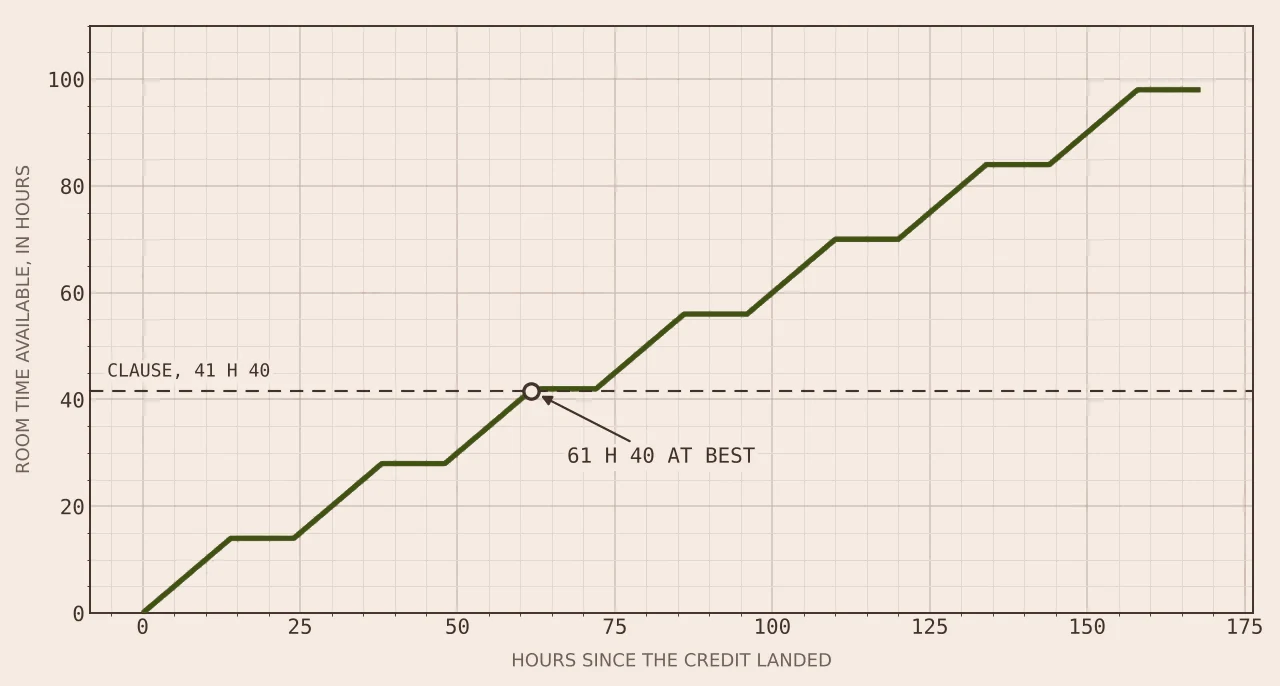
Five hours fifty-seven minutes a day is the rate a seven-day window demands of somebody who means to finish, 2,500 minutes shared out over seven calendar days. In sittings that is seventeen a day on the twenty-two minute assumption, every day, with none dropped for a late shift or a visitor. A window printed as a week is a fortnight of evenings compressed into seven of them.
70 of a window's 168 hours have the doors shut across them
Three hours and forty minutes is what the arithmetic leaves over at the far end, and the leftover is where most of the forfeitures happen. A reader who manages a decent four hours of calling on each of the first seven opening days has put in twenty-eight hours and is 13 h 40 min short. The shortfall is not a small one. It is a third of the whole clause, standing at the moment the window ends.
Closing hours are also uneven, and the unevenness is not in anybody's favour. A window timed to end at nine in the morning gives back nothing at all on its final day, because the room has not opened. The last useful minute was at midnight the night before, and the nine hours the terms appear to grant are nine hours of a shut door.
The dial the room holds, priced minute by minute
Reading time: 3 min
Five hundred calls is settled by money and nothing else, being £400.00 of staking over 80p a call, so the one quantity that can move the hours is the length of the gap between one call and the next. A reader holds no part of that dial. It belongs to the schedule, and the schedule is written where the terms are not.
Twenty-five hours is what 500 calls take at three minutes apiece. Fifty hours is what they take at six. One hundred hours is what they take at twelve. Each additional minute in the cycle adds 500 minutes to the obligation, which is 8 h 20 min, and it adds them without any announcement and without any change to the credit, the multiple or the ticket price.
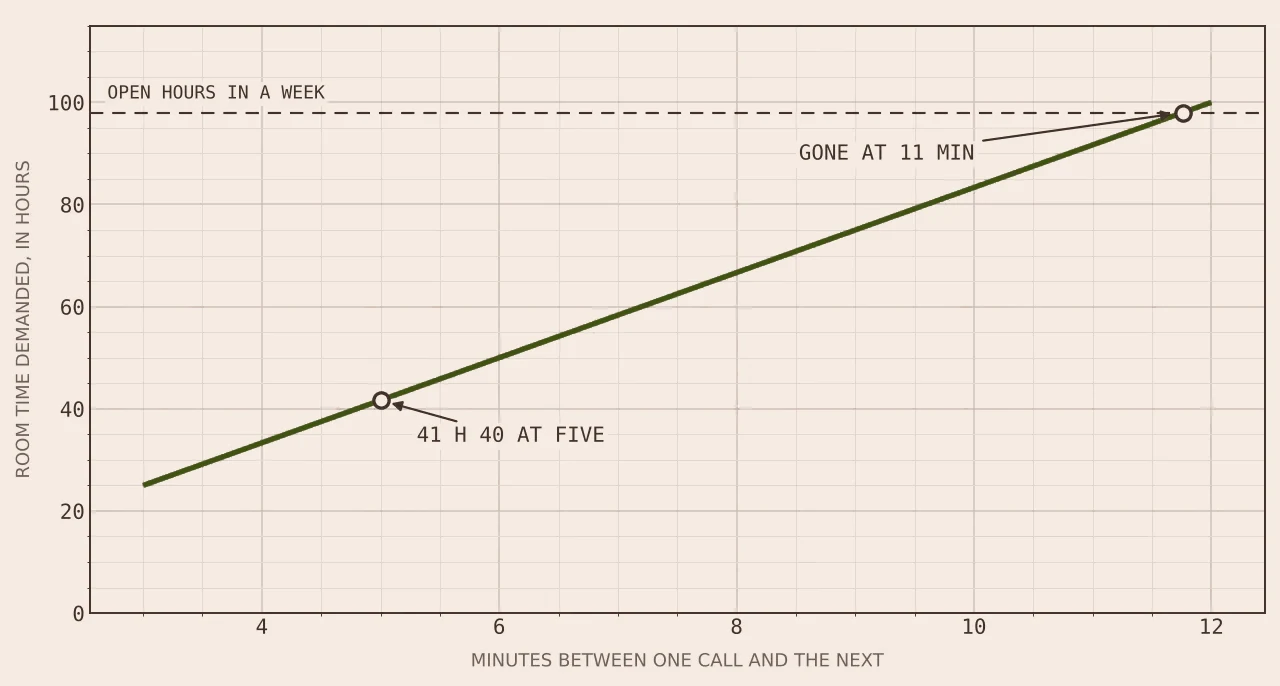
Eleven minutes and forty-six seconds is where the climbing line crosses the horizontal, and that crossing is the page's hardest finding. Beyond it, the obligation is larger than every open hour a seven-day window contains. Not larger than what a reasonable person would manage. Larger than the room's entire output for the week, with the reader present throughout and doing nothing else.
| Gap between calls | Calls in an hour | Room time for 500 calls | Share of a week's open hours | What it asks of a reader |
|---|---|---|---|---|
| Three minutes | 20 | 25 h | 26 per cent | Three and a half hours on each of seven days |
| Four minutes | 15 | 33 h 20 min | 34 per cent | Four and three quarter hours daily |
| Five minutes, modelled here | 12 | 41 h 40 min | 43 per cent | 5 h 57 min daily, none missed |
| Six minutes | 10 | 50 h | 51 per cent | Over half of every open hour there is |
| Eight minutes | 7.5 | 66 h 40 min | 68 per cent | Nine and a half hours of every open day |
| Ten minutes | 6 | 83 h 20 min | 85 per cent | Nearly the whole of the room's week |
Thinness of a room is what moves a reader down that table, and it moves them without telling them. A call wants participants before it is worth calling, so a room with few people in it waits, and the waiting lands inside the gap. Nothing on a screen reports the change. The same credit, the same multiple and the same ticket price quietly acquire another twenty-five hours between the third row and the fifth.
Reading position: Minute 10 of 27
Buying more tickets at each call is the one counter-move available, and it shortens the clock by spending faster rather than by playing longer. Eight tickets a call puts £1.60 over the counter each time, which halves the calls to 250 and the room time to 20 h 50 min. The £400.00 is unchanged, the expected minus £6.00 is unchanged, and the exposure per call has doubled. Time is bought with concentration of stake, and with nothing else.
What the close of a window takes away
Reading time: 3 min
Nought is what a part-finished clause pays. That single property is why a deadline on bingo credit is worth more attention than the multiple attached to it, and it is the property a banner never carries. Four hundred and ninety-nine calls out of 500 settle exactly as nought calls settle, which is to say the credit goes, whatever the credit earned goes with it, and the hours do not come back.
Two hours of calling on each of seven days is a committed reader by any ordinary standard. Fourteen hours against 41 h 40 min is 33.6 per cent of the clause, so that reader reaches the end of the week having discharged a third of it and collects the same nothing as somebody who read the terms and walked away. The 168 tickets they bought along the way were paid for out of the credit, and the credit was never theirs to keep.
| Calling managed each day | Room time in the week | Calls completed | Share of the clause | Paid at the close |
|---|---|---|---|---|
| One hour | 7 h | 84 | 16.8 per cent | £0.00 |
| Two hours | 14 h | 168 | 33.6 per cent | £0.00 |
| Four hours | 28 h | 336 | 67.2 per cent | £0.00 |
| 5 h 57 min | 41 h 40 min | 500 | 100 per cent | Whatever the balance then holds |
Three of those four rows pay the same, and the gap between the third and the fourth is one hour and fifty-seven minutes a day. Somebody doing four hours daily for a week has given up twenty-eight hours and holds nothing. The step between holding nothing and holding something is not gradual anywhere on this page. It is a cliff standing at call number 500.
Winnings sitting on top of the credit go the same way, and that is the part worth reading twice. A clause of this shape generally treats both the credit and whatever it produced as a single parcel until the staking is complete, so a reader 400 calls in with a healthy balance is holding a figure on a screen rather than money. The screen figure and the entitlement are two different things, separated by exactly 100 calls.
Reading position: Minute 12 of 27
Eight hours and twenty minutes is what those last hundred calls are worth in room time, which is a fortnight of comfortable evenings in anybody's week. Measured against the expected close of minus £6.00, it is eight hours and twenty minutes spent protecting a position the arithmetic already expects to be negative. Both halves of that sentence are true at once and neither cancels the other.
Twenty-two minutes laid across a five-minute cycle
Reading time: 3 min
Four calls is what one sitting holds, and two minutes are left over. A sitting of twenty-two minutes is an assumption of this site and a cycle of five minutes an assumption of this page, neither held against a watch, and five goes into twenty-two four times with two minutes spare. Those two minutes are not slack. They are a reader sitting in front of a call that will not finish before they have to go.
One hundred and twenty-five sittings is 500 calls at four to a sitting, against the 114 that 2,500 minutes over twenty-two minutes gives. Eleven whole sittings separate the two figures, and the eleven are pure wastage: four minutes thrown away at each of the 125 occasions, which is 500 minutes, which is 8 h 20 min. The ragged edge between a person's attention span and a room's schedule costs more than eight hours on one £10.00 credit.
| Reading | Sittings | Attention it uses |
|---|---|---|
| Minutes divided by twenty-two | 114 | 41 h 40 min |
| Four whole calls to a sitting | 125 | 45 h 50 min |
| The difference | 11 | 4 h 10 min |
Three pounds twenty is what one sitting puts over the counter, four calls at 80p, and that is the useful unit for anybody deciding whether to start. A credit of £10.00 carrying a forty times clause is 125 occasions of £3.20. Written out that way, the credit reads less like a sum with a condition attached and more like a standing appointment in a diary.
Eighteen sittings a day is what seven days asks on this reading, 125 shared across the week and carried up. A sitting is twenty-two minutes, so eighteen of them is 6 h 36 min of attention a day against the 5 h 57 min of pure calling time, the difference being the thirty-nine minutes a day that fall between calls and the end of a sitting. Both figures rest on assumptions this page has stated and neither has been timed.
Reading position: Minute 14 of 27
Opening a second room is the obvious escape and it is worth pricing rather than dismissing. Two rooms running the same five-minute cycle halve the calendar and leave the money exactly where it was, since 500 calls still cost £400.00 wherever they are bought. What changes is attention: two schedules running side by side demand that a reader watch both, and the sitting that held four calls now holds eight purchases across two timetables.
Two deadlines on one credit, beginning at different moments
Reading time: 3 min
Two clocks sit on an offer of this shape and they are routinely read as one. The first runs on the credit and decides how long it may be staked. The second runs on whatever the staking produced and decides how long that may sit in the account before it must be withdrawn or used. They start at different moments, they can be different lengths, and only one of them is usually printed in the banner.
Nought minutes is the lag between a press and its result at a reel, which is why the two clocks fall on top of each other there and nobody notices the difference. In a room the result of a purchase arrives when the call ends, so money won at the 500th call is credited up to five minutes after the staking finished. A second clock that starts on the credit of winnings therefore starts at a moment the room chooses.
Reading position: Minute 15 of 27
Seven days plus seven days is not a fortnight, and reading it that way is the common error. Suppose the first window runs seven days from the credit landing and the second seven days from the moment winnings are posted. Somebody closing the clause on day three then has until day ten, and somebody closing it at the very last call has until day fourteen. The later date is the worse position, because the first reader kept four days of slack and the second kept none.
| Call the clause is finished at | Day it falls on | Spare before the first clock | Second clock runs to |
|---|---|---|---|
| The soonest the room allows | Day 3 | 4 d 2 h 20 min | Day 10 |
| On a steady 5 h 57 min a day | Day 7 | 0 h | Day 14 |
| Two hours a day, abandoned | Never | Nothing left | Never starts |
Row three is the ordinary case and it is the reason the second clock is so rarely discussed. A deadline on winnings only matters to somebody who reached the winnings, and reaching them wanted 41 h 40 min inside a week. The second window is a protection written for a population that mostly never arrives, which is a sensible way to draft a term and a poor way to read one.
Three windows exist on some sheets rather than two. A third clock, where the terms carry one, limits the period in which the credit may be claimed at all, and claiming takes a minute or two. So of the three deadlines a reader is holding, two are discharged in the time it takes to tap a button and the third is the 41 h 40 min that does every bit of the work.
Clocks a licence runs on whoever writes the timetable
Reading time: 3 min
Credit of this kind is issued without a Great Britain licence. On a page about windows, the protections worth itemising are those that keep the other party from shifting anything after a reader has committed. Three are set out below. Each governs a change of some sort, which is precisely what a timetable invites, and each carries an hour figure from this page so that its absence can be priced rather than deplored.
First comes a bar on repricing an incentive because the qualifying work got done quickly. Finishing that work inside part of the offer period is not, where a licence is held, a permitted reason to pay somebody less, and the prohibition is the third item in the social responsibility code provision covering incentives. Part seven describes exactly that reader: the one closing 500 calls by day three with four days of window to spare. Under a licence the spare days alter nothing about what is owed.
Reading position: Minute 17 of 27
Second comes a duty of notice. Terms must be transparent, reachable without difficulty, and a customer has to learn of a material change in advance of that change biting, all under the condition on fair and transparent terms and practices. On a timetable page the notice half carries the weight. Pulling a window in from seven days to three, or bringing a closing time forward by two hours, lands on 41 h 40 min of somebody's calling.
Third comes a bar on moving a game underneath the person playing it. Rules, payouts and the odds attaching to an outcome are frozen once play is under way, a permitted change must be drawn to the customer's notice, and the guidance picks out one form of words as unacceptable: a term reserving liberty to rewrite the rules of a game whenever the house pleases. Across 500 calls there is ample room for a mid-course adjustment to be worth making.
41 h 40 min of calling sits behind each of those three duties
Nothing in that list binds a business operating outside the British register, and the asymmetry rather than the absence is the thing to take away. A reader on this kind of credit is held to a window counted in days with 41 h 40 min to fit inside it. The party that wrote the window, set the ticket price and published the schedule is held, in the matter of changing any of the three, to whatever its own sheet says about changing them.
Reading position: Minute 19 of 27
One correction belongs here, because overstatement is as useless as silence. A complaint route does exist in at least one of the jurisdictions that licenses this kind of business: a six-month window to complain and an eight-week timeline to answer are published in the Curaçao rulebook, and those match the British periods closely. What is absent is not the route. It is the three rules above, none of which appears in that rulebook at all.
Every hour above, moved one assumption at a time
Reading time: 2 min
Five inputs produced every duration on this page and four of them were chosen rather than found. The multiple of forty and the credit of £10.00 come from the offer. The 20p ticket, the four tickets a call, the five-minute cycle and the fourteen-hour opening day are this page's own, and the twenty-two minute sitting and the twelve-second press are this site's own. Nothing here was timed.
| Input | Modelled at | Moved to | Room time becomes | Change |
|---|---|---|---|---|
| Ticket price | 20p | 10p | 83 h 20 min | plus 41 h 40 min |
| Ticket price | 20p | 50p | 16 h 40 min | minus 25 h |
| Tickets a call | 4 | 8 | 20 h 50 min | minus 20 h 50 min |
| Gap between calls | 5 min | 8 min | 66 h 40 min | plus 25 h |
| Credit | £10.00 | £25.00 | 104 h 10 min | plus 62 h 30 min |
| Multiple | 40 times | 10 times | 10 h 25 min | minus 31 h 15 min |
Row one is the one that catches people out. Halving the ticket price doubles the room time, because the same £400.00 then wants twice as many tickets and the schedule has not changed to accommodate them. Cheap tickets are slow tickets under a staking clause, which inverts the ordinary instinct that a lower price is the kinder option.
Ten hours and twenty-five minutes in the last row is what a ten times clause would ask, ten times being as far as a play-through written over bonus money may be taken wherever a British licence is held, a limit whose commencement date is 19 January 2026. Set beside the 41 h 40 min modelled throughout, that limit is worth 31 h 15 min of room time on one credit. Sixty times is the multiple the regulator itself recorded as being applied in the market when the limit was drafted, and sixty times here would read 62 h 30 min.
Reading position: Minute 20 of 27
Last of the assumptions is the ninety-six pence this site hands back on each pound staked, and that one carries the money rather than the clock. Every expected figure above divides by it, the minus £6.00 included, and the house rate is applied to a generic product rather than claimed of any particular room or any particular game. Where the true return is lower, the minus grows and not one of the hours moves.
Quantities a calendar has already decided
Reading time: 2 min
First, the obligation is fixed in money and spent in time, and only the money half is advertised. Four hundred pounds of staking is what a £10.00 credit at forty times means. Five hundred calls and 41 h 40 min is what that becomes on this page's assumptions, and 13 h 20 min is what the identical £400.00 would be at a reel. The 28 h 20 min between them belongs to the product.
Second, the advertised window is longer than the usable one by the fraction of the day the doors are shut. Seven days reads as 168 hours and delivers 98 on a fourteen-hour opening day. The soonest possible finish is 61 h 40 min after the credit lands, not 41 h 40 min, because two closed nights fall inside any attempt to do it quickly.
Reading position: Minute 22 of 27
Third, the pace belongs to the room and the room's pace moves. Each minute added to the gap between calls adds 8 h 20 min to the obligation. At a gap of 11 min 46 s the clause outgrows every open hour in a seven-day window, and nothing about that change appears on a screen, because a longer gap is only a quieter room.
Reading position: Minute 22 of 27
Fourth, the end of the window pays nothing to anybody short of the last call. Two hours of calling a day for a week discharges a third of the clause and collects £0.00. The credit goes at that moment and so does everything the credit won, and 41 h 40 min of arithmetic separates the reader who arrives from the reader who does not.
Reading position: Minute 22 of 27
Five hundred is the number worth remembering, and what it counts is calls rather than pounds or minutes. Four tickets go on at each of them, 125 sittings hold them on the assumptions stated above, and the far end of the 500 is an expected minus £6.00. Two digits make up the advertised sum. Three make up the thing it buys into.
Questions
Reading time: 5 min
- Why does this page not use ten pence a press like the rest of the site?
- Because nothing here is pressed and a press interval would measure the wrong thing. A ticket commits money to a call that has yet to start, lasts exactly as long as the room makes it last, and admits of no early exit. So this page adopts a ticket at 20p, four tickets taken at each call and a fresh call every five minutes, which puts 80p over the counter at each call and £9.60 in an hour. All three are assumptions of this page and none was observed anywhere.
- How long does a £10 bingo credit at forty times take?
- Multiplying £10.00 by forty gives £400.00 of staking, which at 20p a ticket is 2,000 tickets and at four tickets a call is 500 calls. At the five-minute cycle assumed here that is 2,500 minutes, or 41 h 40 min, and 114 sittings where a sitting is twenty-two minutes on this site's assumption. Expected standing at the close is minus £6.00 on a house return of 96 pence in the pound, a rate used here for a generic product rather than for any named room.
- Does a seven-day window really give seven days?
- It gives 168 hours of clock and rather less of room. On a room assumed open fourteen hours in the day, ninety-eight of those hours are available and seventy have the doors shut, which is 41.67 per cent of the advertised window gone before any term is read. Worse, a credit wanting 41 h 40 min of calling cannot be discharged before 61 h 40 min of wall clock, because two closed nights fall inside even the fastest possible attempt.
- What does a quiet room do to the arithmetic?
- It stretches the gap between calls, and every duration on this page stretches with it while nothing on the screen reports the change. A call wants participants before it is worth starting, so a thin room waits for them. Each extra minute in the cycle adds 500 minutes to the obligation, which is 8 h 20 min. At a gap of 11 min 46 s the clause needs more hours than a seven-day window has open, so it cannot be finished at all.
- Is a part-finished clause worth anything?
- It is worth nothing at all, and that is the single most expensive line in the terms. A reader managing two hours of calling on each of seven days reaches 168 calls, which is 33.6 per cent of the 500 the clause asks, and collects £0.00 at the end of the week. So does a reader who reached 499. The credit goes when the window closes and whatever the credit won goes with it, so the step between nothing and something stands at the last call rather than anywhere earlier.
- Can buying more tickets each call beat the deadline?
- It shortens the calendar and leaves the money exactly where it was. Eight tickets at each call puts £1.60 over the counter rather than 80p, which halves the calls to 250 and the room time to 20 h 50 min. The £400.00 of staking has not changed, the expected minus £6.00 has not changed, and the amount exposed at each single call has doubled. Time is bought here with concentration of stake and with nothing else.
- How many sittings is that in practice?
- One hundred and twenty-five rather than 114, because a sitting does not divide neatly into a schedule. Twenty-two minutes holds four complete calls of five minutes and leaves two minutes over, so 500 calls want 125 occasions rather than the 114 that simple division of the minutes suggests. The eleven extra sittings are 4 h 10 min of attention that the calendar takes and the clause never credits. Both lengths behind that sum are assumptions and neither was timed.
- Are there two expiry clocks or one?
- Commonly two, and sometimes three. One runs on the credit and limits how long it may be staked. A second runs on whatever the staking produced and begins when those winnings are posted, which in a room is up to five minutes after the final purchase rather than instantly. A third, where a sheet carries one, limits the period in which the credit may be claimed at all, and that is a minute's work. All 41 h 40 min sit inside the first of the three.
- What does a British licence require of the party setting the timetable?
- Three things bear directly on a window. An incentive may not be repriced on the ground that the qualifying work was finished inside part of the offer period, which protects whoever gets there early. Terms must be transparent and reachable, and a material change must reach the customer before it bites, which covers a shortened window or a closing time brought forward. And once play is under way the rules, the payouts and the odds attaching to an outcome are frozen, with the guidance picking out as unacceptable any term reserving liberty to rewrite a game's rules at will. Not one of the three reaches a business without that licence.
- Which three figures decide whether this is worth starting?
- None of them is the advertised sum. First, the gap between one call and the next, because every minute of it is 8 h 20 min on a £10.00 credit at forty times. Second, the hours the room is actually open, because ten closed hours a day take seventy hours out of a seven-day window and push the soonest possible finish out to 61 h 40 min. Third, the multiple, because ten times would ask 10 h 25 min where forty times asks 41 h 40 min of the same credit.