Note P01 Revision 1 Terms read 17 October 2026
Ninety seconds in, eighty-seven hours out, and the second rail nobody mentioned at the door
A charge against a phone bill is the quickest way money has ever reached a gambling balance and the one route it cannot come back along. Payment out therefore waits on an instrument that did not exist when play began, and the four lengths this note assumes for that queue add to 87 h on the kindest evening of the week and 135 h on the cruellest. The arithmetic below prices both directions in the same unit.
In, assumed 90 s Out, assumed 87 h Worst evening 135 h
Payout clocks at this end of the market
Advertising has been bought for every destination below. A fee reaches this site when a reader goes on to register, and no figure on this page moves one way or the other because of it.
-
01Mobile Free Spins
Betportal
Ceiling as a multiple
What lands€15.00150 spins at 10c, which is this site's figure and not the operator'sThe run17 h 30 minTurning over 525.00 at 10p means 5,250 presses, or about 48 phone sittings of 22 minutes. Timed at 10p a press and 12 seconds between presses, both of which this site assumes rather than measures.The wait to be paidNOT PUBLISHEDThis operator puts no withdrawal band in its own terms, so there is nothing honest to print here.Spins valued at this site's own 10p a spin
What lands
Spins, at a price15.00150 of them at 10c apiece, a figure belonging to this site rather than to the operatorMatch, and other creditno figure300% of three deposits, to a ceiling of €1,000. Not a sum until money of yours makes it one, so this row totals nothing and carries nothing downwardsThe run
Handed back on the spins(0.60)Each press stakes its own value and returns 96 per cent, which leaves this much with the house from the opening pressPlay-through 35x on the bonus(20.16)Taking 14.40 round 35 times over means 504.00 through the machines, of which 20.16 is the expected cost, and 17 h 30 min of pressing at the pace aboveWhat counts towards it100%Slots only, with no percentage published anywhere, so the row above assumes the whole of each stake countsWhat never clears
Limit on the winningsstated5x the bonusDeducted on the way outno figureNothing is published as a figure here, so this row removes nothingLeast that can leaveno figureNo figure is published, so nothing on this timer is pinned down by oneLeast deposit, and the rung over ityour own€20 a stage. Published in euros, so no rung is named at all: this site's ladder is a sterling oneThe window on the creditstated14 daysBiggest stake while it runsstated€5Removed outright by rulestatedNot publishedVerified before a payoutstatedDocuments before the first withdrawalNever clears€15.00Not a penny of it gets out, so the whole of what landed stands on this rowNo Great Britain licence
Licence held in Anjouan, Comoros, the company named is BetPortal Gaming Ltd, with Excite Ultra Media Ltd, quoted under ALSI-202601040-FI2.
Terms read 17 October 2026
Open the offer at Betportal, opens in a new window -
02Mobile Free Spins
WinBeast
Ceiling as a sum
What lands€50.00500 spins at 10c, which is this site's figure and not the operator'sThe run2 d 18 hTurning over 2,000.00 at 10p means 20,000 presses, or about 182 phone sittings of 22 minutes. Timed at 10p a press and 12 seconds between presses, both of which this site assumes rather than measures.The wait to be paidNOT PUBLISHEDThis operator puts no withdrawal band in its own terms, so there is nothing honest to print here.Spins valued at this site's own 10p a spin
What lands
Spins, at a price50.00500 of them at 10c apiece, a figure belonging to this site rather than to the operatorMatch, and other creditno figure50% to 100% of five deposits, each to a ceiling of €1,000, and a €650 free bet. Not a sum until money of yours makes it one, so this row totals nothing and carries nothing downwardsThe run
Handed back on the spins(2.00)Each press stakes its own value and returns 96 per cent, which leaves this much with the house from the opening pressPlay-through 40x on the bonus and the winnings from the spins(76.80)Taking 48.00 round 40 times over means 1,920.00 through the machines, of which 76.80 is the expected cost, and 2 d 18 h of pressing at the pace aboveWhat counts towards it100%Slots, titles vary by country, with no percentage published anywhere, so the row above assumes the whole of each stake countsWhat never clears
Limit on the winningsstated€100 a batch of spinsDeducted on the way outno figureNothing is published as a figure here, so this row removes nothingLeast that can leaveno figureNo figure is published, so nothing on this timer is pinned down by oneLeast deposit, and the rung over ityour own€20 a stage. Published in euros, so no rung is named at all: this site's ladder is a sterling oneThe window on the creditstated7 days, spins 1 dayBiggest stake while it runsstatedNot publishedRemoved outright by rulestatedNot publishedVerified before a payoutstatedDocuments before the first withdrawalNever clears€50.00Not a penny of it gets out, so the whole of what landed stands on this rowNo Great Britain licence
Licence held in Curaçao, no company named anywhere on the site.
Terms read 17 October 2026
Open the offer at WinBeast, opens in a new window -
03Mobile Free Spins
EliteSpin
Longest spin window
What lands£50.00500 spins at 10p, which is this site's figure and not the operator'sThe run2 d 18 hTurning over 2,000.00 at 10p means 20,000 presses, or about 182 phone sittings of 22 minutes. Timed at 10p a press and 12 seconds between presses, both of which this site assumes rather than measures.The wait to be paidNOT PUBLISHEDThis operator puts no withdrawal band in its own terms, so there is nothing honest to print here.Spins valued at this site's own 10p a spin
What lands
Spins, at a price50.00500 of them at 10p apiece, a figure belonging to this site rather than to the operatorMatch, and other creditno figure50% to 100% of five deposits, each to a ceiling of £1,000. Not a sum until money of yours makes it one, so this row totals nothing and carries nothing downwardsThe run
Handed back on the spins(2.00)Each press stakes its own value and returns 96 per cent, which leaves this much with the house from the opening pressPlay-through 40x on the bonus and the winnings from the spins(76.80)Taking 48.00 round 40 times over means 1,920.00 through the machines, of which 76.80 is the expected cost, and 2 d 18 h of pressing at the pace aboveWhat counts towards it100%Slots, with no percentage published anywhere, so the row above assumes the whole of each stake countsWhat never clears
Limit on the winningsstated5x the bonusDeducted on the way outno figureNothing is published as a figure here, so this row removes nothingLeast that can leaveno figureNo figure is published, so nothing on this timer is pinned down by oneLeast deposit, and the rung over ityour own£20 a stage. It lands square on the £20.00 rung, so none of yours is left perched on topThe window on the creditstated7 days, spins 3 daysBiggest stake while it runsstatedNot publishedRemoved outright by rulestatedNot publishedVerified before a payoutstatedDocuments before the first withdrawalNever clears£50.00Not a penny of it gets out, so the whole of what landed stands on this rowNo Great Britain licence
Licence held in Costa Rica, the company named is PrimeTier Limited.
Terms read 17 October 2026
Open the offer at EliteSpin, opens in a new window -
04Mobile Free Spins
Crown Jewelz
Multiple unpublished
What lands£15.00150 spins at 10p, which is this site's figure and not the operator'sThe runNOT TIMEDThis operator does not publish the play-through multiple in its own terms. The multiple is the one figure the clock cannot work around, so the run is left untimed.The wait to be paidNOT PUBLISHEDThis operator puts no withdrawal band in its own terms, so there is nothing honest to print here.Nothing reckoned
What lands
Spins, at a price15.00150 of them at 10p apiece, a figure belonging to this site rather than to the operatorMatch, and other creditno figure200% of the first deposit, then 150% twice, each to a ceiling of £1,000. Not a sum until money of yours makes it one, so this row totals nothing and carries nothing downwardsThe run
Play-throughno figure40x the bonus, reported rather than published by the operatorWhat counts towards itno figureSlots, with no percentage published anywhere, so the row above assumes the whole of each stake countsWhat never clears
Limit on the winningsstatedNot publishedDeducted on the way outno figureNothing is published as a figure here, so this row removes nothingLeast that can leaveno figureNo figure is published, so nothing on this timer is pinned down by oneLeast deposit, and the rung over ityour own£20. It lands square on the £20.00 rung, so none of yours is left perched on topThe window on the creditstatedNot publishedBiggest stake while it runsstatedNot publishedRemoved outright by rulestatedNot publishedVerified before a payoutstatedDocuments before the first withdrawalNever clearsNOT RECKONEDThis operator leaves the play-through multiple out of its own terms, so nothing below the fourth step can be worked out.No Great Britain licence
Licence held in Curaçao, number not verified, no company named anywhere on the site.
Terms read 17 October 2026
Open the offer at Crown Jewelz, opens in a new window
Only the middle reading comes out of arithmetic belonging to this site. The multiple laid against what lands gives the turnover asked for; dividing that by 10p a spin gives the presses; dividing those by 300 an hour gives the hours, a press on a handset being taken here at 12 seconds from the one before. Both figures are assumptions rather than measurements of anybody: nothing was played and nothing was held a stopwatch to. Anybody quicker should divide the press count by a rate of their own, which is why the presses are printed alongside the hours instead of being summarised away.
The first reading is what arrives before any condition is laid against it. Spins carry no unit of their own so one gets supplied: where an operator values its own spin that figure is used and attributed, and where it does not, this site's 10p a spin stands in and everything below moves with it. The third reading belongs to the operator entirely. It is a withdrawal band quoted from published terms, and a blank there means none was published rather than that nobody looked.
The total along the foot answers what the hours leave open, which is whether any of the running ends anywhere. It is what arrived, less whatever is still standing once the play-through has been paid for at 96 per cent return to player and once a published limit, a published deduction and a published floor beneath the least that can leave have each had a turn. It appears again in pence in the pound, the only fair way of holding a small offer up against a large one. It describes an offer rather than an evening, and where the conditions price out what arrived, a timer prints nothing getting out instead of a negative sum.
Cashiers on a handset take deposits off a row of preset buttons, so a least deposit given in pounds is raised to the next rung of the ladder used here, £10, £20, £25, £50, £75 and £100, and the timer shows what is left perched on it. That money is the reader's own and enters no sum at all. Given in euros it prints untouched, the ladder being sterling. Three words may occupy the figure column where no figure belongs. Stated is a published term that costs something while leaving no number to subtract. No figure is a term nobody has quantified, or a credit that is not a sum until money of yours makes it one. Your own is money of yours, which belongs in none of this.
None of the operators above is licensed in Great Britain, so not one duty that licence carries reaches any of them. Membership of Gamstop Online is compulsory for every online gambling company licensed in Great Britain, which means that shutting yourself out through the scheme shuts you out of none of these. The limit of ten times the bonus funds on a wagering requirement, running since 19 January 2026 under Social Responsibility Code 5.1.1, is a condition of the same licence and binds only whoever holds one. Off that licence, the Gambling Commission writes of consumers meeting unfair gaming practices, financial loss and no recourse when matters go wrong, and lists blocked payouts and withdrawal limits pitched too high to reach among the things it has seen. No account at any of them may be held by anybody under 18.
Every term on a timer is its operator's own and every timer carries the day somebody read it. The oldest of those readings is 17 October 2026. What binds a reader is an operator's full terms and never a line printed here.
1
Ninety seconds, and the twenty minutes they buy
Ninety seconds is what this note assumes a carrier charge takes from first tap to credited balance, broken into thirty seconds of typing a mobile number, twenty seconds while a confirmation message travels, and forty seconds to read it and answer. The three components are declared and none of them was measured anywhere. They exist so that both directions of this arrangement can be reckoned in seconds, which is the one unit the two ends share.
Ten pounds charged that way funds a hundred presses of ten pence. Costing a press at twelve seconds, a convention of this site rather than a reading taken off anything, a hundred presses occupy 20 min, which is 1,200 seconds. So the funding step takes ninety seconds and delivers 1,200, a ratio of one to 13.33, and that is the single number which makes the rail attractive. Nothing else on this page flatters it.
Twenty assumed minutes is also nine tenths of the twenty-two minute sitting this note works in, so a ten pound charge buys slightly under one go. A reader who repeats the charge four times in an evening has spent six minutes of posited funding time to buy eighty minutes of pressing, and has put £40.00 on a bill that will not be presented for weeks. Part six returns to that gap with the figures.
90 assumed seconds of funding against 1,200 of pressing
A ninety-six per cent return is posited everywhere here, which turns £10.00 sent across the reels into an expected £9.60 and a shortfall of forty pence. None of that arithmetic is in dispute on any rail, and it is deliberately set down first, because everything that follows concerns a journey the money makes afterwards rather than what the reels do to it. The reels are indifferent to how a balance arrived.
2
Why the money refuses to retrace the route it came by
A carrier bills; it does not pay. Charging ten pounds to a monthly account or deducting it from a prepaid balance moves value in one direction, and the arrangement has no reverse gear to put a winning balance back onto a phone account. That single property governs every figure in this note and it is a property of the rail, not a policy anybody wrote.
So the queue after play is not the queue before it with the sign flipped. Payment out needs an instrument the account does not hold yet, which means the reader supplies one on the day the request goes in. Four lengths are involved in an ordinary payout and this rail inserts a fifth, so the decomposition used throughout this note runs to five terms rather than four.
Every length named below is this note’s own posited figure and none of them was observed, timed or taken from a published service level. They are set out as separate terms precisely so that a reader who thinks one of them wrong can substitute their own figure and redo the addition, which is linear throughout.
Twenty-four hours is assumed for a desk to look at a payment request before it does anything with it. Twenty hours is assumed for an identity examination, and it falls here rather than earlier because a mobile number tells a desk almost nothing: there is no card, no sort code and no name arriving with the deposit. Twelve hours is assumed for a newly named instrument to become usable. One working day is assumed for the banking leg, which is sent at nine in the morning on a Monday to Friday and lands at nine the following working morning.
Three of those five run continuously, through nights and weekends alike, because they are examinations rather than transfers. Two of them obey a calendar. That division is what produces the whole of part five, where the same request costs 87 hours or 135 hours depending on nothing except which evening it was sent.
3
Twelve hours charged for naming somewhere to send it
Twelve hours is the figure this note posits for a fresh payment instrument to go from typed to usable, and it is the term that exists only because of the rail. On an arrangement where money arrives by card and leaves by the same card, the term is zero. Here it is 12 of the 87 hours, which is 13.79 per cent of the whole wait, and the reader bought it without being told the price.
Worse than the twelve hours is where they fall. The instrument is named after a balance has become worth naming one for, so the first time a desk is asked to form a view about the reader’s bank details is the moment it is also being asked to part with money. Those two questions arriving together is an ordering fault rather than a conspiracy, and the ordering is fixed by the rail.
One action removes it, and it is the only genuinely actionable thing on this page. Nominating the second instrument before play begins, on the day the account is opened, collapses the twelve posited hours to nothing and pulls the twenty posited hours of identity work forward with it. Eighty-seven hours becomes 55 h on the same Monday evening, because 24 and 7 and 24 are all that remain.
Thirty-two hours is therefore what sequencing is worth on this arrangement, 87 less 55, and it costs nothing but doing two forms in a different order. Measured in this site’s own unit, 32 hours at twelve seconds a press is 9,600 presses of waiting removed by a decision taken before the first one.
32 posited hours saved by nominating before playing
4
Eighty-seven hours taken apart into its five pieces
Eighty-seven hours is the sum of 24, 20, 12, 7 and 24, and the table sets each term against the share of the total it carries. The seven hours is the only one that is not a length at all: it is the distance from two in the morning on a Thursday, where the continuous holds happen to end on this worked example, to nine o’clock when the banking leg can be sent.
| Term | Posited length | Does it stop at night | Share of 87 h | Presses it is worth |
|---|---|---|---|---|
| Looking at the request | 24 h | No | 27.59% | 7,200 |
| Examining who the reader is | 20 h | No | 22.99% | 6,000 |
| Making a fresh instrument usable | 12 h | No | 13.79% | 3,600 |
| Standing about until a banking morning | 7 h | It is nothing else | 8.05% | 2,100 |
| The transfer itself | 24 h | Yes, and at weekends | 27.59% | 7,200 |
| Added up | 87 h | 100% | 26,100 |
Twenty-six thousand one hundred presses is 87 hours converted at twelve posited seconds apiece, and it is put in the table to make a duration argue with a reader in the unit this site uses everywhere else. The same 87 hours is 237 sittings of twenty-two posited minutes, which is more sittings than most people manage in a year.
Three hundred and thirteen thousand two hundred seconds is 87 hours written out, and dividing it by the ninety posited seconds of the deposit gives 3,480. The way in is three and a half thousand times quicker than the way out on the best evening of the week. On the worst it is 399,600 seconds over ninety, which is 4,440 to one.
Forty-three of the 87 hours exist only because the deposit rail cannot carry the payment: the twelve posited hours of nomination, the seven spent waiting for a banking morning and the twenty-four of the transfer. That is 49.43 per cent, so very nearly half the wait is the price of a route that was never going to bring anything home. On a Tuesday evening request the same three terms come to 91 of 135 hours, which is 67.41 per cent.
Eighty-four pounds held for 87 hours, at an assumed five per cent a year, costs the reader 4.2 pence. That figure is deliberately printed, because it is the honest money value of the delay and it is almost nothing. What the delay actually costs is counted in days a person spends checking an application, and no interest rate converts that.
5
Forty-eight hours of difference bought by a Tuesday
Fifty-six hours of continuous holding happens whatever day it is, being 24 and 20 and 12 added together. What varies is where those fifty-six hours finish, because the banking leg cannot be sent at two in the morning and cannot be sent at all on a Saturday. Seven identical requests, sent at six in the evening on seven different days, therefore arrive at five different moments.
| Sent at six in the evening on | Holds finish | Transfer goes at | Money lands | Hours |
|---|---|---|---|---|
| Monday | Thursday, 2am | Thursday, 9am | Friday, 9am | 87 |
| Tuesday | Friday, 2am | Friday, 9am | Monday, 9am | 135 |
| Wednesday | Saturday, 2am | Monday, 9am | Tuesday, 9am | 135 |
| Thursday | Sunday, 2am | Monday, 9am | Tuesday, 9am | 111 |
| Friday | Monday, 2am | Monday, 9am | Tuesday, 9am | 87 |
| Saturday | Tuesday, 2am | Tuesday, 9am | Wednesday, 9am | 87 |
| Sunday | Wednesday, 2am | Wednesday, 9am | Thursday, 9am | 87 |
Tuesday evening is the worst moment of the week to ask, which nobody would guess and no cashier anywhere prints. The reason is mechanical: fifty-six continuous hours from Tuesday at six lands at two on Friday morning, the transfer goes out that Friday morning, and a transfer sent on a Friday morning has the whole weekend to sit through before it can be a working day old.
Forty-eight hours is the penalty, 135 against 87, and it is bought by a difference of twenty-four hours in when the button was pressed. Pressing it on Monday evening instead of Tuesday evening saves two whole days. Across the seven evenings the mean is 104.14 hours, the spread is 48, and four of the seven sit at the floor of 87.
Eighty-four pounds across those extra 48 hours is worth 2.3 pence at the assumed five per cent a year, and 14,400 presses at twelve posited seconds. One of those two quantities is negligible and the other is two thousand two hundred and eighteen minutes of elapsed life, which is the form in which a weekend is actually paid for.
Win size is absent from that table altogether, and that absence is the useful part. The same seven totals govern a payment of eight pounds and a payment of eight hundred, because every term in the decomposition is a duration rather than a rate. A larger balance changes the interest arithmetic and leaves the calendar exactly where it was.
48 h of difference, bought by the evening a request goes in
6
Spent in one month and settled for in the next
A charge to a bill is money spent before it is paid for, and the distance between those two events is longer than anything else on this page. This note posits a thirty day billing cycle and fourteen days to pay after the statement is issued, so a charge made on day one of a cycle is settled on day forty-four and a charge made on day thirty is settled on day forty-four as well. The reader pays the same date whenever they spent.
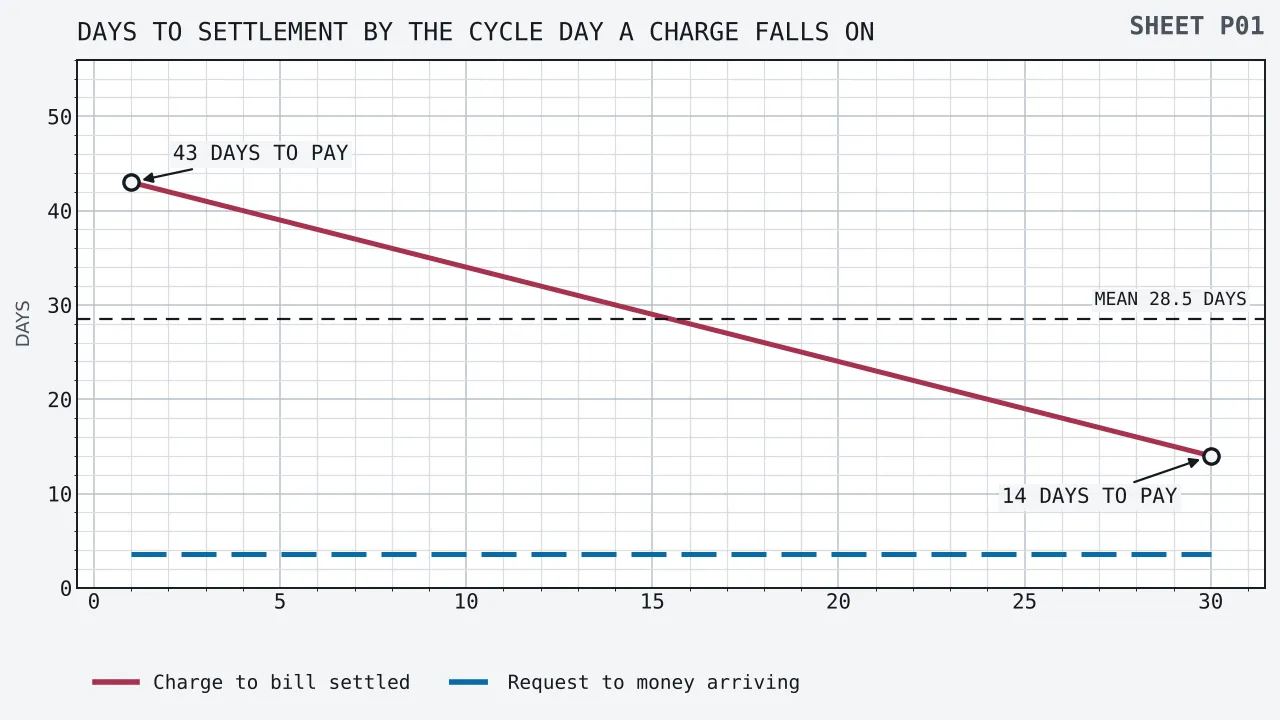
Forty-four less the day number is the whole formula, which gives forty-three days of lag at the start of a cycle and fourteen at the end. Averaged across the thirty days, the mean lag is 28.5 days, and that is the figure worth carrying: a charge to a phone bill is settled for, on average, four weeks and half a day after the reels have finished with it.
Three point six two five days is 87 hours written in the units of the bill, and the pair of them give the oddest result anywhere in this note. Money won is in a bank account 24.875 days before the money that funded it has been asked for. The arrangement pays out faster than it charges, and it does so without anybody intending it.
Twenty assumed minutes of pressing is 0.049 per cent of 28.5 days. The pressing is over in the time it takes to wait for a kettle twice, and the obligation it created sits in a billing system for four weeks afterwards. That ratio, rather than the payout wait, is the thing a reader on this rail should hold on to.
Eight charges of ten pounds across a month, two a week, arrive as one line of £80.00 on one statement. Eight hundred funded presses is 2 h 40 min at twelve posited seconds, spread over four weeks in roughly nine sittings of twenty-two posited minutes, and the first moment the eighty pounds is visible as a single sum is day thirty. Nothing about the rail is designed to hide it, and nothing about the rail shows it either.
A prepaid balance runs the other way and should be said plainly. Topping up ten pounds and spending it is money paid for before it is spent, so the lag is zero or negative and the statement problem disappears. What survives on prepaid is everything in parts two to five, because a prepaid balance is just as incapable of receiving a payout as a bill is.
7
A daily ceiling read as a delay rather than a limit
Thirty pounds a day is the ceiling this note posits for a carrier charge, and it is posited rather than published. Read as a limit it sounds protective. Read as a duration, which is this site’s habit, it turns the quickest deposit on the page into the slowest, and the inversion is worth four paragraphs.
One hundred and twenty pounds funded at an assumed thirty a day takes four calendar days, because the fifth tenner cannot be charged until the clock rolls over. Ninety seconds a charge means twenty-four minutes of actual work spread over four calendar days. So the rail delivers £120.00 in 96 hours of elapsed time and six minutes of attention, against an instrument with no ceiling which delivers the same £120.00 in one go.
| Sum to be funded | Charges needed | Calendar days | Funded presses it buys |
|---|---|---|---|
| £10.00 | 1 | 1 | 100 |
| £30.00 | 1 | 1 | 300 |
| £31.00 | 2 | 2 | 310 |
| £60.00 | 2 | 2 | 600 |
| £120.00 | 4 | 4 | 1,200 |
One pound is what separates row two from row three and a whole day is what it costs, which is the shape every ceiling has: a step function pretending to be a straight line. Thirty-one pounds takes twice as long to fund as thirty, and sixty takes no longer than thirty-one. A reader planning a sum should plan it in multiples of the ceiling or accept the step.
Ninety-six hours of funding against 87 hours of payout is the comparison this part exists to make. At £120.00 the one-way rail is slower going in than it is coming out, which undoes the only advantage it had. Somewhere between a tenner and a hundred and twenty pounds the rail stops being the quick option, and on these posited figures the crossing is at £90.00, where three days of charging equals 72 hours and the payout still wants 87.
£120.00 funded in 96 h, paid back in 87
8
Warnings a licence demands before any money moves
Carrier charges reach cashiers that hold no British licence, and this part prices what that absence takes out of an eighty-seven hour queue. Where a rail has to be replaced after the event, what goes missing is a pair of warnings owed before money moves, plus one sentence about where a balance sits while five posited terms run. Different losses bite on different pages and this one takes three.
Telling the customer what documents will be wanted is the first, and it is a duty owed before a deposit rather than before a payout. A British licensee has to state, before any money can go in, what proof of identity might be called for, at which stage it could be asked of the customer, and by what route it ought to be sent. Set that against the twenty posited hours of examination in part four, which on this rail arrive after a win rather than before a tenner, and the loss is specific: not the twenty hours, but any obligation on anybody to have warned that they were coming.
That duty bites harder here than on any other rail, because a mobile number is almost all the desk receives at the door. No card number, no sort code, no name on an account. Everything a desk would normally learn while taking ten pounds is instead learned while being asked to give eighty-four back, and the licensed sequence puts the warning at the front for precisely that reason.
Terms being reachable is the second. Where an incentive is put in front of somebody, a British licence wants the conditions on it transparent, fair, plainly written and within reach of everyone it is put to. A requirement to nominate a second instrument is a term of that kind, since it decides whether the money can be collected at all, and twelve posited hours is what it is worth on the arithmetic above.
Where the balance is held is the third, and it is the one that fits a payout page best. A British operator is rated on how customer money is kept and has to tell the customer that rating. Where the weakest of them applies, the one saying funds are not protected, licence condition 4.2.1 has the reminder repeated at six month intervals. That reminder is paragraph 3 of the condition, and it has bound licensees since 31 October 2025.
Twelve payouts in a year at the 87 posited hours of part four is 1,044 hours during which somebody else holds money the reader has already asked for. Against the 8,760 hours in a year that is 11.92 per cent, so an ordinary monthly habit leaves a reader waiting on a balance for one twelfth of their life. Six-monthly reminders arrive twice across those twelve payments, which is the rate at which a licensed desk would be obliged to restate how the money is kept.
Nought of those three duties reaches a desk outside the register, and not one number above moves when they are taken away. Eighty-seven hours is 87 hours either way. What is lost is the warning before the tenner, the reachable statement of what the exit requires, and the twice-yearly sentence saying where £84.00 is sitting while five posited terms run their course.
9
Who is served by a rail with one direction
Somebody funding ten pounds who does not expect to collect anything is served very well indeed, and that reader should not be talked out of it. Ninety posited seconds against the four or five minutes of typing a card demands is a real saving, repeated every time, and a tenner on a bill is a tenner whatever happens next.
Anybody who intends to be paid is served badly, and the measure of how badly is 87 hours at best against ninety seconds, which is 3,480 to one. Half of those hours exist for no reason except that the money came in along a route it cannot go out along. A reader who expects to withdraw has bought convenience at one end and paid for it at the other, in a currency nobody quoted.
Two things change the answer and both are decided before play rather than after. Nominating the receiving instrument at the moment the account is opened removes the twelve posited hours and pulls the twenty of identity work forward, taking 87 down to 55. Choosing the evening removes up to forty-eight more, since a Tuesday request costs 135 hours and a Monday request costs 87.
Fifty-five hours is therefore the floor a careful reader can reach on these posited figures, against 135 for a careless one on the wrong evening. The gap between those two numbers is eighty hours, it costs nothing to close, and closing it requires no negotiation with anybody: it is two forms in a different order and one evening chosen deliberately.
Three questions settle it before a first charge. What instrument will the money be sent to, given that the phone cannot receive it. Has the identity examination been completed already, or is it waiting at the exit. And which day of the week does the request go in on, since the calendar is worth two days and the calendar is free.
Questions
- How long does a pay by phone casino withdrawal take?
- On the lengths this note posits, 87 hours from a Monday evening request and 135 hours from a Tuesday one, neither of them measured. The total is five terms added together: 24 hours of a desk looking at the request, 20 hours of identity examination, 12 hours for a freshly named instrument to become usable, up to 7 hours standing about until a banking morning, and one working day for the transfer. Three of the five run through nights and weekends and two obey a calendar.
- Why can winnings not be paid back to a phone bill?
- Because a carrier bills and does not pay. Charging ten pounds to a monthly account or deducting it from a prepaid balance moves value one way, and there is no reverse gear that puts a balance back onto a phone account. The payment out therefore needs an instrument the account does not hold yet, which the reader hands over on the day the request goes in, and 12 of the 87 posited hours are the price of doing it then rather than at the start.
- What is the quickest the money can realistically arrive?
- Fifty-five hours on these posited figures, reached by naming the receiving instrument when the account is opened rather than when the win exists. That removes the 12 hours of making a fresh instrument usable and pulls the 20 hours of identity work forward, leaving 24 hours of review, up to 7 hours of waiting for a banking morning and 24 hours of transfer. Against 135 hours for a careless request on a Tuesday evening, the gap is 80 hours and it costs nothing to close.
- Which evening of the week costs the most to ask on?
- Tuesday evening, by 48 hours. Fifty-six hours of continuous holding from six o’clock on a Tuesday finishes at two on Friday morning, the transfer leaves that Friday morning, and a transfer sent on a Friday morning has the whole weekend to sit through before it can be one working day old. Monday, Friday, Saturday and Sunday evenings all land at the floor of 87 hours, Thursday costs 111, and the mean across the seven is 104.14 hours.
- How fast is the deposit compared with the payout?
- Three thousand four hundred and eighty times faster on the best evening. Ninety posited seconds in against 313,200 seconds out gives that ratio, and on a Tuesday evening request it is 399,600 over ninety, which is 4,440 to one. The deposit is assumed at thirty seconds of typing a mobile number, twenty seconds while a confirmation message travels and forty seconds to answer it, and none of those three figures was timed.
- When is a phone bill deposit actually paid for?
- On an assumed thirty day cycle with fourteen days to pay, between 14 and 43 days after the charge, with a mean of 28.5 days. A charge on day one of a cycle and a charge on day thirty are both settled on day forty-four, so the formula is forty-four less the day number. Set beside an 87 hour payout, which is 3.625 days, the winnings reach a bank account 24.875 days before the charge that funded them is asked for.
- Does a daily ceiling on the rail matter?
- It matters as a delay rather than as a limit. At the thirty pounds a day this note posits, funding £120.00 takes four calendar days and twenty-four minutes of work, so the quickest deposit available becomes 96 hours of elapsed time against an 87 hour payout. The crossing is at £90.00, where three days of charging comes to 72 hours. One pound separates £30.00 from £31.00 and a whole day is what that pound costs, because a ceiling is a step and not a slope.
- Does a cashier on this rail hold a British licence, and what is given up?
- No, it holds no Great Britain licence, and on this rail three duties go missing together. A British licensee must say before any deposit which identity documents may be wanted, when they might be required and how to supply them, which is exactly the warning a mobile number never triggers. Conditions attached to an incentive have to be transparent, fair, plainly written and within reach of everyone the thing is put to, and a requirement to nominate a second instrument is a condition of that kind. And a British operator is rated on how customer money is held and must tell the customer the rating, licence condition 4.2.1 having the reminder repeated at six month intervals where the weakest of them applies, a paragraph written into the condition with effect from 31 October 2025.