New online slots, and the pressing a new figure has not had behind it yet
Settling an observed return to inside a single percentage point takes 3,841,600 presses on the spread modelled below, which at ten pence and three hundred presses an hour is 12,805 h 20 min and £384,160.00 sent across the reels. A sitting of a hundred and ten presses settles it to inside 186.9 points, which is to say it settles nothing, and that is as true of a build released this morning as of one released in 2014.
- 18+
- Reading time of the whole page: 28 min read
- Updated November 2026
- How the minutes are counted
Five offers for your phone
These five links are paid placements: this site is owed a fee when a reader opens an account, and the order below reflects that.
-
 Albion
£4,000
700 FS
700% up to £4,000 + 700 FS
Claim bonus
18+ · Offshore licence, verify on register
Details
- Licence
- Offshore licence, verify on register
- Also listed
- Monday Reload: 50 Free Spins
- MidWeek Reload: 50% Bonus up to £500
- Payments listed
- Visa · Mastercard · Muchbetter · Apple Pay · Revolut · Trustly · ecoPayz · Paysafecard · BTC · ETH · LTC · USDT
The wording above is the operator's own and can change. Read the full terms on the operator's site before you deposit.
-
 Tweedbet
£14,000
470 FS
Casino Welcome Pack 470% up to £14,000 + 470 FS
Claim bonus
18+ · Offshore licence, verify on register
Details
- Licence
- Offshore licence, verify on register
- Also listed
- Crypto Welcome Bonus 110% up to 1,300 USDT + 110 FS
- VIP Welcome Pack 770% up to £13,000
- Payments listed
- Visa · Mastercard · Maestro · Apple Pay · Revolut · Trustly · ecoPayz · Paysafecard · Bank transfer · Bitcoin · Ethereum · Litecoin · Tether
The wording above is the operator's own and can change. Read the full terms on the operator's site before you deposit.
-
 Elite Spin
€/£5,000
500 FS
Welcome bonus get €/£5,000 + 500 FS
Claim bonus
18+ · Offshore licence, verify on register
Details
- Licence
- Offshore licence, verify on register
- Also listed
- Elite lootboxes unlock surprise rewards up to €/£20,000 or 500 FS
- Summer festival by BGaming is here. Win €80,000
- Payments listed
- MasterCard · Litecoin · Tether · Ethereum · VISA
The wording above is the operator's own and can change. Read the full terms on the operator's site before you deposit.
-
 Winbeast
€5,000
500 FS
Welcome pack €5,000 + 500 FS + €650 free bet
Claim bonus
18+ · Offshore licence, verify on register
Details
- Licence
- Offshore licence, verify on register
- Also listed
- Fortune Wheel unleash wild rewards on €40+ deposits with code FORTUNE
- Beast Boost Monday: use code BOOST1 with a deposit €20, 40% up to €300
- Payments listed
- ecoPayz · Tether · Trustly · VISA
The wording above is the operator's own and can change. Read the full terms on the operator's site before you deposit.
-
 Night Luck
€6,400
280 FS
Casino welcome bonus 805% up to €6,400 + 280 FS
Claim bonus
18+ · Offshore licence, verify on register
Details
- Licence
- Offshore licence, verify on register
- Also listed
- Crypto welcome bonus 140% up to 1,600 USDT + 140 FS
- VIP welcome pack 800% up to €14,500
- Payments listed
- VISA · Trustly · Tether · Paysafecard · NETELLER
The wording above is the operator's own and can change. Read the full terms on the operator's site before you deposit.
A figure that exists before anybody has pressed anything
Reading time: 2 min
Nobody needs to play a build for its return to be known, and getting that straight comes before anything else about a fresh release. A theoretical return is worked out from the tables the thing is made of, in the same way the odds on a coin are worked out from the coin. Pressing is not evidence gathering. Pressing is an expensive way of re-deriving a figure that was already written down.
So the gap that opens on release day is not a gap in what is known. It is a gap between what has been calculated and what anybody outside could check. A figure published on the morning of a launch is exactly as sound as a figure published after a decade, and a reader wanting to confirm it by pressing is looking at the arithmetic this note exists to set out.
Reading position: Minute 1 of 28
Twelve thousand eight hundred and five hours is the headline of that arithmetic, and it is the pressing needed to settle an observed return inside one percentage point. Three million eight hundred and forty-one thousand six hundred presses is the same statement in presses. Three hundred and eighty-four thousand one hundred and sixty pounds is the same statement in turnover at ten pence a press.
Reading position: Minute 2 of 28
Forty-seven point eight years is that pressing laid against the habit this part of the site costs everything against, which is two sittings a day of the twenty-two minutes assumed here. Nobody is going to do it. That is the point of quoting it: the confirmation a reader imagines performing is not a long job but an impossible one, and the distinction matters on a release day more than at any other time.
Nought presses have happened on the morning something appears, and nought is also the count of presses this site has made anywhere. The figures below are not observations that came out small. They are calculations, and the calculation says what a given count of presses can and cannot establish. A release day is simply the moment when the count available to everybody is smallest.
3,841,600 presses to settle one percentage point
What this site does in place of watching a reel
Reading time: 2 min
Nothing on this site has been watched, timed with a clock, or played. Every duration printed anywhere here comes out of a stated rate multiplied by a stated count, and every cost comes out of a stated turnover multiplied by a stated shortfall. Where a rate is assumed the sentence carrying it says so, which is why the phrases about assumption recur rather than being tidied away.
Three conventions do the work. Ten pence stands as the stake on one press. Three hundred presses stand as the content of an hour, which is twelve seconds apiece. Twenty-two minutes stands as the length of one sitting, giving a hundred and ten presses to it. Of those three, only the stake is a choice a reader actually makes; the other two are this site's declared shorthand for how a person uses a phone.
Reading position: Minute 3 of 28
Substituting is encouraged and costs one division. A reader whose own sitting runs fifteen minutes should work with seventy-five presses. A reader who presses every twenty seconds should work with a hundred and eighty an hour and divide every cost here by one and two thirds. Nothing in the structure of any argument below depends on the particular conventions chosen.
Four hundred pounds is an example of what the method produces, being the expected cost of a hundred thousand presses on a ninety-six per cent build at ten pence. That figure was not collected. It is four pence of every pound sent across, applied to the £10,000.00 that a hundred thousand presses send, and anybody can check it in one line.
A theoretical return describes the average over an unbounded count of presses, and the companion note at online slots UK prices what that means for an evening and for a year. This note deals with the opposite question: given a count of presses that somebody could actually perform, what range of true returns remains consistent with what they saw.
The press count one percentage point actually costs
Reading time: 3 min
Ten stakes is the spread this note assumes for the return on a single press, written as a standard deviation, and every figure in this part scales directly with it. That assumption belongs to this page and to nothing else. No primary source available here publishes a spread for any build, so the number is declared, used openly, and offered for substitution rather than smuggled in.
Reading position: Minute 4 of 28
Why ten rather than one is worth a sentence. A press mostly returns nothing, returns the stake back now and again, and very occasionally returns a multiple in the hundreds. A distribution shaped like that has a spread many times its own mean, which is precisely why an average over it settles down so slowly and why the counts below are as large as they are.
Dividing the spread by the square root of the press count gives the wobble on an observed average, and multiplying by 1.96 turns that into a ninety-five per cent interval. Ten over the square root of the count, doubled a little, is therefore the whole formula. Everything in the table is that one expression evaluated at a different count.
| Margin wanted on the observed return | Presses it takes | Hours of pressing | Sent across at 10p | Years of the habit |
|---|---|---|---|---|
| Within 10 points | 38,416 presses | 128 h 3 min 12 s | £3,841.60 | 0.5 years |
| Within 5 points | 153,664 presses | 512 h 12 min 48 s | £15,366.40 | 1.9 years |
| Within 2 points | 960,400 presses | 3,201 h 20 min | £96,040.00 | 12.0 years |
| Within 1 point | 3,841,600 presses | 12,805 h 20 min | £384,160.00 | 47.8 years |
| Within half a point | 15,366,400 presses | 51,221 h 20 min | £1,536,640.00 | 191.4 years |
Four to one is the ratio between consecutive rows of the press column, and it is the whole reason these counts get out of hand. Halving the margin quadruples the work, because the wobble falls with the square root. A reader prepared to press for half a year lands within ten points, which cannot tell ninety-six apart from eighty-eight, and those two differ by £722.70 over a year of the modelled habit.
Twelve years is the row that deserves staring at. Pressing for twelve years at forty-four minutes a day, sending £96,040.00 across the reels, settles the return to within two points. Two points is the exact interval this site elsewhere shows to be worth £160.60 a year, so twelve years of pressing just about resolves a quantity that costs £160.60 annually to get wrong.
Reading position: Minute 6 of 28
One million five hundred thousand pounds in the bottom row is not a typographical accident. Half a point is the step between many ordinary versions of a build, and establishing which version was in front of you by pressing would need £1,536,640.00 of turnover and 191.4 years of the habit. The figure is available to read in a moment and unobtainable by observation in a lifetime.
An evening, a week, a decade, and what each settles
Reading time: 3 min
Reverse the question and it gets sharper. Rather than asking what a margin costs in presses, ask what a reader's actual pressing buys in margin. Five spans cover most of what anybody does: one sitting, one week, one month, one year and ten years, all at the habit of two sittings a day that this part of the site works to.
One hundred and eighty-six point nine points is the margin on one sitting, and it is worth saying out loud what a margin that size means. The observed return from a hundred and ten presses is consistent with a true return anywhere from below nothing to nearly three hundred per cent. An evening is not weak evidence about a build. It is no evidence whatever.
| How long the pressing has gone on | Presses behind it | Hours at the assumed rate | Margin on the return | What it could not tell apart |
|---|---|---|---|---|
| One sitting of 22 minutes | 110 presses | 22 min | 186.9 points | Anything from any other thing |
| One week of fourteen sittings | 1,540 presses | 5 h 8 min | 49.9 points | Ninety-six per cent from forty-six |
| One month of thirty days | 6,600 presses | 22 h | 24.1 points | Ninety-six per cent from seventy-two |
| One year of the habit | 80,300 presses | 267 h 40 min | 6.9 points | Ninety-six per cent from eighty-nine |
| Ten years of the habit | 803,000 presses | 2,676 h 40 min | 2.2 points | Ninety-six per cent from ninety-four |
Six point nine points after a full year is the row that undoes most of what readers believe about their own experience. Two sittings a day for 365 days, 80,300 presses, £8,030.00 sent across the reels, and the resulting average still cannot separate ninety-six per cent from ninety. Those two differ by £642.40 against £321.20 over that same year.
Two point two points after ten years still cannot separate a build at ninety-six from one at ninety-four, and that pair is the comparison this section of the site cares about most. Eight hundred and three thousand presses, 2,676 h 40 min and £80,300.00 of turnover produce an answer that is still ambiguous about a difference worth £160.60 every year it runs.
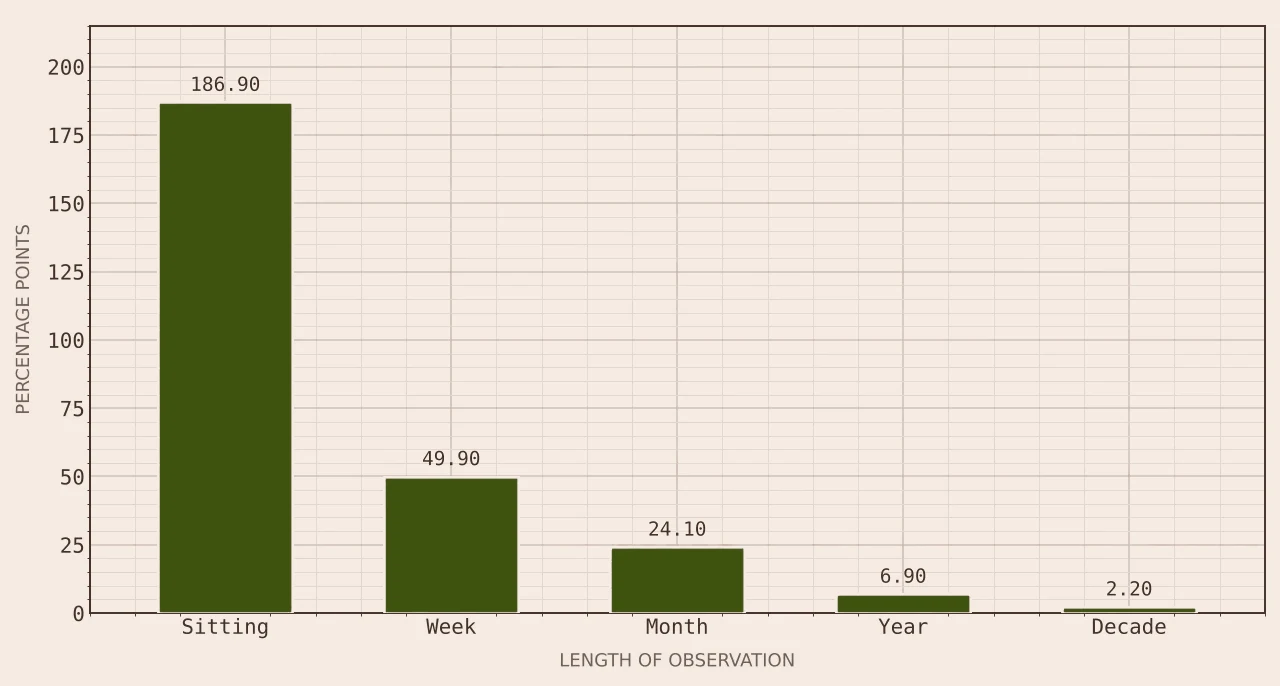
Both ends of that plate are instructive and the left-hand end is the one worth dwelling on. A bar 186.9 points tall sits beside a scale where the entire interesting range of returns is nine points wide. The quantity a reader is trying to detect is about a twentieth of the noise their evening generates, which is why no evening has ever settled anything.
One large payment dropped into a short count
Reading time: 2 min
Arithmetic rather than statistics makes the same point with no assumption at all, and this part uses it as a check on the one above. Take a single press that returns five hundred times its stake. Divided across the hundred and ten presses of a sitting, that one event on its own adds 454.5 percentage points to the observed return of the whole evening.
Four hundred and fifty-four point five is not a near miss on the true figure. It is roughly five times the entire true figure, generated by one press out of a hundred and ten. Whether an evening's observed return comes out at 15 per cent or at 470 per cent is therefore decided by whether one particular press landed, which is the definition of a measurement that measures nothing.
| Size of the single payment | Inside one sitting of 110 | Inside a week of 1,540 | Inside a year of 80,300 | Cash at 10p a press |
|---|---|---|---|---|
| Fifty times the stake | 45.5 points | 3.2 points | 0.06 points | £5.00 |
| A hundred times | 90.9 points | 6.5 points | 0.12 points | £10.00 |
| Five hundred times | 454.5 points | 32.5 points | 0.62 points | £50.00 |
| Five thousand times | 4,545.5 points | 324.7 points | 6.23 points | £500.00 |
Ten pounds in the right-hand column is the second row, and it is the sentence this table exists for. A payment of ten pounds is unremarkable. Nobody would describe it as a significant event in an evening. Arriving inside a hundred and ten presses it moves the observed return of that evening by ninety-one points, which is nine times the whole span between a good build and a poor one.
Six point two three points is the bottom right figure, and it carries the opposite lesson. A payment of five hundred pounds, landing once inside a whole year of pressing, still shifts the year's observed average by more than six points. One event in 80,300 presses is enough to move a year's apparent return across the entire plausible range.
Reading position: Minute 10 of 28
Nought point nought six is the top right figure, and between the two of them the table draws the real boundary. Small payments wash out quickly. Large ones do not wash out at all on any span a person can achieve. A build whose return is delivered partly through rare large payments is a build whose return cannot be checked, and nothing about a new release changes that in either direction.
The single rate a short run can nearly fix
Reading time: 2 min
One quantity does settle quickly, and naming it keeps this page honest. How often a press pays anything at all is a proportion rather than an average of amounts, and a proportion has a spread that cannot exceed half. Modelling one press in four as paying something, the margin after a single sitting is 8.09 points.
Twenty-three to one holds between the two margins at every count whatsoever, because the assumed spread of ten stakes is 23.09 times the spread of a quarter-chance proportion. A week of pressing gives 49.9 points on the return and 2.16 points on the paying rate. A month gives 24.1 and 1.04. The same pressing settles one thing almost precisely and the other not at all.
| Pressing behind it | Margin on the return | Margin on the paying rate |
|---|---|---|
| 110 presses, one sitting | 186.9 points | 8.09 points |
| 1,540 presses, one week | 49.9 points | 2.16 points |
| 6,600 presses, one month | 24.1 points | 1.04 points |
| 80,300 presses, one year | 6.9 points | 0.30 points |
| 7,203 presses, 24 h 36 s | 23.1 points | 1.00 points |
Twenty-four hours of pressing is the last row, and it is the one practical measurement available on this whole page. Seven thousand two hundred and three presses, which is 24 h 0 min 36 s and sixty-six sittings of the assumed length, settles the paying rate to inside a point. Identical pressing leaves the return uncertain by 23.1 points.
Confusing the two is the commonest mistake a reader makes about a new build. How often something pays is noticeable, settles fast, and is often what a first impression is actually about. What the payments add up to is the thing that costs money, settles glacially, and is invisible to a first impression. A build can pay on one press in four and still return eighty-eight per cent.
Reading position: Minute 12 of 28
Eighty-eight per cent and ninety-seven per cent can both be built on a quarter of presses paying something, because the proportion says nothing about the sizes. Four to one is the gap those two returns open on the cost of an hour, 90p against £3.60 at ten pence and the rate assumed here. The quantity a reader can detect and the quantity that bills them are not the same quantity.
Setting two fresh builds against one another
Reading time: 2 min
Comparing is harder than measuring, and by a factor that is exactly two. Two independent averages each carry their own wobble, the wobbles add in quadrature, and the press count needed for a given margin on the difference doubles. Everything in part three therefore gets twice as expensive the moment a second build enters.
Seven million six hundred and eighty-three thousand two hundred presses on each build is what separating them by one point requires. Twenty-five thousand six hundred and ten hours forty minutes is that pressing per build at the rate taken as standard here. Seven hundred and sixty-eight thousand three hundred and twenty pounds is what crosses the reels on each of them at ten pence.
| Difference to be established | Presses on each build | Hours on each | Sent across on each | Worth a year at 10p |
|---|---|---|---|---|
| Half a point apart | 30,732,800 presses | 102,442 h 40 min | £3,073,280.00 | £40.15 |
| One point apart | 7,683,200 presses | 25,610 h 40 min | £768,320.00 | £80.30 |
| Two points apart | 1,920,800 presses | 6,402 h 40 min | £192,080.00 | £160.60 |
| Five points apart | 307,328 presses | 1,024 h 25 min 36 s | £30,732.80 | £401.50 |
Column five against column three is the comparison this table was built to make. Settling a difference worth £80.30 a year costs 25,610 h 40 min of pressing on each side. Settling one worth £401.50 a year costs 1,024 h 25 min 36 s on each side, which is still three years and ten months of the modelled habit spent on each of two builds.
Three million pounds in the top row is the reductio. Half a point is a difference many readers would like to act on, it is worth £40.15 over a year of the habit, and establishing it by pressing would cost £3,073,280.00 of turnover on each build and 204,885 hours between the two. Reading the two figures takes about twenty seconds.
Reading position: Minute 14 of 28
Nothing in that table recommends reading rather than pressing as a matter of taste. The two routes to the same answer differ by a factor somewhere past a million in time and money, which is not a preference. A reader who intends to act on a difference of a point or two has exactly one practicable source for it, and that source is whatever the build itself discloses.
Three parts that shift the bill further than the headline
Reading time: 3 min
Returns on fresh builds cluster, and the parts that genuinely vary between one release and the next are elsewhere. Cycle length varies, feature cadence varies, and the stake ladder varies, and each of the three moves the cost of an hour by more than the half point of return that separates most plausible pairs.
Twelve point five per cent is what half a point of return does to an hour, carrying £1.20 to £1.35 at ten pence on the rate used throughout. That is the yardstick the other three get measured against, and it is deliberately the small end: the whole span from ninety-seven to ninety-two moves the hour from 90p to £2.40, which is a factor of two and two thirds.
Reading position: Minute 15 of 28
Cycle length moves further than that on its own. A release pressed every four seconds puts nine hundred presses in an hour and costs £3.60 at ninety-six per cent. One pressed every twenty seconds puts a hundred and eighty in and costs 72p. Five to one separates those, and nothing about either figure appears in a headline percentage.
Feature cadence moves the hour by slowing it, which is the direction most readers do not expect. A round lasting forty seconds arriving once in every twenty presses stretches the average press to fourteen seconds, which puts 257 presses in an hour and costs £1.03. Arriving once in ten presses it stretches the average to sixteen seconds, 225 presses and 90p.
| What differs between one release and another | Presses an hour holds | Cost of that hour | Against the £1.20 baseline | Over a year of the habit |
|---|---|---|---|---|
| The house model, unchanged | 300 presses | £1.20 an hour | level | £321.20 |
| Half a point less on the return | 300 presses | £1.35 an hour | plus 12.5 per cent | £361.35 |
| A four-second cycle | 900 presses | £3.60 an hour | plus 200 per cent | £963.60 |
| A forty-second round every ten presses | 225 presses | £0.90 an hour | minus 25 per cent | £240.90 |
| A ladder beginning at twenty-five pence | 300 presses | £3.00 an hour | plus 150 per cent | £803.00 |
| A ladder beginning at five pence | 300 presses | £0.60 an hour | minus 50 per cent | £160.60 |
Plus 12.5 per cent sits in the second row and plus 200 per cent sits in the third, and the ordering of that column is the finding. Of the four things that genuinely vary between releases, three shift the annual bill further than the headline figure does, and not one of those three is usually described as a feature of the build at all.
Five pence to twenty-five pence is the widest of them, moving the year from £160.60 to £803.00, a factor of five on identical pressing. A reader who takes the lowest rung a release offers has already made the largest decision available, and the lowest rung on a new ladder is a published fact visible before a single press.
Reading position: Minute 17 of 28
Two hundred and forty pounds ninety in the fourth row is the oddity worth explaining. A heavy feature round makes a build cheaper by the hour, not dearer, because forty seconds spent inside a round is forty seconds not spent sending ten pence across. What it does to a year of play depends entirely on whether a reader measures their play in hours or in presses.
Four design rules a release has to satisfy, or not
Reading time: 4 min
Four rules govern how a licensed release may be built and presented, and a build of the sort covered by this section carries no Great Britain licence, so a release of that kind answers to none of them. Each concerns what a reader is shown while pressing, which makes them the rules carrying most weight where no history exists to fall back on.
Misleading the reader about likelihood is barred first. A licensed design may not be arranged so that somebody would reasonably come away with the wrong idea of how likely a result is, and two arrangements are named outright: dressing a loss up as having nearly been a win, and imitating a physical device while not imitating the odds that device really carries. Putting a different losing result in a losing result's place is barred in the same words.
Reading position: Minute 18 of 28
Explaining the thing comes second, and it comes before any money moves. A licensed release has to have an accurate account of its rules within reach before a customer commits, sufficient to cover every rule that applies, with reasonable steps taken to make it intelligible. What prizes are available and how they are worked out has to be within reach by then as well.
Reading position: Minute 18 of 28
Showing the state of play comes third. As a game proceeds, enough has to be on the screen for the customer to follow where things currently stand. On a release nobody has used before, that duty is doing more work than it does anywhere else, because a reader has no previous run to interpret an unfamiliar screen against.
Celebration comes fourth and cuts deepest. Where a licensed build hands back no more than the press cost, it may not treat that as a win, and sound and animation are both covered by the bar. Ten pence staked and eight pence returned is a loss of tuppence, and the arithmetic of a year is built entirely out of events of exactly that shape.
| What a release is asked to do | Under a British licence | On the offshore rulebook read for this site | Why it bites hardest on something new |
|---|---|---|---|
| Not mislead about how likely a result is | Barred, with the dressed-up loss named outright | Nothing of the kind is written down | No reader has a prior run to calibrate against |
| Explain the rules before money moves | Accurate, complete and within reach beforehand | Unaddressed throughout | Unfamiliar rules are the whole of a new release |
| Show where a game currently stands | Enough on screen to follow it as it proceeds | Unaddressed throughout | An unfamiliar screen cannot be read from habit |
| Treat a handback no larger than the press as a win | Barred, in sound and in animation alike | Nothing of the kind is written down | First impressions are formed inside 110 presses |
One hundred and ten presses is the entry in the last cell of that table, and it is the hinge between the duties and the arithmetic above. A first impression gets formed inside one sitting. One sitting carries a margin of 186.9 points on the return, so the impression cannot be about the money. It is about what the screen did, which is exactly what those four rules govern.
Chasing is dealt with by a fifth rule worth one line, because it too shapes how a first sitting feels. Nothing licensed may actively work on a customer to recover what has gone, to put more on the next press, or to keep going after they have signalled a wish to stop. None of that follows a build across the register.
Reading position: Minute 20 of 28
Ombudsman is a title the regulator here declines, so none of this ends in redress for a transaction even inside the licence, and six months from the day something went wrong is the least a licensed business must keep a complaint open for. Both of those are procedural rather than magical, and both are absent in writing on the other side. The national self-exclusion scheme likewise reaches only as far as the British licence does, nothing on this page helps anybody go round it, and a block put on gambling payments by a bank is treated the same way.
Worth knowing on the morning something appears
Reading time: 2 min
Four things are available on a release day and one thing is not, and sorting them that way is the useful close. The lowest rung on the stake ladder is available. The length of one cycle is available after a few presses. Whatever the build discloses about its own return or margin is available before any commitment. The rules are available. What is not available is any observation worth the name.
Stake first, because it is worth a factor of five. Five pence against twenty-five pence carries the year from £160.60 to £803.00 on identical pressing, and the ladder is printed on the screen before anything happens. Nothing else a reader can establish on a release day is worth as much.
Reading position: Minute 21 of 28
Cycle length second, because it is worth a factor of five as well and takes about a minute to establish. Counting presses against a clock for sixty seconds gives the rate, and the rate multiplied by ten pence gives the turnover an hour, and four per cent of that gives the bill at ninety-six per cent. That is a reader's own arithmetic, not this site's, and it is the one quantity here anybody can check for themselves.
Reading position: Minute 22 of 28
The disclosure third, because it is the only route to the figure that matters. Whatever a build puts within reach before a customer commits, whether that is a percentage, a margin or a set of odds, is the single practicable source for a quantity that 25,610 hours of pressing per build could barely confirm.
Reading position: Minute 22 of 28
Nought is what the first sitting is worth, and it needs naming because it is what most release-day writing consists of. How the first sitting went is worth nothing. A hundred and ten presses carry a margin of 186.9 points, one ten pound payment inside them shifts the observed figure by ninety-one points, and an evening that felt generous and an evening that felt mean are statistically the same evening.
Where all of this lands is £321.20, for a reader who presses twice a day at ten pence on a ninety-six per cent build for a year. That figure was available on the day the build was finished, long before anybody opened it, and no amount of pressing by anybody will produce a better estimate of it within a lifetime.
186.9 points of margin inside one sitting of 110 presses
Questions
Reading time: 6 min
- How many presses does it take to measure a return properly?
- Three million eight hundred and forty-one thousand six hundred, to settle it inside one percentage point, on a modelled spread of ten stakes for the return on a single press. At ten pence and the rate of three hundred presses an hour taken as standard here that is 12,805 h 20 min and £384,160.00 sent across the reels, which is 47.8 years at two sittings a day. Halving the margin quadruples the work, so within half a point needs 15,366,400 presses and 191.4 years.
- What does one evening of play establish about a build?
- Nothing at all. A hundred and ten presses, which is a sitting of the twenty-two minutes assumed here, leaves a margin of 186.9 percentage points around whatever return was observed. That range runs from below nothing to nearly three hundred per cent, while the entire interesting span of real returns is about nine points wide. The thing a reader wants to detect is roughly a twentieth of the noise their own evening produces.
- Does a year of playing settle it?
- No. Two sittings a day for 365 days is 80,300 presses, which runs to 267 h 40 min of pressing and sends £8,030.00 across the reels, and the margin left at the end of it is 6.9 points. That cannot separate ninety-six per cent from ninety, and those two cost £321.20 and £642.40 respectively over that very year. Ten years of the same habit narrows the margin to 2.2 points, which still cannot separate ninety-six from ninety-four.
- Why are the counts so enormous?
- Because the return on one press has a spread many times its own average. A press usually gives back nothing, occasionally gives back the stake, and rarely gives back a multiple in the hundreds, and an average over a shape like that settles slowly. This note models the spread at ten stakes and says so wherever it carries a figure, because no primary source available here publishes a spread for any build. Margin shrinks as the square root of the count grows, which is why halving it calls for four times the pressing.
- How much does one large payment distort a short run?
- A press returning five hundred times its stake, arriving inside a sitting of a hundred and ten presses, adds 454.5 percentage points to that evening's observed return on its own. At ten pence that payment is £50.00. Even a ten pound payment, which is a hundred times a ten pence stake, moves the evening by 90.9 points. Landing once inside a whole year of 80,300 presses, a five hundred pound payment still moves the year's observed average by 6.23 points.
- Is there anything a short run can establish?
- How often a press pays anything, which is a proportion rather than an average of amounts. Modelling one press in four as paying something, a single sitting gives a margin of 8.09 points on that rate against 186.9 on the return, and 7,203 presses, which is 24 h 0 min 36 s and sixty-six sittings, settle it to inside one point. The catch is that the paying rate says nothing about the sizes: eighty-eight per cent and ninety-seven per cent can both be built on a quarter of presses paying something, and those two cost 90p and £3.60 an hour at ten pence.
- How much harder is comparing two builds than measuring one?
- Twice as hard, exactly. Two averages each carry their own wobble and the wobbles add in quadrature, so the press count for a given margin on the difference doubles. Separating two builds by one point needs 7,683,200 presses on each, which is 25,610 h 40 min and £768,320.00 across the reels on each of them. That difference is worth £80.30 across a year of the habit priced here, and reading both disclosures takes about twenty seconds.
- Which parts of a new build actually change what it costs?
- Cycle length, feature cadence and the stake ladder, and all three move the hour further than the half point of return that separates most plausible pairs. Half a point carries an hour from £1.20 to £1.35, a rise of 12.5 per cent. A four-second cycle carries it to £3.60, a rise of 200 per cent. A ladder starting at twenty-five pence carries it to £3.00, and one starting at five pence drops it to 60p. A forty-second round every ten presses actually lowers it to 90p, because time inside a round is time not sending ten pence across.
- What does the British licence require of a new release's design?
- Four things, all of them about what a reader is shown. A design may not be arranged so somebody would reasonably form the wrong idea of how likely a result is, and dressing a losing result up as nearly a winning one is named outright. An accurate and complete account of the rules has to be within reach before any money moves, and so must an account of the prizes and the way they get worked out. Enough has to stay on the screen for a customer to follow where a game currently stands. And where a build hands back no more than the press cost, it may not treat that as a win, in sound or in animation.
- What goes when a release sits outside the British licence?
- Every one of those design rules, together with the bar on working actively on a customer to recover what has gone, to put more on the next press, or to keep going after signalling a wish to stop. Nothing of the sort appears in the offshore document this note works against. Procedural losses follow as well. Half a year, running from the day of the event, is the shortest a licensed business may hold its complaint window open, and no offshore match for that was found in writing, while the regulator here declines the title of ombudsman in any event. The national self-exclusion scheme reaches only as far as the British licence does.