Note P14 Revision 1 Terms read 17 October 2026
Money spent in twenty-two minutes and paid for thirty-six days later
Eleven pounds buys 110 presses, which fills one go at a handset of twenty-two supposed minutes. On a cycle of 31 days with 21 days to settle, the same eleven pounds is asked for between 21 and 51 days afterwards, averaging 36 days. That gap is 2,356 goes of elapsed time for every one that was played, and outside the British licence not a single clock stands inside it.
One charge, as play 22 min Press to payment, mean 36 days Exit modelled 113 h 14 min
What a cashier of this kind asks in hours
Advertising has been bought for every destination below. A fee reaches this site when a reader goes on to register, and no figure on this page moves one way or the other because of it.
-
01Mobile Free Spins
Betportal
Ceiling as a multiple
What lands€15.00150 spins at 10c, which is this site's figure and not the operator'sThe run17 h 30 minTurning over 525.00 at 10p means 5,250 presses, or about 48 phone sittings of 22 minutes. Timed at 10p a press and 12 seconds between presses, both of which this site assumes rather than measures.The wait to be paidNOT PUBLISHEDThis operator puts no withdrawal band in its own terms, so there is nothing honest to print here.Spins valued at this site's own 10p a spin
What lands
Spins, at a price15.00150 of them at 10c apiece, a figure belonging to this site rather than to the operatorMatch, and other creditno figure300% of three deposits, to a ceiling of €1,000. Not a sum until money of yours makes it one, so this row totals nothing and carries nothing downwardsThe run
Handed back on the spins(0.60)Each press stakes its own value and returns 96 per cent, which leaves this much with the house from the opening pressPlay-through 35x on the bonus(20.16)Taking 14.40 round 35 times over means 504.00 through the machines, of which 20.16 is the expected cost, and 17 h 30 min of pressing at the pace aboveWhat counts towards it100%Slots only, with no percentage published anywhere, so the row above assumes the whole of each stake countsWhat never clears
Limit on the winningsstated5x the bonusDeducted on the way outno figureNothing is published as a figure here, so this row removes nothingLeast that can leaveno figureNo figure is published, so nothing on this timer is pinned down by oneLeast deposit, and the rung over ityour own€20 a stage. Published in euros, so no rung is named at all: this site's ladder is a sterling oneThe window on the creditstated14 daysBiggest stake while it runsstated€5Removed outright by rulestatedNot publishedVerified before a payoutstatedDocuments before the first withdrawalNever clears€15.00Not a penny of it gets out, so the whole of what landed stands on this rowNo Great Britain licence
Licence held in Anjouan, Comoros, the company named is BetPortal Gaming Ltd, with Excite Ultra Media Ltd, quoted under ALSI-202601040-FI2.
Terms read 17 October 2026
Open the offer at Betportal, opens in a new window -
02Mobile Free Spins
WinBeast
Ceiling as a sum
What lands€50.00500 spins at 10c, which is this site's figure and not the operator'sThe run2 d 18 hTurning over 2,000.00 at 10p means 20,000 presses, or about 182 phone sittings of 22 minutes. Timed at 10p a press and 12 seconds between presses, both of which this site assumes rather than measures.The wait to be paidNOT PUBLISHEDThis operator puts no withdrawal band in its own terms, so there is nothing honest to print here.Spins valued at this site's own 10p a spin
What lands
Spins, at a price50.00500 of them at 10c apiece, a figure belonging to this site rather than to the operatorMatch, and other creditno figure50% to 100% of five deposits, each to a ceiling of €1,000, and a €650 free bet. Not a sum until money of yours makes it one, so this row totals nothing and carries nothing downwardsThe run
Handed back on the spins(2.00)Each press stakes its own value and returns 96 per cent, which leaves this much with the house from the opening pressPlay-through 40x on the bonus and the winnings from the spins(76.80)Taking 48.00 round 40 times over means 1,920.00 through the machines, of which 76.80 is the expected cost, and 2 d 18 h of pressing at the pace aboveWhat counts towards it100%Slots, titles vary by country, with no percentage published anywhere, so the row above assumes the whole of each stake countsWhat never clears
Limit on the winningsstated€100 a batch of spinsDeducted on the way outno figureNothing is published as a figure here, so this row removes nothingLeast that can leaveno figureNo figure is published, so nothing on this timer is pinned down by oneLeast deposit, and the rung over ityour own€20 a stage. Published in euros, so no rung is named at all: this site's ladder is a sterling oneThe window on the creditstated7 days, spins 1 dayBiggest stake while it runsstatedNot publishedRemoved outright by rulestatedNot publishedVerified before a payoutstatedDocuments before the first withdrawalNever clears€50.00Not a penny of it gets out, so the whole of what landed stands on this rowNo Great Britain licence
Licence held in Curaçao, no company named anywhere on the site.
Terms read 17 October 2026
Open the offer at WinBeast, opens in a new window -
03Mobile Free Spins
EliteSpin
Longest spin window
What lands£50.00500 spins at 10p, which is this site's figure and not the operator'sThe run2 d 18 hTurning over 2,000.00 at 10p means 20,000 presses, or about 182 phone sittings of 22 minutes. Timed at 10p a press and 12 seconds between presses, both of which this site assumes rather than measures.The wait to be paidNOT PUBLISHEDThis operator puts no withdrawal band in its own terms, so there is nothing honest to print here.Spins valued at this site's own 10p a spin
What lands
Spins, at a price50.00500 of them at 10p apiece, a figure belonging to this site rather than to the operatorMatch, and other creditno figure50% to 100% of five deposits, each to a ceiling of £1,000. Not a sum until money of yours makes it one, so this row totals nothing and carries nothing downwardsThe run
Handed back on the spins(2.00)Each press stakes its own value and returns 96 per cent, which leaves this much with the house from the opening pressPlay-through 40x on the bonus and the winnings from the spins(76.80)Taking 48.00 round 40 times over means 1,920.00 through the machines, of which 76.80 is the expected cost, and 2 d 18 h of pressing at the pace aboveWhat counts towards it100%Slots, with no percentage published anywhere, so the row above assumes the whole of each stake countsWhat never clears
Limit on the winningsstated5x the bonusDeducted on the way outno figureNothing is published as a figure here, so this row removes nothingLeast that can leaveno figureNo figure is published, so nothing on this timer is pinned down by oneLeast deposit, and the rung over ityour own£20 a stage. It lands square on the £20.00 rung, so none of yours is left perched on topThe window on the creditstated7 days, spins 3 daysBiggest stake while it runsstatedNot publishedRemoved outright by rulestatedNot publishedVerified before a payoutstatedDocuments before the first withdrawalNever clears£50.00Not a penny of it gets out, so the whole of what landed stands on this rowNo Great Britain licence
Licence held in Costa Rica, the company named is PrimeTier Limited.
Terms read 17 October 2026
Open the offer at EliteSpin, opens in a new window -
04Mobile Free Spins
Crown Jewelz
Multiple unpublished
What lands£15.00150 spins at 10p, which is this site's figure and not the operator'sThe runNOT TIMEDThis operator does not publish the play-through multiple in its own terms. The multiple is the one figure the clock cannot work around, so the run is left untimed.The wait to be paidNOT PUBLISHEDThis operator puts no withdrawal band in its own terms, so there is nothing honest to print here.Nothing reckoned
What lands
Spins, at a price15.00150 of them at 10p apiece, a figure belonging to this site rather than to the operatorMatch, and other creditno figure200% of the first deposit, then 150% twice, each to a ceiling of £1,000. Not a sum until money of yours makes it one, so this row totals nothing and carries nothing downwardsThe run
Play-throughno figure40x the bonus, reported rather than published by the operatorWhat counts towards itno figureSlots, with no percentage published anywhere, so the row above assumes the whole of each stake countsWhat never clears
Limit on the winningsstatedNot publishedDeducted on the way outno figureNothing is published as a figure here, so this row removes nothingLeast that can leaveno figureNo figure is published, so nothing on this timer is pinned down by oneLeast deposit, and the rung over ityour own£20. It lands square on the £20.00 rung, so none of yours is left perched on topThe window on the creditstatedNot publishedBiggest stake while it runsstatedNot publishedRemoved outright by rulestatedNot publishedVerified before a payoutstatedDocuments before the first withdrawalNever clearsNOT RECKONEDThis operator leaves the play-through multiple out of its own terms, so nothing below the fourth step can be worked out.No Great Britain licence
Licence held in Curaçao, number not verified, no company named anywhere on the site.
Terms read 17 October 2026
Open the offer at Crown Jewelz, opens in a new window
Only the middle reading comes out of arithmetic belonging to this site. The multiple laid against what lands gives the turnover asked for; dividing that by 10p a spin gives the presses; dividing those by 300 an hour gives the hours, a press on a handset being taken here at 12 seconds from the one before. Both figures are assumptions rather than measurements of anybody: nothing was played and nothing was held a stopwatch to. Anybody quicker should divide the press count by a rate of their own, which is why the presses are printed alongside the hours instead of being summarised away.
The first reading is what arrives before any condition is laid against it. Spins carry no unit of their own so one gets supplied: where an operator values its own spin that figure is used and attributed, and where it does not, this site's 10p a spin stands in and everything below moves with it. The third reading belongs to the operator entirely. It is a withdrawal band quoted from published terms, and a blank there means none was published rather than that nobody looked.
The total along the foot answers what the hours leave open, which is whether any of the running ends anywhere. It is what arrived, less whatever is still standing once the play-through has been paid for at 96 per cent return to player and once a published limit, a published deduction and a published floor beneath the least that can leave have each had a turn. It appears again in pence in the pound, the only fair way of holding a small offer up against a large one. It describes an offer rather than an evening, and where the conditions price out what arrived, a timer prints nothing getting out instead of a negative sum.
Cashiers on a handset take deposits off a row of preset buttons, so a least deposit given in pounds is raised to the next rung of the ladder used here, £10, £20, £25, £50, £75 and £100, and the timer shows what is left perched on it. That money is the reader's own and enters no sum at all. Given in euros it prints untouched, the ladder being sterling. Three words may occupy the figure column where no figure belongs. Stated is a published term that costs something while leaving no number to subtract. No figure is a term nobody has quantified, or a credit that is not a sum until money of yours makes it one. Your own is money of yours, which belongs in none of this.
None of the operators above is licensed in Great Britain, so not one duty that licence carries reaches any of them. Membership of Gamstop Online is compulsory for every online gambling company licensed in Great Britain, which means that shutting yourself out through the scheme shuts you out of none of these. The limit of ten times the bonus funds on a wagering requirement, running since 19 January 2026 under Social Responsibility Code 5.1.1, is a condition of the same licence and binds only whoever holds one. Off that licence, the Gambling Commission writes of consumers meeting unfair gaming practices, financial loss and no recourse when matters go wrong, and lists blocked payouts and withdrawal limits pitched too high to reach among the things it has seen. No account at any of them may be held by anybody under 18.
Every term on a timer is its operator's own and every timer carries the day somebody read it. The oldest of those readings is 17 October 2026. What binds a reader is an operator's full terms and never a line printed here.
1
Spending that happens now and is charged for later
Most ways of paying ask for the money at the moment the money is spent. A charge to a telephone account does not. The decision is taken tonight, the play happens tonight, and the request for payment turns up weeks afterwards on a statement, bundled with calls and data and whatever else the month held. That lag is the subject of this note and it is the longest feedback delay on any rail in this section.
A carrier’s own bar on gambling charges is a protection, in precisely the sense a registration is, and this page will not discuss working past one. The same goes for a payment a bank refuses to send and a category a card scheme declines. No addresses appear below, no names, nothing about papers, nothing about handsets beyond the assumed pace of pressing, and nothing about how a home is connected to anything.
One suggestion is made on this note and it has a particular reader in mind. A person with a Gamstop Online registration behind them who has typed a phrase like this one tonight is up against the very thing that registration was made to hold, and dialling 0808 8020 133 costs nothing, reaches GamCare whatever the hour, and is the one action on this page worth taking straight away. What follows it is arithmetic about delay.
Delay is not an accident of the rail and it is worth being clear about that early. Charging a purchase to an account that settles monthly is a service, it is useful for ordinary purchases, and nobody designed it against anybody. What makes it awkward here is what the money buys, because a decision about gambling and the evidence of that decision arrive at two ends of a five-week gap.
A neighbouring note in this section prices the same rail where the licence does reach, and takes the lag apart there. This one is about the clocks that would otherwise have stood inside the gap. A live running total, a ceiling a player sets for themselves, a pause before that ceiling can be raised, and something that comes round twice a year and asks: each shortens the distance between spending and knowing, and none of them exists on the far side of the register.
2
Eleven pounds, one go, and nine of them in a cycle
Eleven pounds is the charge this note works with, and it was chosen because it lands exactly on the unit this site measures in. At ten pence a press it funds 110 presses. At twelve seconds a press, an interval supposed here and timed by nobody, 110 presses occupy 22 minutes, which is the length this site takes a go at a handset to be. One charge is therefore one go, with nothing left over.
Forty-four pence is what that go expects to cost, since four pence of every staked pound stays behind wherever ninety-six per cent is the return in force. So the object being bought is clean and small: one evening’s worth of pressing, £11.00 across the reels, 44p of expectation, 22 supposed minutes. Nothing in this note suggests the charge is large, and the smallness is part of why the lag matters.
Ninety-nine pounds is where nine such charges arrive inside one cycle, which is a little over two a week. That is 990 presses, 3 h 18 min of pressing, and nine goes at a handset. Each of the nine felt like £11.00 at the moment it happened. None of the nine was ever displayed beside the other eight, because nothing on this rail adds them up while they are being made.
£11.00 is 110 presses, which is one supposed go of 22 minutes
Three pounds ninety-six is the expectation on the whole cycle, being 44p nine times over, and it is worth printing next to the £99.00 to keep both in proportion. The sum at stake across a month of this is the price of a modest night out. The quantity this note is actually about is not the money. It is the 864 hours between the pressing and the asking, which part three works out.
Eleven thousand eight hundred and eighty presses is a year of the same habit, twelve cycles of 990, which is 39 h 36 min of pressing and 108 goes at a handset. Staked, that is £1,188.00 across the reels and £47.52 of expectation. Those figures are the arithmetic of repetition rather than a claim about anybody, and every one of them rests on the nine charges a cycle supposed at the head of this part.
3
Fifty-two less the day it was charged on
Thirty-one days is the cycle this note assumes and twenty-one days is what it allows for settling once a statement has gone out. No source available to this site prints either length, so both are declared here as suppositions and the rest is then counted rather than guessed. A statement therefore closes on day 31 and is settled on day 52.
Fifty-two minus the day of the cycle is all the formula amounts to, and it has one unusual property. A charge made on day 1 is settled 51 days later. A charge made on day 31 is settled 21 days later. Both are settled on the same date, which means the lag a reader experiences has nothing to do with when they decided anything and everything to do with where in a cycle the decision happened to fall.
Thirty-six days is the mean of those lags across the 31 possible days, being the average of 51 and 21, and it is the figure this note carries. In hours it is 864. In minutes it is 51,840, and set against the 22 minutes one charge buys it gives the ratio part four is built on.
| Day of the cycle the charge falls on | Days to the statement | Days to settling | Hours to settling | Goes of waiting, at 22 min |
|---|---|---|---|---|
| Day 1 | 30 | 51 | 1,224 | 3,338 |
| Day 8 | 23 | 44 | 1,056 | 2,880 |
| Day 16, the middle | 15 | 36 | 864 | 2,356 |
| Day 24 | 7 | 28 | 672 | 1,833 |
| Day 31 | nil | 21 | 504 | 1,375 |
Fifteen days is the mean distance to the statement rather than to the settling, and it earns a line to itself as the first point at which anything gets totalled. Until the statement closes, nine separate charges are nine separate events. On day 31 they become one line of £99.00, and that is the soonest the figure exists anywhere a reader could look at it.
Thirty days of difference stand between the first row and the last, and nobody picks the row they are in. The cycle was set when the account was opened, the charges happen when an evening happens, and the distance between the two is a property of a calendar that belongs to somebody else. A reader cannot shorten it and is not usually aware of its length.
Nought of this arithmetic changes with the size of the charge, which is the useful general result. A charge of £11.00 and a charge of £110.00 sit the same number of days from being settled. The lag is a duration, the money is a quantity, and the two multiply only when somebody wants to know what is outstanding at a given moment.
4
Two thousand goes of waiting for one of playing
Two thousand three hundred and fifty-six is the ratio this note exists to print. One charge buys 22 minutes of pressing. The mean distance to settling is 36 days, which is 51,840 minutes, and 51,840 divided by 22 gives 2,356.4. For every supposed go at a handset the money paid for, 2,356 goes of elapsed time pass before anybody asks for the money.
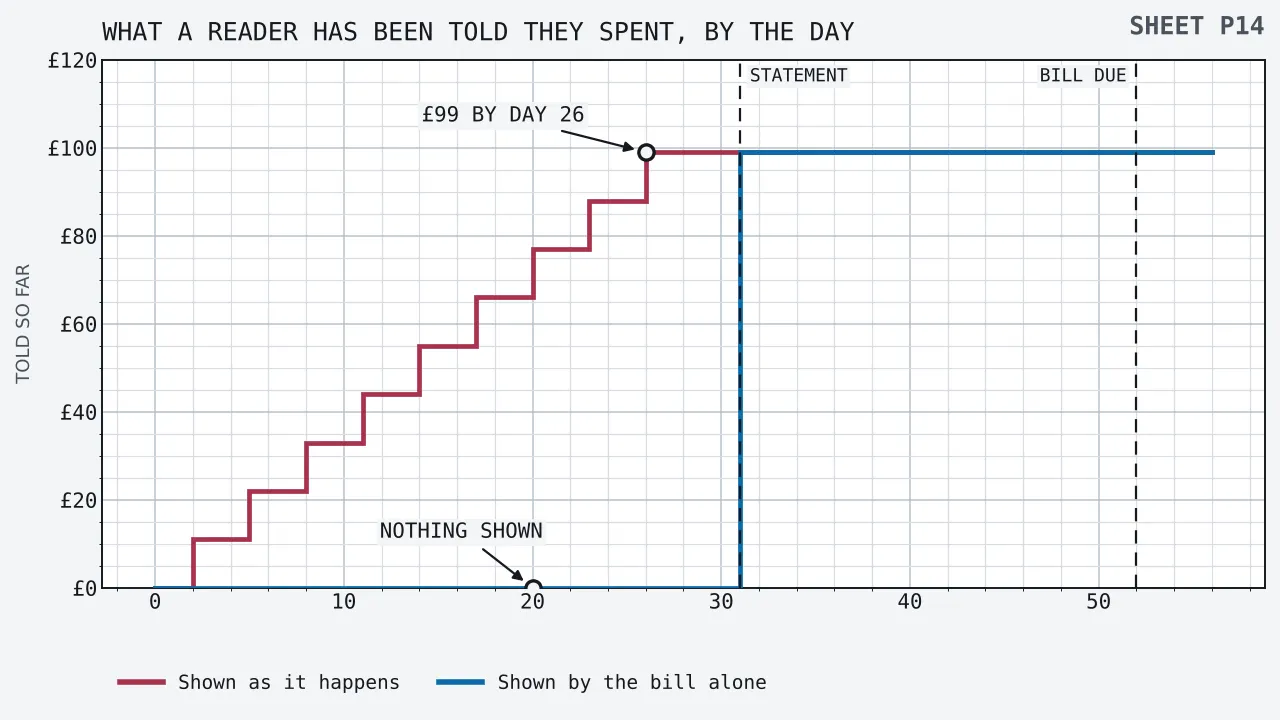
Nought is the height of the lower line for the whole of the first month, and that flatness is the argument of this note in one stroke. Nine decisions are taken. Nothing anywhere adds them together. The figure rises from nothing to £99.00 in a single step on day 31, at which point the spending is a month old and every one of the nine evenings is already past.
Nine hundred and eighty-two is the same ratio measured to the statement rather than to the settling, being 15 days of 1,440 minutes divided by 22. So a reader learns the total 982 goes after an average evening that fed it, and parts with the money 2,356 goes after that evening. Both figures are large and neither gets noticed.
2,356 goes between the pressing and the asking, on a 22 minute go
Twenty-two minutes against 51,840 is the comparison in its rawest form and it is worth leaving on the page without decoration. The activity is short. The obligation it creates is long. No other rail in this section puts those two quantities so far apart, and the distance is not a defect in anybody’s system. It is what a monthly account is for.
Three hours eighteen minutes against 864 hours is the same comparison at the scale of a whole cycle, a ratio of 262 to one. A reader who played for 3 h 18 min across a month carries the resulting obligation for an average of 36 days. Hours of pressing and days of owing are different units, and the whole difficulty of this rail is that only the first is visible while it is happening.
5
A running total shown while the running is going on
A British licensee has been obliged, from 17 January 2025 onwards, to show a customer while play is going on how much they are down and how long they have been at it. A display is not a document: it moves with the pressing instead of arriving a month later, which takes the distance between spending and knowing to nothing at all. Nine charges would be reading £99.00 at the moment the ninth was made.
Eight hundred and sixty-four hours against nought is therefore the shape of what goes missing, and it is the single sharpest comparison on this page. The duty does not make the money cheaper and it does not shorten a billing cycle. It puts the figure somewhere the person spending it can see while there is still something to decide about.
Two quantities sit in that rule and they are worth separating. One is how much has gone. The other is how long it took, which in this site’s own unit is the 3 h 18 min a cycle of nine charges fills. Somebody watching such a display has both the £99.00 and the 198 minutes in front of them, and a telephone bill assembles neither.
A statement supplies something resembling the first of those two a mean of 15 days after a charge, from part three, and supplies the second not at all. A telephone bill totals money. It has no view about minutes of pressing and no reason to have one, so the half of the licensed display that measures duration has no counterpart on this rail in any form.
One further bar arrived in the same release and on the same date, aimed at machinery that lets somebody run more than one product at a time. It is named here because it came out of that change and for no other reason, since it prices nothing in this note and no figure above depends on it.
6
A ceiling that bites while the money is still being spent
A limit the customer sets is the second clock, and the standard behind it is precise about timing. Means of fixing a financial limit have to be within easy reach from the moment an account is opened, and the invitation to use them falls either inside that opening or at the first payment in. Once asked for, a limit comes into force as soon as it practicably can, and the customer is told which moment that is.
Having a limit is the path of least resistance by design, which is the part bearing hardest on a rail like this one. The choice put forward is a limit. Refusing it takes a deliberate act, and that refusal has to be confirmed before depositing can go ahead. Somebody who says nothing at all therefore finishes with a ceiling rather than without one.
Daily, weekly and monthly are the shortest list of spans a limit has to be settable over. The monthly span is the one bearing on this rail. Set against a 31 day cycle it binds inside the same window the charges are being made in, which is 21 days before the statement is settled and up to 51 days before a charge made early in the cycle is paid for.
| What the cycle holds | With no ceiling at all | Against a £50.00 month |
|---|---|---|
| Charges of £11.00 that go through | 9 | 4 |
| Staked across the reels | £99.00 | £44.00 |
| Presses funded | 990 | 440 |
| Pressing, at 12 supposed seconds | 3 h 18 min | 1 h 28 min |
| Expected to be lost | £3.96 | £1.76 |
Fifty-five pounds is the difference the supposed ceiling makes, and the ceiling itself is an illustration of this page rather than a figure from anywhere. What matters is not its size but its position in time. It acts on the fifth charge, in the week the fifth charge is being made, rather than on a statement a reader opens three weeks after the cycle has closed.
One hour and fifty minutes is the same difference counted as pressing, being five goes at a handset that do not happen. Set that against the 2,356 goes of waiting in part four and the two quantities say the same thing from opposite ends. A clock inside the gap is worth more than any amount of information arriving after it.
Lowering a ceiling and raising one move at different speeds under that standard, and the lopsidedness is deliberate. A reduction the customer asks for takes effect at once, unless something has broken. Raising one happens on request only, waits out a day at minimum, and then wants the customer back at the end of the wait to say so again. Neither direction is constrained in any way beyond the register.
7
Something that comes round twice a year and asks
Looking back is the third clock and it turns slowest of the three. An account used at all within a rolling twelve months attracts an invitation, no less than twice a year, to go over the account itself and what has passed through it, and anybody wanting that invitation more often has to be given the means to arrange it.
Three hundred and sixty-five days holds twelve cycles of the kind part two describes, so a six-monthly prompt falls twice across a year of nine charges a cycle. Twice in a year, a licensed reader is handed the whole picture and asked to look at it. On the far side of the register the number of such moments is nought, and the only assembling anybody does is the statement, which assembles one month.
Forty-seven pounds fifty-two is what that whole picture would contain at the end of such a year, being the expectation on £1,188.00 of staking. Thirty-nine hours and thirty-six minutes is the time inside it, and 108 goes at a handset is the same time in goes. Those three figures exist in this note because somebody added twelve statements together, which is exactly the act a six-monthly prompt is designed to provoke.
2 prompts a year inside the licence, against 12 statements and no total
A weaker cousin of that rule reaches a different customer. Somebody holding no financial limit whatever is owed an invitation, not less than yearly, to think about that again. Two sorts of recurring interruption therefore come out of the register, one aimed at the ceiling and one at the figures, while a rail that bills monthly supplies twelve interruptions a year that each describe a single month.
Twelve statements and no total is the honest summary of a year here, and none of it reads as a complaint against a telephone company. A bill is a bill for a period, and no carrier undertakes to add a year of them up or to tell anybody what proportion went one way rather than another. That job belongs to a gambling licence, which is the thing this page is about not having.
8
The other direction, which no telephone account can carry
Nothing travels back along this rail, which is the one structural fact that has to appear on any page about it. A charge is made against an account or taken off a prepaid balance, and neither arrangement has machinery for receiving a payment from a gambling cashier. So a payout needs a destination that did not exist while the money was being spent, and the decomposition below is what that costs.
A desk takes 28 hours over the request. Identity work takes 24, and it falls at this end rather than the other because a mobile number turns up carrying no name, no sort code and no address. A freshly given destination takes 14 to become usable. The money itself takes 32 to travel. All four lengths belong to this page and nothing was watched.
Ninety-eight hours is that sum before the calendar, and the calendar is derived rather than supposed. This note treats a transfer as leaving only between eight in the morning and four in the afternoon on a weekday, which is 40 open hours in every 168. The closed stretches are four nights of 16 hours and one weekend of 64, running from Friday afternoon to Monday morning.
Fifteen hours and fourteen minutes is what those closed stretches insert on average, and the working is one line. A release landing inside a closed stretch of length L waits L over 2 on average and does so for L hours out of the week, so each stretch contributes L squared over 2. Four nights give 4 times 128, the weekend gives 2,048, and 2,560 divided by 168 is 15.238 hours.
One hundred and thirteen hours and fourteen minutes is the modelled total, being the 98 and the 15 h 14 min added. Against the 36 day average lag in part three, which is 864 hours, the payout is 7.6 times quicker than the bill. Money won on this rail is in a bank account about a month before the charge that funded the play has been asked for, which is the oddest consequence of the whole arrangement.
Twenty-four of those 113 hours would disappear if the identity work happened on the day the account opened. That is the one term here a reader can move, it costs nothing but doing a form early, and it is worth 21.2 per cent of the modelled exit. Nothing is skipped and nobody is hurried; the examination simply stands at a moment when no money is queued behind it.
9
What the delay is actually made of
First, the lag is not the problem by itself. Thirty-six days between a press and a payment is a property of monthly billing and it would be unremarkable on a purchase of anything else. What makes it matter is that nothing stands inside the thirty-six days to interrupt the pattern it is recording, and interruption is the only thing that shortens a feedback delay.
Second, the register supplies three interruptions and this page has priced all of them. A display of net spend and time as it happens, binding since 17 January 2025, takes 864 hours down to nothing. A limit the customer sets, offered by default, acts on the fifth charge rather than on the statement. A prompt at least every six months assembles what twelve statements never assemble.
Third, the money itself is small and the arithmetic says so plainly. Eleven pounds is one go of twenty-two supposed minutes. A cycle of nine is £99.00, 3 h 18 min and £3.96 expected. A year of the same is £1,188.00, 39 h 36 min and £47.52. Nobody should finish this page thinking the sums are dramatic, because the thing being measured is a distance in time rather than a quantity of money.
Fourth, a bar a carrier puts on gambling charges protects in the way a registration protects, and the two belong in one sentence. Where such a bar stands it does the work of the three clocks above from outside the gambling system altogether, and nothing on this page is about working past one.
Fifth, and last, the payout direction is the mirror of the deposit one. Nothing comes back along a telephone account, so a destination has to be produced afterwards, and 113 h 14 min is what this note models for the whole exit. Twenty-four of those hours are free to anybody who settles identity at the start. The rest belong to a desk, to a transfer and to a banking week that opens for 40 hours out of 168.
Questions
- How long is it between the pressing and the paying?
- Thirty-six days on average, on the suppositions used here, which are a cycle of 31 days and 21 days to settle once the statement has gone out. A charge on day 1 of the cycle is settled 51 days later and one on day 31 is settled 21 days later, since both fall due on the same date, so the formula is 52 less the day number and the mean of the 31 possible days is 36.
- What does eleven pounds buy, in this site’s units?
- One hundred and ten presses at ten pence, which fills 22 minutes where a press is given the twelve seconds supposed here, and 22 minutes is the length a go at a handset is taken to be. Expected cost is 44p, four pence of every staked pound staying behind wherever ninety-six per cent is the return in force. One charge is one go with nothing left over, which is why that figure was picked.
- Where does the ratio of 2,356 come from?
- From dividing the lag by the play. Thirty-six days is 51,840 minutes and one charge buys 22 minutes of pressing, so 51,840 over 22 is 2,356.4. For each supposed go the money paid for, 2,356 goes of elapsed time pass before anybody asks to be paid. Measured to the statement rather than to the settling, the same ratio is 982.
- When is the total first visible anywhere?
- On the statement, which closes on day 31 of the cycle and is a mean of 15 days after a given charge. Until then nine charges of £11.00 are nine separate events and nothing adds them together. On day 31 they become one line of £99.00, by which point every evening that contributed to it is already in the past.
- What would a British licence have put inside that gap?
- Three things, and every one of them shortens the distance between spending and knowing. A licensee has been obliged, from 17 January 2025 onwards, to show a customer as play goes on how much they are down and how long they have been at it. A financial limit is the choice put forward rather than the one refused, invited either at the opening of an account or at the first payment in, with a deliberate act needed to turn it down. And an account used at all within a rolling twelve months attracts an invitation, no less than twice a year, to go over the account and what has passed through it.
- How much difference does a monthly limit actually make?
- On a supposed ceiling of £50.00 a month, which is this page’s illustration and not a figure from anywhere, it stops the fifth charge of £11.00. The cycle then holds four charges rather than nine: £44.00 staked instead of £99.00, 440 presses instead of 990, 1 h 28 min of pressing instead of 3 h 18 min, and £1.76 expected to go instead of £3.96. What matters is less the size of the ceiling than the week it acts in.
- Why does the standard treat a reduction and an increase differently?
- Because one direction is urgent and the other is not. Lowering a ceiling takes effect at once on the customer’s own request, unless something has broken. Raising one happens on request only, waits out a day at minimum, and then wants the customer back at the end of that wait to say so again. Beyond the register neither direction is constrained in any way.
- What does a year of this habit come to?
- Twelve cycles of nine charges is 11,880 presses, which is £1,188.00 across the reels, 39 h 36 min of pressing, 108 goes at a handset and £47.52 of expected cost. None of those figures appears on any statement, because a statement covers one month. Inside the licence a prompt falls twice in such a year and asks the customer to look at the whole of it.
- Can a payout come back along the telephone account?
- No. A charge moves value in one direction only, whether it goes on a monthly account or comes off a prepaid balance, and neither arrangement has machinery for receiving money from a gambling cashier. A destination therefore has to be produced after the win, which is why the exit modelled here carries a term for a freshly given destination becoming usable.
- How long is the payout modelled at?
- One hundred and thirteen hours and fourteen minutes. A desk takes 28 hours, identity work takes 24 and falls at this end because a mobile number arrives with no name or sort code attached, a fresh destination takes 14 to become usable, the money takes 32 to travel, and 15 h 14 min is averaged in for the hours during which a transfer cannot leave. Four of those five belong to this page and the fifth is worked out.
- Where does the 15 h 14 min come from?
- From one rule and a short calculation. Transfers are taken to leave only between eight in the morning and four in the afternoon on a weekday, which is 40 open hours in 168. A release inside a closed stretch of length L waits L over 2 on average and does so for L hours of the week, contributing L squared over 2. Four nights of 16 hours give 512, the 64 hour weekend gives 2,048, and 2,560 over 168 is 15.238 hours.
- What should a reader do if the registration is what they are trying to get past?
- Ring GamCare. Dialling 0808 8020 133 costs nothing, somebody answers on every date in the year and at every hour of it, and live chat and messaging sit beside the telephone. Unease about another person under the same roof is reason enough. Gamstop Online covers, from one registration, every gambling company that holds a British licence, and a period part way through may be lengthened rather than left to run out. A bar a carrier puts on gambling charges protects in the same way, and working past one is not discussed here.