Note U07 Revision 1 Terms read 17 October 2026
USDT casino balances, and the exact width of a promise that one number will hold still
Granting the promise in full is the fairest way to size it. Seven clocks run across one £10 credit taken at forty times, and holding a price still reaches the first two of them and none of the rest. That is 936 hours out of 6,744 on the assumptions set out below, which is 13.9 per cent, leaving 5,808 hours standing precisely where they stood. The second half of this note prices a different property of the same unit: it exists in more than one version, the versions do not substitute for one another, and the step where a reader settles that has nothing standing behind it.
What the promise reaches 936 h The run 13 h 20 min What it leaves 5,808 h
What offers of this size ask in hours
Advertising has been bought for every destination below. A fee reaches this site when a reader goes on to register, and no figure on this page moves one way or the other because of it.
-
01Mobile Free Spins
Betportal
Ceiling as a multiple
What lands€15.00150 spins at 10c, which is this site's figure and not the operator'sThe run17 h 30 minTurning over 525.00 at 10p means 5,250 presses, or about 48 phone sittings of 22 minutes. Timed at 10p a press and 12 seconds between presses, both of which this site assumes rather than measures.The wait to be paidNOT PUBLISHEDThis operator puts no withdrawal band in its own terms, so there is nothing honest to print here.Spins valued at this site's own 10p a spin
What lands
Spins, at a price15.00150 of them at 10c apiece, a figure belonging to this site rather than to the operatorMatch, and other creditno figure300% of three deposits, to a ceiling of €1,000. Not a sum until money of yours makes it one, so this row totals nothing and carries nothing downwardsThe run
Handed back on the spins(0.60)Each press stakes its own value and returns 96 per cent, which leaves this much with the house from the opening pressPlay-through 35x on the bonus(20.16)Taking 14.40 round 35 times over means 504.00 through the machines, of which 20.16 is the expected cost, and 17 h 30 min of pressing at the pace aboveWhat counts towards it100%Slots only, with no percentage published anywhere, so the row above assumes the whole of each stake countsWhat never clears
Limit on the winningsstated5x the bonusDeducted on the way outno figureNothing is published as a figure here, so this row removes nothingLeast that can leaveno figureNo figure is published, so nothing on this timer is pinned down by oneLeast deposit, and the rung over ityour own€20 a stage. Published in euros, so no rung is named at all: this site's ladder is a sterling oneThe window on the creditstated14 daysBiggest stake while it runsstated€5Removed outright by rulestatedNot publishedVerified before a payoutstatedDocuments before the first withdrawalNever clears€15.00Not a penny of it gets out, so the whole of what landed stands on this rowNo Great Britain licence
Licence held in Anjouan, Comoros, the company named is BetPortal Gaming Ltd, with Excite Ultra Media Ltd, quoted under ALSI-202601040-FI2.
Terms read 17 October 2026
Open the offer at Betportal, opens in a new window -
02Mobile Free Spins
WinBeast
Ceiling as a sum
What lands€50.00500 spins at 10c, which is this site's figure and not the operator'sThe run2 d 18 hTurning over 2,000.00 at 10p means 20,000 presses, or about 182 phone sittings of 22 minutes. Timed at 10p a press and 12 seconds between presses, both of which this site assumes rather than measures.The wait to be paidNOT PUBLISHEDThis operator puts no withdrawal band in its own terms, so there is nothing honest to print here.Spins valued at this site's own 10p a spin
What lands
Spins, at a price50.00500 of them at 10c apiece, a figure belonging to this site rather than to the operatorMatch, and other creditno figure50% to 100% of five deposits, each to a ceiling of €1,000, and a €650 free bet. Not a sum until money of yours makes it one, so this row totals nothing and carries nothing downwardsThe run
Handed back on the spins(2.00)Each press stakes its own value and returns 96 per cent, which leaves this much with the house from the opening pressPlay-through 40x on the bonus and the winnings from the spins(76.80)Taking 48.00 round 40 times over means 1,920.00 through the machines, of which 76.80 is the expected cost, and 2 d 18 h of pressing at the pace aboveWhat counts towards it100%Slots, titles vary by country, with no percentage published anywhere, so the row above assumes the whole of each stake countsWhat never clears
Limit on the winningsstated€100 a batch of spinsDeducted on the way outno figureNothing is published as a figure here, so this row removes nothingLeast that can leaveno figureNo figure is published, so nothing on this timer is pinned down by oneLeast deposit, and the rung over ityour own€20 a stage. Published in euros, so no rung is named at all: this site's ladder is a sterling oneThe window on the creditstated7 days, spins 1 dayBiggest stake while it runsstatedNot publishedRemoved outright by rulestatedNot publishedVerified before a payoutstatedDocuments before the first withdrawalNever clears€50.00Not a penny of it gets out, so the whole of what landed stands on this rowNo Great Britain licence
Licence held in Curaçao, no company named anywhere on the site.
Terms read 17 October 2026
Open the offer at WinBeast, opens in a new window -
03Mobile Free Spins
EliteSpin
Longest spin window
What lands£50.00500 spins at 10p, which is this site's figure and not the operator'sThe run2 d 18 hTurning over 2,000.00 at 10p means 20,000 presses, or about 182 phone sittings of 22 minutes. Timed at 10p a press and 12 seconds between presses, both of which this site assumes rather than measures.The wait to be paidNOT PUBLISHEDThis operator puts no withdrawal band in its own terms, so there is nothing honest to print here.Spins valued at this site's own 10p a spin
What lands
Spins, at a price50.00500 of them at 10p apiece, a figure belonging to this site rather than to the operatorMatch, and other creditno figure50% to 100% of five deposits, each to a ceiling of £1,000. Not a sum until money of yours makes it one, so this row totals nothing and carries nothing downwardsThe run
Handed back on the spins(2.00)Each press stakes its own value and returns 96 per cent, which leaves this much with the house from the opening pressPlay-through 40x on the bonus and the winnings from the spins(76.80)Taking 48.00 round 40 times over means 1,920.00 through the machines, of which 76.80 is the expected cost, and 2 d 18 h of pressing at the pace aboveWhat counts towards it100%Slots, with no percentage published anywhere, so the row above assumes the whole of each stake countsWhat never clears
Limit on the winningsstated5x the bonusDeducted on the way outno figureNothing is published as a figure here, so this row removes nothingLeast that can leaveno figureNo figure is published, so nothing on this timer is pinned down by oneLeast deposit, and the rung over ityour own£20 a stage. It lands square on the £20.00 rung, so none of yours is left perched on topThe window on the creditstated7 days, spins 3 daysBiggest stake while it runsstatedNot publishedRemoved outright by rulestatedNot publishedVerified before a payoutstatedDocuments before the first withdrawalNever clears£50.00Not a penny of it gets out, so the whole of what landed stands on this rowNo Great Britain licence
Licence held in Costa Rica, the company named is PrimeTier Limited.
Terms read 17 October 2026
Open the offer at EliteSpin, opens in a new window -
04Mobile Free Spins
Crown Jewelz
Multiple unpublished
What lands£15.00150 spins at 10p, which is this site's figure and not the operator'sThe runNOT TIMEDThis operator does not publish the play-through multiple in its own terms. The multiple is the one figure the clock cannot work around, so the run is left untimed.The wait to be paidNOT PUBLISHEDThis operator puts no withdrawal band in its own terms, so there is nothing honest to print here.Nothing reckoned
What lands
Spins, at a price15.00150 of them at 10p apiece, a figure belonging to this site rather than to the operatorMatch, and other creditno figure200% of the first deposit, then 150% twice, each to a ceiling of £1,000. Not a sum until money of yours makes it one, so this row totals nothing and carries nothing downwardsThe run
Play-throughno figure40x the bonus, reported rather than published by the operatorWhat counts towards itno figureSlots, with no percentage published anywhere, so the row above assumes the whole of each stake countsWhat never clears
Limit on the winningsstatedNot publishedDeducted on the way outno figureNothing is published as a figure here, so this row removes nothingLeast that can leaveno figureNo figure is published, so nothing on this timer is pinned down by oneLeast deposit, and the rung over ityour own£20. It lands square on the £20.00 rung, so none of yours is left perched on topThe window on the creditstatedNot publishedBiggest stake while it runsstatedNot publishedRemoved outright by rulestatedNot publishedVerified before a payoutstatedDocuments before the first withdrawalNever clearsNOT RECKONEDThis operator leaves the play-through multiple out of its own terms, so nothing below the fourth step can be worked out.No Great Britain licence
Licence held in Curaçao, number not verified, no company named anywhere on the site.
Terms read 17 October 2026
Open the offer at Crown Jewelz, opens in a new window
Only the middle reading comes out of arithmetic belonging to this site. The multiple laid against what lands gives the turnover asked for; dividing that by 10p a spin gives the presses; dividing those by 300 an hour gives the hours, a press on a handset being taken here at 12 seconds from the one before. Both figures are assumptions rather than measurements of anybody: nothing was played and nothing was held a stopwatch to. Anybody quicker should divide the press count by a rate of their own, which is why the presses are printed alongside the hours instead of being summarised away.
The first reading is what arrives before any condition is laid against it. Spins carry no unit of their own so one gets supplied: where an operator values its own spin that figure is used and attributed, and where it does not, this site's 10p a spin stands in and everything below moves with it. The third reading belongs to the operator entirely. It is a withdrawal band quoted from published terms, and a blank there means none was published rather than that nobody looked.
The total along the foot answers what the hours leave open, which is whether any of the running ends anywhere. It is what arrived, less whatever is still standing once the play-through has been paid for at 96 per cent return to player and once a published limit, a published deduction and a published floor beneath the least that can leave have each had a turn. It appears again in pence in the pound, the only fair way of holding a small offer up against a large one. It describes an offer rather than an evening, and where the conditions price out what arrived, a timer prints nothing getting out instead of a negative sum.
Cashiers on a handset take deposits off a row of preset buttons, so a least deposit given in pounds is raised to the next rung of the ladder used here, £10, £20, £25, £50, £75 and £100, and the timer shows what is left perched on it. That money is the reader's own and enters no sum at all. Given in euros it prints untouched, the ladder being sterling. Three words may occupy the figure column where no figure belongs. Stated is a published term that costs something while leaving no number to subtract. No figure is a term nobody has quantified, or a credit that is not a sum until money of yours makes it one. Your own is money of yours, which belongs in none of this.
None of the operators above is licensed in Great Britain, so not one duty that licence carries reaches any of them. Membership of Gamstop Online is compulsory for every online gambling company licensed in Great Britain, which means that shutting yourself out through the scheme shuts you out of none of these. The limit of ten times the bonus funds on a wagering requirement, running since 19 January 2026 under Social Responsibility Code 5.1.1, is a condition of the same licence and binds only whoever holds one. Off that licence, the Gambling Commission writes of consumers meeting unfair gaming practices, financial loss and no recourse when matters go wrong, and lists blocked payouts and withdrawal limits pitched too high to reach among the things it has seen. No account at any of them may be held by anybody under 18.
Every term on a timer is its operator's own and every timer carries the day somebody read it. The oldest of those readings is 17 October 2026. What binds a reader is an operator's full terms and never a line printed here.
1
Granting the claim in full, then measuring its edges
One number is what the unit in this note’s heading is written to hold steady, and the whole of what follows grants that design its claim without argument. Doubting the promise would be the easy page to write and the useless one. Taking it at its word is harder and more informative, because a promise granted in full can then be measured, and measuring it is how a reader learns which of their difficulties it was never addressed to.
Assistance toward a gambling business of this description appears nowhere in these ten parts, and that was settled before any sum was worked. No name is printed and no web address. Paperwork, handsets and the way a household arranges its connection are all left out, and so is every question of acquiring, storing, transferring or cashing anything whatever. A bank stopping a gambling payment is doing a protective job, as is a connection supplier doing the equivalent, and neither gets talked round in a line here.
One course of action is urged on this page and this sentence holds it. Somebody with a Gamstop Online registration who has put a phrase like the one above through a search engine has reached precisely the hour that registration was bought to cover, and the use to make of that hour is a call to 0808 8020 133, which costs nothing, which GamCare staffs, and which shuts on no date in the calendar. Sums occupy the remaining parts, and a sum is a way of sizing a thing rather than a way of settling it.
One pound is not what the promise is written against, and the qualification belongs at the front rather than buried. A unit of this kind holds itself to one United States dollar. A balance read in pounds therefore keeps a second movement, between two national currencies, which the design never set out to remove and which this note prices in part three rather than pretending away.
Five per cent across thirty-seven evenings is what this page assumes of that leftover movement, a round figure of its own making and taken from nowhere, the regulatory sheet standing behind this network carrying no currency pair and no price at any point in it. On a balance of £100.00 the assumption gives £5.00, and at the 4p in each staked pound the house expects, £5.00 is 4 h 10 min of modelled play. A variable narrowed is therefore what the design delivers, and the residue has a measurable size.
Granting a claim and verifying one are different acts, and only the first is performed here. Whether any particular arrangement does hold its number steady is not a question this note can answer, units and networks and prices being absent from every source it is allowed to draw on. The narrower question can be answered: supposing the number holds perfectly, what does a reader still have running against them, and for how many hours.
2
Seven clocks running across one credit of ten pounds
Ten pounds of credit taken at forty times is the engagement every figure below is hung on, and its arithmetic is this site’s standing conversion rather than anything new. Four hundred pounds is the staking a multiple of forty sets against £10.00 of credit. Dividing by a stake of ten pence gives 4,000 presses. Twelve seconds apiece, assumed here and never measured, stretches them across 13 h 20 min. Sittings run to twenty-two assumed minutes and 110 presses, so the clause asks for thirty-seven of them.
Thirty-seven evenings is that same run at one sitting a night, a rhythm this note adopts and did not observe, and 888 hours is what thirty-seven days come to on a wall clock. Add the hold described in part six and the span from the first press to the money leaving is 936 hours on these assumptions. That span is the first clock, and it is the one the promise is about.
Seven is the count of distinct clocks a reader has running across that engagement, and naming them one at a time is the only way to see which the promise reaches. The clearing span comes first. The hold after a request is second. The period in which a payment can be argued with is third. The round of questions about documents is fourth. The delay standing in front of a changed ceiling is fifth. The period an operator owes a reply within is sixth. The cycle a national registration is read on is seventh.
Two of those seven are touched by a price that holds steady and the touch is partial. A balance exposed across the clearing span stops being exposed to a moving number; so does a balance sitting through the hold. Neither span gets shorter. What changes is what is happening to the balance during it, and that is worth saying precisely, because a promise that shortens nothing is easily mistaken for one that does.
Five of the seven are untouched in any degree, and the reason is structural rather than commercial. Each of those five is a duty somebody owes or a cycle somebody runs, and a unit’s design cannot create a duty. No arrangement of software obliges anybody to answer a complaint, to compare a customer list against a national register, to wait before raising a ceiling, to ask for documents early, or to let a payer start an argument. Those things arrive with a licence or they do not arrive.
3
The same inventory added up, and the share that goes
Adding hours of different kinds together is a crude device and this part uses it deliberately, with the crudeness declared. A complaint window and a clearing span are not the same object. What they have in common is the only property being counted here: each is a period during which something that matters to the reader is outside the reader’s control, and a period of that sort can be added to another one.
| What the clock measures | Hours | Where the figure comes from | Does a steady price reach it |
|---|---|---|---|
| The clearing span, pressed at a sitting a night | 888 | This site’s conversion, on assumed rhythms | Yes, as to the price only |
| The hold between asking and the money moving | 48 | This page’s own assumption | Yes, as to the price only |
| The period a payment stays arguable | 0 | A property of the rail, not an assumption | Nothing there to reach |
| The round of questions about documents | 72 | This page’s own assumption | No |
| The delay in front of a raised ceiling | 24 | The licensed minimum, from the standard | No |
| The period an answer is owed inside | 1,344 | Eight weeks, held as a licence condition | No |
| The cycle a registration is read on | 4,368 | A six-month period taken at 182 days | No |
Six thousand seven hundred and forty-four hours is that column added up, and 936 of them are the span a steady price covers. Thirteen point nine per cent is the share, and the count agrees with it: one clock in seven is 14.3 per cent, which is as near the hours figure as two such crude measures ever land. Two independent routes to the same proportion is weak evidence, and weak evidence pointing the same way is still worth printing.
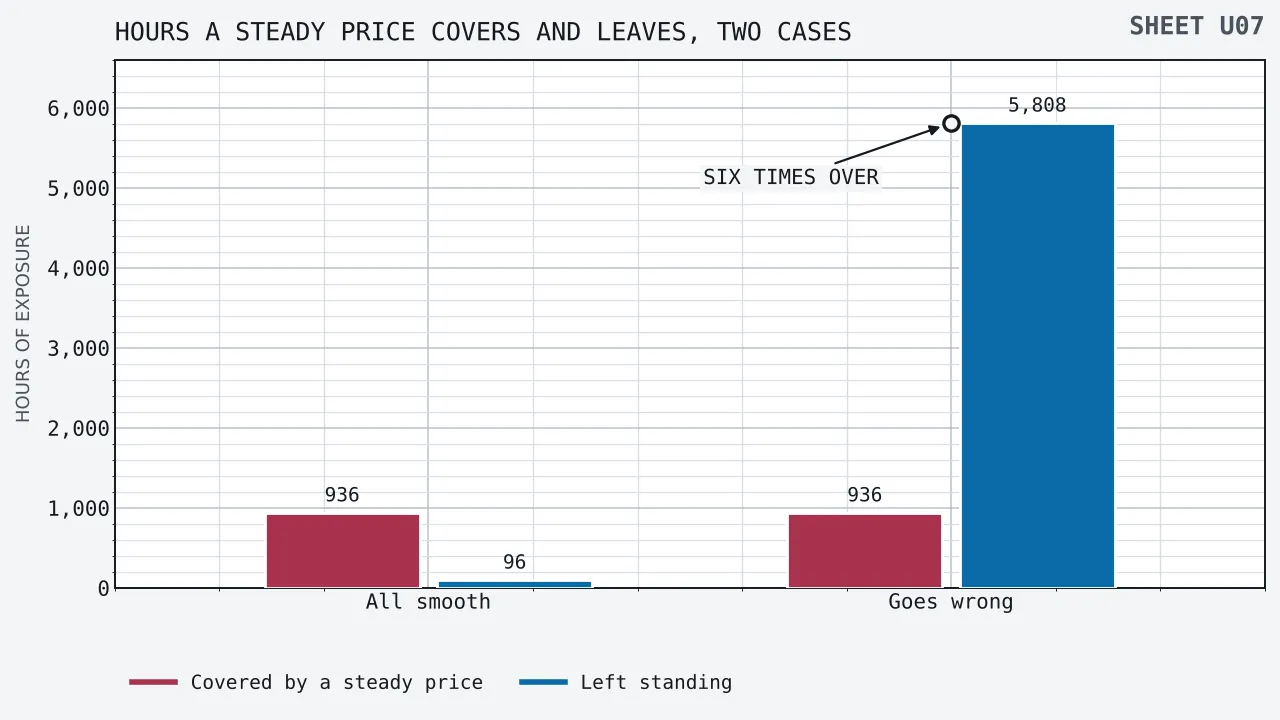
Two cases are drawn there because one proportion would misrepresent the position. An evening where nothing goes wrong runs only the first five clocks in the table, which come to 1,032 hours, and a steady price covers 936 of them. Ninety point seven per cent is the share in that case, and it is a large and genuine number that no honest page would leave out.
Thirteen point nine per cent is the share in the other case, where a complaint is made or a registration is standing, and the difference between the two figures is the finding this part exists to produce. The promise is worth a great deal on the evenings that go smoothly and almost nothing on the evenings that do not. Every clock it fails to reach is a clock a reader only ever consults at a bad moment.
936 hours covered against 5,808 hours standing exactly where they stood
Nothing in those proportions depends on the two assumed figures being right. Push the hold from 48 hours to a week and the covered span rises to 1,056 hours, which lifts the wider share to 15.5 per cent and lowers the narrow one to 90.3. Cut the assumed document round from 72 hours to nought and the narrow share rises to 97.5 per cent while the wider one does not move at all. The gap between the two cases survives every substitution, because it is produced by the two largest rows, and neither of those is an assumption of this page.
4
Eight weeks of owed reply, unmoved by any price
Eight weeks converts to 1,344 hours, and inside the British licence that is as far from the start of a complaint as a business may get before it has to be done, escalation within the firm counted in. A condition carries the period rather than a courtesy, and whatever closes it has to say the firm’s own process is at an end and to explain the escalation available, which runs to an entity holding the regulator’s approval.
Nought is what a steady price does to that figure in either direction. A unit’s behaviour is a fact about a balance; a reply period is an obligation on a company; and no quantity of the first produces any quantity of the second. The alternative to labouring the point is a reader taking a payment arrangement with fewer surprises in it for a business arrangement with fewer surprises in it.
Three working days is the other end of that clock and it belongs here for scale, being the outer edge on telling a complainant their complaint has landed, with a qualifier asking for it as soon as can reasonably be managed. Twenty-four hours is the figure instead where gambling is offered at all hours. Seventy-two against 1,344 is the span a reader with a problem lives inside.
Seven days is a third period in the same guidance and it runs in the firm’s favour. Where a reasonable request for information goes a week unanswered, halting the count can be justified, and it then resumes at the point of halting instead of at the beginning. A ceiling capable of pausing is still a ceiling, and the pause itself is published, which is the property doing the work.
Forty-four hours and forty-eight minutes of modelled play is 1,344 hours read in this site’s own unit at its standing rate, the house expecting £1.20 from each hour of pressing and the eight weeks being worth £53.76 at that rate. The conversion is deliberately odd, and its oddness is the point. A reply period is not a sum of money, and the only way to feel the size of it on a site about duration is to set it beside durations the reader already has a sense of.
5
A reading of a customer base that still does not happen
Six months read as 182 days comes to 4,368 hours, and on every one of those days a British licensed cashier has to put its whole customer base against the national register, at least once. The obligation attaches to the licence. No business chose it as a feature, and no payment arrangement is capable of supplying it.
Twenty-four hours is the longest a registration may sit unread at such a cashier, which is 0.55 per cent of the period, and that fraction is the whole mechanism in one figure. Beyond the licence the fraction is the entire 4,368, because the first reading never arrives and so nothing closes the gap afterwards. A price that holds still changes neither figure, and could not, there being no list on one side to compare anything against.
Four thousand three hundred and sixty-eight is also, by coincidence of arithmetic, 4.67 times the 936 hours the promise does reach. So the single clock this page cannot improve is nearly five times the size of the one it can, measured on the same engagement and in the same unit. A reader weighing a payment property against a protection is weighing two quantities of very different sizes.
Nought acts a day is what the registered person performs to keep that cycle running, which is the property that makes it worth having when an evening turns bad. A clock somebody else winds does not need the person to be in any particular state of mind on any particular night. Everything priced in parts two and three needs the reader to be paying attention, and a reader paying attention is exactly who this market is not built for.
6
Two ceilings, one hold, and a window that was never there
Twenty-four hours is the licensed delay in front of a ceiling going up, and nought is the delay in front of one coming down. Those two figures are a pair and the asymmetry is the whole of their value: a limit that falls the instant it is asked to, and one that rises only after a day has passed and the customer has acted a second time to confirm that they still want it. A steady price has no bearing on either.
Forty-eight hours is this note’s own assumption for the hold, being the period between a request to take money out and the money being somewhere else, and it is declared as an assumption every time it carries a figure here. Nothing was measured, and a hold of any length for any business is absent from every source this page may draw on. The structural half needs no source whatever: a hold belongs to whoever is holding the balance, and the reader spectates for the duration.
Two things happen across those 48 hours and only one of them is improved by a price that sits still. The balance stops being exposed to a moving number, which is a real improvement and is counted in part three. The balance also sits where somebody else controls it, and that does not improve at all. Confusing the two is the commonest mistake available on this subject.
Nought hours is the third figure and it is not an assumption. A payment written into a public network has no period afterwards in which the payer may ask for it back, and the figure reads nought at the first hour and nought at the thousandth. A unit holding its price steady leaves that untouched, because the two properties are unrelated: one is about what a balance is worth and the other is about whether a transfer can be unwound.
Seven thousand two hundred presses is the licensed delay converted at this site’s standing pace, £720.00 of staking at ten pence and £28.80 of expected cost, all of it withheld from a decision taken at midnight and regretted by the morning.
7
Where in the sequence the questions about documents arrive
Seventy-two hours is this page’s own assumption for the round of questions about documents, declared here and wherever else it carries a figure, and the number matters far less than its position. Under the British condition on identity the round stands in front of everything else. Three particulars, being the name, the home address and the birth date, have to be collected and checked before anybody is let near a game at all, and the requirement covers play funded by a credit exactly as it covers play funded with the customer’s own money.
Three further limbs of that condition fix where the round may not be shifted to, and they are what this part is really about. Ahead of any money going in, the customer has to learn which papers might be wanted, at which moment, and by which means of delivery. Whatever particulars the business already holds get kept in good order, so far as is reasonable. And asking to take money out may not trigger a demand for something there was every chance to ask about at the beginning.
Promptly is the regulator’s own word for when anti-money-laundering particulars should be sought, glossed so as to rule out leaving them until a payout has been asked for, and its consumer guide adds that a payout held back for want of identity particulars may leave a business in breach. A household bill, a driving licence or a passport are the examples it gives, with no instruction about choosing between them.
Eighteen or over is all that the offshore rulebook opened for this network insists on at the matching moment. Depositing and wagering are both shut off until the operator is satisfied on that single point, and the ways of becoming satisfied it offers are a birth date confirmed, a tick box asserting adulthood, and a payment route checked. Documents issued by a government belong instead to milestones further down the line, reached on money-laundering grounds and brought forward only where age itself is doubted earlier.
Nothing in that comparison concerns how long the questions take, and the whole of it concerns when they get asked. Businesses of the sort a phrase like that one reaches hold no Great Britain licence, so the round sits wherever an operator finds convenient, and convenient means in front of the money leaving instead of in front of the money going in. Seventy-two assumed hours at the first door is an errand. The same seventy-two at the last door is a balance nobody can get at.
8
Three other things a licence holds still, and one it does not
Holding something still is exactly what the unit in this note’s heading advertises, so the fair comparison is with the other things a British licence holds still across the same engagement. Three of them bear directly on a reader working off a clause, and none of the three has any counterpart in a unit’s design or in the rulebook read for this network.
First, the odds. Acceptably random is the standard set over the number generation and over the results together, and a game that adapts, which the standard calls compensated, is shut out. Anything altering a probability is caught, a person doing it by hand and a routine doing it automatically alike. What comes out has to be distributed as the theory says it should be. Numbers arrive in an order, get used in that order, and throwing one away is not available.
Second, the rules while play is under way. Alteration mid-game is barred on three counts at once, those being the rules, what pays and how likely anything is, and anything altered has to be put where the customer will see it, with play suspended or the game taken down while the work is done. A term reserving a power to rewrite the rules at any moment is named as one that would not pass. A bonus round described properly beforehand is a permitted change, and it is the counter-example showing the rule has an edge to it.
Third, how long a result stays on the screen. Clear and accurate display of the outcome and of what the customer gambled is required, for a period that can reasonably be expected to suffice. That is a duty measured in time, which is rare enough to notice, and on a site converting everything into durations it is the one of the three most plainly a clock.
Nought of those three is held still by a price that sits still, and the sentence is worth its own paragraph. A balance whose pound value never moves can be staked into a game whose probabilities nobody has to leave alone, under rules nobody has to keep fixed while the game is running, with results displayed for whatever period the software allows. Steadiness in one place is not steadiness anywhere else, and the heading of this part is the finding of the whole note in miniature.
9
One name, several networks, and a choice taken once
One name covering several different things is the property this part is about, and it is a fact about the unit rather than about any business. A unit of this kind is issued on more than one public network, Ethereum and Tron among them, and a holding on one network is not a holding on another. The name is shared. The thing is not.
Two consequences follow and the second is the expensive one. The first is that a reader and a cashier have to be on the same network for anything to arrive, which is a compatibility question of the ordinary kind. The second is that settling which network is in use is a step, that step is taken once, and parts two and six have already established the period afterwards in which it may be revisited, which is nought hours.
Nought is an unusual figure to meet in a sequence of steps and it is worth dwelling on rather than hurrying past. Almost everything a person does with money is provisional for a period: an instruction can be countermanded, an institution can be written to, a scheme can be asked to look at it. A choice of network sits outside that pattern entirely. It is not reviewed quickly or reviewed slowly. It is not reviewed.
Three properties therefore sit on top of each other at the same moment, which is why this is the one step in the chain worth a part of its own. The choice is consequential, because the versions do not substitute. It is irreversible, because nothing stands behind it. And it is made by the party with the least information, since the reader is the one person in the arrangement who has never seen the inside of the cashier.
Nothing in this part tells anybody how to make that choice, and the omission is the same one declared in part one. How a unit is obtained, held, moved or converted is absent from this page in its entirety, and so is any description of what a reader would do at the moment of sending. The consequences of a step can be priced in full without a single instruction for taking it, and part ten does the pricing.
10
Pricing a step that has nothing standing behind it
Fifty pounds is the sum run through this part, being big enough to be felt and small enough to be routine. Where a step of the shape described in part nine goes astray, nothing arrives, no party holds a power to fetch it back, and what is lost is the entire amount rather than a fraction of one. That is the structure of it. Turning the structure into hours is the rest of this part.
Forty-one hours and forty minutes is that £50.00 read as modelled play, at £1.20 of expected cost an hour, which is what ten pence every twelve assumed seconds produces against a return of 96 per cent. Three point one two five clearing runs of 13 h 20 min is the identical figure in another unit, and 500 presses of staking is the gentler conversion, printed alongside so that the harsher one does not stand by itself.
A mishap nobody plans for gets priced by multiplying what it costs against how often it lands, and there is no second route to it. The rates below belong to this page, as round assumptions, nothing in the material available here publishing an error rate for any step of anything. Three of them appear because a single rate would read as a finding, and a spread of twenty to one shows the shape of the answer without claiming to know where inside the spread the truth sits.
| How often the step is assumed to go wrong | Cost per send | As modelled play | Cost per send if half were recoverable | Cost per send if nine in ten were |
|---|---|---|---|---|
| Once in fifty | £1.00 | 50 min | £0.50 | £0.10 |
| Once in two hundred | £0.25 | 12 min 30 s | £0.13 | £0.03 |
| Once in a thousand | £0.05 | 2 min 30 s | £0.01 | £0.01 |
Two right-hand columns are there to show what a recovery route would have been worth, and they are the point of the whole table. Where something can be retrieved, the expected cost of a mishap is the loss multiplied by how often it happens and again by the share that cannot be got back. Half the column halves the bill. Nine parts in ten of it cuts the bill to a tenth. Where nothing can be retrieved, that third factor is one, and being one is what makes the first column the ceiling for every row.
Fifty minutes against six pence is the span of the top row across those assumptions, and the span is wider than any disagreement about how careful a reader is. A page that argued about the error rate would be arguing about the smallest of the three factors. The factor that has been fixed at its worst possible value, by the engineering rather than by anybody’s choice, is the one nobody can negotiate with.
Nine hundred and thirty-six hours against 5,808 is where this note finishes, and the two halves of it meet in a single sentence. Holding one number still covers 13.9 per cent of the hours a reader has running when something goes wrong, and the same arrangement introduces a step whose worst outcome has no recovery factor at all. Both findings point the same way, and neither of them is a reason to think any better of the second half of the bargain.
Readers who reached part ten with an exclusion of their own in mind have a better use for the next two minutes than the remainder of this arithmetic, and the better use is 0808 8020 133. GamCare keeps the National Gambling Helpline staffed on it around the clock and right across the calendar, at no cost, by telephone, through live chat or by written message. Unease about a relative is as good a reason to dial as unease about oneself.
Questions
- What is a usdt casino, described without the marketing?
- A gambling business taking payment in a chain unit written to hold itself against one United States dollar, and carrying no Great Britain licence, because the duties arriving with such a licence are not the kind of thing a payment arrangement is able to supply. Nothing here identifies such a business, gives its address or sketches a way to it. What happens instead is that the design is granted its claim in full and the claim is then measured against everything a reader has running.
- How much of the exposure does a steady price actually remove?
- On the inventory in part three, 936 hours out of 6,744, which is 13.9 per cent, where a complaint is made or a registration is standing. Where nothing goes wrong, only the first five clocks run, which come to 1,032 hours, and the same 936 is 90.7 per cent of those. The honest answer is therefore a range rather than a figure, and which end of it applies is decided by whether the evening goes wrong rather than by anything about the unit.
- Is the price held against the pound?
- No. A unit of this kind holds itself against one United States dollar, so a balance read in pounds keeps a second movement, between two national currencies. Five per cent across the thirty-seven evenings a clearing run occupies at one sitting a night is what this page assumes of it, as a round figure of its own, the regulatory sheet behind this network naming no currency pair at any point. On £100.00 the assumption gives £5.00, which is 4 h 10 min of modelled play at the rate the house expects from staking.
- Which clocks does the promise leave exactly where they were?
- Five of the seven. The period a payment stays arguable, which is nought hours whatever the unit. The round of questions about documents, assumed here at 72 hours. The delay in front of a raised ceiling, which is 24 hours inside the licence and nothing outside it. The period an answer to a complaint is owed inside, which is 1,344 hours as a licence condition. And the cycle a national registration is read on, which is at worst daily across 4,368 hours of a six-month period.
- Why can a unit’s design not fix any of those five?
- Because each of them is a duty somebody owes or a cycle somebody runs, and software cannot create a duty. No arrangement of code obliges a business to answer a complaint inside eight weeks, to compare its whole customer base against a national register at least daily, to wait a day before raising a ceiling, to ask for documents at the first door rather than the last, or to leave a payer a period in which to argue. Those arrive with a licence or they do not arrive at all.
- What does a British licence hold still that a steady price does not?
- Three things bearing directly on a clearing run. Acceptably random is the standard over the results and over the numbers producing them, an adapting or compensated game is shut out, anything shifting a probability is caught whoever or whatever does the shifting, and the outcomes have to follow the theory. Alteration while play is under way is barred across the rules, the payouts and the odds together, and a term reserving a power to rewrite rules at any moment is named as one that would not pass. Then the outcome itself has to be displayed clearly, accurately, and for long enough that the period can be called reasonable.
- Does the same unit exist in more than one version?
- It does. A unit of this kind is issued on more than one public network, Ethereum and Tron among them, and a holding on one network is not a holding on another, so the name is shared while the thing is not. Settling which network is in use is therefore a step rather than a detail, it is taken once, and the period afterwards in which it may be revisited is nought hours. Nothing on this page describes how that step is taken, and the omission is deliberate.
- What does a step with no recovery behind it cost?
- Where £50.00 is involved the loss is the entire amount, which reads as 41 h 40 min of modelled play at £1.20 of expected cost an hour, or 3.125 clearing runs of 13 h 20 min. Multiplied through this page’s own assumed rates, that is £1.00 a send at once in fifty, 25p at once in two hundred, and 5p at once in a thousand. Where a thing can be fetched back the bill falls by whatever share is fetched, and the share here is nothing at all.
- How long is the hold used in the arithmetic, and where does it come from?
- Forty-eight hours, and that figure was settled on this page rather than taken from anywhere. Nothing in the material available here states a hold of any length for any business, so it runs through every sum as a declared assumption. Two things happen across a hold and a steady price improves one of them: exposure to a moving number stops, and the balance goes on sitting under somebody else’s control.
- Where should somebody go who recognises themselves in part one?
- Onto a free call to 0808 8020 133, which is answered at GamCare, whose National Gambling Helpline stays staffed around the clock and across the calendar, by telephone, through live chat or by written message. Unease about a relative is as good a reason to dial as unease about oneself. TalkBanStop is also GamCare’s, and it joins up three things: the helpline, software that blocks, and the national scheme. A period already under way may be lengthened rather than left to expire.