Note L08 Revision 1 Terms read 17 October 2026
Twenty slots in an order nobody prints, and what the order is worth
Put twenty builds in a line from ninety-seven per cent down to eighty-eight and £100.00 funds 111 h 6 min 40 s of pressing at one end and 27 h 46 min 40 s at the other, at ten pence a press on the three hundred an hour assumed here. Four to one is the whole spread, 83 h 20 min separates the ends, and no page that declines to print the figures can tell a reader which end anything sits at.
What lands £100.00 The run 28 h to 111 h The wait to be paid 48 h
What offers of this size ask in hours
Advertising has been bought for every destination below. A fee reaches this site when a reader goes on to register, and no figure on this page moves one way or the other because of it.
-
01Mobile Free Spins
Betportal
Ceiling as a multiple
What lands€15.00150 spins at 10c, which is this site's figure and not the operator'sThe run17 h 30 minTurning over 525.00 at 10p means 5,250 presses, or about 48 phone sittings of 22 minutes. Timed at 10p a press and 12 seconds between presses, both of which this site assumes rather than measures.The wait to be paidNOT PUBLISHEDThis operator puts no withdrawal band in its own terms, so there is nothing honest to print here.Spins valued at this site's own 10p a spin
What lands
Spins, at a price15.00150 of them at 10c apiece, a figure belonging to this site rather than to the operatorMatch, and other creditno figure300% of three deposits, to a ceiling of €1,000. Not a sum until money of yours makes it one, so this row totals nothing and carries nothing downwardsThe run
Handed back on the spins(0.60)Each press stakes its own value and returns 96 per cent, which leaves this much with the house from the opening pressPlay-through 35x on the bonus(20.16)Taking 14.40 round 35 times over means 504.00 through the machines, of which 20.16 is the expected cost, and 17 h 30 min of pressing at the pace aboveWhat counts towards it100%Slots only, with no percentage published anywhere, so the row above assumes the whole of each stake countsWhat never clears
Limit on the winningsstated5x the bonusDeducted on the way outno figureNothing is published as a figure here, so this row removes nothingLeast that can leaveno figureNo figure is published, so nothing on this timer is pinned down by oneLeast deposit, and the rung over ityour own€20 a stage. Published in euros, so no rung is named at all: this site's ladder is a sterling oneThe window on the creditstated14 daysBiggest stake while it runsstated€5Removed outright by rulestatedNot publishedVerified before a payoutstatedDocuments before the first withdrawalNever clears€15.00Not a penny of it gets out, so the whole of what landed stands on this rowNo Great Britain licence
Licence held in Anjouan, Comoros, the company named is BetPortal Gaming Ltd, with Excite Ultra Media Ltd, quoted under ALSI-202601040-FI2.
Terms read 17 October 2026
Open the offer at Betportal, opens in a new window -
02Mobile Free Spins
WinBeast
Ceiling as a sum
What lands€50.00500 spins at 10c, which is this site's figure and not the operator'sThe run2 d 18 hTurning over 2,000.00 at 10p means 20,000 presses, or about 182 phone sittings of 22 minutes. Timed at 10p a press and 12 seconds between presses, both of which this site assumes rather than measures.The wait to be paidNOT PUBLISHEDThis operator puts no withdrawal band in its own terms, so there is nothing honest to print here.Spins valued at this site's own 10p a spin
What lands
Spins, at a price50.00500 of them at 10c apiece, a figure belonging to this site rather than to the operatorMatch, and other creditno figure50% to 100% of five deposits, each to a ceiling of €1,000, and a €650 free bet. Not a sum until money of yours makes it one, so this row totals nothing and carries nothing downwardsThe run
Handed back on the spins(2.00)Each press stakes its own value and returns 96 per cent, which leaves this much with the house from the opening pressPlay-through 40x on the bonus and the winnings from the spins(76.80)Taking 48.00 round 40 times over means 1,920.00 through the machines, of which 76.80 is the expected cost, and 2 d 18 h of pressing at the pace aboveWhat counts towards it100%Slots, titles vary by country, with no percentage published anywhere, so the row above assumes the whole of each stake countsWhat never clears
Limit on the winningsstated€100 a batch of spinsDeducted on the way outno figureNothing is published as a figure here, so this row removes nothingLeast that can leaveno figureNo figure is published, so nothing on this timer is pinned down by oneLeast deposit, and the rung over ityour own€20 a stage. Published in euros, so no rung is named at all: this site's ladder is a sterling oneThe window on the creditstated7 days, spins 1 dayBiggest stake while it runsstatedNot publishedRemoved outright by rulestatedNot publishedVerified before a payoutstatedDocuments before the first withdrawalNever clears€50.00Not a penny of it gets out, so the whole of what landed stands on this rowNo Great Britain licence
Licence held in Curaçao, no company named anywhere on the site.
Terms read 17 October 2026
Open the offer at WinBeast, opens in a new window -
03Mobile Free Spins
EliteSpin
Longest spin window
What lands£50.00500 spins at 10p, which is this site's figure and not the operator'sThe run2 d 18 hTurning over 2,000.00 at 10p means 20,000 presses, or about 182 phone sittings of 22 minutes. Timed at 10p a press and 12 seconds between presses, both of which this site assumes rather than measures.The wait to be paidNOT PUBLISHEDThis operator puts no withdrawal band in its own terms, so there is nothing honest to print here.Spins valued at this site's own 10p a spin
What lands
Spins, at a price50.00500 of them at 10p apiece, a figure belonging to this site rather than to the operatorMatch, and other creditno figure50% to 100% of five deposits, each to a ceiling of £1,000. Not a sum until money of yours makes it one, so this row totals nothing and carries nothing downwardsThe run
Handed back on the spins(2.00)Each press stakes its own value and returns 96 per cent, which leaves this much with the house from the opening pressPlay-through 40x on the bonus and the winnings from the spins(76.80)Taking 48.00 round 40 times over means 1,920.00 through the machines, of which 76.80 is the expected cost, and 2 d 18 h of pressing at the pace aboveWhat counts towards it100%Slots, with no percentage published anywhere, so the row above assumes the whole of each stake countsWhat never clears
Limit on the winningsstated5x the bonusDeducted on the way outno figureNothing is published as a figure here, so this row removes nothingLeast that can leaveno figureNo figure is published, so nothing on this timer is pinned down by oneLeast deposit, and the rung over ityour own£20 a stage. It lands square on the £20.00 rung, so none of yours is left perched on topThe window on the creditstated7 days, spins 3 daysBiggest stake while it runsstatedNot publishedRemoved outright by rulestatedNot publishedVerified before a payoutstatedDocuments before the first withdrawalNever clears£50.00Not a penny of it gets out, so the whole of what landed stands on this rowNo Great Britain licence
Licence held in Costa Rica, the company named is PrimeTier Limited.
Terms read 17 October 2026
Open the offer at EliteSpin, opens in a new window -
04Mobile Free Spins
Crown Jewelz
Multiple unpublished
What lands£15.00150 spins at 10p, which is this site's figure and not the operator'sThe runNOT TIMEDThis operator does not publish the play-through multiple in its own terms. The multiple is the one figure the clock cannot work around, so the run is left untimed.The wait to be paidNOT PUBLISHEDThis operator puts no withdrawal band in its own terms, so there is nothing honest to print here.Nothing reckoned
What lands
Spins, at a price15.00150 of them at 10p apiece, a figure belonging to this site rather than to the operatorMatch, and other creditno figure200% of the first deposit, then 150% twice, each to a ceiling of £1,000. Not a sum until money of yours makes it one, so this row totals nothing and carries nothing downwardsThe run
Play-throughno figure40x the bonus, reported rather than published by the operatorWhat counts towards itno figureSlots, with no percentage published anywhere, so the row above assumes the whole of each stake countsWhat never clears
Limit on the winningsstatedNot publishedDeducted on the way outno figureNothing is published as a figure here, so this row removes nothingLeast that can leaveno figureNo figure is published, so nothing on this timer is pinned down by oneLeast deposit, and the rung over ityour own£20. It lands square on the £20.00 rung, so none of yours is left perched on topThe window on the creditstatedNot publishedBiggest stake while it runsstatedNot publishedRemoved outright by rulestatedNot publishedVerified before a payoutstatedDocuments before the first withdrawalNever clearsNOT RECKONEDThis operator leaves the play-through multiple out of its own terms, so nothing below the fourth step can be worked out.No Great Britain licence
Licence held in Curaçao, number not verified, no company named anywhere on the site.
Terms read 17 October 2026
Open the offer at Crown Jewelz, opens in a new window
Only the middle reading comes out of arithmetic belonging to this site. The multiple laid against what lands gives the turnover asked for; dividing that by 10p a spin gives the presses; dividing those by 300 an hour gives the hours, a press on a handset being taken here at 12 seconds from the one before. Both figures are assumptions rather than measurements of anybody: nothing was played and nothing was held a stopwatch to. Anybody quicker should divide the press count by a rate of their own, which is why the presses are printed alongside the hours instead of being summarised away.
The first reading is what arrives before any condition is laid against it. Spins carry no unit of their own so one gets supplied: where an operator values its own spin that figure is used and attributed, and where it does not, this site's 10p a spin stands in and everything below moves with it. The third reading belongs to the operator entirely. It is a withdrawal band quoted from published terms, and a blank there means none was published rather than that nobody looked.
The total along the foot answers what the hours leave open, which is whether any of the running ends anywhere. It is what arrived, less whatever is still standing once the play-through has been paid for at 96 per cent return to player and once a published limit, a published deduction and a published floor beneath the least that can leave have each had a turn. It appears again in pence in the pound, the only fair way of holding a small offer up against a large one. It describes an offer rather than an evening, and where the conditions price out what arrived, a timer prints nothing getting out instead of a negative sum.
Cashiers on a handset take deposits off a row of preset buttons, so a least deposit given in pounds is raised to the next rung of the ladder used here, £10, £20, £25, £50, £75 and £100, and the timer shows what is left perched on it. That money is the reader's own and enters no sum at all. Given in euros it prints untouched, the ladder being sterling. Three words may occupy the figure column where no figure belongs. Stated is a published term that costs something while leaving no number to subtract. No figure is a term nobody has quantified, or a credit that is not a sum until money of yours makes it one. Your own is money of yours, which belongs in none of this.
None of the operators above is licensed in Great Britain, so not one duty that licence carries reaches any of them. Membership of Gamstop Online is compulsory for every online gambling company licensed in Great Britain, which means that shutting yourself out through the scheme shuts you out of none of these. The limit of ten times the bonus funds on a wagering requirement, running since 19 January 2026 under Social Responsibility Code 5.1.1, is a condition of the same licence and binds only whoever holds one. Off that licence, the Gambling Commission writes of consumers meeting unfair gaming practices, financial loss and no recourse when matters go wrong, and lists blocked payouts and withdrawal limits pitched too high to reach among the things it has seen. No account at any of them may be held by anybody under 18.
Every term on a timer is its operator's own and every timer carries the day somebody read it. The oldest of those readings is 17 October 2026. What binds a reader is an operator's full terms and never a line printed here.
1
Why not a single title appears anywhere below
Nought titles are named on this page, and the reason is worth setting out before anything else. The only sheet of fact this site writes from holds regulatory rule, statute and published statistic. It holds nothing whatever about any individual build: no return, no cycle length, no stake rung, no behaviour. A sorted twenty built on numbers absent from that sheet would be a sorted twenty built on numbers invented for the purpose.
Inventing them is the exact failing this whole build exists to replace. The site standing at these addresses before printed the same five scores beside its operators on eighty-six guide pages, the identical five every time, which judges nothing and measures nothing. A list of twenty carrying a column of made-up figures is that fault repeated twenty times instead of five.
So the subject shifts from the list to the sorting. What could legitimately put one build above another, what each candidate does to an hour, a week and a year of play, how far apart the ends of a plausible line would fall in pounds, and what a reader can get out of a line whose sorting rule is never disclosed. Those questions have arithmetic behind them, and the arithmetic does not need a title.
Every figure below is modelled on a generic build at a stated return. Where a return appears it is an assumption written into the sum and labelled as one, never a claim about anything a reader could go and open. Ten pence a press, three hundred presses an hour and a sitting of twenty-two minutes carry through, with the pace and the sitting standing as declared conventions of this site and not as a record of how anybody actually plays.
Two hundred and forty pounds ninety against £963.60 is where this page lands, those being a year of the same modest habit at the two ends of a twenty spanning ninety-seven down to eighty-eight. Seven hundred and twenty-two pounds seventy separates them. That gap is what an undisclosed sorting rule conceals, and it is larger than most readers would guess from a page that prints twenty names and no numbers.
£722.70 a year between the ends of one plausible twenty
2
Seven published quantities that could do the sorting
Seven quantities get published about builds of this sort often enough to be candidate sorting keys, and they fall into three groups. Two of them move the cost of an hour directly. One moves it by moving how many presses the hour holds. Four move nothing at all, however prominently they are displayed.
Return heads the first group. It fixes the price of each pound sent across the reels, and at ten pence a press on the assumed pace it fixes the price of an hour: £1.20 at ninety-six per cent, £1.80 at ninety-four, 90p at ninety-seven. Nothing else on the list of seven sets a rate rather than a quantity, which is argued out in full at online slots UK.
The smallest stake a build accepts heads the second group, and it is the candidate most readers overlook. A build taking ten pence and a build whose lowest rung is twenty pence differ by a factor of two in every hourly figure on this page, before any question of return arises. Ordering twenty by return while ignoring the stake rung sorts on the smaller of the two levers.
Cycle length makes the third group on its own, because it governs how many presses an hour contains without touching what any one press costs. Twelve seconds gives three hundred presses and £30.00 of turnover; six seconds gives six hundred and £60.00. The hour gets dearer and the press does not.
| What might be used to sort a line of twenty | What it fixes | Plausible span | Hourly cost across it, house model otherwise |
|---|---|---|---|
| Published return | The price of a pound crossing | 97 to 88 per cent | £0.90 to £3.60 |
| Smallest stake the build accepts | How much crosses per press | 5p to 50p | £0.60 to £6.00 |
| Length of one cycle | How many presses an hour holds | 2.5 s to 30 s | £5.76 to £0.48 |
| How bunched the payments are | The shape of a session, not its mean | Wide | No change |
| Count of lines or ways | How a fixed stake is divided up | 1 to 100,000 | No change |
| Size of the largest prize | The ceiling on one press | Wide | No change |
| How many people play it | Nothing a sum can use | Wide | No change |
Three rows with figures and four rows reading no change is the shape of that table, and it is the shape of the problem. A list sorted on any of the lower four is sorted on something, and whatever it is sorted on, the bill at the end of a year is identical at both ends of it. A reader cannot tell which sort has been applied by looking at the output.
Combining two of the top three is where ordering gets genuinely slippery. Ninety-seven per cent taken at twenty pence costs £1.80 an hour. Ninety-four per cent taken at ten pence costs £1.80 an hour. Eighty-eight per cent taken at five pence costs £1.80 an hour. Three positions scattered right across a twenty, and the hour bills the same at each.
3
Head to foot of a plausible twenty, measured in hours
Ninety-seven down to eighty-eight is the span this page treats as plausible for a line of twenty, and the width matters more than either endpoint. Pick a narrower span and every conclusion shrinks proportionately. Pick a wider one and they grow. Both endpoints are written down so that a reader preferring a different pair can put them in and run one division again.
Three pence against twelve pence is the span restated as the shortfall each build keeps from every pound crossing, and that restatement is where the factor of four comes from. Twelve over three is four. Hours bought on a fixed sum therefore run four to one between the ends, and so does the annual bill, and so does every other quantity on this page that depends on the return alone.
One hundred and eleven hours six minutes forty seconds is what £100.00 funds at the head of such a line. At the foot the identical £100.00 funds 27 h 46 min 40 s. Lying between them is 83 h 20 min, which is also precisely what £100.00 funds at ninety-six per cent, and that coincidence is worth carrying about.
| How wide the twenty is assumed to spread | Hours £100.00 funds at the head | Hours at the foot | Ratio between the ends | Sittings of 22 min, head and foot |
|---|---|---|---|---|
| 96 down to 94 per cent | 83 h 20 min | 55 h 33 min 20 s | 1.50 to 1 | 228 and 152 |
| 97 down to 92 per cent | 111 h 6 min 40 s | 41 h 40 min | 2.67 to 1 | 304 and 114 |
| 97 down to 88 per cent | 111 h 6 min 40 s | 27 h 46 min 40 s | 4.00 to 1 | 304 and 76 |
Three hundred and four sittings against seventy-six is the bottom row in the unit this site counts in, and it is the clearest reading of the three. A reader spending £100.00 gets either three hundred and four evenings of twenty-two minutes or seventy-six of them. Two hundred and twenty-eight evenings is the difference, which is nearly eight months at two sittings a day.
Nothing in that table is a judgement about any build. It is the arithmetic of a span, and the span is an assumption. What the table does establish is the size of the thing an unlabelled sorting rule is hiding, and the size is large: a factor of four on the widest row and a factor of one and a half even on the narrowest.
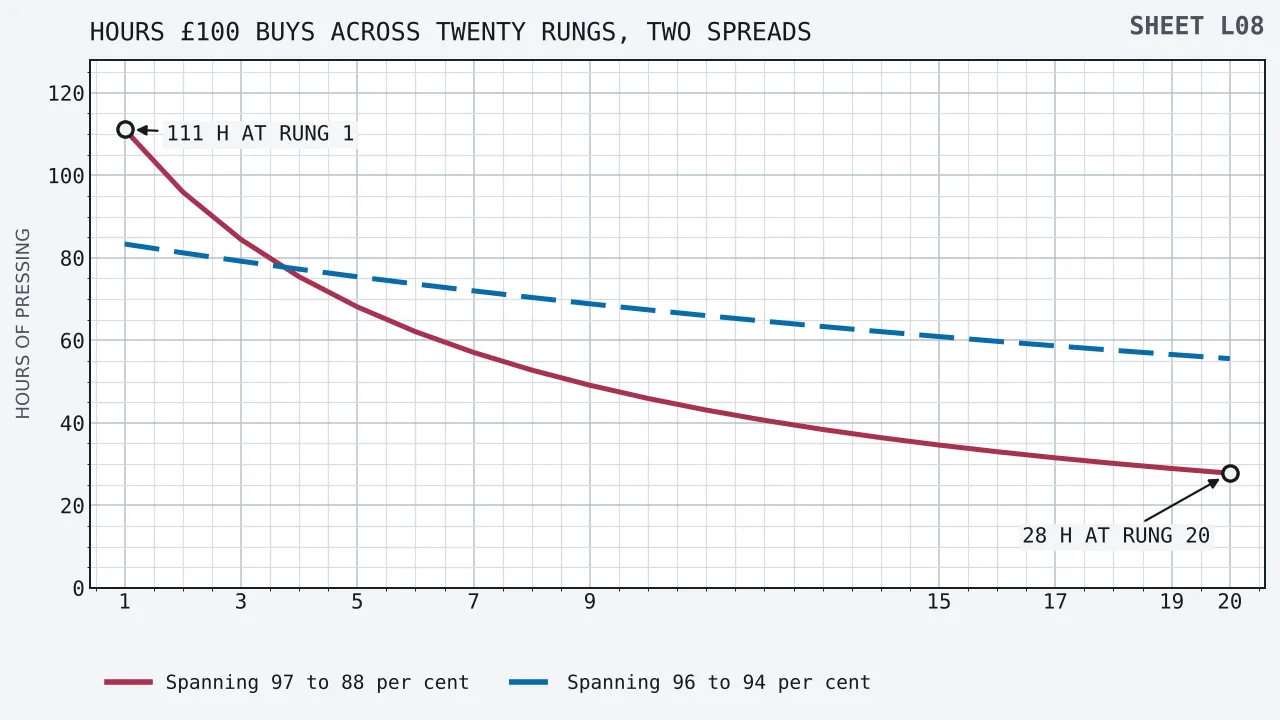
Both curves on that plate run downhill and neither runs straight, which is the second thing worth taking from it. Equal steps in return do not give equal steps in hours, because the hours a fixed sum funds move inversely with the shortfall. Nearly all the value sits in the first few positions of a line, and the last few are close together however wide the line is.
4
Nineteen steps, and what a single step comes to
Nineteen gaps separate twenty positions, and dividing the span by nineteen gives the step. Nine points over nineteen is 0.474 of a point, which is the distance between neighbours on an evenly spread line running from ninety-seven to eighty-eight. Fourteen point two pence an hour is the same step converted at ten pence a press and the assumed pace.
Thirty-eight pounds four is one step over twelve months of the habit this section of the site prices against, which is forty-four minutes a day, 267 h 40 min and £8,030.00 of turnover. Moving a reader one position along the line is therefore worth about thirty-eight pounds a year, and moving them nineteen positions is worth £722.70.
| Position on the line | Return at that position | Cost of an hour | Hours £100.00 funds | Twelve months of the habit |
|---|---|---|---|---|
| First | 97.000% | £0.90 an hour | 111 h 6 min 40 s of play | £240.90 |
| Second | 96.526% | £1.04 an hour | 95 h 57 min 35 s of play | £278.94 |
| Tenth | 92.737% | £2.18 an hour | 45 h 53 min 37 s of play | £583.23 |
| Nineteenth | 88.474% | £3.46 an hour | 28 h 55 min 10 s of play | £925.56 |
| Twentieth | 88.000% | £3.60 an hour | 27 h 46 min 40 s of play | £963.60 |
Fifteen hours nine minutes five seconds is what the move from first to second costs a reader with £100.00, and 1 h 8 min 28 s is what the move from nineteenth to twentieth costs. Both are one step of 0.474 of a point. Measured in the only unit that matters to somebody spending money, the step at the head is worth thirteen of the step at the foot.
Guessing well near the head of a line is therefore worth thirteen times what guessing well near its foot is worth, and that is the single most practical consequence of the reciprocal shape. A reader who narrows twenty down to a plausible best three has done most of the available work. A reader who distinguishes carefully between the seventeenth and the nineteenth has done almost none.
Nothing requires a real line of twenty to spread evenly, and most would not. Builds cluster, because the commercial reasons for choosing a return are much the same across a market. An uneven line concentrates the whole spread into two or three steps somewhere, and those steps are worth the entire £722.70 between them.
5
Sorting by speed, and the lid that sits over it
Speed sorts a line of twenty more sharply than the return does, and it is almost never the thing a list is sorted on. Cycle length decides how many presses sit inside an hour, the press count decides the turnover, and the turnover decides the share kept back. Twelve seconds is the interval assumed all through this site, and nothing about it was measured.
Twelve to one is the width of the pace column, 48p an hour where a press is given an assumed thirty seconds against £5.76 where a cycle turns over as briskly as a licence allows. That is three times the span of the return column across a twenty running ninety-seven to eighty-eight, and it belongs entirely to the clock rather than to anything about how a build pays.
| Seconds a cycle occupies | Presses an hour holds | Turnover an hour | Kept back at 96 per cent | Hours £100.00 funds |
|---|---|---|---|---|
| 2.5, the quickest a licence permits | 1,440 presses | £144.00 sent | £5.76 of it | 17 h 21 min 40 s |
| 4 | 900 presses | £90.00 sent | £3.60 of it | 27 h 46 min 40 s |
| 6 | 600 presses | £60.00 sent | £2.40 of it | 41 h 40 min |
| 12, the interval assumed here | 300 presses | £30.00 sent | £1.20 of it | 83 h 20 min |
| 20 | 180 presses | £18.00 sent | £0.72 of it | 138 h 53 min 20 s |
| 30 | 120 presses | £12.00 sent | £0.48 of it | 208 h 20 min |
Row two of that table earns a second look. A build pressed every four seconds at ninety-six per cent costs £3.60 an hour, which is precisely what the foot of a ninety-seven to eighty-eight twenty costs at twelve seconds. Pace alone has moved a reader from the head of the line to the foot of it, and the printed return never changed.
Two lids hold the top of that column down inside the British licence, and both govern what a reader may be handed rather than what a build may pay. Nothing licensed gives out a way of reaching the result sooner, so a hurried press, a shortened spin and a stopped reel are all out of the question. Nor will a licensed build take a cycle the reader has not asked for, which keeps a thumb in the loop on every single one.
One thousand four hundred and forty is what those two bars leave as an hour’s arithmetical ceiling, because beating it means restarting inside the minimum gap of 2.5 seconds. Ten pence over 1,440 presses comes to £144.00, four per cent of which is £5.76, so the dearest hour at ten pence on a licensed slot runs to 4.8 of the hour modelled at twelve seconds. Away from a licence the only ceiling is a thumb.
Nought is the effect of any of this on the price of one press, which holds at 0.4p on a ninety-six per cent build however quickly the presses arrive. Pace buys and sells pressing. Return prices it. A line of twenty sorted on speed and a line sorted on return are answering two genuinely different questions, and neither answers the other.
6
Sorting by the smallest coin a build will take
Stake rungs differ between builds and the lowest rung is the one that decides a reader’s hourly bill, because most readers take the lowest. Five pence against ten pence at the foot of a ladder is worth exactly two points of return, 60p an hour in both directions, and hardly any list of twenty records where a ladder starts.
One hundred to one is the span from five pence to five pounds, which is wider than the return span and the pace span put together. Sixty pence an hour sits at the bottom and £60.00 at the top, both at ninety-six per cent and the assumed three hundred presses. Nothing about a build’s design produces that range. It is produced by which button a thumb lands on.
| Stake on one press | Turnover an hour | Kept back at 96 per cent | Hours £100.00 funds | Where a British licence stands on it |
|---|---|---|---|---|
| 5p | £15.00 sent | £0.60 of it | 166 h 40 min | Permitted at any age over eighteen |
| 10p | £30.00 sent | £1.20 of it | 83 h 20 min | Permitted at any age over eighteen |
| 20p | £60.00 sent | £2.40 of it | 41 h 40 min | Permitted at any age over eighteen |
| 50p | £150.00 sent | £6.00 of it | 16 h 40 min | Permitted at any age over eighteen |
| £1.00 | £300.00 sent | £12.00 of it | 8 h 20 min | Permitted at any age over eighteen |
| £2.00 | £600.00 across | £24.00 of it | 4 h 10 min | Anybody below twenty-five meets this ceiling |
| £5.00 | £1,500.00 sent | £60.00 of it | 1 h 40 min | Everybody of twenty-five or more meets this one |
One hour forty minutes is the last cell in the hours column, and it is the shortest duration anywhere on this page. A hundred pounds lasts a hundred minutes at the licensed ceiling on a slot stake, which is under five sittings of the assumed twenty-two. Four hours ten minutes is the equivalent for a reader under twenty-five, because their ceiling is two fifths as high.
Two statutory ceilings sit behind those last two rows, and each reaches reel-based games only. One game cycle on a licensed online slot cannot carry above £5.00 from a player who has turned twenty-five, nor above £2.00 from one who has not, and at the assumed three hundred presses those sums hold an hour’s turnover to £1,500.00 and £600.00. Four per cent of each is £60.00 and £24.00. A roulette wheel and a blackjack shoe are untouched, which is a distinction worth keeping straight.
Nine April 2025 is where the regulator’s guidance puts the higher ceiling, with the lower one following on 21 May 2025, six weeks later. Twenty-fifth of February 2025 is the day the instrument was made, and it fixes its own start six weeks after that day while printing no calendar date at all, so the two dates come out of the guidance and not out of the instrument.
Sixty pounds an hour is what the five pound ceiling permits at the assumed pace, and that figure is the honest way to read a stake cap. It is not a promise that an hour will be cheap. It is a statement that an hour cannot cost more than £60.00 at ninety-six per cent on a licensed slot, and that away from the register no equivalent sentence exists anywhere.
7
Five things that sort a list and alter no bill
Five commonly printed quantities sort a line of twenty perfectly well and change the expected cost of a year by nothing whatever. Each deserves naming, because a reader who assumes a sorted list must have been sorted on something that matters will reliably be wrong, and all five produce orderings that look purposeful.
How bunched the payments are comes first, and it is the most widely discussed. A build paying little and often and a build paying rarely and heavily can carry the identical return and therefore the identical £1.20 an hour at ten pence. What differs is the shape of one sitting, not the mean of a thousand of them, and the shape is priced properly at top 10 best online slots.
Count of lines comes second. Dividing a fixed ten pence across one line or across fifty changes how the ten pence is distributed and leaves the ten pence exactly where it was. Turnover an hour stays at £30.00 and the share kept stays at £1.20. A reader comparing a build on twenty lines with one on two hundred and forty-three is comparing presentation.
Size of the largest prize comes third, and it sorts a list very dramatically. A ceiling of five thousand times a ten pence press is £500.00 and a ceiling of fifty thousand times is £5,000.00. Neither figure appears anywhere in the hourly arithmetic, because the return already contains whatever the ceiling contributes to it.
Reel count and release date come fourth and fifth, and they need one sentence between them. Neither has any arithmetical consequence at all. A list sorted on either produces an order, the order is stable, the order is reproducible, and the order tells a reader nothing about £240.90 against £963.60.
| Sorted on | Change to the hourly cost | Change to a year |
|---|---|---|
| How bunched the payments are | £0.00 | £0.00 |
| Count of lines or ways | £0.00 | £0.00 |
| Size of the largest prize | £0.00 | £0.00 |
| Count of reels on the screen | £0.00 | £0.00 |
| The date it was released | £0.00 | £0.00 |
| Published return | Up to £2.70 | Up to £722.70 |
Nought pounds repeated five times and then a figure is the whole message of that table. Five of the six sorts are free, in the precise sense that choosing either end of them costs the same money. The sixth is worth £722.70 across a year of forty-four minutes a day, and the sixth is the one a list of twenty is least likely to print.
8
A year of the same habit at both ends of twenty
Forty-four minutes a day across 365 days is the habit this section of the site costs everything against, and it comes to 267 h 40 min, seven hundred and thirty sittings of the assumed twenty-two minutes, and eighty thousand three hundred presses. Eight thousand and thirty pounds of turnover goes across the reels inside it at ten pence a press.
Two hundred and forty pounds ninety is that year at the head of a ninety-seven to eighty-eight line, and £963.60 is the same year at its foot. Both readers pressed the identical number of times, for the identical number of minutes, on the identical number of evenings. Seven hundred and twenty-two pounds seventy went one way rather than the other, and nobody could have seen it happening.
| Return at the position | Expected in a week | In a month of 30 days | Across twelve months | Against the head of the line |
|---|---|---|---|---|
| 97 per cent | £4.62 | £19.80 | £240.90 | level |
| 96 per cent | £6.16 | £26.40 | £321.20 | plus £80.30 |
| 95 per cent | £7.70 | £33.00 | £401.50 | plus £160.60 |
| 93 per cent | £10.78 | £46.20 | £562.10 | plus £321.20 |
| 90 per cent | £15.40 | £66.00 | £803.00 | plus £562.10 |
| 88 per cent | £18.48 | £79.20 | £963.60 | plus £722.70 |
Four pounds sixty-two against £18.48 is the weekly column at the two ends, and the weekly column is where an undisclosed sorting rule does its hiding. Thirteen pounds eighty-six a week is a difference most readers would notice arriving as a bill. Divided across fourteen sittings of the assumed twenty-two minutes it becomes 99p a sitting, which nobody notices at all.
Ninety-nine pence a sitting is the honest unit for the gap between the head and the foot of a twenty, and it explains why the question never gets asked. Nothing about a sitting at the foot of the line feels different from a sitting at its head. The difference is 0.9p a press, and 0.9p a press is beneath the resolution of any experience.
Eight hundred and three hours of pressing is what £722.70 buys back at the head of the line, being £722.70 divided by the 90p an hour a ninety-seven per cent build keeps. One thousand and ninety-five days at forty-four minutes a day is the same span in calendar terms, so getting the sorting right once buys about three further years of the identical habit and costs nothing extra.
9
Where the lids come off, and how wide the line opens
Three lids hold the ends of this page’s columns in place inside Great Britain. An arrangement of this shape operates outside the British licence, and a lid that binds nobody is no lid, so all three of them govern what a reader may be handed rather than what any build may pay. That is precisely why they belong on a page about sorting.
A ceiling over the stake is the first and the largest. Five pounds is the most a licensed online slot may draw from one game cycle played by somebody of twenty-five or more, with two pounds the most below that age, and both sit on remote casino licences as rules for reel-based games alone. At the assumed three hundred presses those two ceilings hold an hour to £60.00 and £24.00 of expected cost.
A floor under the cycle is the second. Nothing licensed may restart quicker than the floor allows, which puts 1,440 presses at the top of an hour and, at ten pence, £5.76 at the top of the hourly cost at ninety-six per cent. Off the register that multiplication has no upper bound but a thumb, and pressing once a second at ten pence crosses £360.00 an hour for an expected £14.40.
Two controls close the third gap between them. Nothing licensed hands a reader a way of reaching the result sooner, and nothing licensed takes a cycle the reader has not asked for. Both bars exist so that the shortest permitted interval between cycles cannot be stepped around from the other side.
| What sets the end of a column | Dearest hour at that end, house model otherwise | Dearest hour with the lid off | What the lid actually is |
|---|---|---|---|
| The stake one press may carry | £60.00 | No published limit | Five pounds a cycle, two below twenty-five |
| How often a cycle may restart | £5.76 | No published limit | A minimum gap between one cycle and the next |
| A control that hurries a result | Not available | Unaddressed | Quickened presses and halted reels are barred |
| Pressing without a reader present | Not available | Unaddressed | Each cycle is committed to individually |
Seven thousand two hundred pounds is what one hour crosses where a five pound stake meets the 1,440 presses a licensed cycle leaves room for, and four per cent of that is £288.00. No hour on a licensed slot can be dearer than £288.00. Nothing here suggests anybody plays that way; the point is that a finite figure exists, while the same multiplication has no top whatever once the licence is absent.
Six months, counted from the day something went wrong, is how long a licensed business has to keep a complaint about it open at the very least, and no written offshore equivalent could be found. An argument about sorting is a slow one. A reader works it out around month four and wants to raise it around month five, and month five falls inside the British window.
A British licence is also the only thing putting an operator inside the national self-exclusion scheme, whose own terms concede that businesses standing apart from it lie beyond its help. Read that as a measurement of what a registration covers. Nowhere does this page help anybody past it, past a block a bank sets, or past a bar set across a network.
10
Working an order backwards from a budget
Start from the money and the sorting rule becomes unnecessary, which is the practical close to all of the above. A reader who knows what they intend to spend and how long they intend it to last can calculate the return that pairs the two, and then go looking for that figure rather than for a position on somebody’s line.
One pound sixty-seven an hour is the requirement for £100.00 to last sixty hours, and £1.67 an hour at ten pence and the assumed pace means a shortfall of 5.6 pence in the pound, which is a return of about 94.4 per cent. That single sum turns a shopping question into a lookup, and the answer either exists where a reader can read it or the decision is being taken blind.
| What £100.00 is meant to cover | Required at 10p a press | Required at 5p a press |
|---|---|---|
| 20 hours of pressing | 83.3 per cent | 66.7 per cent |
| 40 hours | 91.7 per cent | 83.3 per cent |
| 60 hours | 94.4 per cent | 88.9 per cent |
| 80 hours | 95.8 per cent | 91.7 per cent |
| 120 hours | 97.2 per cent | 94.4 per cent |
| 200 hours | 98.3 per cent | 96.7 per cent |
Column three is the escape hatch. Halving the stake moves the required return down by six or seven points on every row, which is more than the whole width of a plausible twenty. A reader whose budget demands 97.2 per cent at ten pence needs only 94.4 at five pence, and 94.4 is a figure that exists in quantity while 97.2 is scarce.
Four questions get a reader most of the way, and none of them requires a list. What does the build itself say about its return or its margin before anything is committed. What is the lowest rung on its stake ladder. How long does one cycle actually take. And how many hours is the money meant to cover. The sorting falls out of the answers.
Nothing here recommends a build and nothing here could. A page that names no title cannot hand anybody a shortlist, and that limitation is deliberate rather than regrettable. What it can hand over is the conversion: 0.4p a press at ninety-six per cent, £1.20 an hour, 44p a sitting, £321.20 a year, and a factor of four between the ends of one plausible twenty.
£1.67 an hour is 94.4 per cent at 10p a press
Questions
- Why does this page name no games at all?
- Because the only sheet of fact this site writes from carries regulatory rule, statute and official statistic, and carries nothing about any individual build: no return, no cycle length, no stake rung. Sorting twenty names by a number that is absent from that sheet would mean inventing the number, and inventing numbers is the precise failing this build replaced. What can be done honestly is to price the sorting itself, which is what the parts above do.
- How far apart would the ends of a plausible twenty actually sit?
- Four to one, on a line running from ninety-seven per cent down to eighty-eight. At ten pence a press and the three hundred presses an hour assumed here, the head keeps back 90p an hour and the foot keeps back £3.60, so £100.00 funds 111 h 6 min 40 s at one end and 27 h 46 min 40 s at the other. That is three hundred and four sittings of the assumed twenty-two minutes against seventy-six, and 83 h 20 min of pressing separates them.
- What is one position on the line worth?
- Thirty-eight pounds four over twelve months of forty-four minutes a day, where the twenty spreads evenly from ninety-seven to eighty-eight. Nineteen gaps divide that span, so one step is 0.474 of a point, which at ten pence and the assumed pace is 14.2p an hour. The steps are not equal in effect: moving from first to second costs a reader with £100.00 fifteen hours nine minutes, while moving from nineteenth to twentieth costs one hour twenty-eight minutes.
- Which published quantities change nothing?
- How bunched the payments are, the count of lines or ways, the size of the largest prize, the count of reels and the release date. All five sort a line of twenty perfectly well and all five leave the expected cost of a year exactly where it was. A build paying little and often and one paying rarely and heavily can carry the same return and therefore the same £1.20 an hour at ten pence, and a fixed ten pence divided across fifty lines is still a fixed ten pence.
- Does the speed of play matter more than the return?
- Across a plausible range it does. Cycle length spans twelve to one, 48p an hour where a press is given an assumed thirty seconds against £5.76 where a cycle turns over as briskly as a licence allows, while a twenty running ninety-seven to eighty-eight spans only four to one. A build pressed every four seconds at ninety-six per cent costs £3.60 an hour, which is what the foot of that twenty costs at the assumed twelve, so pace by itself shifts a reader the whole width of the line.
- What are the British stake limits on a slot, and when did they start?
- One game cycle on a licensed online slot cannot carry above £5.00 from a player who has turned twenty-five, nor above £2.00 from one who has not, and both ceilings reach reel-based games alone rather than a casino in general. Nine April 2025 is where the regulator’s guidance puts the higher one, with the lower following on 21 May 2025. Twenty-fifth of February 2025 is the day the instrument was made, and it fixes its own start six weeks after that day while printing no calendar date, so the two dates come out of the guidance. At the assumed three hundred presses the ceilings hold an hour to £60.00 and £24.00 of expected cost.
- Can a licensed build be hurried along?
- No. Nothing licensed hands a reader a way of reaching the result sooner, so a hurried press, a shortened spin and a stopped reel are all out, and nothing licensed takes a cycle the reader has not asked for. Both bars exist so that the shortest permitted interval between cycles cannot be stepped around, and between them they fix 1,440 as an hour’s arithmetical ceiling in presses and £5.76 as its dearest expected cost at ninety-six per cent and ten pence.
- How much does the stake rung matter beside all this?
- More than the return and the pace together. Five pence to five pounds is a hundred to one, giving 60p an hour at the bottom and £60.00 at the top, both worked at ninety-six per cent and the assumed three hundred presses. The practical consequence is that three positions scattered right across a twenty can bill identically: ninety-seven per cent at twenty pence, ninety-four per cent at ten pence and eighty-eight per cent at five pence each cost £1.80 an hour.
- How should a reader use a list whose sorting rule is undisclosed?
- Treat it as a set of candidates and work backwards from the money. Decide what the budget is and how many hours it is meant to cover, divide one by the other to get a cost an hour, and convert that into the return it implies: £100.00 over sixty hours is £1.67 an hour, which at ten pence and the assumed pace is a shortfall of 5.6 pence in the pound and a return near 94.4 per cent. Then look for that figure, the lowest stake rung and the length of one cycle, and the sorting looks after itself.
- What happens to all these ceilings outside the British licence?
- They stop existing. The offshore rulebook this site reads carries no stake ceiling, no minimum gap between one cycle and the next, nothing against a control that hurries a result, and nothing obliging a reader to ask for each cycle. Inside the licence the dearest hour a slot can produce is £288.00, being a five pound stake across 1,440 presses. Off the register, pressing once a second at five pounds would cross £18,000.00 in an hour for an expected £720.00. Six months counted from the day something went wrong, which is the least a licensed business has to keep a complaint open for, has no written offshore equivalent either.