Note L10 Revision 1 Terms read 17 October 2026
Best is five different questions, and they have five different answers
A build that wins on the price of an hour charges 36p and delivers a hundred and twenty results in that hour. A build that wins on results delivers one thousand four hundred and forty and charges £5.76, which is sixteen times as much. Twenty pounds survives 55 h 33 min 20 s on the first and 3 h 28 min 20 s on the second, and every figure here is modelled at a stated return on the pace this site assumes.
What lands £20.00 The run 3 h to 56 h The wait to be paid 48 h
What offers of this size ask in hours
Advertising has been bought for every destination below. A fee reaches this site when a reader goes on to register, and no figure on this page moves one way or the other because of it.
-
01Mobile Free Spins
Betportal
Ceiling as a multiple
What lands€15.00150 spins at 10c, which is this site's figure and not the operator'sThe run17 h 30 minTurning over 525.00 at 10p means 5,250 presses, or about 48 phone sittings of 22 minutes. Timed at 10p a press and 12 seconds between presses, both of which this site assumes rather than measures.The wait to be paidNOT PUBLISHEDThis operator puts no withdrawal band in its own terms, so there is nothing honest to print here.Spins valued at this site's own 10p a spin
What lands
Spins, at a price15.00150 of them at 10c apiece, a figure belonging to this site rather than to the operatorMatch, and other creditno figure300% of three deposits, to a ceiling of €1,000. Not a sum until money of yours makes it one, so this row totals nothing and carries nothing downwardsThe run
Handed back on the spins(0.60)Each press stakes its own value and returns 96 per cent, which leaves this much with the house from the opening pressPlay-through 35x on the bonus(20.16)Taking 14.40 round 35 times over means 504.00 through the machines, of which 20.16 is the expected cost, and 17 h 30 min of pressing at the pace aboveWhat counts towards it100%Slots only, with no percentage published anywhere, so the row above assumes the whole of each stake countsWhat never clears
Limit on the winningsstated5x the bonusDeducted on the way outno figureNothing is published as a figure here, so this row removes nothingLeast that can leaveno figureNo figure is published, so nothing on this timer is pinned down by oneLeast deposit, and the rung over ityour own€20 a stage. Published in euros, so no rung is named at all: this site's ladder is a sterling oneThe window on the creditstated14 daysBiggest stake while it runsstated€5Removed outright by rulestatedNot publishedVerified before a payoutstatedDocuments before the first withdrawalNever clears€15.00Not a penny of it gets out, so the whole of what landed stands on this rowNo Great Britain licence
Licence held in Anjouan, Comoros, the company named is BetPortal Gaming Ltd, with Excite Ultra Media Ltd, quoted under ALSI-202601040-FI2.
Terms read 17 October 2026
Open the offer at Betportal, opens in a new window -
02Mobile Free Spins
WinBeast
Ceiling as a sum
What lands€50.00500 spins at 10c, which is this site's figure and not the operator'sThe run2 d 18 hTurning over 2,000.00 at 10p means 20,000 presses, or about 182 phone sittings of 22 minutes. Timed at 10p a press and 12 seconds between presses, both of which this site assumes rather than measures.The wait to be paidNOT PUBLISHEDThis operator puts no withdrawal band in its own terms, so there is nothing honest to print here.Spins valued at this site's own 10p a spin
What lands
Spins, at a price50.00500 of them at 10c apiece, a figure belonging to this site rather than to the operatorMatch, and other creditno figure50% to 100% of five deposits, each to a ceiling of €1,000, and a €650 free bet. Not a sum until money of yours makes it one, so this row totals nothing and carries nothing downwardsThe run
Handed back on the spins(2.00)Each press stakes its own value and returns 96 per cent, which leaves this much with the house from the opening pressPlay-through 40x on the bonus and the winnings from the spins(76.80)Taking 48.00 round 40 times over means 1,920.00 through the machines, of which 76.80 is the expected cost, and 2 d 18 h of pressing at the pace aboveWhat counts towards it100%Slots, titles vary by country, with no percentage published anywhere, so the row above assumes the whole of each stake countsWhat never clears
Limit on the winningsstated€100 a batch of spinsDeducted on the way outno figureNothing is published as a figure here, so this row removes nothingLeast that can leaveno figureNo figure is published, so nothing on this timer is pinned down by oneLeast deposit, and the rung over ityour own€20 a stage. Published in euros, so no rung is named at all: this site's ladder is a sterling oneThe window on the creditstated7 days, spins 1 dayBiggest stake while it runsstatedNot publishedRemoved outright by rulestatedNot publishedVerified before a payoutstatedDocuments before the first withdrawalNever clears€50.00Not a penny of it gets out, so the whole of what landed stands on this rowNo Great Britain licence
Licence held in Curaçao, no company named anywhere on the site.
Terms read 17 October 2026
Open the offer at WinBeast, opens in a new window -
03Mobile Free Spins
EliteSpin
Longest spin window
What lands£50.00500 spins at 10p, which is this site's figure and not the operator'sThe run2 d 18 hTurning over 2,000.00 at 10p means 20,000 presses, or about 182 phone sittings of 22 minutes. Timed at 10p a press and 12 seconds between presses, both of which this site assumes rather than measures.The wait to be paidNOT PUBLISHEDThis operator puts no withdrawal band in its own terms, so there is nothing honest to print here.Spins valued at this site's own 10p a spin
What lands
Spins, at a price50.00500 of them at 10p apiece, a figure belonging to this site rather than to the operatorMatch, and other creditno figure50% to 100% of five deposits, each to a ceiling of £1,000. Not a sum until money of yours makes it one, so this row totals nothing and carries nothing downwardsThe run
Handed back on the spins(2.00)Each press stakes its own value and returns 96 per cent, which leaves this much with the house from the opening pressPlay-through 40x on the bonus and the winnings from the spins(76.80)Taking 48.00 round 40 times over means 1,920.00 through the machines, of which 76.80 is the expected cost, and 2 d 18 h of pressing at the pace aboveWhat counts towards it100%Slots, with no percentage published anywhere, so the row above assumes the whole of each stake countsWhat never clears
Limit on the winningsstated5x the bonusDeducted on the way outno figureNothing is published as a figure here, so this row removes nothingLeast that can leaveno figureNo figure is published, so nothing on this timer is pinned down by oneLeast deposit, and the rung over ityour own£20 a stage. It lands square on the £20.00 rung, so none of yours is left perched on topThe window on the creditstated7 days, spins 3 daysBiggest stake while it runsstatedNot publishedRemoved outright by rulestatedNot publishedVerified before a payoutstatedDocuments before the first withdrawalNever clears£50.00Not a penny of it gets out, so the whole of what landed stands on this rowNo Great Britain licence
Licence held in Costa Rica, the company named is PrimeTier Limited.
Terms read 17 October 2026
Open the offer at EliteSpin, opens in a new window -
04Mobile Free Spins
Crown Jewelz
Multiple unpublished
What lands£15.00150 spins at 10p, which is this site's figure and not the operator'sThe runNOT TIMEDThis operator does not publish the play-through multiple in its own terms. The multiple is the one figure the clock cannot work around, so the run is left untimed.The wait to be paidNOT PUBLISHEDThis operator puts no withdrawal band in its own terms, so there is nothing honest to print here.Nothing reckoned
What lands
Spins, at a price15.00150 of them at 10p apiece, a figure belonging to this site rather than to the operatorMatch, and other creditno figure200% of the first deposit, then 150% twice, each to a ceiling of £1,000. Not a sum until money of yours makes it one, so this row totals nothing and carries nothing downwardsThe run
Play-throughno figure40x the bonus, reported rather than published by the operatorWhat counts towards itno figureSlots, with no percentage published anywhere, so the row above assumes the whole of each stake countsWhat never clears
Limit on the winningsstatedNot publishedDeducted on the way outno figureNothing is published as a figure here, so this row removes nothingLeast that can leaveno figureNo figure is published, so nothing on this timer is pinned down by oneLeast deposit, and the rung over ityour own£20. It lands square on the £20.00 rung, so none of yours is left perched on topThe window on the creditstatedNot publishedBiggest stake while it runsstatedNot publishedRemoved outright by rulestatedNot publishedVerified before a payoutstatedDocuments before the first withdrawalNever clearsNOT RECKONEDThis operator leaves the play-through multiple out of its own terms, so nothing below the fourth step can be worked out.No Great Britain licence
Licence held in Curaçao, number not verified, no company named anywhere on the site.
Terms read 17 October 2026
Open the offer at Crown Jewelz, opens in a new window
Only the middle reading comes out of arithmetic belonging to this site. The multiple laid against what lands gives the turnover asked for; dividing that by 10p a spin gives the presses; dividing those by 300 an hour gives the hours, a press on a handset being taken here at 12 seconds from the one before. Both figures are assumptions rather than measurements of anybody: nothing was played and nothing was held a stopwatch to. Anybody quicker should divide the press count by a rate of their own, which is why the presses are printed alongside the hours instead of being summarised away.
The first reading is what arrives before any condition is laid against it. Spins carry no unit of their own so one gets supplied: where an operator values its own spin that figure is used and attributed, and where it does not, this site's 10p a spin stands in and everything below moves with it. The third reading belongs to the operator entirely. It is a withdrawal band quoted from published terms, and a blank there means none was published rather than that nobody looked.
The total along the foot answers what the hours leave open, which is whether any of the running ends anywhere. It is what arrived, less whatever is still standing once the play-through has been paid for at 96 per cent return to player and once a published limit, a published deduction and a published floor beneath the least that can leave have each had a turn. It appears again in pence in the pound, the only fair way of holding a small offer up against a large one. It describes an offer rather than an evening, and where the conditions price out what arrived, a timer prints nothing getting out instead of a negative sum.
Cashiers on a handset take deposits off a row of preset buttons, so a least deposit given in pounds is raised to the next rung of the ladder used here, £10, £20, £25, £50, £75 and £100, and the timer shows what is left perched on it. That money is the reader's own and enters no sum at all. Given in euros it prints untouched, the ladder being sterling. Three words may occupy the figure column where no figure belongs. Stated is a published term that costs something while leaving no number to subtract. No figure is a term nobody has quantified, or a credit that is not a sum until money of yours makes it one. Your own is money of yours, which belongs in none of this.
None of the operators above is licensed in Great Britain, so not one duty that licence carries reaches any of them. Membership of Gamstop Online is compulsory for every online gambling company licensed in Great Britain, which means that shutting yourself out through the scheme shuts you out of none of these. The limit of ten times the bonus funds on a wagering requirement, running since 19 January 2026 under Social Responsibility Code 5.1.1, is a condition of the same licence and binds only whoever holds one. Off that licence, the Gambling Commission writes of consumers meeting unfair gaming practices, financial loss and no recourse when matters go wrong, and lists blocked payouts and withdrawal limits pitched too high to reach among the things it has seen. No account at any of them may be held by anybody under 18.
Every term on a timer is its operator's own and every timer carries the day somebody read it. The oldest of those readings is 17 October 2026. What binds a reader is an operator's full terms and never a line printed here.
1
Five questions hiding inside one adjective
Ask five readers what best means and five answers come back, and the awkward part is that all five are reasonable. One wants the hour that costs least. One wants as many results as possible inside that hour. One wants as many results as possible for each pound given up. One wants the chance of something very large. One wants a balance that lasts until bedtime.
Pulling in different directions is not a figure of speech where these five are concerned. The build that answers the first question is close to the worst answer to the second. The build that answers the fourth is the worst answer to the fifth, by a factor this page computes at two. No single build can lead on more than about two of the five, and the arithmetic below is why.
Five modelled builds carry the whole page, each one generic and each one defined by three stated quantities: a return, a cycle length and a stake. Nothing here describes a real title, a studio or an operator, and nothing here could. The returns are assumptions written into the sums, the cycle lengths are assumptions of this site, and the stake is whatever a reader puts on a press.
Thirty-six pence an hour is the cheapest figure on this page and £5.76 an hour is the dearest, and the two belong to builds that are each the plain winner on their own criterion. Sixteen to one separates them. A reader who has not decided which question they are asking is choosing between those two by accident.
Ten pence a press, three hundred presses to an hour and a twenty-two minute sitting run underneath everything unless a part says otherwise, and the last two of those are conventions declared by this site rather than anything measured at a screen. Where a part varies the stake or the cycle it says which, and the variation is the point of that part.
36p against £5.76, both of them the best answer to something
2
The hour that costs least, and why it crawls
Two quantities set the price of an hour and both have to be pushed the same way to make it cheap. Turnover inside the hour has to be small, which means few presses or small ones. The shortfall on each pound of that turnover has to be small, which means a high return. Nothing else enters the calculation at all.
Thirty-six pence an hour is what those two give at ninety-seven per cent and an assumed thirty seconds a press. A hundred and twenty presses fill the hour at that interval, ten pence apiece sends £12.00 across, and three pence in the pound of £12.00 is 36p. Twenty pounds therefore survives 55 h 33 min 20 s on that build, which is one hundred and fifty-two sittings of the assumed length.
Slowness is doing most of that work and the high return is doing the rest. Holding ninety-seven per cent but pressing every twelve seconds instead gives three hundred presses, £30.00 of turnover and 90p an hour, dearer than the slow row by 54p. A reader can therefore buy most of the cheapest hour available simply by pausing, and needs nobody’s permission to do it.
| What is being varied | Cost of the hour | Results inside it |
|---|---|---|
| 97 per cent, pressed every 30 s | £0.36 an hour | 120 results |
| 97 per cent, pressed every 12 s | £0.90 an hour | 300 results |
| 96 per cent, pressed every 12 s | £1.20 an hour | 300 results |
| 96 per cent, pressed every 6 s | £2.40 an hour | 600 results |
| 92 per cent, pressed every 12 s | £2.40 an hour | 300 results |
| 96 per cent, pressed every 2.5 s | £5.76 an hour | 1,440 results |
Rows four and five carry the identical hourly figure and nothing else about them matches. One costs £2.40 because it doubles the pressing on a good build; the other costs £2.40 because it keeps the pressing where it was on a poor one. Six hundred results against three hundred is what a reader gets for the same money, and that difference is the whole subject of the next part.
Cheapness bought by slowness is therefore a real win on one criterion and a loss on another, and the loss is proportionate. Halving the pace halves the bill and halves the results. A reader who wanted a cheap hour has got one. A reader who wanted an eventful hour has had it taken away by exactly the same action.
3
Results in an hour against results for a pound
Two criteria live inside the word eventful and they point at different builds, which is the least obvious finding on this page. Results inside an hour is one of them. Results for each pound of expected cost is the other. Pace governs the first completely and does nothing whatsoever to the second.
One over the stake times the shortfall is the whole of the second quantity, and the derivation is two lines. Presses in an hour cancel out: the hour holds some number of presses, the cost of the hour is that number multiplied by the stake and by the shortfall, and dividing one by the other leaves the press count behind. What remains depends on the stake and the return and on nothing else.
Three hundred and thirty-three results for each pound given up is the figure at ninety-seven per cent and ten pence. Two hundred and fifty is the figure at ninety-six. One hundred and twenty-five is the figure at ninety-two. A build pressed at two and a half seconds and the same build pressed at thirty seconds return the identical number of results per pound, and they differ by a factor of twelve in results per hour.
| The modelled build | Results in an hour | Cost of that hour | Results for each pound given up | Which criterion it leads on |
|---|---|---|---|---|
| 97 per cent, 30 s, 10p | 120 results | £0.36 an hour | 333 results | The cheapest hour on the page |
| 96 per cent, 2.5 s, 10p | 1,440 results | £5.76 an hour | 250 results | The most crowded hour on the page |
| 92 per cent ordinary, 12 s, 10p | 300 results | £2.40 an hour | 125 results | The highest top end on the page |
| 96 per cent, 12 s, 10p | 300 results | £1.20 an hour | 250 results | The house model, leading on nothing |
| 96 per cent, 12 s, 5p | 300 results | £0.60 an hour | 500 results | Value per pound, and survival |
Five hundred in the bottom row of that fourth column is the largest number anywhere in this note, and it belongs to the build nobody would place at the head of anything. All that build does is halve the stake. It presses no faster, it returns no more, and it delivers twice the results per pound of any of the others at the same return.
One thousand four hundred and forty results in the second row is the other extreme, and it is the build a reader means when they say they want plenty happening. Paying £5.76 for that hour is the honest price. Measured per pound given up it is the second worst line in the table, which is the trade in its clearest form.
Sixteen to one separates the cost of the first hour from the cost of the second, £0.36 against £5.76, and twelve to one separates their result counts. A reader wanting plenty happening is paying a surcharge of about a third beyond what the extra results alone would cost, because the fast build is also the one with the lower return in this pairing.
4
A top end paid for out of every ordinary press
Wanting a shot at something large is a perfectly coherent thing to want, and it has a price that no headline shows. A return figure is the total of everything a build gives back, averaged over presses. Pushing some of that total into a rare enormous payment necessarily removes it from the payments that arrive often, because the total has to add up.
Ten thousand times the stake, arriving once in two hundred and fifty thousand presses, is the modelled top end this part works with. One press in 250,000 paying 10,000 times contributes 10,000 divided by 250,000 of the return, which is exactly four percentage points. A build advertising ninety-six per cent with that event in it is running at ninety-two on everything else.
One thousand pounds is what the event pays at ten pence a press, and 27.5 per cent is the chance of meeting it anywhere inside a year of the habit this part of the site prices against, that being 80,300 presses. So roughly seven readers in ten press for a whole year on a ninety-six per cent build and experience ninety-two per cent for every minute of it.
| The modelled top end | Points of return it carries | What the ordinary press then runs at | Cash it pays at 10p | Chance of meeting it in a year |
|---|---|---|---|---|
| 500 times, once in 10,000 presses | 5.00 points | 91 per cent | £50.00 | Virtually certain |
| 1,000 times, once in 20,000 | 5.00 points | 91 per cent | £100.00 | 98.2 per cent |
| 5,000 times, once in 100,000 | 5.00 points | 91 per cent | £500.00 | 55.2 per cent |
| 10,000 times, once in 250,000 | 4.00 points | 92 per cent | £1,000.00 | 27.5 per cent |
Ninety-one and ninety-two in the third column are the operative figures, not the ninety-six on the tin. A reader on any build in that table pays £2.70 or £2.40 an hour rather than £1.20, for as long as the rare event stays away, and the rare event stays away for the whole of most years.
Fifty pounds in the first row is worth a separate look, because a top end of five hundred times a ten pence stake is a very ordinary thing to find. It still takes five points out of the ordinary press. A reader who would not cross the road for £50.00 is paying £1.50 an hour extra for the possibility of it, which is £401.50 across a year of two short sittings a day.
Four hundred and one pounds fifty is therefore what a build’s top end can cost somebody who never reaches it. Nothing in that is a criticism of wanting a large payment. It is the price of the ticket, stated per hour rather than hidden in a headline percentage, and it is the sharpest trade on this page.
5
How far twenty pounds goes, counted two ways
Wanting a balance to last is the fifth criterion, and it splits in two the moment anybody writes it down. Lasting can mean hours on the clock or it can mean presses before the money has gone. Those two orderings disagree, because pace moves one of them and leaves the other exactly where it was.
Twenty pounds divided by the hourly cost gives the first. Twenty pounds divided by the stake times the shortfall gives the second. On the cheapest-hour build those come to 55 h 33 min 20 s and 6,667 presses. On the half-stake build they come to 33 h 20 min and 10,000 presses, so the two criteria put the two builds in opposite orders.
| The modelled build | Hours £20.00 survives | Presses £20.00 buys | Sittings of 22 min | Which way it wins |
|---|---|---|---|---|
| 97 per cent, 30 s, 10p | 55 h 33 min 20 s | 6,667 presses | 152 sittings | On the clock, by a long way |
| 96 per cent, 2.5 s, 10p | 3 h 28 min 20 s | 5,000 presses | 10 sittings | On neither, and badly |
| 92 per cent ordinary, 12 s, 10p | 8 h 20 min | 2,500 presses | 23 sittings | On neither, and worst on presses |
| 96 per cent, 12 s, 10p | 16 h 40 min | 5,000 presses | 46 sittings | Middle on both counts |
| 96 per cent, 12 s, 5p | 33 h 20 min | 10,000 presses | 91 sittings | On presses, by a long way |
Rows one and five are the disagreement. Measured in hours the slow high-return build wins at 55 h 33 min 20 s against 33 h 20 min. Measured in presses the half-stake build wins at 10,000 against 6,667. Both readers were asking for a balance that lasts, and the two answers are different builds.
Two to one is the gap between rows three and four, 2,500 presses against 5,000, and those two carry the identical headline figure. The build with the big top end is the one that empties a balance twice as fast, because its ordinary press runs four points lower. Wanting a large payment and wanting a balance that lasts are the two criteria that fight hardest.
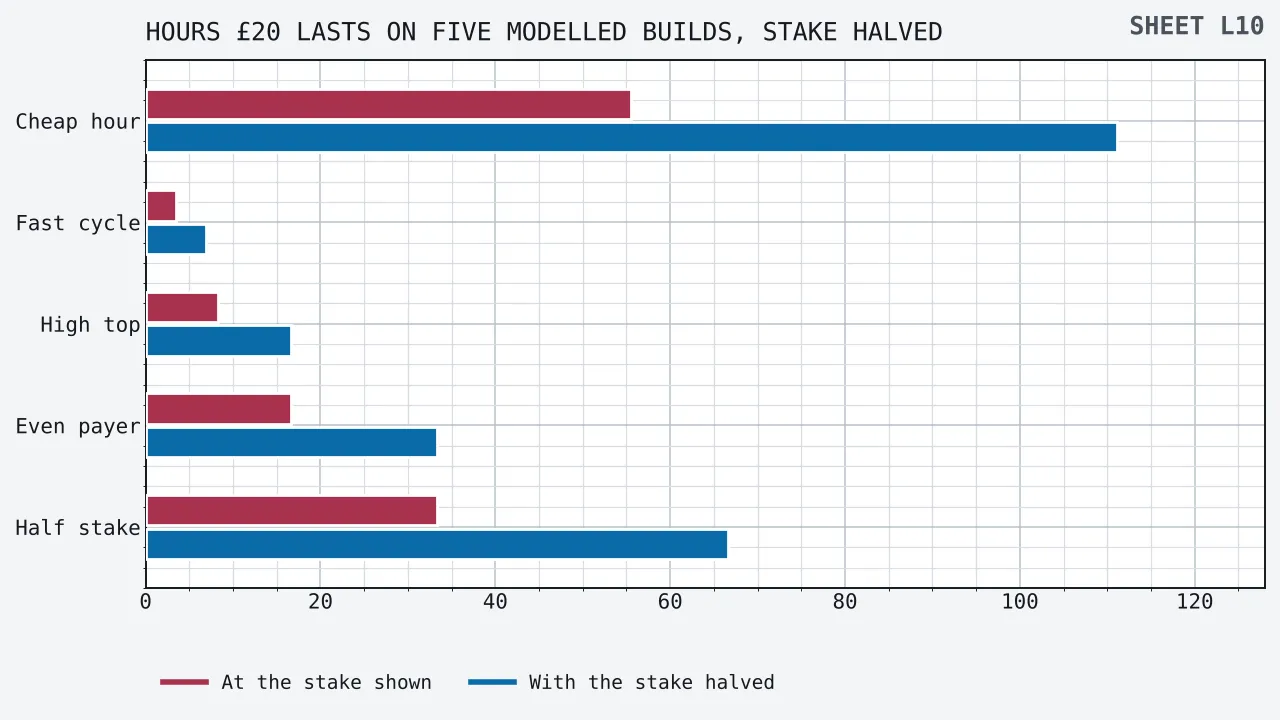
Doubling runs right across the plate and that is the finding it exists for. Every one of the five builds gains exactly as much from a halved stake, so the ordering between them never changes while all five durations double. Of every lever examined in this note, the stake alone lifts a build while taking nothing away from another criterion.
6
Each winner set against the criteria it loses
Collecting the five criteria into one grid makes the shape of the problem visible in a way the separate parts cannot. Down the side goes the question a reader is asking. Across the top goes what the winner of that question costs on each of the others. Nothing in the grid is a recommendation; every cell is a division already done above.
Reading along a row gives the price of an answer. Reading down a column shows which question a build is quietly being optimised against. A build chosen because somebody liked the phrase plenty happening has been chosen on the second row, and the second row costs sixteen times the first on the price of an hour.
| What the reader means by best | Cost of an hour | Results in an hour | Results per pound given up | Hours £20.00 survives | Top end at 10p |
|---|---|---|---|---|---|
| The cheapest hour | £0.36, best | 120, worst | 333, second | 55 h 33 min, best | Modest |
| The most crowded hour | £5.76, worst | 1,440, best | 250, middle | 3 h 28 min, worst | Modest |
| The highest top end | £2.40, fourth | 300, middle | 125, worst | 8 h 20 min, fourth | £1,000.00, best |
| Most presses from a balance | £0.60, second | 300, middle | 500, best | 33 h 20 min, second | Halved by the stake |
| No preference, the house model | £1.20, third | 300, middle | 250, middle | 16 h 40 min, third | Modest |
Best and worst appear in the same row twice over, and that is the grid’s whole message. The first row leads on two columns and trails on one. The second row leads on one and trails on two. No row leads on more than two of the five, and no arrangement of returns, cycle lengths and stakes would produce one that did.
Row three deserves its own sentence because it trails on three columns at once. Buying a top end of £1,000.00 costs the worst figure for results per pound, the fourth of five on the price of an hour and the fourth of five on how long a balance survives. Whether that is a bad bargain depends entirely on how much the possibility is worth to the reader, and this page has no view on that.
Nought cells in the grid describe quality. Every cell is a quantity that follows from three assumptions, and a reader who disagrees with the assumptions should change them and redo the divisions. What the grid establishes is structural rather than particular: these five criteria cannot be jointly maximised, so a list that claims to be best without saying best at what has not answered the question.
7
The lever nobody ever calls best
One choice improves four of the five criteria at once and worsens none of them, and it is never what anybody means by best because it is not a property of a build at all. Halving the stake halves the cost of an hour, doubles the results for each pound given up, doubles the presses a balance buys and doubles the hours it survives. Results inside an hour do not move.
Nought is what it costs, in the sense that no other criterion gives anything up. That is unique on this page. Every build-level choice examined above buys one column by selling another; the stake buys four columns and sells nothing, and the only thing it changes is how much each result is worth to the reader.
| Stake on one press | Cost of an hour | Results in an hour | Results per pound given up | Hours £20.00 survives |
|---|---|---|---|---|
| 20p | £2.40 an hour | 300 results | 125 results | 8 h 20 min |
| 10p | £1.20 an hour | 300 results | 250 results | 16 h 40 min |
| 5p | £0.60 an hour | 300 results | 500 results | 33 h 20 min |
| 2p | £0.24 an hour | 300 results | 1,250 results | 83 h 20 min |
Eighty-three hours twenty minutes in the bottom right is longer than anything any build on this page achieved, and it was produced by a tuppenny press on the ordinary house model rather than by any clever selection. Ten to one separates the first row from the last on three of the four columns, all of it from a control sitting beside the spin button.
One thousand two hundred and fifty results for each pound given up is the other extreme in that table, and it is five times the house model’s figure. A reader who genuinely wants the most play for the least money has their answer, and the answer has nothing to do with which build is opened.
Three criteria out of the five are therefore settled before any build is chosen, which reframes the whole question. Choose the stake and most of the cost per hour, the value per pound and the survival of a balance are already decided. What remains for a build to settle is how crowded the hour is and how high the top end goes, and those two are the pair that fight each other hardest.
8
What protects a balance, and what stops protecting it
Four protections attach to a balance under a British licence, and an arrangement with no Great Britain licence behind it carries not one of them. Every criterion above is about how long money lasts or what it buys, so protections concerning the money itself rather than the reels are the ones this page owes a reader.
Drawing on a deposit balance is the first. Under a British licence a term is not allowed to put a ceiling over what somebody withdraws from a deposit balance of their own, however the ceiling is dressed up, and the regulator offers one pairing as its illustration: fifty pounds in a day alongside five hundred in a week. Winnings left standing there belong to the balance, and any limit still standing, whether it bites on how much leaves at once or on how often, must answer for itself as reasonable.
Forty-eight hours is what a fifty-pound daily ceiling would mean for somebody holding £100.00, and this note can price the wait rather than merely object to it. Money queued behind a ceiling is money still inside an account, and an account is where it can be pressed away at £1.20 an hour on the house model. Two days of queuing is 2.7 sittings of the assumed length spent available rather than banked.
What an insolvency would do to the balance is the second. A licensee holding customer money has to say in its terms whether that money survives the business failing, how far the protection reaches and by what method, slotting itself into a rating the regulator defines rather than into wording of its own invention. The customer gets it in writing and has to acknowledge it before any of that money may be gambled.
Four ratings exist, the regulator fixes how each one is worded, and the table below gives them in that wording. What has not been fixed is the explanation a business writes beside its rating, so the name is the comparable part and the paragraph alongside it is the business speaking for itself.
| The rating a business must adopt | What the name by itself settles |
|---|---|
| Not protected – No segregation | The money is not protected, and is not held apart either |
| Not protected – Segregation of customer funds | Held apart, and the rating still reads as unprotected |
| Medium protection | Protected to a level below the top of the scale |
| High protection | The uppermost of the four levels defined |
Ten seconds is about what reading a rating costs. Twenty pounds surviving 33 h 20 min of pressing on the half-stake build can cease to exist in an afternoon for reasons no criterion in part six measures, and the rating is the only published statement bearing on how likely that is.
Hearing about it again later is the third, and that part of the rule took effect on 31 October 2025. Where the rating is one of the two beginning with the words not protected, the business has to put the position in front of the customer twice yearly, say what is being held, and collect a fresh acknowledgement before the money goes back into play. Two notices a year, against the seven hundred and thirty sittings this site models in a year, is one notice per 365 sittings.
A ceiling the reader sets is the fourth. Limit facilities have to be easy to get at from the moment an account exists, a prompt has to arrive either as the account is being opened or as the first money goes in, and declining has to be a deliberate act because the default runs the other way. Among the periods on offer there must be one of a day, one of seven days and one of a month, and the tighter of two overlapping limits is the one that governs.
| What is being protected | Inside the British licence | On the offshore document this note reads | What it is worth in this note’s units |
|---|---|---|---|
| Drawing on a deposit balance | A ceiling written into the terms is not allowed | Nothing of the sort is written down | £1.20 an hour while it queues |
| What an insolvency would do | A defined rating, disclosed and acknowledged | No rating scheme appears | The whole balance |
| Hearing about it again later | Twice yearly in writing, since 31 October 2025 | Unaddressed throughout | Two notices per 730 sittings |
| A ceiling the reader sets | Prompted, default, cut at once, lifted after a day | Lifted after a week, with no default | Caps the £321.20 year |
Row four runs against the pattern and saying so is part of being accurate rather than reassuring. Cutting a limit bites straight away on either side of the register. Lifting one waits a day under the British standard and a week under the Curaçao policy this note reads, so on that single point the offshore document asks for the longer pause.
Everywhere else the table runs the other way, and the second row is where the money itself sits. One side defines a rating and discloses it; on the other no rating scheme was found at all, so a reader has no published statement about whether a balance would survive the business failing. Thirty-three hours twenty minutes of pressing can disappear for a reason no column in part six measures.
Being an ombudsman is the one job the regulator here disowns, and a transaction is not something it will settle, so the licence buys a rule written in advance and not a remedy collected afterwards. Reach into the national self-exclusion scheme runs through the licence as well, which the scheme itself states about its own limits. This note helps nobody round that, round a bank’s gambling block, or round a bar set across a network.
9
Settling the criterion before settling anything else
Decide the question first and most of the work disappears, because four of the five answers follow from two numbers a reader already controls. The stake settles three criteria on its own. The pace settles the fourth. Only the top end genuinely requires a build to be chosen, and the top end is the criterion with the sharpest price.
Stake first, as part seven worked out. Two pence a press on the house model gives 24p an hour, 1,250 results for each pound given up and 83 h 20 min from £20.00. Twenty pence gives £2.40, 125 results and 8 h 20 min. Ten to one on three criteria, settled before anything is opened.
Pace second, because it is the only lever on crowdedness a reader holds. Pressing every thirty seconds by choice gives a hundred and twenty results an hour and costs 48p on the house model. Pressing as quickly as a licensed cycle permits gives one thousand four hundred and forty and costs £5.76. Both are available on the same build, so crowdedness is rarely a reason to prefer one build over another.
Top end third, and it is the only one left. A top end of five hundred times a ten pence press costs five points of the ordinary press, which is £1.50 an hour beyond the house model and £401.50 across a year of two short sittings a day. That is the single figure this page would put in front of a reader asking which build is best.
Nought is what any of this does to the sign of the arithmetic. Every build above keeps a positive share of everything that crosses it, every criterion is a choice between ways of paying that share, and no arrangement of stake, pace, return and top end makes an hour expected to end level. On the house model at forty-four minutes a day the series begins at £321.20 a year, and what moving the return does to that figure is worked out at online slots UK in full.
Best at what is therefore the only form of the question with an answer. A reader who can finish that sentence has a build-selection problem with one unknown left in it. A reader who cannot is choosing between 36p an hour and £5.76 an hour without knowing which of those two they wanted, and the gap between them is sixteen to one.
£401.50 a year for a top end most readers never meet
Questions
- Why can one build not be best at everything?
- Because the criteria are built out of the same three quantities pulling opposite ways. A cheap hour needs few presses or small ones, which is exactly what a crowded hour cannot have. A high top end has to be funded out of the ordinary press, which is exactly what a long-lasting balance depends on. Across the five modelled builds on this page no row leads on more than two of the five columns, and no arrangement of returns, cycle lengths and stakes would produce one that did.
- What is the cheapest hour that can be modelled here?
- Thirty-six pence, at ninety-seven per cent and an assumed thirty seconds a press. A hundred and twenty presses fill that hour, ten pence apiece sends £12.00 across the reels, and three pence in the pound of £12.00 is 36p. Twenty pounds survives 55 h 33 min 20 s on that build, which is a hundred and fifty-two sittings of the twenty-two minutes assumed here. The slowness is doing most of the work: the same return pressed every twelve seconds costs 90p an hour.
- Are results in an hour and results per pound the same thing?
- No, and treating them as one is the commonest confusion about eventfulness. Results in an hour are decided by the cycle length alone. Results for each pound given up are decided by the stake and the return alone, because the press count cancels out of the division: it is one over the stake multiplied by the shortfall. A build pressed every two and a half seconds and the same build pressed every thirty seconds deliver identical results per pound and differ by twelve to one in results per hour.
- What does a big top end cost on the ordinary press?
- Whatever share of the return it carries. A payment of ten thousand times the stake arriving once in two hundred and fifty thousand presses contributes four percentage points, so a build advertising ninety-six per cent with that event inside it runs at ninety-two on everything else. At ten pence the payment is £1,000.00 and the chance of meeting it inside a year of 80,300 presses is 27.5 per cent. Seven readers in ten therefore press for a year at ninety-two per cent on a ninety-six per cent build.
- Is a modest top end any cheaper?
- Not necessarily. A top end of five hundred times a ten pence stake pays £50.00 and, arriving once in ten thousand presses, still carries five percentage points of the return. That leaves the ordinary press at ninety-one per cent, costing £2.70 an hour instead of £1.20, which is £1.50 an hour of extra cost and £401.50 across a year of two short sittings a day. The size of the payment matters far less than how much of the return has been diverted into it.
- Which build makes a balance last longest?
- That depends on whether lasting is counted in hours or in presses, and the two answers are different builds. Twenty pounds survives 55 h 33 min 20 s on a ninety-seven per cent build pressed every thirty seconds and 33 h 20 min on a ninety-six per cent build pressed every twelve at five pence. Counted in presses the order reverses: 6,667 against 10,000. Pace moves the clock reading and leaves the press reading alone.
- What does halving the stake actually do?
- It halves the cost of an hour, doubles the results for each pound given up, doubles the presses a balance buys and doubles the hours it survives, while leaving the results inside an hour exactly where they were. Nothing else on this page improves four criteria and worsens none. Two pence a press on the house model gives 24p an hour, 1,250 results per pound and 83 h 20 min from £20.00, against £2.40, 125 results and 8 h 20 min at twenty pence.
- What does a British licence guarantee about getting money out?
- That a term is not allowed to put a ceiling over what somebody withdraws from a deposit balance of their own, however the ceiling is dressed up. The regulator offers one pairing as its illustration: fifty pounds in a day alongside five hundred in a week. Winnings left standing there belong to the balance, and any limit still standing, whether it bites on how much leaves at once or on how often, must answer for itself as reasonable. On £100.00 a daily fifty would mean forty-eight hours of queuing, which is two days during which the money stays somewhere it can be pressed away at £1.20 an hour.
- What happens to a balance if the business fails?
- Inside the British licence the customer was told beforehand. A licensee holding customer money has to say in its terms whether that money survives the business failing, how far the protection reaches and by what method, slotting itself into a rating the regulator defines rather than wording of its own. It arrives in writing and has to be acknowledged before any of the money may be gambled. Four ratings exist and the regulator fixes how each is worded. The first reads Not protected – No segregation. The second reads Not protected – Segregation of customer funds. Medium protection is the third and High protection the fourth. From 31 October 2025, a business on either of the two beginning not protected has to put the position in front of the customer twice yearly, say what is being held, and collect a fresh acknowledgement.
- Is the offshore position worse on every one of these?
- No, and pretending otherwise would be inaccurate. Deposit limits run the other way in one respect: lifting a limit waits a week under the Curaçao policy this note reads against a day under the British standard, while cutting one bites straight away on either side. Everywhere else the British position is the stronger. A bar on putting any ceiling over a deposit balance, a defined insolvency rating disclosed and acknowledged, and the twice-yearly notice that follows a not protected rating all sit on one side of the register, and nothing matching them was found on the other.