Note B13 Revision 1 Terms read 17 October 2026
Slots not on Gamstop, measured against the clock a registration sets
One hundred and eighty-two days is the shortest registration the national scheme offers, and at two handset sittings a day that covers 133 h 28 min of pressing, 40,040 presses of 10p and £160.16 of expected margin on the pace this site assumes. Every other clock on this site runs for minutes or hours. This one runs for months, on purpose, and this note explains what it is for rather than how to shorten it.
What lands 182 days The run 133 h 28 min refused The wait to be paid No clock at all
What offers of this size ask in hours
Advertising has been bought for every destination below. A fee reaches this site when a reader goes on to register, and no figure on this page moves one way or the other because of it.
-
01Mobile Free Spins
Betportal
Ceiling as a multiple
What lands€15.00150 spins at 10c, which is this site's figure and not the operator'sThe run17 h 30 minTurning over 525.00 at 10p means 5,250 presses, or about 48 phone sittings of 22 minutes. Timed at 10p a press and 12 seconds between presses, both of which this site assumes rather than measures.The wait to be paidNOT PUBLISHEDThis operator puts no withdrawal band in its own terms, so there is nothing honest to print here.Spins valued at this site's own 10p a spin
What lands
Spins, at a price15.00150 of them at 10c apiece, a figure belonging to this site rather than to the operatorMatch, and other creditno figure300% of three deposits, to a ceiling of €1,000. Not a sum until money of yours makes it one, so this row totals nothing and carries nothing downwardsThe run
Handed back on the spins(0.60)Each press stakes its own value and returns 96 per cent, which leaves this much with the house from the opening pressPlay-through 35x on the bonus(20.16)Taking 14.40 round 35 times over means 504.00 through the machines, of which 20.16 is the expected cost, and 17 h 30 min of pressing at the pace aboveWhat counts towards it100%Slots only, with no percentage published anywhere, so the row above assumes the whole of each stake countsWhat never clears
Limit on the winningsstated5x the bonusDeducted on the way outno figureNothing is published as a figure here, so this row removes nothingLeast that can leaveno figureNo figure is published, so nothing on this timer is pinned down by oneLeast deposit, and the rung over ityour own€20 a stage. Published in euros, so no rung is named at all: this site's ladder is a sterling oneThe window on the creditstated14 daysBiggest stake while it runsstated€5Removed outright by rulestatedNot publishedVerified before a payoutstatedDocuments before the first withdrawalNever clears€15.00Not a penny of it gets out, so the whole of what landed stands on this rowNo Great Britain licence
Licence held in Anjouan, Comoros, the company named is BetPortal Gaming Ltd, with Excite Ultra Media Ltd, quoted under ALSI-202601040-FI2.
Terms read 17 October 2026
Open the offer at Betportal, opens in a new window -
02Mobile Free Spins
WinBeast
Ceiling as a sum
What lands€50.00500 spins at 10c, which is this site's figure and not the operator'sThe run2 d 18 hTurning over 2,000.00 at 10p means 20,000 presses, or about 182 phone sittings of 22 minutes. Timed at 10p a press and 12 seconds between presses, both of which this site assumes rather than measures.The wait to be paidNOT PUBLISHEDThis operator puts no withdrawal band in its own terms, so there is nothing honest to print here.Spins valued at this site's own 10p a spin
What lands
Spins, at a price50.00500 of them at 10c apiece, a figure belonging to this site rather than to the operatorMatch, and other creditno figure50% to 100% of five deposits, each to a ceiling of €1,000, and a €650 free bet. Not a sum until money of yours makes it one, so this row totals nothing and carries nothing downwardsThe run
Handed back on the spins(2.00)Each press stakes its own value and returns 96 per cent, which leaves this much with the house from the opening pressPlay-through 40x on the bonus and the winnings from the spins(76.80)Taking 48.00 round 40 times over means 1,920.00 through the machines, of which 76.80 is the expected cost, and 2 d 18 h of pressing at the pace aboveWhat counts towards it100%Slots, titles vary by country, with no percentage published anywhere, so the row above assumes the whole of each stake countsWhat never clears
Limit on the winningsstated€100 a batch of spinsDeducted on the way outno figureNothing is published as a figure here, so this row removes nothingLeast that can leaveno figureNo figure is published, so nothing on this timer is pinned down by oneLeast deposit, and the rung over ityour own€20 a stage. Published in euros, so no rung is named at all: this site's ladder is a sterling oneThe window on the creditstated7 days, spins 1 dayBiggest stake while it runsstatedNot publishedRemoved outright by rulestatedNot publishedVerified before a payoutstatedDocuments before the first withdrawalNever clears€50.00Not a penny of it gets out, so the whole of what landed stands on this rowNo Great Britain licence
Licence held in Curaçao, no company named anywhere on the site.
Terms read 17 October 2026
Open the offer at WinBeast, opens in a new window -
03Mobile Free Spins
EliteSpin
Longest spin window
What lands£50.00500 spins at 10p, which is this site's figure and not the operator'sThe run2 d 18 hTurning over 2,000.00 at 10p means 20,000 presses, or about 182 phone sittings of 22 minutes. Timed at 10p a press and 12 seconds between presses, both of which this site assumes rather than measures.The wait to be paidNOT PUBLISHEDThis operator puts no withdrawal band in its own terms, so there is nothing honest to print here.Spins valued at this site's own 10p a spin
What lands
Spins, at a price50.00500 of them at 10p apiece, a figure belonging to this site rather than to the operatorMatch, and other creditno figure50% to 100% of five deposits, each to a ceiling of £1,000. Not a sum until money of yours makes it one, so this row totals nothing and carries nothing downwardsThe run
Handed back on the spins(2.00)Each press stakes its own value and returns 96 per cent, which leaves this much with the house from the opening pressPlay-through 40x on the bonus and the winnings from the spins(76.80)Taking 48.00 round 40 times over means 1,920.00 through the machines, of which 76.80 is the expected cost, and 2 d 18 h of pressing at the pace aboveWhat counts towards it100%Slots, with no percentage published anywhere, so the row above assumes the whole of each stake countsWhat never clears
Limit on the winningsstated5x the bonusDeducted on the way outno figureNothing is published as a figure here, so this row removes nothingLeast that can leaveno figureNo figure is published, so nothing on this timer is pinned down by oneLeast deposit, and the rung over ityour own£20 a stage. It lands square on the £20.00 rung, so none of yours is left perched on topThe window on the creditstated7 days, spins 3 daysBiggest stake while it runsstatedNot publishedRemoved outright by rulestatedNot publishedVerified before a payoutstatedDocuments before the first withdrawalNever clears£50.00Not a penny of it gets out, so the whole of what landed stands on this rowNo Great Britain licence
Licence held in Costa Rica, the company named is PrimeTier Limited.
Terms read 17 October 2026
Open the offer at EliteSpin, opens in a new window -
04Mobile Free Spins
Crown Jewelz
Multiple unpublished
What lands£15.00150 spins at 10p, which is this site's figure and not the operator'sThe runNOT TIMEDThis operator does not publish the play-through multiple in its own terms. The multiple is the one figure the clock cannot work around, so the run is left untimed.The wait to be paidNOT PUBLISHEDThis operator puts no withdrawal band in its own terms, so there is nothing honest to print here.Nothing reckoned
What lands
Spins, at a price15.00150 of them at 10p apiece, a figure belonging to this site rather than to the operatorMatch, and other creditno figure200% of the first deposit, then 150% twice, each to a ceiling of £1,000. Not a sum until money of yours makes it one, so this row totals nothing and carries nothing downwardsThe run
Play-throughno figure40x the bonus, reported rather than published by the operatorWhat counts towards itno figureSlots, with no percentage published anywhere, so the row above assumes the whole of each stake countsWhat never clears
Limit on the winningsstatedNot publishedDeducted on the way outno figureNothing is published as a figure here, so this row removes nothingLeast that can leaveno figureNo figure is published, so nothing on this timer is pinned down by oneLeast deposit, and the rung over ityour own£20. It lands square on the £20.00 rung, so none of yours is left perched on topThe window on the creditstatedNot publishedBiggest stake while it runsstatedNot publishedRemoved outright by rulestatedNot publishedVerified before a payoutstatedDocuments before the first withdrawalNever clearsNOT RECKONEDThis operator leaves the play-through multiple out of its own terms, so nothing below the fourth step can be worked out.No Great Britain licence
Licence held in Curaçao, number not verified, no company named anywhere on the site.
Terms read 17 October 2026
Open the offer at Crown Jewelz, opens in a new window
Only the middle reading comes out of arithmetic belonging to this site. The multiple laid against what lands gives the turnover asked for; dividing that by 10p a spin gives the presses; dividing those by 300 an hour gives the hours, a press on a handset being taken here at 12 seconds from the one before. Both figures are assumptions rather than measurements of anybody: nothing was played and nothing was held a stopwatch to. Anybody quicker should divide the press count by a rate of their own, which is why the presses are printed alongside the hours instead of being summarised away.
The first reading is what arrives before any condition is laid against it. Spins carry no unit of their own so one gets supplied: where an operator values its own spin that figure is used and attributed, and where it does not, this site's 10p a spin stands in and everything below moves with it. The third reading belongs to the operator entirely. It is a withdrawal band quoted from published terms, and a blank there means none was published rather than that nobody looked.
The total along the foot answers what the hours leave open, which is whether any of the running ends anywhere. It is what arrived, less whatever is still standing once the play-through has been paid for at 96 per cent return to player and once a published limit, a published deduction and a published floor beneath the least that can leave have each had a turn. It appears again in pence in the pound, the only fair way of holding a small offer up against a large one. It describes an offer rather than an evening, and where the conditions price out what arrived, a timer prints nothing getting out instead of a negative sum.
Cashiers on a handset take deposits off a row of preset buttons, so a least deposit given in pounds is raised to the next rung of the ladder used here, £10, £20, £25, £50, £75 and £100, and the timer shows what is left perched on it. That money is the reader's own and enters no sum at all. Given in euros it prints untouched, the ladder being sterling. Three words may occupy the figure column where no figure belongs. Stated is a published term that costs something while leaving no number to subtract. No figure is a term nobody has quantified, or a credit that is not a sum until money of yours makes it one. Your own is money of yours, which belongs in none of this.
None of the operators above is licensed in Great Britain, so not one duty that licence carries reaches any of them. Membership of Gamstop Online is compulsory for every online gambling company licensed in Great Britain, which means that shutting yourself out through the scheme shuts you out of none of these. The limit of ten times the bonus funds on a wagering requirement, running since 19 January 2026 under Social Responsibility Code 5.1.1, is a condition of the same licence and binds only whoever holds one. Off that licence, the Gambling Commission writes of consumers meeting unfair gaming practices, financial loss and no recourse when matters go wrong, and lists blocked payouts and withdrawal limits pitched too high to reach among the things it has seen. No account at any of them may be held by anybody under 18.
Every term on a timer is its operator's own and every timer carries the day somebody read it. The oldest of those readings is 17 October 2026. What binds a reader is an operator's full terms and never a line printed here.
1
A decision taken once, and the days it is built to outlast
Four lengths appear at registration and the longest of them renews itself. Five years with automatic renewal heads the list; plain five years, a single year and half a year make up the rest. Switching that renewal off is possible only once a five-year run has entered its closing half-year. Those options come from the scheme’s published terms, last revised on 20 May 2026.
One hundred and eighty-two days is roughly what the shortest of them comes to, and every other clock described on this site is shorter by orders of magnitude. A pile of spins lasts minutes. A play-through lasts hours. An expiry window lasts days and a payment lasts a working week. A registration is the one clock in the whole subject designed to outlast the state of mind that started it.
Nought is what a registered person can do to end one early, and the scheme’s terms put that in capital letters rather than in a footnote. Deactivation before the minimum period has run is not available. Nor does the clock simply stop at the end: the scheme does not lift an exclusion automatically, and a person who takes no action keeps it for up to a further seven years.
Twenty-four hours is the shortest delay on the way back out, and the shape of that delay is the shape of the whole mechanism. Deactivating starts by contacting the scheme’s contact centre, and a wait of a day at minimum then passes with the exclusion fully in force. Gambling businesses go on being told, across the seven years following a deactivation, that the person was registered before, though nothing obliges them to keep that person out over those years.
Three further lengths are available instead of deactivating, being six months, one year or five years added on, and extension is the ordinary thing to do with a clock like this one. Nothing on this note is advice about which length to pick. The point is only that the mechanism was built so that one decision, taken at a moment of clarity, governs a long run of moments that may be less clear.
Two schemes exist and they do not cover one another. The national online scheme blocks accounts with online gambling businesses. A separate service under the same group handles betting shops, having started life in 2016 as a multi-operator scheme for premises and joined the group in July 2023. Registering with one of them does nothing whatever about the other, and this note says so because the opposite impression is an easy one to pick up.
2
What sits outside the scheme, and what this note will not do
One rule fixes the scheme’s coverage, and reading it the right way round explains the whole category. Every online gambling company holding a licence in Great Britain has to take part. Coverage is therefore drawn by the licence and not by any choice a business makes, which means a business outside the scheme is a business outside the British register.
Two sentences in the scheme’s own terms state the consequence plainly, and they are the most useful lines on this page. Exclusion extends only to gambling services run by operators who take part. Services run by anyone standing outside it are beyond what it can keep a person from reaching. Set down as the outer edge of what a registration does for somebody, that is also exactly what the search phrase at the head of this note points at.
Nothing on this page helps anybody reach such a business, and that refusal is deliberate and absolute. No site is named, no link is given and no route is described. Payments, documents, devices and networks are absent from this note by design, and a reader who came looking for that material should read the silence as a decision rather than an oversight. A block placed on gambling by a bank, or by whoever runs a network, belongs in the same category and gets the same treatment.
One instruction is worth giving directly, and it is the only instruction on this page. A person who has registered and now finds themselves searching for slots not on Gamstop is experiencing exactly the pressure the registration was set up to absorb. The useful move at that moment is not a different website. It is the telephone number in section eight, which never closes, and the arithmetic in sections three to six is there to show what the registration is holding back.
Over six hundred thousand people stood on the register when the scheme last put out figures, on 16 July 2026, with 614,738 as the exact count, and better than half of them had taken the five-year setting. Nobody picks five years lightly. A page about this category that treated the clock as an obstacle rather than as a decision would be writing against every one of those choices.
3
The thumb work a registration declines, counted out
Two sittings a day is the measure used through this section, being 44 minutes of pressing daily, and it is an assumption of this note rather than a finding about anybody. At the twelve seconds a press this site models, 44 minutes holds 220 presses of 10p, which stake £22.00 and give up 88p to a four per cent margin. Multiply by the days and the registration becomes a quantity.
| Period chosen | Days it runs | Pressing it declines | Presses of 10p | Staking not sent over | Margin not paid |
|---|---|---|---|---|---|
| Six months | 182 | 133 h 28 min | 40,040 | £4,004.00 | £160.16 |
| One year | 365 | 267 h 40 min | 80,300 | £8,030.00 | £321.20 |
| Five years | 1,826 | 1,339 h 4 min | 401,720 | £40,172.00 | £1,606.88 |
One hundred and sixty pounds sixteen is the six-month figure, and it is the honest size of what a short registration saves on these assumptions rather than a dramatic one. Four thousand and four pounds crosses the reels over that period at two sittings a day, and the margin keeps four pence in every pound of it. A reader whose own rhythm is one sitting a day should halve the whole row, and one who manages four should double it.
One thousand six hundred and six pounds eighty-eight is the five-year figure, which is the one worth sitting with. It is not a jackpot foregone and it is not a tragedy averted. It is the arithmetical mean of what the house keeps from somebody pressing for 44 minutes a day across 1,826 days, and the single most striking thing about it is that 1,339 hours of a life sit behind it.
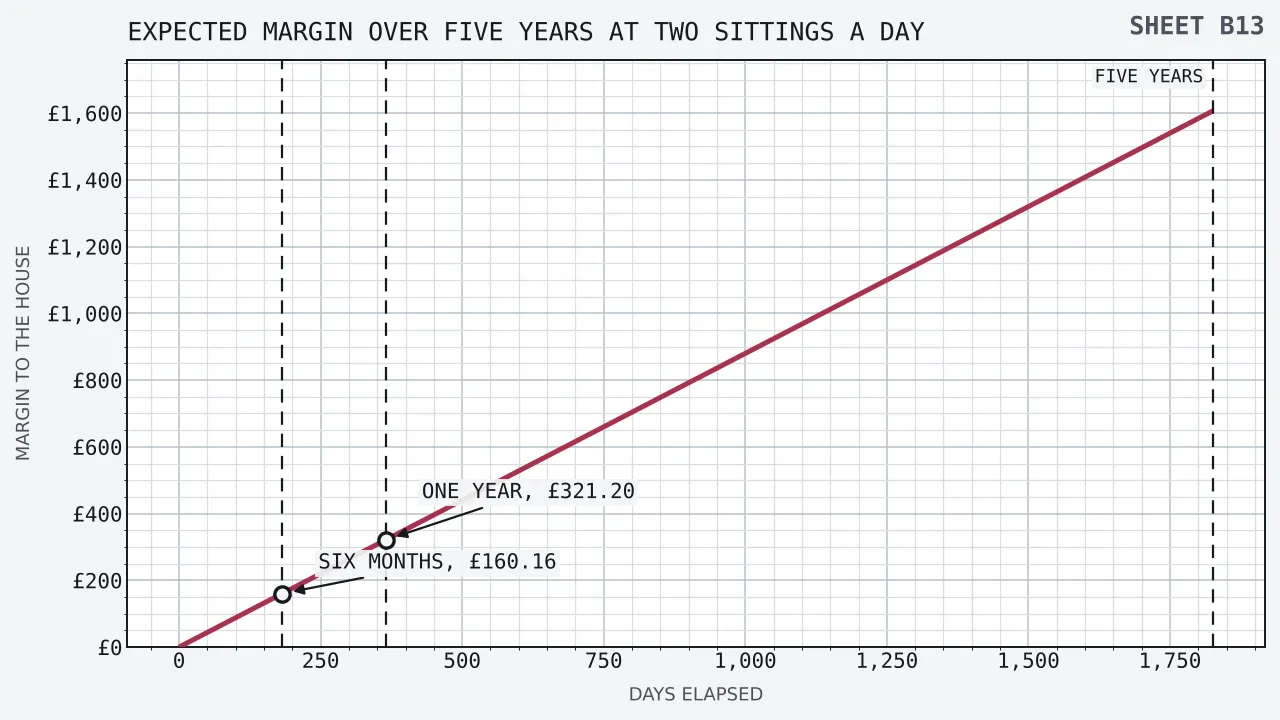
Eighty-eight pence a day is the slope of that line, and the slope is the reason a short period can look pointless while a long one does not. Nothing in the first week of a registration is worth much in money, at £6.16. Six months in, the line has reached £160.16. Five years in, it has reached £1,606.88 and the person reading it has also not spent 1,339 hours of evenings in a lobby.
Twenty-seven hours and forty-eight minutes is what those same 40,040 presses would take at the fastest rate a British slot build may run, since a fresh game cycle cannot begin until two and a half seconds after the one before it. So even a machine pressing without pause needs more than a day to work through what six months at two sittings covers, and a person at the modelled interval needs 133 h 28 min.
40,040 presses declined by the shortest period on offer
4
Twenty-four hours against one thousand eight hundred and twenty-six days
Twenty-four hours is the longest interval a British licensee may leave between checks of its whole customer list against the scheme, a duty running since April 2020. A month before that, in March 2020, taking part turned into a condition of the licence, laid over any scheme an operator already ran for itself. June 2017 is when the thing began, built by the trade association for remote gambling at the request of the government department responsible and of the regulator.
One thousand eight hundred and twenty-six times is therefore how often a five-year registration is re-asserted across the licensed side, once for each day it runs, and 182 times across the shortest period. A reader does nothing to cause any of those checks. The clock is kept by somebody else, which is precisely the property that makes it useful to a person who would rather not be making the decision daily.
| What happens | Where a licence is held | Where none is held |
|---|---|---|
| Taking part in the scheme | A condition of holding the licence from March 2020 | No obligation of any kind |
| Checking the customer list | The whole list, at least daily from April 2020 | Never, at no interval |
| Honouring a registration made elsewhere | Automatic, because the register is shared | Nothing is shared to honour |
| Identity settled before play | Checked before play: full name, home address, birth date, with bonus play and no-prize builds caught by the rule | Set by the operator’s own policy |
One registration against none is the whole of that table, and the second column is what the phrase at the head of this page describes. The third row is the one readers most often misunderstand. A business outside the scheme is not refusing to honour a registration; there is no registration reaching it to refuse, because the shared register follows the licence.
Identity deserves a sentence of its own, because the timing of it is the difference that bites. Full name, home address and birth date all get established and checked before any gambling at all happens where a British licence applies, and the rule takes in staking bonus funds, staking a free bet, and builds that pay out nothing. Catching a registration happens at that check. Push the check later and the catch travels with it.
5
Forty times with nothing at all standing over it
Two thousand pounds is what a forty times condition asks of a £50 balance, and counting it out in ten-pence presses gives 20,000 of them. At the modelled interval those presses occupy 4,000 minutes, which is 66 h 40 min, which divides into 182 handset sittings of twenty-two minutes once the fraction rounds up. One sitting for each day of the shortest registration the scheme offers is the coincidence worth noticing.
Twelve hundred and fifty pounds is the turnover at which a £50 balance would be spent to the penny, that being 12,500 presses and 41 h 40 min on the modelled interval. Four pence departing with the house on each pound is the whole of the reason: twenty-five pounds crossing the reels uses up one pound of balance, so twenty-five times uses up all of it. Forty times carries a reader a further 25 hours past that arrival.
Thirty pounds is the expected position at the end of those 182 sittings, carrying a minus in front of it, since forty multiples of a four-pence margin take 160 per cent of a balance. Those last 25 hours are therefore owed against a wallet the margin is expected to have emptied at press 12,500.
182 sittings asked by one condition, 182 days held by the shortest registration
Ten times is the ceiling a wagering condition may not pass over bonus funds where a British licence applies, in force since 19 January 2026, and ten applied to £50 asks £500.00 over the reels. Five thousand presses and 16 h 40 min is what that comes to, against 66 h 40 min at forty times. Fifty hours of a reader’s evenings is the difference one number in one document makes, and off the register no number caps it at all.
Sixty times is a figure the regulator itself put on record when it explained what the ceiling was fixing, noting that some licensees were then applying wagering requirements that high. Sixty applied to £50 is £3,000.00, 30,000 presses and 100 hours, with an expected position of minus £70.00. No published source sets out how multiples are distributed across the offshore market, and this note will not invent one. What can be said is structural: the ceiling exists here, and the Curaçao policy examined for this network contains no ceiling of any size.
6
Protections that are also clocks, priced in presses
Three duties on the licensed side run on timers of their own, and converting each one into presses shows what a registered person is being kept away from in the unit this site uses. A deposit limit is a clock. An affordability threshold is a monthly clock. A complaint window is a clock that starts when something goes wrong.
| The duty | The clock in it | What it comes to at 10p | Sittings of 22 minutes |
|---|---|---|---|
| Deposit limit, daily | A day, a week, a month: all three have to appear among the durations offered | £10 a day is 100 presses, 20 min | 1 |
| Deposit limit, weekly | The tightest limit set always governs | £70 a week is 700 presses, 2 h 20 min | 7 |
| Lighter financial check | Net deposits over a monthly threshold | £150 a month is 1,500 presses, 5 h | 14 |
| Complaint window | Six months from the incident, eight weeks to finish | Not a quantity of pressing | nil |
Seventy pounds a week is the regulator’s own worked example rather than a figure invented here, and the arithmetic in it repays attention. A £10 ceiling for the day running alongside a £100 ceiling for the week yields £70 as the week’s effective figure, since whichever of two overlapping limits binds tightest has to govern. Seven hundred presses a week is that in this site’s unit, which is 2 h 20 min, which is seven sittings across seven days.
Twenty-four hours is the shortest wait before a limit may be lifted, and the asymmetry in that rule is the clock doing its work. Raising one takes a request, then a wait of a day at the very least with nothing happening, then a second positive act to confirm it. Lowering one takes effect immediately unless something technical gets in the way. No obligation of that shape reaches a business off the register, where a limit, if any exists, is a setting rather than a duty.
One hundred and fifty pounds a month has been the trigger for a lighter financial check since 28 February 2025, the figure having begun at £500 a month, which applied from 30 August 2024. Fifteen hundred presses a month is the lower trigger in this site’s unit, which is five hours of modelled pressing, or fourteen sittings. Heavier risk assessments are a separate exercise, still at pilot stage, not running against consumers, and neither exercise reaches anybody’s credit rating.
Six months after whatever went wrong, a complaint is still admissible at a licensed operator, and a free approved adjudicator waits behind the operator’s own procedure. An offshore desk carries neither obligation.
Eight weeks is as long as the operator’s own stage of that process may run, counted from receipt, and an acknowledgement is owed inside three working days, shrinking to a single day where gambling runs at all hours. Pausing is permitted where a week passes with no answer to a reasonable request for information, and the count picks up again from wherever it halted. Somebody dealing with a business that stands outside the register has none of those windows available, because none of them exists there.
7
Where the scheme’s own reach stops, and who has registered
Six figures describe the register’s size, and the scheme put them out on 16 July 2026: 614,738 people were on it, the opening half of that year having brought registrations in at a rate 16 per cent up on the comparable period, and 12,236 sign-ups during May 2026 made that month the busiest the scheme has recorded. Those are its own published numbers, and they describe a mechanism in heavy use rather than a formality.
Half the register and more had taken the full five years, while a quarter across all ages went for the six-month setting, a proportion climbing to 38 per cent where the person is under twenty-five. Year on year, sign-ups from that youngest group were up by 26 per cent, and it now stands behind something close to a third of the register’s exclusions. Seven in ten new registrations and more came from men.
Thirty-eight per cent choosing the shortest period among the youngest group is the figure worth dwelling on for a page like this one. A six-month clock is the one most likely to be tested, because it is short enough to feel temporary while it is running. On the arithmetic in section three it is also the period that covers 40,040 presses and £160.16 of expected margin, which is not nothing and is nowhere near the five-year figure.
Two limits on the scheme are worth stating together, because readers routinely conflate them. It covers online gambling businesses licensed in Great Britain, and nothing outside that set. It does not reach betting premises, which are handled by the separate service mentioned in section one. Both limits are published by the scheme rather than inferred here, and both are limits on protection rather than invitations of any kind.
November 2025 is when the scheme took its present name, and a reader should expect the older styling in older documents. The scheme’s own terms of use still print the name in capitals throughout, the regulator’s notice of January 2025 does the same, and a 2021 article from a support charity does too. Those are older than the renaming. The current form is Gamstop Online, and most people searching still type the older one.
8
Four routes that go the other way, and what each asks
Zero pounds and a few minutes is what the first route costs, that route being a telephone call. The National Gambling Helpline, which GamCare operates, takes calls free of charge on 0808 8020 133, with no hour of any day in the year when it is shut, and runs live chat and a messaging route beside the telephone. Somebody worried about their own gambling, and somebody worried about a relative or a friend, are equally within its remit, and a professional can put a person forward where that person has agreed to it.
Three organisations paired under one name make the second route, which GamCare publishes as TalkBanStop. Talking is the helpline. Banning is blocking software for the devices around a household. Stopping is the national scheme itself. What GamCare states is that the software costs nothing for a person who rings the helpline, or who comes to it for support and for treatment, and that statement comes from the charity and not from whoever publishes the software.
Seven days of free trial is what the software’s own site advertises, and setting that beside the paragraph above is more honest than blending the two. Nothing free for British users is advertised on those pages at all. The charity’s account of the free route sits in an article carrying the date 12 April 2021, and no period is given in it for how long the access runs, so this note records both as published and attaches a duration to neither.
Three further lengths make up the third route, which is extending a registration instead of letting it run down: a further half-year, a further year, or a further five. Take no action when a period ends and up to seven more years of it can follow. Extending is a decision made at a moment of choice, which is the property that made the first registration worth making.
Four hundred and one thousand seven hundred and twenty presses is the fourth route, in the sense that it is the thing being declined. A reader who has read as far as this and is weighing a five-year clock against 1,339 hours of evenings and £1,606.88 of expected margin has the comparison this whole site exists to produce. The call in the first paragraph of this section takes a few minutes and is the only action on this page anybody is urged to take.
One number on this page is printed unbroken and in full on purpose, because a helpline number split across a line break has caught out other sites in this network. It is 0808 8020 133, it costs nothing to ring, and it answers at any hour of any day of the year.
9
One register against an arrangement made site by site
No Great Britain licence is held by a business of the kind this phrase describes, and the absence is definitional rather than incidental: the shared register follows the licence, so a business without one is outside the register by construction. Every other note on this site names a duty that stops at the border. The duty that matters here is the one making a single registration reach an entire licensed market at once.
One operator at a time is how self-exclusion works under the Curaçao rulebook, which is the clearest sourced contrast available. Its policy describes a player barring themselves from gambling activity with a particular operator, insists the bar take in every domain that operator runs, and handles the question of other sites by saying the player ought to be urged towards doing the same at each. A register spanning operators appears nowhere in it.
One year is the shortest long-term setting operators there have to offer, and the longer ones on the same list reach three, five and ten years and lifetime. Once a player has confirmed one, taking it back before its end is not available. Some of that runs stronger than the British arrangement, and saying so is more honest than pretending nothing is published offshore. A register is what is missing, so one exclusion reaches one business and the next begins again from nothing.
| The question | Under the British licence | Under the offshore rulebook read here |
|---|---|---|
| How many registrations are needed | One, covering the whole licensed online market | One for every business, repeated each time |
| Shortest period available | Six months | One year for a long-term exclusion |
| Longest period available | Five years, renewable automatically | Lifetime |
| Shortest gap before a slot may restart | 2.5 seconds | Nothing of the sort in the policy |
| Ceiling on a wagering condition | Ten times the bonus funds | No ceiling at any figure |
| Stake in a single game cycle | Five pounds, or two for a player under 25 | No cap in the policy |
One line in a warning notice the British regulator published on 20 January 2025 belongs on this page above every other. Unlicensed operations take aim at customers who are vulnerable, the notice says, and the illustration it offers of that category is somebody registered with the national scheme. A reader who arrived here through the phrase in the heading has been described, in print, by the body supervising the licensed market.
Two further matters that notice sets down travel with the first. Arrangements for social responsibility, and arrangements against dirty money, may both be inadequate at a site of that description. Fraud, trouble over the privacy of personal data, and dealing that is simply unfair are what a customer is then open to. Those are losses no arithmetic on this site converts into hours, which is why they are reported from the regulator rather than priced.
10
What a clock set once is actually for
One decision is the entire design, and every feature of the mechanism follows from it. The period cannot be cut short. The clock does not stop by itself at the end. A day of cooling off sits in front of deactivation. Seven years of notice follow it. Each of those is awkward by intention, because the thing being guarded against is a future decision made under pressure rather than a present one made calmly.
One hundred and thirty-three hours twenty-eight minutes is what six months covers on the assumptions in section three, and 1,339 hours is what five years covers. Those are the clocks this site normally prints for a play-through, scaled up by two orders of magnitude and running in the opposite direction. A play-through takes hours from a person. A registration gives them back.
Nought is what the arithmetic here says about whether any particular reader should have registered, should extend or should let a period run out. This note prices durations and does not give advice of that kind. What it can say is that the figures in section three are the size of the thing on the other side of the decision, and they are larger than the headline on any offer this site has ever costed.
Two minutes is what the alternative to this page costs. A reader who searched for slots not on Gamstop, read this far and rang 0808 8020 133 instead has spent less time than a single handset sitting and has not needed any of the arithmetic above. The number is free, it answers at any hour, and anybody worried about another person may ring it quite as readily as anybody worried about themselves.
Six hundred thousand registrations and more, 614,738 of them at the last count, is the figure to close on. Every one of them was a person deciding that a clock kept by somebody else was better than a decision taken fresh each evening. A page that helped undo one of those decisions would be working against the only clock on this site that is on the reader’s side.
Questions
- What does a search for slots not on Gamstop actually describe?
- A gambling business outside the national self-exclusion scheme, which in practice means a business outside the British register, since the scheme’s membership is drawn from the holders of British online gambling licences and from nobody else. Coverage follows the licence rather than any choice the business makes. No such business is named here, no link is given and no route to one is described.
- How long does a registration with the scheme run?
- Four settings: half a year at the short end, then a single year, then five years, and finally five years that renew themselves, with the renewal stoppable only once a five-year run has reached its closing half-year. Those options sit in the scheme’s published terms, last revised on 20 May 2026, and the same terms rule out ending any registration before its minimum has gone by.
- What does the shortest period hold back, in pressing?
- One hundred and thirty-three hours and twenty-eight minutes at two handset sittings a day, being 44 minutes daily across about 182 days. That comes to 40,040 presses of 10p, £4,004.00 of staking and £160.16 of margin on a return assumed at ninety-six per cent. The daily rhythm and the twelve seconds a press are assumptions declared here rather than observations of anybody.
- Why can a registration not be ended early?
- Because ending it early is the thing it exists to prevent. Deactivation before the minimum has gone by is not on offer; afterwards it means contacting the scheme’s contact centre and then sitting out a day at minimum while the exclusion stays in force; and across seven further years gambling businesses go on being told the person was registered before. One decision taken calmly is meant to govern a long run of less calm ones.
- Does the scheme reach a site that holds no British licence?
- No, and the scheme’s own terms say as much. Exclusion extends only to gambling services run by operators who take part, and services run by organisations outside it are beyond what the scheme can keep anybody from reaching. That edge is published by the scheme as the outer limit of what a registration does for anybody. This page helps nobody reach such a business.
- What does a forty times condition cost where nothing caps it?
- On a £50 balance it asks £2,000 over the reels, which is 20,000 presses of 10p, 66 h 40 min at the twelve-second interval modelled here and 182 handset sittings once the fraction rounds up. Expected position at the end is minus £30.00. Where a British licence applies the multiple may not exceed ten over bonus funds, which is 16 h 40 min instead.
- How often is a registration checked on the licensed side?
- At least once every 24 hours against the whole customer list, a duty in place since April 2020, with scheme membership itself a licence condition from March 2020. Across a five-year registration that is 1,826 separate days on which the licensed market re-asserts the decision, and across six months it is 182. A business off the register performs no such check at any interval.
- How does self-exclusion work on the offshore side?
- One business at a time. The Curaçao rulebook describes a player barring themselves from activity with a particular operator, insists the bar take in every domain that operator runs, and handles other sites by urging the player to do the same at each. A year is its shortest long-term setting, with three, five and ten years and lifetime beyond that, and no register spanning operators appears in it.
- Where should somebody go instead of looking for one of these sites?
- To the National Gambling Helpline, which GamCare runs free of charge on 0808 8020 133, with no hour of the year when it is shut, by telephone, live chat or messaging, and open to a person worried about somebody else quite as much as to a person worried about themselves. GamCare also publishes TalkBanStop, pairing the helpline with blocking software and with the national scheme, and a registration already running can be lengthened by six months, by twelve or by sixty.