Note L07 Revision 1 Terms read 17 October 2026
Online slots in the UK, and the one published figure that compounds
A hundred pounds buys 83 h 20 min of pressing where the return is ninety-six per cent, and 55 h 33 min 20 s where it is ninety-four, both worked at ten pence a press on the pace of three hundred an hour assumed throughout. Two points of return remove 27 h 46 min 40 s from the same money, and no decision about how long to sit down for puts a minute of it back.
What lands £100.00 The run 83 h 20 min The wait to be paid 48 h
What offers of this size ask in hours
Advertising has been bought for every destination below. A fee reaches this site when a reader goes on to register, and no figure on this page moves one way or the other because of it.
-
01Mobile Free Spins
Betportal
Ceiling as a multiple
What lands€15.00150 spins at 10c, which is this site's figure and not the operator'sThe run17 h 30 minTurning over 525.00 at 10p means 5,250 presses, or about 48 phone sittings of 22 minutes. Timed at 10p a press and 12 seconds between presses, both of which this site assumes rather than measures.The wait to be paidNOT PUBLISHEDThis operator puts no withdrawal band in its own terms, so there is nothing honest to print here.Spins valued at this site's own 10p a spin
What lands
Spins, at a price15.00150 of them at 10c apiece, a figure belonging to this site rather than to the operatorMatch, and other creditno figure300% of three deposits, to a ceiling of €1,000. Not a sum until money of yours makes it one, so this row totals nothing and carries nothing downwardsThe run
Handed back on the spins(0.60)Each press stakes its own value and returns 96 per cent, which leaves this much with the house from the opening pressPlay-through 35x on the bonus(20.16)Taking 14.40 round 35 times over means 504.00 through the machines, of which 20.16 is the expected cost, and 17 h 30 min of pressing at the pace aboveWhat counts towards it100%Slots only, with no percentage published anywhere, so the row above assumes the whole of each stake countsWhat never clears
Limit on the winningsstated5x the bonusDeducted on the way outno figureNothing is published as a figure here, so this row removes nothingLeast that can leaveno figureNo figure is published, so nothing on this timer is pinned down by oneLeast deposit, and the rung over ityour own€20 a stage. Published in euros, so no rung is named at all: this site's ladder is a sterling oneThe window on the creditstated14 daysBiggest stake while it runsstated€5Removed outright by rulestatedNot publishedVerified before a payoutstatedDocuments before the first withdrawalNever clears€15.00Not a penny of it gets out, so the whole of what landed stands on this rowNo Great Britain licence
Licence held in Anjouan, Comoros, the company named is BetPortal Gaming Ltd, with Excite Ultra Media Ltd, quoted under ALSI-202601040-FI2.
Terms read 17 October 2026
Open the offer at Betportal, opens in a new window -
02Mobile Free Spins
WinBeast
Ceiling as a sum
What lands€50.00500 spins at 10c, which is this site's figure and not the operator'sThe run2 d 18 hTurning over 2,000.00 at 10p means 20,000 presses, or about 182 phone sittings of 22 minutes. Timed at 10p a press and 12 seconds between presses, both of which this site assumes rather than measures.The wait to be paidNOT PUBLISHEDThis operator puts no withdrawal band in its own terms, so there is nothing honest to print here.Spins valued at this site's own 10p a spin
What lands
Spins, at a price50.00500 of them at 10c apiece, a figure belonging to this site rather than to the operatorMatch, and other creditno figure50% to 100% of five deposits, each to a ceiling of €1,000, and a €650 free bet. Not a sum until money of yours makes it one, so this row totals nothing and carries nothing downwardsThe run
Handed back on the spins(2.00)Each press stakes its own value and returns 96 per cent, which leaves this much with the house from the opening pressPlay-through 40x on the bonus and the winnings from the spins(76.80)Taking 48.00 round 40 times over means 1,920.00 through the machines, of which 76.80 is the expected cost, and 2 d 18 h of pressing at the pace aboveWhat counts towards it100%Slots, titles vary by country, with no percentage published anywhere, so the row above assumes the whole of each stake countsWhat never clears
Limit on the winningsstated€100 a batch of spinsDeducted on the way outno figureNothing is published as a figure here, so this row removes nothingLeast that can leaveno figureNo figure is published, so nothing on this timer is pinned down by oneLeast deposit, and the rung over ityour own€20 a stage. Published in euros, so no rung is named at all: this site's ladder is a sterling oneThe window on the creditstated7 days, spins 1 dayBiggest stake while it runsstatedNot publishedRemoved outright by rulestatedNot publishedVerified before a payoutstatedDocuments before the first withdrawalNever clears€50.00Not a penny of it gets out, so the whole of what landed stands on this rowNo Great Britain licence
Licence held in Curaçao, no company named anywhere on the site.
Terms read 17 October 2026
Open the offer at WinBeast, opens in a new window -
03Mobile Free Spins
EliteSpin
Longest spin window
What lands£50.00500 spins at 10p, which is this site's figure and not the operator'sThe run2 d 18 hTurning over 2,000.00 at 10p means 20,000 presses, or about 182 phone sittings of 22 minutes. Timed at 10p a press and 12 seconds between presses, both of which this site assumes rather than measures.The wait to be paidNOT PUBLISHEDThis operator puts no withdrawal band in its own terms, so there is nothing honest to print here.Spins valued at this site's own 10p a spin
What lands
Spins, at a price50.00500 of them at 10p apiece, a figure belonging to this site rather than to the operatorMatch, and other creditno figure50% to 100% of five deposits, each to a ceiling of £1,000. Not a sum until money of yours makes it one, so this row totals nothing and carries nothing downwardsThe run
Handed back on the spins(2.00)Each press stakes its own value and returns 96 per cent, which leaves this much with the house from the opening pressPlay-through 40x on the bonus and the winnings from the spins(76.80)Taking 48.00 round 40 times over means 1,920.00 through the machines, of which 76.80 is the expected cost, and 2 d 18 h of pressing at the pace aboveWhat counts towards it100%Slots, with no percentage published anywhere, so the row above assumes the whole of each stake countsWhat never clears
Limit on the winningsstated5x the bonusDeducted on the way outno figureNothing is published as a figure here, so this row removes nothingLeast that can leaveno figureNo figure is published, so nothing on this timer is pinned down by oneLeast deposit, and the rung over ityour own£20 a stage. It lands square on the £20.00 rung, so none of yours is left perched on topThe window on the creditstated7 days, spins 3 daysBiggest stake while it runsstatedNot publishedRemoved outright by rulestatedNot publishedVerified before a payoutstatedDocuments before the first withdrawalNever clears£50.00Not a penny of it gets out, so the whole of what landed stands on this rowNo Great Britain licence
Licence held in Costa Rica, the company named is PrimeTier Limited.
Terms read 17 October 2026
Open the offer at EliteSpin, opens in a new window -
04Mobile Free Spins
Crown Jewelz
Multiple unpublished
What lands£15.00150 spins at 10p, which is this site's figure and not the operator'sThe runNOT TIMEDThis operator does not publish the play-through multiple in its own terms. The multiple is the one figure the clock cannot work around, so the run is left untimed.The wait to be paidNOT PUBLISHEDThis operator puts no withdrawal band in its own terms, so there is nothing honest to print here.Nothing reckoned
What lands
Spins, at a price15.00150 of them at 10p apiece, a figure belonging to this site rather than to the operatorMatch, and other creditno figure200% of the first deposit, then 150% twice, each to a ceiling of £1,000. Not a sum until money of yours makes it one, so this row totals nothing and carries nothing downwardsThe run
Play-throughno figure40x the bonus, reported rather than published by the operatorWhat counts towards itno figureSlots, with no percentage published anywhere, so the row above assumes the whole of each stake countsWhat never clears
Limit on the winningsstatedNot publishedDeducted on the way outno figureNothing is published as a figure here, so this row removes nothingLeast that can leaveno figureNo figure is published, so nothing on this timer is pinned down by oneLeast deposit, and the rung over ityour own£20. It lands square on the £20.00 rung, so none of yours is left perched on topThe window on the creditstatedNot publishedBiggest stake while it runsstatedNot publishedRemoved outright by rulestatedNot publishedVerified before a payoutstatedDocuments before the first withdrawalNever clearsNOT RECKONEDThis operator leaves the play-through multiple out of its own terms, so nothing below the fourth step can be worked out.No Great Britain licence
Licence held in Curaçao, number not verified, no company named anywhere on the site.
Terms read 17 October 2026
Open the offer at Crown Jewelz, opens in a new window
Only the middle reading comes out of arithmetic belonging to this site. The multiple laid against what lands gives the turnover asked for; dividing that by 10p a spin gives the presses; dividing those by 300 an hour gives the hours, a press on a handset being taken here at 12 seconds from the one before. Both figures are assumptions rather than measurements of anybody: nothing was played and nothing was held a stopwatch to. Anybody quicker should divide the press count by a rate of their own, which is why the presses are printed alongside the hours instead of being summarised away.
The first reading is what arrives before any condition is laid against it. Spins carry no unit of their own so one gets supplied: where an operator values its own spin that figure is used and attributed, and where it does not, this site's 10p a spin stands in and everything below moves with it. The third reading belongs to the operator entirely. It is a withdrawal band quoted from published terms, and a blank there means none was published rather than that nobody looked.
The total along the foot answers what the hours leave open, which is whether any of the running ends anywhere. It is what arrived, less whatever is still standing once the play-through has been paid for at 96 per cent return to player and once a published limit, a published deduction and a published floor beneath the least that can leave have each had a turn. It appears again in pence in the pound, the only fair way of holding a small offer up against a large one. It describes an offer rather than an evening, and where the conditions price out what arrived, a timer prints nothing getting out instead of a negative sum.
Cashiers on a handset take deposits off a row of preset buttons, so a least deposit given in pounds is raised to the next rung of the ladder used here, £10, £20, £25, £50, £75 and £100, and the timer shows what is left perched on it. That money is the reader's own and enters no sum at all. Given in euros it prints untouched, the ladder being sterling. Three words may occupy the figure column where no figure belongs. Stated is a published term that costs something while leaving no number to subtract. No figure is a term nobody has quantified, or a credit that is not a sum until money of yours makes it one. Your own is money of yours, which belongs in none of this.
None of the operators above is licensed in Great Britain, so not one duty that licence carries reaches any of them. Membership of Gamstop Online is compulsory for every online gambling company licensed in Great Britain, which means that shutting yourself out through the scheme shuts you out of none of these. The limit of ten times the bonus funds on a wagering requirement, running since 19 January 2026 under Social Responsibility Code 5.1.1, is a condition of the same licence and binds only whoever holds one. Off that licence, the Gambling Commission writes of consumers meeting unfair gaming practices, financial loss and no recourse when matters go wrong, and lists blocked payouts and withdrawal limits pitched too high to reach among the things it has seen. No account at any of them may be held by anybody under 18.
Every term on a timer is its operator's own and every timer carries the day somebody read it. The oldest of those readings is 17 October 2026. What binds a reader is an operator's full terms and never a line printed here.
1
Thirty pounds across the reels in sixty minutes
Thirty pounds is what an hour of pressing sends across, and that product is where every figure below begins. Three hundred presses fill an hour at the twelve seconds this site assumes for one press, and three hundred presses of ten pence come to £30.00 of turnover. Nothing was timed to reach that. The interval is declared rather than observed.
One pound twenty is the share an hour leaves behind where a build is set to ninety-six per cent. Each pound crossing the reels gives up four pence of itself, £30.00 crossing gives up £1.20, and dividing by three hundred puts 0.4p against a single press. A reader who wants one quantity from this page should carry the 0.4p and multiply it by whatever a year holds.
Four tenths of a penny is at once too small to register and the entire subject here, which is the difficulty this section of the site exists to handle. No individual press costs anything worth noticing. A hundred thousand of them cost £400.00, and press number one hundred thousand is indistinguishable from press number one.
Turnover rather than deposit is what the house share comes out of, and mixing the two up is the commonest arithmetical mistake in this corner of the market. Money handed back gets staked again. A reader depositing £20.00 and pressing until it has gone will have sent far more than £20.00 across, because ninety-six pence of every pound returns to the balance and departs again one press later.
Five hundred pounds of turnover is what £20.00 supports on an unlucky but unremarkable path, and the £20.00 vanishes once the accumulated four-pence shares have reached it. Five thousand presses at ten pence is the working, which comes to 16 h 40 min at the assumed pace and forty-six sittings of the assumed twenty-two minutes. Deposit is fuel; turnover is distance.
| Quantity in an hour of pressing | Figure | How it is arrived at |
|---|---|---|
| Presses at the assumed interval | 300 | Three thousand six hundred seconds over twelve |
| Turnover those presses send | £30.00 | Three hundred multiplied by ten pence |
| Share kept where the build is set to 96 | £1.20 | Fourpence on every pound crossing |
| The same share per press | 0.4p | One pound twenty over three hundred |
| Sittings the hour contains | 2.7 | Sixty minutes over the assumed twenty-two |
| Share kept in one sitting | 44p | One hundred and ten presses at 0.4p |
Forty-four pence is the last line of that table and the quantity the rest of the page argues with. Nobody has ever called off an evening because it was expected to cost forty-four pence. That expectation is correct and the inference drawn from it is not, and measuring the distance between the two is what the parts below do.
2
Why a long-run figure says nothing about one evening
Ninety-six per cent describes an enormous run of presses and describes nothing shorter, which follows from what the figure is rather than qualifying it. Applied to a hundred and ten presses it forecasts £10.56 coming back from £11.00 staked, and the chance of a sitting landing precisely there is negligible.
A sitting of the assumed twenty-two minutes holds a hundred and ten presses, and the ordinary outcomes of that sitting bear no resemblance to minus forty-four pence. Losing all £11.00 happens often. Finishing £30.00 ahead happens often. The single result the arithmetic names is the one almost nobody collects, since an average marks the middle of a spread rather than a typical member of it.
Nothing here forecasts an evening, and that restriction cuts in both directions. A reader who ended last night £40.00 down has learned nothing whatever about the build, and a reader who ended £40.00 up has learned no more. Both outcomes sit comfortably inside the usual range of a hundred and ten presses, and the companion note at new online slots works out how many presses would have to pass before anybody had learned anything.
Repetition turns a definition into an invoice. Forty-four minutes daily for twelve months reaches eighty thousand three hundred presses, and over that count the spread tightens while the middle stays exactly where it was. A figure describing no individual evening comes to describe the year closely, which is the reversal this whole section rests on.
Three hundred and twenty-one pounds twenty is the year’s expected share at ninety-six per cent, being forty-four pence repeated seven hundred and thirty times. No fresh mechanism turns up between the sitting and the year. What differs is how often the identical sum gets run, and that is why the printed figure rather than the evening repays attention.
44p a sitting, £321.20 across 730 of them
A return figure of the usual sort states the average theoretical return to player, a quantity settled by how a build was designed rather than a log of what has gone on inside it. Two builds carrying identical figures can diverge wildly over one sitting and still agree after ten million presses. Part six of top 10 best online slots prices that divergence, because one percentage cannot carry it.
3
A hundred pounds converted into hours, eleven times over
Eighty-three hours twenty minutes is what £100.00 buys at ninety-six per cent, ten pence a press and the pace of three hundred an hour assumed throughout, and that conversion is the spine of this page. A single division produces it, being £100.00 over the £1.20 an hour kept back. Every row underneath repeats the division at another return.
Two hundred and twenty-eight sittings restates the identical quantity in this site’s own counting unit, 5,000 modelled minutes over the assumed twenty-two, part sittings rounded upward as they are everywhere here. A hundred and fourteen days of two sittings apiece gives the calendar reading. All three are equally true, and the calendar one is the version a reader recognises.
| Return the build is built to | Kept back an hour | Hours of pressing £100.00 buys | Sittings of 22 min | Days at two sittings |
|---|---|---|---|---|
| 99 per cent | £0.30 | 333 h 20 min | 910 | 455 |
| 98 per cent | £0.60 | 166 h 40 min | 455 | 228 |
| 97 per cent | £0.90 | 111 h 6 min 40 s | 304 | 152 |
| 96 per cent | £1.20 | 83 h 20 min | 228 | 114 |
| 95 per cent | £1.50 | 66 h 40 min | 182 | 91 |
| 94 per cent | £1.80 | 55 h 33 min 20 s | 152 | 76 |
| 93 per cent | £2.10 | 47 h 37 min 9 s | 130 | 65 |
| 92 per cent | £2.40 | 41 h 40 min | 114 | 57 |
| 90 per cent | £3.00 | 33 h 20 min | 91 | 46 |
| 88 per cent | £3.60 | 27 h 46 min 40 s | 76 | 38 |
| 85 per cent | £4.50 | 22 h 13 min 20 s | 61 | 31 |
Fifteen to one is the ratio between the first row and the last, 333 h 20 min set against 22 h 13 min 20 s, across fourteen points of return. Nobody is deciding between ninety-nine and eighty-five. Where anything is published at all a reader decides between two or three points, and the middle rows are where this page does its work.
Reciprocal is the shape, and naming it explains why the rows crowd at the foot of the column and spread apart at the head. Hours bought vary as one over the shortfall from a hundred. Dropping from ninety-eight to ninety-seven costs 55 h 33 min 20 s of the money’s life. Dropping from eighty-nine to eighty-eight costs 2 h 31 min 31 s.
Three per cent set beside four per cent is the honest reading of that middle column, since the shortfall rather than the return does the arithmetic. Going from ninety-seven to ninety-six lifts the shortfall by a third and takes a quarter off the hours. Points at the head of the scale and points at its foot are not interchangeable.
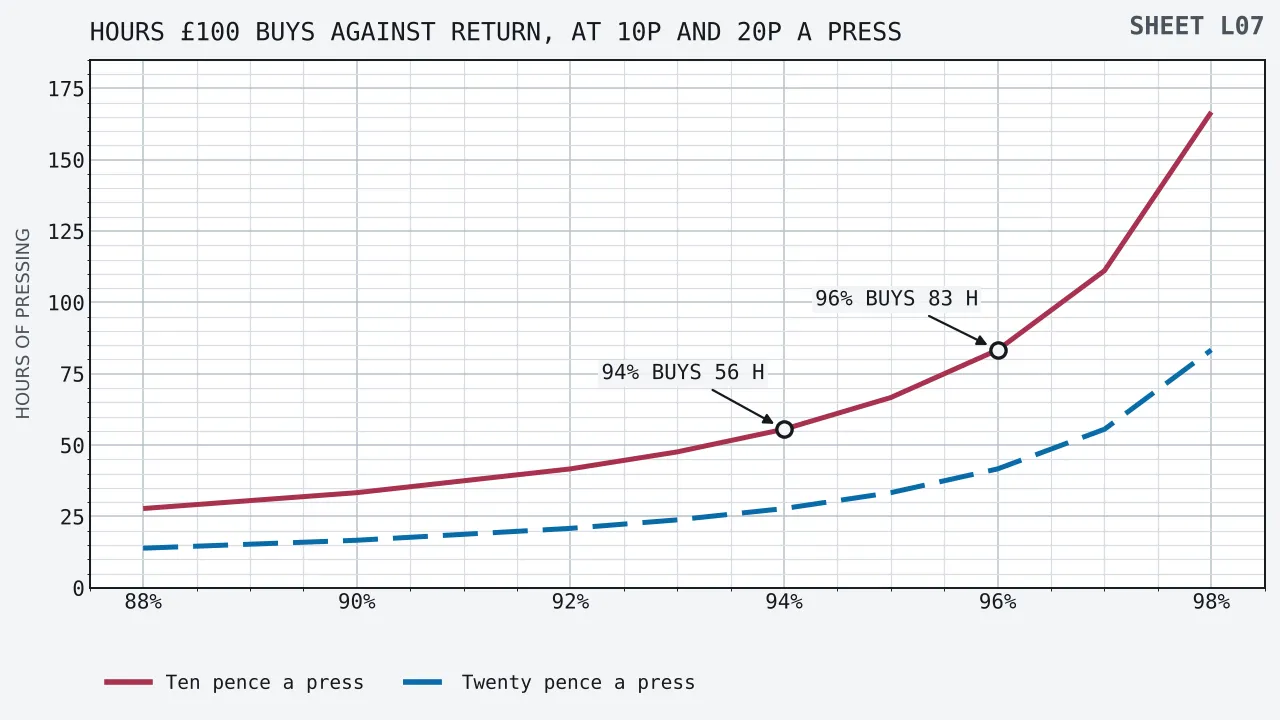
Doubling the stake halves the curve, which is the lower trace on that plate and the plainest statement of how the two quantities relate. Twenty pence a press sends £60.00 across inside an hour, keeps £2.40 of it at ninety-six per cent, and exhausts £100.00 in 41 h 40 min. The ninety-two per cent row gives that same duration at ten pence, reached by an entirely different route.
4
A rate and a quantity behave differently under repetition
Two points of return against a doubled sitting is the comparison this part settles, and the answer turns on which quantity is being held still. Hold the money and the return wins outright. Hold the hours and the sitting length wins trivially, because a longer sitting simply is more hours. Confusing those framings is how the question gets answered wrongly nearly every time.
Fix £100.00 and the table above has already answered it. Ninety-six per cent turns that money into 83 h 20 min of pressing; ninety-four turns the same money into 55 h 33 min 20 s. Doubling every sitting from the assumed twenty-two minutes to forty-four shifts neither duration by a second, because a longer sitting spends identical money faster and buys no extra hour with it.
Calendar days are all a longer sitting moves. One hundred and fourteen days at two sittings becomes fifty-seven days at two doubled ones, and the pressing inside both is the same 83 h 20 min. A reader doubling a sitting has decided how fast to spend. A reader accepting two points fewer has decided how much, and has decided it permanently.
Fix £321.20 instead of the hours and the reversal appears from the other side. That sum funds 267 h 40 min at ninety-six per cent and 178 h 26 min 40 s at ninety-four. Eighty-nine hours thirteen minutes twenty seconds has gone, a third of the year, and no alteration of habit buys any of it back.
| What is being held still | Two points fewer on the return | Every sitting doubled in length | Which lever moves more |
|---|---|---|---|
| A hundred pounds of money | Hours fall from 83 h 20 min to 55 h 33 min 20 s | Hours do not move at all | The return, by every hour of the difference |
| A year of the habit modelled here | Cost rises from £321.20 to £481.80 | Cost rises from £321.20 to £642.40 | The sitting, since it also doubles the pressing |
| The cost of one hour | Rises from £1.20 to £1.80 and stays risen | Does not move, now or afterwards | The return, and nothing else touches the rate |
| One evening, taken once | Adds 22p to a sitting of 110 presses | Adds 44p and one hundred and ten presses | The sitting, on that evening alone |
Row three is the finding. A return is a rate and a sitting length is a quantity, and repetition treats the two completely differently. Buying more hours costs more money once for each hour bought. Accepting a worse rate costs more money on every hour already planned, on every hour added afterwards, and on every hour of every year following this one.
Three hundred and sixty-five is the multiplier that sharpens it. One sitting doubled, on one evening, costs an extra forty-four pence. Two points surrendered over twelve months at forty-four minutes a day cost an extra £160.60. The second is 365 times the first, and both decisions take roughly equal thought.
Compounding is the right word for the return and the wrong word for the sitting, in the plain sense that a rate attaches to whatever comes after it. A reader who plays more next year has already settled the price of next year by picking the build this year. A reader who sat down longer last Tuesday has settled nothing about any Tuesday since.
5
Three hundred and sixty-five days of forty-four minutes
Forty-four minutes is two sittings of the assumed twenty-two, a modest description of a habit, and the one this section of the site prices everything against. Multiplied by 365 it comes to 16,060 minutes, or 267 h 40 min, and the sitting count reaches seven hundred and thirty. Eighty thousand three hundred presses occupy them at the interval assumed here.
Eight thousand and thirty pounds is the turnover those presses send across, being 80,300 at ten pence, and the size of that sum beside the size of the habit is why this page exists. Nobody deposits £8,030.00. The figure is reached because money handed back gets staked again, and after enough returns the accumulated turnover bears no relation to anything ever deposited.
| Return the build is built to | Expected over the year | Against 96 per cent | Per sitting | Weeks of pressing it funds |
|---|---|---|---|---|
| 97 per cent | £240.90 | minus £80.30 | 33p | 52 |
| 96 per cent | £321.20 | level | 44p | 52 |
| 95 per cent | £401.50 | plus £80.30 | 55p | 52 |
| 94 per cent | £481.80 | plus £160.60 | 66p | 52 |
| 92 per cent | £642.40 | plus £321.20 | 88p | 52 |
Eighty pounds thirty is what one point of return is worth across that year, and the column of differences climbs in a straight ladder because the turnover is fixed while the shortfall shifts a point at a time. Five points down the table and the annual bill has doubled. The habit described has not altered by one minute, nor has anything a reader would notice while doing it.
Six pounds sixteen is the week, £26.40 is the month of thirty days, and 44p is the sitting, all at ninety-six per cent. Taking the sitting, the week, the month and the year in order gives the case this section of the site makes, in one line: 44p, £6.16, £26.40, £321.20. Each one is the one before it multiplied by how many of it there are.
Five hours eight minutes of pressing sits behind the £6.16, and £154.00 crosses the reels inside it. Twenty-two hours and £660.00 is the month of thirty days. A reader finding the week believable and the year startling has made no arithmetical error. They have simply never multiplied the week by fifty-two.
Nothing in that table depends on luck, on a streak, on a feature, or on any choice made while playing. It depends on the turnover, settled by the stake and the pace, and on the shortfall, settled by the build. Those are the only two inputs, and just one of them is printed where a reader can find it.
6
One point, priced in sittings and in pounds
One point of return comes to £80.30 over the year described above, and stating it in several other units is worth doing, because a pound figure on its own is too easily waved away. Eleven pence a sitting is the identical quantity. Thirty pence an hour is the identical quantity again. Ninety-one days of the habit is the version that tends to land.
Ninety-one days arrives by asking how far £80.30 goes at ninety-six per cent, which is 66 h 55 min of pressing and 182.5 sittings, and 182.5 sittings at two a day is 91.25 days. Removing a point therefore removes about three months of the year’s pressing, in the sense that identical money now runs dry a quarter of the way earlier.
| Unit the point is expressed in | At 10p a press | At 20p a press |
|---|---|---|
| Pence on one press | 0.1p | 0.2p |
| Pence in one sitting of 110 | 11p | 22p |
| Pounds in one hour | £0.30 | £0.60 |
| Pounds in a week of fourteen sittings | £1.54 | £3.08 |
| Pounds in a month of thirty days | £6.60 | £13.20 |
| Pounds over twelve months of the habit | £80.30 | £160.60 |
Nought point one of a penny heads that table and £80.30 closes it, and both describe the same thing. Eight hundred and three thousand is the ratio, being the press count of a year at ten pence multiplied by ten. A quantity invisible at the top is a month of groceries at the bottom, and nothing happened in between except repetition.
Three points is the realistic span a reader meets wherever returns get published at all, and three points over the year comes to £240.90. Set beside the £321.20 that the ninety-six per cent year costs in total, the proportion is clear enough: the distance between a good printed figure and a poor one is about three quarters of the whole bill.
Half a point earns its own line, because builds are frequently offered in versions differing by exactly that much. Forty pounds fifteen is half a point over the year. Fifty-five pence is half a point over a week. A reader asked to pick between two versions of one thing, with no figure printed on either, is picking £40.15 blind.
7
Two levers that move the bill without moving the rate
Stake and pace shift the annual bill further than the return does, and saying so plainly is the honest counterweight to everything above. Twenty pence a press lifts the year to £642.40. A cycle running at six seconds rather than the assumed twelve lifts it again by the same proportion. Neither effect is small and neither is being hidden here.
What marks them off from the return is that both are quantities while the return is a rate, which is the distinction part four set out. Doubling the stake buys twice the action and surrenders twice the share. Doubling the pace buys twice the presses inside one hour and surrenders twice the share. In both cases the price of a pound crossing stays precisely where it sat.
| What is changed from the house model | Turnover across the year | Expected over the year | Price of one pound crossing | What the reader gets for the extra |
|---|---|---|---|---|
| Nothing, the house model as stated | £8,030.00 | £321.20 | 4.0p | Eighty thousand three hundred presses |
| Twenty pence a press rather than ten | £16,060.00 | £642.40 | 4.0p | The same count of presses, each worth double |
| A six-second cycle rather than twelve | £16,060.00 | £642.40 | 4.0p | Twice the presses inside the same minutes |
| A thirty-second cycle rather than twelve | £3,212.00 | £128.48 | 4.0p | Two fifths of the presses, same minutes |
| A build set to ninety-four, not ninety-six | £8,030.00 | £481.80 | 6.0p | Nothing whatever |
Column four is the one to read downwards. Fourpence, fourpence, fourpence, fourpence, then sixpence. The first four rows buy or sell quantities of pressing at an unchanged price. The last row changes the price and hands back nothing, and it is the only row where the reader receives no presses in exchange for the extra money.
Five pounds seventy-six an hour is where the pace lever stops on licensed slot play. One thousand four hundred and forty presses is the arithmetical ceiling an hour holds under the licensed cycle floor, since a faster rate would need a gap below 2.5 seconds, and 1,440 presses of ten pence push £144.00 across. Four per cent of that is £5.76, which is four and four fifths of the hour modelled here at twelve seconds.
Forty-eight pence an hour is the other end, at an assumed thirty seconds a press, which is a speed a reader sets by pausing rather than one any rule sets. Twelve times separates 48p from £5.76, and the whole of that span belongs to the clock and not to the build. Pressing slowly buys the cheapest hour available with nothing else changed.
Nought is the effect of pace on the cost of a single press, which is where the two sorts of lever part company for the last time. Pressing at twice the speed does not make a press dearer. It makes an hour dearer, by packing more presses into it. A cheaper hour is available immediately; a cheaper press needs a better figure.
8
What must be reachable, and what holds a wheel steady
Three duties stand behind a printed return in Great Britain. An arrangement at this end of the market operates with no Great Britain licence over it, so none of the three touches whoever runs it, and all three concern the figure rather than the money. That is why a British percentage carries weight an unaccompanied one does not.
Reach comes first. Before a customer commits anything at all, a licensed build has to put within easy grasp enough for them to weigh up what their chances amount to, and any of four disclosures satisfies the requirement: how the mechanism runs and how a prize comes to be awarded, the margin a house keeps for itself, the proportion given back to players, or the odds on each paying event. The four are offered as alternatives and not as a list, so a percentage of the sort this page is built on is one permitted answer and never a compulsory one. A reader meeting the margin instead can convert it: three pence kept per pound is ninety-seven per cent, which is 111 h 6 min 40 s from £100.00.
Steadiness comes second. Outcomes on a licensed build must be acceptably random, a build that compensates is not allowed, and the guidance catches any intervention shifting the probabilities, whether a person makes it by hand or a routine makes it automatically. Generated numbers have to be taken as they come, and discarding one to produce an adaptive effect is barred. Remove that and a printed ninety-six sits comfortably over almost any pattern of results underneath, since nothing would oblige the pattern to match the percentage.
Permanence while a game runs comes third. On a licensed build the rules, the payouts and the odds on outcomes may not shift part way through, a change owes the customer notice, and the guidance singles out a clause reserving the right to alter rules whenever the operator likes as one it would not accept. Alterations belong to a build taken offline or suspended first.
| What the figure needs to be worth anything | Inside the British licence | Offshore, on the rulebook this site reads | What its absence is worth a year |
|---|---|---|---|
| Something to read before committing | Four permitted disclosures, a percentage being one | No requirement of the kind appears | Unknowable |
| A generator nobody can lean on | Acceptably random, no compensating, numbers taken as they come | Nothing of the sort is written down | Up to £642.40 |
| A figure holding still during play | Rules, payouts and odds fixed until the build is suspended | Unaddressed throughout | Up to £642.40 |
Six hundred and forty-two pounds forty fills the last column on two of those rows, and it is deliberately an upper bound rather than an accusation. Nothing here says any particular build performs worse than its figure. What the row says is that a year at ninety-two per cent costs £642.40 against £321.20, and that away from the register nothing published forbids the gap.
Ombudsman is the one title the regulator refuses for itself, and that refusal settles where an argument about a return figure finishes even inside the licence. Complaints over gambling transactions fall outside its powers, and it has no sight of what went on inside an account. A British licence supplies the rule in advance rather than redress afterwards, and the rule in advance is worth having on its own terms.
The national self-exclusion scheme reaches an operator through the British licence and by no other route, and it states openly that it cannot keep anybody away from businesses standing outside it. Treat that boundary as a measurement of the protection. No sentence here points at a way across it, and a gambling bar set on a card by a bank gets the identical treatment.
9
Four quantities worth fixing before a year begins
Four numbers settle the whole of a year’s bill, and three of them belong to the reader. Stake, pace and hours get chosen. The return is found or it is not. A reader who settles the first three and then goes looking for the fourth has done everything this page can usefully suggest, and nothing here is advice about which build to take.
Stake comes first, being the largest and the most easily altered. Five pence a press halves the year to £160.60 and twenty pence doubles it to £642.40, and in both cases the count of presses and the minutes spent are untouched. A reader wanting a longer year out of the same money should look here before looking anywhere else.
Pace comes second, and it is the single lever a reader works continuously rather than once. Three hundred presses an hour is what this site assumes. One hundred and twenty an hour, at an assumed thirty seconds a press, costs 48p an hour in place of £1.20 and delivers exactly as many results for each pound. Slowing buys hours outright and costs nothing.
Hours come third, and they are the quantity most people believe they are choosing when they are in fact choosing one of the others. Forty-four minutes a day is 267 h 40 min across a year. Twenty-two minutes a day is 133 h 50 min and £160.60. Halving the habit halves the bill exactly, and this is the only lever that halves the pressing too.
Return comes fourth and is the only one that cannot be adjusted afterwards. Eighty pounds thirty a point a year, £40.15 for half a point, and no sitting, streak or stake recovers a penny of it. The figure is either available before the first press or the decision is being taken without it.
Nought is how much of this turns on choosing well in any other sense. No arrangement of stake, pace and hours leaves a year of pressing expected to finish level, because the shortfall is positive at every return a build has ever been built to. At ninety-six per cent the answer is £321.20, and the working is identical for everybody who runs it.
£80.30 a year for one point, at the habit this site models
Questions
- How long does £100.00 last at ninety-six per cent?
- Eighty-three hours and twenty minutes of pressing, at ten pence a press on the pace of three hundred an hour assumed throughout. An hour pushes £30.00 across the reels and the build keeps back £1.20 of it, so £100.00 divided by £1.20 gives 83.333 hours. Counted in this site’s own unit that is two hundred and twenty-eight sittings of the assumed twenty-two minutes, which at two sittings daily is a hundred and fourteen days.
- Why does a published return say nothing about one evening?
- Because the figure is an average taken over an enormous count of presses, which is what it means rather than a caveat bolted on. A hundred and ten presses at ten pence stake £11.00 and are forecast to hand back £10.56, and the chance of landing precisely there is negligible. Losing all £11.00 and finishing £30.00 ahead are both ordinary results of one sitting. An average marks the middle of a wide spread and describes no member of it.
- Is two points of return really worse than playing twice as long?
- That turns on which quantity is held still, and the question usually gets asked without saying which. Hold £100.00 still and two points cut the pressing it funds from 83 h 20 min to 55 h 33 min 20 s, while doubling every sitting alters the hours bought by nothing and merely spends them over half as many days. Hold the year still and a doubled sitting costs more, because it is also twice the pressing. A rate attaches to every hour ever played; a length attaches only to the evening it was picked on.
- What is one point of return worth over a year?
- Eighty pounds thirty, on a habit of forty-four minutes a day at the assumed twenty-two minutes to a sitting, which is 267 h 40 min of pressing and £8,030.00 of turnover at ten pence. The same point is elevenpence in one sitting, thirty pence in an hour, £1.54 in a week of fourteen sittings and £6.60 in a month of thirty days. Half a point across the year is £40.15.
- Why is the turnover so much larger than anything deposited?
- Because money handed back gets staked again, and the house share comes out of everything that crosses rather than out of the deposit. Twelve months at forty-four minutes a day is eighty thousand three hundred presses, which at ten pence is £8,030.00 of turnover whatever went in at the start. A deposit of £20.00 on a ninety-six per cent build supports roughly £500.00 of crossing before the accumulated fourpence shares reach it, and that is 16 h 40 min at the assumed pace.
- Do the stake and the pace matter more than the return?
- Across one year they can shift the bill further, and this page says so plainly. Twenty pence a press lifts the year to £642.40, and a six-second cycle lifts it again by packing twice the presses into the same minutes. What separates them is that each buys pressing in exchange for the extra money while the price of a pound crossing holds at fourpence. Two points of return raise that price to sixpence and hand back no presses at all.
- How fast may a licensed slot cycle run, and what does that cost?
- One thousand four hundred and forty presses is the ceiling an hour holds under the licensed cycle floor, because anything quicker would need a gap below 2.5 seconds. At ten pence those presses push £144.00 across and the ninety-six per cent share of that is £5.76, so the fastest hour the rule permits costs four and four fifths of the hour modelled here at twelve seconds. At an assumed thirty seconds a press the identical hour costs 48p.
- Does a slower pace improve the odds?
- No, and nothing improves the odds. A slower pace lowers the press count inside an hour, which lowers the turnover in that hour and the share taken from it. A single press costs 0.4p at ninety-six per cent whatever speed it is taken at, and a pound crossing costs fourpence at every pace. Slowing down buys more hours out of the same money; it does not buy a better result out of the same hour.
- What does the British licence require about a return figure?
- Enough has to be within easy grasp before a customer commits for them to weigh up their chances, and four disclosures each satisfy it: how the mechanism runs and how a prize comes to be awarded, the margin a house keeps for itself, the proportion given back to players, or the odds on each paying event. They are offered as alternatives, so a licensed build is under no obligation to print a percentage. Outcomes also have to be acceptably random, a build that compensates is barred, generated numbers go in the order of arrival, and the rules, the payouts and the odds hold still until a game has finished.
- What goes missing once the licence does?
- All three of the duties that make a figure mean anything. Nothing offshore demands information before a customer commits, nothing bars a build that compensates or the discarding of generated numbers, and nothing stops rules, payouts or odds moving part way through a game. A year at ninety-two per cent rather than ninety-six costs £642.40 instead of £321.20, and away from the register nothing published forbids the gap. The regulator here refuses the title of ombudsman, so redress for a transaction was never on offer in either direction, and what the licence supplies is the rule set in advance.