Note U03 Revision 1 Terms read 17 October 2026
Non UK casinos, and the complaint clock that stops existing at the border
A licensed British operator owes an answer inside eight weeks, which is 1,344 hours, and then has to hand over the route to an adjudicator the player never pays. Where that licence is absent the deadline, the forum and the bill are all written by the other party. A £120 argument chased across a hundred hours returns £1.20 an hour, which is precisely what an hour of modelled play costs on this site’s own assumptions.
What lands £120 argued The run 1,344 h ceiling The wait to be paid No ceiling
What offers of this size ask in hours
Advertising has been bought for every destination below. A fee reaches this site when a reader goes on to register, and no figure on this page moves one way or the other because of it.
-
01Mobile Free Spins
Betportal
Ceiling as a multiple
What lands€15.00150 spins at 10c, which is this site's figure and not the operator'sThe run17 h 30 minTurning over 525.00 at 10p means 5,250 presses, or about 48 phone sittings of 22 minutes. Timed at 10p a press and 12 seconds between presses, both of which this site assumes rather than measures.The wait to be paidNOT PUBLISHEDThis operator puts no withdrawal band in its own terms, so there is nothing honest to print here.Spins valued at this site's own 10p a spin
What lands
Spins, at a price15.00150 of them at 10c apiece, a figure belonging to this site rather than to the operatorMatch, and other creditno figure300% of three deposits, to a ceiling of €1,000. Not a sum until money of yours makes it one, so this row totals nothing and carries nothing downwardsThe run
Handed back on the spins(0.60)Each press stakes its own value and returns 96 per cent, which leaves this much with the house from the opening pressPlay-through 35x on the bonus(20.16)Taking 14.40 round 35 times over means 504.00 through the machines, of which 20.16 is the expected cost, and 17 h 30 min of pressing at the pace aboveWhat counts towards it100%Slots only, with no percentage published anywhere, so the row above assumes the whole of each stake countsWhat never clears
Limit on the winningsstated5x the bonusDeducted on the way outno figureNothing is published as a figure here, so this row removes nothingLeast that can leaveno figureNo figure is published, so nothing on this timer is pinned down by oneLeast deposit, and the rung over ityour own€20 a stage. Published in euros, so no rung is named at all: this site's ladder is a sterling oneThe window on the creditstated14 daysBiggest stake while it runsstated€5Removed outright by rulestatedNot publishedVerified before a payoutstatedDocuments before the first withdrawalNever clears€15.00Not a penny of it gets out, so the whole of what landed stands on this rowNo Great Britain licence
Licence held in Anjouan, Comoros, the company named is BetPortal Gaming Ltd, with Excite Ultra Media Ltd, quoted under ALSI-202601040-FI2.
Terms read 17 October 2026
Open the offer at Betportal, opens in a new window -
02Mobile Free Spins
WinBeast
Ceiling as a sum
What lands€50.00500 spins at 10c, which is this site's figure and not the operator'sThe run2 d 18 hTurning over 2,000.00 at 10p means 20,000 presses, or about 182 phone sittings of 22 minutes. Timed at 10p a press and 12 seconds between presses, both of which this site assumes rather than measures.The wait to be paidNOT PUBLISHEDThis operator puts no withdrawal band in its own terms, so there is nothing honest to print here.Spins valued at this site's own 10p a spin
What lands
Spins, at a price50.00500 of them at 10c apiece, a figure belonging to this site rather than to the operatorMatch, and other creditno figure50% to 100% of five deposits, each to a ceiling of €1,000, and a €650 free bet. Not a sum until money of yours makes it one, so this row totals nothing and carries nothing downwardsThe run
Handed back on the spins(2.00)Each press stakes its own value and returns 96 per cent, which leaves this much with the house from the opening pressPlay-through 40x on the bonus and the winnings from the spins(76.80)Taking 48.00 round 40 times over means 1,920.00 through the machines, of which 76.80 is the expected cost, and 2 d 18 h of pressing at the pace aboveWhat counts towards it100%Slots, titles vary by country, with no percentage published anywhere, so the row above assumes the whole of each stake countsWhat never clears
Limit on the winningsstated€100 a batch of spinsDeducted on the way outno figureNothing is published as a figure here, so this row removes nothingLeast that can leaveno figureNo figure is published, so nothing on this timer is pinned down by oneLeast deposit, and the rung over ityour own€20 a stage. Published in euros, so no rung is named at all: this site's ladder is a sterling oneThe window on the creditstated7 days, spins 1 dayBiggest stake while it runsstatedNot publishedRemoved outright by rulestatedNot publishedVerified before a payoutstatedDocuments before the first withdrawalNever clears€50.00Not a penny of it gets out, so the whole of what landed stands on this rowNo Great Britain licence
Licence held in Curaçao, no company named anywhere on the site.
Terms read 17 October 2026
Open the offer at WinBeast, opens in a new window -
03Mobile Free Spins
EliteSpin
Longest spin window
What lands£50.00500 spins at 10p, which is this site's figure and not the operator'sThe run2 d 18 hTurning over 2,000.00 at 10p means 20,000 presses, or about 182 phone sittings of 22 minutes. Timed at 10p a press and 12 seconds between presses, both of which this site assumes rather than measures.The wait to be paidNOT PUBLISHEDThis operator puts no withdrawal band in its own terms, so there is nothing honest to print here.Spins valued at this site's own 10p a spin
What lands
Spins, at a price50.00500 of them at 10p apiece, a figure belonging to this site rather than to the operatorMatch, and other creditno figure50% to 100% of five deposits, each to a ceiling of £1,000. Not a sum until money of yours makes it one, so this row totals nothing and carries nothing downwardsThe run
Handed back on the spins(2.00)Each press stakes its own value and returns 96 per cent, which leaves this much with the house from the opening pressPlay-through 40x on the bonus and the winnings from the spins(76.80)Taking 48.00 round 40 times over means 1,920.00 through the machines, of which 76.80 is the expected cost, and 2 d 18 h of pressing at the pace aboveWhat counts towards it100%Slots, with no percentage published anywhere, so the row above assumes the whole of each stake countsWhat never clears
Limit on the winningsstated5x the bonusDeducted on the way outno figureNothing is published as a figure here, so this row removes nothingLeast that can leaveno figureNo figure is published, so nothing on this timer is pinned down by oneLeast deposit, and the rung over ityour own£20 a stage. It lands square on the £20.00 rung, so none of yours is left perched on topThe window on the creditstated7 days, spins 3 daysBiggest stake while it runsstatedNot publishedRemoved outright by rulestatedNot publishedVerified before a payoutstatedDocuments before the first withdrawalNever clears£50.00Not a penny of it gets out, so the whole of what landed stands on this rowNo Great Britain licence
Licence held in Costa Rica, the company named is PrimeTier Limited.
Terms read 17 October 2026
Open the offer at EliteSpin, opens in a new window -
04Mobile Free Spins
Crown Jewelz
Multiple unpublished
What lands£15.00150 spins at 10p, which is this site's figure and not the operator'sThe runNOT TIMEDThis operator does not publish the play-through multiple in its own terms. The multiple is the one figure the clock cannot work around, so the run is left untimed.The wait to be paidNOT PUBLISHEDThis operator puts no withdrawal band in its own terms, so there is nothing honest to print here.Nothing reckoned
What lands
Spins, at a price15.00150 of them at 10p apiece, a figure belonging to this site rather than to the operatorMatch, and other creditno figure200% of the first deposit, then 150% twice, each to a ceiling of £1,000. Not a sum until money of yours makes it one, so this row totals nothing and carries nothing downwardsThe run
Play-throughno figure40x the bonus, reported rather than published by the operatorWhat counts towards itno figureSlots, with no percentage published anywhere, so the row above assumes the whole of each stake countsWhat never clears
Limit on the winningsstatedNot publishedDeducted on the way outno figureNothing is published as a figure here, so this row removes nothingLeast that can leaveno figureNo figure is published, so nothing on this timer is pinned down by oneLeast deposit, and the rung over ityour own£20. It lands square on the £20.00 rung, so none of yours is left perched on topThe window on the creditstatedNot publishedBiggest stake while it runsstatedNot publishedRemoved outright by rulestatedNot publishedVerified before a payoutstatedDocuments before the first withdrawalNever clearsNOT RECKONEDThis operator leaves the play-through multiple out of its own terms, so nothing below the fourth step can be worked out.No Great Britain licence
Licence held in Curaçao, number not verified, no company named anywhere on the site.
Terms read 17 October 2026
Open the offer at Crown Jewelz, opens in a new window
Only the middle reading comes out of arithmetic belonging to this site. The multiple laid against what lands gives the turnover asked for; dividing that by 10p a spin gives the presses; dividing those by 300 an hour gives the hours, a press on a handset being taken here at 12 seconds from the one before. Both figures are assumptions rather than measurements of anybody: nothing was played and nothing was held a stopwatch to. Anybody quicker should divide the press count by a rate of their own, which is why the presses are printed alongside the hours instead of being summarised away.
The first reading is what arrives before any condition is laid against it. Spins carry no unit of their own so one gets supplied: where an operator values its own spin that figure is used and attributed, and where it does not, this site's 10p a spin stands in and everything below moves with it. The third reading belongs to the operator entirely. It is a withdrawal band quoted from published terms, and a blank there means none was published rather than that nobody looked.
The total along the foot answers what the hours leave open, which is whether any of the running ends anywhere. It is what arrived, less whatever is still standing once the play-through has been paid for at 96 per cent return to player and once a published limit, a published deduction and a published floor beneath the least that can leave have each had a turn. It appears again in pence in the pound, the only fair way of holding a small offer up against a large one. It describes an offer rather than an evening, and where the conditions price out what arrived, a timer prints nothing getting out instead of a negative sum.
Cashiers on a handset take deposits off a row of preset buttons, so a least deposit given in pounds is raised to the next rung of the ladder used here, £10, £20, £25, £50, £75 and £100, and the timer shows what is left perched on it. That money is the reader's own and enters no sum at all. Given in euros it prints untouched, the ladder being sterling. Three words may occupy the figure column where no figure belongs. Stated is a published term that costs something while leaving no number to subtract. No figure is a term nobody has quantified, or a credit that is not a sum until money of yours makes it one. Your own is money of yours, which belongs in none of this.
None of the operators above is licensed in Great Britain, so not one duty that licence carries reaches any of them. Membership of Gamstop Online is compulsory for every online gambling company licensed in Great Britain, which means that shutting yourself out through the scheme shuts you out of none of these. The limit of ten times the bonus funds on a wagering requirement, running since 19 January 2026 under Social Responsibility Code 5.1.1, is a condition of the same licence and binds only whoever holds one. Off that licence, the Gambling Commission writes of consumers meeting unfair gaming practices, financial loss and no recourse when matters go wrong, and lists blocked payouts and withdrawal limits pitched too high to reach among the things it has seen. No account at any of them may be held by anybody under 18.
Every term on a timer is its operator's own and every timer carries the day somebody read it. The oldest of those readings is 17 October 2026. What binds a reader is an operator's full terms and never a line printed here.
1
Whose calendar an argument runs on, and what is refused here
Two timetables govern a dispute and only one of them is written by somebody with no stake in the outcome. Where a Great Britain licence is held, the periods come out of a licence condition and a published code, and the body that writes them collects money when they are broken. Beyond that licence the periods come out of the terms, which were drafted by the party the argument is with.
No address is printed here and no name. Nothing below touches paperwork, ways of paying, handsets or how a household wires itself up. Where a bank halts a gambling payment, or a connection supplier does, that too is a protection, and it draws the same refusal.
One instruction is offered here, and it is for a particular reader. Anybody who holds a registration with Gamstop Online and has arrived at a search of this kind is under the pressure that registration was set up to carry. GamCare keeps the National Gambling Helpline open with nobody charged for the call, on 0808 8020 133, and that is the useful number tonight rather than any address.
Eight weeks is the single figure to carry into the rest of this note, because every other number is measured against it. Counted from receipt, that is 56 days, 1,344 hours and 80,640 minutes, and it is the longest a licensed operator’s own handling of a complaint may take, internal escalation included. No equivalent ceiling exists where the licence is absent, and the parts below price the difference.
Converted into this site’s working unit, those eight weeks come to 20 h 32 min of pressing, taking one sitting of 22 minutes an evening across the 56 days. That is 6,160 presses at ten pence, £616.00 crossing the reels, and £24.64 of expected cost on the ninety-six per cent figure this site works to. The nightly rhythm is a convention declared here rather than measured, and it exists only to put a legal period into a unit a reader already handles.
A complaint and a dispute are not quite the same object, and the difference decides which clock applies. A complaint is an expression of dissatisfaction put to the operator. A dispute is what a complaint becomes once it is unresolved and concerns the outcome of gambling. The first runs on the operator’s timetable; the second is what an adjudicator later receives.
2
Three days, eight weeks, half a year, and the pause between
Acknowledgement carries two ceilings rather than one. A business trading around the clock owes it inside 24 hours. Everyone else owes it inside three working days, with the guidance asking in both cases for it as soon as reasonably possible. Three to one is the ratio between those two before a weekend enters the sum at all.
One hundred and twenty hours is what three working days can stretch to on the calendar, and the arithmetic there is this note’s own rather than anything published. A complaint arriving on a Friday evening has Monday, Tuesday and Wednesday as its three working days, which is five calendar days from arrival. The same complaint arriving on a Monday morning is answered by Thursday, inside 72 hours. Nothing is being criticised in that spread; it is simply what counting in working days does.
| What the period governs | As the rule states it | Hours | Nightly sittings it spans | Who keeps the clock |
|---|---|---|---|---|
| Acknowledging, business trading around the clock | 24 hours | 24 | 1 | The operator, under the guidance |
| Acknowledging, general | Three working days | 72 to 120 | 3 to 5 | The operator, under the guidance |
| Pausing for an unanswered request | Seven days of silence | 168 | 7 | The customer, by replying |
| The operator’s whole handling | Eight weeks from receipt | 1,344 | 56 | A code provision, not a term |
| Raising it at all | At least six months from the incident | 4,368 | 182 | A rule no term may shorten |
Everything the operator does has to fit inside those 1,344 hours, and the operative word in that sentence is everything. Passing a complaint up a management ladder consumes the same clock rather than starting a fresh one. The eight weeks traces to a social responsibility code provision, which makes it part of what the licence costs rather than a courtesy printed in the terms.
A week of silence is the only pause in that timetable, and it is the single part the customer controls. Silence of seven days against a request the operator could reasonably make may turn halting the clock into the reasonable course, and the count resumes at the figure it froze on, rather than restarting, once a reply arrives. Reply inside a day and all 1,344 hours survive.
Raising the matter has a window of its own, 4,368 hours wide, running at least six months out from the incident. Earlier complaints may be encouraged, and terms that bar a complaint inside that half-year may not be used. Holding those two apart is worth the effort, because an encouragement is advice and a bar is a term, and the prohibition catches only the second.
1,344 hours is the ceiling on the operator’s own handling
3
An adjudicator nobody bills the player for
Nought is what alternative dispute resolution costs the player where a British licence applies, and the shape of the arrangement matters as much as the price. The regulator approves the entities. A licensee is required to use one or more entity that approval has been given to, and may not nominate a body of its own choosing. Eight bodies sit on the published list.
Five of those eight carry remote gambling across every sector, and that subset is what an online casino argument can reach. A further two show every sector in that page’s table, though betting alone appears in the entry one of them keeps. Last of the eight is a premises body: amusement arcades for adults, bingo played in a hall, family entertainment centres, pubs and members’ clubs, so a remote casino matter never arrives there. That page carries 17 May 2021 as its publication date and 15 January 2025 as its last update, and its change note records one provider taken off.
Three jobs sit on the final response rather than one. The decision gets explained. The close of the operator’s own handling gets stated. The way to carry the matter to an independent entity gets explained as well. Those three in a single letter are what turns a refusal into a route, and the letter is owed inside the 1,344 hours rather than after them.
Four powers are disclaimed by the regulator in its own published words, under a flat denial that it is any sort of ombudsman. Settling a gambling complaint is beyond it. Getting a consumer’s money back is beyond it. Arguments over a gambling transaction, trouble with a withdrawal or a fault inside a game are beyond it. Looking into an account to see what occurred is beyond it, because it has no access to one. Its instruction to a player is to go to the gambling business first.
Twenty-five million eight hundred and ninety-six thousand nine hundred and thirty-nine pounds is what the money penalties on the regulator’s published enforcement listing came to when this sheet was compiled, across twelve entries running from 1 October 2025 to 7 October 2026. Smallest was £122,835 and largest £10m. Spread across the 372 days between those dates that averages £69,615 a day, and six licence suspensions sit alongside them. A caution rides with those figures: the dates belong to that listing, while an individual licensee’s own register entry may show a different date against the identical penalty.
4
The offshore timetable, published in full and shaped by one side
Six hundred and seventy-two hours is the first answer the Curaçao complaints policy requires, being four weeks, so a page claiming the offshore side publishes nothing would be wrong. Confirmation in writing that something has come in is owed within one week, which is 168 hours. One extension is allowed, of four weeks on top, and written notice has to go out in advance, which puts the ceiling at 1,344 hours and matches the British maximum to the hour.
One hundred and twenty hours is the figure on the priority track, five business days being the target where a complaint touches responsible gaming. Receipt there is confirmed inside two days, so 48 hours, and a delay is held to a fortnight, stretchable by one further fortnight where the player is slow to answer. No separate faster track is published on the British side, and recording that is more useful than pretending the offshore document is empty.
| The stage | Where a Great Britain licence is held | Under the Curaçao complaints policy |
|---|---|---|
| Confirming the thing arrived | Inside 24 hours for a business trading around the clock, three working days for everybody else | One week, in writing, being 168 hours |
| The first substantive answer | No separate period; the ceiling governs | Four weeks, being 672 hours |
| Ceiling on the operator’s stage | 1,344 hours, escalation included | 1,344 hours, as four weeks plus four more on written notice |
| A faster track for harm | None published as a separate period | Receipt in 48 hours, five business days as the target |
| Window for raising it | At least six months out from the incident | Within six months of the bet being settled, or of the incident |
| Who approves the adjudicator | The regulator, choosing from its own approved list | Mandatory and free, with parameters the operator may set |
| Second attempt at adjudication | Not addressed by the rules cited here | Barred once a process has completed |
Three parameters are where the regimes genuinely part, and the offshore policy prints them instead of leaving them to be inferred. One is whether a player has to finish adjudication before heading to law. One is whether the outcome ties the player’s hands. One is a floor on claim value, beneath which nothing escalates. Each of the three is the operator’s to set, with the regulator there advising it to take legal advice of its own and saying it will look at everything relevant in deciding whether such a measure is warranted.
Two illustrations are given for that weighing and they pull against each other. Where a claim is small, the regulator says a worry about abuse of the process may be understandable. Where a self-excluded person was let in, the expectation is that the matter gets taken seriously however small the money. Both examples belong to the regulator and neither promises any result.
Two further limits bind the player and not the business. Finishing one adjudication shuts the door on starting another with a different entity. Walking away from a process already under way is meant to shut the door on raising the same matter later. Complaining is reserved to the registered player, because a claim against a licence holder cannot change hands there at all: not by sale, not as a gift, not on rent or lease, and not as security for anything.
Two reporting dates fall each year, 15 January and 15 June, when operators there hand over their complaint counts, the first set due in January 2026 and covering totals, outcomes, categories, onward referrals and cases that went to law. Nothing aggregated from them could be located. This page therefore prints no offshore complaint volume whatever, and a figure invented to fill that hole would be worse than the hole.
5
What a disputed sum returns for each hour of chasing
A hundred and twenty pounds is the amount argued over in this part, picked because it is the size nobody takes to a solicitor and nobody enjoys losing. Whether it comes back is not the question here. What each hour spent getting it back is worth is the question, and division answers it without any further apparatus.
Forty minutes is the time this note assumes for writing a complaint, sending it and reading the answer, and it is a declared convention rather than an observation of anybody. On that figure a £120 recovery inside the licensed timetable costs the reader two thirds of an hour, which values the exercise at £180.00 an hour. Nothing else is asked of the reader, because the 1,344 hours are kept by the operator under a condition of its licence rather than by the person waiting.
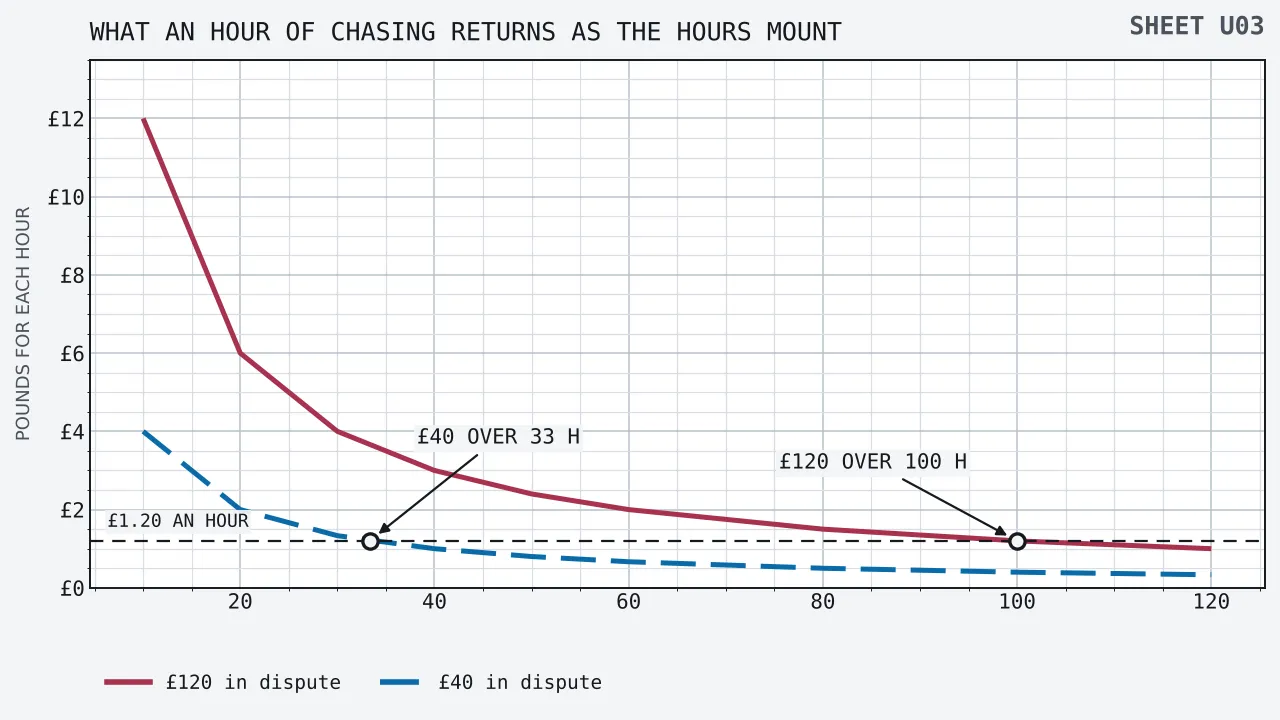
One pound twenty is where both curves are heading, and the rule they cross carries this whole site on its back. An hour at the twelve-second interval modelled here holds 300 presses, so £30.00 goes across the reels, and the four-pence margin leaves £1.20 as the hour’s expected cost. A £120 argument chased for a hundred hours therefore returns, at best and with every penny recovered, the exact rate at which the gambling was losing. That interval is an assumption of this site and nothing anywhere here was measured.
Thirty-three hours and twenty minutes is where a £40 argument reaches the same rule, and smaller sums reach it sooner on a straight division. That is the uncomfortable property of a dispute with no deadline on it: the sum is fixed on the day it is disputed, the hours are not, and every hour added divides the same numerator by a larger denominator.
| Hours of the reader’s own time | £120 returns an hour | £40 returns an hour | How the same hours read as play |
|---|---|---|---|
| Two thirds of one, the assumed letter | £180.00 | £60.00 | 200 presses, 80p of expected cost |
| Ten | £12.00 | £4.00 | 3,000 presses, £12.00 of expected cost |
| Forty | £3.00 | £1.00 | 12,000 presses, £48.00 of expected cost |
| One hundred | £1.20 | £0.40 | 30,000 presses, £120.00 of expected cost |
That bottom row prints £120 twice over, and the repetition is arithmetic rather than rhetoric. Staking at the modelled pace for a hundred hours puts £3,000.00 over the reels, with £120.00 as the expected cost, which is the very amount in dispute. Anybody who would not sit at the reels for a hundred hours to lose £120 has a reason to think before spending a hundred hours of correspondence to get it back.
Nothing in those figures claims that a particular argument runs to a particular number of hours, and the sums were laid out so that they would not have to. Hours are the free variable in all of this. What the licensed timetable supplies is a ceiling on the hours the other side may consume, and losing that ceiling is the whole subject of this note.
6
Three further rulebooks, and two that could not be read
Four silences make Malta hard to price, and naming them before the contents is the honest order. Nothing is published about a time limit. Nothing is published about where a player has to live. Nothing is published about the outer edge of the authority’s own powers. Nothing is published about whether its decision ties a business. Where a player lives does get asked on the form, and no rule of eligibility anywhere on that page is tied to the answer.
What is published there is a gaming statute with directives beneath it, two registers, one for enforcement and one listing licensees, and a form named as the formal channel against a business holding its licence. Reviews happen in English and in Maltese, identification may be sought before a case moves, and a player is told to try the business’s own people first. That is a genuine route, and those silences are the reason no hours can be attached to it here.
Five licence types exist under the Kahnawà:ke interactive gaming regulations. A query, a complaint and an investigation all travel to the commission seated in Mohawk Territory in Quebec, handled by procedures written into those regulations. Not one period is attached anywhere in that, so none of it reaches the arithmetic above, and inventing a period to fill the space would be worse than the brevity.
One error message is the entire reported contents of Anjouan’s complaint process, that being what came back when the page was fetched on 15 October 2026. Such a process is advertised, and so is a list of approved adjudication providers. The web address its publisher uses is a commercial one and not a governmental one, and no ordinance, Act or regulation is cited at all, only the island’s laws in general. Time limits, binding effect and remedies are unknown here, and not one of them gets guessed at.
Nought primary sources turned up for Costa Rica, and that nought is itself the fact. Nothing a regulator there publishes could be reached, so a registration cited in that country has no rulebook behind it that this page could set against the British timetable, and what the law there asks goes unstated. Gibraltar’s official gambling pages failed three times over on 15 October 2026, so not one fact from that regulator appears here. Neither gap gets filled from a trade publication or a law firm’s note.
7
Where the offence sits in the Act, and on whom it falls
Thirty-three is the section number, and the offence it creates is addressed to a provider from its first word to its last. Providing facilities for gambling is what commits it, unless one of the listed exceptions applies. Holding a licence that authorises what is provided, and keeping to that licence’s conditions, is the first exception on the list. Reading the section as a rule about customers is reading it backwards.
Fifty-one weeks is the imprisonment ceiling in subsection 4. A fine capped at the fifth level of the standard scale is the alternative, and the two together make a third possibility. Scotland reads those weeks as six months. Those are a provider’s exposure, and nobody else’s, which is a precise thing to be able to say about a market usually discussed in generalities.
Nought matching offences exist for a person who takes part in remote gambling as a customer. Nothing follows from that about safety, and the step from one to the other is the commonest error made with this statute. What a licence supplies is protection, and every item in part nine is a protection withdrawn rather than a liberty withdrawn. A reader exposed to no prosecution is still exposed to an argument with no ceiling on it, which is a worse position and not a better one.
First of November 2014 is when the reach moved to where the gambling is consumed, through a substitution made by an Act of that year. Whether the facilities sit inside or outside the United Kingdom was already immaterial. What the substitution added was a second limb: equipment used in providing the facilities standing in Great Britain is one route in, and the facilities being used in Great Britain is the other. Before it, only the equipment route existed.
Knowledge is bolted onto that second limb, which applies where the provider knows or ought to know the facilities are in use here or likely to be. Section 330 makes an offence of advertising gambling that is unlawful, with a defence of reasonable belief attached to some conduct and a knowledge test attached to other conduct. Carrying somebody else’s communication, with no say over what sits inside it, commits nothing by itself. A display left up re-commits the offence on every day any part of it shows, the section has been live since 1 September 2007, and the statute page records it as current to 14 October 2026.
8
A charge that follows the player’s address, not the licence
Forty pounds in every hundred of provider profit is Remote Gaming Duty on and after 1 April 2026. Profit there means what was staked with the provider less what it handed back out. Residence does the pulling here, not the licence: a player settled in this country carries the charge along wherever the cashier sits, and the guidance speaks to the provider throughout while naming nothing payable at the handset.
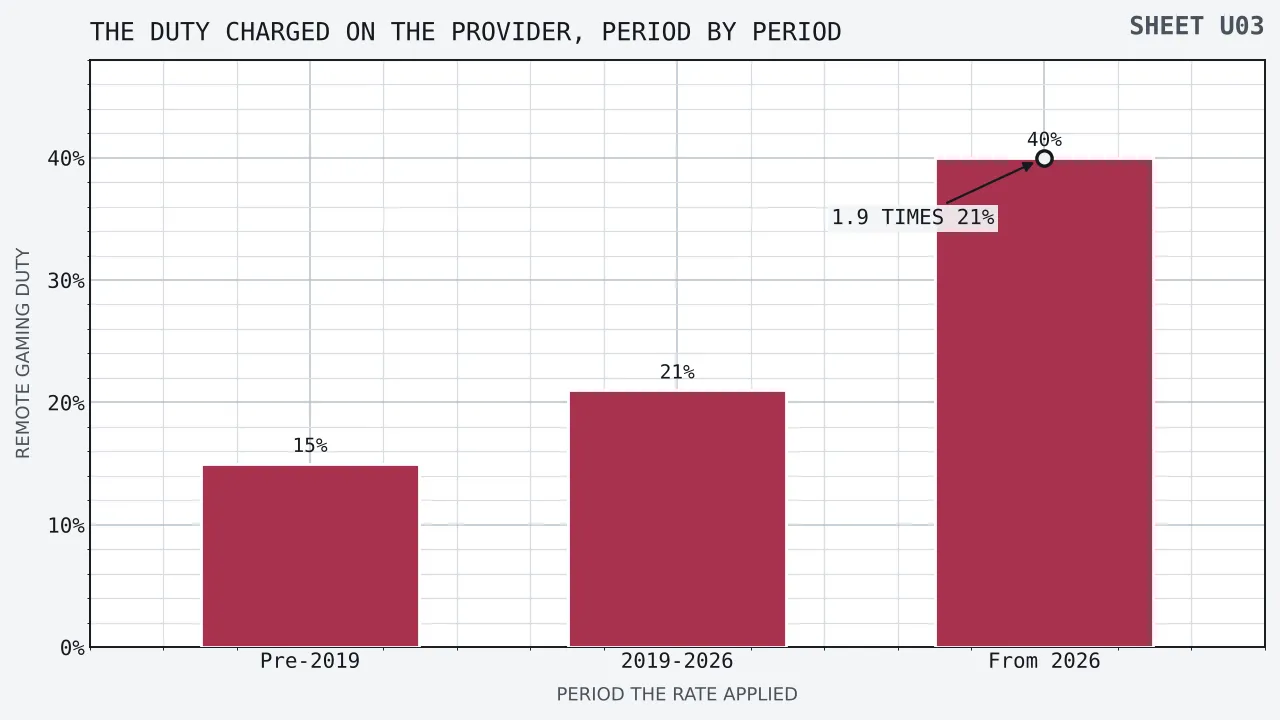
Nineteen points is the step taken on 1 April 2026, from a rate of 21 that had stood since 1 April 2019, which had itself replaced 15. On a hundred pounds of profit the duty has moved from £15 to £21 to £40, so the figure now standing is 1.9 times the middle one and two and two thirds times the oldest. That is the single largest change in the economics of an offshore cashier’s British business on this whole sheet, and it reaches a provider whether or not that provider is licensed here.
Wherever a provider sits, registering and paying follow once remote gambling, spread betting aside, is put in front of somebody ordinarily living here. Appointing an approved representative here is generally required of a provider that stands outside a group, certain jurisdictions are exempted from that, and Gibraltar is named among them. None of that falls away for want of a Great Britain licence, which is a precise and sourced thing to say about the offshore position and better than a loose claim about legality.
Trading is the word the player’s own tax position turns on. Betting and gambling, taken by themselves, are published as not amounting to it. Running something organised to make money from the gambling public normally does amount to it. A spread-betting customer is normally not trading, taxed on no profits and relieved for no losses, while the firm taking that bet is taxed on what it earns.
Nineteen twenty-five supplies the case the manual leans on. A man living wholly off horse bets struck at starting prices was found to be running no trade whatever, and the judgment’s remark that a habit bears no tax is its most quoted line. A system, a livelihood drawn from one, expertise and the study of form are each recorded as not enough on their own. None of that is a published declaration that winnings go untaxed, and nothing here is advice, because nothing here knows anybody’s circumstances.
9
What an argument loses when the licence is missing
No Great Britain licence sits behind a business answering to a search of this shape, and the sequence walked end to end is what shows the cost of that absence to an argument. The window comes first, a floor of six months out from the incident that no term may cut into. The ceiling comes second, 1,344 hours on the operator’s own handling, held as a licence condition rather than as a courtesy. The handover comes third, a final response obliged to point at an independent entity. The forum comes fourth, an entity the regulator approved and the player never pays. Take the licence away and all of them become clauses in a document the other side wrote.
Two duties decide what there is to argue about in the first place, and both are absolute on the licensed side. A maximum on what a consumer may draw from their own deposit balance is prohibited outright, and the illustration of a banned term sets a daily ceiling of £50 with £500 over the week. Nor may the cancelling of a withdrawal already asked for be put to a customer as an option, and funds once requested are not, on the guidance, to be made available for staking afresh.
Fairness and transparency in the terms is the fifth duty, and it holds the other four up. Unfairness within the meaning of the consumer statute is prohibited in the terms and in the notices alike. Transparency within that same meaning is required of both. Contract terms have to be reachable easily. A material change needs telling before it bites. Dealing unfairly with consumers is barred at every stage of the relationship.
Nought is the number of those five binding a business that stands off the register, and that count is not a claim that the offshore side is lawless. Part four set out a published offshore timetable with real periods in it, one of them faster than anything on the British list. What differs is who may move the periods afterwards, and the answer there is the operator, inside parameters the regulator says it will weigh.
A lack of recourse when things go wrong is the regulator’s own phrase for what a consumer meets at such a site. Withdrawal behaviour it reports having seen includes payouts stopped and withdrawal ceilings pitched beyond reach, and it records serious concern over data protection, naming identity theft and fraud as risks running alongside. None of that converts into hours on this site, which is exactly why it is reported here rather than priced.
10
A deadline priced, and what a bad evening is worth
A deadline is 1,344 hours, stated as a quantity instead of as a comfort. It makes no promise that the answer will be the one a reader wants. It promises that the waiting ends, that ending it is somebody else’s duty, and that a route opens when it does. Nothing else priced on this page is worth as much as that one property.
Forty minutes against a hundred hours is the comparison to carry away, both of them this note’s own figures and the first a declared convention. Inside the licence the reader contributes a letter and the clock belongs to the other side. Outside it the clock is built entirely from the reader’s own hours, and each hour added lowers the return on the sum in dispute by division alone.
One pound twenty an hour is where a £120 argument lands after a hundred hours, and it is the same £1.20 an hour the modelled play was quietly costing all along. That coincidence is the sharpest thing arithmetic has to say about a dispute with no timetable. Getting the money back at that rate is indistinguishable, measured in pounds an hour, from having carried on playing.
Eight weeks against no weeks is the honest summary, and the matching offshore ceiling softens it less than it appears to. Those offshore periods are genuine and published. What differs is that the adjudication’s parameters, the binding effect on the player and the floor on what a claim must reach before anything escalates included, are things the operator may write. A ceiling the other side may redraw is a different object from a ceiling fixed by a licence condition.
Avoiding the need for an argument beats winning one, and the closing paragraph is for a different reader. Anybody who came here because an exclusion they set for themselves has become hard to keep should ring 0808 8020 133, where GamCare answers without charge and without closing. The call takes a few minutes, less than the letter costed back in part five, and it is the single action urged anywhere in this note.
Questions
- How long does a licensed operator have to deal with a complaint?
- Eight weeks counted from receipt, internal escalation included, which is 56 days, 1,344 hours and 80,640 minutes. The period traces to a social responsibility code provision, making it part of what the licence costs rather than a courtesy printed in the terms. Acknowledgement is owed within three working days, tightening to 24 hours for a business that trades around the clock.
- How long does a player have to raise the matter at all?
- A floor of six months out from the incident, which is 4,368 hours wide. Earlier complaints may be encouraged, and terms that bar one inside that half-year may not be used. An encouragement is advice and a bar is a term, and the prohibition catches only the second of the two.
- Can the eight weeks be paused, and by whom?
- By silence, and only by the customer’s. Leave a request the operator could reasonably make without a reply for seven days and halting the clock may become the reasonable course, and once the reply arrives the count resumes at the figure it froze on instead of restarting. Answer inside a day and the whole 1,344 hours survives intact, which makes the pause the single part of the timetable the customer controls.
- Who pays for the adjudicator where a British licence is held?
- Not the player. Approval of the entities rests with the regulator, a licensee has to use one that approval has been given to, and eight bodies sit on the published list with five of them carrying remote gambling across every sector. The last of the eight is a premises body: amusement arcades for adults, bingo played in a hall, family entertainment centres, pubs and members’ clubs, so a remote casino matter never arrives there. The page carries 17 May 2021 as its publication date and 15 January 2025 as its last update.
- Does the offshore side publish a complaints timetable?
- It does, and a page claiming otherwise would be inaccurate. Confirmation in writing that something has come in is owed within one week under the Curaçao policy, an assessment and response within four weeks, and one extension of four weeks on top is allowed where written notice goes out in advance, which puts the ceiling at 1,344 hours and matches the British maximum to the hour. Complaints touching responsible gaming get a priority track, with receipt confirmed inside two days and five business days as the target.
- So where do the two regimes actually differ on disputes?
- In who writes the adjudication’s terms. On the British side approval of the entity rests with the regulator and nothing is billed to the player. Adjudication under the Curaçao policy is compulsory with the operator carrying the cost, yet that same policy expressly envisages the operator fixing three parameters: whether adjudication has to be finished before heading to law, whether the outcome ties the player’s hands, and what floor a claim must clear before anything escalates.
- What is a disputed sum worth once the route to recover it has no deadline?
- Whatever remains after dividing it by the hours spent. A £120 argument recovered after ten hours of correspondence returns £12.00 an hour, after forty hours £3.00 an hour, and after a hundred hours £1.20 an hour. That last figure is exactly what an hour of play is modelled to cost here, three hundred presses of ten pence filling an hour at the twelve-second interval assumed and the four-pence margin taking £1.20, so a hundred hours of chasing returns the rate the gambling was losing.
- Is a player who uses an unlicensed site committing an offence?
- No. Whoever provides the facilities is the person section 33 of the Gambling Act 2005 addresses, with up to fifty-one weeks inside, a fine capped at the fifth level of the standard scale, or both at once, and the Act builds nothing equivalent aimed at the person taking part. Safety does not follow from that. A licence supplies protection, and every item catalogued on this page is a protection withdrawn rather than a liberty withdrawn.
- Is a site outside Great Britain outside British gambling tax?
- No. Remote Gaming Duty takes forty pounds in every hundred of provider profit on and after 1 April 2026, triggered by where the player ordinarily lives, with the rate standing at 21 from 1 April 2019 and at 15 before that. Wherever a provider sits, registering and paying follow once remote gambling, spread betting aside, is put in front of such a person, and one standing outside a group must normally have somebody approved acting for it here unless its base is an exempted jurisdiction. The charge addresses the provider and names nothing payable by the person at the handset.
- What can be said about complaints routes in the other jurisdictions?
- Malta publishes a formal channel surrounded by four silences: nothing on a time limit, nothing on where a player has to live, nothing on the outer edge of the authority’s powers, and nothing on whether a decision ties a business. A query, a complaint and an investigation all travel to the commission seated in Mohawk Territory, handled under its interactive gaming regulations, with not one period attached. Anjouan advertises a complaint process whose page returned an error when fetched on 15 October 2026, so nothing about its contents may be inferred. Costa Rica yielded no regulator source at all, and Gibraltar’s official pages could not be reached.
- Where should somebody go who is really looking for a way past their own exclusion?
- To the number 0808 8020 133, where GamCare answers the National Gambling Helpline at no charge, over the telephone, in live chat or by message, with no hour in the year at which it shuts. Worry about another person in the house is as good a reason to ring as worry about oneself. TalkBanStop is published by GamCare as well, bringing the helpline together with blocking software and the national scheme, and a period already running may be extended instead of being allowed to lapse.