Note P13 Revision 1 Terms read 17 October 2026
An instrument with one end, and a balance nobody is obliged to answer about
Sixty-six pounds is the sum followed through this note, made by 660 presses and six goes at a handset on the figures supposed here. Paid in by a code with no way back along it, the money leaves by whichever exit the party holding it picks, at 60 modelled hours, 94 h 17 min or 118 h 17 min. Where nobody owes an answer at all, this note measures the quiet against the play that made the money, and at the point a licensed business would have had to finish it stands at 611 times it.
Stranded, worked example £66.00 Quiet, against the play 611 times Slowest exit modelled 118 h 17 min
What a cashier of this kind asks in hours
Advertising has been bought for every destination below. A fee reaches this site when a reader goes on to register, and no figure on this page moves one way or the other because of it.
-
01Mobile Free Spins
Betportal
Ceiling as a multiple
What lands€15.00150 spins at 10c, which is this site's figure and not the operator'sThe run17 h 30 minTurning over 525.00 at 10p means 5,250 presses, or about 48 phone sittings of 22 minutes. Timed at 10p a press and 12 seconds between presses, both of which this site assumes rather than measures.The wait to be paidNOT PUBLISHEDThis operator puts no withdrawal band in its own terms, so there is nothing honest to print here.Spins valued at this site's own 10p a spin
What lands
Spins, at a price15.00150 of them at 10c apiece, a figure belonging to this site rather than to the operatorMatch, and other creditno figure300% of three deposits, to a ceiling of €1,000. Not a sum until money of yours makes it one, so this row totals nothing and carries nothing downwardsThe run
Handed back on the spins(0.60)Each press stakes its own value and returns 96 per cent, which leaves this much with the house from the opening pressPlay-through 35x on the bonus(20.16)Taking 14.40 round 35 times over means 504.00 through the machines, of which 20.16 is the expected cost, and 17 h 30 min of pressing at the pace aboveWhat counts towards it100%Slots only, with no percentage published anywhere, so the row above assumes the whole of each stake countsWhat never clears
Limit on the winningsstated5x the bonusDeducted on the way outno figureNothing is published as a figure here, so this row removes nothingLeast that can leaveno figureNo figure is published, so nothing on this timer is pinned down by oneLeast deposit, and the rung over ityour own€20 a stage. Published in euros, so no rung is named at all: this site's ladder is a sterling oneThe window on the creditstated14 daysBiggest stake while it runsstated€5Removed outright by rulestatedNot publishedVerified before a payoutstatedDocuments before the first withdrawalNever clears€15.00Not a penny of it gets out, so the whole of what landed stands on this rowNo Great Britain licence
Licence held in Anjouan, Comoros, the company named is BetPortal Gaming Ltd, with Excite Ultra Media Ltd, quoted under ALSI-202601040-FI2.
Terms read 17 October 2026
Open the offer at Betportal, opens in a new window -
02Mobile Free Spins
WinBeast
Ceiling as a sum
What lands€50.00500 spins at 10c, which is this site's figure and not the operator'sThe run2 d 18 hTurning over 2,000.00 at 10p means 20,000 presses, or about 182 phone sittings of 22 minutes. Timed at 10p a press and 12 seconds between presses, both of which this site assumes rather than measures.The wait to be paidNOT PUBLISHEDThis operator puts no withdrawal band in its own terms, so there is nothing honest to print here.Spins valued at this site's own 10p a spin
What lands
Spins, at a price50.00500 of them at 10c apiece, a figure belonging to this site rather than to the operatorMatch, and other creditno figure50% to 100% of five deposits, each to a ceiling of €1,000, and a €650 free bet. Not a sum until money of yours makes it one, so this row totals nothing and carries nothing downwardsThe run
Handed back on the spins(2.00)Each press stakes its own value and returns 96 per cent, which leaves this much with the house from the opening pressPlay-through 40x on the bonus and the winnings from the spins(76.80)Taking 48.00 round 40 times over means 1,920.00 through the machines, of which 76.80 is the expected cost, and 2 d 18 h of pressing at the pace aboveWhat counts towards it100%Slots, titles vary by country, with no percentage published anywhere, so the row above assumes the whole of each stake countsWhat never clears
Limit on the winningsstated€100 a batch of spinsDeducted on the way outno figureNothing is published as a figure here, so this row removes nothingLeast that can leaveno figureNo figure is published, so nothing on this timer is pinned down by oneLeast deposit, and the rung over ityour own€20 a stage. Published in euros, so no rung is named at all: this site's ladder is a sterling oneThe window on the creditstated7 days, spins 1 dayBiggest stake while it runsstatedNot publishedRemoved outright by rulestatedNot publishedVerified before a payoutstatedDocuments before the first withdrawalNever clears€50.00Not a penny of it gets out, so the whole of what landed stands on this rowNo Great Britain licence
Licence held in Curaçao, no company named anywhere on the site.
Terms read 17 October 2026
Open the offer at WinBeast, opens in a new window -
03Mobile Free Spins
EliteSpin
Longest spin window
What lands£50.00500 spins at 10p, which is this site's figure and not the operator'sThe run2 d 18 hTurning over 2,000.00 at 10p means 20,000 presses, or about 182 phone sittings of 22 minutes. Timed at 10p a press and 12 seconds between presses, both of which this site assumes rather than measures.The wait to be paidNOT PUBLISHEDThis operator puts no withdrawal band in its own terms, so there is nothing honest to print here.Spins valued at this site's own 10p a spin
What lands
Spins, at a price50.00500 of them at 10p apiece, a figure belonging to this site rather than to the operatorMatch, and other creditno figure50% to 100% of five deposits, each to a ceiling of £1,000. Not a sum until money of yours makes it one, so this row totals nothing and carries nothing downwardsThe run
Handed back on the spins(2.00)Each press stakes its own value and returns 96 per cent, which leaves this much with the house from the opening pressPlay-through 40x on the bonus and the winnings from the spins(76.80)Taking 48.00 round 40 times over means 1,920.00 through the machines, of which 76.80 is the expected cost, and 2 d 18 h of pressing at the pace aboveWhat counts towards it100%Slots, with no percentage published anywhere, so the row above assumes the whole of each stake countsWhat never clears
Limit on the winningsstated5x the bonusDeducted on the way outno figureNothing is published as a figure here, so this row removes nothingLeast that can leaveno figureNo figure is published, so nothing on this timer is pinned down by oneLeast deposit, and the rung over ityour own£20 a stage. It lands square on the £20.00 rung, so none of yours is left perched on topThe window on the creditstated7 days, spins 3 daysBiggest stake while it runsstatedNot publishedRemoved outright by rulestatedNot publishedVerified before a payoutstatedDocuments before the first withdrawalNever clears£50.00Not a penny of it gets out, so the whole of what landed stands on this rowNo Great Britain licence
Licence held in Costa Rica, the company named is PrimeTier Limited.
Terms read 17 October 2026
Open the offer at EliteSpin, opens in a new window -
04Mobile Free Spins
Crown Jewelz
Multiple unpublished
What lands£15.00150 spins at 10p, which is this site's figure and not the operator'sThe runNOT TIMEDThis operator does not publish the play-through multiple in its own terms. The multiple is the one figure the clock cannot work around, so the run is left untimed.The wait to be paidNOT PUBLISHEDThis operator puts no withdrawal band in its own terms, so there is nothing honest to print here.Nothing reckoned
What lands
Spins, at a price15.00150 of them at 10p apiece, a figure belonging to this site rather than to the operatorMatch, and other creditno figure200% of the first deposit, then 150% twice, each to a ceiling of £1,000. Not a sum until money of yours makes it one, so this row totals nothing and carries nothing downwardsThe run
Play-throughno figure40x the bonus, reported rather than published by the operatorWhat counts towards itno figureSlots, with no percentage published anywhere, so the row above assumes the whole of each stake countsWhat never clears
Limit on the winningsstatedNot publishedDeducted on the way outno figureNothing is published as a figure here, so this row removes nothingLeast that can leaveno figureNo figure is published, so nothing on this timer is pinned down by oneLeast deposit, and the rung over ityour own£20. It lands square on the £20.00 rung, so none of yours is left perched on topThe window on the creditstatedNot publishedBiggest stake while it runsstatedNot publishedRemoved outright by rulestatedNot publishedVerified before a payoutstatedDocuments before the first withdrawalNever clearsNOT RECKONEDThis operator leaves the play-through multiple out of its own terms, so nothing below the fourth step can be worked out.No Great Britain licence
Licence held in Curaçao, number not verified, no company named anywhere on the site.
Terms read 17 October 2026
Open the offer at Crown Jewelz, opens in a new window
Only the middle reading comes out of arithmetic belonging to this site. The multiple laid against what lands gives the turnover asked for; dividing that by 10p a spin gives the presses; dividing those by 300 an hour gives the hours, a press on a handset being taken here at 12 seconds from the one before. Both figures are assumptions rather than measurements of anybody: nothing was played and nothing was held a stopwatch to. Anybody quicker should divide the press count by a rate of their own, which is why the presses are printed alongside the hours instead of being summarised away.
The first reading is what arrives before any condition is laid against it. Spins carry no unit of their own so one gets supplied: where an operator values its own spin that figure is used and attributed, and where it does not, this site's 10p a spin stands in and everything below moves with it. The third reading belongs to the operator entirely. It is a withdrawal band quoted from published terms, and a blank there means none was published rather than that nobody looked.
The total along the foot answers what the hours leave open, which is whether any of the running ends anywhere. It is what arrived, less whatever is still standing once the play-through has been paid for at 96 per cent return to player and once a published limit, a published deduction and a published floor beneath the least that can leave have each had a turn. It appears again in pence in the pound, the only fair way of holding a small offer up against a large one. It describes an offer rather than an evening, and where the conditions price out what arrived, a timer prints nothing getting out instead of a negative sum.
Cashiers on a handset take deposits off a row of preset buttons, so a least deposit given in pounds is raised to the next rung of the ladder used here, £10, £20, £25, £50, £75 and £100, and the timer shows what is left perched on it. That money is the reader's own and enters no sum at all. Given in euros it prints untouched, the ladder being sterling. Three words may occupy the figure column where no figure belongs. Stated is a published term that costs something while leaving no number to subtract. No figure is a term nobody has quantified, or a credit that is not a sum until money of yours makes it one. Your own is money of yours, which belongs in none of this.
None of the operators above is licensed in Great Britain, so not one duty that licence carries reaches any of them. Membership of Gamstop Online is compulsory for every online gambling company licensed in Great Britain, which means that shutting yourself out through the scheme shuts you out of none of these. The limit of ten times the bonus funds on a wagering requirement, running since 19 January 2026 under Social Responsibility Code 5.1.1, is a condition of the same licence and binds only whoever holds one. Off that licence, the Gambling Commission writes of consumers meeting unfair gaming practices, financial loss and no recourse when matters go wrong, and lists blocked payouts and withdrawal limits pitched too high to reach among the things it has seen. No account at any of them may be held by anybody under 18.
Every term on a timer is its operator's own and every timer carries the day somebody read it. The oldest of those readings is 17 October 2026. What binds a reader is an operator's full terms and never a line printed here.
1
Bought at a till, spent at a cashier, and finished
One end is all a prepaid code has. It is bought with cash or with a card, it carries a string of figures, and typing the string into a cashier spends it. No account stands behind the string to be credited later, and the holder of the code is nobody in particular, which is exactly the property that makes it attractive at the entrance. Paysafe publishes the instrument; what this note is about is the far end of it, where the publisher is no longer involved at all.
Two things are therefore true at once about a balance built that way, and this note separates them before doing any sums. The money arrived by a road with no opposite carriageway, so the journey out has to be made along something else. And the something else is not chosen by the person waiting. It is chosen by the party sitting on the balance, which is a different complaint from the first and a larger one.
Reaching a cashier of that sort is not something this page assists with. No name, no address, nothing about documents, nothing about handsets, and nothing about how a home is put on the internet. A gambling payment a bank refuses to send, a category a card scheme will not authorise, a bar a telephone company applies to its own accounts: every one of those is a protection in the same sense a registration is, and every one of them goes undiscussed here on purpose.
One piece of advice is offered on this note and it belongs to a particular reader. Somebody who registered with Gamstop Online and has ended up at a search of this shape is meeting the pressure the registration exists to take, and the thing worth doing with that pressure is one telephone call. GamCare keeps 0808 8020 133 staffed at every hour of the year and charges nobody for using it. The rest of this page is division and addition, and it is set out to show the size of what sits on the other side.
A neighbouring note in this section prices what a fixed denomination does to a deposit inside the British licence, and that ground is not covered again here. This one begins after the money has already been played, with a balance standing and a request lodged. The question is not what the code cost at the counter. It is what a balance is worth when the route out belongs to somebody else and no hour exists by which they have to say anything about it.
2
Sixty-six pounds, and the six goes that made it
Sixty-six pounds is the balance this note follows, picked because it divides cleanly into the units this site works in. At ten pence a press it is 660 presses. At the twelve seconds a press supposed throughout and measured by nobody, 660 presses fill 2 h 12 min. At the twenty-two minute go this site supposes for a handset, it is six goes exactly, which is a week of evenings for a good many people.
Sixteen thousand five hundred presses is the same £66.00 read the other way round, as expectation rather than as stake. Every staked pound loses four pence of itself once the return is held at ninety-six per cent throughout, so each press loses 0.4p, and £66.00 divided by 0.4p is 16,500 of them. Fifty-five hours is what those presses occupy, and 150 goes at a handset is what the fifty-five hours come to.
£66.00 made in 6 goes, and worth 150 of them if it is written off
Twenty-five is the ratio between those two readings and it is not a coincidence. Sixteen thousand five hundred over 660 is 25, which is the reciprocal of the four pence in the pound, and it means a balance given up for lost costs twenty-five times the pressing that produced it. That is the honest price of walking away, and it is printed early because the rest of this note is about how long somebody might wait before deciding to.
Three things can happen to a sum in that position and only two of them are usually discussed. It is handed over, which ends the matter. It is refused, which also ends something, because a refusal is an answer and an answer can be argued with. Or neither occurs, which ends nothing at all, and the whole of part seven is about that third state.
Two pounds sixty-four is what one pass of £66.00 over the reels expects to cost, and it is worth having beside the larger figures as a corrective. The sums in this note run to hundreds of hours and thousands of presses. The thing being argued over is the size of a modest evening, and nobody should finish this page believing that the arithmetic has made the balance important. It has made the waiting measurable.
3
An exit picked by whoever is holding the money
A request to be paid, on this rail, is a request with a blank in it. The reader cannot write the destination, because the instrument that funded the account is incapable of receiving anything, so the blank is filled in by the party being asked for the money. Three fillings are modelled below and they differ by nearly 60 hours, which is the quantity this part exists to put a size on.
Six hours is the quickest of the three, where a balance is pushed into a holding account that credits at any hour of any day. Thirty hours is the middle one, a straightforward transfer towards a current account. Fifty-four hours is the slowest, a return sent back along a card scheme. Each of the three lengths is supposed by this page and none was observed, and part five then adds the calendar to the two that wait on a bank.
Nought of that choice sits with the reader, and the absence of an option is the argument rather than the lengths themselves. A person who paid in by card has a destination on file and will usually be paid back along it. A person who paid in by code has given a cashier no destination at all, so the cashier supplies one, and whichever it supplies becomes the reader’s waiting time without the reader having expressed a view.
Fifty-eight hours and seventeen minutes is the spread between the quickest total and the slowest, on the figures set out in part four. Put beside the balance itself, that spread is worth more than two full days of somebody’s life, decided by a routing preference that is nowhere printed and that the person waiting never sees being exercised.
The three totals average out at 90 h 51 min where each is treated as equally likely, and that equal likelihood is a device rather than a finding. Nothing is known here about how often any particular exit gets picked, and no source this site may cite publishes it. The mean is printed so that the three can be held as one number, and it should be read as the middle of a range and not as a forecast.
4
Sixty, ninety-four and a hundred and eighteen hours
Four terms make each total and two of them never move. Thirty-six hours goes to a desk considering the request. Eighteen hours goes to identity work, which on this rail lands at the exit because a string of figures typed into a cashier tells nobody anything about who typed it. The third term is the exit the other side picked. The fourth is the calendar, derived in part five.
| Exit the other side supplies | Desk | Identity | Leg itself | Calendar | Modelled total |
|---|---|---|---|---|---|
| A holding account crediting at any hour | 36 h | 18 h | 6 h | nil | 60 h |
| A transfer towards a current account | 36 h | 18 h | 30 h | 10 h 17 min | 94 h 17 min |
| A return sent back along a card scheme | 36 h | 18 h | 54 h | 10 h 17 min | 118 h 17 min |
| The three averaged, each held equally likely | 36 h | 18 h | 30 h | 6 h 51 min | 90 h 51 min |
Fifty-four hours of the top line is the desk and nothing else, being 36 and 18 added, and it is the same on every row. Ninety per cent of the quickest total is therefore work that has no payment network behind it whatever, and 45.6 per cent of the slowest total is. Whichever exit gets picked, over two days of the wait belong to a view being formed rather than to money being carried anywhere.
Eighteen of those hours would not exist at all had the same examination happened on the day the account was opened. That is the one term on the table a reader can move, it costs nothing to move, and moving it is a matter of doing the paperwork at the start instead of after a win. Nothing is skipped and nobody is asked for a favour; the work simply stands somewhere nothing is queued behind it.
Thirty-six hours of desk time against 6 hours of movement is the comparison in the quickest row, a ratio of six to one. Even in the slowest row the desk and the examination together outweigh the moving leg. A reader told that the rail is the slow part has been told something that is false on two rows out of three and barely true on the third.
Ten hours and seventeen minutes appears twice in the calendar column and 6 h 51 min appears once, which needs a word of explanation. The two slower exits meet the banking week and the quickest does not, so averaging across all three spreads two helpings of 10 h 17 min over three rows. Part five derives the 10 h 17 min itself, which is the only figure on this page produced by counting rather than by supposition.
5
Movement on weekdays, averaged over seven possible starts
Monday to Friday is when value moves between banks on the rule this note adopts, and Saturday and Sunday are when it does not. That is the whole of the calendar apparatus here, it is this page’s own, and it is deliberately the simplest rule that produces a number. What follows from it is a short piece of counting rather than a further assumption.
Seven starting days make seven cases. A leg ready to move on any of the five weekdays waits nothing. A leg ready on a Saturday waits two days. A leg ready on a Sunday waits one. Adding those seven waits gives three days, and dividing by seven gives 0.4286 of a day, which is 10 h 17 min and the figure carried through part four.
Twenty-eight point six per cent of starts meet any delay at all, being two days out of seven, and 71.4 per cent meet none. An average of 10 h 17 min therefore describes very few actual journeys. Most of them wait nothing, a minority wait a day, and a smaller minority wait two, and a reader planning around the mean is planning around an outcome that happens to nobody.
| When the leg becomes ready | Days it stands still |
|---|---|
| Any of the five weekdays | nil |
| Sunday | 1 |
| Saturday | 2 |
| Averaged over the seven | 0.43 |
Fifty-four hours of desk and examination stand in front of the leg, so the day it becomes ready is fixed by the day the request went in, two and a quarter days earlier. A request lodged on a Wednesday evening leaves the leg ready in the small hours of Saturday, which is the least helpful moment of the week at which to reach a bank. The same request lodged on a Thursday evening reaches it on Sunday and waits one day rather than two.
Two days of difference is therefore available for nothing, and it is available only to somebody who knows the 54 hours is there. Nobody prints that figure. It is assembled here out of two suppositions, so a reader whose desk is quicker should work out their own run-up and count forward from it, which is a minute’s arithmetic and worth more than any adjective on a banking page.
Nought of this touches the quickest exit in part four, and that asymmetry is worth keeping in view. A holding account that credits at three on a Sunday morning is indifferent to every word in this part. Where the other side picks that filling, the calendar costs the reader nothing, and where it picks either of the others, the calendar costs on average 10 h 17 min that the reader never agreed to.
6
Where an answer has a last hour, and where it has none
A cashier answering to this phrase holds no Great Britain licence, which matters here as a set of dates rather than as anything else. Where a balance is one nobody will discuss, dates are the losses worth naming. Four of them bind a British licensee, every one is a point on a calendar rather than a standard of behaviour, and their joint absence is what makes the third state in part two possible.
Fifty-six days at most is what a licensed business gets for its own handling of a complaint, counted from the day the thing arrives and holding every internal step inside that span instead of starting a fresh one. Those are 1,344 hours. The period traces back to a social responsibility code provision, so it is part of what the licence costs and not a courtesy somebody elected to print.
One day is the ceiling on confirming that a complaint has arrived, where the business trades at every hour, and three working days is the ceiling for everybody else. A confirmation is not an answer and should not be mistaken for one. What it does is prove that something has been received, which is the first fact a person holding a stranded balance has no way of establishing on their own.
One pause exists in that timetable and the customer owns it. Leave a request the business could fairly make unanswered for seven days and stopping the count can become the sensible step, with a reply then restarting it at the figure it stopped on rather than at nought. Replying inside a day keeps all 1,344 hours intact.
A fourth date runs the opposite way and it is the half-year during which a complaint may still be raised. Six months at minimum has to stay open from the incident, no term may cut into it, and asking that trouble be reported sooner is allowed as encouragement. The distinction is worth keeping, because advice and a term are different objects and only the second one is barred.
Nought such dates attach to a business outside the register, and nothing in parts three to five changes when they are removed. The exits still run to 60, 94 h 17 min or 118 h 17 min. What disappears is the guarantee that somebody says something by a particular hour, and part seven is what that absence does to arithmetic.
7
Arithmetic for a sum that is neither handed over nor refused
An unanswered claim is not a slow claim and the difference is mathematical rather than rhetorical. A slow process has a longest case, so it has an average, and an average can be planned around. A process with no last hour has no longest case, so no mean exists to quote, and any page printing an average waiting time for one has invented the ceiling it divided by.
Two hours twelve minutes is the denominator this note uses instead, being the pressing that made the £66.00 in the first place. Measuring quiet against that puts the two sides of the matter in the same unit. Every day of silence adds 24 hours to the top of the fraction and nothing to the bottom, so the ratio climbs by 10.9 a day and keeps climbing for as long as nobody writes.
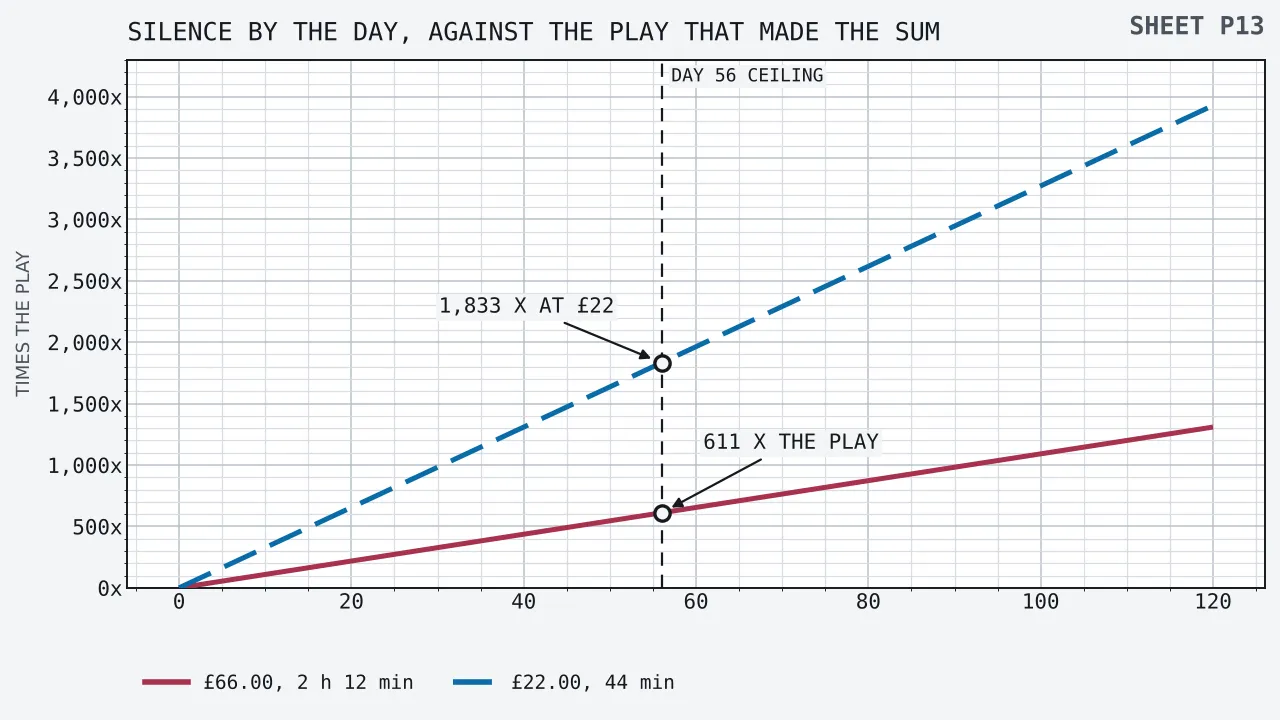
Six hundred and ten point nine is where the lower line crosses that rule, and it is the figure this note was written to produce. At the moment a licensed business would have had to conclude the matter, a person holding £66.00 has spent 611 hours of silence for every hour of pressing that produced it. The ratio is not a penalty and nobody charged it. It is simply what 1,344 hours divided by 2 h 12 min comes to.
One thousand eight hundred and thirty-two point seven is the same crossing for a £22.00 balance made in 44 minutes, and the smaller sum is worse off because the denominator shrank while the clock did not. Put generally, a modest balance gets argued over on precisely the timetable a large one does, so the smaller the sum, the more absurd the ratio of waiting to winning becomes.
10.9 added to the ratio each day, on a sum made in 2 h 12 min
Fifty-five hours is the other end of this arithmetic, being what £66.00 amounts to as expected cost rather than as stake, and it is the figure to have in mind at the moment of deciding to stop. Giving the balance up costs 16,500 presses of expectation, 150 goes at a handset, twenty-five times the pressing that made it. That is a real price, it is payable at any moment, and the only thing the waiting adds to it is more waiting.
Three hundred and sixty-five days of quiet puts the ratio at 3,982 and the money at exactly the same £66.00 it was on the first evening. Nothing accrues. No interest runs, no penalty attaches, and no figure anywhere grows except the count of hours. A reader who understands only that sentence has the whole of this note, because it is the precise difference between a dispute with a deadline and a dispute without one.
8
Limits that fall on the person complaining rather than the business
Saying that nothing exists offshore would be wrong, and the Curaçao rulebook is the one that can actually be read, so this part reports what it binds. Three of its limits fall on the player rather than on the operator, an unusual direction for a consumer rule to point, and the reason each of them gets a paragraph to itself.
One attempt is all an independent adjudication gets. Restarting it in front of some other body is shut off to both sides once a process has finished, so a disappointing outcome is final in the practical sense even where nothing about it binds in the formal one. A reader with £66.00 outstanding gets one go at the independent step and then the independent step is spent.
Walking out mid-process costs the same thing. Where a player abandons an adjudication already under way, the rulebook’s position is that the matter should not be raised again later. Somebody who starts, loses patience and stops has not paused. They have finished, and the balance they stopped arguing about keeps its place in part seven’s third state permanently.
Complaining is reserved to the registered player, and the reason sits in a provision about ownership rather than one about procedure. Selling such a claim is barred there, and so is giving it away, renting it, leasing it, pawning it or pledging it as security, so it cannot pass to anybody better placed to pursue it. The claim and the person are welded together, whatever the person’s circumstances by the time the argument matures.
Twice a year the operators there report how many complaints they have had, the two dates being 15 January and 15 June. January 2026 was when the first set fell due, and what goes in covers totals, outcomes, categories, referrals onward and cases that reached a court. Nothing aggregating those returns could be found at any citable source. No offshore complaint volume appears on this page as a result, and an invented one would be worse than the gap.
Nothing in this part is an argument that the offshore side ignores complaints. It is an argument about who holds the pen. Dates set by a licence condition bind whoever holds the licence. Dates set in a rulebook that leaves the parameters to the operator bind in whatever shape the operator gave them, and a reader cannot read that shape off a banking page before depositing.
9
What can be settled at the till, and what cannot
First, the instrument is honest about itself and should be given credit for it. A code buys a fixed quantity of play with no account attached, which is a genuine thing to want. Nothing in this note argues that the object is defective. The argument is about what happens at the other end, where the object has no part to play and never claimed to have one.
Second, the exit belongs to the other side and that is the fact to carry away. Sixty hours, 94 h 17 min and 118 h 17 min are the three modelled fillings of a blank the reader cannot write in, and 58 h 17 min separates the quickest from the slowest. No banking page says which filling is used, and asking before depositing is the only moment at which the question can be asked usefully.
Third, eighteen of those hours are free to remove. Identity work settled on the day an account opens is identity work that cannot stand in front of a payment later, and the saving is the same whichever exit gets picked. It is the only term on the table in part four that answers to the person waiting.
Fourth, a deadline is worth more than a verdict. Fifty-six days from arrival is not a promise that anybody will agree with the complaint. It is a promise that the silence ends, which is the single property part seven shows to be missing, and 611 times the play is what that property is worth on a £66.00 balance.
Fifth, and last, the price of stopping is knowable in advance and the price of continuing is not. Writing £66.00 off costs 16,500 presses of expectation, 55 hours, 150 goes at a handset, and it costs that whether the decision is taken on day three or day three hundred. Everything gained by waiting is an answer that nobody is obliged to give, and everything spent on waiting is the only quantity in this note that never stops rising.
Questions
- Can a win be sent back onto the code that paid it in?
- No, and that is the premise everything here rests on. A prepaid code has no account behind it waiting to be credited, and nobody owns one in a way that a payment could be addressed to. So the destination for a payout has to come from somewhere else, and on this rail it comes from the party holding the money rather than from the person asking for it.
- How long does the payout take on the figures used here?
- Sixty hours, 94 h 17 min or 118 h 17 min, depending on which exit the other side supplies. Each total is 36 hours of a desk considering the request, 18 hours of identity work landing at the exit, the leg itself at 6, 30 or 54 hours, and a calendar allowance of 10 h 17 min on the two that wait for a bank. Every length is supposed by this page and nothing was observed.
- Why can the reader not choose where the money is sent?
- Because the instrument that funded the account cannot receive anything, so the request goes in with the destination blank and the blank is filled in by whoever is being asked to pay. Somebody who deposited by card has a destination already on file. Somebody who deposited by code has given a cashier nothing to send to, and the cashier’s own preference becomes the waiting time.
- Where does the calendar allowance of 10 h 17 min come from?
- From counting seven starting days under one rule, which is that value travels between banks on weekdays and not at weekends. A leg ready on any weekday waits nothing, one ready on a Sunday waits a day and one ready on a Saturday waits two. Three days of waiting spread over seven starts is 0.4286 of a day, which is 10 h 17 min, and 71.4 per cent of starts in fact meet no delay whatever.
- Is there a worse evening of the week to ask on?
- Wednesday, on these suppositions. Fifty-four hours of desk and examination stand in front of the moving leg, so a request lodged on a Wednesday evening leaves the leg ready in the small hours of Saturday and it waits the full two days. The same request a day later reaches the leg on a Sunday and waits one. Nobody prints the 54 hours, so the only way to use this is to work out a run-up and count forward from it.
- What does a licensed business have to do about a complaint, and by when?
- Four dates bind it. Confirming receipt takes one day where the business trades at every hour and three working days otherwise. Its own handling, internal steps included, runs no further than 56 days from arrival, which is 1,344 hours and traces back to a provision of the social responsibility code. Six months at minimum has to stay open from the incident for a complaint to be raised in, and no term may cut into that half-year. One pause exists and the customer owns it: a request the business could fairly make, left seven days without a reply, can stop the count, which a reply then restarts at the figure it stopped on.
- Why does the page measure silence against hours of play?
- Because a wait with no last hour has no average, so there is nothing honest to divide by. Measuring it instead against the 2 h 12 min of pressing that produced the £66.00 puts both sides in one unit. The ratio rises by 10.9 every day, reaches 610.9 at day 56, where a licensed business would have had to finish, and simply keeps going after that.
- Does a smaller balance come off better?
- Worse, and the arithmetic says why. A £22.00 balance is 44 minutes of pressing, so the same day of silence counts for three times as much against it. At day 56 the ratio stands at 1,832.7 rather than 610.9. A modest sum is argued over on exactly the same timetable as a large one, which makes the waiting absurd in proportion to the money rather than in proportion to anything else.
- What does giving up on the balance actually cost?
- Sixteen thousand five hundred presses of expected cost, which is 55 hours of pressing and 150 goes at a handset of twenty-two supposed minutes. At four pence in every staked pound each press expects to cost 0.4p, so £66.00 is 16,500 presses, and 16,500 over the 660 presses that made the sum is twenty-five, the reciprocal of the margin. The price is the same on day three as on day three hundred.
- Does the offshore rulebook say nothing about complaints?
- It says a good deal, and three of its limits land on the player. Restarting an independent adjudication in front of some other body is shut off once a process has finished. Somebody who abandons one already under way should not raise the matter again afterwards. And complaining is reserved to the registered player, since selling such a claim is barred there, as are giving it away, renting it, leasing it, pawning it and pledging it as security. Twice a year the operators there report how many complaints they have had, on 15 June and on 15 January, the first set falling due in January 2026, and nothing aggregating those returns could be found, so no offshore volume is quoted here.
- What is worth doing before any of this arises?
- Getting identity settled on the day the account is opened, which takes 18 hours out of every total in part four and costs nothing beyond doing the paperwork early. Asking, before depositing, what a payout gets sent to when the deposit arrived by code. And noticing that a deadline is worth more than a verdict, because 56 days from arrival promises only that the silence ends, and the silence ending is the one thing part seven shows to be missing.
- Who should a reader ring if the registration is what stands in the way?
- GamCare. Its National Gambling Helpline answers, free of charge, on 0808 8020 133. Nobody pays for the call, messages and live chat work as readily as the telephone, and no hour of the year finds it shut. Worry about another member of the household is as good a reason to use it as worry about oneself. One registration with Gamstop Online reaches every gambling company licensed in Great Britain, and one part way through may be added to instead of being left to expire.