Note C03 Revision 1 Terms read 17 October 2026
One pound in, and the altogether larger number a cashier wants before it will send anything back
Matched at a hundred per cent, a single pound makes a balance of £2.00 and a condition of £40.00. That is 400 presses at ten pence, 1 h 20 min where this note supposes twelve seconds for one, and four sittings. Discharging it is expected to leave forty pence, and forty pence is what any floor on the way out gets measured against.
The balance £2.00 The run 1 h 20 min Expected at the close £0.40
What a payment of this size asks in hours
Advertising has been bought for every destination below. A fee reaches this site when a reader goes on to register, and no figure on this page moves one way or the other because of it.
-
01Mobile Free Spins
Betportal
Ceiling as a multiple
What lands€15.00150 spins at 10c, which is this site's figure and not the operator'sThe run17 h 30 minTurning over 525.00 at 10p means 5,250 presses, or about 48 phone sittings of 22 minutes. Timed at 10p a press and 12 seconds between presses, both of which this site assumes rather than measures.The wait to be paidNOT PUBLISHEDThis operator puts no withdrawal band in its own terms, so there is nothing honest to print here.Spins valued at this site's own 10p a spin
What lands
Spins, at a price15.00150 of them at 10c apiece, a figure belonging to this site rather than to the operatorMatch, and other creditno figure300% of three deposits, to a ceiling of €1,000. Not a sum until money of yours makes it one, so this row totals nothing and carries nothing downwardsThe run
Handed back on the spins(0.60)Each press stakes its own value and returns 96 per cent, which leaves this much with the house from the opening pressPlay-through 35x on the bonus(20.16)Taking 14.40 round 35 times over means 504.00 through the machines, of which 20.16 is the expected cost, and 17 h 30 min of pressing at the pace aboveWhat counts towards it100%Slots only, with no percentage published anywhere, so the row above assumes the whole of each stake countsWhat never clears
Limit on the winningsstated5x the bonusDeducted on the way outno figureNothing is published as a figure here, so this row removes nothingLeast that can leaveno figureNo figure is published, so nothing on this timer is pinned down by oneLeast deposit, and the rung over ityour own€20 a stage. Published in euros, so no rung is named at all: this site's ladder is a sterling oneThe window on the creditstated14 daysBiggest stake while it runsstated€5Removed outright by rulestatedNot publishedVerified before a payoutstatedDocuments before the first withdrawalNever clears€15.00Not a penny of it gets out, so the whole of what landed stands on this rowNo Great Britain licence
Licence held in Anjouan, Comoros, the company named is BetPortal Gaming Ltd, with Excite Ultra Media Ltd, quoted under ALSI-202601040-FI2.
Terms read 17 October 2026
Open the offer at Betportal, opens in a new window -
02Mobile Free Spins
WinBeast
Ceiling as a sum
What lands€50.00500 spins at 10c, which is this site's figure and not the operator'sThe run2 d 18 hTurning over 2,000.00 at 10p means 20,000 presses, or about 182 phone sittings of 22 minutes. Timed at 10p a press and 12 seconds between presses, both of which this site assumes rather than measures.The wait to be paidNOT PUBLISHEDThis operator puts no withdrawal band in its own terms, so there is nothing honest to print here.Spins valued at this site's own 10p a spin
What lands
Spins, at a price50.00500 of them at 10c apiece, a figure belonging to this site rather than to the operatorMatch, and other creditno figure50% to 100% of five deposits, each to a ceiling of €1,000, and a €650 free bet. Not a sum until money of yours makes it one, so this row totals nothing and carries nothing downwardsThe run
Handed back on the spins(2.00)Each press stakes its own value and returns 96 per cent, which leaves this much with the house from the opening pressPlay-through 40x on the bonus and the winnings from the spins(76.80)Taking 48.00 round 40 times over means 1,920.00 through the machines, of which 76.80 is the expected cost, and 2 d 18 h of pressing at the pace aboveWhat counts towards it100%Slots, titles vary by country, with no percentage published anywhere, so the row above assumes the whole of each stake countsWhat never clears
Limit on the winningsstated€100 a batch of spinsDeducted on the way outno figureNothing is published as a figure here, so this row removes nothingLeast that can leaveno figureNo figure is published, so nothing on this timer is pinned down by oneLeast deposit, and the rung over ityour own€20 a stage. Published in euros, so no rung is named at all: this site's ladder is a sterling oneThe window on the creditstated7 days, spins 1 dayBiggest stake while it runsstatedNot publishedRemoved outright by rulestatedNot publishedVerified before a payoutstatedDocuments before the first withdrawalNever clears€50.00Not a penny of it gets out, so the whole of what landed stands on this rowNo Great Britain licence
Licence held in Curaçao, no company named anywhere on the site.
Terms read 17 October 2026
Open the offer at WinBeast, opens in a new window -
03Mobile Free Spins
EliteSpin
Longest spin window
What lands£50.00500 spins at 10p, which is this site's figure and not the operator'sThe run2 d 18 hTurning over 2,000.00 at 10p means 20,000 presses, or about 182 phone sittings of 22 minutes. Timed at 10p a press and 12 seconds between presses, both of which this site assumes rather than measures.The wait to be paidNOT PUBLISHEDThis operator puts no withdrawal band in its own terms, so there is nothing honest to print here.Spins valued at this site's own 10p a spin
What lands
Spins, at a price50.00500 of them at 10p apiece, a figure belonging to this site rather than to the operatorMatch, and other creditno figure50% to 100% of five deposits, each to a ceiling of £1,000. Not a sum until money of yours makes it one, so this row totals nothing and carries nothing downwardsThe run
Handed back on the spins(2.00)Each press stakes its own value and returns 96 per cent, which leaves this much with the house from the opening pressPlay-through 40x on the bonus and the winnings from the spins(76.80)Taking 48.00 round 40 times over means 1,920.00 through the machines, of which 76.80 is the expected cost, and 2 d 18 h of pressing at the pace aboveWhat counts towards it100%Slots, with no percentage published anywhere, so the row above assumes the whole of each stake countsWhat never clears
Limit on the winningsstated5x the bonusDeducted on the way outno figureNothing is published as a figure here, so this row removes nothingLeast that can leaveno figureNo figure is published, so nothing on this timer is pinned down by oneLeast deposit, and the rung over ityour own£20 a stage. It lands square on the £20.00 rung, so none of yours is left perched on topThe window on the creditstated7 days, spins 3 daysBiggest stake while it runsstatedNot publishedRemoved outright by rulestatedNot publishedVerified before a payoutstatedDocuments before the first withdrawalNever clears£50.00Not a penny of it gets out, so the whole of what landed stands on this rowNo Great Britain licence
Licence held in Costa Rica, the company named is PrimeTier Limited.
Terms read 17 October 2026
Open the offer at EliteSpin, opens in a new window -
04Mobile Free Spins
Crown Jewelz
Multiple unpublished
What lands£15.00150 spins at 10p, which is this site's figure and not the operator'sThe runNOT TIMEDThis operator does not publish the play-through multiple in its own terms. The multiple is the one figure the clock cannot work around, so the run is left untimed.The wait to be paidNOT PUBLISHEDThis operator puts no withdrawal band in its own terms, so there is nothing honest to print here.Nothing reckoned
What lands
Spins, at a price15.00150 of them at 10p apiece, a figure belonging to this site rather than to the operatorMatch, and other creditno figure200% of the first deposit, then 150% twice, each to a ceiling of £1,000. Not a sum until money of yours makes it one, so this row totals nothing and carries nothing downwardsThe run
Play-throughno figure40x the bonus, reported rather than published by the operatorWhat counts towards itno figureSlots, with no percentage published anywhere, so the row above assumes the whole of each stake countsWhat never clears
Limit on the winningsstatedNot publishedDeducted on the way outno figureNothing is published as a figure here, so this row removes nothingLeast that can leaveno figureNo figure is published, so nothing on this timer is pinned down by oneLeast deposit, and the rung over ityour own£20. It lands square on the £20.00 rung, so none of yours is left perched on topThe window on the creditstatedNot publishedBiggest stake while it runsstatedNot publishedRemoved outright by rulestatedNot publishedVerified before a payoutstatedDocuments before the first withdrawalNever clearsNOT RECKONEDThis operator leaves the play-through multiple out of its own terms, so nothing below the fourth step can be worked out.No Great Britain licence
Licence held in Curaçao, number not verified, no company named anywhere on the site.
Terms read 17 October 2026
Open the offer at Crown Jewelz, opens in a new window
Only the middle reading comes out of arithmetic belonging to this site. The multiple laid against what lands gives the turnover asked for; dividing that by 10p a spin gives the presses; dividing those by 300 an hour gives the hours, a press on a handset being taken here at 12 seconds from the one before. Both figures are assumptions rather than measurements of anybody: nothing was played and nothing was held a stopwatch to. Anybody quicker should divide the press count by a rate of their own, which is why the presses are printed alongside the hours instead of being summarised away.
The first reading is what arrives before any condition is laid against it. Spins carry no unit of their own so one gets supplied: where an operator values its own spin that figure is used and attributed, and where it does not, this site's 10p a spin stands in and everything below moves with it. The third reading belongs to the operator entirely. It is a withdrawal band quoted from published terms, and a blank there means none was published rather than that nobody looked.
The total along the foot answers what the hours leave open, which is whether any of the running ends anywhere. It is what arrived, less whatever is still standing once the play-through has been paid for at 96 per cent return to player and once a published limit, a published deduction and a published floor beneath the least that can leave have each had a turn. It appears again in pence in the pound, the only fair way of holding a small offer up against a large one. It describes an offer rather than an evening, and where the conditions price out what arrived, a timer prints nothing getting out instead of a negative sum.
Cashiers on a handset take deposits off a row of preset buttons, so a least deposit given in pounds is raised to the next rung of the ladder used here, £10, £20, £25, £50, £75 and £100, and the timer shows what is left perched on it. That money is the reader's own and enters no sum at all. Given in euros it prints untouched, the ladder being sterling. Three words may occupy the figure column where no figure belongs. Stated is a published term that costs something while leaving no number to subtract. No figure is a term nobody has quantified, or a credit that is not a sum until money of yours makes it one. Your own is money of yours, which belongs in none of this.
None of the operators above is licensed in Great Britain, so not one duty that licence carries reaches any of them. Membership of Gamstop Online is compulsory for every online gambling company licensed in Great Britain, which means that shutting yourself out through the scheme shuts you out of none of these. The limit of ten times the bonus funds on a wagering requirement, running since 19 January 2026 under Social Responsibility Code 5.1.1, is a condition of the same licence and binds only whoever holds one. Off that licence, the Gambling Commission writes of consumers meeting unfair gaming practices, financial loss and no recourse when matters go wrong, and lists blocked payouts and withdrawal limits pitched too high to reach among the things it has seen. No account at any of them may be held by anybody under 18.
Every term on a timer is its operator's own and every timer carries the day somebody read it. The oldest of those readings is 17 October 2026. What binds a reader is an operator's full terms and never a line printed here.
1
Two doorways, two figures, and only one of them advertised
A cashier screen carries a smallest number for money arriving and a smallest number for money leaving, and almost nobody notices that they are two separate decisions. The arriving one is printed large, because a low figure sells an account. The leaving one sits in a payments article several taps away and is usually a multiple of the other.
One pound is as low as the arriving figure goes on a British-facing cashier page. This note takes a tenner as the figure on the way out and labels that as its own supposition throughout, because nothing on the regulator’s pages that this note draws on fixes a smallest sum a business must be willing to send, and a figure nobody publishes is not a figure to invent. Everything below marked as supposed rests on that £10.00 and on nothing firmer.
Three readings come out of a pound once a hundred per cent match has doubled it. Ten presses is what the pound itself funds at ten pence a press. Twenty presses is what the pair funds once the credited pound joins it, which is four minutes of reel where this note supposes twelve seconds for a press. Four hundred presses is what the condition demands, and the distance between twenty and four hundred is the whole subject here.
| What is being counted | Presses | Length supposed |
|---|---|---|
| The payment, staked once | 10 | 2 min |
| Payment and credit, staked once | 20 | 4 min |
| Forty times the credited pound | 400 | 1 h 20 min |
| The balance played to exhaustion | 500 | 1 h 40 min |
Twelve seconds for one press and twenty-two minutes for one sitting with a handset are suppositions this note adopts in order to compute at all. Neither was observed, timed or read off any instrument, and every length below follows from them, from a ten pence press and from ninety-six pence supposed to return in the pound. A sentence carrying a length says which supposition it stands on, every time.
Arrangements of this build hold no Great Britain licence, which means the register carries no entry to look the business up in, and the figure on the way out is settled by whoever wrote the payments article. Part seven sets out what that costs precisely rather than loosely, since the subject of this note is the exit and the exit is where the loss lands.
2
Where £40.00 of staking comes out of a two pound balance
Forty pounds is forty applied to a credited pound, and no other sum on this page comes straight out of the terms. Broken into ten pence pieces it makes 400 of them. Each piece takes the twelve seconds supposed here, so the total reaches 4,800 seconds, eighty minutes, 1 h 20 min. Eighty minutes over a sitting supposed at twenty-two returns 3.64, carried to four because nobody attends two thirds of a sitting.
£40.00 across the reels, asked of a £1.00 payment
Twenty to one is how the condition stands against the balance behind it. The account holds £2.00 and the clause wants £40.00 to cross the reels, so every pound in the account is asked to make the journey twenty times over. That ratio is fixed by the multiple and the match and it does not shift with the size of the payment, which is the first thing worth knowing about the axis this page works on.
Thirty pounds an hour is the rate money leaves at, being 300 presses in the hour where one press takes the supposed twelve seconds and costs ten pence. Four pence in each pound is supposed to stay behind, so the balance falls by twelve pence an hour. Eighty minutes of that comes to sixteen pence of expected margin on an account of two pounds, and the clause is discharged before the second pound is anywhere near gone.
Five hundred presses is where the whole balance is expected to run out, two pounds over the 0.4p a ten pence press is supposed to shed on average. That is one hour and forty minutes on the supposed interval, twenty minutes beyond the end of the clause. A hundred per cent match is the one shape where the money outlives the condition at every payment size, and the comfort in that is smaller than it sounds, for the reason part three gives.
Four sittings, at the length supposed here, is a figure for a week rather than for a bank statement. One sitting an evening, at that same supposed length, finishes the condition on the fourth night. Two on a Saturday and two on a Sunday finishes it inside a weekend. Nothing in that arrangement touches the 400, a count fixed by the multiple and by the size of one press before a reader opens anything at all.
3
Forty pence, which is what finishing is expected to leave
Forty pence is the balance expected to be standing at press 400. Two pounds went in between the two parties, £1.60 of expected margin came out of £40.00 sent across the reels at the four pence a pound supposed here, and £0.40 is the remainder. A reader who completes everything the sheet asks is expected to be looking at forty pence, having sent a pound.
Two fifths of the payment is that same figure written as a fraction, and the fraction holds at every size on this axis. Double the payment and the balance, the condition and the expected close all double with it, so the close stays at forty per cent of whatever was paid in. There is no payment size at which finishing the condition is expected to return more than went in, because the arithmetic that produces the forty per cent has no term in it for the size of the payment at all.
| Paid in | Balance | Presses the clause asks | Presses the balance funds | Run supposed | Expected at the close |
|---|---|---|---|---|---|
| £1.00 | £2.00 | 400 | 500 | 1 h 20 min | £0.40 |
| £2.00 | £4.00 | 800 | 1,000 | 2 h 40 min | £0.80 |
| £3.00 | £6.00 | 1,200 | 1,500 | 4 h | £1.20 |
| £5.00 | £10.00 | 2,000 | 2,500 | 6 h 40 min | £2.00 |
| £10.00 | £20.00 | 4,000 | 5,000 | 13 h 20 min | £4.00 |
| £20.00 | £40.00 | 8,000 | 10,000 | 26 h 40 min | £8.00 |
Column five is the one that does the damage and column six is the one that explains why. Each extra pound paid in adds 400 presses and an hour and twenty minutes of pressing on the supposed interval, and returns forty pence of expectation against the pound that bought it. Sixty pence a pound is therefore the expected cost of travelling this axis upwards, and it buys nothing the reader did not already have.
Minus sixty pence is the house formula’s answer for a credited pound at forty times with ninety-six per cent supposed back. Forty lots of four hundredths make 1.6; one less 1.6 leaves minus 0.6; a pound taken through that is minus £0.60. The bank statement reaches the same answer by subtraction: a pound out, forty pence expected back, sixty pence between them.
1.00 × (1 − 40 × 0.04) = minus 0.60
Agreement between those two routes deserves saying outright, since it is the thing that prices the credited pound at nothing. One route prices the credit by itself, the other prices the entire exercise from the bank outwards, and they can only land on the same sixty pence where the credited half contributes nought to the answer.
4
A ten pound exit read against a two pound account
Ten pounds, supposed here as the smallest sum a payments article will send, is five times the whole balance and twenty-five times what the condition is expected to leave standing. The two figures are not near enough to argue about. They are in different orders of magnitude, and that is the honest shape of a one pound payment at a cashier that writes both ends of its own arrangement.
Four hundred presses have to be made before the comparison can even be attempted, which is the part that gets missed. A balance holding credit is not a balance anybody can ask for, so the exit figure is unreachable not because the sum is too small but because the money is not yet the reader’s to request. One hour and twenty minutes of pressing on the supposed interval stands between the payment and the first moment the question of a floor on the way out becomes a real question.
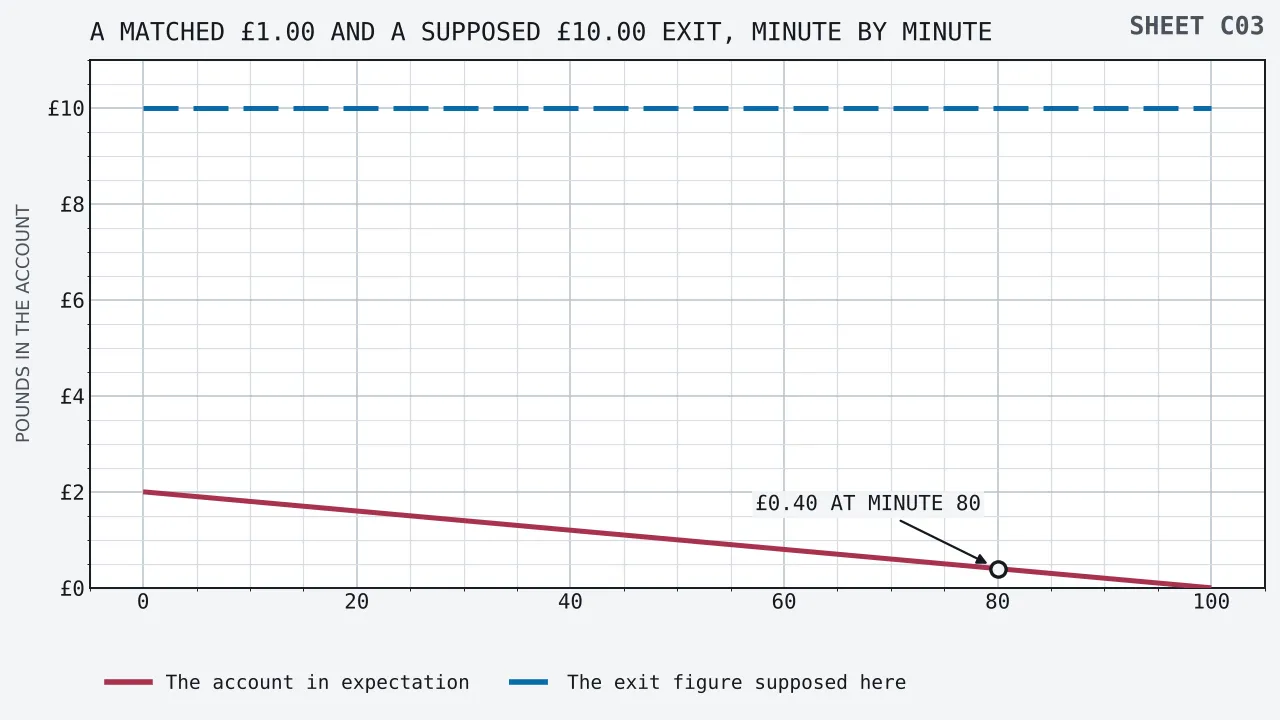
Nine pounds and sixty pence is the distance between the start of the falling line and the flat one, and the distance widens rather than narrows as the pressing goes on. By press 400 the gap is £9.60 and the clause is finished. By press 500 the gap is the whole ten pounds and so is the loss. Nothing in the run is working towards the figure the exit requires, because the run is an expenditure and the exit figure is a threshold.
Twenty-five times the expected close is what reaching a supposed £10.00 exit would ask of a single pound, and a page that pretended to put a likelihood on that would be inventing one. What can be said without inventing anything is the arithmetic of the average: the average lands at forty pence, the threshold sits at ten pounds, and anybody who gets there has had a run far above the average rather than a better method.
A floor on the way out is not the same creature as a charge on the way out, and the two are often printed in the same paragraph. A floor refuses the movement altogether. A charge permits it and shortens it. Against a balance expected to hold forty pence, the floor is decisive and the charge never gets the chance to be.
5
What it would cost to pay a way over the exit figure
Twenty-five pounds is the payment at which the expected close first reaches a supposed £10.00 exit, since the close is two fifths of whatever went in and two fifths of twenty-five is ten. That single figure reframes the whole page. The way to make the arithmetic of the exit work is not to press harder or longer but to pay in twenty-five times as much, and the bill for doing so is the point of this part.
Ten thousand presses is what a £25.00 payment signs up to: forty times a credited twenty-five is £1,000.00 across the reels, which at ten pence is 10,000 presses, 120,000 seconds, and 33 h 20 min on the supposed interval. Against a sitting supposed at twenty-two minutes that is 91 separate occasions with a handset, 90.9 carried up.
| Paid in | Expected close | Against a £10.00 exit | Presses | Run supposed | Expected cost |
|---|---|---|---|---|---|
| £1.00 | £0.40 | Short by £9.60 | 400 | 1 h 20 min | £0.60 |
| £5.00 | £2.00 | Short by £8.00 | 2,000 | 6 h 40 min | £3.00 |
| £10.00 | £4.00 | Short by £6.00 | 4,000 | 13 h 20 min | £6.00 |
| £20.00 | £8.00 | Short by £2.00 | 8,000 | 26 h 40 min | £12.00 |
| £25.00 | £10.00 | Level with it | 10,000 | 33 h 20 min | £15.00 |
Fifteen pounds in the last column is the expected cost of arriving at a sum of exactly ten pounds that a payments article would then agree to move. Nobody would describe that as a purchase if it were written on a receipt. Thirty-three hours and twenty minutes at the handset is the other half of the price, and the two together buy the right to request, on average, forty per cent of the money originally sent.
One pound and twenty-five pounds are the two ends of that table and they fail the exit test in opposite ways. The pound fails it by a distance nothing can close. The twenty-five pounds clears it and costs more than the clearing is worth. Between them every row is the same trade at a different scale, which is the plainest demonstration that the exit figure is not a hurdle a reader can train for.
Nought of this changes if the pressing speeds up. Ten thousand is settled by forty times at ten pence and by nothing else, so supposing six seconds instead puts the same payment at 16 h 40 min and leaves every pound in the table where it stands. Pace settles the count of weeks and nothing besides, the sum at the far end having been fixed by the terms before anybody began.
6
The price of moving a pound, counted in presses
Charges for moving money are a proportion of the sum being moved, and on a pound that proportion is brutal in a way it never is on a larger payment. This part supposes a flat charge of twenty pence on a movement, declares the supposition plainly, and then works out what a flat charge of that size does at each end of the arrangement.
Twenty per cent is a twenty pence charge set against a one pound payment. The identical charge against twenty pounds is one per cent. Nothing about the charge has altered between those two sentences and the burden has moved by a factor of twenty, which is the ordinary behaviour of a flat fee and the reason the smallest payments are the worst served by one.
| Paid in | 20p as a share | Presses it removes | Reel lost, supposed | Set against the expected close |
|---|---|---|---|---|
| £1.00 | 20.0% | 2 | 24 s | Half of a £0.40 close |
| £2.00 | 10.0% | 2 | 24 s | A quarter of a £0.80 close |
| £3.00 | 6.7% | 2 | 24 s | A sixth of a £1.20 close |
| £5.00 | 4.0% | 2 | 24 s | A tenth of a £2.00 close |
| £10.00 | 2.0% | 2 | 24 s | A twentieth of a £4.00 close |
| £20.00 | 1.0% | 2 | 24 s | A fortieth of an £8.00 close |
Forty pence is what a supposed twenty pence at each end of the journey comes to, and forty pence is also the sum the condition is expected to leave on a one pound payment. Those two figures being equal is the sharpest line this page has to offer: on the suppositions set out here, the charges for moving the money in and out swallow the entire expected proceeds of an hour and twenty minutes of pressing, with nothing over.
Two presses is the same charge counted the way this site counts everything, twenty pence at ten pence a press, which is twenty-four seconds of reel on the supposed interval. On a pound that is a fifth of the funded pressing gone before a reel has turned. On twenty pounds it is a fiftieth, and the reader barely notices it because there are 198 presses left behind it rather than eight.
One warning belongs on this part and it is about the word supposed. A charge of twenty pence is used here because a worked figure is more useful than an adjective, and it is this note’s figure rather than anybody’s published one. A reader with the actual charge in front of them should redo the column: divide the charge by the payment for the share, and by ten pence for the presses, and the rest of the part follows unchanged.
7
Where the statute reaches, and where a payout does not
A desk arranged this way holds no Great Britain licence. On a page about getting one pound back out, the loss worth setting out is the statutory one, alongside the payout behaviour the regulator has put in writing. Both answer the same question: who stands at the other end of forty pence, and what exists to be done about them.
An operating licence is what section 33 of the 2005 Act demands before anybody may supply facilities for gambling at all, and the activity has to be carried on inside the licence it was granted under. Criminal penalties sit behind that demand: a custodial limit of 51 weeks, a fine at the standard scale’s fifth level, or both at once. North of the border the same 51 weeks is read as six months.
Nobody reading this takes on that offence by sending a pound. The section is drafted at the party supplying the facilities, no companion offence exists for the person using them, and what £1.00 forfeits at an unlicensed desk is therefore a set of protections rather than anybody’s liberty. Which protections is the business of the rest of this part.
Being elsewhere is no answer for the supplier either. Section 36 makes it beside the point whether facilities are put up within the United Kingdom or beyond it, and catches remote gambling along two routes: kit used to supply the facilities standing on British ground, or none of it standing there while the facilities get used here. A knowledge test rides on the second route, turning on what the supplier knows or ought to know about use in Great Britain. Both subsections arrived with the 2014 Act on licensing and advertising and bite for specified purposes from 1 November that year, the reach before then stopping at hardware inside the country.
| What a reader wants to know | What the Act fixes | What it leaves open |
|---|---|---|
| Who is on the hook | Whoever supplies the facilities | Nothing stands against the person playing |
| Whether a foreign desk is out of reach | No, since where it sits is beside the point | Whether anyone will in fact be pursued |
| Which remote set-ups are caught | Kit on British ground, or use on British ground | How a reader is meant to tell the two apart |
| How long the second route has run | Since 1 November 2014, for specified purposes | Anything at all about one particular payment |
| How forty pence gets home | Nought | Which is the entire subject of this note |
Row five is the live one on a payment this small, and the regulator has named the failure it keeps meeting rather than leaving it to be imagined. A post on the illegal market in October 2025, from the enforcement and intelligence director, records payouts being stopped, and sums demanded before money may leave pitched so high that nobody gets to them. That second observation is the arithmetic of this page described from the other side of the screen.
Unattainable is the word used there, and it is useful because it reports a relationship and not a number. Ten pounds standing alone is an unremarkable sum. Ten pounds beside a £2.00 balance whose expected close is forty pence is a different object entirely. The same post sets down financial loss and the absence of any route onwards when matters go wrong, which is exactly where a reader stands with 400 presses behind them and a payments article saying no.
Nought in that machinery brings forty pence back, and pretending otherwise would be the easiest error available here. An offence committed by a business under some other flag is not a mechanism for recovering a small balance from it. What the Act hands a reader instead is the position of the line, drawn by where the customer stands rather than by where the hardware does, and the knowledge that a desk sitting beyond it put itself there.
8
Who a single pound is genuinely for
One pound buys twenty presses and four minutes of reel on the supposed interval, half of it funded by somebody else, and for one sort of reader that is the entire transaction and a fair one. Somebody who wants to see whether a sign-up works, whether the lobby loads on their handset and whether a payment clears has bought the cheapest test available, and the answer arrives inside four minutes.
Four hundred presses is the other reading and it suits almost nobody. An hour and twenty minutes across four sittings, undertaken to arrive at an expected forty pence that a supposed £10.00 exit will not move, is work performed for a sum that cannot be collected. The condition is short by the standards of this section and it is still the wrong thing to attempt, which is an unusual combination worth naming.
Three figures settle it and all three sit away from the headline. Where the floor on the way out sits, since no amount of pressing moves the arithmetic any nearer to it. Whether the payment can be asked for back with the credit untouched, because that converts the pound from a stake into a deposit. And what a single movement of money costs, because at this size a flat charge is measured in fifths rather than in percentages.
Twenty to one is the ratio worth leaving with. The balance is £2.00, the condition is £40.00, and the ratio between them holds at every payment size because both grow together. What does not grow together is the figure on the way out, which is fixed in pounds while the expected close is fixed at two fifths of the payment, and those two facts are what make a small payment a different proposition rather than a smaller one.
Nobody should read any of this as an argument for paying in more. Sixty pence a pound is the expected cost of travelling up this axis, the run lengthens by an hour and twenty minutes for each pound added, and the only thing bought at the top of it is permission to request a sum smaller than the one that was sent. A pound spent on four minutes of reel, with the condition left alone, is the better of the two readings by a wide margin.
Questions
- How long does a £1 deposit casino bonus take to clear?
- One hour and twenty minutes of pressing. A hundred per cent match on a pound credits a pound, forty times that is £40.00 to send across the reels, which at ten pence a go comes to 400 presses and 4,800 seconds on the twelve seconds supposed here. Against a sitting supposed at twenty-two minutes it comes to four separate occasions with a handset. Both suppositions belong to this note and neither was observed.
- Can I withdraw after depositing only £1?
- Not until the condition is discharged, and probably not then either. A balance carrying credit is not a sum anybody can request, so 400 presses stand between the payment and the question. This note supposes a £10.00 figure on the way out, declares that as its own supposition because no published British rule fixes one, and finds the condition expected to leave forty pence against it. Five times the whole balance is what such a figure asks for.
- What is a matched pound expected to be worth at the end?
- Forty pence, and two separate sums agree on it. Two pounds goes into the account between the two parties, £1.60 of expected margin comes out of the £40.00 sent over the reels, four pence being supposed to stay behind in each pound, and the remainder is £0.40. The house formula prices the credited pound alone at minus sixty pence, and a pound sent against forty pence expected back is the same sixty pence by subtraction.
- Does paying in more fix the problem?
- It moves the expected close and it moves the bill with it. The close is two fifths of whatever was paid in, so reaching a supposed £10.00 figure on the way out needs a payment of £25.00. That carries £1,000.00 of staking, 10,000 presses, 33 h 20 min on the supposed interval and 91 sittings, at an expected cost of £15.00. Paying a way over a threshold costs half as much again as the threshold is worth.
- Why do small deposits suffer most from transfer charges?
- Because a flat charge is a fixed sum against a varying one. Twenty pence, a figure this note supposes rather than publishes, is twenty per cent of a one pound payment and one per cent of a twenty pound one. Counted the way this site counts, it is two presses and twenty-four seconds of reel at either size. A supposed twenty pence at each end comes to forty pence, which is the whole of what the condition is expected to leave on a pound.
- Is the balance expected to last long enough to finish the condition?
- Yes, at a hundred per cent, and that holds at every payment size. A balance of twice the payment funds five hundred presses for each pound paid in, against four hundred the condition asks for, so the money outlives the clause by a fifth. One hour and forty minutes against one hour and twenty is the shape of it on a single pound at the supposed interval.
- Does a cashier taking one pound payments hold a British licence?
- No, and the position is worth stating in the Act’s own terms. Such a lobby holds no Great Britain licence at all, and supplying facilities for gambling without one puts the supplier inside section 33 of the 2005 Act, which carries a custodial limit of 51 weeks, a fine at the standard scale’s fifth level, or both at once. Section 36 makes the location of the desk beside the point and catches remote gambling used on British ground, with a knowledge test running for specified purposes from 1 November 2014. No companion offence exists for the person playing, so what a pound forfeits is a set of protections and not anybody’s liberty. A post from the enforcement and intelligence director in October 2025 records payouts being stopped and sums demanded before money may leave pitched so high that nobody gets to them.
- Is a one pound deposit worth making at all?
- As a test of a cashier it is the cheapest one available, and four minutes of reel at the supposed interval will answer whether a sign-up, a lobby and a payment work. As a route to money it is the wrong move at any size, because the expected close is two fifths of the payment, the figure on the way out is fixed in pounds rather than in fifths, and sixty pence a pound is the expected cost of climbing towards it.