Section P Revision 1 Terms read 17 October 2026
The payout wait, broken into four lengths and reassembled rail by rail
Asking for money and receiving it are separated by four intervals and no more than four: a hold while somebody decides, an identity round where that was left until now, the rail’s own carrying leg, and the shut part of the banking week. Only the third of those belongs to the rail whose name is on the cashier screen, and the first is the largest on every route costed here. Nobody publishes a distribution of payout times, so every hour in this section is modelled from stated lengths, and the model is printed rather than implied.
Lengths in the chain Four Hold’s share on the quickest route 85.9% Calendar, averaged over a week 6 h 51 min
What a payout route is quoted at, and what it is costed at
Advertising has been bought for every destination below. A fee reaches this site when a reader goes on to register, and no figure on this page moves one way or the other because of it.
-
01Mobile Free Spins
Betportal
Ceiling as a multiple
What lands€15.00150 spins at 10c, which is this site's figure and not the operator'sThe run17 h 30 minTurning over 525.00 at 10p means 5,250 presses, or about 48 phone sittings of 22 minutes. Timed at 10p a press and 12 seconds between presses, both of which this site assumes rather than measures.The wait to be paidNOT PUBLISHEDThis operator puts no withdrawal band in its own terms, so there is nothing honest to print here.Spins valued at this site's own 10p a spin
What lands
Spins, at a price15.00150 of them at 10c apiece, a figure belonging to this site rather than to the operatorMatch, and other creditno figure300% of three deposits, to a ceiling of €1,000. Not a sum until money of yours makes it one, so this row totals nothing and carries nothing downwardsThe run
Handed back on the spins(0.60)Each press stakes its own value and returns 96 per cent, which leaves this much with the house from the opening pressPlay-through 35x on the bonus(20.16)Taking 14.40 round 35 times over means 504.00 through the machines, of which 20.16 is the expected cost, and 17 h 30 min of pressing at the pace aboveWhat counts towards it100%Slots only, with no percentage published anywhere, so the row above assumes the whole of each stake countsWhat never clears
Limit on the winningsstated5x the bonusDeducted on the way outno figureNothing is published as a figure here, so this row removes nothingLeast that can leaveno figureNo figure is published, so nothing on this timer is pinned down by oneLeast deposit, and the rung over ityour own€20 a stage. Published in euros, so no rung is named at all: this site's ladder is a sterling oneThe window on the creditstated14 daysBiggest stake while it runsstated€5Removed outright by rulestatedNot publishedVerified before a payoutstatedDocuments before the first withdrawalNever clears€15.00Not a penny of it gets out, so the whole of what landed stands on this rowNo Great Britain licence
Licence held in Anjouan, Comoros, the company named is BetPortal Gaming Ltd, with Excite Ultra Media Ltd, quoted under ALSI-202601040-FI2.
Terms read 17 October 2026
Open the offer at Betportal, opens in a new window -
02Mobile Free Spins
WinBeast
Ceiling as a sum
What lands€50.00500 spins at 10c, which is this site's figure and not the operator'sThe run2 d 18 hTurning over 2,000.00 at 10p means 20,000 presses, or about 182 phone sittings of 22 minutes. Timed at 10p a press and 12 seconds between presses, both of which this site assumes rather than measures.The wait to be paidNOT PUBLISHEDThis operator puts no withdrawal band in its own terms, so there is nothing honest to print here.Spins valued at this site's own 10p a spin
What lands
Spins, at a price50.00500 of them at 10c apiece, a figure belonging to this site rather than to the operatorMatch, and other creditno figure50% to 100% of five deposits, each to a ceiling of €1,000, and a €650 free bet. Not a sum until money of yours makes it one, so this row totals nothing and carries nothing downwardsThe run
Handed back on the spins(2.00)Each press stakes its own value and returns 96 per cent, which leaves this much with the house from the opening pressPlay-through 40x on the bonus and the winnings from the spins(76.80)Taking 48.00 round 40 times over means 1,920.00 through the machines, of which 76.80 is the expected cost, and 2 d 18 h of pressing at the pace aboveWhat counts towards it100%Slots, titles vary by country, with no percentage published anywhere, so the row above assumes the whole of each stake countsWhat never clears
Limit on the winningsstated€100 a batch of spinsDeducted on the way outno figureNothing is published as a figure here, so this row removes nothingLeast that can leaveno figureNo figure is published, so nothing on this timer is pinned down by oneLeast deposit, and the rung over ityour own€20 a stage. Published in euros, so no rung is named at all: this site's ladder is a sterling oneThe window on the creditstated7 days, spins 1 dayBiggest stake while it runsstatedNot publishedRemoved outright by rulestatedNot publishedVerified before a payoutstatedDocuments before the first withdrawalNever clears€50.00Not a penny of it gets out, so the whole of what landed stands on this rowNo Great Britain licence
Licence held in Curaçao, no company named anywhere on the site.
Terms read 17 October 2026
Open the offer at WinBeast, opens in a new window -
03Mobile Free Spins
EliteSpin
Longest spin window
What lands£50.00500 spins at 10p, which is this site's figure and not the operator'sThe run2 d 18 hTurning over 2,000.00 at 10p means 20,000 presses, or about 182 phone sittings of 22 minutes. Timed at 10p a press and 12 seconds between presses, both of which this site assumes rather than measures.The wait to be paidNOT PUBLISHEDThis operator puts no withdrawal band in its own terms, so there is nothing honest to print here.Spins valued at this site's own 10p a spin
What lands
Spins, at a price50.00500 of them at 10p apiece, a figure belonging to this site rather than to the operatorMatch, and other creditno figure50% to 100% of five deposits, each to a ceiling of £1,000. Not a sum until money of yours makes it one, so this row totals nothing and carries nothing downwardsThe run
Handed back on the spins(2.00)Each press stakes its own value and returns 96 per cent, which leaves this much with the house from the opening pressPlay-through 40x on the bonus and the winnings from the spins(76.80)Taking 48.00 round 40 times over means 1,920.00 through the machines, of which 76.80 is the expected cost, and 2 d 18 h of pressing at the pace aboveWhat counts towards it100%Slots, with no percentage published anywhere, so the row above assumes the whole of each stake countsWhat never clears
Limit on the winningsstated5x the bonusDeducted on the way outno figureNothing is published as a figure here, so this row removes nothingLeast that can leaveno figureNo figure is published, so nothing on this timer is pinned down by oneLeast deposit, and the rung over ityour own£20 a stage. It lands square on the £20.00 rung, so none of yours is left perched on topThe window on the creditstated7 days, spins 3 daysBiggest stake while it runsstatedNot publishedRemoved outright by rulestatedNot publishedVerified before a payoutstatedDocuments before the first withdrawalNever clears£50.00Not a penny of it gets out, so the whole of what landed stands on this rowNo Great Britain licence
Licence held in Costa Rica, the company named is PrimeTier Limited.
Terms read 17 October 2026
Open the offer at EliteSpin, opens in a new window -
04Mobile Free Spins
Crown Jewelz
Multiple unpublished
What lands£15.00150 spins at 10p, which is this site's figure and not the operator'sThe runNOT TIMEDThis operator does not publish the play-through multiple in its own terms. The multiple is the one figure the clock cannot work around, so the run is left untimed.The wait to be paidNOT PUBLISHEDThis operator puts no withdrawal band in its own terms, so there is nothing honest to print here.Nothing reckoned
What lands
Spins, at a price15.00150 of them at 10p apiece, a figure belonging to this site rather than to the operatorMatch, and other creditno figure200% of the first deposit, then 150% twice, each to a ceiling of £1,000. Not a sum until money of yours makes it one, so this row totals nothing and carries nothing downwardsThe run
Play-throughno figure40x the bonus, reported rather than published by the operatorWhat counts towards itno figureSlots, with no percentage published anywhere, so the row above assumes the whole of each stake countsWhat never clears
Limit on the winningsstatedNot publishedDeducted on the way outno figureNothing is published as a figure here, so this row removes nothingLeast that can leaveno figureNo figure is published, so nothing on this timer is pinned down by oneLeast deposit, and the rung over ityour own£20. It lands square on the £20.00 rung, so none of yours is left perched on topThe window on the creditstatedNot publishedBiggest stake while it runsstatedNot publishedRemoved outright by rulestatedNot publishedVerified before a payoutstatedDocuments before the first withdrawalNever clearsNOT RECKONEDThis operator leaves the play-through multiple out of its own terms, so nothing below the fourth step can be worked out.No Great Britain licence
Licence held in Curaçao, number not verified, no company named anywhere on the site.
Terms read 17 October 2026
Open the offer at Crown Jewelz, opens in a new window
Only the middle reading comes out of arithmetic belonging to this site. The multiple laid against what lands gives the turnover asked for; dividing that by 10p a spin gives the presses; dividing those by 300 an hour gives the hours, a press on a handset being taken here at 12 seconds from the one before. Both figures are assumptions rather than measurements of anybody: nothing was played and nothing was held a stopwatch to. Anybody quicker should divide the press count by a rate of their own, which is why the presses are printed alongside the hours instead of being summarised away.
The first reading is what arrives before any condition is laid against it. Spins carry no unit of their own so one gets supplied: where an operator values its own spin that figure is used and attributed, and where it does not, this site's 10p a spin stands in and everything below moves with it. The third reading belongs to the operator entirely. It is a withdrawal band quoted from published terms, and a blank there means none was published rather than that nobody looked.
The total along the foot answers what the hours leave open, which is whether any of the running ends anywhere. It is what arrived, less whatever is still standing once the play-through has been paid for at 96 per cent return to player and once a published limit, a published deduction and a published floor beneath the least that can leave have each had a turn. It appears again in pence in the pound, the only fair way of holding a small offer up against a large one. It describes an offer rather than an evening, and where the conditions price out what arrived, a timer prints nothing getting out instead of a negative sum.
Cashiers on a handset take deposits off a row of preset buttons, so a least deposit given in pounds is raised to the next rung of the ladder used here, £10, £20, £25, £50, £75 and £100, and the timer shows what is left perched on it. That money is the reader's own and enters no sum at all. Given in euros it prints untouched, the ladder being sterling. Three words may occupy the figure column where no figure belongs. Stated is a published term that costs something while leaving no number to subtract. No figure is a term nobody has quantified, or a credit that is not a sum until money of yours makes it one. Your own is money of yours, which belongs in none of this.
None of the operators above is licensed in Great Britain, so not one duty that licence carries reaches any of them. Membership of Gamstop Online is compulsory for every online gambling company licensed in Great Britain, which means that shutting yourself out through the scheme shuts you out of none of these. The limit of ten times the bonus funds on a wagering requirement, running since 19 January 2026 under Social Responsibility Code 5.1.1, is a condition of the same licence and binds only whoever holds one. Off that licence, the Gambling Commission writes of consumers meeting unfair gaming practices, financial loss and no recourse when matters go wrong, and lists blocked payouts and withdrawal limits pitched too high to reach among the things it has seen. No account at any of them may be held by anybody under 18.
Every term on a timer is its operator's own and every timer carries the day somebody read it. The oldest of those readings is 17 October 2026. What binds a reader is an operator's full terms and never a line printed here.
1
Four lengths, and what each of them is waiting on
Every page beneath this heading takes the same chain apart, and the chain has four links. Naming them once is the main thing a section page can do, because almost every argument about payout speed turns out to be an argument about which link is being discussed.
First comes the hold. A request is lodged and somebody, or something standing in for somebody, releases it or does not. No network carries this, no settlement cycle governs it and no timetable binds it. Second comes the identity round, where establishing whose account it is was deferred until money was asked for. Third is the carrying leg, the only part belonging to the rail whose mark sits on the cashier screen. Fourth is the calendar, inserting whatever part of the week is shut between a release and an arrival.
| The link | Who holds it | Carried here as | Published anywhere |
|---|---|---|---|
| The hold before release | The cashier alone | 48 h | A band at most, never a distribution |
| The identity round, if deferred | Shared with the reader | 20 h | No, and it is nil where it was done early |
| The carrying leg | A bank, a card scheme or a wallet | 1 h to 48 h | Sometimes, as working days |
| The shut part of the week | Nobody | 6 h 51 min | No, and part three derives it |
Forty-eight hours in the first row is a round central figure chosen here and defended nowhere, because nothing better exists. Twenty hours in the second covers papers asked for, supplied and read. The third row is a range rather than a figure because it genuinely differs by route, and part five sets five of them out side by side.
Fourteen workings sit beneath this heading and all of them are built from stated lengths rather than from anything observed. No request was lodged anywhere, no payment was received, nothing was watched arriving and no operator’s performance is described. Where a figure here carries a duration, it came out of an assumption written down on the page carrying it, and the sentence says so. Pounds and pence behave the same way: the house arithmetic used across this site is a press of ten pence, ninety-six pence back from each staked pound and a clause of forty times, and a twelve-second gap between presses, a sitting running to twenty-two minutes, those last two being modelling conventions adopted here.
2
Why none of these figures could be looked up
A section about durations ought to open with a measured spread of outcomes, and no such spread exists to open with. Payout times are published by no regulator. No official statistic counts them. The fact sheet from which this site draws its regulatory claims records that gap rather than filling it, and forbids any payout speed being attached to a business by name. Trade commentary and operator marketing both discuss the subject at length, and neither can be cited here.
What follows from the gap is a method rather than a silence. Each length is given a figure, the figure is labelled as chosen rather than found, and every total is the sum of the four. Disagree with a length, substitute another, and the totals move by exactly the difference, which is what makes a declared model more useful than an undeclared estimate.
A band printed at a cashier is not a distribution either. It caps one link, and it usually starts at release rather than at the request, so the advertised interval and the experienced one begin in different places. The link with no published figure at all turns out, in part six, to be the one deciding the answer.
3
Working out the shut week instead of assuming it
Three of the four lengths are stipulated. The fourth should not be, because it follows from a single rule about the week and can be computed exactly. The rule adopted here is that nothing travels between banks across a weekend, which closes 48 hours out of every 168.
Suppose a release lands at an hour picked at random from the week. Landing anywhere in the open 120 hours inserts nothing. Landing inside the shut block inserts the remainder of that block, which runs from nothing up to the length of the block and averages half of it. Multiplying the chance of landing there by that conditional mean gives the block’s length squared over twice the week, and a block of 48 hours makes that 6 h 51 min.
6 h 51 min, a mean standing between two outcomes almost nobody has
That average describes nobody, and saying so is part of using it. Seven releases in ten meet no shut hours whatever. Rather fewer than three in ten meet a great deal of them. A mean lying between those two groups is the right figure to add to a total and the wrong one to plan around.
Tightening the rule makes it worse rather than better. Treat the week as open only during ordinary banking hours and the shut time becomes 128 hours of the 168, in five separate blocks: four overnight gaps of sixteen hours and one weekend gap of sixty-four. Each block contributes its own length squared, halved, and the sum divided by the week gives 15 h 14 min. This section carries the gentler of the two figures throughout and says which it is using.
4
One extra closed day does not add one day
The derivation above generalises, and the general form is where the practical value of it sits for anybody timing a request around a public holiday. A shut run of length L in a week of 168 hours inserts, on average, L squared divided by twice the week. The term is quadratic, so the shut run and its cost do not move together.
Two shut days cost 6 h 51 min. Three shut days do not cost half as much again; they cost 15 h 26 min, which is 2.25 times the two-day figure. Four cost 27 h 26 min, which is four times it. The square is doing all the work, because a longer block is both likelier to be landed in and longer to wait out once it has been.
| Days the week is shut for | Hours shut | Share of releases affected | Average inserted | Against the two day case |
|---|---|---|---|---|
| One | 24 | 14.3% | 1 h 43 min | 0.25 |
| Two | 48 | 28.6% | 6 h 51 min | 1.00 |
| Three | 72 | 42.9% | 15 h 26 min | 2.25 |
| Four | 96 | 57.1% | 27 h 26 min | 4.00 |
| Five | 120 | 71.4% | 42 h 51 min | 6.25 |
A week carrying a public holiday beside its weekend therefore adds 8 h 35 min to the average request, which is more than the whole carrying leg on the quickest route in part five. Nobody announces that and nobody is at fault for not announcing it, since anybody holding the formula can see it coming.
5
Five carrying legs set against one chain
Only the third link differs by route, and the workings beneath this heading set out five shapes it takes. A balance left sitting inside a wallet is shortest, since nothing has left the wallet. Emptying that wallet onward adds a second leg. A transfer arranged straight to an account is one longer leg, a card scheme is longer again, and a route that did not exist before the win has to be built first, which is the longest of the five.
| The carrying leg | Leg | Hold of 24 h | Hold of 48 h | Hold of 72 h | Hold’s share at 48 h |
|---|---|---|---|---|---|
| A balance left in a wallet | 1 h | 31 h 51 min | 55 h 51 min | 79 h 51 min | 85.9% |
| A transfer to a current account | 18 h | 48 h 51 min | 72 h 51 min | 96 h 51 min | 65.9% |
| A wallet emptied onward | 21 h | 51 h 51 min | 75 h 51 min | 99 h 51 min | 63.3% |
| A route opened after the win | 46 h | 76 h 51 min | 100 h 51 min | 124 h 51 min | 47.6% |
| A card scheme | 48 h | 78 h 51 min | 102 h 51 min | 126 h 51 min | 46.7% |
Every total ends in fifty-one minutes, which is the tell. The calendar is a constant added to all of them, so it changes no comparison between routes. Deferring the identity round adds a flat twenty hours to every cell, and changes no ordering either.
Forty-seven hours separate the top row from the bottom at any given hold, which is the entire contribution the choice of route makes. Set that against the hold’s own band and the comparison is not close.
6
Which of the four decides the answer, and by how much
Two tests settle the question, and they agree. The first is the level: at a hold of 48 hours the hold is the largest single length on four of the five routes and is level with the fifth. The second is the spread, which is the better test, because a length that never varies cannot explain a difference between two outcomes.
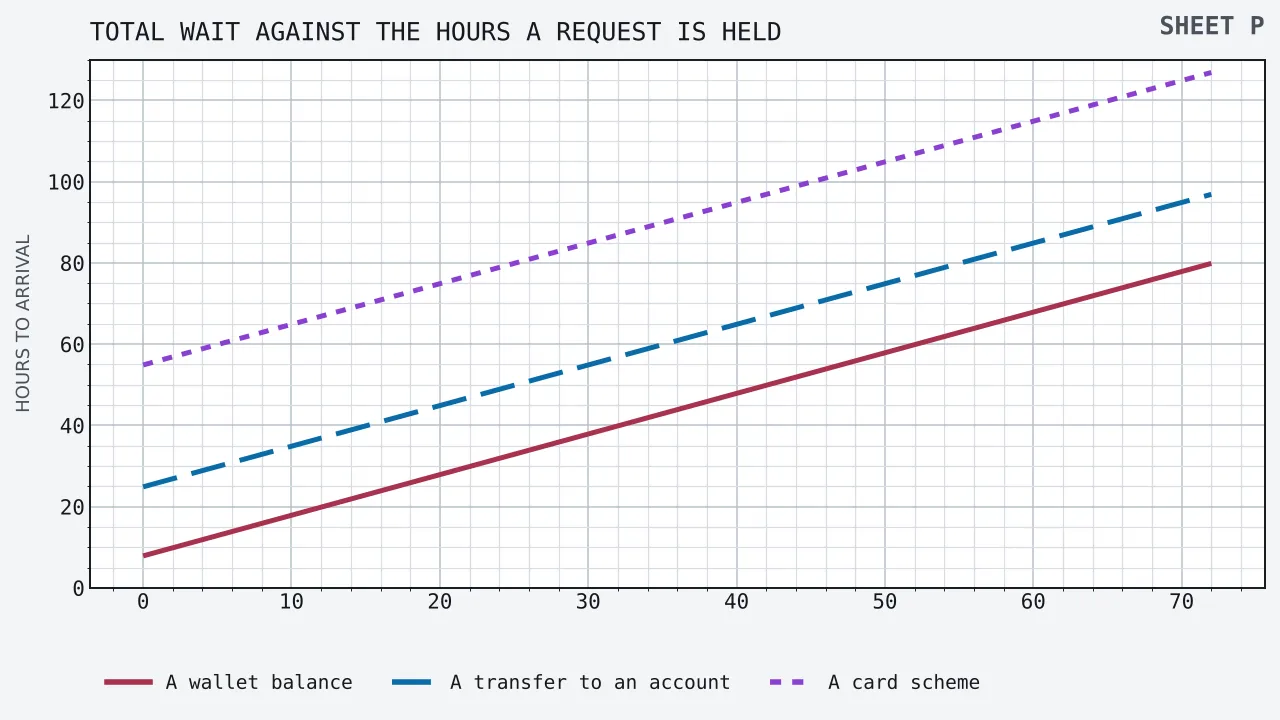
Parallel lines are the whole finding. An hour added to the hold moves every route by one hour, so the ordering never changes and the vertical gaps never close. The proportion does change: at 48 hours the hold takes 85.9 per cent of the lowest line and 46.7 per cent of the highest, where it is still the largest single piece.
Now the spread. Across the band this section models, the hold moves a total by 60 hours, from 12 at the quickest to 72 at the slowest. The carrying leg moves it by 47, from 1 to 48. The identity round moves it by 20, and the calendar moves the average by under 7 while moving an individual request by up to 48. So the one length with the widest spread is also the one with no published figure at all, and a promise about payout speed can only be a promise about it.
| The length | Shortest | Longest | Spread | Who moves it |
|---|---|---|---|---|
| The hold | 12 h | 72 h | 60 h | The cashier, to no published timetable |
| The carrying leg | 1 h | 48 h | 47 h | Chosen once, at the first deposit |
| The identity round | nil | 20 h | 20 h | Mostly the reader, and early |
| The calendar, on average | nil | 6 h 51 min | 6 h 51 min | Nobody |
7
Twenty hours anybody can remove before winning anything
One length in the chain is nil or twenty hours depending on a decision taken long before any money is asked for, and no other saving here is free. Settle who the account holder is at the door and the second link is already finished when the request is lodged. Leave it, and the demand for papers arrives at the precise moment a balance is standing and somebody wants it.
Twenty hours against a 55 h 51 min total is 26 per cent of the quickest wait, and against 102 h 51 min it is 16 per cent of the slowest. Neither costs a penny to collect, because the work is identical in both positions. Only the position differs, and the later one is where the file is larger, the reviewer more careful and the reader least able to walk away.
No part of this page is a way round a check. Where papers are wanted, supplying them is the answer, and the argument throughout is that supplying them early is cheaper than supplying them late. A bank’s gambling block falls under the same rule, as does a ceiling somebody has put over their own play, as does Gamstop Online, and past none of the three will this section help anybody.
8
The hours in which the money can still go back
One mechanism shortens a quoted figure without removing a single hour from the chain, and it works by moving the starting line. Where a request can be taken back after it is lodged, with the balance returning to the account it came from, the chain in part one has not started during that period. A cashier timing from the end of it is answering a different question from a reader timing from the button.
Price the window rather than describing it. Twenty-four hours of reversibility in front of a modelled 55 h 51 min makes the experienced figure 79 h 51 min while the quoted one stays put. More to the point, money inside that period is reachable, and reachable money at the end of a long clause often goes back over a reel.
Two wrinkles sit in the same place. A request lodged and then taken back restarts everything, the hold included, so hesitating once means paying the longest length twice. And where a win arrives in instalments, each one carries its own hold, its own calendar term and its own window, so the chain runs once per payment.
9
What a British licence puts over each of the four
Routes of this kind run at desks that hold no Great Britain licence, so the loss is priced link by link rather than in general terms. Three links carry a British duty and the carrying leg carries none.
| The link | What a British licence imposes | What it does not fix |
|---|---|---|
| The hold | Bars any term putting a ceiling on a deposit balance | No maximum length for the hold itself |
| The identity round | Papers sought promptly, not kept back until money is wanted | No published turnaround on either side |
| The carrying leg | Nothing, the rail sitting outside the gambling rules | Nothing |
| The whole request | Removes the option of taking a request back | Not how long the request then takes |
Read the right-hand column first, because the point of the table is what stays unregulated on either side of the register. No maximum length for the hold appears anywhere in the British rulebook. The terms wrapped round the money are attacked instead. A term putting a ceiling on withdrawals from money the customer deposited is forbidden outright, and a licensee may not write one, apply one or rely on one. What such a term looks like, the regulator illustrates for itself: fifty pounds in a day, capped again at five hundred across a week. Where a limit on withdrawal size or frequency does exist, reasonableness is the test it has to meet.
Cancellation is the sharpest of the duties, because it reverses part eight. A licensed system must not offer a consumer the option of calling a withdrawal request back, and the guidance adds that money sitting inside a request ought not to be offered back as something to stake, and that the business should keep the process of withdrawing as free of friction as it can. Off the register, the window in part eight is a design choice rather than a prohibited one.
The identity duty bears on the second link in a different way. Guidance written for players puts anti-money-laundering requests early rather than at the point of withdrawal, and records that where a payout is held back because identity material is missing, a breach of the identity condition may follow. Those player-facing pages were published 23 September 2020 and carry an update of 13 April 2022, which puts them further back than most sources used here, and the live wording on identity sits in the condition rather than in the guide.
Where the money sits during all of it is the fourth loss, and the regulator has given the answer four names. A licensee holding customer funds must set out in its terms whether those funds survive the business failing, at what level and by what means, on a rating system the regulator specifies, in writing, with the customer acknowledging it before the funds are gambled with. Highest first, the ratings read “High protection”, “Medium protection”, and then two separate “Not protected” ratings, one reading “No segregation” and the other “Segregation of customer funds”. Since 31 October 2025 a licensee resting on either of the lower two has had to put the warning in front of the customer every six months, state the value it is holding for them, and take the acknowledgement afresh. Nothing of that kind governs a balance standing in a hold at an unlicensed desk.
A disagreement about any of it runs on its own clock, and overstating the difference helps nobody. Three working days is what a licensee here has to acknowledge a complaint in, dropping to a single day where it runs gambling round the clock, and eight weeks walls its whole internal process, those weeks stopping where a customer has gone seven days without answering a reasonable information request. Approval is the part that matters at the end of it: the list belongs to the regulator, only an entity standing on it may be used, and the entities on it do not all cover remote casino. The offshore rulebook consulted here runs a comparable timetable, free to the player, with the operator permitted to draft the conditions of it.
Gamstop Online covers businesses that participate in it, which the British licence makes compulsory and which nothing makes compulsory elsewhere, and the scheme states that limit in its own terms. Nothing in this section helps anybody reach a desk they have excluded themselves from, and no page here treats a bank’s gambling block or a step in a document check as an obstacle to be got round. Timing the chain is the work, and the chain is the same work whoever is holding it.
10
Fourteen cases, and the leg each one takes apart
The four links settle the general question. Which of the fourteen workings settles a particular request depends on which link that request is standing in.
Where the hold is the question, the pause nobody documents, costed against a fixed rail is the one to open, and a claim of speed taken apart into what it could possibly be a claim about is its companion. Where the carrying leg is the question, the shape of the leg decides which working applies. A wallet that is a stop rather than a destination runs the two-leg case, one win sent out by three different routes on a single clock sets three legs against each other, and the gap between a payment released and a balance rising is where a card scheme’s own hours are costed. A rail closed on the British side in April 2020 prices the absence of a route rather than a route.
Where the rail went in one direction only, the exit has to be built after the fact. Ninety seconds in and a second instrument out is the extreme case, a prepaid code with no way back along it is the same problem at a different counter, and an account opened purely in order to collect prices the hours of opening it against the hours it saves.
Where the mark on the screen stands in for something else, eighty-seven seconds saved at a door into a week of waiting and three totals from one identical request make the same point from different ends: a token is not a rail.
Three workings cover routes at desks beyond the British register, where the first link answers to no rulebook. A wallet route past the scheme, a prepaid route past it and a phone-bill route past it each take one rail and set out what goes missing when the duties in part nine are absent. No one of them is a way round a self-exclusion.
Where the question is what happened before the request, the section converting a clause into hours and the section on the periods over it are the ones to read. And where the method itself is in question, the assumptions sit in one place, the four lengths of this section among them. Change a length and every total here moves by exactly the difference, which is why each one is printed.
Questions
- What is actually being waited on between asking for money and getting it?
- Four things and no more. A hold while the request is looked at and released, carried here at 48 hours. An identity round where that was left until the exit, carried at 20 hours and nil where it was done at the door. The carrying leg belonging to the rail, running from about an hour to about two days. And the shut part of the banking week, worked out in part three at 6 h 51 min on average rather than assumed.
- Why is every figure in this section modelled rather than measured?
- Because nobody publishes a spread of payout outcomes that could be cited. Regulators release none, official statistics count none, and the fact sheet behind this site’s regulatory claims records the gap rather than filling it while barring any payout speed from being attached to a business by name. So each length is given a stated figure, the figure is labelled as chosen rather than found, and the total is the sum of the four. Substitute a different length and every total moves by exactly the difference.
- How is the weekend figure worked out?
- From one rule about the week. Treat 48 of every 168 hours as hours in which nothing moves between banks. A release landing in the open 120 inserts nothing; a release landing inside the shut block waits out whatever is left of it, averaging half the block. Multiplying the chance of landing there by that conditional mean gives the block’s length squared over twice the week, which for a 48 hour block is 6 h 51 min. Seven releases in ten meet none of it at all.
- Does a bank holiday just add a day to the wait?
- No, it adds rather more than a day to the average, because the term is quadratic. A shut run of length L inserts L squared divided by twice the week, so two shut days charge 6 h 51 min, three charge 15 h 26 min and four charge 27 h 26 min. Moving from two to three is 2.25 times the cost, not 1.5, because a longer block is both likelier to be landed in and longer to wait out.
- Which part of the chain dominates?
- The hold, on both tests. At 48 hours it is the largest single length on four of the five routes costed here and level with the fifth, taking 85.9 per cent of the total where money stops in a wallet and 46.7 per cent where it goes by card scheme. Its spread is the widest too: 60 hours, against 47 for the carrying leg, 20 for the identity round and under 7 for the calendar.
- Does choosing a faster rail make much difference?
- Forty-seven hours at most, which is the whole distance between the shortest and longest carrying legs modelled here. That gap never closes and never widens as the hold moves, because the hold adds the same hours to every route, so the lines stay parallel and the ordering never changes. Choosing the rail is a real saving and a smaller one than most readers expect.
- What is the cheapest hour anybody can take off a payout?
- The twenty hours of the identity round, removed by settling who the account holder is at the door rather than at the exit. That is 26 per cent of the quickest modelled total and 16 per cent of the slowest, and it costs nothing to collect, because the work is identical in both positions. The later position is simply the one where the file is larger and the reader least able to walk away.
- Why can a request sometimes be taken back?
- Because the chain has not started during that period, so a window in which the balance can return to the account moves the starting line rather than any length. A twenty-four hour window in front of a 55 h 51 min total makes the experienced wait 79 h 51 min while the quoted figure stays where it is. Taking a request back restarts everything, the hold included, so hesitating once means paying the longest length twice.
- Does a British licence set a maximum on how long a payout may take?
- Not on the hold, and that gap is worth naming. The terms wrapped round the money are attacked instead: a term putting a ceiling on withdrawals from money the customer deposited is forbidden outright, and a licensee may not write one, apply one or rely on one, with the regulator illustrating such a term for itself as fifty pounds in a day capped again at five hundred across a week; where a limit on withdrawal size or frequency does exist, reasonableness is the test it meets. A licensed system must also not offer the option of calling a request back at all.
- What happens to the money while it is sitting in the hold?
- Under a British licence the customer has to be told, in writing and on a rating the regulator specifies, whether funds survive the business failing, at what level and by what means, with an acknowledgement taken before those funds are gambled with. Highest first, the ratings read “High protection”, “Medium protection”, and then two separate “Not protected” ratings, one reading “No segregation” and the other “Segregation of customer funds”. Since 31 October 2025 a licensee resting on either of the lower two has had to put the warning in front of the customer every six months and state the value it is holding for them.
- Where does a complaint go when a payment does not turn up?
- A route usually exists on both sides and claiming otherwise would overstate it. Three working days is what a licensee here has to acknowledge a complaint in, dropping to a single day where it runs gambling round the clock, and eight weeks walls the whole internal process, those weeks stopping where a customer has gone seven days without answering a reasonable request for information. A letter closes it, explaining the decision and naming the route onward to an adjudicator, and the entities the regulator approves do not all cover remote casino. The offshore rulebook consulted here runs a comparable timetable, free to the player, with the operator permitted to draft the conditions of it.