Section D Revision 1 Terms read 17 October 2026
The deadline, converted from days on a term sheet into sittings at a handset
Windows are printed in days and spent in occasions, and the rate between the two units is this site’s own convention rather than anybody’s measurement. Two occasions to a day puts 220 presses, £22.00 of staking and 55p of credit inside each printed day. So a period of any length discharges 55 pence of credit per day it runs, a week tops out at £3.85 and a month at £16.50. Above that line the clause is unfinishable by arithmetic, and diligence makes no difference to it.
One printed day holds 55p of credit Ceiling on a seven day window £3.85 Where the money is expected to be gone 62.5%
Windows printed against the work they have to hold
Advertising has been bought for every destination below. A fee reaches this site when a reader goes on to register, and no figure on this page moves one way or the other because of it.
-
01Mobile Free Spins
Betportal
Ceiling as a multiple
What lands€15.00150 spins at 10c, which is this site's figure and not the operator'sThe run17 h 30 minTurning over 525.00 at 10p means 5,250 presses, or about 48 phone sittings of 22 minutes. Timed at 10p a press and 12 seconds between presses, both of which this site assumes rather than measures.The wait to be paidNOT PUBLISHEDThis operator puts no withdrawal band in its own terms, so there is nothing honest to print here.Spins valued at this site's own 10p a spin
What lands
Spins, at a price15.00150 of them at 10c apiece, a figure belonging to this site rather than to the operatorMatch, and other creditno figure300% of three deposits, to a ceiling of €1,000. Not a sum until money of yours makes it one, so this row totals nothing and carries nothing downwardsThe run
Handed back on the spins(0.60)Each press stakes its own value and returns 96 per cent, which leaves this much with the house from the opening pressPlay-through 35x on the bonus(20.16)Taking 14.40 round 35 times over means 504.00 through the machines, of which 20.16 is the expected cost, and 17 h 30 min of pressing at the pace aboveWhat counts towards it100%Slots only, with no percentage published anywhere, so the row above assumes the whole of each stake countsWhat never clears
Limit on the winningsstated5x the bonusDeducted on the way outno figureNothing is published as a figure here, so this row removes nothingLeast that can leaveno figureNo figure is published, so nothing on this timer is pinned down by oneLeast deposit, and the rung over ityour own€20 a stage. Published in euros, so no rung is named at all: this site's ladder is a sterling oneThe window on the creditstated14 daysBiggest stake while it runsstated€5Removed outright by rulestatedNot publishedVerified before a payoutstatedDocuments before the first withdrawalNever clears€15.00Not a penny of it gets out, so the whole of what landed stands on this rowNo Great Britain licence
Licence held in Anjouan, Comoros, the company named is BetPortal Gaming Ltd, with Excite Ultra Media Ltd, quoted under ALSI-202601040-FI2.
Terms read 17 October 2026
Open the offer at Betportal, opens in a new window -
02Mobile Free Spins
WinBeast
Ceiling as a sum
What lands€50.00500 spins at 10c, which is this site's figure and not the operator'sThe run2 d 18 hTurning over 2,000.00 at 10p means 20,000 presses, or about 182 phone sittings of 22 minutes. Timed at 10p a press and 12 seconds between presses, both of which this site assumes rather than measures.The wait to be paidNOT PUBLISHEDThis operator puts no withdrawal band in its own terms, so there is nothing honest to print here.Spins valued at this site's own 10p a spin
What lands
Spins, at a price50.00500 of them at 10c apiece, a figure belonging to this site rather than to the operatorMatch, and other creditno figure50% to 100% of five deposits, each to a ceiling of €1,000, and a €650 free bet. Not a sum until money of yours makes it one, so this row totals nothing and carries nothing downwardsThe run
Handed back on the spins(2.00)Each press stakes its own value and returns 96 per cent, which leaves this much with the house from the opening pressPlay-through 40x on the bonus and the winnings from the spins(76.80)Taking 48.00 round 40 times over means 1,920.00 through the machines, of which 76.80 is the expected cost, and 2 d 18 h of pressing at the pace aboveWhat counts towards it100%Slots, titles vary by country, with no percentage published anywhere, so the row above assumes the whole of each stake countsWhat never clears
Limit on the winningsstated€100 a batch of spinsDeducted on the way outno figureNothing is published as a figure here, so this row removes nothingLeast that can leaveno figureNo figure is published, so nothing on this timer is pinned down by oneLeast deposit, and the rung over ityour own€20 a stage. Published in euros, so no rung is named at all: this site's ladder is a sterling oneThe window on the creditstated7 days, spins 1 dayBiggest stake while it runsstatedNot publishedRemoved outright by rulestatedNot publishedVerified before a payoutstatedDocuments before the first withdrawalNever clears€50.00Not a penny of it gets out, so the whole of what landed stands on this rowNo Great Britain licence
Licence held in Curaçao, no company named anywhere on the site.
Terms read 17 October 2026
Open the offer at WinBeast, opens in a new window -
03Mobile Free Spins
EliteSpin
Longest spin window
What lands£50.00500 spins at 10p, which is this site's figure and not the operator'sThe run2 d 18 hTurning over 2,000.00 at 10p means 20,000 presses, or about 182 phone sittings of 22 minutes. Timed at 10p a press and 12 seconds between presses, both of which this site assumes rather than measures.The wait to be paidNOT PUBLISHEDThis operator puts no withdrawal band in its own terms, so there is nothing honest to print here.Spins valued at this site's own 10p a spin
What lands
Spins, at a price50.00500 of them at 10p apiece, a figure belonging to this site rather than to the operatorMatch, and other creditno figure50% to 100% of five deposits, each to a ceiling of £1,000. Not a sum until money of yours makes it one, so this row totals nothing and carries nothing downwardsThe run
Handed back on the spins(2.00)Each press stakes its own value and returns 96 per cent, which leaves this much with the house from the opening pressPlay-through 40x on the bonus and the winnings from the spins(76.80)Taking 48.00 round 40 times over means 1,920.00 through the machines, of which 76.80 is the expected cost, and 2 d 18 h of pressing at the pace aboveWhat counts towards it100%Slots, with no percentage published anywhere, so the row above assumes the whole of each stake countsWhat never clears
Limit on the winningsstated5x the bonusDeducted on the way outno figureNothing is published as a figure here, so this row removes nothingLeast that can leaveno figureNo figure is published, so nothing on this timer is pinned down by oneLeast deposit, and the rung over ityour own£20 a stage. It lands square on the £20.00 rung, so none of yours is left perched on topThe window on the creditstated7 days, spins 3 daysBiggest stake while it runsstatedNot publishedRemoved outright by rulestatedNot publishedVerified before a payoutstatedDocuments before the first withdrawalNever clears£50.00Not a penny of it gets out, so the whole of what landed stands on this rowNo Great Britain licence
Licence held in Costa Rica, the company named is PrimeTier Limited.
Terms read 17 October 2026
Open the offer at EliteSpin, opens in a new window -
04Mobile Free Spins
Crown Jewelz
Multiple unpublished
What lands£15.00150 spins at 10p, which is this site's figure and not the operator'sThe runNOT TIMEDThis operator does not publish the play-through multiple in its own terms. The multiple is the one figure the clock cannot work around, so the run is left untimed.The wait to be paidNOT PUBLISHEDThis operator puts no withdrawal band in its own terms, so there is nothing honest to print here.Nothing reckoned
What lands
Spins, at a price15.00150 of them at 10p apiece, a figure belonging to this site rather than to the operatorMatch, and other creditno figure200% of the first deposit, then 150% twice, each to a ceiling of £1,000. Not a sum until money of yours makes it one, so this row totals nothing and carries nothing downwardsThe run
Play-throughno figure40x the bonus, reported rather than published by the operatorWhat counts towards itno figureSlots, with no percentage published anywhere, so the row above assumes the whole of each stake countsWhat never clears
Limit on the winningsstatedNot publishedDeducted on the way outno figureNothing is published as a figure here, so this row removes nothingLeast that can leaveno figureNo figure is published, so nothing on this timer is pinned down by oneLeast deposit, and the rung over ityour own£20. It lands square on the £20.00 rung, so none of yours is left perched on topThe window on the creditstatedNot publishedBiggest stake while it runsstatedNot publishedRemoved outright by rulestatedNot publishedVerified before a payoutstatedDocuments before the first withdrawalNever clearsNOT RECKONEDThis operator leaves the play-through multiple out of its own terms, so nothing below the fourth step can be worked out.No Great Britain licence
Licence held in Curaçao, number not verified, no company named anywhere on the site.
Terms read 17 October 2026
Open the offer at Crown Jewelz, opens in a new window
Only the middle reading comes out of arithmetic belonging to this site. The multiple laid against what lands gives the turnover asked for; dividing that by 10p a spin gives the presses; dividing those by 300 an hour gives the hours, a press on a handset being taken here at 12 seconds from the one before. Both figures are assumptions rather than measurements of anybody: nothing was played and nothing was held a stopwatch to. Anybody quicker should divide the press count by a rate of their own, which is why the presses are printed alongside the hours instead of being summarised away.
The first reading is what arrives before any condition is laid against it. Spins carry no unit of their own so one gets supplied: where an operator values its own spin that figure is used and attributed, and where it does not, this site's 10p a spin stands in and everything below moves with it. The third reading belongs to the operator entirely. It is a withdrawal band quoted from published terms, and a blank there means none was published rather than that nobody looked.
The total along the foot answers what the hours leave open, which is whether any of the running ends anywhere. It is what arrived, less whatever is still standing once the play-through has been paid for at 96 per cent return to player and once a published limit, a published deduction and a published floor beneath the least that can leave have each had a turn. It appears again in pence in the pound, the only fair way of holding a small offer up against a large one. It describes an offer rather than an evening, and where the conditions price out what arrived, a timer prints nothing getting out instead of a negative sum.
Cashiers on a handset take deposits off a row of preset buttons, so a least deposit given in pounds is raised to the next rung of the ladder used here, £10, £20, £25, £50, £75 and £100, and the timer shows what is left perched on it. That money is the reader's own and enters no sum at all. Given in euros it prints untouched, the ladder being sterling. Three words may occupy the figure column where no figure belongs. Stated is a published term that costs something while leaving no number to subtract. No figure is a term nobody has quantified, or a credit that is not a sum until money of yours makes it one. Your own is money of yours, which belongs in none of this.
None of the operators above is licensed in Great Britain, so not one duty that licence carries reaches any of them. Membership of Gamstop Online is compulsory for every online gambling company licensed in Great Britain, which means that shutting yourself out through the scheme shuts you out of none of these. The limit of ten times the bonus funds on a wagering requirement, running since 19 January 2026 under Social Responsibility Code 5.1.1, is a condition of the same licence and binds only whoever holds one. Off that licence, the Gambling Commission writes of consumers meeting unfair gaming practices, financial loss and no recourse when matters go wrong, and lists blocked payouts and withdrawal limits pitched too high to reach among the things it has seen. No account at any of them may be held by anybody under 18.
Every term on a timer is its operator's own and every timer carries the day somebody read it. The oldest of those readings is 17 October 2026. What binds a reader is an operator's full terms and never a line printed here.
1
What a printed day is worth once it is spent
A period in a term sheet is written in one unit and consumed in another. The sheet counts days, which are units of calendar. A handset consumes occasions, which are units of attention, and the two bear no fixed relation until somebody fixes one. Fixing it is what this section does, and the figure used is declared rather than discovered.
Two occasions in a day is the rate carried throughout, and it belongs to this site alone. Nobody was watched, no diary was collected, and no study supports it. It is a working assumption chosen because it is easy to argue with, and anybody who prefers one occasion a day or five doubles or halves every figure beneath it in a single step.
| What is being counted | How it is reached | In one printed day |
|---|---|---|
| Occasions at a handset | The rate this site declares and nobody measured | 2 |
| Minutes of attention | Twenty-two minutes to an occasion, also assumed | 44 min |
| Presses made | One press every twelve seconds, assumed likewise | 220 |
| Staking sent over a reel | Presses at ten pence apiece | £22.00 |
| Credit discharged | Staking divided by a clause of forty times | 55p |
| Expected cost of the day | Four pence of each pound that crosses | 88p |
Fifty-five pence is the whole of the section’s arithmetic in one figure. It is what a day of a printed period is actually capable of removing from a clause, and it is the number that collides with every headline this section covers, because headlines are written in tens of pounds and periods are written in single days.
Twelve workings sit beneath this heading on a shared footing. Each press costs 10p. Each staked pound returns 96p. Each clause runs to forty. Weighting stays at one. One press follows another after twelve seconds, and an occasion lasts twenty-two minutes. To those six this section adds a seventh of its own, the two occasions a day used above. Three of the seven are modelling conventions and not findings, nothing here was held against a watch, and the sentence carrying any of the three says as much. Occasions round upward, because an occasion begun has happened.
2
The largest credit each length of period can finish
Here is the general shape of the problem this section keeps meeting. A clause grows in proportion to the credit. A period does not grow at all, because it is set by a drafter before anybody knows what will be credited. One quantity scales and the other is a constant, so beyond some credit the two cannot both be satisfied, and that boundary can be solved once and read off afterwards.
Multiply 55 pence by the days printed and the ceiling falls out. Seven days finish £3.85 of credit at the very most. Thirty days finish £16.50. Ninety days, which is about as long as this market ever prints, finish £49.50.
| Period printed | Occasions inside it | Presses available | Staking available | Largest credit it finishes |
|---|---|---|---|---|
| 24 hours | 2 | 220 | £22.00 | 55p |
| 48 hours | 4 | 440 | £44.00 | £1.10 |
| 72 hours | 6 | 660 | £66.00 | £1.65 |
| A week | 14 | 1,540 | £154.00 | £3.85 |
| Ten days | 20 | 2,200 | £220.00 | £5.50 |
| A fortnight | 28 | 3,080 | £308.00 | £7.70 |
| Three weeks | 42 | 4,620 | £462.00 | £11.55 |
| Thirty days | 60 | 6,600 | £660.00 | £16.50 |
| Ninety days | 180 | 19,800 | £1,980.00 | £49.50 |
Read the last column against the headlines this market prints and the mismatch is plain. Twenty and thirty pound credits are ordinary, and the right-hand column does not reach twenty pounds until a period of thirty-seven days. Three of the commonest periods in the whole section, the day, the two days and the three days, cannot between them finish two pounds.
Nothing about that is a complaint against any particular sheet. It is what happens when two numbers are chosen by different people for different reasons and printed on the same banner, and the case where thirty pounds meets a week works one instance of it down to the last press.
3
Reading the boundary from the other end
Turning the division round answers the question a reader actually arrives with, which is not how much credit a week holds but how long their own credit needs. Divide the credit by 55 pence and the answer is in printed days.
Five pounds wants ten days. Ten pounds wants nineteen. Twenty wants thirty-seven and fifty wants ninety-one, which is a quarter of a year of picking a handset up twice daily without missing one.
| Credit | Staking owed | Occasions | Days wanted | Against a seven day period |
|---|---|---|---|---|
| £2.00 | £80.00 | 8 | 4 | Fits, with three days spare |
| £3.00 | £120.00 | 11 | 6 | Fits, with one day spare |
| £5.00 | £200.00 | 19 | 10 | Three days short |
| £10.00 | £400.00 | 37 | 19 | Twelve days short |
| £20.00 | £800.00 | 73 | 37 | Thirty days short |
| £30.00 | £1,200.00 | 110 | 55 | Forty-eight days short |
| £50.00 | £2,000.00 | 182 | 91 | Eighty-four days short |
55p of credit a day, which is the exchange rate the whole section turns on
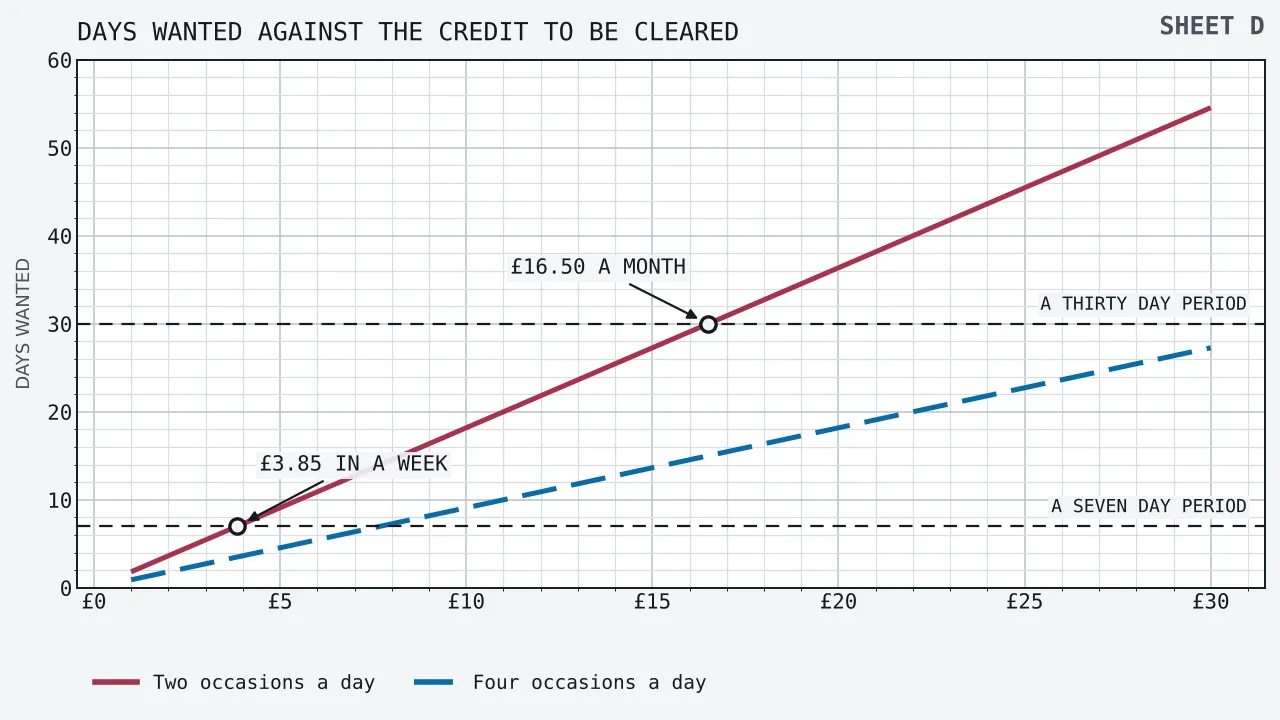
Where a line crosses a rule is the only reading on the picture that matters. Below the crossing a period has slack in it and the deadline is an irrelevance. Above the crossing the deadline is the binding term on the whole offer, more binding than the multiple, the ceiling on a press or anything else in the sheet, and it decides the outcome before the first press is made.
Doubling the daily rate moves the crossing by exactly one factor of two, which is the second line on the picture. Somebody finding four occasions a day instead of two takes a week’s ceiling from £3.85 to £7.70. That is a real improvement and it still does not reach a ten pound credit.
4
One clause decides which of two jobs a period does
Everything above assumes a multiple is attached. Strike the multiple out and the same printed period changes its function entirely, because there is no longer any work for it to fail to hold. Credit without a play-through is reel time and nothing more: ten pounds of it buys a hundred presses, twenty minutes on the assumed interval, and fits inside any period this market has ever printed.
What the period governs in that case is not the play but the proceeds. Money won and left standing has a life of its own, and the clock over it is frequently shorter than the clock over the credit that produced it.
| What is being asked | Carrying forty times | With the multiple struck out |
|---|---|---|
| Presses the build demands | 4,000 | 100 |
| Time at a handset | 13 h 20 min | 20 min |
| Occasions | 37 | 1 |
| Days wanted at two a day | 19 | Part of one |
| What a seven day period limits | The credit, at £3.85 | Nothing about the play |
| Where the deadline then bites | On work nobody could finish | On money already won |
Twelve workings split along that line and the split is not where a reader expects. A build with no multiple is the easier arrangement to finish and the harder one to hold, because the single remaining clock is attached to the only part that has any value. Fifty presses with the multiple deleted ends up with ten minutes of play inside a period measured in days, and the days are doing all the work.
Arrangements carrying two dates are the awkward middle case, and they are commoner than the market admits. One date governs the credit and another governs whatever the credit produced, the second is usually the shorter, and an arrangement with two separate expiries shows a reader pacing to the longer one losing most of the expectation to the shorter.
5
Ninety-nine per cent pays what nought per cent pays
A play-through does not settle gradually. It settles once, at the press that completes it, and until then the sum under it is worth nothing that can be moved. Partial completion earns no partial release, and nothing on these sheets pro-rates anything. So the value of a discharged fraction is a step: nil, nil, nil, and then the whole of it.
Pair that step with the money and a second line appears. Credit worn down at four pence in each staked pound is expected to be exhausted once the staking reaches twenty-five times the credit, and a clause asking forty puts that moment at 62.5 per cent of the way along. Two regimes follow, split at that fraction.
Under five eighths of the way an expiry takes money and work together. Past five eighths it takes work alone, because on an average run there is no money left to take. Both are losses and they are different losses, and only one of them is visible on a balance.
| Share of the clause discharged | Presses made | Occasions spent | Expected balance | Released by the clause |
|---|---|---|---|---|
| A quarter | 1,000 | 10 | £6.00 | nil |
| A half | 2,000 | 19 | £2.00 | nil |
| Five eighths | 2,500 | 23 | nil | nil |
| Three quarters | 3,000 | 28 | nil | nil |
| All but one press | 3,999 | 37 | nil | nil |
| Complete | 4,000 | 37 | nil | Whatever is standing |
Thirty-seven occasions reaching the same release as ten occasions is the harshest sentence in this section, and the harshness is structural rather than anybody’s choice. A condition expressed as a total has no mechanism for paying out a part. Twenty pounds that pays on one press and on none of the thousands before it itemises the same step at a larger size.
6
Line by line, what the stroke carries off
Expiry is usually described in a single clause of a sheet and it removes more than one thing. Setting the removals out separately is worth doing, because three of them are invisible on a statement and one of them is not recoverable in any currency.
| What is standing when the period closes | What becomes of it | How this section prices it |
|---|---|---|
| Credit still undischarged | Taken back in full | Up to the whole of the headline figure |
| Winnings resting on that credit | Removed along with it | Whatever had gathered, often nothing |
| Presses already made | Count towards no later clause | Four hundred for each pound discharged |
| Attention already spent | Nothing returns it | Occasions of twenty-two assumed minutes |
| The expected balance | Already nil past five eighths | Four pence of every pound crossed |
Attention is the row with no market price and the only row that cannot be replaced. A credit swept at eighty per cent of a ten pound clause has consumed thirty occasions of twenty-two assumed minutes apiece, which is eleven hours, and those eleven hours bought a position worth exactly what nought hours would have bought.
Two further removals fall outside the table, having no quantity attached. A registration stands whether the credit was discharged or swept, with the particulars handed over at the counter staying handed over. And any further arrangement offered afterwards begins from a sheet the reader has already demonstrated they will accept, which is a position rather than a sum.
7
Which event starts the counting, and the hours already gone
Every figure above treats a printed day as a whole day of availability. Sheets of this kind rarely do. A period usually runs from the instant credit is posted to an account, and posting happens before a reader has decided anything, sometimes before they have finished registering.
Count what sits between the posting and the first press and the shortest periods lose most of their length to it. Opening a form, confirming an address, waiting on a document check and reaching a reel that qualifies are all real intervals, and on the slow readings this section carries they can reach two thirds of a seventy-two hour period before anything has been pressed at all.
Three consequences follow from that and none of them appears in the arithmetic of part two. The first is that the ceilings in that table are generous, since they assume a full period. The second is that a short period and a slow check are the same hazard wearing two labels, and five pounds that dies inside its own document queue is where that collision is worked right through. The third is that anybody who presses nothing on the day credit lands has already spent 55 pence of ceiling without a press to show for it.
Instalments change the shape again rather than the total. Where credit is released a portion at a time, every portion arrives with a clock of its own, so the count of deadlines rises with the count of releases while the work stays where it was. Two hundred presses handed over twenty a day turns two occasions of work into ten separate days somebody has to be present for.
8
Four ways to beat a period, and what closes each of them
A ceiling of 55 pence a day rests on three assumptions and one of them is the reader’s own. Moving any of the three moves the ceiling in exact proportion, so it is worth asking how far each will actually travel before something stops it.
| What is moved | The setting | Presses a day | Staking a day | Credit a week finishes |
|---|---|---|---|---|
| Nothing | Two occasions, twelve seconds, ten pence | 220 | £22.00 | £3.85 |
| The daily rate | Four occasions a day instead of two | 440 | £44.00 | £7.70 |
| The interval | Two occasions at the licensed floor of 2.5 s | 1,056 | £105.60 | £18.48 |
| The press | Two occasions at fifty pence a press | 220 | £110.00 | £19.25 |
| The press, further | Two occasions at a pound a press | 220 | £220.00 | £38.50 |
| Both at their limits | 2.5 s and five pounds a press | 1,056 | £5,280.00 | £924.00 |
Each row is real arithmetic and most of the rows are unavailable. Pressing at the licensed floor means one press each two and a half seconds for forty-four minutes without pause, which describes machinery rather than a person. Pressing at fifty pence or a pound runs into the ceiling a sheet puts on a stake while credited funds are live, and exceeding that ceiling is the surest way to have a finished clause voided afterwards.
So the one dial genuinely within reach is the daily rate, and it is also the weakest of the four. Doubling it doubles the ceiling, which takes a week from £3.85 to £7.70 and leaves every ordinary headline in this section still out of range. That is the finding the whole part exists for: the boundary in part two is not an artefact of a cautious assumption, and the dials that would move it are held by somebody else.
9
A date is a significant condition, and two rulings say so
Credit of this kind issues from desks with no Great Britain licence over them. What bites on a page about deadlines is neither a cap nor a floor. It is the body of rule governing where a date has to be printed and how visibly.
Four kinds of thing appear on the worked list the advertising regulator keeps of what a gambling promotion is obliged to disclose. Who may take it up. What has to be paid in or played through. Which odds or bet types qualify. And the time limits set over claiming it and over using it. Any condition of that weight must stand in front of a reader clearly and prominently, the test being whether its absence would mislead, and online the full terms are meant to be about one click away rather than folded into a footer.
Two published rulings turn on nothing but an absent date. Dated 17 July 2024, the first concerned a bet of ten pounds whose claim turned on sending a text back before an hour the advertisement never printed, and the regulator put that missing hour among the conditions weighty enough that omitting one misleads. Dated 27 August 2025, the second concerned a voucher worth five pounds and a single date, 14 March, on which a race meeting made it unusable; the voucher mentioned no such thing, and that decision is recorded in the regulator’s own word as a breach. So an expiry is not decoration fastened to an offer. It is a term, and terms get shown.
One sentence from the gambling regulator supplies the consequence: conditions of that weight, shown without enough prominence, make the advertisement misleading, and it wants them beside the headline on whatever page a reader arrives at or signs up through. A separate duty reaches the far end of a period. Where somebody completes what qualifies them before the offer period has run out, that is no permitted reason for the value of an incentive to move. No counterpart to any of it exists in the rulebook this network read for the offshore side, where bonuses occupy two sentences asking for transparency and no aggression. Nothing there mentions a date at all.
One period in this field cannot be shortened by anybody, and it is the only clock of that sort on the page. Gamstop Online puts four lengths on its own registration form: a half year, twelve months, sixty months, and sixty months with renewal attached. It will not end before its minimum has elapsed; it does not expire quietly once that minimum passes; and closing it means contacting the scheme and then waiting out a day of cooling off at the least, with the exclusion live throughout. The scheme covers participating businesses and says so plainly, nothing here assists anybody in reaching what they have closed off, and a bank’s own gambling block answers to the same rule.
10
Twelve cases, and the clock each one turns on
The boundary settles the general question. Which of the twelve workings settles a particular sheet depends on which clock that sheet hangs its credit from.
Where a multiple is attached and a short period is printed over it, the arithmetic of part two applies directly. Thirty pounds against a week is the clearest collision in the section, and ten pounds converted into thirty-seven occasions builds the exchange rate between printed days and usable ones from the ground up. Twenty pounds settling on a single press takes apart the step in part five, and half an hour of spins owing nineteen hours reads a period as the seconds it leaves between presses.
Where the multiple has been struck out, the clock moves on to the money. Fifty presses with the clause deleted shows what survives the deletion, seventy presses under two separate dates prices the gap between them, and a hundred presses under a ceiling in pounds covers the build where a cap on winnings has taken over the work a multiple used to do. A promise to keep the winnings names exactly which clause it lifts and which four clocks it leaves running.
Where the schedule rather than the length is the problem, credit released twenty presses at a time turns one total into ten separate attendances, and four minutes of play under a one day period is the smallest money in the section carrying the tightest clock. Where the pace belongs to somebody else entirely, a room calling to its own timetable replaces the press interval with a published schedule, and the period has to be read against opening hours instead of against occasions. And where the hazard is the queue in front of the credit rather than the period over it, a seventy-two hour clock that starts without the reader is the case.
Where the question is how long the clause itself runs, the section converting a matched payment into hours supplies the numerator for every division above. Where it is the pace, the section on how quickly a pile is spent does. And where it is the method, the assumptions are gathered in one place, including the daily rate this section adds to them. Anybody preferring a different rate rescales the whole boundary in one multiplication.
Questions
- How much of a play-through does one day of a deadline actually hold?
- Fifty-five pence of credit, on the figures this section carries. Two occasions a day at twenty-two minutes each is 44 minutes, which at twelve seconds a press comes to 220 presses. Those presses send £22.00 over a reel, and £22.00 measured against forty times discharges 55p of credit. The daily rate, the interval and the length of an occasion are conventions this site adopted for modelling, and none of the three was timed.
- Is there a size of credit a seven day window simply cannot finish?
- Yes, and it is £3.85. Seven days multiplied by 55 pence is everything a week can discharge, so any credit above that figure is unfinishable inside a week no matter how diligent anybody is. A fortnight reaches £7.70, thirty days reach £16.50 and ninety days reach £49.50. Ordinary headlines of ten, twenty and thirty pounds sit above all but the longest of those.
- How long would a ten pound credit need?
- Nineteen days. A ten pound credit under forty times owes £400.00 over the reels, which comes to 4,000 presses, 13 h 20 min and 37 occasions once a part-used occasion is counted whole, and 37 occasions at two a day is nineteen printed days. Twenty pounds wants thirty-seven days, and fifty pounds wants ninety-one, which is three months of turning up twice daily without a gap.
- Does finishing most of a clause earn anything?
- Nothing at all. A condition written as a total settles at the press that completes it and pays nothing before, so 3,999 presses of a 4,000 press clause release exactly what nought presses release. There is no pro-rata term on sheets of this kind, and the thirty-seven occasions behind those presses are not returned in any form.
- What is actually taken when a window closes?
- Five things, and three of them never show on a balance. The undischarged credit goes back in full. Winnings resting on it go with it. Presses already made count towards no later clause. The attention spent making them is not recoverable. And the expected balance is already nil past five eighths of the clause, because credit worn down at four pence in each staked pound is expected to be exhausted at twenty-five times its own value while the clause asks for forty.
- Why does a window matter more where the multiple has been struck out?
- Because the only thing left for it to bite on is money. A ten pound credit with no play-through is a hundred presses and twenty minutes, which fits inside any period ever printed, so the period stops governing the play and starts governing the proceeds. Arrangements of that shape commonly carry two dates, one over the credit and a shorter one over whatever the credit produced, and the shorter one does the taking.
- When does the clock start, at the credit or at the first press?
- Almost always at the posting of the credit, which happens before a reader has decided anything. Registering, confirming an address, waiting on a document check and reaching a reel that qualifies all sit between the two events, and on the slower readings carried here they can take two thirds of a seventy-two hour period before a single press is made. Every ceiling in this section assumes whole days and is therefore generous.
- Can a faster thumb or a bigger stake rescue a short window?
- Arithmetically yes and practically no. A press every 2.5 seconds, which is the floor a British licensed reel works to, would take a week’s ceiling from £3.85 to £18.48, and fifty pence a press would take it to £19.25. Neither is available: the first describes machinery rather than a person, and the second runs into the stake ceiling a sheet imposes while credited funds are live, where exceeding it is the surest way to have a finished clause voided.
- Does an advertisement have to print the deadline?
- Under the advertising code anything weighty enough to mislead by its absence must stand in front of a reader clearly and prominently, and the worked list kept for gambling promotions names the time limits set over claiming a thing and over using it, alongside eligibility, what has to be paid in or played through, and qualifying odds. Online, the full terms are meant to be about one click away rather than folded into a footer. Two published rulings turn on nothing but an absent date, dated 17 July 2024 and 27 August 2025.
- Is there any window that works in the reader’s favour?
- One, and nobody can shorten it. Gamstop Online puts four lengths on its own registration form: a half year, twelve months, sixty months, and sixty months with renewal attached. It will not end before its minimum has elapsed. It does not expire quietly once that minimum passes. And closing it means contacting the scheme and then waiting out a day of cooling off at the least, with the exclusion live throughout. What the scheme covers is the participating businesses, which it states plainly.