Note U10 Revision 1 Terms read 17 October 2026
Non Gamstop Curacao casino sites, and the other rulebook set out hour by hour
Calling the offshore side unregulated is quicker than reading what it publishes, and it is also wrong. Converted into hours and laid beside the British timetable, the Curaçao periods are the longer protection on several rows and the shorter one on others: 168 hours in front of a deposit limit going up against a British 24, and 168 hours to confirm a complaint has landed against a British 24. The same 144 hours of difference, running in opposite directions. What has no counterpart at all is not a period.
Stricter there 168 h The gap, either way 144 h Rules on the product None
What offers of this size ask in hours
Advertising has been bought for every destination below. A fee reaches this site when a reader goes on to register, and no figure on this page moves one way or the other because of it.
-
01Mobile Free Spins
Betportal
Ceiling as a multiple
What lands€15.00150 spins at 10c, which is this site's figure and not the operator'sThe run17 h 30 minTurning over 525.00 at 10p means 5,250 presses, or about 48 phone sittings of 22 minutes. Timed at 10p a press and 12 seconds between presses, both of which this site assumes rather than measures.The wait to be paidNOT PUBLISHEDThis operator puts no withdrawal band in its own terms, so there is nothing honest to print here.Spins valued at this site's own 10p a spin
What lands
Spins, at a price15.00150 of them at 10c apiece, a figure belonging to this site rather than to the operatorMatch, and other creditno figure300% of three deposits, to a ceiling of €1,000. Not a sum until money of yours makes it one, so this row totals nothing and carries nothing downwardsThe run
Handed back on the spins(0.60)Each press stakes its own value and returns 96 per cent, which leaves this much with the house from the opening pressPlay-through 35x on the bonus(20.16)Taking 14.40 round 35 times over means 504.00 through the machines, of which 20.16 is the expected cost, and 17 h 30 min of pressing at the pace aboveWhat counts towards it100%Slots only, with no percentage published anywhere, so the row above assumes the whole of each stake countsWhat never clears
Limit on the winningsstated5x the bonusDeducted on the way outno figureNothing is published as a figure here, so this row removes nothingLeast that can leaveno figureNo figure is published, so nothing on this timer is pinned down by oneLeast deposit, and the rung over ityour own€20 a stage. Published in euros, so no rung is named at all: this site's ladder is a sterling oneThe window on the creditstated14 daysBiggest stake while it runsstated€5Removed outright by rulestatedNot publishedVerified before a payoutstatedDocuments before the first withdrawalNever clears€15.00Not a penny of it gets out, so the whole of what landed stands on this rowNo Great Britain licence
Licence held in Anjouan, Comoros, the company named is BetPortal Gaming Ltd, with Excite Ultra Media Ltd, quoted under ALSI-202601040-FI2.
Terms read 17 October 2026
Open the offer at Betportal, opens in a new window -
02Mobile Free Spins
WinBeast
Ceiling as a sum
What lands€50.00500 spins at 10c, which is this site's figure and not the operator'sThe run2 d 18 hTurning over 2,000.00 at 10p means 20,000 presses, or about 182 phone sittings of 22 minutes. Timed at 10p a press and 12 seconds between presses, both of which this site assumes rather than measures.The wait to be paidNOT PUBLISHEDThis operator puts no withdrawal band in its own terms, so there is nothing honest to print here.Spins valued at this site's own 10p a spin
What lands
Spins, at a price50.00500 of them at 10c apiece, a figure belonging to this site rather than to the operatorMatch, and other creditno figure50% to 100% of five deposits, each to a ceiling of €1,000, and a €650 free bet. Not a sum until money of yours makes it one, so this row totals nothing and carries nothing downwardsThe run
Handed back on the spins(2.00)Each press stakes its own value and returns 96 per cent, which leaves this much with the house from the opening pressPlay-through 40x on the bonus and the winnings from the spins(76.80)Taking 48.00 round 40 times over means 1,920.00 through the machines, of which 76.80 is the expected cost, and 2 d 18 h of pressing at the pace aboveWhat counts towards it100%Slots, titles vary by country, with no percentage published anywhere, so the row above assumes the whole of each stake countsWhat never clears
Limit on the winningsstated€100 a batch of spinsDeducted on the way outno figureNothing is published as a figure here, so this row removes nothingLeast that can leaveno figureNo figure is published, so nothing on this timer is pinned down by oneLeast deposit, and the rung over ityour own€20 a stage. Published in euros, so no rung is named at all: this site's ladder is a sterling oneThe window on the creditstated7 days, spins 1 dayBiggest stake while it runsstatedNot publishedRemoved outright by rulestatedNot publishedVerified before a payoutstatedDocuments before the first withdrawalNever clears€50.00Not a penny of it gets out, so the whole of what landed stands on this rowNo Great Britain licence
Licence held in Curaçao, no company named anywhere on the site.
Terms read 17 October 2026
Open the offer at WinBeast, opens in a new window -
03Mobile Free Spins
EliteSpin
Longest spin window
What lands£50.00500 spins at 10p, which is this site's figure and not the operator'sThe run2 d 18 hTurning over 2,000.00 at 10p means 20,000 presses, or about 182 phone sittings of 22 minutes. Timed at 10p a press and 12 seconds between presses, both of which this site assumes rather than measures.The wait to be paidNOT PUBLISHEDThis operator puts no withdrawal band in its own terms, so there is nothing honest to print here.Spins valued at this site's own 10p a spin
What lands
Spins, at a price50.00500 of them at 10p apiece, a figure belonging to this site rather than to the operatorMatch, and other creditno figure50% to 100% of five deposits, each to a ceiling of £1,000. Not a sum until money of yours makes it one, so this row totals nothing and carries nothing downwardsThe run
Handed back on the spins(2.00)Each press stakes its own value and returns 96 per cent, which leaves this much with the house from the opening pressPlay-through 40x on the bonus and the winnings from the spins(76.80)Taking 48.00 round 40 times over means 1,920.00 through the machines, of which 76.80 is the expected cost, and 2 d 18 h of pressing at the pace aboveWhat counts towards it100%Slots, with no percentage published anywhere, so the row above assumes the whole of each stake countsWhat never clears
Limit on the winningsstated5x the bonusDeducted on the way outno figureNothing is published as a figure here, so this row removes nothingLeast that can leaveno figureNo figure is published, so nothing on this timer is pinned down by oneLeast deposit, and the rung over ityour own£20 a stage. It lands square on the £20.00 rung, so none of yours is left perched on topThe window on the creditstated7 days, spins 3 daysBiggest stake while it runsstatedNot publishedRemoved outright by rulestatedNot publishedVerified before a payoutstatedDocuments before the first withdrawalNever clears£50.00Not a penny of it gets out, so the whole of what landed stands on this rowNo Great Britain licence
Licence held in Costa Rica, the company named is PrimeTier Limited.
Terms read 17 October 2026
Open the offer at EliteSpin, opens in a new window -
04Mobile Free Spins
Crown Jewelz
Multiple unpublished
What lands£15.00150 spins at 10p, which is this site's figure and not the operator'sThe runNOT TIMEDThis operator does not publish the play-through multiple in its own terms. The multiple is the one figure the clock cannot work around, so the run is left untimed.The wait to be paidNOT PUBLISHEDThis operator puts no withdrawal band in its own terms, so there is nothing honest to print here.Nothing reckoned
What lands
Spins, at a price15.00150 of them at 10p apiece, a figure belonging to this site rather than to the operatorMatch, and other creditno figure200% of the first deposit, then 150% twice, each to a ceiling of £1,000. Not a sum until money of yours makes it one, so this row totals nothing and carries nothing downwardsThe run
Play-throughno figure40x the bonus, reported rather than published by the operatorWhat counts towards itno figureSlots, with no percentage published anywhere, so the row above assumes the whole of each stake countsWhat never clears
Limit on the winningsstatedNot publishedDeducted on the way outno figureNothing is published as a figure here, so this row removes nothingLeast that can leaveno figureNo figure is published, so nothing on this timer is pinned down by oneLeast deposit, and the rung over ityour own£20. It lands square on the £20.00 rung, so none of yours is left perched on topThe window on the creditstatedNot publishedBiggest stake while it runsstatedNot publishedRemoved outright by rulestatedNot publishedVerified before a payoutstatedDocuments before the first withdrawalNever clearsNOT RECKONEDThis operator leaves the play-through multiple out of its own terms, so nothing below the fourth step can be worked out.No Great Britain licence
Licence held in Curaçao, number not verified, no company named anywhere on the site.
Terms read 17 October 2026
Open the offer at Crown Jewelz, opens in a new window
Only the middle reading comes out of arithmetic belonging to this site. The multiple laid against what lands gives the turnover asked for; dividing that by 10p a spin gives the presses; dividing those by 300 an hour gives the hours, a press on a handset being taken here at 12 seconds from the one before. Both figures are assumptions rather than measurements of anybody: nothing was played and nothing was held a stopwatch to. Anybody quicker should divide the press count by a rate of their own, which is why the presses are printed alongside the hours instead of being summarised away.
The first reading is what arrives before any condition is laid against it. Spins carry no unit of their own so one gets supplied: where an operator values its own spin that figure is used and attributed, and where it does not, this site's 10p a spin stands in and everything below moves with it. The third reading belongs to the operator entirely. It is a withdrawal band quoted from published terms, and a blank there means none was published rather than that nobody looked.
The total along the foot answers what the hours leave open, which is whether any of the running ends anywhere. It is what arrived, less whatever is still standing once the play-through has been paid for at 96 per cent return to player and once a published limit, a published deduction and a published floor beneath the least that can leave have each had a turn. It appears again in pence in the pound, the only fair way of holding a small offer up against a large one. It describes an offer rather than an evening, and where the conditions price out what arrived, a timer prints nothing getting out instead of a negative sum.
Cashiers on a handset take deposits off a row of preset buttons, so a least deposit given in pounds is raised to the next rung of the ladder used here, £10, £20, £25, £50, £75 and £100, and the timer shows what is left perched on it. That money is the reader's own and enters no sum at all. Given in euros it prints untouched, the ladder being sterling. Three words may occupy the figure column where no figure belongs. Stated is a published term that costs something while leaving no number to subtract. No figure is a term nobody has quantified, or a credit that is not a sum until money of yours makes it one. Your own is money of yours, which belongs in none of this.
None of the operators above is licensed in Great Britain, so not one duty that licence carries reaches any of them. Membership of Gamstop Online is compulsory for every online gambling company licensed in Great Britain, which means that shutting yourself out through the scheme shuts you out of none of these. The limit of ten times the bonus funds on a wagering requirement, running since 19 January 2026 under Social Responsibility Code 5.1.1, is a condition of the same licence and binds only whoever holds one. Off that licence, the Gambling Commission writes of consumers meeting unfair gaming practices, financial loss and no recourse when matters go wrong, and lists blocked payouts and withdrawal limits pitched too high to reach among the things it has seen. No account at any of them may be held by anybody under 18.
Every term on a timer is its operator's own and every timer carries the day somebody read it. The oldest of those readings is 17 October 2026. What binds a reader is an operator's full terms and never a line printed here.
1
A document that exists, read before anything is said about it
Reading a rulebook before describing it is the method of this note, and it is slower than the alternative. Two documents of the Curaçao Gaming Authority stand behind every figure below. The first is a policy on responsible gaming, numbered version 1.0 and carrying 21 February 2025. The second is guidance covering complaints from players, numbered 1.1 and carrying 18 June 2025. Real periods sit in both, and they appear here as written rather than as anybody might expect them to read.
Assistance in reaching a business of the kind that phrase describes is absent from these ten parts. Nothing is named and nothing is linked. Sign-up paperwork, handsets, instruments of payment and however a household has its connection set up were each struck out on purpose. Gambling payments stopped by a bank belong in that same category, as do those stopped by whoever provides the broadband, and no sentence here works round either.
One thing is recommended here and it is a telephone number. Where a reader holding a Gamstop Online registration has come to this page through a phrase of that kind, the registration is doing exactly what it was taken out to do, and the response worth making is to ring 0808 8020 133, which costs nothing and which GamCare answers at any hour of any date. What follows that paragraph is comparison, and a comparison settles a size rather than a decision.
Nineteenth of April 1999 is when the authority itself was incorporated, as a foundation, in the wake of a mutual evaluation report by the regional financial action task force the year before. Its governing ordinance on games of chance came into force on 24 December 2024, which its online gaming page states, and which the regulator’s own about-us page muddles by carrying a 2025 date for the enactment alongside a 2024 date for entry into force. Two of the three statements give 2024, which is the reading used here.
Nothing in that last paragraph is a point against the regulator, and treating it as one would be cheap. What it is instead is the first measurement this note takes: a reader trying to establish when a rulebook started has to reconcile two pages of one website, and that is before any question arises about whether the rulebook reached a particular business. Part eight returns to that and gives it a size.
Offshore is a geography and not a verdict. The claim being tested here is narrow and checkable: that the published Curaçao requirements, converted into hours, are sometimes longer than their British equivalents and sometimes shorter. A page asserting that no rules exist on that side would be inaccurate, and a page asserting that the two regimes come to the same thing would be inaccurate in the other direction. Both errors are avoidable by printing the periods.
2
Why both sides get converted into one unit
Working days, calendar weeks, business days and months are the four units the two rulebooks between them use, and nothing can be compared while that remains true. Three working days and one week look close together until somebody notices that one of them skips weekends. A month is 28 days or 31 depending on which month. The conversion below takes a week as 168 hours, a month as 730 and six months as 4,368, which is 182 days, and says so wherever a figure rests on it.
Seventy-two hours is this note’s reading of three working days, taken as three periods of twenty-four rather than as three office days with nights and weekends between them. That is the conservative choice, because it makes the British period look shorter than a strict reading would, and a comparison should be generous to the side it is being written from.
Five business days becomes 120 hours on the same basis, and two weeks becomes 336. Both belong to the offshore complaints document rather than to the British one, and both appear in part four. Converting them this way is the only treatment that lets a reader see that one of those periods is shorter than anything the British timetable sets for the same category of complaint.
Pressing is the unit this site usually reaches for and it is the wrong one here, a complaint period being time somebody waits rather than time they spend, so only part four turns any of these hours into presses.
Two rulebooks and one unit is therefore the whole method. Every row in part three states a question, the British answer in hours and the Curaçao answer in hours, and says which of the two is the longer protection. Nothing is averaged, nothing is scored and no row is left out because it runs the wrong way for the argument.
3
An argument, timed from the first letter to the last
Eleven rows is what the comparison comes to, and they are set out below in the order a complaint meets them. Confirmation that something has been received comes first. The substantive answer comes next. The outer limit on the whole business comes third. The window inside which it may be started at all comes fourth, and the rest concern the clocks a person can set for themselves.
| The question put to both rulebooks | Great Britain | Curaçao | Which period protects for longer |
|---|---|---|---|
| Confirming a complaint has arrived | 24 h | 168 h | Great Britain, by a factor of seven |
| Confirming one about gambling harm | 24 h | 48 h | Great Britain, by a factor of two |
| The substantive answer owed | 1,344 h | 672 h | Curaçao, by a factor of two |
| Outer limit once an extension is used | 1,344 h | 1,344 h | Neither, the two are level |
| Window to raise it from the incident | 4,368 h | 4,368 h | Neither, the two are level |
| Best efforts on a gambling harm case | Not set | 120 h | Curaçao, the British side setting no separate figure |
| Silence from the customer that pauses it | 168 h | Not set | Different devices, not comparable |
| Standing in front of a deposit limit rising | 24 h | 168 h | Curaçao, by a factor of seven |
| Standing in front of one coming down | 0 h | 0 h | Neither, both are immediate |
| Shortest break a person may take at one press | Not set | 24 h | Curaçao, the British side setting no menu |
| Shortest exclusion a person may take | 4,368 h | 8,760 h | Different objects, read part five |
Six hundred and seventy-two hours against 1,344 is the row most likely to surprise a reader, and it is the third. Four weeks is what the offshore guidelines give an operator to assess and answer, extendable once by a further four with written notice beforehand. Eight weeks is the British outer limit on the whole process, escalation inside the business included. So the first answer is owed sooner on the offshore side and the final deadline lands in the same place.
One week is what the same guidelines give for confirming in writing that a complaint has been received, which is 168 hours. Twenty-four hours is what the British guidance asks of a business offering gambling round the clock, with three working days for one that does not. That row runs the other way from the one above it, which is the first sign of what part seven is about.
Six months is where the two agree exactly. On the British side a half-year from the incident is the floor on how long a customer may still raise one, and no term may eat into it. On the offshore side the half-year runs from the incident or from the settlement of the bet, whichever is the matter being raised, and lodging costs the player nothing. On this note’s conversion that is 4,368 hours on each side.
4
Rows where the offshore period is the longer protection
One hundred and sixty-eight hours stands in front of a deposit limit going up under the Curaçao policy, against at least twenty-four under the British standard, and this is the clearest row in the whole comparison. Both sides make a reduction immediate. Both put a delay in front of an increase. One of those delays is seven times the other, and it is not the British one.
One hundred and forty-four hours is the difference, and it is worth converting once because the arithmetic is available. On this site’s assumed rhythm, 144 hours is six evenings at one sitting apiece, which comes to 660 presses at ten pence, £66.00 going across the reels, and £2.64 the house expects to keep from it where 96 per cent returns. That is the quantity of play a longer delay holds back from somebody who raised a ceiling on a bad night.
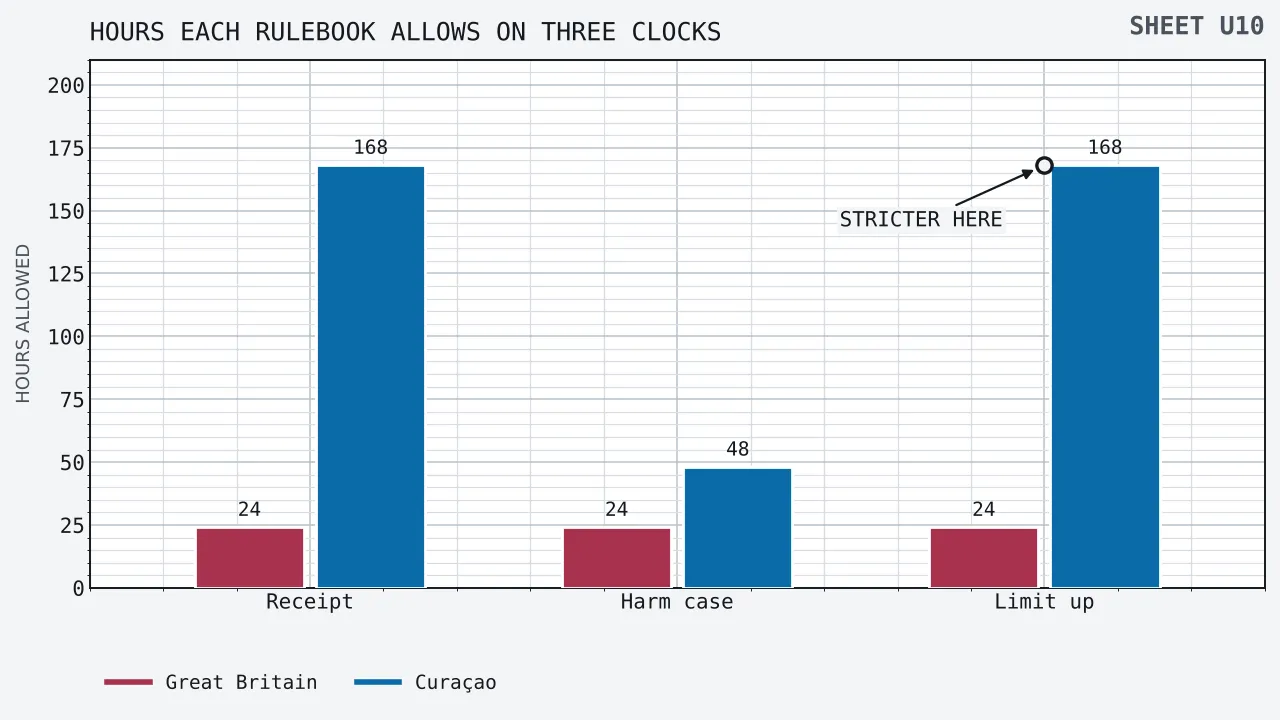
Three bars against three bars is the whole drawing, and the trap in it is worth naming before anybody reads it wrongly. Longer is not better and longer is not worse. On the first two clocks a bigger figure means a person waits longer to hear anything, which is weaker. On the third a bigger figure means a ceiling takes longer to rise, which is stronger. Direction is decided by what the period is standing in front of.
Eight thousand seven hundred and sixty hours is the shortest long-term shutting-out an operator there has to put on the table, being a year, and above it sit three years, five, ten, and an option that simply never ends. The national British scheme opens at 4,368 hours. Twice the minimum, plus a never-ending setting with no British equivalent, is a fair reading of those two lists together.
Twenty-four hours is the shortest pause the offshore policy obliges an operator to put on the menu, with a week, a month and a quarter standing above it. One press is to be enough to start one, with no message to send and nobody’s permission to obtain, taking hold at once and choosable by product. Arguing a player out of taking one is forbidden, and the forbidden list reaches a promotion dangled to keep them at it. No menu of that description appears on the British side read for this note.
Affiliates close this part, and here the offshore document is explicit where the British advertising guidance is not. An operator carries responsibility for whether its affiliates observe the responsible gaming standards, and securing that is to be done by contract, by audit and by penalty. Third parties reach the British advertising page only in its digital section, and only on where an advertisement is placed.
5
Rows where it is the weaker, and by what margin
Seven times is the margin on the first row of part three and it belongs at the head of this part. A week to confirm receipt against a day is a difference a person feels immediately, because the first thing anybody wants after sending a complaint is evidence that it arrived somewhere. Six days of not knowing is the practical shape of 144 hours in that position.
Two different objects is the honest reading of the exclusion row, and calling the longer minimum a stronger protection would be a mistake. A British registration is taken once with the national scheme and reaches every holder of a Great Britain licence at the same moment. An offshore exclusion is taken with one named operator, covers all of that operator’s domains, and reaches no further. One year at one business is a different instrument from six months across a market.
Encouragement is the offshore answer for everywhere else, and the policy puts it in those terms: having shut themselves out at one business, a player should be pressed to repeat the exercise elsewhere. Pressing leaves the doing to the person, business by business, one at a time. A clock other people wind carries on through the evenings when the person is doing nothing, and that evening is the one the whole instrument exists for.
Age is the whole of what the offshore policy settles before money or a wager is accepted. Confirming when somebody was born will satisfy it, as will a box ticked to assert adulthood or a payment route checked, while a document issued by a government belongs to milestones further along on money-laundering grounds. Britain wants three particulars verified in front of any gambling whatever: the name, the residential address and the birth date. No period separates the two positions. A door does.
Nought of five things turns up anywhere in that offshore policy: a ceiling over a wagering multiple, a ceiling over a stake, a minimum gap between one game cycle and the next, a bar on play running itself, and a bar on applause for a return no bigger than what went in. A business outside the British licence is reached by none of those either, and part nine takes four further rules of the same family.
Bonuses occupy two sentences of that document, and both are reported here in substance. How a bonus is communicated has to be transparent, its terms clear. Promotion of the aggressive sort, used to drive excessive play, is shut out. Nothing corresponds there to a ceiling at ten times a credit. Nothing corresponds to the bar on one incentive spanning two kinds of gambling. Nothing corresponds to the advertising regulator’s roll of conditions that have to be shown prominently.
6
Periods one party is left to settle for itself
Compulsory, and free at the point of use because every penny of the cost falls on the operator, is how the offshore guidance sets out the independent route for a dispute. That is a genuine requirement rather than a gesture. Beside it sits the feature this part exists for, which is that certain settings on the route are left for the operator to fill in, and three of them get named.
Three settings, each converting a published rule into something one side decides. Is the route something a player has to finish with before the courts become available. Does whatever comes out of it bind that player. Does a claim have to be worth some stated minimum before anybody will escalate it. Independent legal advice is what the regulator suggests an operator take, and it says it will weigh the circumstances in deciding whether a measure of that sort was warranted.
Small claims are where it indicates it may follow an operator worried about the route being abused. Letting in somebody who had shut themselves out is where it indicates it expects seriousness whatever sum is at stake. Published, and sensible, and both of them a judgement reached after the event about a setting chosen before it.
Approval first is the British arrangement, and the contrast is structural rather than one of degree. Entities get approved by the Commission, and a licensee picks from those or from nobody. Eight stand on the published list, five of them covering remote gambling across every sector. Explaining the escalation is part of what a final response has to do, and the escalation costs the player nothing.
Two further offshore limits bind the player rather than the business, and a fair comparison prints them. Going through the route once rules out going through it again somewhere else. Walking away from one already under way is meant to close the matter permanently. And the registered player is the only person who may complain at all, the ordinance having shut off any sale, rental or pledge of a claim against a holder of a licence.
Twice a year a return of complaint numbers goes to the offshore regulator, timed to 15 June and to 15 January, with the January of 2026 the earliest due, and it covers totals, outcomes, categories, referrals and whatever reached a court. No published total of those returns turned up anywhere, so none of their figures appears here, and the absence is recorded rather than filled.
7
What the difference is shaped like, once the rows are counted
Eleven rows produced four where the offshore period is the longer protection, two where the British one is, three where the two sit level and two where the objects are not comparable at all. Anybody expecting the offshore column to be shorter on every row has now been shown otherwise, and the honest summary of part three is that the published periods sit close together and lean in both directions.
Nought matters more than any of those figures, and it is the count of rules in the offshore responsible gaming policy governing the behaviour of the product under somebody’s thumb. Every row in part three concerns a relationship instead: when a business has to answer, how long it has to wait, what a person may ask for and how quickly they may have it. None of them touches the game.
Two objects and one object is therefore the shape of the difference, and it is not a difference of degree at all. One rulebook regulates the relationship between a person and a business, and also regulates the thing on the screen: how fast it may come round, what it may celebrate, what it may show, whether it may run twice at once. The other regulates the first object thoroughly and the second not at all.
Periods are easy to compare and that is exactly why a comparison stops there. A reader can set 168 hours against 24 and reach a view in a second. Setting a published rule against nothing takes longer to describe and is the larger finding, because a period running the wrong way costs somebody six days and an unregulated product costs them every press of every evening.
Enforcement is the second axis and it deserves one paragraph rather than a part. Both regulators decline individual disputes in almost the same words, the British one saying it is not an ombudsman and the offshore one saying it will not resolve or decide complaints about transactions. Where they differ is upstream: one approves the forum beforehand, and the other weighs afterwards whether the forum’s parameters were justified.
Four rows longer, two rows shorter, and nought rules about the game itself
8
A record of a licence, and the three things it cannot settle
A rulebook that exists is a different object from a rulebook that reaches a particular business, and measuring the distance between those two is what this part does. Everything in parts three to seven describes a document. Whether any of it was applied to one player on one evening is a separate question, and most readers have exactly one instrument for approaching it, which is a record of a licence.
Three things a record of that kind does settle belong first, the point here being not that records are worthless. Who holds it. Under what number it was granted. Which activities it covers. Online gaming is licensed and supervised by the offshore authority, which publishes a register and offers a tool for checking an entry against it, and that portal was reported offline on the day this network last looked.
Three things it cannot settle are what this part is for, and each takes a sentence. Not whether the duties in the rulebook were carried out, since a licence is a permission and not an account of anybody’s conduct. Not which licence a given site is trading under, no source available to this network stating that for any named business. Not whether a period written into a policy is the period some particular person was given.
Counting is the further thing no page here may do with a register of that sort, for the same reason. Nothing reachable during this build produces a dated figure for how many businesses hold such a licence, so no such figure appears. Describing what a licence demands is permitted and is the whole of parts three to seven, and it is a different claim altogether from saying how many carry one.
Spotting a game you have played before settles nothing either, and that is the trap most likely to catch somebody checking for themselves. Titles from licensed suppliers have shown up on websites with no licence at all, something the British regulator has put on record. Recognising one therefore tells a reader who made the game and tells them nothing about whose hands their money is in.
A register check is allowed two minutes here, as a declared assumption rather than anything timed, and it is present to drive one comparison. At the pace used throughout, two minutes is ten presses, which is a pound across the reels and fourpence of expected cost. Those ten presses answer one question and leave the three in the paragraph above standing untouched.
9
Four rules about the game itself, with nothing opposite them
Whatever a phrase of this shape finds carries no Great Britain licence, and on a note comparing two timetables the losses worth itemising are the four with no row anywhere in part three. Every one of them governs the behaviour of the thing on the screen. Every one is published and specific. Not one has an opposite number in the offshore document opened for this network.
One game at a time is the first of them. Offering functionality that lets two proceed together is shut out, and the guidance sweeps in screens divided, screens multiplied, and games packaged so as to run side by side. Expressed as a clock, the effect is that an hour of somebody’s evening cannot be spent twice over.
Full length for a result is the second. Handing a customer any means of cutting the wait before an outcome shows itself is barred, three features being named and excluded: turbo, then quick spin, then slam stop. Games of every native speed sit inside it. Three carve-outs ride along: a feature round taking no additional stake is untouched, uncovering a scratch panel in one movement stays allowed, and so does a game where a stake goes unless the player acts to finish.
Quiet over a return that is not a win is the third. Where what comes back is no larger than the sum that went in, applause is out, and effects of the winning sort, whether heard or seen, may not attach to it. Three alternatives are put forward: state the total awarded, flash up the lines that paid for a moment, and let a brief sound mark the crediting.
Honest odds on the face of the game is the fourth. Prohibition reaches any design or feature liable, on a reasonable view, to leave somebody misled over the likelihood of particular results, and two instances get spelled out. Dressing a loss up as something that nearly came in is one. Imitating a physical device on screen while giving it probabilities the real one does not have is the other. A loss swapped for a differently shaped loss is not available.
Nought of those four duties binds a business beyond the British licence, and between them they describe a single object from four sides. How long a result takes. How many may be under way at once. What a result may sound like. What a result may be made to look like. Each governs the interior of a game cycle, which is where the whole of a reader’s evening is spent.
10
Two rulebooks, two objects, one of them unregulated
One hundred and forty-four hours is the figure to leave this comparison holding, because it appears twice and faces opposite ways. It is the gap between a day and a week on confirming that a complaint arrived, where the British period is the shorter and therefore the better. It is also the gap between a day and a week in front of a deposit limit rising, where the longer period is the better and it is the offshore one.
Four rows against two is the count across the whole timetable, and a page setting out to show an offshore rulebook as empty would have had to drop most of part three to manage it. Four weeks to a first answer, a seven-day wait before a ceiling rises, a cooling-off menu reachable by one press, a one-year minimum exclusion and an express bar on dangling a bonus to stop somebody pausing are all published requirements with real periods inside them.
Nought rules about the product is the other half, and the two halves are what make the shape rather than the verdict. A comparison of periods says the two documents are within a factor of seven of one another in both directions. A comparison of objects says one of them governs the thing a person is looking at and the other does not mention it.
One row where a level reading hides the largest difference on the page is the window for complaining, 4,368 hours apiece on this note’s conversion. Both sides allow six months of complaining. Only one side runs a register that every licensed business has to read its whole customer list against, daily, so a decision taken once keeps working without the person doing anything further.
Anybody who got this far while weighing a registration of their own would do better with the next few minutes than reading further, and the better thing is 0808 8020 133, which is free, which GamCare answers whatever the hour and whatever the date, and which takes a telephone call, a chat window or a written message equally. Worrying about somebody else under the same roof earns as warm a welcome there as worrying about yourself, and the call is the only recommendation these ten parts make.
Questions
- What does the phrase non gamstop curacao casino sites actually point at?
- A gambling business holding a Curaçao licence and standing outside the British national self-exclusion scheme, membership of which comes with the Great Britain licence and with nothing else. Nothing here is named, nothing is linked and no way to one is sketched. What happens instead is that the Curaçao rulebook gets read, its periods get turned into hours, and the hours get laid beside the British ones a row at a time.
- Is the offshore rulebook weaker on every period?
- No, and a page claiming that would be wrong. Of the eleven rows compared here, four hand the longer protection to the Curaçao side, two hand it to the British side, three come out level and two set objects side by side that are not alike. Four weeks is the offshore allowance for a first answer against a British outer limit of eight, and seven days stand in front of a deposit limit rising there against twenty-four hours in Britain.
- Where is the British timetable the stricter of the two?
- On telling a complainant that their complaint has landed. A week is the offshore allowance, which is 168 hours, where British guidance wants twenty-four hours from a business trading round the clock and three working days from one that is not. Where the subject is gambling harm, two days, or 48 hours, is the offshore figure against the same British twenty-four. Six days of hearing nothing is what the larger gap amounts to in practice.
- How long does each side give for the whole complaint?
- Eight weeks in Great Britain, which is 1,344 hours, taking in the firm’s own handling and whatever escalation happens inside it. Four weeks in Curaçao to assess and answer, which is 672 hours, stretchable once by another four on written notice given in advance. Outer limits therefore land together, and the first substantive answer falls due sooner on the offshore side.
- How long does a player have to complain in the first place?
- Half a year on both sides, which this note converts to 4,368 hours by reading the period as 182 days. In Britain that half-year runs from the incident, it is a floor rather than a ceiling, and no term may eat into it. On the offshore side it runs from the incident or from the settlement of the bet, whichever is being raised, and lodging the complaint costs the player nothing.
- Why is a one-year offshore exclusion not better than a six-month British one?
- Because they are different instruments rather than two lengths of one instrument. Registering with the British national scheme happens once and lands on every holder of a Great Britain licence in the same moment. Shutting yourself out under the Curaçao policy happens at one named business, covers the web addresses that business runs, and goes no further, the policy’s own remedy for everywhere else being to press the player into repeating the exercise there, which leaves the doing to them each time.
- Who decides the terms of the dispute route?
- In Great Britain approval comes from the Commission, a licensee may pick only from those approved, eight appear on the published list of whom five cover remote gambling in every sector, and the player is charged nothing. In Curaçao the route is compulsory and free at the point of use because the cost falls on the operator, while the guidance leaves certain settings to that operator: is the route something to finish with before the courts open, does its outcome bind the player, and must a claim be worth a stated minimum before anybody escalates it.
- What is the shape of the difference between the two rulebooks?
- Not a gap in the timetable. Published periods on the two sides sit within a factor of seven of one another and lean in both directions. What has no opposite number is a different sort of rule altogether. Behaviour of the thing on the screen goes unmentioned in the Curaçao responsible gaming policy, while British standards reach how fast a result may come round, how many games may be under way together, what may be applauded, and what a loss may be made to resemble.
- What does a licence record settle?
- Three things: who holds it, under what number it was granted, and which activities it covers. Online gaming is licensed and supervised by the Curaçao authority, which publishes a register and a tool for checking an entry, and that portal was reported offline the day this network last looked. What no record settles is whether the duties were carried out, which licence a given site is trading under, or whether a period written into a policy is the one some particular person was given.
- Does a familiar game prove a site is licensed?
- It does not. Titles from licensed suppliers have shown up on websites holding no licence at all, something the British regulator has put on record. Spotting one on the screen therefore tells a reader who made that game, and tells them nothing about whose hands their money is in, what licence those hands hold, or which rulebook reaches them.
- Which product rules go missing outside the British licence?
- Four are worth naming. Functionality letting two games proceed together may not be offered, screens divided and screens multiplied included. Nothing may be handed to a customer that cuts the wait before an outcome shows itself, with turbo, then quick spin, then slam stop excluded by name. Applause may not attach to a return no larger than the sum that went in, whether heard or seen. And prohibition reaches any design liable, on a reasonable view, to leave somebody misled over the likelihood of particular results, two instances being a loss presented as something that nearly came in and a device imitated on screen with probabilities the real one does not have.
- Where should somebody go who is weighing this up tonight?
- To 0808 8020 133, at no charge, answered at GamCare, where the National Gambling Helpline runs whatever the hour and whatever the date, taking a telephone call, a chat window or a written message equally. Worrying about somebody else under the same roof earns as warm a welcome as worrying about yourself. TalkBanStop is GamCare’s too, putting that helpline together with software for blocking and with the scheme a person registers on, and a period already running may be lengthened rather than allowed to lapse.