Note U02 Revision 1 Terms read 17 October 2026
A credit that asks for no payment, and the four minutes it needs to be spent
Everything else a cashier sells has a payment step in front of it, and a payment step is a duration, an instrument and a point at which somebody can say no. Take it away and this note’s assumed 4 minutes are all that separate a thought from a first press. What the credit then sets up cannot be finished whatever happens: £10.00 at forty times is £400.00 of staking, 4,000 presses and 13 h 20 min at twelve assumed seconds apiece, ending at minus £6.00 in expectation.
Asked of the reader £0.00 The run it sets up 13 h 20 min Expected at the end minus £6.00
What a credit of this size asks in hours
Advertising has been bought for every destination below. A fee reaches this site when a reader goes on to register, and no figure on this page moves one way or the other because of it.
-
01Mobile Free Spins
Betportal
Ceiling as a multiple
What lands€15.00150 spins at 10c, which is this site's figure and not the operator'sThe run17 h 30 minTurning over 525.00 at 10p means 5,250 presses, or about 48 phone sittings of 22 minutes. Timed at 10p a press and 12 seconds between presses, both of which this site assumes rather than measures.The wait to be paidNOT PUBLISHEDThis operator puts no withdrawal band in its own terms, so there is nothing honest to print here.Spins valued at this site's own 10p a spin
What lands
Spins, at a price15.00150 of them at 10c apiece, a figure belonging to this site rather than to the operatorMatch, and other creditno figure300% of three deposits, to a ceiling of €1,000. Not a sum until money of yours makes it one, so this row totals nothing and carries nothing downwardsThe run
Handed back on the spins(0.60)Each press stakes its own value and returns 96 per cent, which leaves this much with the house from the opening pressPlay-through 35x on the bonus(20.16)Taking 14.40 round 35 times over means 504.00 through the machines, of which 20.16 is the expected cost, and 17 h 30 min of pressing at the pace aboveWhat counts towards it100%Slots only, with no percentage published anywhere, so the row above assumes the whole of each stake countsWhat never clears
Limit on the winningsstated5x the bonusDeducted on the way outno figureNothing is published as a figure here, so this row removes nothingLeast that can leaveno figureNo figure is published, so nothing on this timer is pinned down by oneLeast deposit, and the rung over ityour own€20 a stage. Published in euros, so no rung is named at all: this site's ladder is a sterling oneThe window on the creditstated14 daysBiggest stake while it runsstated€5Removed outright by rulestatedNot publishedVerified before a payoutstatedDocuments before the first withdrawalNever clears€15.00Not a penny of it gets out, so the whole of what landed stands on this rowNo Great Britain licence
Licence held in Anjouan, Comoros, the company named is BetPortal Gaming Ltd, with Excite Ultra Media Ltd, quoted under ALSI-202601040-FI2.
Terms read 17 October 2026
Open the offer at Betportal, opens in a new window -
02Mobile Free Spins
WinBeast
Ceiling as a sum
What lands€50.00500 spins at 10c, which is this site's figure and not the operator'sThe run2 d 18 hTurning over 2,000.00 at 10p means 20,000 presses, or about 182 phone sittings of 22 minutes. Timed at 10p a press and 12 seconds between presses, both of which this site assumes rather than measures.The wait to be paidNOT PUBLISHEDThis operator puts no withdrawal band in its own terms, so there is nothing honest to print here.Spins valued at this site's own 10p a spin
What lands
Spins, at a price50.00500 of them at 10c apiece, a figure belonging to this site rather than to the operatorMatch, and other creditno figure50% to 100% of five deposits, each to a ceiling of €1,000, and a €650 free bet. Not a sum until money of yours makes it one, so this row totals nothing and carries nothing downwardsThe run
Handed back on the spins(2.00)Each press stakes its own value and returns 96 per cent, which leaves this much with the house from the opening pressPlay-through 40x on the bonus and the winnings from the spins(76.80)Taking 48.00 round 40 times over means 1,920.00 through the machines, of which 76.80 is the expected cost, and 2 d 18 h of pressing at the pace aboveWhat counts towards it100%Slots, titles vary by country, with no percentage published anywhere, so the row above assumes the whole of each stake countsWhat never clears
Limit on the winningsstated€100 a batch of spinsDeducted on the way outno figureNothing is published as a figure here, so this row removes nothingLeast that can leaveno figureNo figure is published, so nothing on this timer is pinned down by oneLeast deposit, and the rung over ityour own€20 a stage. Published in euros, so no rung is named at all: this site's ladder is a sterling oneThe window on the creditstated7 days, spins 1 dayBiggest stake while it runsstatedNot publishedRemoved outright by rulestatedNot publishedVerified before a payoutstatedDocuments before the first withdrawalNever clears€50.00Not a penny of it gets out, so the whole of what landed stands on this rowNo Great Britain licence
Licence held in Curaçao, no company named anywhere on the site.
Terms read 17 October 2026
Open the offer at WinBeast, opens in a new window -
03Mobile Free Spins
EliteSpin
Longest spin window
What lands£50.00500 spins at 10p, which is this site's figure and not the operator'sThe run2 d 18 hTurning over 2,000.00 at 10p means 20,000 presses, or about 182 phone sittings of 22 minutes. Timed at 10p a press and 12 seconds between presses, both of which this site assumes rather than measures.The wait to be paidNOT PUBLISHEDThis operator puts no withdrawal band in its own terms, so there is nothing honest to print here.Spins valued at this site's own 10p a spin
What lands
Spins, at a price50.00500 of them at 10p apiece, a figure belonging to this site rather than to the operatorMatch, and other creditno figure50% to 100% of five deposits, each to a ceiling of £1,000. Not a sum until money of yours makes it one, so this row totals nothing and carries nothing downwardsThe run
Handed back on the spins(2.00)Each press stakes its own value and returns 96 per cent, which leaves this much with the house from the opening pressPlay-through 40x on the bonus and the winnings from the spins(76.80)Taking 48.00 round 40 times over means 1,920.00 through the machines, of which 76.80 is the expected cost, and 2 d 18 h of pressing at the pace aboveWhat counts towards it100%Slots, with no percentage published anywhere, so the row above assumes the whole of each stake countsWhat never clears
Limit on the winningsstated5x the bonusDeducted on the way outno figureNothing is published as a figure here, so this row removes nothingLeast that can leaveno figureNo figure is published, so nothing on this timer is pinned down by oneLeast deposit, and the rung over ityour own£20 a stage. It lands square on the £20.00 rung, so none of yours is left perched on topThe window on the creditstated7 days, spins 3 daysBiggest stake while it runsstatedNot publishedRemoved outright by rulestatedNot publishedVerified before a payoutstatedDocuments before the first withdrawalNever clears£50.00Not a penny of it gets out, so the whole of what landed stands on this rowNo Great Britain licence
Licence held in Costa Rica, the company named is PrimeTier Limited.
Terms read 17 October 2026
Open the offer at EliteSpin, opens in a new window -
04Mobile Free Spins
Crown Jewelz
Multiple unpublished
What lands£15.00150 spins at 10p, which is this site's figure and not the operator'sThe runNOT TIMEDThis operator does not publish the play-through multiple in its own terms. The multiple is the one figure the clock cannot work around, so the run is left untimed.The wait to be paidNOT PUBLISHEDThis operator puts no withdrawal band in its own terms, so there is nothing honest to print here.Nothing reckoned
What lands
Spins, at a price15.00150 of them at 10p apiece, a figure belonging to this site rather than to the operatorMatch, and other creditno figure200% of the first deposit, then 150% twice, each to a ceiling of £1,000. Not a sum until money of yours makes it one, so this row totals nothing and carries nothing downwardsThe run
Play-throughno figure40x the bonus, reported rather than published by the operatorWhat counts towards itno figureSlots, with no percentage published anywhere, so the row above assumes the whole of each stake countsWhat never clears
Limit on the winningsstatedNot publishedDeducted on the way outno figureNothing is published as a figure here, so this row removes nothingLeast that can leaveno figureNo figure is published, so nothing on this timer is pinned down by oneLeast deposit, and the rung over ityour own£20. It lands square on the £20.00 rung, so none of yours is left perched on topThe window on the creditstatedNot publishedBiggest stake while it runsstatedNot publishedRemoved outright by rulestatedNot publishedVerified before a payoutstatedDocuments before the first withdrawalNever clearsNOT RECKONEDThis operator leaves the play-through multiple out of its own terms, so nothing below the fourth step can be worked out.No Great Britain licence
Licence held in Curaçao, number not verified, no company named anywhere on the site.
Terms read 17 October 2026
Open the offer at Crown Jewelz, opens in a new window
Only the middle reading comes out of arithmetic belonging to this site. The multiple laid against what lands gives the turnover asked for; dividing that by 10p a spin gives the presses; dividing those by 300 an hour gives the hours, a press on a handset being taken here at 12 seconds from the one before. Both figures are assumptions rather than measurements of anybody: nothing was played and nothing was held a stopwatch to. Anybody quicker should divide the press count by a rate of their own, which is why the presses are printed alongside the hours instead of being summarised away.
The first reading is what arrives before any condition is laid against it. Spins carry no unit of their own so one gets supplied: where an operator values its own spin that figure is used and attributed, and where it does not, this site's 10p a spin stands in and everything below moves with it. The third reading belongs to the operator entirely. It is a withdrawal band quoted from published terms, and a blank there means none was published rather than that nobody looked.
The total along the foot answers what the hours leave open, which is whether any of the running ends anywhere. It is what arrived, less whatever is still standing once the play-through has been paid for at 96 per cent return to player and once a published limit, a published deduction and a published floor beneath the least that can leave have each had a turn. It appears again in pence in the pound, the only fair way of holding a small offer up against a large one. It describes an offer rather than an evening, and where the conditions price out what arrived, a timer prints nothing getting out instead of a negative sum.
Cashiers on a handset take deposits off a row of preset buttons, so a least deposit given in pounds is raised to the next rung of the ladder used here, £10, £20, £25, £50, £75 and £100, and the timer shows what is left perched on it. That money is the reader's own and enters no sum at all. Given in euros it prints untouched, the ladder being sterling. Three words may occupy the figure column where no figure belongs. Stated is a published term that costs something while leaving no number to subtract. No figure is a term nobody has quantified, or a credit that is not a sum until money of yours makes it one. Your own is money of yours, which belongs in none of this.
None of the operators above is licensed in Great Britain, so not one duty that licence carries reaches any of them. Membership of Gamstop Online is compulsory for every online gambling company licensed in Great Britain, which means that shutting yourself out through the scheme shuts you out of none of these. The limit of ten times the bonus funds on a wagering requirement, running since 19 January 2026 under Social Responsibility Code 5.1.1, is a condition of the same licence and binds only whoever holds one. Off that licence, the Gambling Commission writes of consumers meeting unfair gaming practices, financial loss and no recourse when matters go wrong, and lists blocked payouts and withdrawal limits pitched too high to reach among the things it has seen. No account at any of them may be held by anybody under 18.
Every term on a timer is its operator's own and every timer carries the day somebody read it. The oldest of those readings is 17 October 2026. What binds a reader is an operator's full terms and never a line printed here.
1
What comes off when the payment step comes off
Three separate things disappear when a product stops asking to be paid for, and this note spends most of its length holding the three apart. A payment takes a measurable number of minutes. A payment needs an instrument, which has to be fetched, remembered or typed. And a payment can be refused, by the institution behind the instrument, before anything reaches a balance.
Credits handed over without a payment drop all three at once. No minutes go on the instrument because there is no instrument. Nothing is fetched. Nobody sits between the request and the balance with the power to decline it. What is left is a registration form and whatever time it takes to fill one in, which part two puts at four minutes and labels an assumption of this note rather than an observation of anybody.
Nothing below is a route to such a product, and the refusal is wider than it may look. No business is named here, no address appears, and nothing is said about paperwork, about ways of paying, about handsets or about the way a household arranges its connection. A gambling bar applied by a bank, by a card scheme, by a wallet or by a telephone company is a protection of the same family as a registration, and arranging one’s way past any of them is the thing this note most firmly declines to help with.
One action is urged on this page and it belongs at the top rather than the bottom. Somebody who registered with Gamstop Online, and who is reading a page with this phrase in its address at eleven at night, is sitting inside the exact pressure the registration was taken out against. The useful move is the telephone: 0808 8020 133 reaches GamCare, costs nothing to dial, and nobody there keeps office hours. Arithmetic fills the rest of this note, and arithmetic is not company.
Four figures carry the whole of what follows. Four assumed minutes to a first press. Thirteen hours and twenty minutes of pressing demanded by a ten pound credit at forty times. Minus £6.00 of expectation at the end of that demand. And 4,368 hours, which is the shortest period a registration with the national scheme runs for. The note is an exercise in setting the first of those against the last.
A credit paid as a cash sum and a credit paid as a count of spins behave the same way in the arithmetic here, because both become a quantity of staking once a multiple is attached. Ten pounds and a hundred presses at ten pence are the same object seen from two ends. This note works in pounds because the multiple is written in pounds.
2
Four assumed minutes, counted stage by stage
Four minutes is this note’s own figure for the distance between arriving at a page and making a first press where nothing has to be paid, and it is a declared convention. Nobody was watched and nothing was timed. One minute goes on reading a headline and deciding. Two go on the four fields a form of that sort wants: name, address, birth date, password. One goes on opening the credit and reaching a game.
Ten minutes is the same journey with a payment in the middle of it, on the same sort of convention: six further minutes to find an instrument, enter it, and wait for whatever confirmation the institution behind it wants. A reader who keeps a card in a drawer rather than in a pocket should push that figure up, and a reader whose handset fills the fields unaided should pull it down. The argument below survives either move, because it turns on the order of the stages and not on their exact lengths.
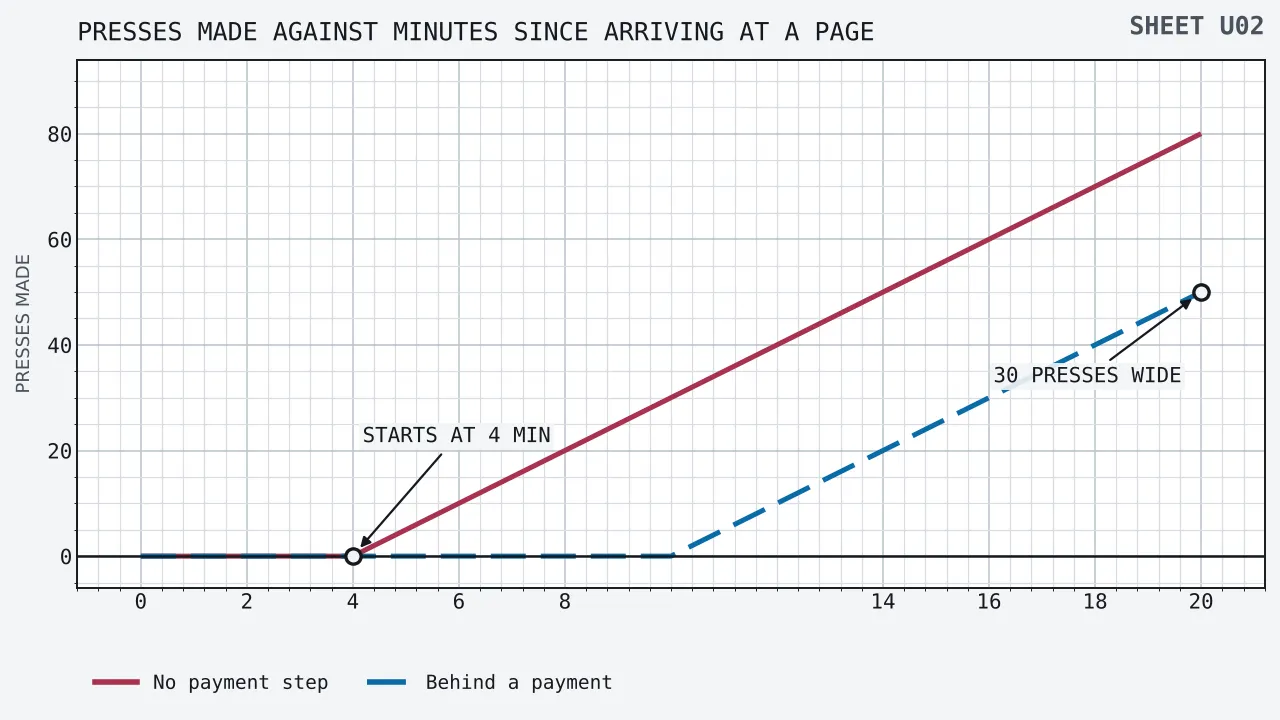
Thirty presses is the constant vertical distance between those two lines once both have started, being six minutes at five presses a minute. Three pounds of staking sits in that gap and twelve pence of expected cost, which is a trivial sum and entirely beside the point. The gap matters because of where it falls, not because of what it holds: it falls before anything has happened, in the only stretch of the evening where stopping costs nothing at all.
Six minutes is therefore the size of the interval a payment step buys, and a second thought is the thing it is usually bought for. Somebody fetching a card has to look at the card. Somebody typing a long number has to watch themselves type it. A payment is a small, dull, friction-laden errand, and every property that makes it annoying is a property that makes it a brake.
Nought is the number of institutions standing between a reader and a credit that costs nothing, and that is the second half of what the payment step was doing. An instrument belongs to somebody: a bank, a card scheme, a wallet, a telephone company. Each of them has its own rules about gambling and its own ability to stop a payment dead. Remove the payment and every one of those parties is removed from the transaction along with it.
3
Periods a registration runs, measured in sign-ups
Six months comes to 262,080 minutes once the period is taken at 182 days of 1,440. Divide by the four assumed minutes of part two and the shortest registration the national scheme offers holds 65,520 sign-ups of that length, laid end to end. The ratio is not a rhetorical flourish. It is the plainest way to show that the two quantities in this exchange are not of the same order.
Four settings are offered at registration, and in months they run 6, 12, 60, and 60 again with automatic renewal behind them. The terms carrying them were last revised on 20 May 2026. None can be ended before its minimum has run. None lifts itself when that minimum passes, and one left untouched keeps running, by up to 84 further months. Those are the periods the table below converts.
| The period, as the scheme offers it | Days | Hours | Four-minute sign-ups it holds | 13 h 20 min as a share of it |
|---|---|---|---|---|
| Six months | 182 | 4,368 | 65,520 | 0.31 per cent |
| One year | 365 | 8,760 | 131,400 | 0.15 per cent |
| Five years | 1,826 | 43,824 | 657,360 | 0.03 per cent |
| Five years, then silence | 4,383 | 105,192 | 1,577,880 | 0.01 per cent |
Nought point three one per cent is the figure in the top right and it repays a moment. The whole run of pressing that a ten pound credit demands, all 13 h 20 min of it, is three thousandths of the shortest period on the list. A reader who imagines they are weighing one evening against a decision made months ago is weighing something smaller than an evening against something very much larger than a decision.
Sixty-five thousand five hundred and twenty is the other end of the same comparison and it is deliberately absurd. Nobody signs up 65,520 times. The number exists to put a measurable value on an exchange nobody writes down: minutes spent getting in against months spent having decided not to. Every figure in that column is this note’s own arithmetic over the scheme’s own published periods.
Seven years is the tail on the fourth row and it is the row readers forget. A registration left alone at the end of five years does not expire; it continues, which carries the span to roughly 4,383 days and 105,192 hours. An early finish is not on the menu, and a finish at the proper time starts at the scheme’s contact centre with a cooling-off of at least 24 hours in which the exclusion stays fully live.
4
Four hundred pounds of staking on a ten pound credit
Four hundred pounds is what a forty times clause asks of a ten pound credit, and the multiplication is the only step in it. Forty multiplied by ten is the staking the terms want to see before anything becomes withdrawable. Ten pence a press turns £400.00 into 4,000 of them, and the twelve seconds this site assumes for each puts the lot at 13 h 20 min.
Thirty-seven is what that comes to in sittings, a sitting being the 22 minutes and 110 presses this note allows one spell with a handset. Neither the interval nor the sitting was measured, and both are conventions declared here. A reader who manages one sitting an evening is looking at five weeks of evenings to discharge a clause attached to a credit that arrived in four minutes.
Squeezing the same 4,000 presses into two hours would need one press every 1.8 seconds, and a slot built to the British minimum interval between game cycles will not run that fast. So the hours are not a matter of patience or of thumb speed. They are fixed by the size of the clause divided by a pace that has a floor under it, and the floor is one of the things that stops existing once the cashier does.
13 h 20 min of pressing demanded by a credit that lands in 4 min
Two hundred to one is how those two durations stand against each other: 800 minutes of pressing, four minutes of typing. That single pair is the honest shape of the product. The part advertised as effortless is the part measured in minutes, and the part never advertised at all is the part measured in days of evenings.
Sixteen pounds is the expected cost of discharging the clause, being four pence in each pound of the £400.00 at the ninety-six per cent return held fixed across this site. Set that against the ten pounds credited and the arithmetic closes: a credit of £10.00 that expects to cost £16.00 to unlock leaves minus £6.00, which is the figure in the third reading at the head of this note. Nothing in that depends on luck. It is what the average outcome is, worked from a stated return.
5
Twenty-five times, and the two sides of it
Twenty-five is where a credit’s expectation lands on exactly nothing, that multiple being the reciprocal of the four-pence margin rather than anybody’s policy. Below it a credit is worth something on average. Above it the clause asks for more staking than the credit can survive, and the expected value of the whole arrangement turns negative. The table below walks across that point.
| Multiple applied | Staking it calls for | Pressing at the assumed pace | Presses of 10p | Sittings of 22 min | Expected at the end |
|---|---|---|---|---|---|
| One time | £10.00 | 20 min | 100 | 1 | £9.60 |
| Ten times, the ceiling inside the licence | £100.00 | 3 h 20 min | 1,000 | 10 | £6.00 |
| Twenty-five times | £250.00 | 8 h 20 min | 2,500 | 23 | £0.00 |
| Forty times | £400.00 | 13 h 20 min | 4,000 | 37 | minus £6.00 |
| Sixty times | £600.00 | 20 h | 6,000 | 55 | minus £14.00 |
Ten times is a ceiling on the British side rather than a habit, and it has a date. A social responsibility code provision stops a licensee setting a multiple above ten on the bonus funds credited, and the consultation response that settled the drafting dates it from 19 January 2026. The same day brought a companion rule barring more than one kind of gambling product inside a single incentive.
Sixty times is what the regulator reached for in describing the practice the ceiling was built against, its consultation response attributing that multiple to some licensees of the day. That figure belongs to the regulator and the row converting it belongs to this note. Twenty hours of pressing and minus £14.00 is what sixty times does to a ten pound credit on the assumptions declared here.
Six pounds either side of nothing is the cleanest way to hold the whole table. At the British ceiling a ten pound credit is worth £6.00 in expectation to the person holding it. At forty times the identical credit is worth minus £6.00, which is £6.00 expected to travel the other way. The headline on both is the same ten pounds, and the multiple decides which direction the money is expected to move.
Nothing in the paragraphs above says a particular clause anywhere asks forty times. The multiple is this site’s working assumption, stated so that every figure can be rebuilt at another one, and the table exists precisely so that a reader meeting a different number can find their own row. What no row can do is make a clause above twenty-five times worth taking on the arithmetic.
6
What a headline has to carry, and who makes it
Significant conditions is the term the advertising regulator uses, and its worked list for a gambling promotion runs to four. Eligibility is one, which may turn on newness, on age or on where somebody lives. A requirement to deposit or to wager is two. A clock on claiming the thing, or on using it, is three. Minimum odds or bet types are four. Leave any of them out where the absence could mislead, and the promotion has broken a duty, since each is owed clearly and prominently to whoever sees it.
Every item on that list is a line in a credit of the shape this note prices. The multiple is a wagering requirement. The window is a time limit. New customers only is an eligibility restriction. So a British promotion carrying a face value and nothing else is not an incomplete advertisement; it is an advertisement missing the four things the code names by name.
One click is the distance the gambling regulator puts between an online advertisement and its full terms, with the significant conditions themselves set beside the headline wherever a landing or sign-up page carries one. Too little prominence and the advertisement counts as misleading, which the regulator states flatly. Three rulings put shapes on that: a deadline nobody printed, a way of paying excluded in the small print, and a voucher no good on one particular day.
A hundred and seventy thousand pounds is the published price of a term of a different kind, dated 3 July 2025. The rules for bonuses on that operator’s new casino promotions kept a discretion for the operator alone: shut the account, or keep the winnings. The condition the regulator recorded as breached is the one about dealing fairly and openly, with a note that terms of the sort lack transparency and may produce unfair outcomes. An audit followed, run by a third party at arm’s length and covering what the operator had in place. A penalty is what the source gives, not a term struck down, and this note claims no more.
Two lines, and incentives get nothing more than that from the offshore rulebook this network opened. Reporting it accurately matters more than scoring off it. Communicate bonuses and promotions transparently, on clear terms, says the first. Do not push excessive gambling with aggressive promotion, says the second. Behind them sits no list of significant conditions, no rule about prominence, and no ceiling on the multiple anywhere in the document.
7
The one step that was also a reading
The British regulator puts three reasons behind the check that happens before anybody gambles, and the middle one is the subject of this part. Age is the first. Whether the person has excluded themselves is the second. Confirming who they are is the third. One procedure, three jobs, and the second job is the machinery by which a decision taken months ago reaches tonight.
Three items go in before a customer may gamble at all, obtained and then checked under the licence condition governing identity: name, address, date of birth. The rule reaches a free bet and bonus funds exactly as it reaches a customer’s own money, and age verification extends even to versions of games that pay no prize at all. A credit costing nothing is therefore not a side door inside the register: it stands behind the identical check, at the identical moment.
So the payment step and the identity step were doing two different jobs in the same few minutes, and only one of them is about money. Removing the payment removes a brake. Removing the reading removes the mechanism that connects a registration to the evening it was made for. A product with neither is not the same thing run faster. It is another thing entirely, with the checkpoint lifted out.
Participation in the national scheme binds online gambling companies licensed in Great Britain, which is why the boundary of the protection and the boundary of the licence are one line and not two. The scheme publishes that limit itself, in terms: it assists with exclusion from services supplied by participating operators, and it is unable to help prevent somebody reaching services supplied by organisations that do not participate. Nothing on this page helps anybody over that wall.
614,738 is the count the scheme published on 16 July 2026, a half-yearly release that also puts 2026’s first six months 16 per cent ahead on registrations and records 12,236 sign-ups in May, the busiest month it has had. Divide 12,236 by 31 and that month ran at 395 registrations a day, which is one every 3 minutes 39 seconds. More than one registrant in two of the 614,738 took the five-year period, the longest single one the scheme offers. Those are decisions about future evenings, taken by people who expected future evenings to be difficult.
8
A product shaped for somebody who has already stopped
The British technical standard on responsible product design names four behaviours a product may not actively encourage, and the fourth of them is the one this note is about: play that continues after a customer has made the wish to stop known. Chasing a loss is one, lifting a stake is two, and running past a figure already settled on is three. Its guidance adds that nobody who has chosen to leave should be coaxed back, and the illustration it picks is a game given free.
A credit asking for no payment is that example almost word for word, and a registration with the national scheme is the clearest indication of a wish to stop that a person can give. Put the two together and the product this note prices is, inside the register, precisely the thing the design standard names. Outside the register it is a marketing budget.
Fairness in reporting cuts the other way as well, and the offshore rulebook examined for this network does address the point. An operator licensed under it must not put a player off reaching for a cooling-off control, and one of the named ways of putting them off is to put a bonus or a promotion in the way of the decision. Marketing is barred there as well, for as long as a cooling-off period or an exclusion remains live.
One structural difference survives all of that, and it is not about the drafting. A bar on marketing during an exclusion can only bite where the business doing the marketing knows about the exclusion, and under that rulebook an exclusion is an arrangement between a player and one operator, covering the domains that operator runs. What the policy offers for everywhere else is an encouragement: the player should go and exclude themselves again, site by site.
Six pounds is what a ten pound credit is expected to be worth to whoever issues it, once a forty times clause is run to the end. Four hundred pounds crosses the reels, the house holds four pence in the pound, and £16.00 is the expected transfer against £10.00 of credit handed out. That is the commercial answer to the question of why a product with no payment step exists at all, and it is an entirely ordinary answer.
9
Five rules standing over a credit, and where they stand
Where no Great Britain licence is held, a credit of this shape arrives with five particular rules missing from behind it, and this part names them through the credit rather than in the abstract. First, a wagering requirement capped at a multiple of ten, in force from 19 January 2026. Second, a bar on putting more than one kind of gambling product inside one incentive, from the same day. Third, a duty to set out clear, transparent and fair terms for the incentive and to make them easily reachable by anybody it is offered to. Fourth, significant conditions carried prominently in the advertisement itself rather than a click or two behind it. Fifth, identity obtained and verified before any gambling at all, bonus funds and prize-free versions included.
Five absences, then, each with a different shape. The first removes a number. The second removes a boundary between products. The third removes a standard the terms have to meet. The fourth removes a position on the page. The fifth removes a moment in the sequence, and it is the only one of the five whose removal a reader cannot see by reading anything.
Nought of that means the offshore side is unregulated, and writing it that way would be inaccurate in the opposite direction. The rulebook read for this network carries mandatory responsible gaming requirements, cooling-off controls reachable by one press, self-exclusion periods beginning at a year, deposit limits with a seven-day wait in front of any increase, and a complaints timetable with real periods in it. Five absences are countable in it: nothing caps the multiple, nothing caps the stake, nothing sets a minimum between game cycles, nothing forbids autoplay, and nothing stops a win smaller than the stake being celebrated as one.
Every item in that second list is a rule about what the product does while somebody is using it, which is why their absence is invisible to a reader comparing headlines. A multiple is printed. A ceiling on a multiple is not printed anywhere, because a ceiling is a thing that shows up only when something tries to exceed it.
Recourse is the word in the British regulator’s own sentence, and the sentence says a consumer faces its lack when things go wrong at a site off the register. The post carrying it is dated 21 October 2025 and names three absences besides: age verification, responsible gambling tools, and payment systems that are secure. 20 January 2025 is the date on a warning notice to the industry, which adds that unlicensed sites commonly aim at vulnerable customers, the group it picks out being people holding a registration with the national scheme.
10
A price of nothing, paid in something else
Nothing in money is the honest answer to what a credit of this kind costs a reader, and any page saying otherwise is inventing a charge. No payment leaves a pocket. No instrument is exposed. The sum at risk, if the credit is simply allowed to run out, is genuinely nought, and refusing to admit that would make the rest of this note less believable rather than more.
Thirteen hours and twenty minutes is the first real price, and it is paid in a currency nobody refunds. Thirty-seven sittings at the rhythm this site assumes. Minus £6.00 of expectation at the end, which means the clause is not a hurdle to be cleared with luck but an arrangement whose average outcome is already known. A reader who finishes it has spent five weeks of evenings arriving at a figure the arithmetic could have given them in a line.
Four minutes against 4,368 hours is the second price and the one this note was written for. The shortest period the national scheme offers is 4,368 hours long, it cannot be shortened once it starts, and it exists because somebody decided in daylight that their own later judgement should not be trusted with an evening. The product priced here is the one product on the market that can be taken inside the four minutes before that judgement arrives.
Sixty-five thousand five hundred and twenty sign-ups of four minutes fit inside those six months, which is the arithmetic form of the same sentence. Nobody is going to be persuaded by a ratio. What a ratio can do is make visible that the two sides of this exchange were never comparable, and that the side costing nothing is the side that was never the expensive one.
Anybody who has read this far because a registration they made is turning hard to live with should dial 0808 8020 133 rather than open the eleventh page of search results. The call costs nothing, GamCare takes it at any hour, and it can be made on the telephone, in a live chat window or by written message. Fear for somebody else under the same roof is as good a reason to make it. That call is shorter than the four minutes costed in part two, and it is the only thing this note recommends.
Questions
- What makes a credit with no payment step different from any other offer?
- Three things come off at once. A payment takes minutes, needs an instrument, and can be refused by whoever stands behind that instrument. Remove it and this note’s assumed four minutes of typing are all that separate a thought from a first press, with no bank, card scheme, wallet or telephone company left anywhere in the transaction.
- How long does a forty times clause take on a ten pound credit?
- Four hundred pounds of staking. Ten pence a press makes that 4,000 presses, and twelve assumed seconds apiece makes those 13 h 20 min. Thirty-seven sittings is the same span cut at the 22 minutes assumed here for one spell with a handset. Neither the interval nor the sitting was measured, and both are conventions declared on the page.
- Can that clause be finished at a profit?
- Not on average, and not by anybody. The margin is fourpence where ninety-six pence in each pound comes back, so £400.00 of staking is expected to take £16.00 against £10.00 of credit, leaving minus £6.00. The break-even multiple is twenty-five, being the reciprocal of that margin, and every multiple above it has a negative expectation built into it before a press is made.
- Why does twenty-five times go on appearing?
- Because that is where a credit’s expectation lands on exactly nothing, which is arithmetic and not policy. Divide one by the fourpence margin and twenty-five comes out. A £10.00 credit carries £6.00 of expectation at a multiple of ten, exactly nothing at twenty-five, minus £6.00 once the multiple is forty, and minus £14.00 at sixty.
- How high may a play-through go inside the British licence?
- Ten, as a multiple, and nothing above it may be applied to the bonus funds. A social responsibility code provision forbids more, the consultation response that settled the drafting dating the requirement from 19 January 2026, with a companion rule arriving the same day against mixing kinds of gambling product inside one incentive. That response attributes a multiple of sixty to some licensees of the day.
- What has to appear in the advertisement itself?
- The significant conditions, four of them on the advertising regulator’s worked list. Who qualifies is one, which newness, age or location can decide. A requirement to put money in or to wager it is two. A clock on claiming or on using is three. Minimum odds or bet types are four. The gambling regulator puts the full terms one click from an online advertisement, and says too little prominence turns the advertisement into a misleading one.
- Does a credit costing nothing still go through an identity check inside the licence?
- Yes, and the rule is explicit about it. Three items go in first, being name, address and date of birth, each obtained and then checked before any gambling happens at all. A free bet and bonus funds are reached exactly as a customer’s own money is, and the age check extends to versions of games that pay no prize. Three reasons are put behind that check by the regulator, and whether the person has excluded themselves is one.
- How do four minutes compare with the period a registration runs?
- Six months is 182 days, 4,368 hours and 262,080 minutes, so it holds 65,520 sign-ups of the four minutes assumed here. One year holds 131,400 of them and five years 657,360. The whole 13 h 20 min of pressing that the clause demands is 0.31 per cent of the shortest of those periods.
- Does the offshore rulebook say anything about bonuses?
- Two lines and no more. The first asks that bonuses and promotions be put across transparently, on terms that are clear. The second bars aggressive bonus promotion that pushes excessive gambling. Nowhere in it stands a ceiling on a multiple, a list of significant conditions, or a rule about where a condition has to sit.
- Where should somebody go who came here looking for a way past their own registration?
- To 0808 8020 133. GamCare runs the National Gambling Helpline on that number, free, with no hour of the day shut and no date in the year missed, and it takes a telephone call, a live chat or a written message. Fear for another person in the household earns the call as surely as fear for oneself. TalkBanStop is GamCare’s as well: the helpline, a blocker for gambling sites, and the national scheme, the three handed over together. A registration under way can be lengthened rather than left to lapse, by a further 6, 12 or 60 months.