Note W07 Revision 1 Terms read 17 October 2026
No verification casinos, and the three jobs one check is doing
Three separate jobs hide inside the word verification, and a phrase offering to skip the paperwork is offering to skip all three. Five hundred pounds standing in an account leaves in one movement where a Great Britain licence applies, at £50.00 a day under a ceiling nothing elsewhere forbids, and at £8.93 a day behind a complaints timetable of fifty-six. This note prices the jobs and the pounds, not the photographing.
Jobs inside one check 3 £500.00 released at £8.93 a day Before a payout is reachable 46 d
What a joining of this kind asks in days
Advertising has been bought for every destination below. A fee reaches this site when a reader goes on to register, and no figure on this page moves one way or the other because of it.
-
01Mobile Free Spins
Betportal
Ceiling as a multiple
What lands€15.00150 spins at 10c, which is this site's figure and not the operator'sThe run17 h 30 minTurning over 525.00 at 10p means 5,250 presses, or about 48 phone sittings of 22 minutes. Timed at 10p a press and 12 seconds between presses, both of which this site assumes rather than measures.The wait to be paidNOT PUBLISHEDThis operator puts no withdrawal band in its own terms, so there is nothing honest to print here.Spins valued at this site's own 10p a spin
What lands
Spins, at a price15.00150 of them at 10c apiece, a figure belonging to this site rather than to the operatorMatch, and other creditno figure300% of three deposits, to a ceiling of €1,000. Not a sum until money of yours makes it one, so this row totals nothing and carries nothing downwardsThe run
Handed back on the spins(0.60)Each press stakes its own value and returns 96 per cent, which leaves this much with the house from the opening pressPlay-through 35x on the bonus(20.16)Taking 14.40 round 35 times over means 504.00 through the machines, of which 20.16 is the expected cost, and 17 h 30 min of pressing at the pace aboveWhat counts towards it100%Slots only, with no percentage published anywhere, so the row above assumes the whole of each stake countsWhat never clears
Limit on the winningsstated5x the bonusDeducted on the way outno figureNothing is published as a figure here, so this row removes nothingLeast that can leaveno figureNo figure is published, so nothing on this timer is pinned down by oneLeast deposit, and the rung over ityour own€20 a stage. Published in euros, so no rung is named at all: this site's ladder is a sterling oneThe window on the creditstated14 daysBiggest stake while it runsstated€5Removed outright by rulestatedNot publishedVerified before a payoutstatedDocuments before the first withdrawalNever clears€15.00Not a penny of it gets out, so the whole of what landed stands on this rowNo Great Britain licence
Licence held in Anjouan, Comoros, the company named is BetPortal Gaming Ltd, with Excite Ultra Media Ltd, quoted under ALSI-202601040-FI2.
Terms read 17 October 2026
Open the offer at Betportal, opens in a new window -
02Mobile Free Spins
WinBeast
Ceiling as a sum
What lands€50.00500 spins at 10c, which is this site's figure and not the operator'sThe run2 d 18 hTurning over 2,000.00 at 10p means 20,000 presses, or about 182 phone sittings of 22 minutes. Timed at 10p a press and 12 seconds between presses, both of which this site assumes rather than measures.The wait to be paidNOT PUBLISHEDThis operator puts no withdrawal band in its own terms, so there is nothing honest to print here.Spins valued at this site's own 10p a spin
What lands
Spins, at a price50.00500 of them at 10c apiece, a figure belonging to this site rather than to the operatorMatch, and other creditno figure50% to 100% of five deposits, each to a ceiling of €1,000, and a €650 free bet. Not a sum until money of yours makes it one, so this row totals nothing and carries nothing downwardsThe run
Handed back on the spins(2.00)Each press stakes its own value and returns 96 per cent, which leaves this much with the house from the opening pressPlay-through 40x on the bonus and the winnings from the spins(76.80)Taking 48.00 round 40 times over means 1,920.00 through the machines, of which 76.80 is the expected cost, and 2 d 18 h of pressing at the pace aboveWhat counts towards it100%Slots, titles vary by country, with no percentage published anywhere, so the row above assumes the whole of each stake countsWhat never clears
Limit on the winningsstated€100 a batch of spinsDeducted on the way outno figureNothing is published as a figure here, so this row removes nothingLeast that can leaveno figureNo figure is published, so nothing on this timer is pinned down by oneLeast deposit, and the rung over ityour own€20 a stage. Published in euros, so no rung is named at all: this site's ladder is a sterling oneThe window on the creditstated7 days, spins 1 dayBiggest stake while it runsstatedNot publishedRemoved outright by rulestatedNot publishedVerified before a payoutstatedDocuments before the first withdrawalNever clears€50.00Not a penny of it gets out, so the whole of what landed stands on this rowNo Great Britain licence
Licence held in Curaçao, no company named anywhere on the site.
Terms read 17 October 2026
Open the offer at WinBeast, opens in a new window -
03Mobile Free Spins
EliteSpin
Longest spin window
What lands£50.00500 spins at 10p, which is this site's figure and not the operator'sThe run2 d 18 hTurning over 2,000.00 at 10p means 20,000 presses, or about 182 phone sittings of 22 minutes. Timed at 10p a press and 12 seconds between presses, both of which this site assumes rather than measures.The wait to be paidNOT PUBLISHEDThis operator puts no withdrawal band in its own terms, so there is nothing honest to print here.Spins valued at this site's own 10p a spin
What lands
Spins, at a price50.00500 of them at 10p apiece, a figure belonging to this site rather than to the operatorMatch, and other creditno figure50% to 100% of five deposits, each to a ceiling of £1,000. Not a sum until money of yours makes it one, so this row totals nothing and carries nothing downwardsThe run
Handed back on the spins(2.00)Each press stakes its own value and returns 96 per cent, which leaves this much with the house from the opening pressPlay-through 40x on the bonus and the winnings from the spins(76.80)Taking 48.00 round 40 times over means 1,920.00 through the machines, of which 76.80 is the expected cost, and 2 d 18 h of pressing at the pace aboveWhat counts towards it100%Slots, with no percentage published anywhere, so the row above assumes the whole of each stake countsWhat never clears
Limit on the winningsstated5x the bonusDeducted on the way outno figureNothing is published as a figure here, so this row removes nothingLeast that can leaveno figureNo figure is published, so nothing on this timer is pinned down by oneLeast deposit, and the rung over ityour own£20 a stage. It lands square on the £20.00 rung, so none of yours is left perched on topThe window on the creditstated7 days, spins 3 daysBiggest stake while it runsstatedNot publishedRemoved outright by rulestatedNot publishedVerified before a payoutstatedDocuments before the first withdrawalNever clears£50.00Not a penny of it gets out, so the whole of what landed stands on this rowNo Great Britain licence
Licence held in Costa Rica, the company named is PrimeTier Limited.
Terms read 17 October 2026
Open the offer at EliteSpin, opens in a new window -
04Mobile Free Spins
Crown Jewelz
Multiple unpublished
What lands£15.00150 spins at 10p, which is this site's figure and not the operator'sThe runNOT TIMEDThis operator does not publish the play-through multiple in its own terms. The multiple is the one figure the clock cannot work around, so the run is left untimed.The wait to be paidNOT PUBLISHEDThis operator puts no withdrawal band in its own terms, so there is nothing honest to print here.Nothing reckoned
What lands
Spins, at a price15.00150 of them at 10p apiece, a figure belonging to this site rather than to the operatorMatch, and other creditno figure200% of the first deposit, then 150% twice, each to a ceiling of £1,000. Not a sum until money of yours makes it one, so this row totals nothing and carries nothing downwardsThe run
Play-throughno figure40x the bonus, reported rather than published by the operatorWhat counts towards itno figureSlots, with no percentage published anywhere, so the row above assumes the whole of each stake countsWhat never clears
Limit on the winningsstatedNot publishedDeducted on the way outno figureNothing is published as a figure here, so this row removes nothingLeast that can leaveno figureNo figure is published, so nothing on this timer is pinned down by oneLeast deposit, and the rung over ityour own£20. It lands square on the £20.00 rung, so none of yours is left perched on topThe window on the creditstatedNot publishedBiggest stake while it runsstatedNot publishedRemoved outright by rulestatedNot publishedVerified before a payoutstatedDocuments before the first withdrawalNever clearsNOT RECKONEDThis operator leaves the play-through multiple out of its own terms, so nothing below the fourth step can be worked out.No Great Britain licence
Licence held in Curaçao, number not verified, no company named anywhere on the site.
Terms read 17 October 2026
Open the offer at Crown Jewelz, opens in a new window
Only the middle reading comes out of arithmetic belonging to this site. The multiple laid against what lands gives the turnover asked for; dividing that by 10p a spin gives the presses; dividing those by 300 an hour gives the hours, a press on a handset being taken here at 12 seconds from the one before. Both figures are assumptions rather than measurements of anybody: nothing was played and nothing was held a stopwatch to. Anybody quicker should divide the press count by a rate of their own, which is why the presses are printed alongside the hours instead of being summarised away.
The first reading is what arrives before any condition is laid against it. Spins carry no unit of their own so one gets supplied: where an operator values its own spin that figure is used and attributed, and where it does not, this site's 10p a spin stands in and everything below moves with it. The third reading belongs to the operator entirely. It is a withdrawal band quoted from published terms, and a blank there means none was published rather than that nobody looked.
The total along the foot answers what the hours leave open, which is whether any of the running ends anywhere. It is what arrived, less whatever is still standing once the play-through has been paid for at 96 per cent return to player and once a published limit, a published deduction and a published floor beneath the least that can leave have each had a turn. It appears again in pence in the pound, the only fair way of holding a small offer up against a large one. It describes an offer rather than an evening, and where the conditions price out what arrived, a timer prints nothing getting out instead of a negative sum.
Cashiers on a handset take deposits off a row of preset buttons, so a least deposit given in pounds is raised to the next rung of the ladder used here, £10, £20, £25, £50, £75 and £100, and the timer shows what is left perched on it. That money is the reader's own and enters no sum at all. Given in euros it prints untouched, the ladder being sterling. Three words may occupy the figure column where no figure belongs. Stated is a published term that costs something while leaving no number to subtract. No figure is a term nobody has quantified, or a credit that is not a sum until money of yours makes it one. Your own is money of yours, which belongs in none of this.
None of the operators above is licensed in Great Britain, so not one duty that licence carries reaches any of them. Membership of Gamstop Online is compulsory for every online gambling company licensed in Great Britain, which means that shutting yourself out through the scheme shuts you out of none of these. The limit of ten times the bonus funds on a wagering requirement, running since 19 January 2026 under Social Responsibility Code 5.1.1, is a condition of the same licence and binds only whoever holds one. Off that licence, the Gambling Commission writes of consumers meeting unfair gaming practices, financial loss and no recourse when matters go wrong, and lists blocked payouts and withdrawal limits pitched too high to reach among the things it has seen. No account at any of them may be held by anybody under 18.
Every term on a timer is its operator's own and every timer carries the day somebody read it. The oldest of those readings is 17 October 2026. What binds a reader is an operator's full terms and never a line printed here.
1
Three jobs under one word, and who each is for
Three reasons are given by the British regulator for asking who somebody is before they gamble, and they are not three descriptions of one reason. Whether the holder is old enough comes first. Whether an exclusion already stands against them comes next. Which living person owns the account is the remaining one. Each protects somebody different, each fails differently when nobody performs it, and only one of the three involves a document.
One phrase covers all three at once and hides the difference between them. Searches for no verification casinos are searches about photographing, and photographing is the form the work takes rather than the work itself. Prising the three apart is the whole method of this note, because two of them cost a reader nothing in effort and everything in standing.
Five hundred pounds is the balance every sum below is worked against, and £25.00 is the qualifying payment that opened the account it sits in. Neither figure is a measurement and neither is a forecast. They are two sums held still so that the three jobs can be costed in pounds and in days rather than in patience.
| The job | What it settles | Who is better off for it | What its absence is felt in |
|---|---|---|---|
| Age | That the holder of the account has turned eighteen | A household, and not the person typing | Nothing measurable, which is the difficulty |
| Self-exclusion status | Whether a decision already taken ought to stop this account | Whoever took that decision, possibly years ago | Days of a registration that cannot reach anything |
| Identity | Which living person a balance actually belongs to | The business first, and the account holder second | Pounds, and the days they spend somewhere else |
Two of those rows have no column for effort and that is deliberate rather than an oversight. Typing a date of birth costs seconds. Being matched against a list of names costs nothing at all, since the reader does not participate in it. The first two jobs are invisible to the person being checked, which is precisely why a phrase that promises to remove friction can remove them without anybody noticing a change.
No Great Britain licence stands behind a business trading on that promise, and on a page about what a check is for what goes missing is standing rather than speed. All three jobs are duties on the licensed side and drafting choices on the other one. A reader cannot tell which of them is being done, because there is no entry anywhere to look the answer up in, and a duty nobody can look up behaves exactly like a duty nobody holds.
Nought routes past an identity check appear in these ten parts, and the position is flat rather than hedged. No business is named, no document policy is recommended, and no order of events is suggested that would carry money beyond a check. Using another person’s papers is fraud. A gambling bar applied by a bank, a restriction run across a network, and Gamstop Online, whose terms draw a boundary round what the scheme can act on, are protections and are written about here as protections.
2
The first job, settled by a date somebody types
Four steps make up the registration test the Curaçao responsible gaming policy sets for age, and only the first of them is unqualified. A date of birth is to be confirmed. Open-source verification comes next, if possible. A box declaring the player to be over eighteen is third. Confirmation of a payment method closes the list.
Two words in the second step carry more weight than everything around them. If possible hangs on the only item in the list that holds a claim up against a record kept elsewhere. Strip that one out and the remaining three consist of the account holder telling the business something about themselves, with a box to tick as the purest instance: it poses the question and accepts the answer in the same movement of a thumb.
One photographic document does appear in the same policy, and the point is where. A government-issued identity document hangs off milestones the authority sets around knowing a customer and around money laundering, which is to say nowhere near the door. It is pulled earlier in a single circumstance, that being an operator already holding some doubt about the age in front of it. Doubt is therefore the trigger, and nothing obliges anybody to go hunting for any.
Nought prizes are paid by a free-to-play build and nothing is staked in one, which is why the British regulator describes those builds as not technically gambling in its own words. It put the age check over those builds anyway, having published the view that nothing legitimate is served by a child getting into one. That is the clearest statement available anywhere of what an age check is for, because it imposes the check where there is no money in play at all.
0 seconds of friction separate a confirmed date of birth from an asserted one
Nought pounds and nought days is what the first job costs an adult reader, and that is exactly why it is the easiest of the three to quietly drop. Removing it changes nothing a reader would feel. The person who feels it is somebody who never read the terms, was never asked for a password and does not appear in any column of this note, because a cost that lands on a household rather than on an account holder has no honest unit in a table about money.
Three keystrokes and a tap is the whole of the difference between an eighteenth birthday that happened and one that did not, where the test is a typed date. A business that asks for a document at the door is buying certainty with somebody else’s minutes. A business that asks for a tick is buying nothing, spending nothing, and reporting the same compliance either way.
3
The second job needs a person, and an account is not one
Two is the job nobody thinks of as a check, and it is the one the third job exists to make possible. A self-exclusion register is a list of people. Holding an account up against a list of people requires first establishing which person the account is. Without identity the second job cannot be attempted at all, however good the list is and however carefully somebody keeps it.
Three hundred and sixty-five days is the shortest self-exclusion a Curaçao licensee must put in front of a player, and four longer rungs stand over it: 1,095 days, then 1,825, then 3,650, then a span given no finish at all. None of those lengths can be lifted by the player before it runs out. They are serious commitments, drafted by somebody who grasped what the tool is for, and all of them are fastened to a single operator rather than to a market.
| Period the policy requires to be offered | Days at 365 to the year | Can the player end it early | How far it reaches on its own terms |
|---|---|---|---|
| One year, the floor under the ladder | 365 | No | That operator, and all of its domains |
| Three years | 1,095 | No | That operator, and all of its domains |
| Five years | 1,825 | No | That operator, and all of its domains |
| Ten years | 3,650 | No | That operator, and all of its domains |
| A lifetime | No end date | No | That operator, and all of its domains |
One column there repeats itself five times over and the repetition is the finding. Every length on the ladder buys the same reach, because length and reach are separate properties and only one of them is being sold. Ten years of resolve spent on one desk is ten years of resolve spent on one desk, and what the policy supplies about the remainder of the market is a verb: the player is to be encouraged into taking the same decision again, business by business.
Nought duties attach to that word. Encouragement is what a policy says where it has decided not to oblige, and the drafting is honest about it. Set the same decision beside a Great Britain licence and the machinery is a different shape. Joining the national scheme is something the licence itself demands, so a single registration carries right across the licensed market with nothing further asked of the person who made it.
Three thousand six hundred and fifty days of a ten-year decision are therefore worth precisely as much as the second job is worth, and at a desk which has not established who holds the account that comes to nothing. Gamstop Online publishes the limit of its own reach, and that limit is drawn at the businesses which signed up to it. That sentence is a limit on a protection, which is what it was written to be, and it is not an instruction to anybody.
4
Whose five hundred pounds it is, and who says so
Three is the job the search phrase is aimed at, and the only one of the three with money riding on the answer. Identity settles which living person a balance belongs to. Five hundred pounds belongs to somebody from the moment it exists, and until that job is finished the sole record of which somebody is one the business drew up by itself.
Four verbs are used to shut one door in the British drafting, and the door is the one a balance has to leave through. A term in a consumer contract or notice whose object or effect is a ceiling over what somebody may draw out of their own deposit balance may not be imposed. Nor used, nor enforced, nor leaned on. Writing it is already the breach, so a ceiling that has never once been applied is still the forbidden thing.
Two figures make up the single illustration the regulator prints of wording that may not appear, and they are £50.00 inside a day set against £500.00 inside a week. Reaching for a pair is what a drafter does, which is presumably why the example is a pair. Three further sentences on the same page run the same way. Money in a deposit balance, winnings and all, is the customer’s to call for whenever they want it. Nothing may stand over the largest sum they are allowed to call for. Reasonable is the single word guarding whatever limits remain, whether they bite on the amount or on the tally.
Nought publication dates sit on that page, and recording the gap matters more than smoothing it over. Its wording is the thing this note leans on. Nothing here asserts that the page is current, because the page makes no such assertion about itself, and every figure built on it rests on the drafting alone.
One option is kept out of the customer’s hands by the technical standards, and it is the option of taking a withdrawal request back once it has gone in. Money sitting behind a live request is not to be presented again as something to stake. The route out, in the same guidance, is to be kept as free of obstruction as a business can manage.
One direction of travel is being described by all of that, and it is outward. A request to be paid is treated in British drafting as a decision that should be easy to make and hard to reverse. Outside the register the same request is a decision that can be throttled by a ceiling, reopened by a cashier, or answered with an offer to keep playing, and none of those three responses breaks any published rule.
5
Fifty pounds a day, and where two ceilings cross
Ten days is what £500.00 takes to leave an account at £50.00 a day, and that one division carries more of this note than anything else in it. Seven days is what the same £500.00 takes under a weekly ceiling of £500.00. Both ceilings come from the one worked example a British regulator has published as a term that may not be written, and both are ordinary drafting where that rule does not reach.
| What is standing in the account | Days at £50.00 a day | Days at £500.00 a week | Which ceiling is the slower one | Days where neither is written |
|---|---|---|---|---|
| £120.00 | 3 | 7 | The weekly one | 1 |
| £250.00 | 5 | 7 | The weekly one | 1 |
| £350.00 | 7 | 7 | Neither, they meet | 1 |
| £500.00 | 10 | 7 | The daily one | 1 |
| £1,000.00 | 20 | 14 | The daily one | 1 |
| £2,500.00 | 50 | 35 | The daily one | 1 |
Three hundred and fifty pounds is where the two lines meet, and nothing about the figure is a coincidence worth admiring. Seven times fifty is 350, so any balance under it empties faster on the weekly ceiling and any balance above it empties faster on the daily one. A reader holding a small win is slowed most by the weekly wording and a reader holding a large one is slowed most by the daily wording, which is a neat arrangement for whoever writes both.
Twenty days is what a four-figure balance costs at the daily ceiling, and the figure keeps climbing in a straight line while the balance does. Nothing in that shape self-corrects. A larger win is not released faster, it is released at the same rate for longer, and the ceiling converts every extra fifty pounds into another whole day of somebody else holding it.
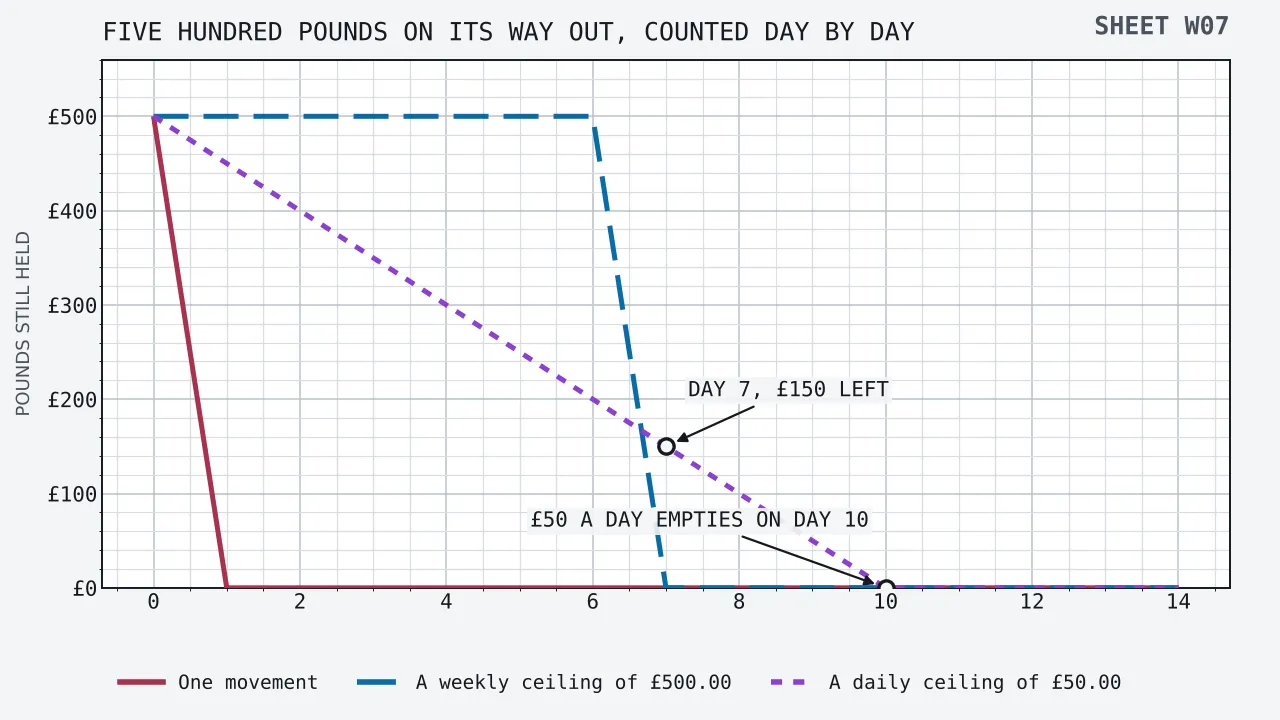
Eight pounds and ninety-three pence a day is the figure that comes out of dividing a balance by the days it takes to arrive, and that unit is the point of the next table. Pounds a day is how a reader actually experiences a ceiling, because the question in front of them is never how many days the terms allow. It is how much of their own money is reachable this week.
| How it comes out | Days | Pounds a day |
|---|---|---|
| In one movement, as the British drafting requires | 1 | £500.00 |
| Under a weekly ceiling of £500.00 | 7 | £71.43 |
| Under a daily ceiling of £50.00 | 10 | £50.00 |
| Behind a four-week assessment of a grievance | 28 | £17.86 |
| Behind that assessment once extended in writing | 56 | £8.93 |
£8.93 a day is the rate £500.00 comes back at across fifty-six
Fifty-six to one separates the quickest row of that table from the slowest, and not one document was refused along the way. Nobody photographed a passport badly. Nobody missed a message. The entire distance is made of wording that one party wrote and the other party agreed to without reading, and the arithmetic merely converts the wording into the unit a reader thinks in.
6
An account closed with the balance still inside it
Twenty-eight days is what a Curaçao licensee has to assess a grievance and answer it, and the clock may be extended once by a further four weeks on written notice to the player. Fifty-six days is therefore the published outside figure. Receipt has to be confirmed in writing inside one week, which is seven of those days gone before anybody has looked at the substance of anything.
Five hundred pounds held across fifty-six days is £8.93 a day, and the division is not a flourish. Money and time share no unit until one of them is divided by the other, and what comes out is something a reader can weigh against whatever else the money would have been doing. Nobody has done anything wrong to arrive at it. The timetable is published and the business is keeping to it.
| What is being waited for | Where the figure is written | Days | What £500.00 is worth a day across it |
|---|---|---|---|
| Receipt of the grievance confirmed in writing | The Curaçao complaints policy | 7 | £71.43 |
| The operator assesses and answers | The same policy, four weeks | 28 | £17.86 |
| That assessment extended once on notice | The same policy, four weeks more | 56 | £8.93 |
| A delay to a prioritised safer-gambling matter | The same policy, capped at two weeks | 14 | £35.71 |
| That cap doubled where a reply is slow in coming | The same policy, two weeks more | 28 | £17.86 |
Two days and five working days are the quickest figures anywhere in that policy, and they belong to safer-gambling matters rather than to money. Receipt on one of those is owed inside two days and best efforts to settle it inside five working days, which is faster than anything the same document asks for a disputed balance. Reporting that the other way round would be easier to write and would be wrong.
Seven days is the British figure worth setting beside all of it, and it runs the other way. Silence of that length against a reasonable request for information lets a licensee pause its own clock rather than reset it. A reply picks the count up from wherever it halted. Days are therefore the whole of what delay costs a reader there, which is gentler than the wording first sounds.
Three things are owed in the letter that closes a British process, and nothing of the sort closes the other one. Why the decision went the way it did. That the business has now exhausted its own internal steps. And which independent adjudicator the matter may be carried to, with the means of reaching them. That letter is the hinge turning a refusal into a next move, and without the duty a refusal is simply where the correspondence stops.
Fifty pounds a day and £8.93 a day are two different diseases with one symptom. The first is a ceiling applied to an account that is working normally. The second is a timetable applied to an account that has stopped. A reader can meet both in sequence on the same balance, and nothing in either set of wording prevents the second from beginning on the day the first finishes.
7
What a grievance is, and the six things it cannot be
Six verbs are used by the governing ordinance to fence a claim in, and the list reads like the window of a pawnbroker. Selling one is out. So is handing it over as a gift, renting it, leasing it, pawning it, or putting it up as security. What the whole prohibition comes to in practice is that only the registered player may bring the thing at all.
One consequence of that falls on exactly the reader this note is about. A balance stuck behind a closed account cannot be handed to somebody with more time, more patience or more appetite for correspondence. It stays with the person whose name is on the registration, whatever else is happening in their life, and it stays there for the fifty-six days the timetable allows.
One attempt is what the dispute route itself is worth, and two separate rules produce that. A process carried through to its conclusion cannot be opened again in front of a different adjudicator. Somebody who abandons one already under way is not meant to bring the same matter back afterwards. Both are defensible drafting, and between them they give a reader a single pass at £500.00.
Nought individual disputes are settled by the Curaçao authority, which writes that refusal into its own policy. Arguments over transactions carried out on a licensee’s websites are not matters it will resolve or decide, and it places itself outside any mediation between the two sides. What it does with the information instead is feed its supervision, and unless a decision has been handled inadequately it leaves the operator’s conclusion, or the adjudicator’s, exactly where it stands.
Two dates a year are set for reporting, and no total has ever appeared against either. Complaint numbers go to the authority in the middle of January and again in the middle of June, the first of those returns falling due in January 2026. They cover the total raised, how many were settled, how many upheld and how many rejected, how many remain open, the breakdown by category, how many reached an adjudicator and how many ended in court. Nothing adding those returns together has been put in public, so there is no telling how often £500.00 finds its way back.
Three unknowns therefore sit on top of the fifty-six days, and they are unknowns of a particular kind. The timetable is published. The dispute route is published. The outcome rate is not published anywhere, which means the one figure a reader would most like before deciding whether to pursue a balance is the single figure the system does not emit.
8
Twenty-five pounds, and the forty-six days it buys into
Twenty-five pounds is the qualifying payment this note models, and paying it is the moment the third job stops being a matter of principle. Money changes hands. The person it came from has been established to the standard of a typed date and a tick box, and the business it went to has been established to no standard a reader can go and read.
One thousand pounds is the staking a forty times condition wants out of a £25.00 credit, which is 10,000 presses at ten pence each. Thirty-three hours and twenty minutes is what those presses fill at twelve seconds apiece, an interval this site adopts and has never put a watch to. Ninety-one is what 2,000 minutes comes to in sittings of twenty-two, a part sitting being counted whole throughout this site.
| What the condition wants | The figure |
|---|---|
| Staking across the reels at forty times | £1,000.00 |
| Presses of 10p that comes to | 10,000 |
| Pressing at the assumed twelve-second interval | 33 h 20 min |
| Sittings of twenty-two minutes, rounded up | 91 |
| Days of that at two sittings a day | 46 |
| Expected position when the last press lands | minus £15.00 |
Forty-six days is the row that belongs on a page about waiting, and it is reached by halving 91 and rounding up. Nothing can be asked for before the condition is satisfied, so the £25.00 sits with the business for forty-six days on a schedule nobody would call demanding. Two sittings a day is a quiet evening, not a campaign.
Fifteen pounds carries a minus in front of it at the end of that, and the sum behind it is short. Forty multiples of a four-pence margin remove 160 per cent of a credit, so a £25.00 face is expected to finish at minus £15.00 with nothing left standing. A reader who still holds £500.00 on day forty-six is a reader the average never described, and that reader is the subject of every other part of this note.
46 days of two sittings before a payout can even be asked for
Two clocks therefore run end to end before the third job is reached at all. Forty-six days of condition, then whatever the ceiling adds, then whatever the grievance timetable adds after that. A reader who meets the condition and the daily ceiling and nothing else is at fifty-six days from the first press to the last pound, which coincides exactly with the outside figure for a disputed balance and arrives by a completely different road.
9
The same balance under two arrangements, counted in days
Seven rows are enough to put the whole of this note side by side, and the point of setting it out that way is that most of the differences are not about paperwork. Two of the three jobs change character entirely between the columns. The third changes who is allowed to write the terms, which turns out to be the expensive one.
| What is at stake | Under a Great Britain licence | Where no Great Britain licence is held |
|---|---|---|
| The age job | Name, address and day of birth obtained and checked before any play | Satisfaction that the player is eighteen, resting on a confirmed date and a tick box |
| The exclusion job | One registration reaches the whole licensed side, because joining is a licence condition | One operator and its domains, with encouragement to repeat the decision elsewhere |
| A ceiling on taking money out | A forbidden term, in the drafting as well as the applying | Ordinary wording, with nothing published against it |
| £500.00 at £50.00 a day | Not available to be written | 10 days |
| Undoing a withdrawal already asked for | Not to be offered to the customer at all | A matter for whoever drafted the terms |
| An account shut with the balance inside | A final letter, then an adjudicator from an approved list | Four weeks, extendable once, then an adjudicator the operator may set conditions for |
| How often any of it ends well | Published enforcement, published decisions | No aggregate of the returns has appeared |
One hundred and sixty websites were assessed for traffic after enforcement work, and a 32 per cent drop is what the British regulator reports across them. That is the most encouraging figure available about the supervision standing behind the right-hand column. It is also, on the regulator’s own account, a dent rather than a dismantling.
Nought promises accompany it either, which is unusual in a regulator’s own writing. Given the scale of revenue involved, the same post says it is unlikely the ecosystem will ever be fully taken apart, and it characterises what it faces as growing more sophisticated, as running on digital rails, and as global. No revenue figure is given anywhere in it.
Two readings of that are available and only one of them is honest. Writing that nothing at all stands behind an offshore desk would be false, because a rulebook exists, a complaints timetable exists and an adjudicator exists. Writing that those add up to the same thing as the left-hand column would be equally false, because the right-hand column is a set of arrangements the party holding the money is largely free to configure.
Five hundred pounds is the whole argument reduced to a sum. It leaves in one movement under the left-hand column because a ceiling on it is a term that may not exist. It leaves at £50.00 a day under the right-hand one if somebody chose to write that figure, and at £8.93 a day if the account was closed and the matter went the published distance.
10
Which figure to settle before any money moves
Three jobs, and the phrase in the search box addresses none of them squarely. Age is settled by an assertion and costs a reader nothing either way. Exclusion status cannot be settled at all while the third job is outstanding. Identity is settled late if it is settled, and everything about where £500.00 ends up hangs off that third one.
Fifty pounds a day is the figure to carry away, because it is a term a British licence forbids by name and nothing forbids elsewhere. Ten days is what it does to £500.00. Seven is what a weekly ceiling of the same shape does to the same balance, and £350.00 is the balance at which the two arrangements take precisely as long as each other.
Fifty-six days is the second figure and it arrives twice, which is the oddest feature of the whole arithmetic. Four weeks of assessment extended once by four more is 56, giving £8.93 a day on a balance of £500.00. Forty-six days of condition followed by ten days of daily ceiling is also 56, with no grievance, no refusal and nobody at fault.
Nought published figures describe how often this ends in the reader’s favour, and that absence is worth more attention than any of the timetables. Returns are collected twice a year. The categories they cover are itemised in the policy. No total has been published from them, so a reader deciding whether £500.00 is worth pursuing is deciding without the one number that would settle it.
Three questions are worth answering before £25.00 goes anywhere, and not one of them is about which documents a desk accepts. Whether a ceiling on taking money out is written into the terms, and at what figure. Whether a decision taken elsewhere about one’s own gambling reaches this account at all. And who would decide the matter if the account were shut with a balance inside it. A promise about verification answers none of the three, and that is the most that can usefully be said about it.
Questions
- What is an identity check for, apart from the paperwork?
- Three separate jobs, named by the British regulator as its reasons for asking. One settles an age. Another settles whether an exclusion already stands against the person. Tying the account to a living person is the last, and that last one is the only part involving a document. Neither of the other two costs the account holder any effort, which is why a promise to strip out friction can strip them out with nobody noticing.
- Does a promise of no verification mean nobody is checked?
- No, and the more useful reading is that the three jobs have been set at different strengths. Age can rest on a date of birth merely confirmed, plus a box somebody ticked. Self-exclusion status cannot be settled at all until somebody knows which person the account is. Identity itself arrives at a milestone the business picks rather than at the door, which is costed in full on the note about a check that has been moved rather than dropped.
- What does an age check add that a typed date does not?
- A record kept by somebody else. The Curaçao registration test runs to four steps, and only the first is unqualified: a date of birth confirmed, then open-source verification if possible, then a box declaring the player to be over eighteen, then confirmation of a payment method. Strip out the qualified step and the rest consists of the account holder telling the business something about themselves. A government-issued document waits for milestones the authority sets around knowing a customer and around money laundering, and arrives sooner only when an operator already holds some doubt about the age in front of it.
- Why does a self-exclusion need an identity check to work at all?
- Because a self-exclusion register is a list of people, and holding an account against a list of people means first establishing which person the account is. The Curaçao floor is 365 days, with rungs above it at 1,095 days, at 1,825, at 3,650 and at a period carrying no finish date, none of which the player may lift early, and every one fastened to one operator and its domains. Past that one operator the policy supplies encouragement where it might have supplied a duty, and encouragement is the word a rulebook reaches for once it has decided not to compel.
- Can a ceiling be put on what I take out of my own balance?
- Not under a Great Britain licence, where a term of that shape may not be imposed, nor used, nor enforced, nor leaned on, the writing of it counting as much as the applying. The one illustration the regulator prints of the forbidden wording pairs £50.00 inside a day with £500.00 inside a week. The same page says money in a deposit balance, winnings and all, is the customer’s to call for whenever they want it, that nothing may stand over the largest sum they are allowed to call for, and that any limit surviving that, on the amount or on the count, has only the word reasonable standing over it. No date of publication appears on it, so the drafting is what gets quoted and nothing about its currency is claimed.
- How long does a ceiling like that actually hold money for?
- Ten days on a balance of £500.00 at £50.00 a day, and seven days under a weekly ceiling of £500.00. The crossover sits at £350.00, because seven times fifty is 350, so smaller balances are slowed most by the weekly wording and larger ones by the daily wording. A £1,000.00 balance takes twenty days at the daily figure and fourteen at the weekly one, and a £2,500.00 balance takes fifty and thirty-five.
- What happens if an account is closed with money still in it?
- A published timetable starts. Receipt is to be confirmed in writing inside a week. Four weeks is then what the operator gets for assessing the matter and answering it, with one written extension of four more permitted. Fifty-six days is the outside figure, which on a balance of £500.00 works out at £8.93 a day. A prioritised safer-gambling matter runs quicker, receipt being owed inside two days and best efforts inside five working days, with any delay capped at two weeks and doubled again where a reply is slow in coming.
- Can somebody else chase a balance on my behalf?
- No. A claim against a licence holder cannot be sold under the governing ordinance, nor given as a gift, rented, leased, pawned or put up as security, which leaves the registered player as the only person able to bring one. The dispute route gets a single pass as well: a process carried to its conclusion cannot be opened again in front of another adjudicator, and somebody who abandons one already running is not meant to raise the same matter later.
- How much money and how many days are at stake altogether?
- Forty-six days before a payout is even reachable, on a £25.00 credit at forty times. That condition puts £1,000.00 across the reels, being 10,000 presses of 10p and 33 h 20 min at twelve seconds a press, an interval this site adopts rather than measures. Ninety-one is what the 2,000 minutes comes to in sittings of twenty-two, a part sitting counted whole. Two sittings a day makes that forty-six days, and the expected position at the end is minus £15.00. Add ten days of a daily ceiling and a reader is fifty-six days from the first press to the last pound.
- Is there anywhere that publishes how often this ends well?
- Not that could be found. Twice a year, in the middle of January and again in the middle of June, operators are to send their complaint numbers in, the first of those returns falling due in January 2026. They cover the total raised, how many settled, how many upheld and how many rejected, how many remain open, the breakdown by category, how many reached an adjudicator and how many ended in court. Nothing adding them up has been put in public, so the single figure a reader would want before chasing a balance is the one the system does not produce.