Note W01 Revision 1 Terms read 17 October 2026
No KYC casinos, and the identity check that waits at the far door
Four minutes is what this note assumes between arriving at a cashier advertising no identity check and the first press of a reel. Ninety-six hours is what it assumes between asking for money back and holding it, because the check was relocated rather than dropped. Those two figures divide into 1,440 minutes of waiting for each minute of joining, and both are built out of their parts below.
To the first press 4 min To the money 96 h Waiting bought per minute 1,440 min
What a joining of this kind asks in minutes
Advertising has been bought for every destination below. A fee reaches this site when a reader goes on to register, and no figure on this page moves one way or the other because of it.
-
01Mobile Free Spins
Betportal
Ceiling as a multiple
What lands€15.00150 spins at 10c, which is this site's figure and not the operator'sThe run17 h 30 minTurning over 525.00 at 10p means 5,250 presses, or about 48 phone sittings of 22 minutes. Timed at 10p a press and 12 seconds between presses, both of which this site assumes rather than measures.The wait to be paidNOT PUBLISHEDThis operator puts no withdrawal band in its own terms, so there is nothing honest to print here.Spins valued at this site's own 10p a spin
What lands
Spins, at a price15.00150 of them at 10c apiece, a figure belonging to this site rather than to the operatorMatch, and other creditno figure300% of three deposits, to a ceiling of €1,000. Not a sum until money of yours makes it one, so this row totals nothing and carries nothing downwardsThe run
Handed back on the spins(0.60)Each press stakes its own value and returns 96 per cent, which leaves this much with the house from the opening pressPlay-through 35x on the bonus(20.16)Taking 14.40 round 35 times over means 504.00 through the machines, of which 20.16 is the expected cost, and 17 h 30 min of pressing at the pace aboveWhat counts towards it100%Slots only, with no percentage published anywhere, so the row above assumes the whole of each stake countsWhat never clears
Limit on the winningsstated5x the bonusDeducted on the way outno figureNothing is published as a figure here, so this row removes nothingLeast that can leaveno figureNo figure is published, so nothing on this timer is pinned down by oneLeast deposit, and the rung over ityour own€20 a stage. Published in euros, so no rung is named at all: this site's ladder is a sterling oneThe window on the creditstated14 daysBiggest stake while it runsstated€5Removed outright by rulestatedNot publishedVerified before a payoutstatedDocuments before the first withdrawalNever clears€15.00Not a penny of it gets out, so the whole of what landed stands on this rowNo Great Britain licence
Licence held in Anjouan, Comoros, the company named is BetPortal Gaming Ltd, with Excite Ultra Media Ltd, quoted under ALSI-202601040-FI2.
Terms read 17 October 2026
Open the offer at Betportal, opens in a new window -
02Mobile Free Spins
WinBeast
Ceiling as a sum
What lands€50.00500 spins at 10c, which is this site's figure and not the operator'sThe run2 d 18 hTurning over 2,000.00 at 10p means 20,000 presses, or about 182 phone sittings of 22 minutes. Timed at 10p a press and 12 seconds between presses, both of which this site assumes rather than measures.The wait to be paidNOT PUBLISHEDThis operator puts no withdrawal band in its own terms, so there is nothing honest to print here.Spins valued at this site's own 10p a spin
What lands
Spins, at a price50.00500 of them at 10c apiece, a figure belonging to this site rather than to the operatorMatch, and other creditno figure50% to 100% of five deposits, each to a ceiling of €1,000, and a €650 free bet. Not a sum until money of yours makes it one, so this row totals nothing and carries nothing downwardsThe run
Handed back on the spins(2.00)Each press stakes its own value and returns 96 per cent, which leaves this much with the house from the opening pressPlay-through 40x on the bonus and the winnings from the spins(76.80)Taking 48.00 round 40 times over means 1,920.00 through the machines, of which 76.80 is the expected cost, and 2 d 18 h of pressing at the pace aboveWhat counts towards it100%Slots, titles vary by country, with no percentage published anywhere, so the row above assumes the whole of each stake countsWhat never clears
Limit on the winningsstated€100 a batch of spinsDeducted on the way outno figureNothing is published as a figure here, so this row removes nothingLeast that can leaveno figureNo figure is published, so nothing on this timer is pinned down by oneLeast deposit, and the rung over ityour own€20 a stage. Published in euros, so no rung is named at all: this site's ladder is a sterling oneThe window on the creditstated7 days, spins 1 dayBiggest stake while it runsstatedNot publishedRemoved outright by rulestatedNot publishedVerified before a payoutstatedDocuments before the first withdrawalNever clears€50.00Not a penny of it gets out, so the whole of what landed stands on this rowNo Great Britain licence
Licence held in Curaçao, no company named anywhere on the site.
Terms read 17 October 2026
Open the offer at WinBeast, opens in a new window -
03Mobile Free Spins
EliteSpin
Longest spin window
What lands£50.00500 spins at 10p, which is this site's figure and not the operator'sThe run2 d 18 hTurning over 2,000.00 at 10p means 20,000 presses, or about 182 phone sittings of 22 minutes. Timed at 10p a press and 12 seconds between presses, both of which this site assumes rather than measures.The wait to be paidNOT PUBLISHEDThis operator puts no withdrawal band in its own terms, so there is nothing honest to print here.Spins valued at this site's own 10p a spin
What lands
Spins, at a price50.00500 of them at 10p apiece, a figure belonging to this site rather than to the operatorMatch, and other creditno figure50% to 100% of five deposits, each to a ceiling of £1,000. Not a sum until money of yours makes it one, so this row totals nothing and carries nothing downwardsThe run
Handed back on the spins(2.00)Each press stakes its own value and returns 96 per cent, which leaves this much with the house from the opening pressPlay-through 40x on the bonus and the winnings from the spins(76.80)Taking 48.00 round 40 times over means 1,920.00 through the machines, of which 76.80 is the expected cost, and 2 d 18 h of pressing at the pace aboveWhat counts towards it100%Slots, with no percentage published anywhere, so the row above assumes the whole of each stake countsWhat never clears
Limit on the winningsstated5x the bonusDeducted on the way outno figureNothing is published as a figure here, so this row removes nothingLeast that can leaveno figureNo figure is published, so nothing on this timer is pinned down by oneLeast deposit, and the rung over ityour own£20 a stage. It lands square on the £20.00 rung, so none of yours is left perched on topThe window on the creditstated7 days, spins 3 daysBiggest stake while it runsstatedNot publishedRemoved outright by rulestatedNot publishedVerified before a payoutstatedDocuments before the first withdrawalNever clears£50.00Not a penny of it gets out, so the whole of what landed stands on this rowNo Great Britain licence
Licence held in Costa Rica, the company named is PrimeTier Limited.
Terms read 17 October 2026
Open the offer at EliteSpin, opens in a new window -
04Mobile Free Spins
Crown Jewelz
Multiple unpublished
What lands£15.00150 spins at 10p, which is this site's figure and not the operator'sThe runNOT TIMEDThis operator does not publish the play-through multiple in its own terms. The multiple is the one figure the clock cannot work around, so the run is left untimed.The wait to be paidNOT PUBLISHEDThis operator puts no withdrawal band in its own terms, so there is nothing honest to print here.Nothing reckoned
What lands
Spins, at a price15.00150 of them at 10p apiece, a figure belonging to this site rather than to the operatorMatch, and other creditno figure200% of the first deposit, then 150% twice, each to a ceiling of £1,000. Not a sum until money of yours makes it one, so this row totals nothing and carries nothing downwardsThe run
Play-throughno figure40x the bonus, reported rather than published by the operatorWhat counts towards itno figureSlots, with no percentage published anywhere, so the row above assumes the whole of each stake countsWhat never clears
Limit on the winningsstatedNot publishedDeducted on the way outno figureNothing is published as a figure here, so this row removes nothingLeast that can leaveno figureNo figure is published, so nothing on this timer is pinned down by oneLeast deposit, and the rung over ityour own£20. It lands square on the £20.00 rung, so none of yours is left perched on topThe window on the creditstatedNot publishedBiggest stake while it runsstatedNot publishedRemoved outright by rulestatedNot publishedVerified before a payoutstatedDocuments before the first withdrawalNever clearsNOT RECKONEDThis operator leaves the play-through multiple out of its own terms, so nothing below the fourth step can be worked out.No Great Britain licence
Licence held in Curaçao, number not verified, no company named anywhere on the site.
Terms read 17 October 2026
Open the offer at Crown Jewelz, opens in a new window
Only the middle reading comes out of arithmetic belonging to this site. The multiple laid against what lands gives the turnover asked for; dividing that by 10p a spin gives the presses; dividing those by 300 an hour gives the hours, a press on a handset being taken here at 12 seconds from the one before. Both figures are assumptions rather than measurements of anybody: nothing was played and nothing was held a stopwatch to. Anybody quicker should divide the press count by a rate of their own, which is why the presses are printed alongside the hours instead of being summarised away.
The first reading is what arrives before any condition is laid against it. Spins carry no unit of their own so one gets supplied: where an operator values its own spin that figure is used and attributed, and where it does not, this site's 10p a spin stands in and everything below moves with it. The third reading belongs to the operator entirely. It is a withdrawal band quoted from published terms, and a blank there means none was published rather than that nobody looked.
The total along the foot answers what the hours leave open, which is whether any of the running ends anywhere. It is what arrived, less whatever is still standing once the play-through has been paid for at 96 per cent return to player and once a published limit, a published deduction and a published floor beneath the least that can leave have each had a turn. It appears again in pence in the pound, the only fair way of holding a small offer up against a large one. It describes an offer rather than an evening, and where the conditions price out what arrived, a timer prints nothing getting out instead of a negative sum.
Cashiers on a handset take deposits off a row of preset buttons, so a least deposit given in pounds is raised to the next rung of the ladder used here, £10, £20, £25, £50, £75 and £100, and the timer shows what is left perched on it. That money is the reader's own and enters no sum at all. Given in euros it prints untouched, the ladder being sterling. Three words may occupy the figure column where no figure belongs. Stated is a published term that costs something while leaving no number to subtract. No figure is a term nobody has quantified, or a credit that is not a sum until money of yours makes it one. Your own is money of yours, which belongs in none of this.
None of the operators above is licensed in Great Britain, so not one duty that licence carries reaches any of them. Membership of Gamstop Online is compulsory for every online gambling company licensed in Great Britain, which means that shutting yourself out through the scheme shuts you out of none of these. The limit of ten times the bonus funds on a wagering requirement, running since 19 January 2026 under Social Responsibility Code 5.1.1, is a condition of the same licence and binds only whoever holds one. Off that licence, the Gambling Commission writes of consumers meeting unfair gaming practices, financial loss and no recourse when matters go wrong, and lists blocked payouts and withdrawal limits pitched too high to reach among the things it has seen. No account at any of them may be held by anybody under 18.
Every term on a timer is its operator's own and every timer carries the day somebody read it. The oldest of those readings is 17 October 2026. What binds a reader is an operator's full terms and never a line printed here.
1
Two hundred and forty seconds at the near door
Two hundred and forty seconds is the admission this note assumes in total, a stated input and not a finding. No lobby was opened to produce it and no watch was run over anybody. A reader whose own joining takes ninety seconds, or ten minutes, substitutes that figure and redoes the comparisons, every one of which is plain division.
Three letters carry the entire advertisement. KYC shortens a compliance formula borrowed from banking, and the work it names is the tying of an account to a person. A phrase promising none of it makes a claim about order rather than about existence, which is the distinction the remaining nine parts cost out. Searches for no KYC casinos land on a cashier whose paperwork has been shifted to the withdrawal, not on a cashier holding no paperwork at all.
Nought documents leave a reader at the near door, and that single fact is all the phrase delivers. Everything in the four stages below gets typed rather than photographed, and typing is quick precisely because nothing typed is matched against anything while it is being typed.
| Stage | Assumed seconds | What leaves the reader |
|---|---|---|
| An address for messages, and a password chosen | 60 | A working inbox, and a password a good many people use twice |
| A birth date typed, two boxes ticked | 45 | A date of birth, an acceptance, and a marketing permission in places |
| Paying in through a wallet already signed in | 75 | Real money, and a live payment instrument |
| A lobby loading, a reel picked | 60 | Nothing further |
| The four stages together | 240 | Enough to open an account and fund it |
Seventy-five seconds against the payment is the softest line in that table and the first worth arguing with. A wallet already signed in on the same handset really does move money in about that long, whereas a card keyed in from memory, or a transfer pushed out of a banking application, runs into several minutes. Choosing the quick route makes part three harder on this note rather than easier, which is why it was chosen.
Nine per cent of one sitting is what 240 seconds comes to, a sitting running twenty-two minutes by adoption rather than by measurement. Joining is therefore not the difficulty at a cashier built this way. The difficulty sits at the opposite end, and measuring it is what everything after this heading does.
Nothing on this page describes a way of avoiding an identity check, and the refusal is flat rather than hedged. No route is given, no wording is suggested, no cashier is named. It extends without qualification to a bank’s own gambling bar, to a restriction run across a network, and to Gamstop Online, whose terms record that businesses declining to join it fall outside anything the scheme is able to shut. Borrowing another person’s papers or details is fraud, and fraud is not something this note will treat as a tactic.
2
Five waits that add up to four days at the far one
Ninety-six hours is the modelled distance between pressing a withdrawal button and seeing money in an account, and it is assembled from five separate waits rather than asserted as a round number. Each is an assumption of this note. Each can be argued with on its own, and the total moves by whatever is argued.
Twelve hours goes to the first of them, which is the queue a request sits in before a human being opens it. Six hours goes to the second, the gap between a demand for documents landing in an inbox and a reader noticing it, finding the paperwork and sending it. Twenty-four hours goes to the third, a reviewer reaching the file and deciding on it.
| The wait | Who moves it | Assumed hours | Running total |
|---|---|---|---|
| The request queues before anybody opens it | The cashier | 12 | 12 |
| A demand for papers is noticed and answered | Shared | 6 | 18 |
| A reviewer reaches the file and decides | The cashier | 24 | 42 |
| The published band, which runs from approval | The cashier | 48 | 90 |
| Whichever rail carries the payment | A bank or a wallet | 6 | 96 |
Forty-eight hours is the fourth wait and the single row most readers will have met in print, a band of that length being the usual promise in this bracket. Its preposition does the damage. Where the wording reads up to forty-eight hours, the count opens at approval, so those forty-eight cover none of the queue, none of the demand for papers and none of the review.
Six hours closes the sequence and is the kindest row in it, a wallet moving money between accounts in minutes once a cashier has released it. Substituting a debit card at three to five working days pushes the total from 96 hours towards 150. The far door is therefore somewhere between four days and a week on figures nobody is being asked to accept without checking.
Nought of those five waits is shortened by anything a reader does at the near door. Typing faster, picking a wallet, choosing a smaller payment: none of it touches the queue, the review or the band. That independence is the structural point of the whole note, because it means the two doors cannot be traded against each other.
3
A minute of typing weighed against a day of waiting
Five thousand seven hundred and sixty minutes is 96 hours written in the unit the near door was measured in. Divide by the four minutes of joining and the answer is 1,440, which is the number of minutes in one day. Every minute spent getting in buys a day’s worth of minutes spent waiting to get out.
1,440 minutes of waiting bought by each minute of joining
One coincidence is doing no work in that sentence, and it is worth saying so plainly. The 1,440 arrives because 96 divided by four is 24 and an hour holds sixty minutes, so the figure would be 1,440 for any pair of numbers in that proportion. What makes it useful is not the arithmetic trick but the size: three orders of magnitude between the two halves of one transaction, with the short half advertised and the long half not mentioned at all.
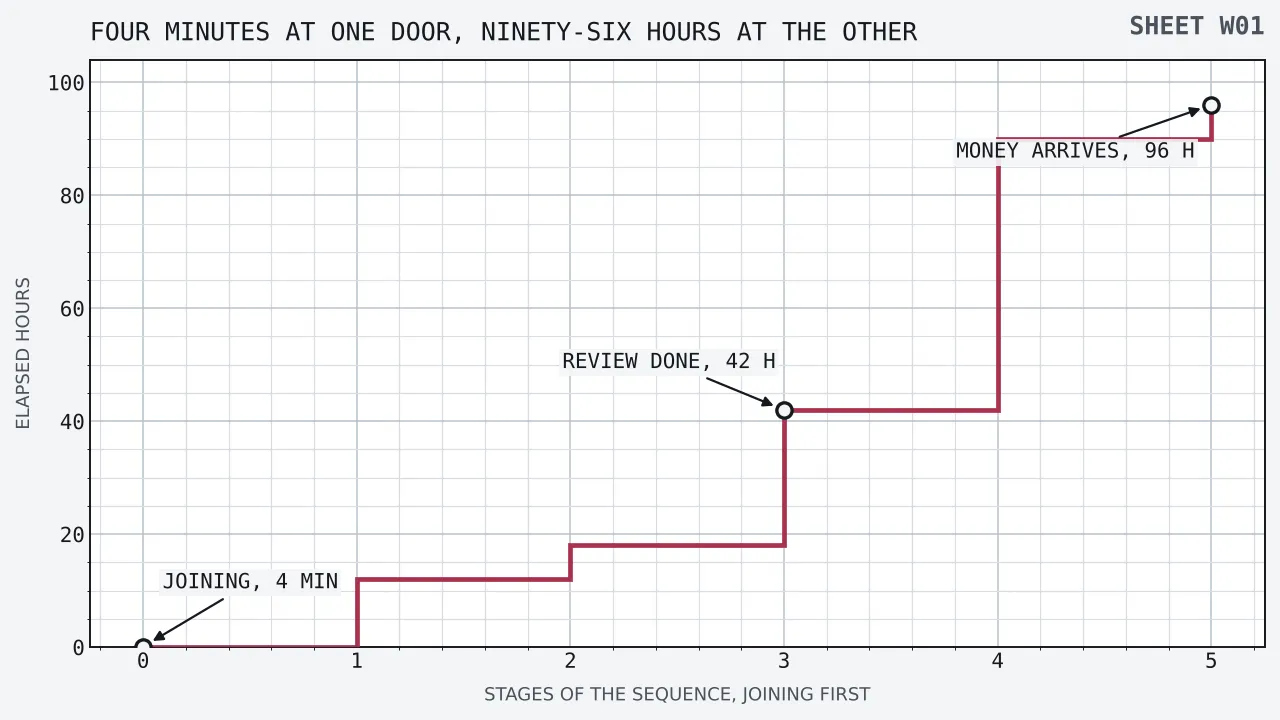
Nought point zero seven hours is where the joining sits on that axis, which is why it is drawn as a segment rather than a step. A reader looking for it will have to be told where to look. That invisibility is the honest picture of the arrangement: the part a banner describes is the part too small to see once both halves are drawn at one scale.
Twenty-four to one is the same relationship said in hours rather than minutes, and it survives a great deal of argument about the inputs. Halve the exit to 48 hours and double the joining to eight minutes and the ratio is still 360 to one. There is no setting of either assumption, short of absurdity, at which the two halves come out comparable.
4
What an account does while nothing is being checked
One question decides how much the relocation is worth to the business doing it, and it is not a question about documents. It is how long the account stays live and unexamined. Everything between the first press and the withdrawal request falls inside that span, and the length of it is the reader’s to set rather than the desk’s.
Two hundred and twenty presses is what a single day inside that span comes to at two sittings, 110 presses filling a sitting at the twelve-second interval this site assumes and never measured. Twenty-two pounds crosses the reels across those two, and a four per cent margin keeps 88p of it.
| Span before a withdrawal is asked for | Sittings at two a day | Presses of 10p | Staking across the reels | Expected margin |
|---|---|---|---|---|
| One day | 2 | 220 | £22.00 | £0.88 |
| Four days | 8 | 880 | £88.00 | £3.52 |
| A week | 14 | 1,540 | £154.00 | £6.16 |
| Three weeks | 42 | 4,620 | £462.00 | £18.48 |
| Thirty-seven days | 73 | 8,030 | £803.00 | £32.12 |
Thirty-seven days closes that table for a reason belonging to a wagering clause rather than to a calendar. Twenty pounds of bonus balance at forty times asks £800.00 across the reels. Cut that into ten-pence pieces and 8,000 of them appear, occupying 26 h 40 min at the modelled interval and 73 pick-ups of a phone. Two sittings a day puts the last of those on day thirty-seven.
Eight hundred and three pounds therefore crosses the reels before the clause is satisfied, with £32.12 of that the house’s expected share. None of the staking happens on an account anybody has identified. A reader finishing the clause and asking for the balance meets the document round at press 8,000 having met nothing at press one.
Four hours and twenty-six minutes is what those same 8,000 presses would occupy at two seconds apiece, a cadence no handset lobby offers and this note does not model. Pace therefore is not what holds an unexamined span open for weeks. Evenings are. Seventy-three pick-ups have to be found, and finding them is what fills thirty-seven days.
Twelve pounds carries a minus sign at the end of that run. Forty times a four per cent edge consumes 160 per cent of whatever the balance was, so a £20.00 face finishes at minus £12.00. Relocating the check moves that figure by nothing at all. What it moves is who knows what about whom while the figure is being produced.
5
The qualifying payment, priced by the second
Seventy-five seconds is all the payment stage costs in attention, and it is the only stage at the near door where something irreversible happens. A password can be changed and an inbox abandoned. Money paid in is money held by a business that has established nothing about the person who sent it, and nothing about itself that the person who sent it could look up.
Thirteen point three pence a second is the rate at which a £10.00 payment moves, being a thousand pence across seventy-five of them. Doubling the payment doubles the rate and changes nothing else, because the typing is identical whatever figure sits in the box. That is the first asymmetry in a page full of them: effort is flat and exposure is linear.
| Paid in | Pence a second going in | Presses of 10p it funds | Reel time at the assumed pace | Pick-ups of a phone | Expected margin on that staking |
|---|---|---|---|---|---|
| £5.00 | 6.7 | 50 | 10 min | 1 | £0.20 |
| £10.00 | 13.3 | 100 | 20 min | 1 | £0.40 |
| £20.00 | 26.7 | 200 | 40 min | 2 | £0.80 |
| £25.00 | 33.3 | 250 | 50 min | 3 | £1.00 |
| £50.00 | 66.7 | 500 | 1 h 40 min | 5 | £2.00 |
Fifty minutes of reel time is what £25.00 funds on a single pass, which is a little over two pick-ups and rounds to three. Set that against four days of waiting to get whatever survives it, and the proportions of the arrangement are visible without any further argument. The playing is an afternoon. The retrieving is a long weekend.
Twenty pence is the margin expected on a fiver’s worth of staking, and the smallness of that figure is the point of including the last column. A cashier does not make its money on one pass of a payment. It makes it on the recycling, which is what a wagering clause is for, and part four has already counted the £32.12 that a single £20.00 clause is expected to produce from £803.00 of crossings.
One further line belongs on a page about money paid in before any check has been run. Credit is barred as a funding route at a British licensee and has been since 14 April 2020, the bar extending to a card presented through an intermediary that is a money service business. Off the register nothing of that kind applies, so the instrument a reader picks answers to a cashier’s preferences and to a card scheme’s rules rather than to any licensing rule.
6
Four thousand six hundred and eight to one, in and out
Three hundred and forty-five thousand six hundred seconds is 96 hours counted the way the payment stage was counted, and that single change of unit produces the sharpest figure on this page. Twenty pounds going in at 75 seconds and the same twenty pounds coming out across 345,600 of them differ by a factor of 4,608.
4,608 times faster in than out, on the same £20.00
Nothing about the sum depends on the amount. Divide 345,600 by 75 and the twenty pounds cancels out, which means a fiver and five hundred pounds share the ratio exactly. A reader cannot improve it by paying in less, and paying in more makes the slow direction carry more without making it any quicker.
Two features of the market explain the gap, and only one of them is about identity. Money coming in is wanted, so the route for it is built to be frictionless and is tested until it is. Money going out is not wanted, and the work that was skipped at the near door has to happen somewhere, so it happens on the slow side where it also functions as a brake. Both directions are rational from the desk’s side of the screen, and neither is printed next to the other.
Eight seconds is roughly what the outward direction would need per pound for the two halves to balance on a £20.00 payment, since 75 seconds of inward movement would have to be matched by 75 seconds of outward movement. Published payout bands in this bracket are not written in seconds and were never going to be. They are written in days, and the shortest of them starts its count after the part of the process a reader is actually waiting on.
7
Reading the document list with a balance already standing
One sentence carries the worst feature of a relocated check, and documents are not what it is about. A reader learns which papers are wanted at the exact moment a balance exists to be held against the answer. Learning the identical list on day one costs nothing whatever. Learning it on day thirty-seven costs whatever is standing in the account.
Three duties written into a British licence attack that ordering directly, and the last of them is the one readers have least often heard of. Sequence is what the first settles: a licensee has to obtain and check who somebody is before letting them gamble, and what it holds must stretch at least as far as a name, an address and a day of birth. Money of the customer’s own is not the boundary either, since a bonus stake sits inside the rule and so does a build paying no prize.
Warning is what the second settles. Ahead of any payment in, a reader is to be told which papers may be called for, at which stage, and by which route. Timing is what the third settles. Where something could have been sought sooner, a withdrawal request is not an opportunity to begin asking, and material wanted for money-laundering purposes is to be gathered early, not held back until a payout has been requested.
| What happens | Under a British licence | Where the check has been relocated |
|---|---|---|
| Who the account belongs to | Settled before a customer may gamble, bonus stakes and prizeless builds included | At whatever milestone an operator’s own policy names |
| The list of papers disclosed | Before money may be paid in, with the stage and the route stated | Commonly inside the reply to a withdrawal request |
| A withdrawal used to start a fresh demand | Barred where the material could have been sought sooner | Nothing forbids it |
| Money-laundering material | Asked for promptly, not saved for the moment money is wanted | A matter of the operator’s own policy |
| Age settled before a payment or a wager | Verified before the customer may gamble | Satisfaction that the player is eighteen, with full identity tied to later milestones |
One published rulebook supplies the bottom row of that table. Under the Curaçao responsible gaming policy an operator may let nobody deposit or wager until it is satisfied the player has turned eighteen, and at sign-up that satisfaction is built on a confirmed date of birth. A full identity check, a government-issued photographic document included, is attached instead to milestones the authority sets for customer due diligence and for money-laundering control. That attachment, drafted and published, is what carries the paperwork to the far door.
Twenty-six hours and forty minutes of pressing, 73 pick-ups of a phone and a thirty-seven day span separate the two columns of that table in practice. A reader under the left-hand column meets the paperwork before any of it. A reader under the right-hand column meets it after all of it, with minus £12.00 of expectation already spent and a residue they would now like released.
Nought is what a part-finished document round pays, which is the second half of the asymmetry. A clause part-finished pays nothing and a document round part-finished pays nothing, but the clause at least gave a reader something to do. Sitting with a file rejected for a reason nobody has itemised is the single state this whole arrangement is best at producing, and it is produced at the moment of greatest exposure rather than the moment of least.
8
A desk with no entry to look up behind it
One licence is missing from every arrangement of this shape, and its absence is this part’s whole subject. Holding no Great Britain licence, a cashier willing to take money from somebody it has not identified is also a cashier the reader has no way of identifying. The second half of that sentence is the half nobody prints.
Four questions the regulator tells a player to settle before gambling are all register work, and out here the answer to each is the same blank. Is a Commission licence held at all. Does the site show a licensed status on its own pages. Can that status be followed through to an entry and the licence read there. Do the licence details tally with the entry, permitted activities and domain names included.
Nought guidance accompanies the register itself, and the caution applies to this note as much as to anybody. The Commission’s register page carries no date and nothing on how an entry should be read, so a page leaning on register data has to publish the day it looked and must not invent an interpretation the regulator has never issued.
Unlawful is the Commission’s own word for a gambling business running without its licence, and the two consequences it names both repay a close reading, since neither is a refund. Action may be taken against the operator. Payment facilities can go, pulled away by the organisations running the major payment systems. A reader whose money is sitting behind a document round while either of those happens is not a party to any of it.
Two failure modes at the far door sit on the public record, set down on 21 October 2025 by the official who directs enforcement and intelligence at the Commission. Payouts blocked outright is the first. A withdrawal limit pitched out of reach is the second. Both describe the far door rather than the near one, which is precisely where this note has located the whole arrangement.
Statutory offence falls on the provider and not on the customer, and accuracy requires saying so. The Act is written about the person providing facilities for gambling, and it creates nothing equivalent for the person doing the gambling. Protection rather than liberty is what gets surrendered, and the four register questions are the first piece of it to go.
9
Ninety-six hours against one thousand three hundred and forty-four
One thousand three hundred and forty-four hours is eight weeks, and eight weeks is the outer wall around a British licensee’s own complaints process, internal escalation included. Set that beside the 96-hour exit this page has been costing and a disagreement runs fourteen times the length of the thing disagreed about.
Half a year is the period inside which a complaint can be brought at all, counted from the incident, and a licensee may press for promptness without writing a term that shuts the door early. Confirming that a complaint has arrived is owed inside three working days, and that is the slower of the two deadlines in play. An online lobby never closes, which pulls the same confirmation down to 24 hours. Those two are the only figures in the dispute sequence measured in the unit the rest of this page uses.
| The step | Under a British licence | Under the Curaçao policy | Distance between them |
|---|---|---|---|
| Receipt confirmed | Inside three working days, or 24 hours for a lobby that never shuts | In writing inside one week | Up to 144 h |
| The operator’s own process closes | Eight weeks at the outside | Four weeks, with one written extension of four more | Nil at the outside |
| Window for bringing one | Half a year from the incident, as a minimum | Half a year from the settlement of the bet or the incident | Nil |
| Who approves the adjudicator | The Commission, from a list of its own | Free to the player, with the operator allowed to fix the parameters | Not a quantity of hours |
| Who settles a transaction dispute | Not the regulator, which says it is no ombudsman | Not the authority, which stands back from individual disputes in similar words | Not a quantity of hours |
Two surprises sit inside that table and both cut against what a page of this kind is normally expected to say. A complaint window of identical length is published by the Curaçao authority, and so is an operator timeline topping out at the same eight weeks. Writing that nothing exists outside the register would be false, and the false version is the easier one to write, which is presumably why it gets written so often.
One row does part company, and it is the fourth. Where a British licence applies the adjudicator comes off a list the Commission approves and a licensee may turn to nobody outside it, that list running to eight entities with five of them covering remote gambling across all sectors. Under the Curaçao policy the dispute route is free to the player with its cost falling on the operator, who is also permitted to fix the parameters: whether the route has to be exhausted ahead of any court, whether its outcome is binding on the player, and whether a claim under some value is eligible at all.
Twenty pounds is where the difference stops being abstract. A balance that size stalled behind a document round is exactly the sort of low-value claim a minimum-value rule would exclude, and the authority’s own guidance records that it may understand a concern about misuse where values are small. What a reader gives up is therefore not the existence of a route. It is the right to a route somebody else did not write the terms of.
10
Who a relocated check actually suits
Four minutes of joining is genuinely quick, and a note that pretended otherwise would be arguing with its own table. Typing an address and a date of birth is faster than photographing a passport, the lobby opens sooner, and for a reader who wants twenty minutes with a reel this evening the near door delivers exactly what it advertises. Everything said against the arrangement is said about the other end.
Ninety-six hours is the whole of the case, and it is only paid by somebody who asks for money back. That produces an uncomfortable conclusion worth stating in terms: an arrangement of this shape suits a reader who never withdraws. Anybody expecting to finish a clause and request a balance is choosing to do the paperwork later, at worse odds, with a sum at stake, and under rules written by one party.
Eight thousand presses, 73 pick-ups of a phone and thirty-seven days at two sittings a day is what a £20.00 clause asks before the question even arises. A reader who gets that far has already produced minus £12.00 of expectation and £803.00 of crossings, and has not yet met a single document request. The sequence puts the heaviest administrative moment at the point of greatest exposure, and that is a design feature rather than an accident.
Three figures decide the thing for an individual reader, and none of them is the advertised one. Whether money will ever be asked for, because the whole cost sits behind that single event. How large the qualifying payment is, since that money belongs to the reader and travels 4,608 times faster in than out. And whether a complaint would ever be worth making, because a route with a minimum claim value set by the party complained about has a floor under it somewhere.
Nought documents at the near door, then every document at the far one, is the whole sequence in nine words. A reader choosing a cashier on the strength of the first half of that sentence is choosing the second half as well, and the second half is ninety-six hours long on the most generous assumptions this note could justify.
Questions
- Does no KYC mean a casino never checks who you are?
- No. It describes where the check sits rather than whether it happens. At a cashier of this shape nothing is photographed at the sign-up, which is why this note models the joining at four minutes, and the document round turns up in the reply to a withdrawal request instead. A reader who never asks for money out may genuinely never be asked for a document. A reader who does meets the whole of it at once.
- How long does the withdrawal side actually take?
- Ninety-six hours on the assumptions set out in part two, assembled from five waits: twelve hours of queue before anybody opens the request, six hours for a demand for papers to be noticed and answered, twenty-four hours for a reviewer to decide, forty-eight hours of published band starting at approval, and six hours on the rail. Swapping a wallet for a debit card pushes the total towards 150 hours. None of those figures was measured and each is declared.
- What is the ratio between joining and being paid?
- One to 1,440. Four assumed minutes at the near door against 5,760 minutes at the far one, so every minute spent getting in buys a day’s worth of minutes spent waiting to get out. Halving the exit and doubling the joining still leaves 360 to one, so no reasonable setting of either assumption makes the two halves comparable.
- Why is money so much quicker going in than coming out?
- By a factor of 4,608 on these figures, which is 345,600 seconds of exit divided by 75 seconds of payment. The amount cancels out of that sum, so a fiver and five hundred pounds share the ratio. Two things produce it: the inward route is built to be frictionless because the money is wanted, and the identity work skipped at the sign-up has to happen somewhere, so it lands on the outward side where it also works as a brake.
- What is the account doing while nobody has checked it?
- Staking. Two sittings a day is 220 presses of 10p, which is £22.00 across the reels and 88p of expected margin at a four per cent house edge. A twenty pound balance under a forty times clause asks £800.00 of turnover, which comes to 8,000 presses, 26 h 40 min on the twelve-second interval modelled throughout, and 73 pick-ups of a phone. Two sittings a day puts the last of those on day thirty-seven, by which point £803.00 has crossed and £32.12 is expected to have stayed with the house.
- Could a reader finish a clause faster to shorten the wait?
- Not meaningfully, and the arithmetic says why. Even at two seconds a press, which no handset lobby offers and this note does not claim, 8,000 presses still occupy 4 h 26 min. The thirty-seven days come from finding 73 separate pick-ups of a phone, not from the speed of any of them, and nothing done at the sign-up shortens the queue, the review or the payout band.
- When would a British licensed operator ask for documents instead?
- Before anything else happens. A licensee has to obtain and check who somebody is before letting them gamble, and what it holds must stretch at least as far as a name, an address and a day of birth, with a bonus stake and a build paying no prize both inside the rule. Ahead of any payment in, a reader is to be told which papers may be called for, at which stage and by which route. And where something could have been sought sooner, a withdrawal request is not an opportunity to begin asking.
- What does a reader lose when there is no entry on the register?
- Four questions the regulator tells a player to settle, all of which are register work: whether a Commission licence is held at all, whether the site shows a licensed status on its own pages, whether that status can be followed through to an entry, and whether the licence details tally with the entry, permitted activities and domain names included. Unlawful is the Commission’s own word for a business running without the licence, and the two consequences it names are action against the operator and the loss of payment facilities, pulled away by the organisations running the major payment systems. Neither is a refund.
- Is there any way to complain if the money does not arrive?
- Usually there is, and pretending otherwise would be inaccurate. Eight weeks walls a British licensee’s own process, acknowledgement is owed inside three working days or 24 hours for a lobby that never shuts, and half a year from the incident is the period for bringing one. The Curaçao policy publishes the same half year and the same eight weeks at the outside. Authorship of the dispute route is the real difference: in Great Britain the adjudicator comes off a list the Commission approves, while the Curaçao operator may fix the parameters, including whether a claim under some value is eligible at all.
- Who does this arrangement suit?
- Somebody who never asks for money back, because the entire cost of it sits behind that one event. For anybody else the sequence puts nought documents at the near door and every document at the far one, at the point where a balance exists to be held against the answer. Four minutes in, ninety-six hours out, and a £20.00 clause that wants 8,000 presses before the question even arises.