Note W05 Revision 1 Terms read 17 October 2026
New casino sites, and the price of being the one who goes first
Nobody has waited yet. A desk three weeks old has settled no exit a reader could count, so its published payout band carries nought completed observations behind it. An opening face of £35.00 at forty times wants £1,400.00 across the reels, which is 14,000 presses and 46 h 40 min on the press interval this note assumes, and the exit cannot be tried until the last of 128 evenings has gone.
The opening face £35.00 What it wants back 46 h 40 min Evenings before the exit is tried 128
What a first-week joining asks in minutes
Advertising has been bought for every destination below. A fee reaches this site when a reader goes on to register, and no figure on this page moves one way or the other because of it.
-
01Mobile Free Spins
Betportal
Ceiling as a multiple
What lands€15.00150 spins at 10c, which is this site's figure and not the operator'sThe run17 h 30 minTurning over 525.00 at 10p means 5,250 presses, or about 48 phone sittings of 22 minutes. Timed at 10p a press and 12 seconds between presses, both of which this site assumes rather than measures.The wait to be paidNOT PUBLISHEDThis operator puts no withdrawal band in its own terms, so there is nothing honest to print here.Spins valued at this site's own 10p a spin
What lands
Spins, at a price15.00150 of them at 10c apiece, a figure belonging to this site rather than to the operatorMatch, and other creditno figure300% of three deposits, to a ceiling of €1,000. Not a sum until money of yours makes it one, so this row totals nothing and carries nothing downwardsThe run
Handed back on the spins(0.60)Each press stakes its own value and returns 96 per cent, which leaves this much with the house from the opening pressPlay-through 35x on the bonus(20.16)Taking 14.40 round 35 times over means 504.00 through the machines, of which 20.16 is the expected cost, and 17 h 30 min of pressing at the pace aboveWhat counts towards it100%Slots only, with no percentage published anywhere, so the row above assumes the whole of each stake countsWhat never clears
Limit on the winningsstated5x the bonusDeducted on the way outno figureNothing is published as a figure here, so this row removes nothingLeast that can leaveno figureNo figure is published, so nothing on this timer is pinned down by oneLeast deposit, and the rung over ityour own€20 a stage. Published in euros, so no rung is named at all: this site's ladder is a sterling oneThe window on the creditstated14 daysBiggest stake while it runsstated€5Removed outright by rulestatedNot publishedVerified before a payoutstatedDocuments before the first withdrawalNever clears€15.00Not a penny of it gets out, so the whole of what landed stands on this rowNo Great Britain licence
Licence held in Anjouan, Comoros, the company named is BetPortal Gaming Ltd, with Excite Ultra Media Ltd, quoted under ALSI-202601040-FI2.
Terms read 17 October 2026
Open the offer at Betportal, opens in a new window -
02Mobile Free Spins
WinBeast
Ceiling as a sum
What lands€50.00500 spins at 10c, which is this site's figure and not the operator'sThe run2 d 18 hTurning over 2,000.00 at 10p means 20,000 presses, or about 182 phone sittings of 22 minutes. Timed at 10p a press and 12 seconds between presses, both of which this site assumes rather than measures.The wait to be paidNOT PUBLISHEDThis operator puts no withdrawal band in its own terms, so there is nothing honest to print here.Spins valued at this site's own 10p a spin
What lands
Spins, at a price50.00500 of them at 10c apiece, a figure belonging to this site rather than to the operatorMatch, and other creditno figure50% to 100% of five deposits, each to a ceiling of €1,000, and a €650 free bet. Not a sum until money of yours makes it one, so this row totals nothing and carries nothing downwardsThe run
Handed back on the spins(2.00)Each press stakes its own value and returns 96 per cent, which leaves this much with the house from the opening pressPlay-through 40x on the bonus and the winnings from the spins(76.80)Taking 48.00 round 40 times over means 1,920.00 through the machines, of which 76.80 is the expected cost, and 2 d 18 h of pressing at the pace aboveWhat counts towards it100%Slots, titles vary by country, with no percentage published anywhere, so the row above assumes the whole of each stake countsWhat never clears
Limit on the winningsstated€100 a batch of spinsDeducted on the way outno figureNothing is published as a figure here, so this row removes nothingLeast that can leaveno figureNo figure is published, so nothing on this timer is pinned down by oneLeast deposit, and the rung over ityour own€20 a stage. Published in euros, so no rung is named at all: this site's ladder is a sterling oneThe window on the creditstated7 days, spins 1 dayBiggest stake while it runsstatedNot publishedRemoved outright by rulestatedNot publishedVerified before a payoutstatedDocuments before the first withdrawalNever clears€50.00Not a penny of it gets out, so the whole of what landed stands on this rowNo Great Britain licence
Licence held in Curaçao, no company named anywhere on the site.
Terms read 17 October 2026
Open the offer at WinBeast, opens in a new window -
03Mobile Free Spins
EliteSpin
Longest spin window
What lands£50.00500 spins at 10p, which is this site's figure and not the operator'sThe run2 d 18 hTurning over 2,000.00 at 10p means 20,000 presses, or about 182 phone sittings of 22 minutes. Timed at 10p a press and 12 seconds between presses, both of which this site assumes rather than measures.The wait to be paidNOT PUBLISHEDThis operator puts no withdrawal band in its own terms, so there is nothing honest to print here.Spins valued at this site's own 10p a spin
What lands
Spins, at a price50.00500 of them at 10p apiece, a figure belonging to this site rather than to the operatorMatch, and other creditno figure50% to 100% of five deposits, each to a ceiling of £1,000. Not a sum until money of yours makes it one, so this row totals nothing and carries nothing downwardsThe run
Handed back on the spins(2.00)Each press stakes its own value and returns 96 per cent, which leaves this much with the house from the opening pressPlay-through 40x on the bonus and the winnings from the spins(76.80)Taking 48.00 round 40 times over means 1,920.00 through the machines, of which 76.80 is the expected cost, and 2 d 18 h of pressing at the pace aboveWhat counts towards it100%Slots, with no percentage published anywhere, so the row above assumes the whole of each stake countsWhat never clears
Limit on the winningsstated5x the bonusDeducted on the way outno figureNothing is published as a figure here, so this row removes nothingLeast that can leaveno figureNo figure is published, so nothing on this timer is pinned down by oneLeast deposit, and the rung over ityour own£20 a stage. It lands square on the £20.00 rung, so none of yours is left perched on topThe window on the creditstated7 days, spins 3 daysBiggest stake while it runsstatedNot publishedRemoved outright by rulestatedNot publishedVerified before a payoutstatedDocuments before the first withdrawalNever clears£50.00Not a penny of it gets out, so the whole of what landed stands on this rowNo Great Britain licence
Licence held in Costa Rica, the company named is PrimeTier Limited.
Terms read 17 October 2026
Open the offer at EliteSpin, opens in a new window -
04Mobile Free Spins
Crown Jewelz
Multiple unpublished
What lands£15.00150 spins at 10p, which is this site's figure and not the operator'sThe runNOT TIMEDThis operator does not publish the play-through multiple in its own terms. The multiple is the one figure the clock cannot work around, so the run is left untimed.The wait to be paidNOT PUBLISHEDThis operator puts no withdrawal band in its own terms, so there is nothing honest to print here.Nothing reckoned
What lands
Spins, at a price15.00150 of them at 10p apiece, a figure belonging to this site rather than to the operatorMatch, and other creditno figure200% of the first deposit, then 150% twice, each to a ceiling of £1,000. Not a sum until money of yours makes it one, so this row totals nothing and carries nothing downwardsThe run
Play-throughno figure40x the bonus, reported rather than published by the operatorWhat counts towards itno figureSlots, with no percentage published anywhere, so the row above assumes the whole of each stake countsWhat never clears
Limit on the winningsstatedNot publishedDeducted on the way outno figureNothing is published as a figure here, so this row removes nothingLeast that can leaveno figureNo figure is published, so nothing on this timer is pinned down by oneLeast deposit, and the rung over ityour own£20. It lands square on the £20.00 rung, so none of yours is left perched on topThe window on the creditstatedNot publishedBiggest stake while it runsstatedNot publishedRemoved outright by rulestatedNot publishedVerified before a payoutstatedDocuments before the first withdrawalNever clearsNOT RECKONEDThis operator leaves the play-through multiple out of its own terms, so nothing below the fourth step can be worked out.No Great Britain licence
Licence held in Curaçao, number not verified, no company named anywhere on the site.
Terms read 17 October 2026
Open the offer at Crown Jewelz, opens in a new window
Only the middle reading comes out of arithmetic belonging to this site. The multiple laid against what lands gives the turnover asked for; dividing that by 10p a spin gives the presses; dividing those by 300 an hour gives the hours, a press on a handset being taken here at 12 seconds from the one before. Both figures are assumptions rather than measurements of anybody: nothing was played and nothing was held a stopwatch to. Anybody quicker should divide the press count by a rate of their own, which is why the presses are printed alongside the hours instead of being summarised away.
The first reading is what arrives before any condition is laid against it. Spins carry no unit of their own so one gets supplied: where an operator values its own spin that figure is used and attributed, and where it does not, this site's 10p a spin stands in and everything below moves with it. The third reading belongs to the operator entirely. It is a withdrawal band quoted from published terms, and a blank there means none was published rather than that nobody looked.
The total along the foot answers what the hours leave open, which is whether any of the running ends anywhere. It is what arrived, less whatever is still standing once the play-through has been paid for at 96 per cent return to player and once a published limit, a published deduction and a published floor beneath the least that can leave have each had a turn. It appears again in pence in the pound, the only fair way of holding a small offer up against a large one. It describes an offer rather than an evening, and where the conditions price out what arrived, a timer prints nothing getting out instead of a negative sum.
Cashiers on a handset take deposits off a row of preset buttons, so a least deposit given in pounds is raised to the next rung of the ladder used here, £10, £20, £25, £50, £75 and £100, and the timer shows what is left perched on it. That money is the reader's own and enters no sum at all. Given in euros it prints untouched, the ladder being sterling. Three words may occupy the figure column where no figure belongs. Stated is a published term that costs something while leaving no number to subtract. No figure is a term nobody has quantified, or a credit that is not a sum until money of yours makes it one. Your own is money of yours, which belongs in none of this.
None of the operators above is licensed in Great Britain, so not one duty that licence carries reaches any of them. Membership of Gamstop Online is compulsory for every online gambling company licensed in Great Britain, which means that shutting yourself out through the scheme shuts you out of none of these. The limit of ten times the bonus funds on a wagering requirement, running since 19 January 2026 under Social Responsibility Code 5.1.1, is a condition of the same licence and binds only whoever holds one. Off that licence, the Gambling Commission writes of consumers meeting unfair gaming practices, financial loss and no recourse when matters go wrong, and lists blocked payouts and withdrawal limits pitched too high to reach among the things it has seen. No account at any of them may be held by anybody under 18.
Every term on a timer is its operator's own and every timer carries the day somebody read it. The oldest of those readings is 17 October 2026. What binds a reader is an operator's full terms and never a line printed here.
1
What goes missing when a desk has no past
Nought completed exits stand behind a cashier that opened a fortnight ago, and that absence is the whole subject of this note. Searches for new casino sites are searches for a promotion nobody has yet had to wait on. Everything a banner says about how quickly money comes back is a description of an intention, because the process it describes has not finished running even once.
Two things are being bought at the same moment and they pull in opposite directions. The first is an opening promotion, which on a young desk is ordinarily the largest it will ever print. The second is an exit of unknown length, because length is a property of a queue and a queue with nobody in it has none.
Thirty-five pounds is the opening face this note works with throughout, taken as a round sum of credit rather than as a count of presses, and nothing about it is drawn from any particular promotion. Four inputs sit under every duration below: a stake held at ten pence, a return holding at 96 per cent, a condition set at forty times, and twelve seconds given over to each press. Nobody was watched to arrive at the last of those. It is adopted, so a reader whose thumb runs quicker swaps in a shorter interval and every division below moves with it.
Forty-six hours and forty minutes is where that face lands once the condition is counted out, and the chain runs through four multiplications. Multiply £35.00 by forty and £1,400.00 must pass across the reels. Divide by a stake of ten pence and the count comes out at 14,000 presses. Give each press the twelve seconds supposed throughout this note and 168,000 seconds are spoken for.
One hundred and twenty-eight is the same span said in evenings, dividing 2,800 minutes by a sitting this site fixes at twenty-two minutes without having watched anybody’s evening, and carrying the remainder upward because 127 sittings leave 106 minutes unpressed. Eighteen weeks and two evenings is what 128 comes to at one sitting a night. That is the distance between taking an opening promotion and being in a position to find out what the exit does.
Minus twenty-one pounds is the expected position once the last press has gone in, which is before the exit has even been approached. Forty passes over an edge of four pence eat 160 per cent of whatever was credited, leaving a £35.00 face standing at minus £21.00 as an average. Twenty-five is where the sign turns, because a pound gives up its final penny after twenty-five such passes, and forty sits a long way beyond twenty-five.
Nothing across these ten parts is a route past an age check, past a check on whose account it is, or past a bar somebody has set over their own play, and no wording is suggested for any of those purposes. Handing a desk another person’s documents is fraud and nothing on this site treats it as anything else. A gambling bar run by a bank is a protection of the same order as Gamstop Online, whose reach is fixed by the Great Britain licence and therefore stops at the edge of everything priced in these parts.
2
Ninety seconds of looking that comes back empty
Ninety seconds is the allowance made for the one check available before anything at all is committed, and like every other duration on the page it is an input rather than a finding. It covers opening the regulator’s public register, typing a trading name into it and reading what comes back. Seven and a half presses is the same ninety seconds restated in the unit the rest of this note counts in, at the twelve-second interval assumed throughout.
Two outcomes exist and the difference between them is the entire value of the check. A business holding a Great Britain licence appears in a published register of licensed businesses, alongside registers of individuals, premises and regulatory actions, each searchable and downloadable. The regulator tells a player to click through to that register and confirm that the licence details, the permitted activities and the domain names all match what the website claims.
Nought entries come back where the business being looked up sits outside the Great Britain licence, and an empty result is no fault in the searching. It is the right answer. Ninety assumed seconds buy a blank, and deciding what a blank means is harder than it sounds at a desk nobody has written anything about either.
| What is looked for | Inside the Great Britain licence | Outside it |
|---|---|---|
| An entry naming the business | Published and searchable | Nothing to find |
| The activities permitted | Listed against the entry | Not published |
| The domain names covered | Listed, and meant to match the site | Not published |
| Penalties and suspensions recorded | Published with dates and sums | No register to carry them |
| Other people’s completed exits | Not published either | Not published either |
One row of that table reads identically in both columns, and that single row does more work on this page than the rest of the table together. How long a particular business took to pay a particular person is published by no regulator, on either side of the line. Identity, permission and a disciplinary record are what a register supplies, and a disciplinary record wants something to discipline. Age is what a young business lacks in both columns at once.
Two sums give the measure of a disciplinary record where one exists. Six websites with no licence behind them were found carrying games from a licensed supplier, all of them within reach of consumers in Great Britain, and £4.75m was agreed in consequence on a release dated 23 July 2026. Separately, bonus rules for new casino promotions reserved a power to end an account or strip the winnings from it, and £170,000 followed on 3 July 2025. Both sums are published, both are dated, and neither could exist without a licence to be breached.
Nought of that record attaches to a trading name opened last month, which is the honest shape of the problem. A clean record and no record read identically to a reader with ninety assumed seconds and a search box. Distinguishing them is not a matter of looking harder. It is a matter of waiting, and waiting is what the rest of this note prices.
3
An opening face against the face that replaces it
Fourteen pounds is the standing face this note sets against the opening £35.00, chosen to make the comparison concrete rather than to describe anybody’s promotion. The ratio between them is two and a half to one, and the whole of this part is an argument that the ratio travels straight through every figure that follows it without altering anything about the quality of the trade.
Five hundred and sixty pounds is what the condition fastens to the standing face, forty multiplied by £14.00, and that is 5,600 presses of ten pence filling 67,200 seconds at the interval supposed throughout. Eighteen hours and forty minutes is that span in hours. Fifty-one evenings is the same span read against a sitting this site puts at twenty-two minutes by adoption and by no observation, the fraction 50.9 carried upward.
| Worked at forty times | An opening face | The standing face | What moves between them |
|---|---|---|---|
| Credit posted | £35.00 | £14.00 | Two and a half to one |
| Staking the condition wants | £1,400.00 | £560.00 | The same ratio, untouched |
| Presses of 10p | 14,000 | 5,600 | The same ratio again |
| Hours at the assumed interval | 46 h 40 min | 18 h 40 min | Twenty-eight hours apart |
| Evenings at an assumed sitting | 128 | 51 | Seventy-seven evenings apart |
| Expected when the condition closes | minus £21.00 | minus £8.40 | The same ratio, with a sign |
Seventy-seven evenings is the gap the table exists to produce, and it is the figure a banner comparing an opening promotion with a later one would have to print in order to be useful. Both columns rest on an interval this note assumes and on a sitting length it adopts, and neither rests on anybody having been watched. A reader doubting either input moves both columns together, which leaves the seventy-seven proportionally intact.
77 more evenings fastened to an opening face two and a half times the size
Nought of the quality of the deal changes between the two columns, and that is the finding this part was written to reach. Every row scales by the identical two and a half, including the expected loss. A larger opening face is not a better offer per pound credited. It is the same offer, bought in a larger quantity, with a longer obligation fastened to it.
Twelve pounds sixty is the difference between the two expected losses, £21.00 against £8.40, and it is what the extra twenty-one pounds of face is expected to cost rather than yield. A reader attracted by the bigger number is therefore being attracted by the bigger obligation, measured in evenings, and by the bigger expected shortfall, measured in pounds. Those are the same thing seen from two ends.
One qualification belongs on that conclusion and part eight takes it seriously. The entrance to a desk costs the same attention whenever a reader arrives, so for a reader who has already decided to take an offer of this kind, a face two and a half times larger is two and a half times more of whatever it is worth. The argument does not rescue the expected value. It does change which week to arrive in.
4
Why the first promotion is the biggest one printed
Fifty-six pounds is what the opening condition is expected to return to the giving side, being four pence in the pound across £1,400.00 of staking. Thirty-five pounds of credit was handed over to set that staking in motion. Twenty-one pounds is the difference, and it is the same twenty-one the reader is expected to be down, because at a game weighting of one and nobody else taking a cut the arrangement is a transfer rather than a production.
Twenty-two pounds forty is the identical calculation on the standing face, four per cent of £560.00, against £14.00 of credit given away. Eight pounds forty is the difference. So the opening promotion is expected to earn the business two and a half times what the standing one earns it, out of a face that is two and a half times larger, which is why the opening promotion can afford to be the larger of the two.
| Expected at forty times | An opening face | The standing face |
|---|---|---|
| Credit handed over | £35.00 | £14.00 |
| Margin on the staking it sets up | £56.00 | £22.40 |
| Net expected to the business | £21.00 | £8.40 |
| Expected per press made | 0.4p | 0.4p |
| Presses it takes to collect | 14,000 | 5,600 |
Nought point four of a penny is the constant running down that table, and it is the engine under every opening promotion ever printed. A ten-pence press at a four per cent margin is expected to leave four tenths of a penny behind. Nothing about the age of a business changes that rate. What age changes is how many presses a business needs to buy in order to establish itself, and a business with no customers needs to buy a great many at once.
Two further reasons sit behind the opening size and neither is sinister. A promotion is the cheapest advertising available to a desk with no reputation, because it is paid for out of expected margin rather than out of cash. And a face posted on day one competes against nothing, since a reader arriving at a young business has no account there to lose by comparison. Both reasons describe commercial logic, not a trick.
One consequence follows for a reader and it is a genuine point in favour of arriving early. If an opening promotion really is the biggest a business will print, then the reader arriving in month eighteen is being offered the standing £14.00 column, with every row scaled down by two and a half. Arriving late is not safer in expectation. It is simply smaller.
Nought protection attaches to the size either way, and that is the limit of the argument. A bigger face at the same multiple is a bigger expected loss, as part three worked out, so the reader arriving early is buying more of a negative quantity. The honest statement is that the early arrival gets the larger version of the same trade, and whether a larger version is wanted depends on what the trade is worth, which part nine settles.
5
A hundred and twenty-eight evenings before the exit can be tried
One hundred and twenty-eight evenings is the gate between a reader and any information whatever about how a young business pays, and the gate is built out of the condition rather than out of the payout process. Bonus funds do not become a reader’s own until the staking has crossed the reels. So the earliest honest test of an exit is the evening the last of 14,000 presses is made.
Two days is what a published band of the usual length comes to once the exit does begin, and set against 128 evenings of getting there the proportions are the point. Sixty-four to one is the ratio between the run and the band, 128 evenings against two days. A reader worrying about the band before the run has worried about the smaller of the two quantities by a factor of sixty-four.
Nought presses can be skipped to reach the test sooner, and the arithmetic settles that without appeal to any rulebook. Fitting 14,000 presses inside one waking day of sixteen hours works out at a press every 4.11 seconds, sustained without a pause from waking to sleeping. Squeezing the lot into one sitting, which this site puts at twenty-two minutes by adoption and never by observation, would want a press every 0.09 seconds, far beneath the cadence any slot answering to a Great Britain licence may run at.
128 assumed evenings between the opening face and the first look at the exit
Three states a reader can be in during those 128 evenings are worth separating, because they carry different exposures. In the first the condition is unfinished and the balance is not the reader’s to take. In the second the condition is finished and a request has been made. In the third the request has been answered, and only a reader who has reached the third knows anything at all about the exit.
Eighteen weeks and two evenings is the first state written as a calendar, at one sitting a night. A reader who manages two sittings a night halves it to nine weeks and one evening, on the sitting length this site adopts rather than measures, and a reader who finds four evenings a week stretches it to thirty-two weeks. None of those readings makes the information arrive before the pressing is done.
Twenty-eight hours of pressing separate the two faces of part three, and they separate the two tests as well. A reader taking the standing £14.00 reaches the same third state after 51 evenings instead of 128, on the identical assumptions. Being offered less is therefore being told sooner, which is an odd thing to have to write and is nonetheless what the arithmetic gives.
6
How slowly one reader learns anything at all
One hundred and thirty days is the length of one complete cycle on the opening face, being 128 evenings of pressing at a sitting this site adopts without measurement plus two days of exit. Fifty-three days is the same cycle on the standing face, 51 evenings plus two days. Those two lengths govern how fast a single reader can accumulate anything resembling evidence.
Three observations is all a reader on the opening face can hold after 390 days, because 390 divided by 130 is exactly three. Seven is what a reader on the standing face holds over the identical stretch, 390 divided by 53 being 7.36 and the fraction not counting. Being handed a larger face slows the rate at which a reader finds out what they have joined.
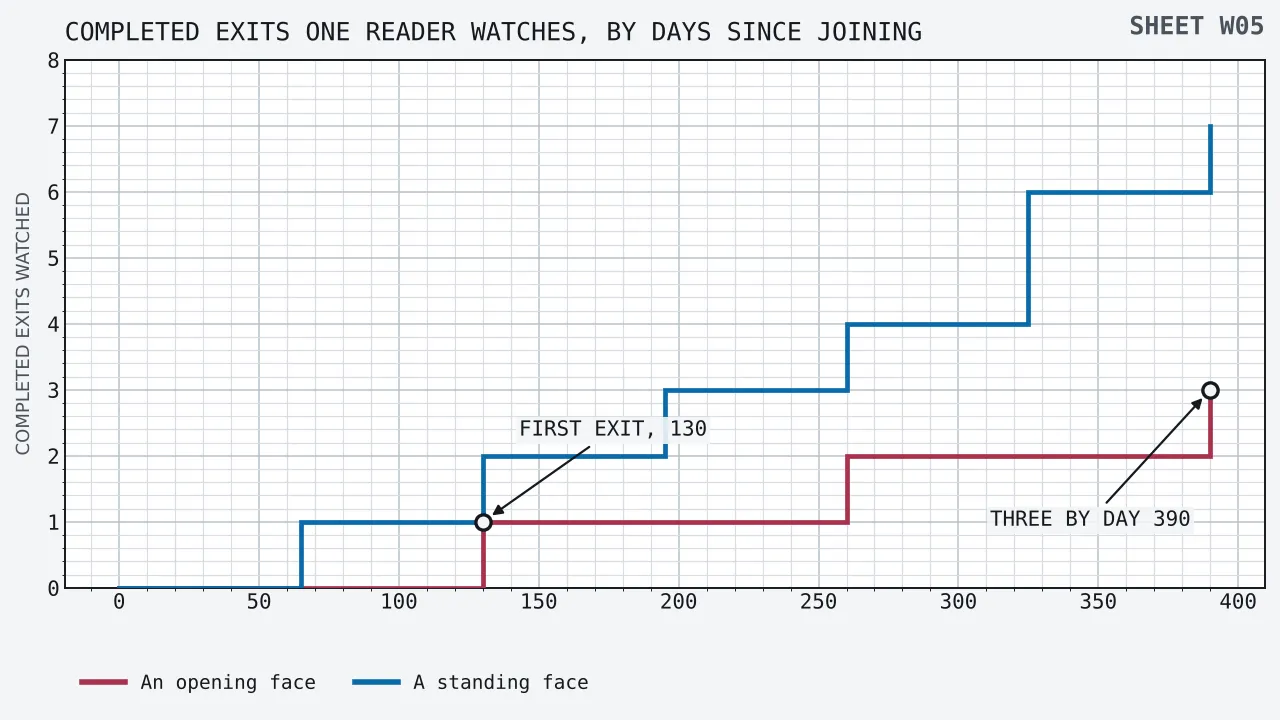
Nought is where both traces start and the flat stretch at the left of the opening one is the honest picture of a first year. Four months and change pass before a reader holds a single observation. A judgement formed inside that stretch is a judgement formed on no completed exits whatever, however many evenings of pressing have gone into it.
Two to one is roughly the ratio between the traces at the right-hand edge, seven against three, and it comes out of nothing except the length of the condition. Neither face says anything about how well a business pays. What the drawing shows is how long a reader must wait before the question can even be asked, which is this section’s subject and not the next section’s.
Nought of this improves by reading what other people say, which is the argument a reader will reach for and it is worth meeting directly. A business open for three weeks has had three weeks in which anybody at all could have completed a cycle, and on the opening face the fastest possible cycle is 130 days. Nobody has finished one. Accounts of how quickly it pays are therefore accounts of something else, most often of how quickly a deposit cleared, which runs the other way and takes minutes.
7
Where a printed band parts company with a measured one
Two numbers can both be called a payout time and they are not the same kind of thing. One is a band printed in a help page, which is a statement of intent made before the process has run. The other is the distribution of what actually happened across completed requests, which needs completed requests to exist. A young desk has the first and cannot have the second.
Nought variance can be quoted about a process with nought observations, and variance is what a reader actually needs. A band of two days tells a reader nothing about whether the ninth request takes two days or eleven. The spread is the quantity that decides whether a band is useful, and the spread is exactly the quantity a new desk has no means of reporting and no obligation to report.
| The quantity | Available on day one | Needs completed exits | Soonest a reader could hold it |
|---|---|---|---|
| A printed band | Yes, it is a claim | No | Day 0 |
| The reader’s own first exit | No | Yes, one of them | Day 130 |
| A second reading to compare it with | No | Yes, two of them | Day 260 |
| Any sense of the spread | No | Several of them | Day 390 and beyond |
| Whether a delay was typical | No | Several of them | Not reachable inside a year |
Three hundred and ninety days is the bottom of that table, and it is the earliest a reader working the opening face could begin to form a view about the spread rather than about a single instance. Every date in the column rests on the assumed press interval and the adopted sitting, carried through the cycle arithmetic of part six. Shortening the condition shortens all of them together.
One asymmetry is worth naming because it works against a young business as well as against a reader. A desk that pays its earliest requests promptly has an interest in being seen to, and cannot be seen to by anybody who has not finished a condition. So the business most motivated to pay quickly is also the business least able to demonstrate that it did, for exactly as long as its conditions are long.
Nought published figure exists for how long any business takes to pay, licensed or not, and none is going to be supplied by this note. Two things can be set down instead. Where a route exists to complain about a delay and where none does, which part nine takes up. And what a reader’s own first measurement costs to obtain, which is 128 evenings on the suppositions carried throughout.
8
Going first, argued at its strongest
Four arguments favour arriving early, and each survives contact with the arithmetic, so they go before the objections rather than after. Together they are why this note declines to call going first a plain mistake. Against the expected value they do not turn the sign over, and part nine says why.
Two and a half to one is the first of them, already worked in part three. A face of £35.00 against a standing £14.00 is more of whatever a promotion of this shape is worth to a particular reader, bought with the same attention at the entrance. Nothing about joining costs more in week one than in month twenty.
Nought rivals is the second. A reader arriving at a business with no customers is arriving before any promotion has had to be trimmed to fit a budget, and the acquisition arithmetic of part four shows why a young desk can afford the larger face and why it stops being able to.
One incentive is the third and it is the strongest of the four. A business with no completed exits has nothing to show except the next one, so the earliest requests are the requests it can least afford to mishandle. That is an argument about motive rather than about rules, and it is worth exactly what a motive is worth.
Twenty-one pounds is the fourth argument and the one least often put. Set a ceiling of ten times over the bonus funds, which is the limit a Great Britain licence fixes on an incentive, and the identical £35.00 face is expected to be worth a positive £21.00 instead of a negative one, because ten passes of a four per cent edge leave sixty pence standing in every pound. A bigger face is worth having where the multiple is small, and the opening promotion is where the bigger face lives.
| Worked against £35.00 | At a ten times ceiling | At forty times |
|---|---|---|
| Staking demanded | £350.00 | £1,400.00 |
| Presses of 10p | 3,500 | 14,000 |
| Hours at the assumed interval | 11 h 40 min | 46 h 40 min |
| Evenings at an assumed sitting | 32 | 128 |
| Expected when it closes | £21.00 | minus £21.00 |
| Soonest the exit can be tried | Day 34 | Day 130 |
Ninety-six evenings separate those two columns and the sign on the last row but one turns over between them. Nothing above ten times the bonus funds may be asked by a holder of a Great Britain licence, a restriction binding remote casino licensing since 19 January 2026 and therefore binding every licensed incentive. It is not a habit of the market, and careful choosing among businesses that hold no such licence collects none of it.
One hundred and twenty-eight against thirty-two is the same difference stated as information rather than as money. Under the ceiling a reader reaches a first completed exit on day 34 rather than day 130, so the licence buys ninety-six days off the wait for the first fact. Going first is most defensible precisely where the multiple is small, and least defensible where it is forty.
9
What an absent licence costs a desk with no history
Two absences compound on a young offshore desk and the compounding is this page’s own version of a point every page on this site has to make. A desk holding no Great Britain licence carries no register entry to its name, and a desk three weeks old carries no record to its name either. Neither gap is odd by itself. Side by side they leave a reader with no published fact of any kind to work from.
Fifty-six days is the first thing to go, that being the outer wall a licensed business’s own complaints process runs to, finishing with a letter that has to say the process is over and point the way to an adjudicator outside the business. Six months is the second, that being the window a licensed business must keep open for a complaint to be raised at all. Neither clock can be started at a desk outside the licence, which bites hardest on the first exit anybody ever handles.
Eight bodies stand on the approved list for resolving disputes under a British licence, and a licensee may use nothing outside that list. Offshore the difference lies in who drafts the terms rather than in whether a route is there at all. Dispute resolution under the Curaçao complaints framework is compulsory and costs the player nothing, while the parameters belong to the operator, among them the binding force of an outcome upon the player and any floor on claim value standing in front of an escalation.
Four weeks, extendable once by a further four, is the Curaçao operator timeline, which arrives at the same eight weeks the British one does, so it would be false to say that nothing offshore answers a complaint. Losing the route is not what happens. Losing the drafting of its edges is, and at a desk with nought completed cases nobody has yet pushed against those edges.
Nought cross-operator exclusion register reaches a desk outside the Great Britain licence either, and the scheme marks that boundary itself. Its help reaches the gambling services run by participating businesses, and it states that it is unable to stop anybody arriving at services offered by organisations outside that group. Membership is settled by the licence, since holding one in Great Britain for online gambling carries the obligation to join. A desk opening offshore is outside the scheme on its first morning, which follows from where it took a licence and not from anything it chose.
One ceiling, one stake limit and one identity rule close the list for this page, and each bites hardest where there is no history. A lid of ten times over an incentive turns the expected £21.00 of part eight from positive to negative. The £5 and £2 per-spin limits on licensed online slots reach no desk outside the licence. And a licensed business has to establish who somebody is before any play whatever, taking in at least a name, a place of residence and a date of birth, with bonus rounds and free-to-play covered alike, which is the rule that gives a register entry its meaning.
10
Quantities that can be settled on day one
First is the multiple, because it is the only input that decides the sign. Twenty-five repetitions of a four per cent edge take a credit down to nothing, which leaves sixty pence of every pound standing at ten times and costs sixty pence at forty. A business opening this week publishes its multiple on the day it opens, and that figure is checkable in the time it takes to read a terms page, with no waiting required at all.
Second is the face, which decides the size of everything and the quality of nothing. Thirty-five pounds against fourteen moves the staking, the presses, the hours, the evenings and the expected loss by the identical two and a half, as part three sets out row by row. A reader comparing two promotions on the face alone has compared them on the one quantity that is pure scale.
Third is the pence behind a press, which no published British requirement fixes and which therefore belongs to whoever is writing the terms. Ten pence is this site’s working stake throughout and a promotion crediting presses at 5p halves every press count and doubles nothing. Where credit arrives as a sum rather than as a count, as it does on the £35.00 worked in these parts, the pence behind a press fix the press count the staking breaks into, and the press count fixes the evenings.
Fourth is the one quantity that cannot be settled on day one, which is why it closes the list. How long the exit takes is unknowable until 128 evenings have gone, on the press interval assumed throughout and the sitting adopted without measurement. A reader who needs that answer before committing cannot have it from a desk that opened this month, and no amount of reading substitutes for the 130 days the cycle takes.
Forty-six hours and forty minutes against ninety assumed seconds of looking is the comparison this note ends on. One thousand eight hundred and sixty-seven to one is the ratio between them, 168,000 seconds of pressing against ninety seconds of checking that comes back empty. The check is cheap and returns a blank. The pressing is the part nobody prints, and on a desk with no past it is also the price of the first fact anybody will ever have about it.
Questions
- What is actually different about joining a casino site that has just opened?
- Nothing at the entrance and everything at the exit. The joining costs the same attention in week one as in month twenty. What differs is that nought completed withdrawals stand behind the business, so a published payout band is a statement of intent rather than a summary of what has happened. The first person to find out is the person who waits.
- How long before a reader could know how quickly a new site pays?
- A hundred and twenty-eight evenings, on the figures this note carries. Bonus funds are not a reader’s own until the condition has been satisfied, and a £35.00 face at forty times wants £1,400.00 of staking, which is 14,000 presses of ten pence and 46 h 40 min at a press assumed to take twelve seconds. Against a sitting adopted at twenty-two minutes and never observed, that is 128 evenings.
- Why is an opening promotion usually bigger than the one that follows it?
- Because it is paid for out of expected margin rather than out of cash, and because a business with no customers needs a great many presses at once. Four pence in the pound on £1,400.00 of staking is £56.00 expected back against £35.00 of credit given away. The same sum on the standing £14.00 face is £22.40 against £14.00. Both leave the business ahead if the condition closes.
- Is a bigger opening face a better offer?
- It is a bigger version of the same offer. Every row scales by two and a half between £35.00 and £14.00: the staking, the press count, the hours, the evenings and the expected loss. At forty times the expected positions are minus £21.00 and minus £8.40, so the larger face is the larger shortfall as well as the larger headline.
- Can a reader just read what other people say about a new site instead?
- Not about the exit, and the reason is arithmetic rather than scepticism. A cycle on the opening face is 130 days, being 128 evenings of pressing plus a two-day exit. A business open for three weeks has given nobody time to complete one. Accounts written inside that stretch describe something else, most often how quickly a deposit cleared, which runs the other way and takes minutes.
- Is there ever a good reason to go first?
- There are several, and this note takes them seriously. The face is the largest the business will print, the entrance costs the same whenever a reader arrives, and a desk with no completed exits has the strongest motive to handle its earliest requests well. Put a ceiling of ten times over the bonus funds and the identical £35.00 face is expected to be worth a positive £21.00, which is the setting in which going first is clearly worth doing.
- What does the ten times ceiling change about an opening face?
- The sign and the wait together. A limit of ten times the bonus funds has been a condition of holding a Great Britain licence since 19 January 2026, covering every remote casino licence. It cuts £1,400.00 of staking to £350.00, 14,000 presses to 3,500, 46 h 40 min to 11 h 40 min and 128 evenings to 32, which brings a first completed exit forward from day 130 to day 34.
- What does the public register tell a reader about a business that opened last month?
- Whether it holds a Great Britain licence, which activities that licence permits and which domain names it covers, along with any penalties or suspensions recorded against it. A business holding no Great Britain licence returns nothing, and the blank is the correct answer rather than a failed search. No register on either side of the line publishes how long anybody took to pay anybody.
- What happens to a complaint about a new offshore site?
- The eight-week wall a licensed business works to does not apply, nor the six-month window it must leave open for a complaint to be raised, nor the requirement to escalate to an adjudicator drawn from a set the regulator has approved. A route can still exist. Dispute resolution under the Curaçao framework is compulsory and costs the player nothing, though the parameters belong to the operator, a floor on claim value among them.
- Does Gamstop Online cover a site that opened recently?
- Only where a Great Britain licence is held, because membership follows from that licence for online gambling companies. On its own wording the scheme shuts a person out of whatever gambling services participating businesses run, and records that stopping them arriving at services from organisations outside that group is beyond it. A desk outside the licence is outside the scheme from its opening morning, which is a consequence of where it took a licence rather than of anything it decided.
- What can be settled before committing anything?
- The multiple, the face and the pence behind a press, and all three are readable in the time a terms page takes. Twenty-five times is where a four per cent margin has eaten a credit whole, so the multiple decides the sign. The face decides the scale and nothing else. A stake of ten pence against one of 5p doubles the press count under any given sum of staking, and the press count is what the evenings are counted out of, at a pace supposed throughout and measured nowhere.