Note L04 Revision 1 Terms read 17 October 2026
Mobile casinos multiply the occasions, not the speed, and the bill follows the occasions
A handset does not shorten a press. What it does is make a sitting possible in a queue, on a platform and in a bed, so the quantity it moves is how many sittings a day happen. One assumed sitting of twenty-two minutes a day costs an expected £160.60 a year at 10p a press, two costs £321.20 and five costs £803.00. This page models the cost as a function of occasions, and then takes the twelve second press apart.
One occasion, assumed at 22 min 44p Each daily occasion, over a year £160.60 Presses the assumption gives a sitting 110
What a handset offer of this kind asks in minutes
Advertising has been bought for every destination below. A fee reaches this site when a reader goes on to register, and no figure on this page moves one way or the other because of it.
-
01Mobile Free Spins
Betportal
Ceiling as a multiple
What lands€15.00150 spins at 10c, which is this site's figure and not the operator'sThe run17 h 30 minTurning over 525.00 at 10p means 5,250 presses, or about 48 phone sittings of 22 minutes. Timed at 10p a press and 12 seconds between presses, both of which this site assumes rather than measures.The wait to be paidNOT PUBLISHEDThis operator puts no withdrawal band in its own terms, so there is nothing honest to print here.Spins valued at this site's own 10p a spin
What lands
Spins, at a price15.00150 of them at 10c apiece, a figure belonging to this site rather than to the operatorMatch, and other creditno figure300% of three deposits, to a ceiling of €1,000. Not a sum until money of yours makes it one, so this row totals nothing and carries nothing downwardsThe run
Handed back on the spins(0.60)Each press stakes its own value and returns 96 per cent, which leaves this much with the house from the opening pressPlay-through 35x on the bonus(20.16)Taking 14.40 round 35 times over means 504.00 through the machines, of which 20.16 is the expected cost, and 17 h 30 min of pressing at the pace aboveWhat counts towards it100%Slots only, with no percentage published anywhere, so the row above assumes the whole of each stake countsWhat never clears
Limit on the winningsstated5x the bonusDeducted on the way outno figureNothing is published as a figure here, so this row removes nothingLeast that can leaveno figureNo figure is published, so nothing on this timer is pinned down by oneLeast deposit, and the rung over ityour own€20 a stage. Published in euros, so no rung is named at all: this site's ladder is a sterling oneThe window on the creditstated14 daysBiggest stake while it runsstated€5Removed outright by rulestatedNot publishedVerified before a payoutstatedDocuments before the first withdrawalNever clears€15.00Not a penny of it gets out, so the whole of what landed stands on this rowNo Great Britain licence
Licence held in Anjouan, Comoros, the company named is BetPortal Gaming Ltd, with Excite Ultra Media Ltd, quoted under ALSI-202601040-FI2.
Terms read 17 October 2026
Open the offer at Betportal, opens in a new window -
02Mobile Free Spins
WinBeast
Ceiling as a sum
What lands€50.00500 spins at 10c, which is this site's figure and not the operator'sThe run2 d 18 hTurning over 2,000.00 at 10p means 20,000 presses, or about 182 phone sittings of 22 minutes. Timed at 10p a press and 12 seconds between presses, both of which this site assumes rather than measures.The wait to be paidNOT PUBLISHEDThis operator puts no withdrawal band in its own terms, so there is nothing honest to print here.Spins valued at this site's own 10p a spin
What lands
Spins, at a price50.00500 of them at 10c apiece, a figure belonging to this site rather than to the operatorMatch, and other creditno figure50% to 100% of five deposits, each to a ceiling of €1,000, and a €650 free bet. Not a sum until money of yours makes it one, so this row totals nothing and carries nothing downwardsThe run
Handed back on the spins(2.00)Each press stakes its own value and returns 96 per cent, which leaves this much with the house from the opening pressPlay-through 40x on the bonus and the winnings from the spins(76.80)Taking 48.00 round 40 times over means 1,920.00 through the machines, of which 76.80 is the expected cost, and 2 d 18 h of pressing at the pace aboveWhat counts towards it100%Slots, titles vary by country, with no percentage published anywhere, so the row above assumes the whole of each stake countsWhat never clears
Limit on the winningsstated€100 a batch of spinsDeducted on the way outno figureNothing is published as a figure here, so this row removes nothingLeast that can leaveno figureNo figure is published, so nothing on this timer is pinned down by oneLeast deposit, and the rung over ityour own€20 a stage. Published in euros, so no rung is named at all: this site's ladder is a sterling oneThe window on the creditstated7 days, spins 1 dayBiggest stake while it runsstatedNot publishedRemoved outright by rulestatedNot publishedVerified before a payoutstatedDocuments before the first withdrawalNever clears€50.00Not a penny of it gets out, so the whole of what landed stands on this rowNo Great Britain licence
Licence held in Curaçao, no company named anywhere on the site.
Terms read 17 October 2026
Open the offer at WinBeast, opens in a new window -
03Mobile Free Spins
EliteSpin
Longest spin window
What lands£50.00500 spins at 10p, which is this site's figure and not the operator'sThe run2 d 18 hTurning over 2,000.00 at 10p means 20,000 presses, or about 182 phone sittings of 22 minutes. Timed at 10p a press and 12 seconds between presses, both of which this site assumes rather than measures.The wait to be paidNOT PUBLISHEDThis operator puts no withdrawal band in its own terms, so there is nothing honest to print here.Spins valued at this site's own 10p a spin
What lands
Spins, at a price50.00500 of them at 10p apiece, a figure belonging to this site rather than to the operatorMatch, and other creditno figure50% to 100% of five deposits, each to a ceiling of £1,000. Not a sum until money of yours makes it one, so this row totals nothing and carries nothing downwardsThe run
Handed back on the spins(2.00)Each press stakes its own value and returns 96 per cent, which leaves this much with the house from the opening pressPlay-through 40x on the bonus and the winnings from the spins(76.80)Taking 48.00 round 40 times over means 1,920.00 through the machines, of which 76.80 is the expected cost, and 2 d 18 h of pressing at the pace aboveWhat counts towards it100%Slots, with no percentage published anywhere, so the row above assumes the whole of each stake countsWhat never clears
Limit on the winningsstated5x the bonusDeducted on the way outno figureNothing is published as a figure here, so this row removes nothingLeast that can leaveno figureNo figure is published, so nothing on this timer is pinned down by oneLeast deposit, and the rung over ityour own£20 a stage. It lands square on the £20.00 rung, so none of yours is left perched on topThe window on the creditstated7 days, spins 3 daysBiggest stake while it runsstatedNot publishedRemoved outright by rulestatedNot publishedVerified before a payoutstatedDocuments before the first withdrawalNever clears£50.00Not a penny of it gets out, so the whole of what landed stands on this rowNo Great Britain licence
Licence held in Costa Rica, the company named is PrimeTier Limited.
Terms read 17 October 2026
Open the offer at EliteSpin, opens in a new window -
04Mobile Free Spins
Crown Jewelz
Multiple unpublished
What lands£15.00150 spins at 10p, which is this site's figure and not the operator'sThe runNOT TIMEDThis operator does not publish the play-through multiple in its own terms. The multiple is the one figure the clock cannot work around, so the run is left untimed.The wait to be paidNOT PUBLISHEDThis operator puts no withdrawal band in its own terms, so there is nothing honest to print here.Nothing reckoned
What lands
Spins, at a price15.00150 of them at 10p apiece, a figure belonging to this site rather than to the operatorMatch, and other creditno figure200% of the first deposit, then 150% twice, each to a ceiling of £1,000. Not a sum until money of yours makes it one, so this row totals nothing and carries nothing downwardsThe run
Play-throughno figure40x the bonus, reported rather than published by the operatorWhat counts towards itno figureSlots, with no percentage published anywhere, so the row above assumes the whole of each stake countsWhat never clears
Limit on the winningsstatedNot publishedDeducted on the way outno figureNothing is published as a figure here, so this row removes nothingLeast that can leaveno figureNo figure is published, so nothing on this timer is pinned down by oneLeast deposit, and the rung over ityour own£20. It lands square on the £20.00 rung, so none of yours is left perched on topThe window on the creditstatedNot publishedBiggest stake while it runsstatedNot publishedRemoved outright by rulestatedNot publishedVerified before a payoutstatedDocuments before the first withdrawalNever clearsNOT RECKONEDThis operator leaves the play-through multiple out of its own terms, so nothing below the fourth step can be worked out.No Great Britain licence
Licence held in Curaçao, number not verified, no company named anywhere on the site.
Terms read 17 October 2026
Open the offer at Crown Jewelz, opens in a new window
Only the middle reading comes out of arithmetic belonging to this site. The multiple laid against what lands gives the turnover asked for; dividing that by 10p a spin gives the presses; dividing those by 300 an hour gives the hours, a press on a handset being taken here at 12 seconds from the one before. Both figures are assumptions rather than measurements of anybody: nothing was played and nothing was held a stopwatch to. Anybody quicker should divide the press count by a rate of their own, which is why the presses are printed alongside the hours instead of being summarised away.
The first reading is what arrives before any condition is laid against it. Spins carry no unit of their own so one gets supplied: where an operator values its own spin that figure is used and attributed, and where it does not, this site's 10p a spin stands in and everything below moves with it. The third reading belongs to the operator entirely. It is a withdrawal band quoted from published terms, and a blank there means none was published rather than that nobody looked.
The total along the foot answers what the hours leave open, which is whether any of the running ends anywhere. It is what arrived, less whatever is still standing once the play-through has been paid for at 96 per cent return to player and once a published limit, a published deduction and a published floor beneath the least that can leave have each had a turn. It appears again in pence in the pound, the only fair way of holding a small offer up against a large one. It describes an offer rather than an evening, and where the conditions price out what arrived, a timer prints nothing getting out instead of a negative sum.
Cashiers on a handset take deposits off a row of preset buttons, so a least deposit given in pounds is raised to the next rung of the ladder used here, £10, £20, £25, £50, £75 and £100, and the timer shows what is left perched on it. That money is the reader's own and enters no sum at all. Given in euros it prints untouched, the ladder being sterling. Three words may occupy the figure column where no figure belongs. Stated is a published term that costs something while leaving no number to subtract. No figure is a term nobody has quantified, or a credit that is not a sum until money of yours makes it one. Your own is money of yours, which belongs in none of this.
None of the operators above is licensed in Great Britain, so not one duty that licence carries reaches any of them. Membership of Gamstop Online is compulsory for every online gambling company licensed in Great Britain, which means that shutting yourself out through the scheme shuts you out of none of these. The limit of ten times the bonus funds on a wagering requirement, running since 19 January 2026 under Social Responsibility Code 5.1.1, is a condition of the same licence and binds only whoever holds one. Off that licence, the Gambling Commission writes of consumers meeting unfair gaming practices, financial loss and no recourse when matters go wrong, and lists blocked payouts and withdrawal limits pitched too high to reach among the things it has seen. No account at any of them may be held by anybody under 18.
Every term on a timer is its operator's own and every timer carries the day somebody read it. The oldest of those readings is 17 October 2026. What binds a reader is an operator's full terms and never a line printed here.
1
A pocket does not speed a press up, it finds somewhere to make one
Everything written about gambling on a phone treats the phone as an accelerator, and the arithmetic says it is not one. A press takes as long as a person takes to decide to make it and as long as the reels take to settle, and neither of those is shorter on a handset than on a desk. The glass is smaller and the thumb is closer, which is worth a second here or there and nothing structural.
What the handset genuinely changes is where a sitting can happen. A desk needs a room, a chair and an uninterrupted stretch. A pocket needs a free hand. So the variable the device moves is not seconds per press and not pounds per press. It is the count of separate occasions in a day on which pressing begins at all, and that variable has never been priced on a page like this one.
Price it with the unit this site uses everywhere. A sitting is assumed to run twenty-two minutes, and a press is assumed to take twelve seconds. Neither figure was timed, observed or taken from any measurement, and both are conventions adopted here so that one page agrees with the next. On those two assumptions a sitting holds 110 presses, sends £11.00 over the reels at 10p a press, and where ninety-six pence of each staked pound comes back it expects to part with 44p.
Forty-four pence is the price of one occasion. That is the whole model. A day with one occasion costs 44p, a day with three costs £1.32, and a day with none costs nothing. No other quantity in the arrangement responds to the device at all.
44p per occasion, the only unit a handset actually multiplies
Two consequences follow immediately and neither is obvious. The first is that a reader who plays for the same total minutes on a phone as on a desk pays exactly the same, to the penny, because the price is linear in minutes and indifferent to how they are split. The second is that nobody plays for the same total minutes, which is the entire commercial case for building the thing for a pocket.
So the question a reader should put to a handset is not how fast it is. It is how many times a day it gets picked up for this purpose. That number is knowable without any equipment, it is entirely within the reader’s gift, and multiplied by 44p and by 365 it produces a figure nobody ever arrives at by thinking about spins.
2
One hundred and sixty pounds sixty for each daily occasion
Three hundred and sixty-five occasions at 44p is £160.60, and that single product is the spine of this page. Every daily occasion a handset adds is worth £160.60 a year at 10p a press on the assumptions above. The function has no curve in it, no threshold and no discount for volume: it is a straight multiplication from the count of occasions to the bill.
Read the ladder upwards. One occasion a day gives 365 sittings, 133 h 50 min at the reels and turnover of £4,015.00, for an expected £160.60. Two gives 730 sittings, 267 h 40 min, turnover of £8,030.00 and £321.20. Five gives 1,825 sittings, 669 h 10 min, turnover of £20,075.00 and £803.00.
| How often a handset is picked up for this | Occasions in a year | Expected price of one occasion | Time at the reels | Sent over the reels, in turnover | Expected price of the year |
|---|---|---|---|---|---|
| Once a week | 52 | 44p | 19 h 4 min | £572.00 of turnover | £22.88 |
| Three times a week | 156 | 44p | 57 h 12 min | £1,716.00 of turnover | £68.64 |
| Once a day | 365 | 44p | 133 h 50 min | £4,015.00 of turnover | £160.60 |
| Twice a day | 730 | 44p | 267 h 40 min | £8,030.00 of turnover | £321.20 |
| Three times a day | 1,095 | 44p | 401 h 30 min | £12,045.00 of turnover | £481.80 |
| Four times a day | 1,460 | 44p | 535 h 20 min | £16,060.00 of turnover | £642.40 |
| Five times a day | 1,825 | 44p | 669 h 10 min | £20,075.00 of turnover | £803.00 |
| Six times a day | 2,190 | 44p | 803 h | £24,090.00 of turnover | £963.60 |
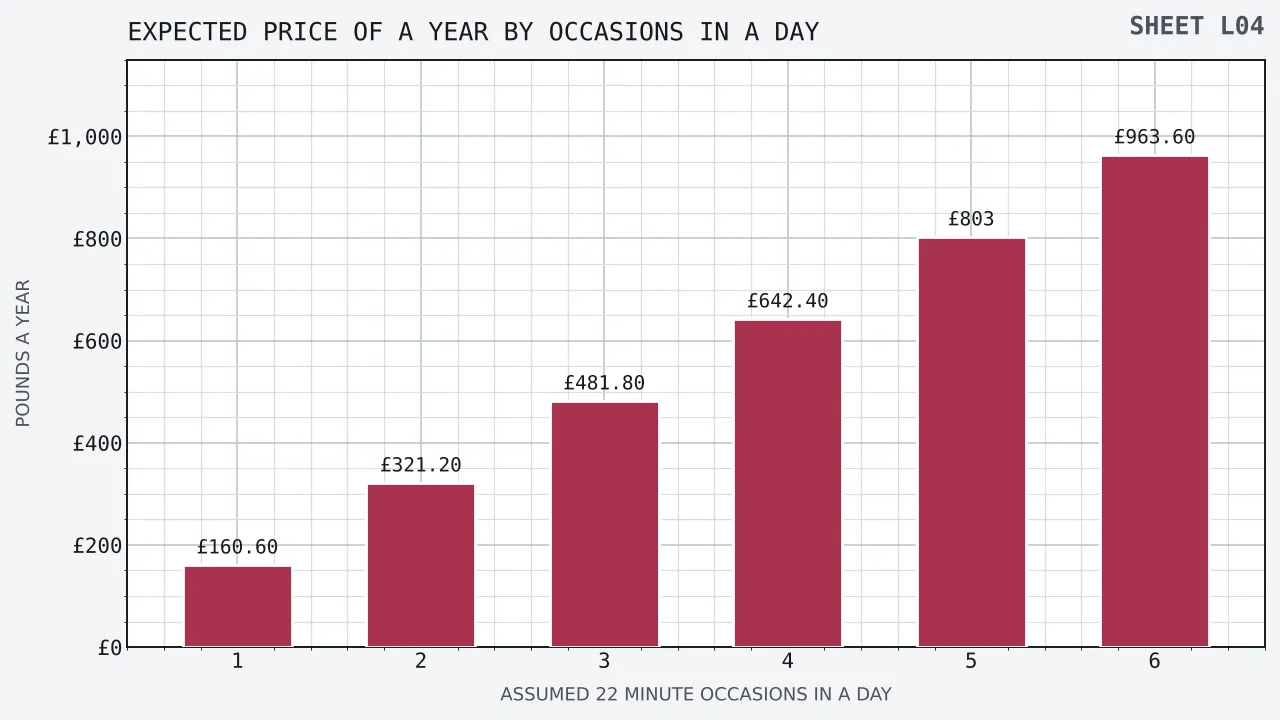
Eight hundred and three hours against the six a day row is worth stopping on, because it is the only cell in the table that reads as a quantity of life rather than a quantity of money. Thirty-three days and eleven hours of unbroken pressing is what those 803 hours amount to, and they are produced by picking a handset up six times in a day for twenty-two minutes each, which nobody would call excessive on any one day.
The equal steps are the finding. Going from one occasion to two costs the same £160.60 as going from five to six. There is no point on the ladder where the arrangement becomes more expensive per occasion, which also means there is no point at which it becomes cheaper. A reader looking for the rung where the cost starts to bite will not find one, because the cost bites identically at every rung.
Twenty-two pounds eighty-eight at the top of the table is the other end of the same statement. A handset picked up once a week for this purpose is a thoroughly modest arrangement and costs about what one takeaway costs across a year. The ladder is not an argument against the first rung. It is an argument for knowing which rung is being stood on.
3
Minutes chopped small cost what minutes chopped large cost
A handset makes the three minute occasion possible, and the three minute occasion is the thing a desk never offered. Three minutes at a press every twelve seconds is 15 presses, £1.50 across the reels and an expected 6p. That is a quantity so small it is difficult to take seriously, which is the first reason to write it down.
Now multiply it the way a day actually multiplies it. Seven three minute occasions scattered across a day come to 21 minutes, 105 presses, £10.50 of turnover and an expected 42p. A single twenty-two minute sitting comes to 110 presses, £11.00 and 44p. The two days are, to within a couple of pence, the same day, and only one of them feels like gambling.
| How long one occasion runs | Presses at the assumed interval | Sent over the reels at 10p | Expected price of the occasion | Occasions that fill 22 minutes | Price of those 22 minutes |
|---|---|---|---|---|---|
| 1 minute | 5 presses | 50p | 2p | 22 | 44p |
| 2 minutes | 10 presses | £1.00 | 4p | 11 | 44p |
| 3 minutes | 15 presses | £1.50 | 6p | 7.33 | 44p |
| 5 minutes | 25 presses | £2.50 | 10p | 4.4 | 44p |
| 11 minutes | 55 presses | £5.50 | 22p | 2 | 44p |
| 22 minutes | 110 presses | £11.00 | 44p | 1 | 44p |
The last column being one figure repeated six times is the point of the table. Minutes are indifferent to how they are cut. Twenty-two of them cost 44p whether they arrive in one piece or in twenty-two, and any page suggesting that short bursts are a cheaper way to play is confusing the size of a slice with the size of the cake.
Where the two days part company is not in the price but in the counting. A reader who sits down once for twenty-two minutes has had one experience and can remember it. A reader who picked the handset up eleven times for two minutes has had eleven experiences, none of them memorable enough to add up, and will reliably under-report the total to themselves when asked.
Which puts the honest version of the handset’s effect in a single sentence. It does not make the pressing faster or dearer. It makes the total harder to assemble, because the total is now distributed across a day in pieces too small to register, and 44p was already too small to register when it arrived in one piece.
The arithmetic in this part assumes a press costs the same ten pence and takes the same twelve seconds whichever occasion it falls in, which is the simplest assumption available and not a measured fact. A real two minute occasion includes opening something and choosing something, so it holds fewer than ten presses. That pushes every figure in the table down a little and leaves the shape of it exactly where it is.
4
Where the twelve seconds came from, and what it is not
Twelve seconds a press is this site’s own convention and this is the page where it gets examined, because every duration this site prints is built on it. It was not timed. No stop-watch was run, no session was observed, no sample was drawn and no handset was held. It is a number chosen for modelling so that pages agree with each other, and anything it produces is model output and not a discovery.
What can be argued for it is bounded. A press on a handset involves a result settling, a glance, a decision and a tap, and on a slot the result may not be hurried along under British rules. Twelve seconds sits comfortably above the fastest a licensed reel may restart and comfortably below the pace of somebody doing something else at the same time. It is a plausible middle and nothing stronger.
What cannot be said for it is more important. It is not an average of anything. It is not a figure any regulator publishes. It is not drawn from traffic data, from an operator, or from any secondary source, and this site would not use such a figure if it found one, because the whole value of a modelled duration is that the reader can see every input and change one.
| The question | The answer this site gives |
|---|---|
| Was it measured | No. Nothing on this site was timed, played or observed |
| Is it published anywhere | No. It is a convention of this site alone |
| Does any rule set it | No. A rule sets a floor, and the floor is five times quicker |
| What would make it wrong | Any real interval, which will differ by person, game and moment |
| What happens to the page if it is wrong | Every duration moves in exact proportion, and part five does the moving |
| What does not move when it is wrong | The share of turnover kept, which is four pence in the pound |
The last row is the one that keeps this page honest. Press size and return between them fix the price of a pound of turnover, and the interval decides only how many pounds of turnover an hour contains. So a reader who thinks twelve seconds is wrong does not have to throw the page away. They move one input and every figure moves with it, which is what part five sets out.
Worth stating plainly, because the subject invites the opposite impression: a duration printed on this site sounds measured and is not. Thirteen hours of something, forty minutes of something else, 803 hours in a year. None of those came off a watch. All of them came out of a press size, an interval and a count, and the sentence carrying each one says which.
5
A quicker thumb and a slower one, run through every figure
Change the interval and every duration on this site changes with it in exact proportion, so the honest thing to do is show the range rather than defend the middle. A twenty-two minute occasion holds 132 presses at ten seconds, 110 at twelve, 88 at fifteen, 66 at twenty and 44 at thirty. The money follows the presses and nothing else.
Take the two sittings a day habit through the range. At ten seconds a press it costs an expected £385.44 a year. At twelve it is £321.20. At twenty it is £192.72, and at thirty it is £128.48. The spread from end to end is a factor of three, from a quantity nobody can measure.
| Seconds a press is given | Presses in a 22 minute occasion | Expected price of one occasion | Presses across a year of two a day | Sent over the reels, in turnover | Expected price of that year |
|---|---|---|---|---|---|
| 10 s | 132 presses | 52.8p | 96,360 over the year | £9,636.00 of turnover | £385.44 |
| 11 s | 120 presses | 48p | 87,600 over the year | £8,760.00 of turnover | £350.40 |
| 12 s, the figure this site assumes | 110 presses | 44p | 80,300 over the year | £8,030.00 of turnover | £321.20 |
| 15 s | 88 presses | 35.2p | 64,240 over the year | £6,424.00 of turnover | £256.96 |
| 20 s | 66 presses | 26.4p | 48,180 over the year | £4,818.00 of turnover | £192.72 |
| 24 s | 55 presses | 22p | 40,150 over the year | £4,015.00 of turnover | £160.60 |
| 30 s | 44 presses | 17.6p | 32,120 over the year | £3,212.00 of turnover | £128.48 |
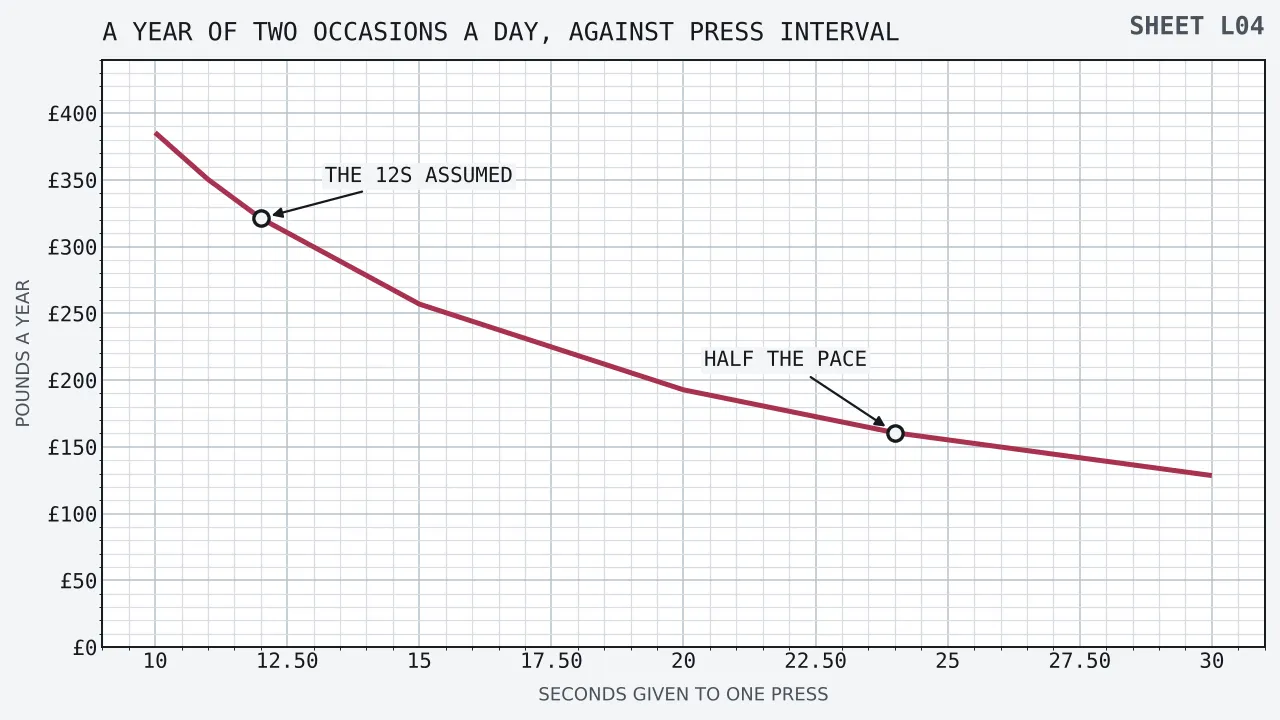
One row in that table coincides with a row from part two, and the coincidence earns its keep. At twenty-four seconds a press, two occasions a day cost £160.60 a year, which is exactly what one occasion a day costs at twelve. Halving the pace and halving the occasions buy the identical reduction.
They do not cost the reader the same thing, though, and the difference decides which one to reach for. Cutting the occasions from two to one removes an entire sitting from the day. Doubling the interval keeps both sittings, keeps all 44 minutes of reels, and simply puts twice as long between results. The second route leaves everything the reader came for in place.
The spread in the final column also sets a limit on how much weight any figure on this site can carry. A quantity that moves from £128.48 to £385.44 on an unmeasured input is not a prediction. What survives the whole range is the shape: linear in occasions, linear in minutes, linear in press size, and a twenty-fifth out of each pound crossed whatever the interval turns out to be.
6
What a single press is permitted to be under British rules
A handset is a machine for making one press easy, so the rules worth reading on this page are the ones written about what a single press is allowed to be. Four of them govern that directly in Great Britain, and all four are design rules rather than disclosure rules, which means a reader meets them without ever being told they exist.
First, a customer has to commit to each game cycle on its own. Automatic play cannot be offered for online gaming at all, and the only carve-out in the guidance concerns posting blinds in peer-to-peer poker. On the model this page runs, that is the rule holding the interval above nothing: 110 presses in an occasion means 110 separate decisions, not one decision and a switch.
Second, no part of the build may bring a result forward. A quick-spin control, a turbo setting and a stop that drops the reels early all sit outside what a licensed system offers, and the rule holds whatever speed a game runs at natively. That is what stands between twelve seconds and something a good deal shorter.
Third, where a result gives back no more than was staked on it, the build may not present it as a win. Neither a winning sound nor a winning animation may be attached to such a result. On a 110 press occasion that matters, because most presses return less than they cost, and a lobby free to treat each of those as an event is a lobby that alters how long somebody stays.
Fourth, nothing in the build may make two games playable side by side. Split screens and multi-screen arrangements fall inside that prohibition. Without it the occasion stops being 110 presses and becomes 220 or 330, with the price of the occasion multiplying alongside.
| What the rule governs | What it does to the arithmetic on this page |
|---|---|
| Each cycle committed to separately | Keeps an occasion at 110 decisions rather than one decision and a run of presses |
| No bringing a result forward | Keeps the interval from collapsing towards the floor and the hour from reaching £5.76 |
| No fanfare for a result paying the stake or less | Keeps the majority of the 110 presses from being dressed as outcomes they are not |
| No two games side by side | Keeps the occasion to one stream of presses, so 22 minutes cannot hold 220 of them |
Put the four together and they amount to a ceiling on what twenty-two minutes can contain. With every cycle committed to individually, with no way to hurry a result, with nothing encouraging a stay past the moment of leaving and with one game at a time, an occasion on a British licensed handset build is bounded at somewhere near the 110 presses this page assumes.
That is a different kind of protection from a limit or a disclosure, and it is easy to miss precisely because it is built into the product. Nobody is told that the turbo button is absent. Nobody is told the reels will not celebrate a sub-stake return. The rules show up as an absence of things, and an absence of things is the hardest thing in the world for a reader to notice.
7
The same four rules absent, priced in occasions
A pocket build of this kind sits outside the British licensing regime altogether. A ceiling is what that takes away, not the arithmetic, and the ceiling is the only thing standing between an occasion of 110 presses and an occasion several times that. None of the press rules in part six is anywhere in the Curaçao policy checked for this build: it sets no minimum on a game cycle, bars no automatic play, bars no feature that brings a result forward, and says nothing whatever about how a shortfall may be dressed.
Price the absence rather than deplore it. Suppose automatic play were available and the interval fell to the fastest a slot reel may lawfully restart in Great Britain, which is 1,440 cycles in an hour. A twenty-two minute occasion would then hold 528 presses, send £52.80 over the reels and cost an expected £2.11, which is four point eight times what the same twenty-two minutes cost at the pace this page assumes.
Run that through the year and the shape of the loss is visible. Two occasions a day at 528 presses each is 385,440 presses, £38,544.00 of turnover and an expected £1,541.76. The reader’s behaviour has not changed by a minute: the same two pick-ups, the same twenty-two minutes, the same ten pence press. Only the ceiling on what those minutes can hold has gone.
That £1,541.76 is a modelled upper bound and not a description of any lobby. It assumes an interval nobody has observed, applied to occasions nobody has counted, at a press size the reader chooses. It is in this page to show the size of the gap a design rule closes, which is a far larger gap than any disclosure rule closes.
Two occasions a day is also where the multi-game rule bites hardest, because a split screen does to presses what automatic play does to seconds. Two streams inside the same twenty-two minutes is 220 presses and an expected 88p an occasion, which is £642.40 across a year. Three streams is £963.60. The clock on the wall says twenty-two minutes throughout.
And the fanfare rule, softest looking of the set, is the one that moves the occasion count rather than the press count. A product that greets a shortfall with the sounds of a win reports a different day back to the person having it, and the quantity this page is built on is how many times in a day a handset gets picked up for this.
None of which says a reader is safe inside the British licensing system and unsafe outside it. The price of a press is four pence in the pound under either, and 44p an occasion is 44p an occasion. What the licence supplies is an upper bound on how many presses twenty-two minutes may contain, and the whole of this page is a count of presses.
8
The one dial on a handset a thumb cannot undo later
Press size is set once, usually in the first few seconds, usually with a small control in a corner, and it then multiplies every occasion for as long as it stands. Unlike the interval it cannot be adjusted gradually, and unlike the occasion count it does not announce itself: a day of two sittings at 50p looks identical, minute for minute, to a day of two sittings at 10p.
Set the two against each other properly. An occasion at 10p costs an expected 44p. The same occasion at 50p costs £2.20, which is what five occasions at 10p cost. So one pick-up at 50p is, in price, five pick-ups at 10p, and a reader who would never pick up a handset five times in a day may be doing exactly that in money by moving a single control.
| Press size chosen | Sent over in one occasion | Expected price of the occasion | Ten pence occasions it costs the same as | A year of two occasions a day |
|---|---|---|---|---|
| 10p | £11.00 | 44p | 1 | £321.20 |
| 20p | £22.00 | 88p | 2 | £642.40 |
| 25p | £27.50 | £1.10 | 2.5 | £803.00 |
| 50p | £55.00 | £2.20 | 5 | £1,606.00 |
| £1.00 | £110.00 | £4.40 | 10 | £3,212.00 |
| £2.00 | £220.00 | £8.80 | 20 | £6,424.00 |
| £5.00 | £550.00 | £22.00 | 50 | £16,060.00 |
The fourth column is the whole argument of this part. It converts a control nobody thinks about into the quantity this page is built on. Fifty pence a press is fifty pence a press, which means nothing to anybody; five occasions a day is a description of a life, and the two are the same statement.
One ceiling is worth naming beside that column. A statutory instrument of 25 February 2025 caps a single cycle of a British licensed online slot: £5.00 for an individual of twenty-five or over, £2.00 for one below that age. The larger of the two began on 9 April 2025. Six weeks later, on 21 May 2025, the smaller one did. Both reach online slots alone rather than casino games at large.
Read that cap through this page’s unit and it is a ceiling on the occasion. Five pounds a press is £22.00 an occasion, 50 ten pence occasions, and £16,060.00 across a year of two a day. Two pounds a press is £8.80 an occasion and £6,424.00 across the same year. A rule on a single cycle is, converted, a rule on how much a twenty-two minute pick-up can cost.
9
Why no month of a year of occasions looks like a decision
A habit built out of occasions has a particular shape, and the shape is the reason it goes unexamined. Two pick-ups a day runs to 88p in a day, £6.16 inside a week, £26.40 over a thirty day stretch and £321.20 by the end of twelve months. One behaviour, four figures, and each figure invites a completely different reaction from the person producing it.
Eighty-eight pence a day sits beneath the threshold at which anybody decides anything. Nobody reviews a spending habit at 88p. Six pounds sixteen inside a week buys a sandwich. Twenty-six pounds forty in a month would show on a bank statement and be read, correctly, as entertainment. Only the last figure of the set would prompt a conversation with anybody.
What makes the year hard to reach is that it is never presented. The occasions arrive one at a time, each one costs 44p in expectation and anything at all in fact, and no month differs from any other. There is no point in the twelve months where the arrangement changes character, which means there is no natural moment at which a reader stops to add it up.
730 pick-ups behind one figure a reader never sees assembled
Seven hundred and thirty pick-ups is the other way to state the same year, and it may be the version that lands. It is more separate occasions than there are days, meals or journeys to work. A reader who asked themselves at the start of a year whether they intended to open a casino 730 times would have an opinion about it, and nobody is ever asked that question in that form.
Compare the figure with the things it sits beside on a statement. The year’s £321.20 is roughly a mid-range handset contract, or a modest annual insurance premium, and in both of those cases a person signs something and sees a total. Here the equivalent total exists only as a product of 730 and 44p, and nothing in the arrangement performs that multiplication.
None of this is an argument that the figure is large. For many readers it will be perfectly affordable and entirely deliberate, which is a legitimate position and not one this page is in any position to assess. The argument is narrower: that a sum reached by 730 identical steps is a sum nobody has ever actually been shown, and being shown it is the whole purpose of the multiplication.
10
What a pocket owner is actually able to move
Three dials exist and a handset owner holds all three, which is a more useful finding than it sounds. The count of occasions, the length of an occasion and the size of a press are each chosen by the person holding the device. The return in each pound is not, and the interval is bounded below by rules rather than by the reader.
Occasions first, because the device exists to raise them. Every daily pick-up removed saves £160.60 across a year at ten pence a press. Going from three a day to two saves that. Going from two to one saves it again. No other change available to a reader produces a round, predictable, repeatable saving of that size for so little effort.
Length second, and it behaves exactly like the count. Cutting an occasion from twenty-two minutes to eleven halves its presses, its turnover and its price, and two eleven minute occasions cost precisely what one twenty-two minute occasion costs. There is no arithmetic advantage in either arrangement, which means the choice can be made on other grounds entirely.
Press size third, and a factor of fifty lives inside it. Ten pence to five pounds takes an occasion from 44p to £22.00, and takes a year of the same two pick-ups a day from £321.20 to £16,060.00. It is also the dial most easily moved by accident, sitting as it does in the corner of a screen built for a thumb.
£160.60 a year saved by one fewer pick-up a day
What a handset cannot do is make any of this cheaper per minute. Twenty-two minutes costs 44p at ten pence a press on a phone, on a tablet and on a desk alike, because the price is press size times presses times four pence in the pound and no term in that product knows what it is running on. The device is a distribution mechanism for occasions and nothing else.
Which is why the figure worth carrying away from this page is not an hourly rate at all. It is £160.60, what a single daily pick-up comes to across a year on a ten pence press and the sitting length assumed here. Multiply it by however many pick-ups a day a handset genuinely produces, and the product is the figure the whole subject turns on.
Questions
- Does playing on a phone make the presses faster?
- No, and this page treats the idea as the main thing to correct. A press involves a result settling, a glance, a decision and a tap, and none of those is quicker in a hand than at a desk. What a handset changes is where pressing can start, so the quantity it multiplies is the number of separate occasions in a day. On a ten pence press, with twelve seconds given to it by assumption rather than by measurement, each daily occasion of twenty-two minutes is worth £160.60 a year.
- What does one more pick-up a day cost over twelve months?
- One hundred and sixty pounds sixty, at ten pence a press. One occasion of twenty-two minutes holds 110 presses on the interval this site assumes, sends £11.00 over the reels and expects to part with 44p of it. Three hundred and sixty-five of those is £4,015.00 of turnover and £160.60 of expected price. The step is the same between every pair of rungs, so going from five pick-ups a day to six costs what going from one to two costs.
- Are short bursts on a phone cheaper than one long session?
- No. The price is linear in minutes and completely indifferent to how they are cut. Twenty-two minutes costs an expected 44p whether it arrives as one sitting of twenty-two, two of eleven, seven of three or twenty-two of one. What changes is the counting rather than the cost: eleven two minute pick-ups are far harder to add up afterwards than one sitting somebody can remember.
- Where does the twelve second press come from?
- From this site and nowhere else. Nothing was timed, observed, played or sampled, and no regulator publishes such a figure. It is a convention adopted so that every page here agrees with every other, chosen to sit above the fastest a licensed reel may restart and below the pace of somebody doing two things at once. Any duration printed on this site is a model output built from that interval, a press size and a count.
- What happens to the figures if a handset is slower or quicker than that?
- Every duration moves in exact proportion and the share of turnover kept does not move at all. A twenty-two minute occasion holds 132 presses at ten seconds, 110 at twelve, 88 at fifteen, 66 at twenty and 44 at thirty. Two occasions a day across a year then costs an expected £385.44, £321.20, £256.96, £192.72 or £128.48. The twenty-fifth taken out of each pound crossed is the one quantity that stays put throughout.
- Is cutting the pick-ups better than slowing down?
- They are identical in money and different in everything else. Two occasions a day at twenty-four seconds a press costs £160.60 across a year, which is exactly what one occasion a day at twelve seconds costs. Cutting the pick-ups removes a whole sitting from the day. Doubling the interval keeps both sittings and all forty-four minutes of reels, and simply puts twice as long between results, so it leaves intact whatever the reader came for.
- Which British rules apply to what one press can be?
- Four of them, every one a design rule a reader meets without being told. Commitment to each game cycle has to be made separately, so automatic play cannot be offered for online gaming at all. Nothing in the build may bring a result forward, which puts a quick-spin control, a turbo setting and an early stop outside what a licensed system offers. Where a result gives back no more than was staked on it, the build may not present it as a win. And two games may not be made playable side by side.
- Where does a casino built for a pocket stand on the British licence?
- A pocket build of this kind sits outside the British licensing regime altogether, and the loss is a ceiling rather than a sum. None of the press rules above is anywhere in the Curaçao policy checked for this build, which sets no minimum on a game cycle, bars no automatic play, bars no feature that brings a result forward and says nothing about how a shortfall may be dressed. Modelled at the briskest a British licensed slot reel may restart, twenty-two minutes would hold 528 presses rather than 110, cost an expected £2.11 rather than 44p, and run to £1,541.76 across a year of two pick-ups a day. The behaviour is unchanged and only the bound over it has gone.
- How much does the press size matter compared with the number of pick-ups?
- It carries a factor of fifty where the pick-up count usually carries a factor of two or three. An occasion at 10p costs 44p and an occasion at £5.00 costs £22.00, which is what fifty ten pence occasions cost. Put another way, moving one small control in the corner of a screen can do more to the year than adding four pick-ups a day would. On a British licensed online slot that control is capped at £5.00 on a single cycle, or at £2.00 for anyone not yet twenty-five.
- Why is a yearly figure so much harder to see than a daily one?
- Because nothing ever assembles it. Two pick-ups a day runs to 88p in a day, £6.16 inside a week, £26.40 over a thirty day stretch and £321.20 by the end of twelve months, and only the last figure of that set would prompt anybody to think about it. The occasions arrive one at a time, no month differs from any other, and no moment comes at which the arrangement changes character and invites a reader to stop and add up 730 pick-ups.
- Is a twenty-two minute sitting a real measurement?
- No, and the same warning attaches to it as to the twelve second press. It is a convention this site adopted for modelling so that its pages agree, and nobody observed a sitting of any length to arrive at it. The page works because every figure is a product of inputs the reader can see and change, not because any of the inputs was taken off a watch.
- What is the single figure worth carrying away?
- One hundred and sixty pounds sixty, what a single daily occasion comes to across a year on a ten pence press and the twenty-two minutes assumed here. Multiply it by the number of times a day a handset genuinely gets picked up for this purpose and the product is the year. Everything else above is that product with one input moved.