Note L01 Revision 1 Terms read 17 October 2026
Five pounds a press buys fifty times the money and not one penny of better rate
Raise a press from ten pence to five pounds and three hundred presses in an hour go from £30.00 of staking to £1,500.00, with the expected margin going from £1.20 to £60.00. Four pence in the pound is the proportion in both lines. The only quantity a bigger balance alters is how soon the arithmetic finishes with it.
Staked in an hour at £5.00 £1,500.00 Until £100 is expected gone 1 h 40 min Expected margin an hour £60.00
Stakes of this size, and the hours they ask
Advertising has been bought for every destination below. A fee reaches this site when a reader goes on to register, and no figure on this page moves one way or the other because of it.
-
01Mobile Free Spins
Betportal
Ceiling as a multiple
What lands€15.00150 spins at 10c, which is this site's figure and not the operator'sThe run17 h 30 minTurning over 525.00 at 10p means 5,250 presses, or about 48 phone sittings of 22 minutes. Timed at 10p a press and 12 seconds between presses, both of which this site assumes rather than measures.The wait to be paidNOT PUBLISHEDThis operator puts no withdrawal band in its own terms, so there is nothing honest to print here.Spins valued at this site's own 10p a spin
What lands
Spins, at a price15.00150 of them at 10c apiece, a figure belonging to this site rather than to the operatorMatch, and other creditno figure300% of three deposits, to a ceiling of €1,000. Not a sum until money of yours makes it one, so this row totals nothing and carries nothing downwardsThe run
Handed back on the spins(0.60)Each press stakes its own value and returns 96 per cent, which leaves this much with the house from the opening pressPlay-through 35x on the bonus(20.16)Taking 14.40 round 35 times over means 504.00 through the machines, of which 20.16 is the expected cost, and 17 h 30 min of pressing at the pace aboveWhat counts towards it100%Slots only, with no percentage published anywhere, so the row above assumes the whole of each stake countsWhat never clears
Limit on the winningsstated5x the bonusDeducted on the way outno figureNothing is published as a figure here, so this row removes nothingLeast that can leaveno figureNo figure is published, so nothing on this timer is pinned down by oneLeast deposit, and the rung over ityour own€20 a stage. Published in euros, so no rung is named at all: this site's ladder is a sterling oneThe window on the creditstated14 daysBiggest stake while it runsstated€5Removed outright by rulestatedNot publishedVerified before a payoutstatedDocuments before the first withdrawalNever clears€15.00Not a penny of it gets out, so the whole of what landed stands on this rowNo Great Britain licence
Licence held in Anjouan, Comoros, the company named is BetPortal Gaming Ltd, with Excite Ultra Media Ltd, quoted under ALSI-202601040-FI2.
Terms read 17 October 2026
Open the offer at Betportal, opens in a new window -
02Mobile Free Spins
WinBeast
Ceiling as a sum
What lands€50.00500 spins at 10c, which is this site's figure and not the operator'sThe run2 d 18 hTurning over 2,000.00 at 10p means 20,000 presses, or about 182 phone sittings of 22 minutes. Timed at 10p a press and 12 seconds between presses, both of which this site assumes rather than measures.The wait to be paidNOT PUBLISHEDThis operator puts no withdrawal band in its own terms, so there is nothing honest to print here.Spins valued at this site's own 10p a spin
What lands
Spins, at a price50.00500 of them at 10c apiece, a figure belonging to this site rather than to the operatorMatch, and other creditno figure50% to 100% of five deposits, each to a ceiling of €1,000, and a €650 free bet. Not a sum until money of yours makes it one, so this row totals nothing and carries nothing downwardsThe run
Handed back on the spins(2.00)Each press stakes its own value and returns 96 per cent, which leaves this much with the house from the opening pressPlay-through 40x on the bonus and the winnings from the spins(76.80)Taking 48.00 round 40 times over means 1,920.00 through the machines, of which 76.80 is the expected cost, and 2 d 18 h of pressing at the pace aboveWhat counts towards it100%Slots, titles vary by country, with no percentage published anywhere, so the row above assumes the whole of each stake countsWhat never clears
Limit on the winningsstated€100 a batch of spinsDeducted on the way outno figureNothing is published as a figure here, so this row removes nothingLeast that can leaveno figureNo figure is published, so nothing on this timer is pinned down by oneLeast deposit, and the rung over ityour own€20 a stage. Published in euros, so no rung is named at all: this site's ladder is a sterling oneThe window on the creditstated7 days, spins 1 dayBiggest stake while it runsstatedNot publishedRemoved outright by rulestatedNot publishedVerified before a payoutstatedDocuments before the first withdrawalNever clears€50.00Not a penny of it gets out, so the whole of what landed stands on this rowNo Great Britain licence
Licence held in Curaçao, no company named anywhere on the site.
Terms read 17 October 2026
Open the offer at WinBeast, opens in a new window -
03Mobile Free Spins
EliteSpin
Longest spin window
What lands£50.00500 spins at 10p, which is this site's figure and not the operator'sThe run2 d 18 hTurning over 2,000.00 at 10p means 20,000 presses, or about 182 phone sittings of 22 minutes. Timed at 10p a press and 12 seconds between presses, both of which this site assumes rather than measures.The wait to be paidNOT PUBLISHEDThis operator puts no withdrawal band in its own terms, so there is nothing honest to print here.Spins valued at this site's own 10p a spin
What lands
Spins, at a price50.00500 of them at 10p apiece, a figure belonging to this site rather than to the operatorMatch, and other creditno figure50% to 100% of five deposits, each to a ceiling of £1,000. Not a sum until money of yours makes it one, so this row totals nothing and carries nothing downwardsThe run
Handed back on the spins(2.00)Each press stakes its own value and returns 96 per cent, which leaves this much with the house from the opening pressPlay-through 40x on the bonus and the winnings from the spins(76.80)Taking 48.00 round 40 times over means 1,920.00 through the machines, of which 76.80 is the expected cost, and 2 d 18 h of pressing at the pace aboveWhat counts towards it100%Slots, with no percentage published anywhere, so the row above assumes the whole of each stake countsWhat never clears
Limit on the winningsstated5x the bonusDeducted on the way outno figureNothing is published as a figure here, so this row removes nothingLeast that can leaveno figureNo figure is published, so nothing on this timer is pinned down by oneLeast deposit, and the rung over ityour own£20 a stage. It lands square on the £20.00 rung, so none of yours is left perched on topThe window on the creditstated7 days, spins 3 daysBiggest stake while it runsstatedNot publishedRemoved outright by rulestatedNot publishedVerified before a payoutstatedDocuments before the first withdrawalNever clears£50.00Not a penny of it gets out, so the whole of what landed stands on this rowNo Great Britain licence
Licence held in Costa Rica, the company named is PrimeTier Limited.
Terms read 17 October 2026
Open the offer at EliteSpin, opens in a new window -
04Mobile Free Spins
Crown Jewelz
Multiple unpublished
What lands£15.00150 spins at 10p, which is this site's figure and not the operator'sThe runNOT TIMEDThis operator does not publish the play-through multiple in its own terms. The multiple is the one figure the clock cannot work around, so the run is left untimed.The wait to be paidNOT PUBLISHEDThis operator puts no withdrawal band in its own terms, so there is nothing honest to print here.Nothing reckoned
What lands
Spins, at a price15.00150 of them at 10p apiece, a figure belonging to this site rather than to the operatorMatch, and other creditno figure200% of the first deposit, then 150% twice, each to a ceiling of £1,000. Not a sum until money of yours makes it one, so this row totals nothing and carries nothing downwardsThe run
Play-throughno figure40x the bonus, reported rather than published by the operatorWhat counts towards itno figureSlots, with no percentage published anywhere, so the row above assumes the whole of each stake countsWhat never clears
Limit on the winningsstatedNot publishedDeducted on the way outno figureNothing is published as a figure here, so this row removes nothingLeast that can leaveno figureNo figure is published, so nothing on this timer is pinned down by oneLeast deposit, and the rung over ityour own£20. It lands square on the £20.00 rung, so none of yours is left perched on topThe window on the creditstatedNot publishedBiggest stake while it runsstatedNot publishedRemoved outright by rulestatedNot publishedVerified before a payoutstatedDocuments before the first withdrawalNever clearsNOT RECKONEDThis operator leaves the play-through multiple out of its own terms, so nothing below the fourth step can be worked out.No Great Britain licence
Licence held in Curaçao, number not verified, no company named anywhere on the site.
Terms read 17 October 2026
Open the offer at Crown Jewelz, opens in a new window
Only the middle reading comes out of arithmetic belonging to this site. The multiple laid against what lands gives the turnover asked for; dividing that by 10p a spin gives the presses; dividing those by 300 an hour gives the hours, a press on a handset being taken here at 12 seconds from the one before. Both figures are assumptions rather than measurements of anybody: nothing was played and nothing was held a stopwatch to. Anybody quicker should divide the press count by a rate of their own, which is why the presses are printed alongside the hours instead of being summarised away.
The first reading is what arrives before any condition is laid against it. Spins carry no unit of their own so one gets supplied: where an operator values its own spin that figure is used and attributed, and where it does not, this site's 10p a spin stands in and everything below moves with it. The third reading belongs to the operator entirely. It is a withdrawal band quoted from published terms, and a blank there means none was published rather than that nobody looked.
The total along the foot answers what the hours leave open, which is whether any of the running ends anywhere. It is what arrived, less whatever is still standing once the play-through has been paid for at 96 per cent return to player and once a published limit, a published deduction and a published floor beneath the least that can leave have each had a turn. It appears again in pence in the pound, the only fair way of holding a small offer up against a large one. It describes an offer rather than an evening, and where the conditions price out what arrived, a timer prints nothing getting out instead of a negative sum.
Cashiers on a handset take deposits off a row of preset buttons, so a least deposit given in pounds is raised to the next rung of the ladder used here, £10, £20, £25, £50, £75 and £100, and the timer shows what is left perched on it. That money is the reader's own and enters no sum at all. Given in euros it prints untouched, the ladder being sterling. Three words may occupy the figure column where no figure belongs. Stated is a published term that costs something while leaving no number to subtract. No figure is a term nobody has quantified, or a credit that is not a sum until money of yours makes it one. Your own is money of yours, which belongs in none of this.
None of the operators above is licensed in Great Britain, so not one duty that licence carries reaches any of them. Membership of Gamstop Online is compulsory for every online gambling company licensed in Great Britain, which means that shutting yourself out through the scheme shuts you out of none of these. The limit of ten times the bonus funds on a wagering requirement, running since 19 January 2026 under Social Responsibility Code 5.1.1, is a condition of the same licence and binds only whoever holds one. Off that licence, the Gambling Commission writes of consumers meeting unfair gaming practices, financial loss and no recourse when matters go wrong, and lists blocked payouts and withdrawal limits pitched too high to reach among the things it has seen. No account at any of them may be held by anybody under 18.
Every term on a timer is its operator's own and every timer carries the day somebody read it. The oldest of those readings is 17 October 2026. What binds a reader is an operator's full terms and never a line printed here.
1
One proportion, fifty times the money passing through it
Multiplication is the whole of what a large stake does, and it is applied to one side of the arrangement only. Ten pence on a press, with three hundred presses fitted into an hour because this note posits twelve seconds for each one, sends £30.00 across the reels in that hour. Ninety-six pence of every pound is modelled as coming back, so the four pence that does not comes to £1.20, and a single press carries four tenths of a penny of it.
Now put five pounds on the identical press and change nothing else. The hour still holds three hundred of them at the twelve seconds posited throughout, so the staking is £1,500.00 and the expected margin is £60.00. Each press carries twenty pence of that rather than four tenths of one. Fifty times the money has moved and the share taken out of it has not shifted by a hundredth of a per cent.
Four pence of every pound crossed is the quantity that refuses to shift, and refusing to shift is the whole of its behaviour. It does not run higher for a modest player and lower for a lavish one. It does not thin as a balance thickens. A reader staking fifty times what somebody else stakes is handing over fifty times as much margin for exactly the same proportion of exposure, which means the two of them are buying the same product at two different speeds.
Speed is therefore the thing a larger balance purchases, and the word is meant literally rather than as a figure of speech. Both readers above will arrive at the same expected position per pound crossed. One of them will arrive there inside an evening and one will take most of a year, and nothing else about the two accounts differs.
| What the hour holds | At 10p a press | At £5.00 a press |
|---|---|---|
| Presses, at the twelve seconds posited here | 300 | 300 |
| Staking crossing the reels | £30.00 | £1,500.00 |
| Expected margin at ninety-six in the hundred | £1.20 | £60.00 |
| Borne by one press | 0.4p | 20p |
| Share of staking retained by the house | 4 per cent | 4 per cent |
Nothing in the last row is an opinion and nothing in it can be negotiated. It is the arithmetic of a published return applied to a quantity of turnover, and the quantity of turnover is the one variable a reader controls. Picking a stake is picking a rate of turnover, and picking a rate of turnover is picking how quickly a fixed proportion eats a finite pile.
Twelve seconds on a press, and twenty-two minutes on one pick-up of a handset, are conventions adopted for modelling by this site. No watch produced either of them. Every duration below rests on that pair, on ninety-six pence coming back in each pound, and on whatever stake a sentence names, and each sentence carrying one says which of the four it is leaning on.
2
A ladder of ten stakes, read as a bill by the hour
Ten rungs cover everything from a penny lobby to the sort of press that would empty an ordinary current account inside a sitting, and every rung is the same two multiplications. Three hundred presses an hour, at the interval this note posits, gives the staking. Four pence in the pound of that staking gives the expected margin. There is no third operation anywhere on the ladder.
| Stake on one press | Staked in an hour | Expected margin an hour | Expected margin on one press | Staked in a posited sitting | Expected margin in that sitting |
|---|---|---|---|---|---|
| 5p | £15.00 | 60p | 0.2p | £5.50 | 22p |
| 10p | £30.00 | £1.20 | 0.4p | £11.00 | 44p |
| 20p | £60.00 | £2.40 | 0.8p | £22.00 | 88p |
| 50p | £150.00 | £6.00 | 2p | £55.00 | £2.20 |
| £1.00 | £300.00 | £12.00 | 4p | £110.00 | £4.40 |
| £2.00 | £600.00 | £24.00 | 8p | £220.00 | £8.80 |
| £5.00 | £1,500.00 | £60.00 | 20p | £550.00 | £22.00 |
| £10.00 | £3,000.00 | £120.00 | 40p | £1,100.00 | £44.00 |
| £25.00 | £7,500.00 | £300.00 | £1.00 | £2,750.00 | £110.00 |
| £100.00 | £30,000.00 | £1,200.00 | £4.00 | £11,000.00 | £440.00 |
Column four is the one to sit with, because it converts an abstraction into a price tag on a single thumb movement. Four tenths of a penny is a rounding error nobody would notice leaving a pocket. Twenty pence is the sort of sum that buys something. Four pounds, which is the figure attached to a press of a hundred, is a sandwich, and the press lasts the twelve seconds this note posits for it.
Twenty-two minutes is what the last two columns are built on, assumed for a single pick-up of a handset rather than observed in one. It holds 110 presses. At ten pence those hundred and ten presses move £11.00 and are expected to retain 44p. At twenty-five pounds the same hundred and ten presses move £2,750.00 and are expected to retain £110.00, which is ten times the whole staking of the ten pence sitting.
20p of expected margin on one press of five pounds
Reading the ladder downwards gives the impression of a product getting more serious. Reading it across gives the opposite and more accurate impression, which is of one product being metered faster. Each rung returns ninety-six in the hundred, fills its hour with three hundred events at the interval posited above, and surrenders the identical four per cent. The one variable moving down the column is the scale of a single event.
Two rungs are worth naming against the rest. A press of fifty pence costs the same in expectation, per press, as five presses of ten pence, which is obvious once written and invisible on a lobby screen. And a press of a hundred pounds retains £4.00 in expectation, which is precisely what a thousand presses of ten pence retain: one interval of twelve posited seconds set against 3 h 20 min of them.
3
How long a hundred pounds survives as the press grows
Division is the better way round for a reader with a pile rather than an hour. Take a hundred pounds set aside for reels and ask how much pressing it buys before the modelled margin has consumed the lot. The sum is a hundred divided by the expected margin an hour, and the answer falls off a cliff as the rungs are climbed.
At ten pence that hundred pounds is modelled to last 83 h 20 min of pressing, which, taken two pick-ups of a handset a day at twenty-two assumed minutes each, spreads across a hundred and fourteen days. At one pound it is 8 h 20 min. At five pounds it is 1 h 40 min. At twenty-five pounds it is twenty minutes, and a reader who sets the hundred aside on a Friday evening is modelled as finished with it before the kettle has gone cold.
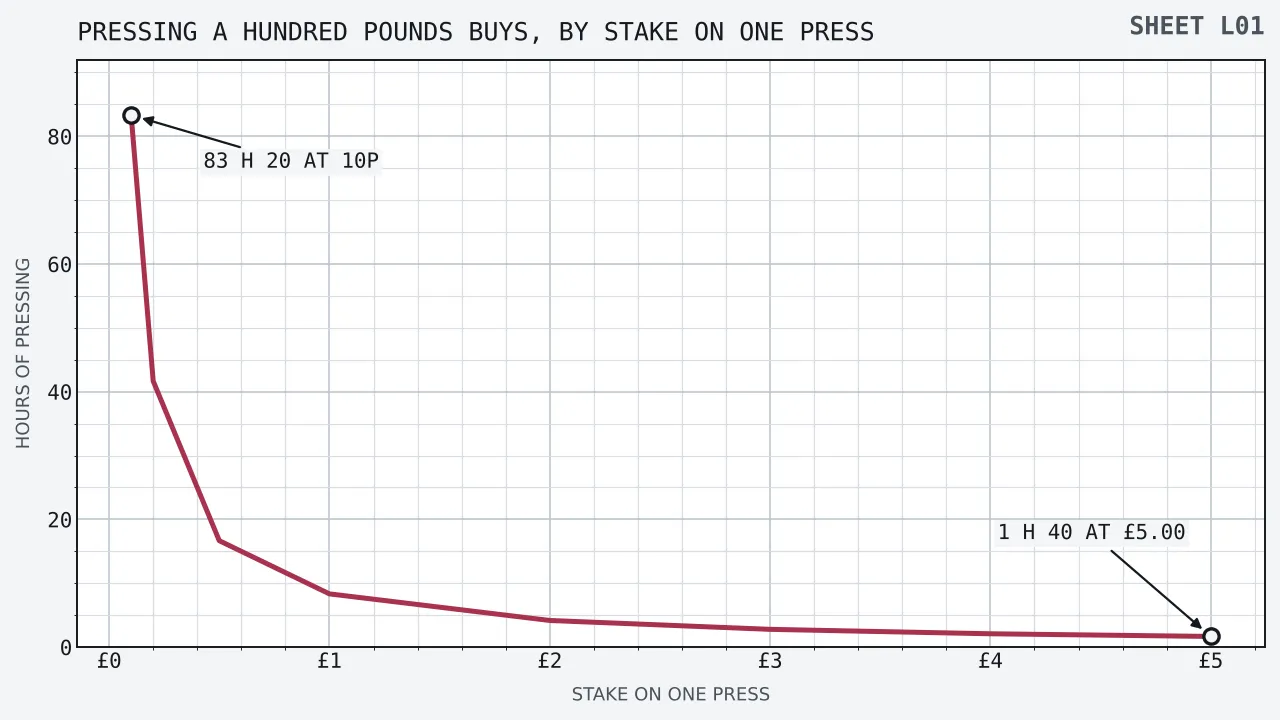
What the curve shows is a reciprocal, and a reciprocal is a shape most people read wrongly. Going from ten pence to twenty pence costs 41 h 40 min of the pile’s modelled life. Going from four pounds to five pounds costs twenty-five minutes. Almost the whole of the collapse happens inside the first pound of stake, and by the time a reader is choosing between large presses the hours have already been spent.
Multiply the pile by ten and the shape is identical with a nought on it. A thousand pounds at ten pence is modelled to last 833 h 20 min, which comes to 2,273 pick-ups of a handset once each one is given its twenty-two assumed minutes. The same thousand at five pounds a press is 16 h 40 min, and at twenty-five pounds a press it is 3 h 20 min.
| Stake on one press | £100 lasts | £1,000 lasts | Presses inside the £100 | Posited sittings inside the £100 |
|---|---|---|---|---|
| 10p | 83 h 20 min | 833 h 20 min | 25,000 | 228 |
| 50p | 16 h 40 min | 166 h 40 min | 5,000 | 46 |
| £1.00 | 8 h 20 min | 83 h 20 min | 2,500 | 23 |
| £5.00 | 1 h 40 min | 16 h 40 min | 500 | 5 |
| £25.00 | 20 min | 3 h 20 min | 100 | 1 |
Presses in the fourth column is the quantity that makes the point without any reference to a clock at all. A hundred pounds is twenty-five thousand presses of ten pence in expectation and a hundred presses of twenty-five pounds. The reader at the bottom of that table has bought one four-hundredth of the events the reader at the top has bought, out of a pile of identical size.
Events are what the product actually supplies. Pounds of margin are what it charges. One pound of expected margin buys £25.00 of turnover at every rung of the ladder, that £25.00 being the reciprocal of a four per cent retention, and nothing a reader chooses moves it. What the stake decides is how few events that £25.00 is cut into: two hundred and fifty at ten pence, twenty-five at a pound, five at five pounds, and exactly one at twenty-five.
4
Where the per-spin ceiling bites, and where the ladder carries on
Three rungs of that ladder are shut on a British licensed reel, and the boundary is drawn around a shape of game rather than around a size of player. Hanging on every remote casino operating licence is a condition fixing the most that may ride on one game cycle: five pounds for anybody of twenty-five years or more, two pounds for anybody younger. It arrived by statutory instrument, made on the twenty-fifth of February 2025, which set its own commencement as a span of six weeks rather than as a calendar day.
Calendar days belong to the regulator’s guidance instead, and it supplies two. 9 April 2025 is where the five pound ceiling begins in that guidance and 21 May 2025 is where the lower one begins. The six weeks between them were transitional, one ceiling of five pounds covering every age at once, so an eighteen to twenty-four year old met the tighter figure a month and a half after everybody else met the looser one.
Reel-based is the test the instrument applies, and the test is where a ladder’s upper rungs survive. What it regulates is an online casino game settled by images or text shown as reels, or shown by anything else doing that job, the arrangement reached being what awards a prize or some other advantage. Online slots alone carry the stake limits, the regulator’s guidance says, and it names two games they do not reach: roulette, and blackjack beside it.
So a press of £25.00 is shut to a player of any age on a licensed reel, while the same £25.00 may ride on a licensed game that is dealt rather than spun. On a build that holds no Great Britain licence the figure may ride on anything at all, since not one line of the condition above reaches such a build.
Put arithmetic to the two ceilings and the gap between them stops being abstract. Fill an hour with the three hundred events posited here and a licensed reel takes at most £1,500.00 from somebody at or past twenty-five, keeping an expected £60.00 of it. The same hour tops out at £600.00 for somebody between eighteen and twenty-four, keeping an expected £24.00. Thirty-six pounds an hour divides them, which over a hundred hours of pressing is £3,600.00.
Pace carries a floor as well, and folding it in sharpens the edge. A licensed reel has to let two and a half seconds pass before a further game cycle may start, so dividing sixty minutes by that interval leaves 1,440 events in the briskest lawful hour, against the three hundred modelled throughout. Five pounds on each of those is £7,200.00 of staking and £288.00 expected. Two pounds on each is £2,880.00 and £115.20.
Those two figures are the outer edge of what a British licensed reel can charge a person in sixty minutes, and they are worth holding because they bound the whole discussion. Nothing in the stake rules, the pace rules or the return assumed here lets a licensed reel exceed them. A build outside the register is bound by none of the three, and the ladder in part two simply continues past the point where the British one stops.
£288.00 an hour, the outer edge of a licensed reel
One correction is worth making before leaving the subject, because it is the commonest misreading of these figures. A ceiling of this sort is set on one game cycle and on nothing larger: not on an hour, not on a day and not on an account. Five pounds may go down, and then five pounds again, and then five pounds again, for as long as a balance and an evening last, so the rule governs the size of one event and leaves the count of events alone.
5
Eighty presses instead of four thousand, for the same clause
Where a credit carries a play-through, the stake decides the number of events needed to discharge it and nothing else about it. Forty times a ten pound credit is £400.00 of staking. That £400.00 is fixed by the clause. Dividing it by the stake gives the presses, and dividing the presses by three hundred an hour gives the hours at the interval this note posits.
Ten pence turns that £400.00 into four thousand events, 13 h 20 min of pressing, thirty-seven pick-ups of a handset of twenty-two assumed minutes. One pound turns it into four hundred events and 1 h 20 min, four pick-ups. Five pounds turns it into eighty events and sixteen minutes, which does not fill a single one. The clause has not altered. The number of times a thumb has to move has fallen by a factor of fifty.
| Stake on one press | Presses to discharge | Run at the posited interval | Whether one pick-up covers it | Posited sittings | Expected margin on the clause | Margin arriving each hour |
|---|---|---|---|---|---|---|
| Ten pence | 4,000 | 13 h 20 min | Nowhere near | 37 | £16.00 | £1.20 |
| Twenty pence | 2,000 | 6 h 40 min | Nowhere near | 19 | £16.00 | £2.40 |
| Fifty pence | 800 | 2 h 40 min | Not quite | 8 | £16.00 | £6.00 |
| One pound | 400 | 1 h 20 min | Not quite | 4 | £16.00 | £12.00 |
| Two pounds | 200 | 40 min | Two would | 2 | £16.00 | £24.00 |
| Five pounds | 80 | 16 min | With six minutes spare | 1 | £16.00 | £60.00 |
Column five is a constant and column six is not, and the pair of them is the entire content of this page. Sixteen pounds is what the clause is expected to retain whoever discharges it and however fast, because the clause is written on turnover and turnover is settled at £400.00 before a press is made. What the stake changes is the rate at which those sixteen pounds are handed over.
Larger credits behave identically because the relationship is a straight line. A hundred pound credit at forty times is £4,000.00 of staking: forty thousand presses and 133 h 20 min at ten pence, four thousand presses and 13 h 20 min at a pound, eight hundred presses and 2 h 40 min at five pounds. The expected margin is £160.00 on every one of those rows.
Go up again to a five hundred pound credit, which is the region a page with this heading is really about, and the staking is £20,000.00. At ten pence that is two hundred thousand presses and 666 h 40 min, which is more pressing than most people will do in a decade. At five pounds it is four thousand presses and 13 h 20 min, the same run a ten pound credit asks of a ten pence press. Expected margin on the clause is £800.00 either way.
Those last two rows are worth setting side by side, because they look like the same obligation and are fifty times apart in money. Thirteen hours and twenty minutes of pressing discharges a ten pound credit for an expected sixteen pounds, or a five hundred pound credit for an expected eight hundred. The clock reads the same. The bill does not.
6
Pricing the shortening, which is the thing being bought
A clause compressed from 13 h 20 min into sixteen minutes has been bought, and it is worth asking at what price. The naive answer is that it cost nothing, since the expected sixteen pounds is the same in both rows. The naive answer is wrong in two ways, and both of them are arithmetic rather than caution.
First, the balance has to survive the compression. A clause of four thousand presses at ten pence puts £400.00 across the reels in units of a tenth of a pound, so the largest single thing that can go wrong in one event is ten pence. The same £400.00 at five pounds a press goes over in eighty units, and the largest single thing that can go wrong in one event is five pounds. The expected result is identical; the size of one step towards it is fifty times coarser.
Second, and this is the part a reader feels, the shortening does not usually stop at the end of the clause. Sixteen minutes does not fill a pick-up of a handset, so the remaining six minutes of a twenty-two minute sitting, at the length this site posits, carries on at the stake the clause was discharged at. Those six minutes are thirty presses of five pounds, £150.00 of staking and £6.00 of expected margin, which is more than a third of the whole clause again.
£6.00 expected in the six minutes after the clause closes
Run that forward over a habit rather than an evening and the shortening is revealed as the expensive half of the transaction. A reader clearing the clause at ten pence lands forty presses into their thirty-seventh pick-up of a handset, so finishing that sitting adds seventy presses, £7.00 of staking and 28p of expected margin. A reader who discharges it at five pounds and presses on for the rest of a sitting is adding the £150.00 and £6.00 above. The clause was the same length in pounds. The tail is not.
There is a third reading that matters more than either, and it concerns what a shortened clause is for. Clearing a condition quickly is only valuable if the account is then closed, the balance taken and the pressing stopped. If the pressing continues, the clause was never the obligation. It was the first sixteen minutes of a habit whose hourly bill has already been printed in part two at £60.00.
One more sum finishes the point. Discharging a five hundred pound credit at five pounds a press takes four thousand presses, which at three hundred an hour on the posited interval is 13 h 20 min. Give every pick-up of a handset its twenty-two assumed minutes and thirty-seven of them is the count, two and a half weeks at a pair an evening. Over those thirty-seven sittings the expected margin is £800.00, and nothing about the shortening has made the £800.00 smaller. It has made it arrive inside a fortnight.
7
Rules written over a large balance on its way out
A press of this size is commonly offered from a cashier which holds no Great Britain licence whatever, and what that subtracts from a large balance is not what a reader would name first. Two British duties govern money on its way out of an account. Neither follows a build sitting off the register, and each reads better as a sum than as a principle.
Restrictions on getting money out are the first of them. Under the British rules a licensee may neither write, apply nor lean on a consumer term capping what somebody takes back from the money they themselves paid in, and the regulator illustrates the ban with a right of fifty pounds in any day, five hundred in any week. Reasonableness governs whatever is said about the size or the frequency of a payment out. No publication date is printed on the page carrying that rule, so none is attached here.
Set that illustration against the ladder and it stops reading as a small print irritation. Five hundred pounds is a hundred presses at the five pound stake priced throughout here, filling twenty minutes on the posited interval. A whole week of permitted release under such a term is therefore worth less staking than one pick-up of a handset, and £5,000.00 sitting in an account would need ten weeks to get out of it.
Fifty pounds in a day sharpens it again. Ten presses of five pounds occupies two minutes on the posited interval, so the daily release in that illustration matches two minutes of what the identical account will accept without a murmur. Lopsidedness is the whole content of the comparison: arriving at £1,500.00 an hour, departing at a rate counted in weeks.
Two arrangements that look alike are not alike. A cap written over what a credit may pay out is one thing; an unrestricted right to the deposit balance is another, and the British rule just given reaches only the second of the pair. A maximum-win term sitting on bonus funds is untouched by it, and reading them as one misreads each.
Second comes what sits between the asking and the arriving. Across all gambling the British technical standard forbids offering anybody a way to call back a request to be paid, and the guidance under it says money once requested ought not to be available for staking, with the exit kept as smooth as an operator can make it.
Behind that rule is a sum this page is placed to perform. Five thousand pounds pulled back into a balance and staked at five pounds a press is a thousand events, which the posited interval puts at 3 h 20 min, carrying £200.00 of expected margin. Pull the same sum back at twenty-five pounds a press and it is two hundred events, forty minutes, and the identical £200.00. Nothing about that is housekeeping. It is three and a bit modelled hours bought back off somebody who had decided to stop.
Let it happen once a month for a year and the reversals on their own carry £2,400.00 of expected margin, which is more than seven times what part eight prices a whole year of ten pence pressing at. Off the register, nothing bars the button that turns a reversal into one tap, and nothing bars a restriction on the way out of the shape the regulator’s illustration describes.
8
Twelve months of the identical habit, stake by stake
Everything above prices an hour, a clause or a pile. The quantity that decides what a stake actually did to somebody is none of those; it is a year of the same behaviour repeated. Take two pick-ups of a handset a day, each given the twenty-two assumed minutes, on every day of a year. Seven hundred and thirty sittings is what that comes to, holding 80,300 presses and filling 267 h 40 min.
Ten pence on each of those presses sends £8,030.00 over the reels for an expected £321.20 retained, and that pair is where the long-run arithmetic starts. Multiply the stake and the pair multiplies with it, the hours being untouched and the proportion being untouchable.
| Stake on one press | Presses in the year | Staked across the year | Expected margin across the year | Expected margin a week |
|---|---|---|---|---|
| 10p | 80,300 | £8,030.00 | £321.20 | £6.16 |
| 50p | 80,300 | £40,150.00 | £1,606.00 | £30.80 |
| £1.00 | 80,300 | £80,300.00 | £3,212.00 | £61.60 |
| £2.00 | 80,300 | £160,600.00 | £6,424.00 | £123.20 |
| £5.00 | 80,300 | £401,500.00 | £16,060.00 | £308.00 |
Column two being constant down the whole table is the finding this section exists to produce. The reader at every rung does exactly the same thing with their evenings: eighty thousand three hundred deliberate acts, spread over seven hundred and thirty sittings, at the pace this site posits. What separates the top row from the bottom row is not effort, attention, hours or habit. It is a single setting.
Four hundred and one thousand five hundred pounds of turnover in the bottom row is a figure that invites disbelief, so it is worth restating how it is reached. Five pounds multiplied by three hundred presses is £1,500.00 an hour. Multiplied by the 267 h 40 min of the modelled year it is £401,500.00. None of that is money lost; most of it is the same pounds passing through the account repeatedly. The sixteen thousand and sixty pounds in column four is the part that does not come back.
Weekly is the column a reader can test against their own bank. Six pounds and sixteen pence a week is a magazine. Three hundred and eight pounds a week is a rent payment, arriving from the same two sittings a day, at the same pace, for the same number of events. Whether a stake is affordable is a question nobody can answer from outside, and the week column is the form of the question that can actually be answered.
9
Settling the question in pounds an hour
Three findings survive everything above, and all three are divisions rather than opinions. A larger stake does not improve the rate, because the four per cent takes no notice of how big a pound has been made. A larger stake does shorten every clock on the page, from the life of a pile to the length of a play-through. And a shortened clock is worth having only to somebody who stops when it reaches zero.
Put the three together and the proposition a big press makes becomes legible. It offers the same expected outcome delivered sooner, at a price of £60.00 an hour against £1.20, with each individual event fifty times coarser. Nothing in that list is a bonus, a privilege or a tier, and nothing in it changes with a bigger balance except how long the balance is around.
Five pounds on one game cycle, dropping to two for anybody under twenty-five, is the single external brake on a licensed reel, and part four set out how narrow that brake is: reel-based casino games played online, and no other product whatever. A build holding no Great Britain licence falls outside the condition altogether, which is why the ladder in part two runs up to a hundred pounds a press instead of stopping where the British one does.
Twenty pence is the number worth carrying away, being the expected margin on one press of five pounds. Each remaining figure above is that twenty pence multiplied by some count of events: eighty to clear a ten pound credit, three hundred inside an hour, a hundred and ten inside a posited sitting, 80,300 across a modelled year. Settle the stake and the remainder of the arithmetic has already been written.
Which leaves the only question that was ever really open, and it is not about stakes. Two pick-ups of a handset a day for a year is the habit; the stake merely prices it. A reader who wants the year to cost less has two levers and the smaller one is the stake. The larger one is the seven hundred and thirty.
Questions
- Does a bigger stake get a better return to the player?
- No, and the sums leave no opening for it. Ninety-six pence coming back in each pound leaves four of them behind, and that share is identical whether a press carries ten pence or five pounds. What moves is the pile the share is lifted from: £30.00 crossing the reels in an hour at ten pence against £1,500.00 at five pounds, on the three hundred events an hour posited here. Expected margin climbs from £1.20 an hour to £60.00 an hour while the four per cent sits still.
- How much does an hour cost at five pounds a press?
- Sixty pounds in expectation, on £1,500.00 of staking. An hour holds three hundred presses once each one is given the twelve seconds posited here, five pounds apiece sends £1,500.00 over the reels, and the four per cent retained out of that is £60.00. A press of that size carries twenty pence of expected margin, where a ten pence press carries four tenths of a penny.
- How long does a hundred pounds last at a large stake?
- An hour and forty minutes at five pounds a press, twenty minutes at twenty-five pounds. Divide a hundred by the expected margin an hour, which is twelve times the stake once an hour is filled with the three hundred events posited here. Ten pence stretches the same hundred pounds to 83 h 20 min, fifty pence to 16 h 40 min, one pound to 8 h 20 min. Nearly the whole of the collapse happens inside the first pound of stake.
- What is the maximum stake on a slot under the British licence?
- Five pounds on any one game cycle for anybody of twenty-five years or more, two pounds for anybody younger. The condition came by statutory instrument, made on the twenty-fifth of February 2025, hanging on each licence that authorises a remote casino, and it set its own start as a span of six weeks instead of a calendar day. Days come from the regulator’s guidance, which puts the upper figure at 9 April 2025 and the lower at 21 May 2025, one ceiling of five pounds having covered every age in between.
- Do the per-spin stake limits apply to every casino game?
- No. Reel-based and played online is the test, which covers a casino game settled by images or text shown as reels or by anything else doing that job. Online slots alone carry these stake limits, says the regulator’s guidance, which names two games they do not reach: roulette, and blackjack beside it. A ceiling of that sort attaches to a shape of game rather than a kind of player, so larger stakes live on products that spin no reels, and on builds that hold no Great Britain licence at all.
- Does a larger stake clear a play-through faster?
- In events and in hours, yes, and in pounds not at all. A ten pound credit at forty times asks £400.00 of staking whatever rides on one press, so £16.00 is the expected margin on the clause in every case. Divide £400.00 by the stake and the events come to four thousand at ten pence, four hundred at one pound and eighty at five pounds, filling 13 h 20 min, 1 h 20 min and sixteen minutes once an hour is given three hundred of them.
- What does the shortening of a clause actually cost?
- The same sixteen pounds arriving fifty times sooner, and then whatever gets pressed afterwards. Sixteen minutes fails to fill a pick-up of a handset of twenty-two assumed minutes, so the six minutes left over at five pounds a press are thirty events, £150.00 of staking and £6.00 of expected margin. Clearing a clause quickly is worth something only to somebody who then stops, the bill once it closes being £60.00 an hour.
- Can a cashier cap how much comes out of an account?
- Not under the British rules, which bar a licensee from writing, applying or leaning on a consumer term capping what somebody takes back from the money they themselves paid in. The regulator illustrates the ban with a right of fifty pounds in any day, five hundred in any week. Five hundred pounds is a hundred presses of five, twenty minutes on the interval posited here, so £5,000.00 sitting in an account would need ten weeks to get out of it.
- What does an unlicensed cashier cost a large balance?
- Two British duties that do not travel with it. A licensee here may not lean on a consumer term capping what somebody takes back from money they paid in, and across all gambling the British technical standard forbids offering anybody a way to call back a request to be paid, the exit being kept as smooth as an operator can make it. Five thousand pounds pulled back and staked at five pounds a press is a thousand events, which the posited interval puts at 3 h 20 min, carrying £200.00 of expected margin. Twelve reversals of that size inside a year come to £2,400.00.
- What does a year of large stakes come to?
- Sixteen thousand and sixty pounds in expectation at five pounds a press. The habit modelled here is two pick-ups of a handset a day, each given twenty-two assumed minutes, coming to 730 sittings, 80,300 presses and 267 h 40 min over a year. Ten pence on each press stakes £8,030.00 for an expected £321.20; five pounds stakes £401,500.00 for an expected £16,060.00, or £308.00 a week out of the identical count of events.
- Is there any sense in which a high stake is better value?
- Only if turnover bought per pound of margin counts as value, and on that measure every rung is identical: £25.00 of staking passes through the account for each pound retained, at ten pence and at twenty-five pounds alike. What the stake settles is how few events that £25.00 is divided into, two hundred and fifty at ten pence against exactly one at twenty-five pounds, and therefore how much of a life a given pile occupies.