Note W02 Revision 1 Terms read 17 October 2026
Free spins no deposit: the six things handed over instead of money
Two words in the phrase describe an absence. Nothing in it describes the address, the mobile number, the birth date, the handset signature, the marketing permission and the 270 seconds that go the other way, and this note puts a unit on all six. Twenty-three presses is the shortest handout that gives back as much screen time as the entry consumed, on the admission figures assumed here and set out in part two.
Handed over at entry 6 items Assumed entry time 4 min 30 s Presses that repay it 23
What a handout of this kind asks before it starts
Advertising has been bought for every destination below. A fee reaches this site when a reader goes on to register, and no figure on this page moves one way or the other because of it.
-
01Mobile Free Spins
Betportal
Ceiling as a multiple
What lands€15.00150 spins at 10c, which is this site's figure and not the operator'sThe run17 h 30 minTurning over 525.00 at 10p means 5,250 presses, or about 48 phone sittings of 22 minutes. Timed at 10p a press and 12 seconds between presses, both of which this site assumes rather than measures.The wait to be paidNOT PUBLISHEDThis operator puts no withdrawal band in its own terms, so there is nothing honest to print here.Spins valued at this site's own 10p a spin
What lands
Spins, at a price15.00150 of them at 10c apiece, a figure belonging to this site rather than to the operatorMatch, and other creditno figure300% of three deposits, to a ceiling of €1,000. Not a sum until money of yours makes it one, so this row totals nothing and carries nothing downwardsThe run
Handed back on the spins(0.60)Each press stakes its own value and returns 96 per cent, which leaves this much with the house from the opening pressPlay-through 35x on the bonus(20.16)Taking 14.40 round 35 times over means 504.00 through the machines, of which 20.16 is the expected cost, and 17 h 30 min of pressing at the pace aboveWhat counts towards it100%Slots only, with no percentage published anywhere, so the row above assumes the whole of each stake countsWhat never clears
Limit on the winningsstated5x the bonusDeducted on the way outno figureNothing is published as a figure here, so this row removes nothingLeast that can leaveno figureNo figure is published, so nothing on this timer is pinned down by oneLeast deposit, and the rung over ityour own€20 a stage. Published in euros, so no rung is named at all: this site's ladder is a sterling oneThe window on the creditstated14 daysBiggest stake while it runsstated€5Removed outright by rulestatedNot publishedVerified before a payoutstatedDocuments before the first withdrawalNever clears€15.00Not a penny of it gets out, so the whole of what landed stands on this rowNo Great Britain licence
Licence held in Anjouan, Comoros, the company named is BetPortal Gaming Ltd, with Excite Ultra Media Ltd, quoted under ALSI-202601040-FI2.
Terms read 17 October 2026
Open the offer at Betportal, opens in a new window -
02Mobile Free Spins
WinBeast
Ceiling as a sum
What lands€50.00500 spins at 10c, which is this site's figure and not the operator'sThe run2 d 18 hTurning over 2,000.00 at 10p means 20,000 presses, or about 182 phone sittings of 22 minutes. Timed at 10p a press and 12 seconds between presses, both of which this site assumes rather than measures.The wait to be paidNOT PUBLISHEDThis operator puts no withdrawal band in its own terms, so there is nothing honest to print here.Spins valued at this site's own 10p a spin
What lands
Spins, at a price50.00500 of them at 10c apiece, a figure belonging to this site rather than to the operatorMatch, and other creditno figure50% to 100% of five deposits, each to a ceiling of €1,000, and a €650 free bet. Not a sum until money of yours makes it one, so this row totals nothing and carries nothing downwardsThe run
Handed back on the spins(2.00)Each press stakes its own value and returns 96 per cent, which leaves this much with the house from the opening pressPlay-through 40x on the bonus and the winnings from the spins(76.80)Taking 48.00 round 40 times over means 1,920.00 through the machines, of which 76.80 is the expected cost, and 2 d 18 h of pressing at the pace aboveWhat counts towards it100%Slots, titles vary by country, with no percentage published anywhere, so the row above assumes the whole of each stake countsWhat never clears
Limit on the winningsstated€100 a batch of spinsDeducted on the way outno figureNothing is published as a figure here, so this row removes nothingLeast that can leaveno figureNo figure is published, so nothing on this timer is pinned down by oneLeast deposit, and the rung over ityour own€20 a stage. Published in euros, so no rung is named at all: this site's ladder is a sterling oneThe window on the creditstated7 days, spins 1 dayBiggest stake while it runsstatedNot publishedRemoved outright by rulestatedNot publishedVerified before a payoutstatedDocuments before the first withdrawalNever clears€50.00Not a penny of it gets out, so the whole of what landed stands on this rowNo Great Britain licence
Licence held in Curaçao, no company named anywhere on the site.
Terms read 17 October 2026
Open the offer at WinBeast, opens in a new window -
03Mobile Free Spins
EliteSpin
Longest spin window
What lands£50.00500 spins at 10p, which is this site's figure and not the operator'sThe run2 d 18 hTurning over 2,000.00 at 10p means 20,000 presses, or about 182 phone sittings of 22 minutes. Timed at 10p a press and 12 seconds between presses, both of which this site assumes rather than measures.The wait to be paidNOT PUBLISHEDThis operator puts no withdrawal band in its own terms, so there is nothing honest to print here.Spins valued at this site's own 10p a spin
What lands
Spins, at a price50.00500 of them at 10p apiece, a figure belonging to this site rather than to the operatorMatch, and other creditno figure50% to 100% of five deposits, each to a ceiling of £1,000. Not a sum until money of yours makes it one, so this row totals nothing and carries nothing downwardsThe run
Handed back on the spins(2.00)Each press stakes its own value and returns 96 per cent, which leaves this much with the house from the opening pressPlay-through 40x on the bonus and the winnings from the spins(76.80)Taking 48.00 round 40 times over means 1,920.00 through the machines, of which 76.80 is the expected cost, and 2 d 18 h of pressing at the pace aboveWhat counts towards it100%Slots, with no percentage published anywhere, so the row above assumes the whole of each stake countsWhat never clears
Limit on the winningsstated5x the bonusDeducted on the way outno figureNothing is published as a figure here, so this row removes nothingLeast that can leaveno figureNo figure is published, so nothing on this timer is pinned down by oneLeast deposit, and the rung over ityour own£20 a stage. It lands square on the £20.00 rung, so none of yours is left perched on topThe window on the creditstated7 days, spins 3 daysBiggest stake while it runsstatedNot publishedRemoved outright by rulestatedNot publishedVerified before a payoutstatedDocuments before the first withdrawalNever clears£50.00Not a penny of it gets out, so the whole of what landed stands on this rowNo Great Britain licence
Licence held in Costa Rica, the company named is PrimeTier Limited.
Terms read 17 October 2026
Open the offer at EliteSpin, opens in a new window -
04Mobile Free Spins
Crown Jewelz
Multiple unpublished
What lands£15.00150 spins at 10p, which is this site's figure and not the operator'sThe runNOT TIMEDThis operator does not publish the play-through multiple in its own terms. The multiple is the one figure the clock cannot work around, so the run is left untimed.The wait to be paidNOT PUBLISHEDThis operator puts no withdrawal band in its own terms, so there is nothing honest to print here.Nothing reckoned
What lands
Spins, at a price15.00150 of them at 10p apiece, a figure belonging to this site rather than to the operatorMatch, and other creditno figure200% of the first deposit, then 150% twice, each to a ceiling of £1,000. Not a sum until money of yours makes it one, so this row totals nothing and carries nothing downwardsThe run
Play-throughno figure40x the bonus, reported rather than published by the operatorWhat counts towards itno figureSlots, with no percentage published anywhere, so the row above assumes the whole of each stake countsWhat never clears
Limit on the winningsstatedNot publishedDeducted on the way outno figureNothing is published as a figure here, so this row removes nothingLeast that can leaveno figureNo figure is published, so nothing on this timer is pinned down by oneLeast deposit, and the rung over ityour own£20. It lands square on the £20.00 rung, so none of yours is left perched on topThe window on the creditstatedNot publishedBiggest stake while it runsstatedNot publishedRemoved outright by rulestatedNot publishedVerified before a payoutstatedDocuments before the first withdrawalNever clearsNOT RECKONEDThis operator leaves the play-through multiple out of its own terms, so nothing below the fourth step can be worked out.No Great Britain licence
Licence held in Curaçao, number not verified, no company named anywhere on the site.
Terms read 17 October 2026
Open the offer at Crown Jewelz, opens in a new window
Only the middle reading comes out of arithmetic belonging to this site. The multiple laid against what lands gives the turnover asked for; dividing that by 10p a spin gives the presses; dividing those by 300 an hour gives the hours, a press on a handset being taken here at 12 seconds from the one before. Both figures are assumptions rather than measurements of anybody: nothing was played and nothing was held a stopwatch to. Anybody quicker should divide the press count by a rate of their own, which is why the presses are printed alongside the hours instead of being summarised away.
The first reading is what arrives before any condition is laid against it. Spins carry no unit of their own so one gets supplied: where an operator values its own spin that figure is used and attributed, and where it does not, this site's 10p a spin stands in and everything below moves with it. The third reading belongs to the operator entirely. It is a withdrawal band quoted from published terms, and a blank there means none was published rather than that nobody looked.
The total along the foot answers what the hours leave open, which is whether any of the running ends anywhere. It is what arrived, less whatever is still standing once the play-through has been paid for at 96 per cent return to player and once a published limit, a published deduction and a published floor beneath the least that can leave have each had a turn. It appears again in pence in the pound, the only fair way of holding a small offer up against a large one. It describes an offer rather than an evening, and where the conditions price out what arrived, a timer prints nothing getting out instead of a negative sum.
Cashiers on a handset take deposits off a row of preset buttons, so a least deposit given in pounds is raised to the next rung of the ladder used here, £10, £20, £25, £50, £75 and £100, and the timer shows what is left perched on it. That money is the reader's own and enters no sum at all. Given in euros it prints untouched, the ladder being sterling. Three words may occupy the figure column where no figure belongs. Stated is a published term that costs something while leaving no number to subtract. No figure is a term nobody has quantified, or a credit that is not a sum until money of yours makes it one. Your own is money of yours, which belongs in none of this.
None of the operators above is licensed in Great Britain, so not one duty that licence carries reaches any of them. Membership of Gamstop Online is compulsory for every online gambling company licensed in Great Britain, which means that shutting yourself out through the scheme shuts you out of none of these. The limit of ten times the bonus funds on a wagering requirement, running since 19 January 2026 under Social Responsibility Code 5.1.1, is a condition of the same licence and binds only whoever holds one. Off that licence, the Gambling Commission writes of consumers meeting unfair gaming practices, financial loss and no recourse when matters go wrong, and lists blocked payouts and withdrawal limits pitched too high to reach among the things it has seen. No account at any of them may be held by anybody under 18.
Every term on a timer is its operator's own and every timer carries the day somebody read it. The oldest of those readings is 17 October 2026. What binds a reader is an operator's full terms and never a line printed here.
1
What the absent word hides, and the six items filling the gap
Two words of the search phrase are a negative, and a negative describes only what has been subtracted. Deposit is the subtracted thing. Everything still standing at the entrance goes unnamed, because naming it would turn a two-word absence into a six-item invoice, and an invoice is a thing a reader compares against what arrives.
Six items make up that invoice as this note counts them: an address for messages, a mobile number with a code sent to it, a name beside a birth date, a signature the handset gives up without being asked, a permission for future marketing, and the minutes spent supplying the first five. Not one of those is money. Every one of them is a quantity, and a quantity can be priced.
Nought pounds leaves a current account, which is the whole of what the phrase promises and the whole of what it delivers. A promotion of this shape is the only one on the market whose price is settled entirely in units a term sheet has no line for, and the ten parts underneath are an attempt to supply the missing line.
Two hundred and seventy seconds is where the pricing starts, that being the entry time this note assumes for a handset registration and not a figure taken off any clock. Nobody was observed joining anything. A reader whose own entry runs to ninety seconds, or to a quarter of an hour, puts their own number in and redoes every comparison below, all of which are division.
| What goes across the counter | The unit it is priced in here |
|---|---|
| An address for messages | Minutes a year of attention, for as long as it stays live |
| A mobile number, and a code keyed back | Seconds at entry, then minutes a year of interruption |
| A name and a birth date | Permanence, since neither can be withdrawn or altered later |
| A signature the handset supplies | Nothing at all at entry, which is the reason it is taken |
| A permission for future messages | A multiplier on the first two, renewed rather than spent |
| The minutes of supplying all five | Presses of a reel, at the stake and pace used throughout |
Three of those rows carry a cost that lands after the reels have stopped, which is the feature that makes the arithmetic worth doing at all. Minutes at the entrance are visible and get grudged. Minutes paid out in forty-second instalments across five years are invisible, and part four prices them at 1,148 presses on the message rates assumed there.
Nought routes past an age check, an identity check or a self-exclusion appear anywhere in these ten parts, and nothing here is a method for supplying a desk with details belonging to somebody else. Doing that is fraud. A bank’s gambling bar, a block running across a whole handset and Gamstop Online, whose own terms mark out the businesses it can and cannot reach, are all protections, and a page that priced the minutes of getting round one of them would have failed at the first sum.
2
Two hundred and seventy seconds, box by box
Seven fields make up the entry this note models, and they are drawn out one at a time because a single lump figure hides which of them is expensive. Every second in the table is an assumption of this page. Nothing in it was measured, and the total is whatever the rows add to rather than a round number chosen first.
| The field | Assumed seconds | Running total |
|---|---|---|
| An address typed into the first box | 25 | 25 |
| A password invented, or recalled from elsewhere | 35 | 60 |
| A mobile number keyed in | 20 | 80 |
| A code sent to it, waited for, read back | 70 | 150 |
| A name and a date of birth | 30 | 180 |
| Two permission boxes answered | 40 | 220 |
| A lobby loading, a reel chosen | 50 | 270 |
Seventy seconds against the code is the longest single row and the one worth disputing first. A handset that fills the box itself the instant the message lands cuts it to perhaps fifteen. A handset that does not, on a network taking its time, runs past two minutes while the reader watches a screen. Picking seventy sits nearer the quick end, which makes every comparison below harder on this note rather than softer.
Thirty-five seconds against the password is the row that hides a cost rather than carrying one. Inventing a password takes that long. Reusing one already in service somewhere takes four seconds and transfers something the time column cannot express, so the row is priced at the honest version and the dishonest version is noted here instead of being averaged in.
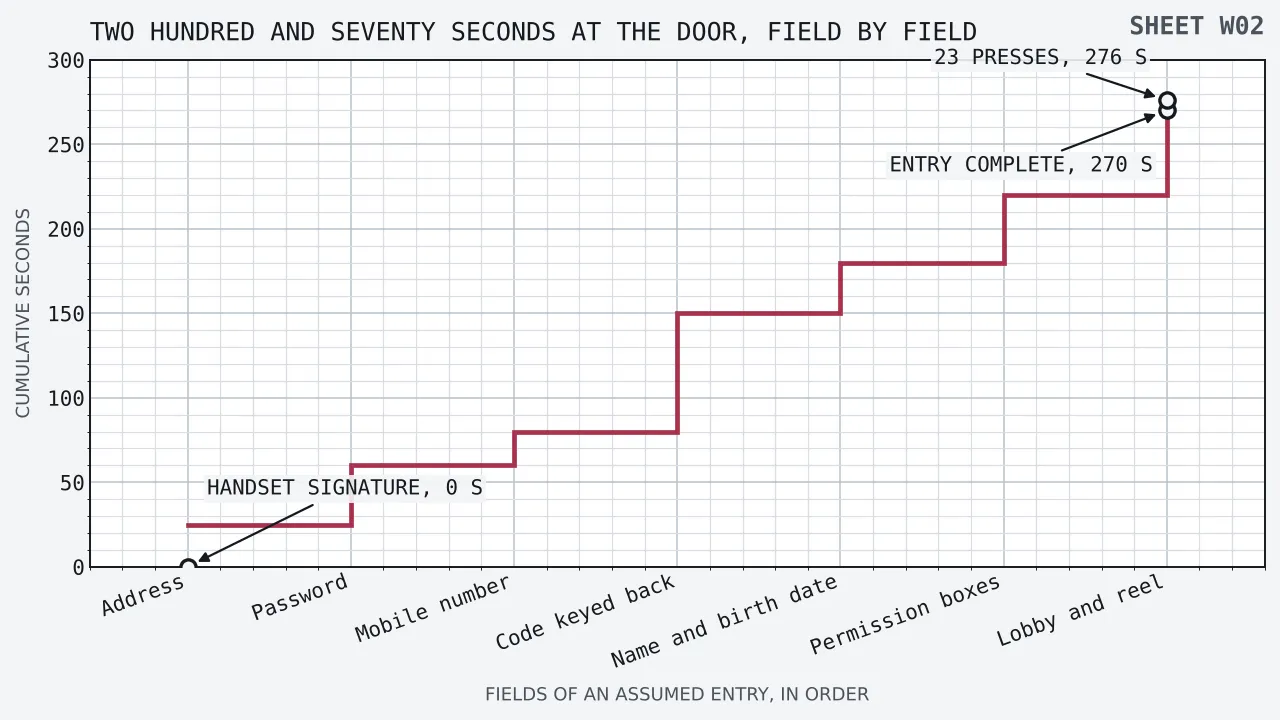
Nought seconds is where the handset signature sits on that drawing, and a reader looking for it will need the label. Among the six it alone arrives with no box, no prompt and no instant at which a person decides anything. Part six is about that absence, because an item costing nothing to give is an item nobody weighs.
Four minutes and thirty seconds, then, is the whole visible entry. Twenty per cent of a sitting is what that comes to, one sitting being put at twenty-two minutes by this site’s adoption and never by observation, so the entrance is not where a reader’s evening disappears. The entrance is where the reader’s details disappear, and the two are measured in different units, which is exactly why one gets noticed and the other does not.
3
Where a handout starts paying back the entry
Twenty-two and a half presses is 270 seconds divided by the twelve-second press this site works to, a figure adopted for modelling and never checked against a clock. Rounding that up gives the figure in the standfirst: twenty-three presses, lasting 276 seconds, is the smallest handout that leaves a reader with more reel time than entry time. Anything at twenty-two or under is an evening where the form took longer than the game.
23 presses is the shortest handout that outlasts an assumed 4 min 30 s of entry
Two pounds and twenty-five pence is the same figure in money, since twenty-two and a half presses at a 10p stake is what the entrance costs expressed as reel time. Converting that way is how minutes and pounds get put on one scale here, and the scale reads in both directions: a ten-press handout is worth £1.00 of play and costs £2.25 of entry, leaving a net £1.25 of time handed to the business.
| Presses handed out | Pressing time at the assumed 12 s | Entry seconds per press | True seconds a press | Entry as a share of the visit |
|---|---|---|---|---|
| 10 | 2 min | 27.0 | 39.0 | 69 per cent |
| 25 | 5 min | 10.8 | 22.8 | 47 per cent |
| 50 | 10 min | 5.4 | 17.4 | 31 per cent |
| 100 | 20 min | 2.7 | 14.7 | 18 per cent |
| 150 | 30 min | 1.8 | 13.8 | 13 per cent |
| 200 | 40 min | 1.35 | 13.35 | 10 per cent |
Thirty-nine seconds a press is the figure in the fourth column against a ten-press handout, and it is the most useful number in this part. A press advertised at twelve seconds costs thirty-nine once the entrance is spread across the handful of presses it bought. Three and a quarter times the stated cadence, on a small handout, comes entirely from paperwork.
Ten per cent is where that weight finally settles, at two hundred presses. The fourth column never reaches twelve seconds and never can, because the entrance is a fixed charge divided by a variable count. What it does is fall quickly and then flatten, which means the difference between a fifty-press handout and a two hundred-press handout matters far less than the difference between ten and fifty.
Six hours and twenty-four minutes is the one figure from beyond the entrance that earns a place in this part, and it earns it purely as something to measure 270 seconds against. Fifty presses stake £5.00 at the 10p unit, £4.80 is the expected hand-back where a return of 96 per cent is assumed, and a forty times condition against that sum calls for £192.00 across the reels: 1,920 presses, filling 6 h 24 min at the twelve-second cadence adopted here. Thirty-eight times the ten minutes a banner of that size delivers, and the running of it is costed on the section on how fast it burns instead of on this one.
Four and a half minutes against six and a half hours is therefore the honest framing of what this page covers. The entrance is a rounding error against the condition, and the entrance is still the part nobody has priced, because the items it collects are not returned when the condition fails and are not returned when it succeeds either.
4
An address that goes on costing after the reels stop
Twenty-five seconds buys the address and nothing else, and the address is the item whose price is almost entirely deferred. Three messages a week is the rate this note assumes from one live registration, with fifteen seconds spent noticing each one, reading enough of a subject line to classify it and removing it. Both figures are adopted here and neither came off a sample of anything.
One hundred and fifty-six messages is what three a week comes to across a year, and at fifteen seconds apiece that is 2,340 seconds, or 39 minutes. One text a week, at eight seconds to see and dismiss, adds 416 seconds. Together the two streams run to 2,756 seconds a year, which is 45 min 56 s, or three sittings of twenty-two minutes once a part sitting is counted whole as it is everywhere on this site.
45 min 56 s a year of assumed messages against 20 minutes of pressing once
| Elapsed since the registration | Assumed seconds spent | In hours and minutes | Sittings of an assumed 22 min | Presses at the assumed 12 s |
|---|---|---|---|---|
| One year | 2,756 | 45 min 56 s | 3 | 229 |
| Two years | 5,512 | 1 h 31 min 52 s | 5 | 459 |
| Three years | 8,268 | 2 h 17 min 48 s | 7 | 689 |
| Five years | 13,780 | 3 h 49 min 40 s | 11 | 1,148 |
One thousand one hundred and forty-eight presses is the last cell of that table and the reason the table exists. Five years of a message stream, converted through the same twelve-second press this site assumes everywhere, covers more than eleven times the pressing a hundred-press handout delivered. The handout is the smaller half of its own transaction by a factor nobody prints beside it.
One hundred and fourteen pounds and eighty-three pence is what that last cell converts to at a 10p stake, and the comparison is worth making in that direction too. Ten presses stake £1.00 and give two minutes. Five years of consequent messages take 3 h 49 min 40 s, which is near enough 115 times those two minutes, and is £114.83 of reel time nobody gets back.
Three assumptions carry all of that and each one is arguable. A reader who never opens the folder those messages land in pays close to nothing. A reader on four registrations rather than one multiplies the lot by four. A stream that stops after eight months because the account went quiet costs two thirds of the first row and nothing after. The method survives every one of those substitutions, because the method is a rate multiplied by a duration, and only the numbers move.
Nought of this is an argument that messages are the worst thing in a promotion. They are the cheapest thing to measure and the easiest thing to ignore, and that combination is precisely why they belong in the invoice rather than in a complaint. A cost nobody can see is still a cost, and here it is a cost with a figure on it.
5
One field a reader can abandon, one they cannot
Two fields on the form look alike and behave nothing alike. An address can be replaced in four minutes by anybody with a browser, which makes its cost recurrent but escapable. A date of birth cannot be replaced at all, by anybody, ever, and neither can the name beside it. Thirty seconds buys both, and thirty seconds is the cheapest the irreversible has ever been priced.
Three items a British licensee must obtain and check before anybody gambles are the holder’s name, the day they were born and where they live, and the condition states that what is held has to run to at least that much. One consequence a reader rarely draws from it is the useful one: at a licensed desk those fields are not merely collected, they are tested against something, and a field that is tested is a field with a purpose beyond storage.
Nought testing is implied by a box that accepts a typed date, and the difference matters more to the business than to the person typing. An untested birth date still identifies a household, a decade and a likely life stage, and it still sits in a file that outlives the account. What it no longer does is any of the work the licence condition demands of it.
Eighteen is the age the whole field exists to establish, and the requirement travels further than money does. Staking a bonus counts, exactly as staking a reader’s own funds counts, and so does opening a free-to-play build carrying no prize whatever, the regulator having recorded that it can see no proper reason for a child to get inside one. Seventy-two hours was once allowed for finishing the checking, and that allowance went on 7 May 2019.
| What was supplied | Cost shape | Can a reader undo it |
|---|---|---|
| An address for messages | Minutes a year, running while the address stays live | Yes, by abandoning the address |
| A mobile number | Minutes a year, plus reachability at any hour | Rarely in practice, since the number is the one everybody holds |
| A name and a date of birth | No minutes at all after the first thirty seconds | No, and nothing about the pair can be amended later |
| A handset signature | No minutes at any point | No box was offered, so there is nothing to withdraw |
Nought minutes are carried by the third row at any point after the first thirty seconds, which is why a page priced in minutes alone would score it as free and be wrong. Permanence is its unit. A reader can walk away from an address, change a number with difficulty, and do nothing whatever about a birth date already typed into a form at a business they cannot look up on any register.
Ninety seconds is the mobile number’s full price at entry, twenty for the typing and seventy for the code, and the code is the part that converts a number into a confirmed channel. Before the code the business holds a string of digits. After it the business holds a line into a pocket, and that line is worth more than the digits by exactly the amount of verification the reader performed on its behalf.
6
The item with no box beside it
Nought seconds and nought fields is what the handset signature costs, and it is the fourth item on the invoice precisely because of that. Screen dimensions, the set of installed fonts, the language the keyboard is set to, the time zone, the make of the browser and the way the graphics layer draws a test image all leave the device without anybody choosing to send them. No prompt appears, so no decision gets made, so no cost registers.
Two uses explain why it is collected and only one of them is about the reader. Telling one returning visitor from a thousand new ones is the first, which is ordinary and is how a site knows a session is a session. Telling one person holding two accounts from two people holding one each is the second, and that use is the one with money attached, because a handout given twice to the same handset is a handout given away.
Four minutes and thirty seconds of entry buys the whole of the rest of the invoice, and the handset signature is the item that outlasts every other entry on it. Abandoning an address ends the first cost. Changing a number ends the second. The signature is attached to the device rather than to the account, so it survives a closed account, a new registration, and a reader who believes they are starting again.
0 seconds of entry time, and no field, is what the handset signature costs to supply
Three honest limits belong on that claim and go here rather than in a footnote. Signatures are not unique in the way a passport number is unique, and a shared handset model with default settings looks much like another. Browsers in recent years have narrowed what they hand out. And nothing in this note says what any particular business does with one, because nothing published says it. What can be said is the shape: an item that costs nought seconds to take is an item nobody negotiates over.
One asymmetry runs through the whole list and this is where it is sharpest. Every other item on the invoice was supplied by a person who could, in principle, have declined and walked. The signature was supplied by a device, on the reader’s behalf, with no moment at which declining was offered. That is not a complaint about technology. It is a reason the item belongs on an invoice rather than being left off it for want of a unit.
7
A tick that renews every other cost on the list
Forty seconds is what the two permission boxes cost at entry if a reader reads them, and close to nothing if a reader does what most people do with a box. Either way the item is unlike the other five, because it is not spent on being supplied. It is spent continuously afterwards, by converting the address and the number from things a business holds into things a business uses.
Two limbs of the British rulebook sit over that tick and both are worth stating exactly. Under the code provision governing it, nobody is to be reached with direct electronic marketing without consent that is informed and specific, unless the law expressly allows otherwise. Since 1 May 2025 that agreement has been something to obtain afresh for every channel used and every product type promoted, and the release announcing the rule records its date as having been shifted from one set earlier, which is why only the later one belongs beside it.
Three practical consequences follow from that split, and the third is the one a reader can do something with. Agreeing to messages about one kind of gambling is not agreement about another. Agreeing to a message in an inbox is not agreement to a message on a handset. And a permission framed as one box covering everything is, on the licensed side, not the shape the rule contemplates at all.
Forty-five minutes and fifty-six seconds a year is what that tick costs on the rates assumed in part four, so the tick is the most expensive forty seconds on the form by a wide margin. A reader comparing the two numbers is comparing forty seconds of answering against 2,756 seconds a year of being answered, which is a return of sixty-nine to one on the business’s side in the first twelve months alone.
| The stream it switches on | Assumed items a year | Assumed seconds each | Seconds a year | Presses that buys at the assumed 12 s |
|---|---|---|---|---|
| Messages to the address | 156 | 15 | 2,340 | 195 |
| Texts to the number | 52 | 8 | 416 | 34 |
| Both, on one registration | 208 | 13.25 mean | 2,756 | 229 |
One hundred and ninety-five presses a year is the address row converted, and 34 is the number row. Setting those two against a handout of twenty-five presses makes the shape of the trade plain: one year of permitted messages is worth a shade over nine times the handout that bought the permission, measured in the only unit both sides of the transaction share.
Nought of that is forbidden anywhere, and saying so matters. A business holding a valid permission and sending 208 messages a year is doing an ordinary thing. The point of pricing it is not that a rule has been broken but that a cost has been paid, and that the cost was agreed in forty seconds against an offer whose whole visible content was a count of presses.
8
Where the word free gets tested, and what the test leaves alone
One advertising test governs whether a promotion may call itself free, and it is written entirely about money. Advice from the advertising regulator holds that the word is wrong wherever qualifying obliges a customer to put funds of their own up. A handout asking for no deposit passes that test cleanly, and passes it because the test is about pounds, which the handout does not ask for.
Six items on this page’s invoice sit outside that test, and none of them is an accusation. The test asks a single question about a single currency. An address, a number, a birth date, a handset signature, a permission and 270 seconds are not that currency, so a promotion can be accurate under the test and still be the most expensive thing a reader does with their evening in the units this page uses.
Four categories of significant condition are set out in the advertising regulator’s worked list, and a promotion has to put all of them clearly and prominently in front of anybody it is offered to. The British regulator states the consequence without hedging: where significant conditions are short of prominence, the advertisement is taken to be misleading.
| What the worked list covers | The unit it arrives in |
|---|---|
| Eligibility, reaching newness, reaching age, reaching whereabouts | Nought minutes, because it is settled before a single box is filled |
| Whatever has to be paid in, and whatever has to be staked after | Hours, and the section on how fast a pile burns carries them |
| How long there is to claim, and how long to use what is claimed | Days, which the section on deadlines is built around |
| Any floor on prices, and any restriction on which bet shapes count | Presses, since a ceiling over the stake fixes how many are needed |
Nought on that list of four names an item from this page’s invoice either, which is the symmetry worth noticing. The list is a good one and it is aimed at the terms a reader will be held to. What a reader hands over at the entrance is not a term they are held to. It is a price already paid by the time the terms are reachable, and a prominence rule cannot reach backwards to it.
Three published rulings show the rule biting on timing and on wording rather than on anything a form collects, and that is as near as the published record comes to this page’s subject. Twenty-seven August 2025 carries a five-pound voucher that happened to be void on 14 March with nothing on it saying so, and the finding there was a breach of the code. Thirty-one July 2024 produced a holding that a payment method shut out of an offer, mentioned only in small type among the full terms, had been given too little prominence. Seventeen July 2024 turned on a ten-pound free bet whose claim depended on answering a text by a stated hour, a deadline the advertisement left unsaid.
Two readings of those three are available and the modest one is right. They establish that a condition affecting when and how an offer can be used has to be visible. They establish nothing at all about disclosing what a registration collects, because no published ruling on that point could be found, and a page inventing one would be doing the thing this site exists to stop.
9
Six items into a desk with no entry behind it
Six items go across a counter holding no Great Britain licence, which on a page about what a reader supplies is the finding itself rather than a disclaimer bolted to the end. Everything priced in the nine parts before this one is supplied to a business whose name cannot be followed through to a public register entry, and a business nobody can look up cannot be held to anything a reader could cite.
One permission is the item that changes character most sharply across that line. On the licensed side it has to be informed, it has to be specific, it has had since 1 May 2025 to be collected one channel at a time and one product type at a time, and it sits under a condition an operator can be penalised against. Off the register it is a tick, governed by whatever sentence the business put above the box, and the 209th message of the year arrives on the same authority as the first.
Two published statements from the British regulator describe what the data side looks like when it goes wrong, and both are worth taking by their substance rather than their adjectives. Twentieth of January 2025 is the date carried by an industry warning notice, and what that notice sets down as possibly missing behind an unlicensed address is control: social responsibility arrangements that are not adequate to the job, anti-laundering arrangements in the same state, and customers left facing unfair practices, fraud and difficulty about the privacy of their data. Twenty-one October 2025 carries the second, from the official who directs enforcement and intelligence, naming data protection concerns described as serious and putting identity theft and fraud among the hazards attached.
Three of the six items are the ones those statements bear on directly, and they are the three a reader cannot take back. Between a birth date, a full legal name and a mobile number whose owner has already proved they answer it, most of the material for a convincing impersonation is sitting in one file. An address can be abandoned. The rest sit wherever they were sent, under a retention policy nobody showed to the person who supplied them.
| What happens to an item | Under a Great Britain licence | Where no such licence is held |
|---|---|---|
| Who the account holder is, down to the day of birth | Established and tested ahead of any play at all, bonus-funded and prizeless builds alike | Collected at whatever point and to whatever standard the business settled on |
| The permission to message | Informed, specific, and given one channel and one product type at a time since 1 May 2025 | Whatever the wording above the box provides for |
| Being told what papers may be wanted | Owed ahead of a first payment in, naming which papers, at which point and by which means | Commonly first met in a reply to a withdrawal request |
| Looking the business up | A register entry, with activities and domain names to match against | Nothing to search, so nothing to match |
| Somebody to complain to about any of it | A walled internal process and an adjudicator from an approved list | An operator timetable, and an adjudicator whose parameters the operator may set |
One row of that table is about paperwork and four are about standing, which is the honest balance of what gets surrendered. Nothing here says a desk outside the register does anything wrong with an address. What it says is that the question has no answer a reader can obtain, and that an unanswerable question about an irreversible item is a poor trade for 276 seconds of reel.
Nought refunds exist for any of it, which closes the part. A handout that fails to clear its condition costs a reader the pressing time and nothing else, because the stake was never theirs. A registration that goes wrong costs them items with no return path, supplied in four and a half minutes to a counter they cannot name on any public list.
10
Which size of handout actually settles the account
Twenty-three presses is the threshold these ten parts were assembled to produce, a low bar which plenty of handouts clear without effort. Fifty presses, a hundred, two hundred: all give back more reel time than the entrance took, and the fourth column of part three shows the weight falling away quickly once a handout gets past about fifty.
Nought of that threshold accounts for the deferred items, and a reader who stops at it has stopped too early. Adding the first year of messages moves the bar from 270 seconds to 3,026 seconds of total cost, which at the twelve-second press this site assumes is 253 presses. A handout has to run past two hundred and fifty presses before it covers its own first year, and very few do.
| Cost counted | Seconds | Presses at the assumed 12 s |
|---|---|---|
| The entry alone | 270 | 23 |
| Entry plus one year of messages | 3,026 | 253 |
| Entry plus three years | 8,538 | 712 |
| Entry plus five years | 14,050 | 1,171 |
One thousand one hundred and seventy-one presses is the bottom row, and no handout of this kind reaches it. That is the finding, stated without decoration: on the message rates assumed in part four, a five-year view of one registration is never repaid by the handout that started it, whatever the count on the banner.
Three substitutions change that conclusion and each is available to any reader. Deleting messages without reading them drops the second column towards nothing. Declining the permission at entry removes the second, third and fourth rows outright and leaves the bar at twenty-three presses. Using an address kept for exactly this purpose shifts the cost from attention to housekeeping, which is a different unit and a cheaper one.
Two questions are worth settling before any of the six items moves, and neither is about the count on the banner. Whether the permission boxes were read, since forty seconds there decides 2,756 seconds a year afterwards. And whether the business behind the counter can be found on a public register, because a birth date and a confirmed number cannot be recalled from anywhere, and the only moment a reader controls is the moment before they are sent.
Questions
- If there is no deposit, what does a free spins offer actually cost?
- Six things, none of them money. An address for messages, a mobile number with a code keyed back to confirm it, a name beside a date of birth, a signature the handset supplies without being asked, a permission for future marketing, and the minutes spent handing the first five over. This note prices the entry at 270 seconds as an assumption of its own rather than a timing, and prices the message stream that follows at 2,756 seconds a year on assumed rates of three messages and one text a week.
- How many spins does it take to be worth the sign-up time?
- Twenty-three, on the entry figure assumed here. Two hundred and seventy seconds divided by the twelve-second press this site adopts gives twenty-two and a half presses, so twenty-three presses at 276 seconds is the smallest handout leaving a reader with more reel time than entry time. Counting the first year of messages as well moves the bar to 253 presses, and counting five years moves it to 1,171, which no handout of this kind reaches.
- What is a handset signature and why is it on the list?
- Screen dimensions, installed fonts, keyboard language, time zone, browser build and the way the graphics layer draws a test image, all leaving the device with no box to tick and no prompt to answer. It is on the list because it costs nought seconds to supply, which is exactly why nobody weighs it, and because it attaches to the device rather than to the account, so it outlives a closed account and a fresh registration. Signatures are not unique the way a passport number is, browsers have narrowed what they hand out, and nothing published says what any particular business does with one.
- Is a marketing tick really worth more than the spins?
- On the rates assumed in part four, comfortably. Forty seconds of answering two permission boxes switches on 208 items a year, which is 2,756 seconds, or 45 min 56 s, or three sittings of twenty-two minutes once a part sitting is counted whole. Converted at the twelve-second press this site assumes, that is 229 presses a year against a handout that is commonly 25 or 50, so the first year of permitted messages is worth several times the thing that bought the permission.
- Why does a date of birth matter more than an email address?
- Because one can be abandoned and the other cannot. Replacing an address takes about four minutes and ends its cost. A name and a date of birth cost thirty seconds together, carry no minutes at all afterwards, and can never be amended, withdrawn or replaced at any business that already holds them. A licensed operator must establish who the holder is before any gambling happens, and what it keeps has to extend at least to the name, the home address and the day of birth. Staking a bonus is inside that requirement and so is opening a demo build paying no prize, and 7 May 2019 is when the old seventy-two hour window for completing a check disappeared.
- Can an offer be advertised as free if it collects all this?
- Yes, and understanding why is the useful part. One question is asked, and it is whether qualifying obliges a customer to put funds of their own up. A no-deposit handout does not, so it passes. That question is written about money. An address, a number, a birth date, a handset signature, a permission and 270 seconds are not money, so they sit outside a thing nobody has asked them.
- What must a promotion spell out before a reader claims it?
- Its significant conditions, prominently. Four categories carry that label in the advertising regulator’s worked list. Eligibility is the first of them, reaching newness, age and whereabouts. Whatever has to be deposited or staked is the second. Third come the windows, one for claiming and one for using what was claimed. Fourth is any floor under a price, together with any limit on which bet shapes count. Where those fall short of prominence the British regulator’s position is that the advertisement misleads, and three published rulings show it applied: to a voucher void on one day of the year and silent about it, a breach found on 27 August 2025; to a payment method shut out of an offer and left in small type among the full terms, too little prominence on 31 July 2024; and to a free bet whose claim turned on answering a text by a stated hour, the deadline unsaid, on 17 July 2024.
- What changes about all this when the offer sits outside the British licence?
- The permission and the register entry, mostly. On the licensed side nobody may be reached with direct electronic marketing without consent that is informed and specific, a separate agreement being needed per channel and per product type since 1 May 2025, under a condition an operator can be penalised against. Off the register it is a tick governed by whatever sentence sat above the box. Twentieth of January 2025 sits on an industry warning notice setting out what may be absent at an unlicensed address, with social responsibility arrangements and anti-laundering arrangements both named as possibly inadequate, and setting out what a customer may meet in their place: unfair practices, fraud, and difficulty over the privacy of data. Then on 21 October 2025 the official directing enforcement and intelligence set down data protection concerns of a serious kind, with identity theft and fraud named among them.
- How long do the spins themselves last?
- Two minutes for ten, five for twenty-five, ten for fifty, twenty for a hundred and forty for two hundred, worked at the twelve-second press this site assumes rather than measures. What those presses set up runs far longer: fifty presses stake £5.00, bring back an expected £4.80 where the return assumed is 96 per cent, and a forty times condition against that sum calls for £192.00 across the reels, which is 1,920 presses filling 6 h 24 min. That run is costed on the section about how fast a pile burns, not here.
- What is the one thing to decide before registering?
- Whether to answer the permission boxes, and then whether the business can be found on a public register. Forty seconds at the first decides 2,756 seconds a year afterwards on the rates assumed here. The second decides whether a birth date, a full legal name and a number already proved to answer have gone to a business with an address, an entry and a regulator standing behind it, or to one with none of the three, and that is a question with no answer available after the fact.