Section B Revision 1 Terms read 17 October 2026
How fast it burns: a printed count, converted into hours of pressing
Every spin a banner hands over creates 38.4 presses that have to be made later. At twelve seconds a press, which this site assumes and never measured, that puts 7 min 41 s of clearing behind one spin of headline and 1 h 17 min behind one pound of face value. The ratio is fixed, so the run is a straight line in the count: 38 min at five spins, 12 h 48 min at a hundred, 128 h at a thousand. This page sets out the conversion the notes beneath it all use, then says which of them to open.
One spin of headline 7 min 41 s The run, 5 to 1,000 38 min to 128 h After the last press 48 h band
Hours asked at each size of offer
Advertising has been bought for every destination below. A fee reaches this site when a reader goes on to register, and no figure on this page moves one way or the other because of it.
-
01Mobile Free Spins
Betportal
Ceiling as a multiple
What lands€15.00150 spins at 10c, which is this site's figure and not the operator'sThe run17 h 30 minTurning over 525.00 at 10p means 5,250 presses, or about 48 phone sittings of 22 minutes. Timed at 10p a press and 12 seconds between presses, both of which this site assumes rather than measures.The wait to be paidNOT PUBLISHEDThis operator puts no withdrawal band in its own terms, so there is nothing honest to print here.Spins valued at this site's own 10p a spin
What lands
Spins, at a price15.00150 of them at 10c apiece, a figure belonging to this site rather than to the operatorMatch, and other creditno figure300% of three deposits, to a ceiling of €1,000. Not a sum until money of yours makes it one, so this row totals nothing and carries nothing downwardsThe run
Handed back on the spins(0.60)Each press stakes its own value and returns 96 per cent, which leaves this much with the house from the opening pressPlay-through 35x on the bonus(20.16)Taking 14.40 round 35 times over means 504.00 through the machines, of which 20.16 is the expected cost, and 17 h 30 min of pressing at the pace aboveWhat counts towards it100%Slots only, with no percentage published anywhere, so the row above assumes the whole of each stake countsWhat never clears
Limit on the winningsstated5x the bonusDeducted on the way outno figureNothing is published as a figure here, so this row removes nothingLeast that can leaveno figureNo figure is published, so nothing on this timer is pinned down by oneLeast deposit, and the rung over ityour own€20 a stage. Published in euros, so no rung is named at all: this site's ladder is a sterling oneThe window on the creditstated14 daysBiggest stake while it runsstated€5Removed outright by rulestatedNot publishedVerified before a payoutstatedDocuments before the first withdrawalNever clears€15.00Not a penny of it gets out, so the whole of what landed stands on this rowNo Great Britain licence
Licence held in Anjouan, Comoros, the company named is BetPortal Gaming Ltd, with Excite Ultra Media Ltd, quoted under ALSI-202601040-FI2.
Terms read 17 October 2026
Open the offer at Betportal, opens in a new window -
02Mobile Free Spins
WinBeast
Ceiling as a sum
What lands€50.00500 spins at 10c, which is this site's figure and not the operator'sThe run2 d 18 hTurning over 2,000.00 at 10p means 20,000 presses, or about 182 phone sittings of 22 minutes. Timed at 10p a press and 12 seconds between presses, both of which this site assumes rather than measures.The wait to be paidNOT PUBLISHEDThis operator puts no withdrawal band in its own terms, so there is nothing honest to print here.Spins valued at this site's own 10p a spin
What lands
Spins, at a price50.00500 of them at 10c apiece, a figure belonging to this site rather than to the operatorMatch, and other creditno figure50% to 100% of five deposits, each to a ceiling of €1,000, and a €650 free bet. Not a sum until money of yours makes it one, so this row totals nothing and carries nothing downwardsThe run
Handed back on the spins(2.00)Each press stakes its own value and returns 96 per cent, which leaves this much with the house from the opening pressPlay-through 40x on the bonus and the winnings from the spins(76.80)Taking 48.00 round 40 times over means 1,920.00 through the machines, of which 76.80 is the expected cost, and 2 d 18 h of pressing at the pace aboveWhat counts towards it100%Slots, titles vary by country, with no percentage published anywhere, so the row above assumes the whole of each stake countsWhat never clears
Limit on the winningsstated€100 a batch of spinsDeducted on the way outno figureNothing is published as a figure here, so this row removes nothingLeast that can leaveno figureNo figure is published, so nothing on this timer is pinned down by oneLeast deposit, and the rung over ityour own€20 a stage. Published in euros, so no rung is named at all: this site's ladder is a sterling oneThe window on the creditstated7 days, spins 1 dayBiggest stake while it runsstatedNot publishedRemoved outright by rulestatedNot publishedVerified before a payoutstatedDocuments before the first withdrawalNever clears€50.00Not a penny of it gets out, so the whole of what landed stands on this rowNo Great Britain licence
Licence held in Curaçao, no company named anywhere on the site.
Terms read 17 October 2026
Open the offer at WinBeast, opens in a new window -
03Mobile Free Spins
EliteSpin
Longest spin window
What lands£50.00500 spins at 10p, which is this site's figure and not the operator'sThe run2 d 18 hTurning over 2,000.00 at 10p means 20,000 presses, or about 182 phone sittings of 22 minutes. Timed at 10p a press and 12 seconds between presses, both of which this site assumes rather than measures.The wait to be paidNOT PUBLISHEDThis operator puts no withdrawal band in its own terms, so there is nothing honest to print here.Spins valued at this site's own 10p a spin
What lands
Spins, at a price50.00500 of them at 10p apiece, a figure belonging to this site rather than to the operatorMatch, and other creditno figure50% to 100% of five deposits, each to a ceiling of £1,000. Not a sum until money of yours makes it one, so this row totals nothing and carries nothing downwardsThe run
Handed back on the spins(2.00)Each press stakes its own value and returns 96 per cent, which leaves this much with the house from the opening pressPlay-through 40x on the bonus and the winnings from the spins(76.80)Taking 48.00 round 40 times over means 1,920.00 through the machines, of which 76.80 is the expected cost, and 2 d 18 h of pressing at the pace aboveWhat counts towards it100%Slots, with no percentage published anywhere, so the row above assumes the whole of each stake countsWhat never clears
Limit on the winningsstated5x the bonusDeducted on the way outno figureNothing is published as a figure here, so this row removes nothingLeast that can leaveno figureNo figure is published, so nothing on this timer is pinned down by oneLeast deposit, and the rung over ityour own£20 a stage. It lands square on the £20.00 rung, so none of yours is left perched on topThe window on the creditstated7 days, spins 3 daysBiggest stake while it runsstatedNot publishedRemoved outright by rulestatedNot publishedVerified before a payoutstatedDocuments before the first withdrawalNever clears£50.00Not a penny of it gets out, so the whole of what landed stands on this rowNo Great Britain licence
Licence held in Costa Rica, the company named is PrimeTier Limited.
Terms read 17 October 2026
Open the offer at EliteSpin, opens in a new window -
04Mobile Free Spins
Crown Jewelz
Multiple unpublished
What lands£15.00150 spins at 10p, which is this site's figure and not the operator'sThe runNOT TIMEDThis operator does not publish the play-through multiple in its own terms. The multiple is the one figure the clock cannot work around, so the run is left untimed.The wait to be paidNOT PUBLISHEDThis operator puts no withdrawal band in its own terms, so there is nothing honest to print here.Nothing reckoned
What lands
Spins, at a price15.00150 of them at 10p apiece, a figure belonging to this site rather than to the operatorMatch, and other creditno figure200% of the first deposit, then 150% twice, each to a ceiling of £1,000. Not a sum until money of yours makes it one, so this row totals nothing and carries nothing downwardsThe run
Play-throughno figure40x the bonus, reported rather than published by the operatorWhat counts towards itno figureSlots, with no percentage published anywhere, so the row above assumes the whole of each stake countsWhat never clears
Limit on the winningsstatedNot publishedDeducted on the way outno figureNothing is published as a figure here, so this row removes nothingLeast that can leaveno figureNo figure is published, so nothing on this timer is pinned down by oneLeast deposit, and the rung over ityour own£20. It lands square on the £20.00 rung, so none of yours is left perched on topThe window on the creditstatedNot publishedBiggest stake while it runsstatedNot publishedRemoved outright by rulestatedNot publishedVerified before a payoutstatedDocuments before the first withdrawalNever clearsNOT RECKONEDThis operator leaves the play-through multiple out of its own terms, so nothing below the fourth step can be worked out.No Great Britain licence
Licence held in Curaçao, number not verified, no company named anywhere on the site.
Terms read 17 October 2026
Open the offer at Crown Jewelz, opens in a new window
Only the middle reading comes out of arithmetic belonging to this site. The multiple laid against what lands gives the turnover asked for; dividing that by 10p a spin gives the presses; dividing those by 300 an hour gives the hours, a press on a handset being taken here at 12 seconds from the one before. Both figures are assumptions rather than measurements of anybody: nothing was played and nothing was held a stopwatch to. Anybody quicker should divide the press count by a rate of their own, which is why the presses are printed alongside the hours instead of being summarised away.
The first reading is what arrives before any condition is laid against it. Spins carry no unit of their own so one gets supplied: where an operator values its own spin that figure is used and attributed, and where it does not, this site's 10p a spin stands in and everything below moves with it. The third reading belongs to the operator entirely. It is a withdrawal band quoted from published terms, and a blank there means none was published rather than that nobody looked.
The total along the foot answers what the hours leave open, which is whether any of the running ends anywhere. It is what arrived, less whatever is still standing once the play-through has been paid for at 96 per cent return to player and once a published limit, a published deduction and a published floor beneath the least that can leave have each had a turn. It appears again in pence in the pound, the only fair way of holding a small offer up against a large one. It describes an offer rather than an evening, and where the conditions price out what arrived, a timer prints nothing getting out instead of a negative sum.
Cashiers on a handset take deposits off a row of preset buttons, so a least deposit given in pounds is raised to the next rung of the ladder used here, £10, £20, £25, £50, £75 and £100, and the timer shows what is left perched on it. That money is the reader's own and enters no sum at all. Given in euros it prints untouched, the ladder being sterling. Three words may occupy the figure column where no figure belongs. Stated is a published term that costs something while leaving no number to subtract. No figure is a term nobody has quantified, or a credit that is not a sum until money of yours makes it one. Your own is money of yours, which belongs in none of this.
None of the operators above is licensed in Great Britain, so not one duty that licence carries reaches any of them. Membership of Gamstop Online is compulsory for every online gambling company licensed in Great Britain, which means that shutting yourself out through the scheme shuts you out of none of these. The limit of ten times the bonus funds on a wagering requirement, running since 19 January 2026 under Social Responsibility Code 5.1.1, is a condition of the same licence and binds only whoever holds one. Off that licence, the Gambling Commission writes of consumers meeting unfair gaming practices, financial loss and no recourse when matters go wrong, and lists blocked payouts and withdrawal limits pitched too high to reach among the things it has seen. No account at any of them may be held by anybody under 18.
Every term on a timer is its operator's own and every timer carries the day somebody read it. The oldest of those readings is 17 October 2026. What binds a reader is an operator's full terms and never a line printed here.
1
Five lines that turn a printed count into a clock
A banner carries one number and withholds four others. Everything written under this heading puts the missing four back, in a fixed order, and the order is the same on every note. Count times stake gives the face. The face at a ninety-six per cent return gives the residue, which is the sum a play-through is actually measured against. Residue times the multiple gives the turnover owed. Turnover divided by the stake gives the presses. Presses divided by three hundred an hour, that rate being the assumed twelve-second interval in other clothes, gives the clock.
Worked on a headline of a hundred, those five lines read £10.00, then £9.60, then £384.00, then 3,840, then 12 h 48 min. Each is one multiplication or one division. None asks the reader for a decision, so the result is settled before anybody presses anything.
| The line | What it does | Result |
|---|---|---|
| Face | Count multiplied by the stake on a press | £10.00 |
| Residue | Face reduced by the house margin | £9.60 |
| Turnover | Residue multiplied by the play-through | £384.00 |
| Presses | Turnover divided back by the stake | 3,840 |
| Clock | Presses divided by the modelled hourly rate | 12 h 48 min |
Six quantities are held fixed across the whole section so that sixteen notes can be compared with each other: a stake of 10p, a return of ninety-six per cent, a play-through of forty times, a weighting of one, an interval of twelve seconds between presses, and a sitting of twenty-two minutes. The last two are adopted figures rather than findings. Nothing on these pages was observed at a lobby or held against a clock, and the sentence carrying either of them says so.
All of this describes offers of this kind, where no Great Britain licence is in force over any of the five lines. Three of the five have something above them on the licensed side: a ceiling on the multiple, a ceiling on the stake per game cycle, a floor under the interval. Off the register nothing in the chain is bounded, so the arithmetic keeps working while its output answers to the drafter of a sheet and to nobody else. Forfeited with it are a public register to check a counterparty against, a statutory limit on the size of a press, membership of Gamstop Online, and a vetted list of adjudicators to turn to at the end.
2
Nine sizes of headline, set in one column
Sixteen notes sit beneath this heading and each prices one size of offer. Put their central figures into a single column and the section stops being a row of separate cases. It becomes one rule with nine readings off it, every entry in the last two columns resting on an interval this site assumes rather than timed.
| Headline | Handout | Residue | Turnover | Presses at 10p | Sittings | Run |
|---|---|---|---|---|---|---|
| 5 spins | 1 min | £0.48 | £19.20 | 192 | 2 | 38 min |
| 10 spins | 2 min | £0.96 | £38.40 | 384 | 4 | 1 h 17 min |
| 40 spins | 8 min | £3.84 | £153.60 | 1,536 | 14 | 5 h 7 min |
| 100 spins | 20 min | £9.60 | £384.00 | 3,840 | 35 | 12 h 48 min |
| 120 spins | 24 min | £11.52 | £460.80 | 4,608 | 42 | 15 h 22 min |
| 150 spins | 30 min | £14.40 | £576.00 | 5,760 | 53 | 19 h 12 min |
| 200 spins | 40 min | £19.20 | £768.00 | 7,680 | 70 | 25 h 36 min |
| 300 spins | 60 min | £28.80 | £1,152.00 | 11,520 | 105 | 38 h 24 min |
| 1,000 spins | 3 h 20 min | £96.00 | £3,840.00 | 38,400 | 350 | 128 h |
Read the right of that table before the left. Five presses, the smallest arrangement anybody bothers to print, buy thirty-eight minutes of obligation against sixty seconds of handout. Ten reach an hour and seventeen minutes, by which point the joining itself is the larger cost. Forty put five hours and seven minutes on the clock, where the deciding figure turns out to be the smallest payment a cashier permits rather than the hours.
Past a hundred the arithmetic stops being an evening and starts being a fortnight. A hundred presses buy twelve hours and forty-eight minutes, a hundred and twenty buy fifteen hours and twenty-two where the wording alone decides which of two runs applies, and a hundred and fifty buy nineteen hours and twelve minutes. Two hundred reach twenty-five hours thirty-six, which is past a day of continuous pressing. Three hundred, usually quoted against a payment of ten pounds, reach thirty-eight hours twenty-four. A thousand reach one hundred and twenty-eight hours, which is over three working weeks and longer than any window this market issues.
3
A straight line, and what it does to a doubled banner
Divide any row of that table by its own headline and one answer keeps coming back. Five spins give 0.128 hours each. So do a hundred. So do a thousand. In units a reader can hold, and still at the assumed interval, a single spin on a banner has 7 min 41 s of clearing standing behind it, and a single pound of face value has 1 h 17 min.
7 min 41 s of clearing behind every spin a banner prints
Nothing in the chain discounts for volume. Residue grows with count, turnover with residue, presses with turnover, clock with presses. Proportional steps in a row make a proportional whole, so hours against headline plots as a line through the origin with no bend in it.
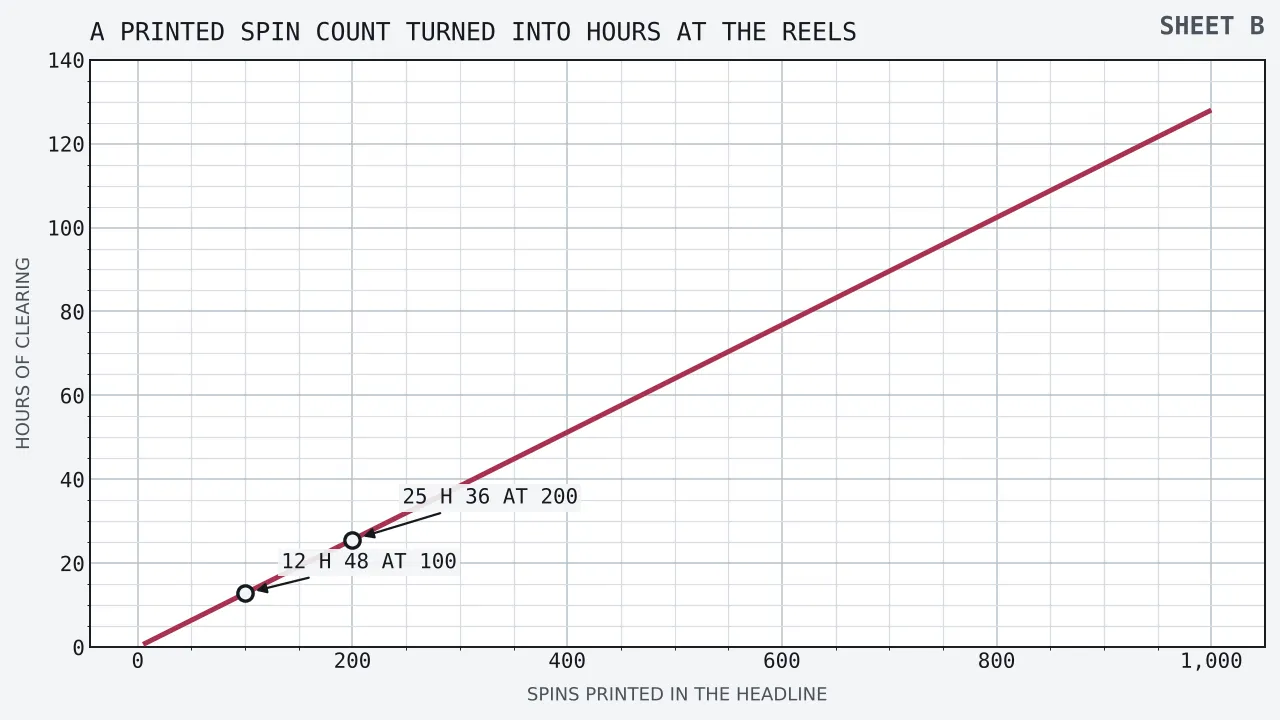
The practical consequence is the thing banners are built to obscure. Doubling the number in the headline doubles the hours exactly, so a move from a hundred to two hundred spins is not a better arrangement on the same terms. It is the identical arrangement with 12 h 48 min of further pressing attached. The expected position at the foot doubles too, in the unhelpful direction: minus £5.76 becomes minus £11.52.
One figure in the row does move out of step, and it moves the wrong way. The handout is linear as well, but it is tiny: twelve seconds a spin against 7 min 41 s of clearing puts the free part at 2.6 per cent of the pressing involved. A headline of a thousand spends 3 h 20 min giving something away and 128 h taking it back.
4
Twenty-five, the figure a headline cannot move
Everything above scales with the count. One quantity refuses to, and it is the one worth carrying from note to note. Ninety-six pence coming back leaves four with the house per pound crossed. Twenty-four crossings are survivable and the twenty-fifth is not, since twenty-five fours account for the entire pound. Break-even therefore settles at a play-through of 25.
Notice what is absent from that sum. No count, no stake, no pace. The hinge reads 25 for five spins and 25 for a thousand, and would still read 25 at a penny a press or at a pound. Being a property of the margin alone, it is the single number worth memorising and applying to any banner without redoing anything.
Forty times is the band this section assumes wherever a sheet prints none, and forty is sixty per cent past the hinge. Put 1 minus 40 times 0.04 against any residue and the bracket returns minus 0.6 of it: minus 28.8p on five spins, minus £5.76 on a hundred, minus £57.60 on a thousand. Both sides of the ledger scale with the headline, and the proportion between them never shifts.
25 times, the only reading on this page that nine headlines share
Shortening an evening is what the hinge does not do, and the confusion is worth heading off. Twenty-five times still demands 0.08 hours for every spin printed, so a hundred would be eight hours and a thousand eighty. Finding a sheet at or under twenty-five means finding one whose expected residue is not negative, which is a different discovery from finding a short run. Money and time are separate tests, and this is the only page that applies both.
None of it forecasts an individual evening. Outcomes at 10p scatter widely and plenty of people finish with money standing. An average earns its place for a narrower reason: it is the only thing weighable before the first press.
5
Three readings that decide whether a run finishes
A run having a length is one question. A run being completable is a different one, and three readings settle it. None appears on a banner, each appears in the terms, and together they take under a minute to look up.
Length comes from the multiple, as part three works through. Available time comes from the window. How far that length squeezes into that time comes from the stake ceiling. Any one of the three can make a run impossible while the other two look generous.
The window is the brutal one, because it converts a total into a daily rate, and a daily rate is what somebody has to find. Divide the hours by the days on the clock and the answer is an evening or an absurdity.
| Headline | In 24 hours | In 72 hours | Over 7 days | Over 30 days | Shortest of those that two sittings a day would finish |
|---|---|---|---|---|---|
| 5 spins | 38 min | 13 min | 5 min | 1 min | A single day |
| 40 spins | 5 h 7 min | 1 h 42 min | 44 min | 10 min | A week, with nothing to spare |
| 100 spins | 12 h 48 min | 4 h 16 min | 1 h 50 min | 26 min | A month |
| 200 spins | 25 h 36 min | 8 h 32 min | 3 h 39 min | 51 min | No window in this row |
| 1,000 spins | 128 h | 42 h 40 min | 18 h 17 min | 4 h 16 min | No window in this row |
The top left cell is the test worth applying before any other. Two hundred spins inside a single day want 25 h 36 min out of twenty-four, so the shortfall is arithmetic and no amount of diligence repairs it. What an expired window takes is everything standing under it: on most sheets of this kind the balance and its winnings go at the stroke, with part-finished play-through earning nothing.
The stake ceiling is the third reading and the least read. Presses are turnover divided by stake, so a £1.00 ceiling would turn 3,840 presses into 384 and 12 h 48 min into 1 h 17 min. Sheets of this kind shut that door: while bonus money is live the permitted stake sits near £5.00 at a desk and tighter in a hand, and the hand is where most of these runs happen. Exceeding it is the most dependable way of having a finished run voided afterwards.
Compression is paid for in any case. A heavier stake divides the clock in exact proportion while the expectation ignores it, no stake term appearing inside the bracket. What widens is the swing: a residue spent in 384 large presses runs out before the condition more often than one spent in 3,840 small ones.
6
A hundred and ten presses, and the evenings they fill
Hours are the wrong unit for a phone. Nobody spends twelve hours forty-eight minutes at a handset in one stretch, so the section converts once more, into a unit a reader recognises. Twelve seconds a press across twenty-two minutes puts 110 presses in one sitting, both figures being this site’s own assumptions rather than observations of anybody.
Sittings round up throughout, because a part-used sitting is a sitting that happened. The rounding costs at most one and keeps the column an honest count of the times a phone comes out of a pocket.
| Headline | Presses owed | Sittings of 110 | Days at two a day |
|---|---|---|---|
| 5 spins | 192 | 2 | 1 |
| 40 spins | 1,536 | 14 | 7 |
| 100 spins | 3,840 | 35 | 18 |
| 200 spins | 7,680 | 70 | 35 |
| 1,000 spins | 38,400 | 350 | 175 |
Read the right-hand column aloud and the proposition changes shape. Picking a phone up twice daily for a hundred and seventy-five days is most of half a year, and it is what a four-figure headline asks of anybody intending to finish. A hundred spins still wants eighteen such days. Where credit arrives in instalments rather than as one pile the sittings hold steady and the deadlines multiply, since every day’s portion brings a clock of its own.
A sitting is also where the handset adds costs a desk never charges. Opening the application, waiting for a lobby, picking up where the last press left off and losing a result to a dropped connection are all real minutes, and counted properly they carry 12 h 48 min to 15 h 12 min. Every figure in this section is therefore a floor rather than a forecast.
7
Two inputs held still here, and what moves them
The conversion holds two quantities still, and both belong to the build rather than to the reader or even to the cashier. Freezing them is what lets sixteen notes be compared with each other.
The first is the weighting. At a weighting of one, a pound staked counts a pound towards the condition. Halve it and the turnover doubles, lifting a hundred spins to 25 h 36 min across 7,680 presses, which is identical to the clock a plain two hundred produces at full contribution. A contribution rate buried several screens into a sheet can double a headline without altering the headline, and it never sits anywhere near the number it doubles.
The second is the return. This one moves the hinge rather than the clock. At eighty-eight pence back in the pound the margin is twelve pence and break-even arrives at 8.33 times; at ninety-seven pence the margin is three pence and break-even waits until 33.33. The run barely stirs over that range, because a poorer reel leaves a smaller residue and a smaller residue owes fewer presses. A hundred spins run 11 h 44 min on the first build and 12 h 56 min on the second, while the expected close moves from minus £33.44 to minus £1.94. The shorter clock is the worse deal, and a reel nobody chose works that out in full.
Seconds between presses belong to the build as well. A reel that resolves many lines, or one whose money is parked in a round that arrives once in a hundred and fifty presses, puts a different interval under every hour printed here, and a rare feature splits one clock into two. A build that sells its feature outright points the other way: one press at a hundred times the stake would retire £460.80 of turnover in 47 presses, and a term sheet shuts that route for exactly as long as bonus money is live.
8
The last press is not the end of the clock
Completing a condition and holding the money are different events, separated by two further waits. Neither is driven by the reader, and neither appears in any figure above.
Verification is the first. A cashier away from the register will often hang its document check on a milestone later than the opening deposit, so somebody can press for a fortnight before being asked who they are. The demand then lands at precisely the point money is wanted, and a scan sent back begins a further round of a day or more. The licensed sequence is the reverse one, with a customer’s name, address and birth date settled ahead of any gambling whatever, bonus credit and practice builds counted in.
The payout band is the second, and its preposition carries the weight. A band written as up to forty-eight hours starts at approval and not at the request, so the clock somebody starts by pressing a button is not the clock being described. Underneath it the rail charges its own time.
| What is waited on | Who moves it | Usual span |
|---|---|---|
| Documents asked for and supplied | Shared | Anything from the same day to two |
| Approval of the account | The cashier | A day to three, slower over a weekend |
| The band, which starts at approval | The cashier | 48 hours at the outside |
| Whichever rail is carrying it | A bank or a wallet | Minutes through one, days through another |
Set that tail against the ladder and the proportions invert at the small end. A 38 min run on five spins can be followed by the better part of a week of waiting, which makes the pressing a rounding error. Only past three hundred spins is the run the longest thing in the sequence.
9
The same ladder with a British licence over it
Pricing a missing licence is cleanest done by running the conversion twice and subtracting. Ten times bonus funds is the ceiling on a wagering requirement here, the third item on the list of things a licensee must not do in the social responsibility provisions at 5.1.1. Its start date was 19 January 2026, and two licence types escape it, those issued for machine technology and for software. So where the winnings off a spin credit land as bonus funds, a requirement hung on those funds stops at ten.
Ten against forty divides the whole ladder by four. Count, stake, return and the assumed pace are untouched; the third line changes, and every line after it follows.
| Headline | Turnover at forty | Run at forty | Turnover at ten | Run at ten | Evenings saved |
|---|---|---|---|---|---|
| 5 spins | £19.20 | 38 min | £4.80 | 10 min | 29 min |
| 40 spins | £153.60 | 5 h 7 min | £38.40 | 1 h 17 min | 3 h 50 min |
| 100 spins | £384.00 | 12 h 48 min | £96.00 | 3 h 12 min | 9 h 36 min |
| 200 spins | £768.00 | 25 h 36 min | £192.00 | 6 h 24 min | 19 h 12 min |
| 1,000 spins | £3,840.00 | 128 h | £960.00 | 32 h | 96 h |
Ninety-six hours sits at the foot of the right-hand column, which is what one rule is worth to somebody set on finishing a four-figure count. The cap bites on the multiple alone, so a larger credit still carries a proportionally larger obligation: ten to one, whatever the headline.
Two further ceilings land on the same arithmetic. Statute holds one game cycle of an online slots game to a £5 stake, dropping to £2 for anybody under twenty-five; the £5 limit began on 9 April 2025 and the £2 one on 21 May 2025, by the Commission’s own guidance, and neither touches a casino game outside the slots definition. That is part five’s stake ceiling written into law instead of into a term sheet. The last boundary is a minimum interval between the launch of one game cycle and the launch of the following one, which keeps a long condition from being squeezed into an afternoon by driving a lobby harder.
Then comes the clock on a disagreement, where the honest account is not that offshore leaves a reader with nowhere to go. Six months is the window for raising a complaint against a British licensee. A reply confirming receipt is due inside three working days. Where a lobby runs without closing, that shortens to twenty-four hours. Eight weeks walls the operator’s own process, after which an adjudicator from a Commission-approved list takes it on. Not an ombudsman is how the regulator describes itself, which rules out its settling a transaction dispute. Offshore, the rulebook read for this network sets four weeks, extendable once to eight, with dispute resolution free to the player. What a reader pays for is authorship: there the operator may set the parameters of that resolution, and nowhere in those pages is any multiple capped.
Membership of Gamstop Online is a condition of holding an online licence here, which is why one registration covers the whole licensed set, and the scheme states its own boundary plainly: it cannot help with anything outside that set. No page here assists with getting past it, and the refusal extends to a bank’s gambling block, a network restriction and any verification step. Pricing the hours is what this section does instead, and a registration measured in months is the longest clock on the site.
10
Which note to open next
The ladder answers the general question. Which note answers a particular banner depends on what that banner is quoting.
Where it quotes a bare count and asks for no money, the arithmetic runs down the table: five, ten, forty, a hundred, a hundred and fifty or a thousand, each priced with whatever condition bites hardest at that size. Where it pairs a count with a payment, the payment is priced on its own account first: a fiver buys 25 h 36 min of obligation, a tenner 38 h 24 min at about twenty-six pence an hour.
Where the wording matters more than the count, start with the wording. Three words can name either of two runs, fifteen hours apart, and only the sentence in the terms settles which. Where the credit is dripped out day by day rather than handed over at once, thirty short errands wear one banner and each one carries its own deadline.
Where the question is about the reel rather than the offer, the inputs held still in part seven are the subject: the return and the fraction credited decide the residue, a feature arriving once in a hundred and fifty presses decides how an evening feels against how an average reads, and a purchasable feature decides whether a short route exists at all. Where the question is the device, four handset costs sit on top of every figure here. Where it is the scheme, a registration outlasts every other clock on the site.
And where the question is the method rather than any offer, the assumptions are set out in full: stake, return, multiple, interval and sitting, with a plain statement of which two are adopted rather than measured. Anybody who disagrees with twelve seconds rescales the whole section in one division, which is why the number is printed.
Questions
- How do you turn a number of free spins into a number of hours?
- Five lines, in order. Count times stake gives the face. The face at a ninety-six per cent return gives the residue. Residue times the multiple gives the turnover. Turnover divided by the stake gives the presses. Presses divided by three hundred an hour gives the clock. On a hundred spins that reads £10.00, £9.60, £384.00, 3,840 and twelve hours forty-eight minutes. The hourly rate is assumed here and was never timed.
- Why does doubling the headline double the hours?
- Because every step after the count is proportional. Twice the count gives twice the residue, twice the turnover, twice the presses and twice the clock, with no discount anywhere for volume. Two hundred spins is not a hundred spins on better terms; it is the same terms carrying twelve hours forty-eight minutes of further pressing.
- How much clearing does one free spin create?
- On a 10p press, with four pence of each pound kept back and a forty times condition attached, every spin of headline creates 38.4 presses owed later. On the twelve-second interval adopted here that comes to 7 min 41 s, and a whole pound of face value comes to 1 h 17 min. The handout itself lasts twelve seconds, or 2.6 per cent of the pressing involved.
- Is twenty-five times different for a small offer and a large one?
- No, and that is the unusual thing about it. Break-even is one divided by the margin, so ninety-six pence back in the pound puts it at 25 whether a headline reads five spins or a thousand. Neither count nor stake nor pace enters that sum. A sheet pitched at twenty-five or under leaves an expected residue standing, which is not the same as leaving a short run.
- Which usually stops a run first, the multiple or the window?
- The window, because it converts a total into a daily rate. Two hundred spins inside twenty-four hours asks 25 h 36 min of a day that holds twenty-four, which is impossible rather than demanding. Seven days on the same count still asks 3 h 39 min every day without a gap, and an expired window takes the balance and everything standing under it.
- Does staking more than 10p finish a run sooner?
- Within the ceiling the terms set, yes, and in exact proportion, because presses are turnover divided by stake. The expected value does not move, since no stake term appears in the bracket. What moves is the spread: fewer, larger presses reach nothing before the condition more often.
- What is a sitting, and why do they round up?
- Twenty-two minutes at twelve seconds a press is 110 presses, and both figures are assumptions this site adopts rather than measurements of anyone. Sittings round up because a run two presses into its thirty-sixth go has used thirty-six of them. A hundred spins comes to 35 sittings, which is eighteen days at two a day; a thousand comes to 350, which is a hundred and seventy-five days.
- How long is the wait after the last press?
- Two clocks follow it. A cashier away from the register often hangs its document check on a later milestone, so the first demand for papers lands when money is wanted. The band then starts at approval rather than at the request, written commonly as up to forty-eight hours, and the rail adds minutes through a wallet or five working days through a card.
- What does a Great Britain licence take off these hours?
- It would divide the ladder by four. Ten times bonus funds is the ceiling on a wagering requirement here, the third item on the list of things a licensee must not do in the social responsibility provisions at 5.1.1, biting from 19 January 2026. A hundred spins would then ask 3 h 12 min rather than 12 h 48 min, and a thousand 32 hours rather than 128. Statute caps a slots game cycle at £5, or £2 under twenty-five.
- Is there any complaints route when an offer sits outside the register?
- Usually there is, which is why this page does not claim the opposite. Six months of complaint window stands over a British licensee. Receipt must be confirmed inside three working days, shortening to twenty-four hours where a lobby runs without closing, and eight weeks walls the whole of the operator’s own process. Offshore, the rulebook read for this network sets four weeks extendable once to eight, with dispute resolution free to the player. What differs is authorship: there the operator may set the parameters, and no multiple is capped at all.