Section W Revision 1 Terms read 17 October 2026
The wait to start, and the doorway that charges the same at every size
Getting in is payable, and it is payable in evenings and in fields rather than in pounds. Where no money is asked for, the seven movements of the entrance come to 9 min 10 s on the allowances the notes beneath this heading declare. That figure does not move when the credit does, so it costs 110 seconds for each press of a five-press handout and 0.55 of a second for each press of a thousand-press one. Two hundred to one, from one end of the market to the other, on a doorway nobody charges for.
The doorway, unpaid 9 min 10 s Where a handout repays it 46 presses Worst ratio against best 200 to 1
What a doorway of this kind asks in minutes
Advertising has been bought for every destination below. A fee reaches this site when a reader goes on to register, and no figure on this page moves one way or the other because of it.
-
01Mobile Free Spins
Betportal
Ceiling as a multiple
What lands€15.00150 spins at 10c, which is this site's figure and not the operator'sThe run17 h 30 minTurning over 525.00 at 10p means 5,250 presses, or about 48 phone sittings of 22 minutes. Timed at 10p a press and 12 seconds between presses, both of which this site assumes rather than measures.The wait to be paidNOT PUBLISHEDThis operator puts no withdrawal band in its own terms, so there is nothing honest to print here.Spins valued at this site's own 10p a spin
What lands
Spins, at a price15.00150 of them at 10c apiece, a figure belonging to this site rather than to the operatorMatch, and other creditno figure300% of three deposits, to a ceiling of €1,000. Not a sum until money of yours makes it one, so this row totals nothing and carries nothing downwardsThe run
Handed back on the spins(0.60)Each press stakes its own value and returns 96 per cent, which leaves this much with the house from the opening pressPlay-through 35x on the bonus(20.16)Taking 14.40 round 35 times over means 504.00 through the machines, of which 20.16 is the expected cost, and 17 h 30 min of pressing at the pace aboveWhat counts towards it100%Slots only, with no percentage published anywhere, so the row above assumes the whole of each stake countsWhat never clears
Limit on the winningsstated5x the bonusDeducted on the way outno figureNothing is published as a figure here, so this row removes nothingLeast that can leaveno figureNo figure is published, so nothing on this timer is pinned down by oneLeast deposit, and the rung over ityour own€20 a stage. Published in euros, so no rung is named at all: this site's ladder is a sterling oneThe window on the creditstated14 daysBiggest stake while it runsstated€5Removed outright by rulestatedNot publishedVerified before a payoutstatedDocuments before the first withdrawalNever clears€15.00Not a penny of it gets out, so the whole of what landed stands on this rowNo Great Britain licence
Licence held in Anjouan, Comoros, the company named is BetPortal Gaming Ltd, with Excite Ultra Media Ltd, quoted under ALSI-202601040-FI2.
Terms read 17 October 2026
Open the offer at Betportal, opens in a new window -
02Mobile Free Spins
WinBeast
Ceiling as a sum
What lands€50.00500 spins at 10c, which is this site's figure and not the operator'sThe run2 d 18 hTurning over 2,000.00 at 10p means 20,000 presses, or about 182 phone sittings of 22 minutes. Timed at 10p a press and 12 seconds between presses, both of which this site assumes rather than measures.The wait to be paidNOT PUBLISHEDThis operator puts no withdrawal band in its own terms, so there is nothing honest to print here.Spins valued at this site's own 10p a spin
What lands
Spins, at a price50.00500 of them at 10c apiece, a figure belonging to this site rather than to the operatorMatch, and other creditno figure50% to 100% of five deposits, each to a ceiling of €1,000, and a €650 free bet. Not a sum until money of yours makes it one, so this row totals nothing and carries nothing downwardsThe run
Handed back on the spins(2.00)Each press stakes its own value and returns 96 per cent, which leaves this much with the house from the opening pressPlay-through 40x on the bonus and the winnings from the spins(76.80)Taking 48.00 round 40 times over means 1,920.00 through the machines, of which 76.80 is the expected cost, and 2 d 18 h of pressing at the pace aboveWhat counts towards it100%Slots, titles vary by country, with no percentage published anywhere, so the row above assumes the whole of each stake countsWhat never clears
Limit on the winningsstated€100 a batch of spinsDeducted on the way outno figureNothing is published as a figure here, so this row removes nothingLeast that can leaveno figureNo figure is published, so nothing on this timer is pinned down by oneLeast deposit, and the rung over ityour own€20 a stage. Published in euros, so no rung is named at all: this site's ladder is a sterling oneThe window on the creditstated7 days, spins 1 dayBiggest stake while it runsstatedNot publishedRemoved outright by rulestatedNot publishedVerified before a payoutstatedDocuments before the first withdrawalNever clears€50.00Not a penny of it gets out, so the whole of what landed stands on this rowNo Great Britain licence
Licence held in Curaçao, no company named anywhere on the site.
Terms read 17 October 2026
Open the offer at WinBeast, opens in a new window -
03Mobile Free Spins
EliteSpin
Longest spin window
What lands£50.00500 spins at 10p, which is this site's figure and not the operator'sThe run2 d 18 hTurning over 2,000.00 at 10p means 20,000 presses, or about 182 phone sittings of 22 minutes. Timed at 10p a press and 12 seconds between presses, both of which this site assumes rather than measures.The wait to be paidNOT PUBLISHEDThis operator puts no withdrawal band in its own terms, so there is nothing honest to print here.Spins valued at this site's own 10p a spin
What lands
Spins, at a price50.00500 of them at 10p apiece, a figure belonging to this site rather than to the operatorMatch, and other creditno figure50% to 100% of five deposits, each to a ceiling of £1,000. Not a sum until money of yours makes it one, so this row totals nothing and carries nothing downwardsThe run
Handed back on the spins(2.00)Each press stakes its own value and returns 96 per cent, which leaves this much with the house from the opening pressPlay-through 40x on the bonus and the winnings from the spins(76.80)Taking 48.00 round 40 times over means 1,920.00 through the machines, of which 76.80 is the expected cost, and 2 d 18 h of pressing at the pace aboveWhat counts towards it100%Slots, with no percentage published anywhere, so the row above assumes the whole of each stake countsWhat never clears
Limit on the winningsstated5x the bonusDeducted on the way outno figureNothing is published as a figure here, so this row removes nothingLeast that can leaveno figureNo figure is published, so nothing on this timer is pinned down by oneLeast deposit, and the rung over ityour own£20 a stage. It lands square on the £20.00 rung, so none of yours is left perched on topThe window on the creditstated7 days, spins 3 daysBiggest stake while it runsstatedNot publishedRemoved outright by rulestatedNot publishedVerified before a payoutstatedDocuments before the first withdrawalNever clears£50.00Not a penny of it gets out, so the whole of what landed stands on this rowNo Great Britain licence
Licence held in Costa Rica, the company named is PrimeTier Limited.
Terms read 17 October 2026
Open the offer at EliteSpin, opens in a new window -
04Mobile Free Spins
Crown Jewelz
Multiple unpublished
What lands£15.00150 spins at 10p, which is this site's figure and not the operator'sThe runNOT TIMEDThis operator does not publish the play-through multiple in its own terms. The multiple is the one figure the clock cannot work around, so the run is left untimed.The wait to be paidNOT PUBLISHEDThis operator puts no withdrawal band in its own terms, so there is nothing honest to print here.Nothing reckoned
What lands
Spins, at a price15.00150 of them at 10p apiece, a figure belonging to this site rather than to the operatorMatch, and other creditno figure200% of the first deposit, then 150% twice, each to a ceiling of £1,000. Not a sum until money of yours makes it one, so this row totals nothing and carries nothing downwardsThe run
Play-throughno figure40x the bonus, reported rather than published by the operatorWhat counts towards itno figureSlots, with no percentage published anywhere, so the row above assumes the whole of each stake countsWhat never clears
Limit on the winningsstatedNot publishedDeducted on the way outno figureNothing is published as a figure here, so this row removes nothingLeast that can leaveno figureNo figure is published, so nothing on this timer is pinned down by oneLeast deposit, and the rung over ityour own£20. It lands square on the £20.00 rung, so none of yours is left perched on topThe window on the creditstatedNot publishedBiggest stake while it runsstatedNot publishedRemoved outright by rulestatedNot publishedVerified before a payoutstatedDocuments before the first withdrawalNever clearsNOT RECKONEDThis operator leaves the play-through multiple out of its own terms, so nothing below the fourth step can be worked out.No Great Britain licence
Licence held in Curaçao, number not verified, no company named anywhere on the site.
Terms read 17 October 2026
Open the offer at Crown Jewelz, opens in a new window
Only the middle reading comes out of arithmetic belonging to this site. The multiple laid against what lands gives the turnover asked for; dividing that by 10p a spin gives the presses; dividing those by 300 an hour gives the hours, a press on a handset being taken here at 12 seconds from the one before. Both figures are assumptions rather than measurements of anybody: nothing was played and nothing was held a stopwatch to. Anybody quicker should divide the press count by a rate of their own, which is why the presses are printed alongside the hours instead of being summarised away.
The first reading is what arrives before any condition is laid against it. Spins carry no unit of their own so one gets supplied: where an operator values its own spin that figure is used and attributed, and where it does not, this site's 10p a spin stands in and everything below moves with it. The third reading belongs to the operator entirely. It is a withdrawal band quoted from published terms, and a blank there means none was published rather than that nobody looked.
The total along the foot answers what the hours leave open, which is whether any of the running ends anywhere. It is what arrived, less whatever is still standing once the play-through has been paid for at 96 per cent return to player and once a published limit, a published deduction and a published floor beneath the least that can leave have each had a turn. It appears again in pence in the pound, the only fair way of holding a small offer up against a large one. It describes an offer rather than an evening, and where the conditions price out what arrived, a timer prints nothing getting out instead of a negative sum.
Cashiers on a handset take deposits off a row of preset buttons, so a least deposit given in pounds is raised to the next rung of the ladder used here, £10, £20, £25, £50, £75 and £100, and the timer shows what is left perched on it. That money is the reader's own and enters no sum at all. Given in euros it prints untouched, the ladder being sterling. Three words may occupy the figure column where no figure belongs. Stated is a published term that costs something while leaving no number to subtract. No figure is a term nobody has quantified, or a credit that is not a sum until money of yours makes it one. Your own is money of yours, which belongs in none of this.
None of the operators above is licensed in Great Britain, so not one duty that licence carries reaches any of them. Membership of Gamstop Online is compulsory for every online gambling company licensed in Great Britain, which means that shutting yourself out through the scheme shuts you out of none of these. The limit of ten times the bonus funds on a wagering requirement, running since 19 January 2026 under Social Responsibility Code 5.1.1, is a condition of the same licence and binds only whoever holds one. Off that licence, the Gambling Commission writes of consumers meeting unfair gaming practices, financial loss and no recourse when matters go wrong, and lists blocked payouts and withdrawal limits pitched too high to reach among the things it has seen. No account at any of them may be held by anybody under 18.
Every term on a timer is its operator's own and every timer carries the day somebody read it. The oldest of those readings is 17 October 2026. What binds a reader is an operator's full terms and never a line printed here.
1
What is being queued for, and what each movement is settled in
A doorway has movements and every movement has a price, and not one of those prices is quoted in sterling. Thirteen notes under this heading arrive at that separately, which is why they sit together. Deciding. Registering. Confirming. Qualifying, where a payment is wanted at all. Reading whatever the credit is fastened to. Waiting while the posting happens. Opening a reel. Settlement for all seven is drawn on an evening and on a filing cabinet, and the banner above them quotes neither account.
Allowances for the movements are stipulated rather than observed, and the fullest set belongs to the note on a sign-up credit, which declares a figure for each of the seven and totals them at 700 seconds. None of it was held against a watch. Anybody disputing a row substitutes their own and carries it through.
| Movement | Stipulated seconds | Settled in | Scales with the credit | Present without a payment |
|---|---|---|---|---|
| Deciding, and opening the page it sits on | 40 | Attention | No | Yes |
| Registering, box by box | 120 | Attention and six fields | No | Yes |
| Confirming, by code or by inbox | 75 | Attention and reachability | No | Yes |
| Reading what signifies | 210 | Attention, refundable in none | No | Yes |
| Qualifying, where a payment is asked | 150 | Attention and money | No | No |
| Waiting while the credit posts | 60 | Nothing the reader supplies | No | Yes |
| Opening a reel that qualifies | 45 | Attention | No | Yes |
Two totals come off that table and the market cares about neither. Seven hundred seconds is the whole of it, eleven minutes forty, applying where a payment qualifies the reader for the credit. Five hundred and fifty is what remains once the cashier movement is struck out, nine minutes ten, and that is the figure every no-deposit arrangement in the section runs on. One hundred and fifty seconds separates them, making the paid doorway 27 per cent longer and no more arduous in any other respect.
Nought of the five hundred and fifty is optional in the mechanical sense, with a single exception. A form will not submit half completed and a lobby will not open a reel nobody chose, but the 210 seconds of reading can be set to zero by anybody willing to scroll. That one row is 38 per cent of the unpaid doorway and the only part of it under the reader’s control.
Six inputs are held still across the whole section so that thirteen notes can be read against one another: a press worth 10p, 96p back from each pound crossed, a condition of forty times, a weighting of one, twelve seconds between presses and twenty-two minutes to a sitting. The last pair are adopted figures and not findings, nothing here was observed or held against a clock, and any sentence carrying either of them says so where it stands. Sittings are carried upward throughout, since a sitting half attended is a sitting that occurred.
2
Nine minutes ten, put back into presses and evenings
Seconds are a poor unit to weigh anything in, so the section converts the doorway twice into units it uses elsewhere. Dividing 550 by the twelve seconds a press is allowed here gives 45.83 presses, that interval being an assumption this site adopts rather than a measurement of anybody. Dividing 550 by the 1,320 seconds a twenty-two minute sitting holds, an assumption of the same kind, gives 41.67 per cent of one evening at a handset.
45.83 assumed presses go on the doorway before a single one is credited
Forty-six presses is admission stated in the currency the rest of the section counts in, and it is a price no banner prints. Two fifths of an evening disappears before the first real press of the visit, and the disappearance is complete whether what waits beyond is worth fifty pence or a hundred pounds.
Three notes allow a shorter doorway than 550 seconds, and the reason is scope rather than disagreement. The note on what goes across the counter instead of money allows 270 seconds, covering seven fields of a form and nothing on either side of it. The note on a credit handed over at the moment of registering allows 195, covering boxes, a returned code and a lobby. The note on a cashier advertising no document check allows 240 across four stages with a payment among them. The useful observation there is not the spread. It is that none of the three allowed a different figure for a different size of credit, because none of them had any reason to.
3
The one ledger here that does not move when the credit does
Everything else on this site scales. Hours scale with the count, turnover with the residue, evenings with the presses, and the expected close with all of it. The doorway refuses. Five hundred and fifty seconds buys entry to a handout of five presses and five hundred and fifty buys entry to a thousand, and no row in the ledger of part one holds a term the credit could enter through.
Dividing a constant by a rising number produces the section’s finding, and the finding runs opposite to the way this market advertises itself. The smaller the thing beyond the doorway, the larger a share of the visit the doorway becomes.
| Presses handed over | Face at 10p | Reel time it buys | Doorway seconds per press | Doorway share of the visit | The run it opens at forty times |
|---|---|---|---|---|---|
| 5 | £0.50 | 1 min | 110 | 90% | 38.4 min |
| 10 | £1.00 | 2 min | 55 | 82% | 1 h 16.8 min |
| 20 | £2.00 | 4 min | 27.5 | 70% | 2 h 33.6 min |
| 25 | £2.50 | 5 min | 22 | 65% | 3 h 12 min |
| 46 | £4.60 | 9 min 12 s | 11.96 | 50% | 5 h 53.3 min |
| 50 | £5.00 | 10 min | 11 | 48% | 6 h 24 min |
| 100 | £10.00 | 20 min | 5.5 | 31% | 12 h 48 min |
| 200 | £20.00 | 40 min | 2.75 | 19% | 25 h 36 min |
| 1,000 | £100.00 | 3 h 20 min | 0.55 | 4% | 128 h |
Ninety per cent against four per cent spans the fifth column, and it is the sharpest sentence the section owns. Entry is nine tenths of the visit a five-press handout produces and a twenty-fifth of the visit a four-figure one produces, off an identical form, an identical code and an identical sheet of conditions. Column four says it in one division: 110 seconds a press at the bottom of the ladder, 0.55 at the top, two hundred to one between them.
Nothing advertises that ratio, and the reason is that no part of it is priced. A cost nobody bills for is a cost nobody compares, so the smallest arrangements in this market are sold on precisely the ground where they are worst.
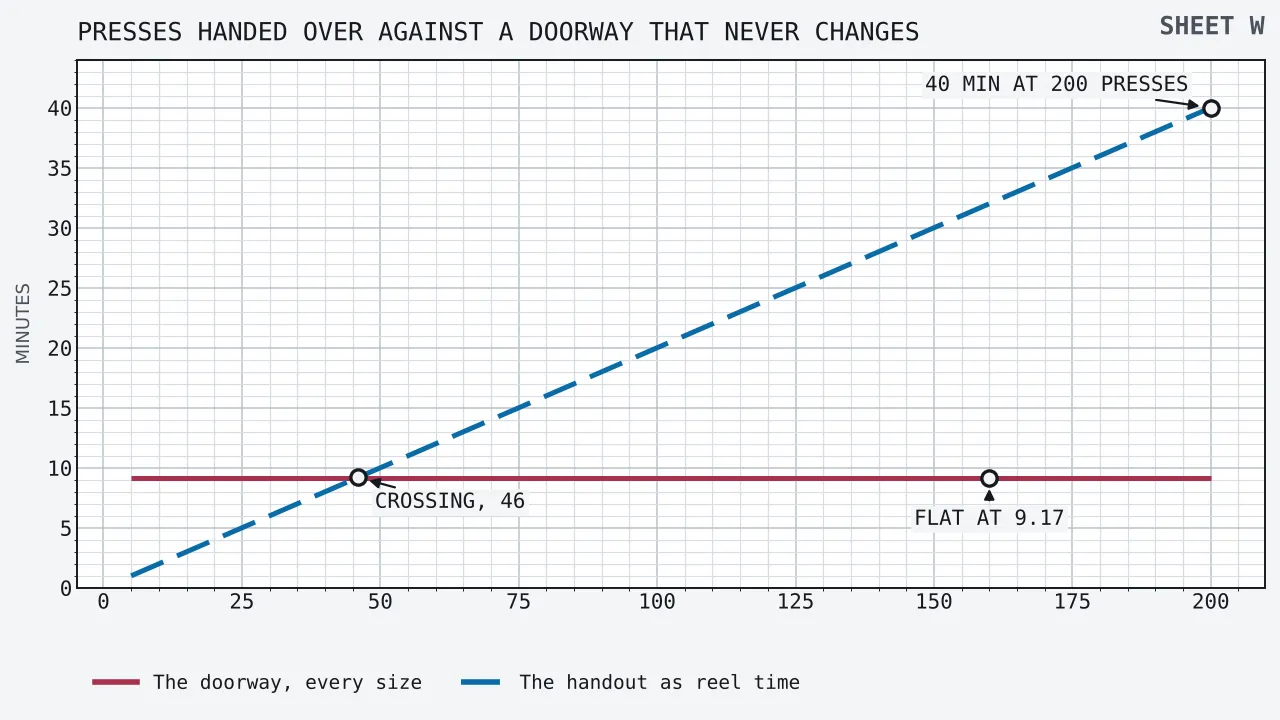
Reading the picture from the left is the uncomfortable way round. Up to the crossing the flat trace is the taller, meaning a reader spent longer getting at the credit than the credit will occupy them for. Past it the climbing trace pulls away and never returns, reaching four and a third times the doorway at two hundred presses.
4
The movement settled in fields rather than in seconds
One hundred and twenty seconds of the ledger buys something the other six movements do not, and the ledger cannot show it, because what leaves the reader at that row is not time. Six particulars cross the counter during registering, and the note enumerating them puts a unit on each: a working electronic address, a mobile number that answers, the reader’s name, the day they were born, a device fingerprint the handset volunteers with no box beside it, and a tick governing whatever is sent later.
Two properties of that list matter at section level and neither is visible from inside any single note. The first is that the list has no size either. A form collecting six particulars in front of a five-press handout collects the identical six in front of a thousand-press one, so the data column behaves exactly as the seconds column does and worsens in the same proportion as the credit shrinks.
The second is that one entry is not spent but renewed. An address and a number keep costing minutes for as long as they stay reachable, turning a single movement at the doorway into an annual subscription nobody quoted a term for. The same note prices a year of that at 45 min 56 s against a handout lasting twenty minutes, on assumed volumes it declares.
| What leaves the reader | Changed by the credit’s size | Whether it can be taken back |
|---|---|---|
| Stipulated seconds at the form | No | No, and nothing is offered in exchange |
| An address and a mobile number | No | Only by abandoning the address or the number |
| A name and a day of birth | No | Neither can be amended afterwards |
| A fingerprint the handset volunteers | No | No box was offered, so none can be unticked |
| A tick governing later messages | No | Yes, and it is the one entry that can be |
Nought of that is a figure anybody bills. The section prices it because a reader weighing five presses is posting six permanent particulars for sixty seconds of reel, and that exchange rate is written down nowhere either party can see it.
5
One movement with two addresses, and the distance between them
Settling whose account it is has to happen at some point, and the whole argument about it turns on which point. Two notes own the question between them. One follows the check when it lands late and the other takes it apart into the jobs it is doing, which are three: whether the account holder has turned eighteen, whether an exclusion settled earlier ought to bar this registration, and which living person a balance belongs to.
Forty-five seconds is what the check costs inside the registering movement, which is the allowance the sign-up ledger sets aside for the particulars a licensed business settles ahead of any gambling. Ninety-six hours is what the same work costs once it has moved to the far end, which is the total the first of those two notes builds out of a request queueing, papers asked for and answered, a reviewer reaching the file, a published band running from approval, and a rail carrying the payment.
7,680 to one between the check at the near door and the same check at the far one
Dividing 345,600 seconds by 45 is where that comes from, and it is the largest ratio printed in the section. A reader treating a quick entrance as a saving has priced the numerator alone. The work was not deleted. It was relocated to the one moment at which a balance is standing and nobody can be hurried, which is the worst moment available to be asked.
Two consequences follow and neither is a duration. A demand landing at the exit arrives after the file has grown, so there is more to assess, and it arrives when refusing means abandoning money instead of an empty account.
6
What a British licence times, and what it merely orders
Reading the licensed rulebook with a stopwatch in hand produces a surprising result. Almost nothing in it is a duration. The conditions fix the order of the movements and the content of two, leaving the length of the whole alone.
Sequence is where the force sits. Three particulars, being a person’s name, where they live and the day they were born, have to be settled and tested in advance of any gambling, and play funded by a credit or carrying no prize sits under the identical duty, which puts the check out of reach of a milestone the business picked. Which papers might later be sought, at which point, and by which route, is owed to the customer before a first payment goes in. A fresh demand at the moment of withdrawal is barred where the material could reasonably have been sought sooner. Each fixes a position rather than a span.
| Part of the entrance | What a British licence does to it | A duration attached |
|---|---|---|
| Settling who the account holder is | Fixes its position, in advance of any play | None published |
| Disclosing which papers may be wanted | Fixes its position, in advance of a first payment | None published |
| The offer of a financial limit | Fixes its position and makes setting one the default answer | None for the offer itself |
| Raising a limit already set | Delays it on purpose | 24 hours at the least, then a confirming act |
| Lowering a limit already set | Forbids delay | Immediate, barring a technical failure |
| Qualifying by credit card | Closes the route, from 14 April 2020 | Not applicable |
| How long the registering may take | Nothing | None published |
| How quickly a credit must post | Nothing beyond clear, fair and reachable terms | None published |
| The smallest qualifying payment | Nothing | None published |
| How long the conditions may run | Fixes prominence and proximity, not length | None published |
Two genuine durations appear in the licensed entrance and both point against the direction of the sale. Twenty-four hours of cooling off stands in front of a customer raising their own deposit ceiling, with a confirming act wanted at the end of it, while a reduction takes effect at once. And seventy-two hours once stood behind the age check as slack for the business to finish in, until the requirement was moved in front of play altogether, from 7 May 2019 on the reading the source’s own date makes the only available one. Three days of operator slack have come out of the queue and one day of friction has gone into it, both at the reader’s end.
Nought of that reaches the length a reader experiences. Five hundred and fifty seconds is not a regulated quantity and could not be, since the conditions govern what must be true at each position and leave every stopwatch to the business. Protection sits in the order. The bill sits in the minutes.
7
Why a doorway billed at nothing still carries a total
Two words at the front of most of these phrases describe an absence of outlay and nothing beyond it. The absence is real, and saying otherwise oversells the complaint. What it leaves uncovered is the 550 seconds, the six particulars, the subscription one of those particulars starts, a check that has to land somewhere, and a run of 38.4 minutes to 128 hours beyond the posting.
Credit of this sort is posted by businesses holding no Great Britain licence, which the entrance registers before anything else does. Three of the seven movements change shape without one. Registering sheds the particulars that would have been settled ahead of any play, which is the forty-five seconds of part five and the ninety-six hours it turns into, and it sheds the limit presented as the default answer, the only thing in the entire entrance written to slow a reader down. Qualifying regains a card route the licensed side closed in April 2020. And reading loses the ceiling of ten times that would otherwise bound the run, which is the figure the whole of the section on pace turns on.
A movement absent from the ledger belongs here too. Looking a business up against a published entry, with its permitted activities and its domain names set out to match, takes about ninety seconds and returns something on the licensed side. The note on a desk with no past spends the same ninety seconds where no entry exists, and the answer is an empty hand. Identical cost, nothing returned.
Recourse gets overstated in both directions often enough that the two timetables are better set out than judged. Confirming receipt takes a British licensee three working days at the outside, or one day where the lobby stays open at every hour; its internal process is walled at eight weeks, after which an adjudicator drawn from a list the Commission approves picks the file up. Six months from the incident is the floor under the window for raising one at all. The Curaçao rulebook read for this network wants receipt confirmed in writing inside a week, allows four weeks to assess and answer plus one written extension of four more, carries the same six-month window, and makes dispute resolution free to the player while permitting the operator to draft the conditions of it, including how far the result binds the player and what size a claim must reach to qualify. Both regulators decline to settle an individual transaction, each in its own words. A route exists either side. Authorship is the difference, and the queue mentions neither.
Membership of Gamstop Online rides on holding an online licence in Great Britain, which is why one registration reaches the whole of the licensed side, and the scheme states in its own terms that it cannot assist with services provided by businesses outside it. Nothing here helps anybody reach a service they have excluded themselves from, and that refusal reaches a block set by a bank, a restriction on a network, and any step at a document check. Pricing the queue is what this page does instead.
8
Forty-six presses, and the handout that pays for its own entrance
Dividing 550 seconds by twelve gives 45.83, so forty-six presses is the smallest whole handout whose reel time outlasts the doorway producing it. Beneath that line the entrance is the main event of the visit and the credit is the interlude. Above it the proportions invert.
46 presses, the point where an entrance stops being the longer half of the visit
Four of the published rungs sit beneath the crossing. Five presses, ten, twenty and twenty-five are all shorter than their own doorway, and the note on why the rungs stop where they stop shows that the counts in use are chosen for the shape of the number rather than for anything in the arithmetic. Twenty-five gives five minutes of reel against nine minutes ten of entrance. Fifty is the first commonly printed count to clear the line.
One arrangement escapes the exercise by having no doorway at all. A build that takes no money asks for no registration where the business holds no licence requiring one, which sets six of the seven movements to nought and leaves nothing to amortise. Every clock the section measures reads zero there, and the comparison is useful precisely because it shows how much of the 550 seconds exists to open a cashier relationship rather than a reel.
9
Thirteen cases, and the question each one settles
Thirteen cases sit under this heading and the ledger above is what they have in common. Picking one starts from where a given banner is likely to bite.
Where the entrance itself is the question, the full ledger of seven movements is the one to open, with the enumeration of what crosses the counter as its companion for the row settled in fields. A credit timed to the moment of registering is the cleanest small case, nearly all of its cost being the acquiring, and a count chosen for a banner prices the step from one rung to the next.
Where the check is the question, the three jobs hiding inside one word come first and the ninety-six hours at the far door second, in that order, because knowing what the work is for makes the wait legible rather than merely long.
Where a payment qualifies the reader, the smallest figure a cashier prints is the one to read first, a floor being the finest resolution at which a decision to stop can be acted on, and ten pounds beyond the register follows the same payment into everything it signs a reader up to. Where the wording is the problem rather than the figure, six words with the noun missing read two ways that are ten and a half times apart.
Where the business rather than the offer is in question, a desk with no past is the case, a published band with nought completed exits behind it being a claim and not a measurement. A sum against a pile of presses and a credit spent in a room cover the two shapes a credit can take, and a column of noughts covers the shape with no cashier behind it.
Where the question is what happens after the posting, the section on pace takes over, that being where a count becomes hours. And where the question is the method, the assumptions are set out in one place: the stake, the return, the multiple, the interval and the sitting, with a plain word on which pair are adopted figures instead of findings. Anybody preferring a different interval rescales this page in one division, which is why the figure is printed rather than buried.
Questions
- How long does it take to get from wanting one of these to pressing a reel?
- Nine minutes ten where no payment qualifies the reader, and eleven minutes forty where one does. Both totals are stipulated allowances and not measurements: 40 seconds to decide and open the page, 120 at the form, 75 for the code round trip, 210 on the conditions, 150 at the cashier where there is one, 60 while the credit posts and 45 to open a reel. Strike the cashier row and 700 becomes 550.
- Why does a bigger offer not come with a longer queue?
- Because no row in the ledger holds a term the credit could enter through. The same six particulars go into the same form, the same code comes back, and the sheet of conditions carries the same headings whether what waits beyond is fifty pence or a hundred pounds. A constant divided by a rising number produces the finding: 110 seconds of doorway for each press of a five-press handout, 0.55 of a second for each press of a thousand-press one, two hundred to one between the ends.
- What does an offer with no deposit actually cost?
- Five hundred and fifty seconds of an evening, being 45.83 presses and 41.67 per cent of a sitting, on a press of twelve seconds and a sitting of twenty-two minutes, both adopted here and neither timed. Six particulars, two of which keep costing minutes for as long as they stay reachable. A check that has to land somewhere. And a run beyond the posting coming to 38.4 minutes at five presses and 128 hours at a thousand.
- When is the identity check supposed to happen?
- In advance of any gambling where a Great Britain licence applies, with a person’s name, where they live and the day they were born settled and tested first, and with play funded by a credit or carrying no prize under the identical duty. Where no such licence is held, the position in the sequence is whatever the business chose, which commonly means the reply to a withdrawal request. Forty-five seconds at the near door against ninety-six hours at the far one is 7,680 to one, and the work itself is identical.
- Does a British licence put a time limit on any part of joining?
- Almost none. The conditions fix the order of the movements and the content of two of them, not how many seconds any may take. Nothing published sets a length for the registering, a speed for the credit to post, a floor under the qualifying payment or a limit on how long the conditions may run. Two real durations do appear and both run against the sale: twenty-four hours of cooling off before a deposit ceiling can be raised, with a confirming act afterwards and no delay at all on lowering one, and the seventy-two hours of slack the age check once carried before the requirement moved in front of play.
- How large does a handout have to be before it pays for its own entrance?
- Forty-six presses. Dividing 550 seconds by the twelve a press is allowed here gives 45.83, so forty-six is the smallest whole count whose reel time outlasts the doorway producing it. Five, ten, twenty and twenty-five presses all sit beneath that line, which puts the entrance at between 90 and 65 per cent of the whole visit. Fifty is the first commonly printed count to clear it.
- What goes across the counter instead of money?
- A working electronic address, a mobile number that answers, the reader’s name, the day they were born, a device fingerprint the handset volunteers with no box beside it, and a tick governing whatever is sent later. Neither the name nor the day of birth can be amended afterwards, no box was offered for the fingerprint, and the address and the number keep billing minutes for as long as they stay live. The list is the same length in front of every size of credit, so it worsens in the same proportion as the credit shrinks.
- Can anybody complain where the business sits outside the register?
- A route usually exists, and claiming otherwise would overstate the case. Confirming receipt takes a British licensee three working days at the outside, or one day where the lobby stays open at every hour, the internal process is walled at eight weeks, and an adjudicator drawn from a list the Commission approves picks the file up after that. Six months from the incident is the floor under the window. The Curaçao rulebook read for this network wants receipt confirmed in writing inside a week, allows four weeks plus one written extension of four more, carries the same six-month window, and makes dispute resolution free to the player while permitting the operator to draft the conditions of it. Neither regulator settles an individual transaction.
- Which part of joining is worth the most attention?
- The 210 seconds of reading, 38 per cent of the unpaid doorway and the only movement of the seven nothing forces on anybody. It is also the movement settling the multiple, and the multiple is what turns a credit worth pennies into a run measured in evenings. Scrolling past it reclaims 17.5 presses on the assumed interval and leaves every other figure here unexamined.