Note B01 Revision 1 Terms read 17 October 2026
Free daily spins, or thirty separate errands wearing one banner
Ten presses a day across a month stake £30.00 and are expected to leave £28.80, which is sixty minutes of thumb work cut into thirty two-minute pieces. Forty times that residue wants £1,152.00 over the reels, being 38 h 24 min at the twelve seconds a press modelled here, and the day-by-day reading of the same schedule is harsher still. What a banner counts as one arrangement is thirty appointments.
What lands 2 min a day The run 38 h 24 min The wait to be paid 30 closes
What offers of this size ask in hours
Advertising has been bought for every destination below. A fee reaches this site when a reader goes on to register, and no figure on this page moves one way or the other because of it.
-
01Mobile Free Spins
Betportal
Ceiling as a multiple
What lands€15.00150 spins at 10c, which is this site's figure and not the operator'sThe run17 h 30 minTurning over 525.00 at 10p means 5,250 presses, or about 48 phone sittings of 22 minutes. Timed at 10p a press and 12 seconds between presses, both of which this site assumes rather than measures.The wait to be paidNOT PUBLISHEDThis operator puts no withdrawal band in its own terms, so there is nothing honest to print here.Spins valued at this site's own 10p a spin
What lands
Spins, at a price15.00150 of them at 10c apiece, a figure belonging to this site rather than to the operatorMatch, and other creditno figure300% of three deposits, to a ceiling of €1,000. Not a sum until money of yours makes it one, so this row totals nothing and carries nothing downwardsThe run
Handed back on the spins(0.60)Each press stakes its own value and returns 96 per cent, which leaves this much with the house from the opening pressPlay-through 35x on the bonus(20.16)Taking 14.40 round 35 times over means 504.00 through the machines, of which 20.16 is the expected cost, and 17 h 30 min of pressing at the pace aboveWhat counts towards it100%Slots only, with no percentage published anywhere, so the row above assumes the whole of each stake countsWhat never clears
Limit on the winningsstated5x the bonusDeducted on the way outno figureNothing is published as a figure here, so this row removes nothingLeast that can leaveno figureNo figure is published, so nothing on this timer is pinned down by oneLeast deposit, and the rung over ityour own€20 a stage. Published in euros, so no rung is named at all: this site's ladder is a sterling oneThe window on the creditstated14 daysBiggest stake while it runsstated€5Removed outright by rulestatedNot publishedVerified before a payoutstatedDocuments before the first withdrawalNever clears€15.00Not a penny of it gets out, so the whole of what landed stands on this rowNo Great Britain licence
Licence held in Anjouan, Comoros, the company named is BetPortal Gaming Ltd, with Excite Ultra Media Ltd, quoted under ALSI-202601040-FI2.
Terms read 17 October 2026
Open the offer at Betportal, opens in a new window -
02Mobile Free Spins
WinBeast
Ceiling as a sum
What lands€50.00500 spins at 10c, which is this site's figure and not the operator'sThe run2 d 18 hTurning over 2,000.00 at 10p means 20,000 presses, or about 182 phone sittings of 22 minutes. Timed at 10p a press and 12 seconds between presses, both of which this site assumes rather than measures.The wait to be paidNOT PUBLISHEDThis operator puts no withdrawal band in its own terms, so there is nothing honest to print here.Spins valued at this site's own 10p a spin
What lands
Spins, at a price50.00500 of them at 10c apiece, a figure belonging to this site rather than to the operatorMatch, and other creditno figure50% to 100% of five deposits, each to a ceiling of €1,000, and a €650 free bet. Not a sum until money of yours makes it one, so this row totals nothing and carries nothing downwardsThe run
Handed back on the spins(2.00)Each press stakes its own value and returns 96 per cent, which leaves this much with the house from the opening pressPlay-through 40x on the bonus and the winnings from the spins(76.80)Taking 48.00 round 40 times over means 1,920.00 through the machines, of which 76.80 is the expected cost, and 2 d 18 h of pressing at the pace aboveWhat counts towards it100%Slots, titles vary by country, with no percentage published anywhere, so the row above assumes the whole of each stake countsWhat never clears
Limit on the winningsstated€100 a batch of spinsDeducted on the way outno figureNothing is published as a figure here, so this row removes nothingLeast that can leaveno figureNo figure is published, so nothing on this timer is pinned down by oneLeast deposit, and the rung over ityour own€20 a stage. Published in euros, so no rung is named at all: this site's ladder is a sterling oneThe window on the creditstated7 days, spins 1 dayBiggest stake while it runsstatedNot publishedRemoved outright by rulestatedNot publishedVerified before a payoutstatedDocuments before the first withdrawalNever clears€50.00Not a penny of it gets out, so the whole of what landed stands on this rowNo Great Britain licence
Licence held in Curaçao, no company named anywhere on the site.
Terms read 17 October 2026
Open the offer at WinBeast, opens in a new window -
03Mobile Free Spins
EliteSpin
Longest spin window
What lands£50.00500 spins at 10p, which is this site's figure and not the operator'sThe run2 d 18 hTurning over 2,000.00 at 10p means 20,000 presses, or about 182 phone sittings of 22 minutes. Timed at 10p a press and 12 seconds between presses, both of which this site assumes rather than measures.The wait to be paidNOT PUBLISHEDThis operator puts no withdrawal band in its own terms, so there is nothing honest to print here.Spins valued at this site's own 10p a spin
What lands
Spins, at a price50.00500 of them at 10p apiece, a figure belonging to this site rather than to the operatorMatch, and other creditno figure50% to 100% of five deposits, each to a ceiling of £1,000. Not a sum until money of yours makes it one, so this row totals nothing and carries nothing downwardsThe run
Handed back on the spins(2.00)Each press stakes its own value and returns 96 per cent, which leaves this much with the house from the opening pressPlay-through 40x on the bonus and the winnings from the spins(76.80)Taking 48.00 round 40 times over means 1,920.00 through the machines, of which 76.80 is the expected cost, and 2 d 18 h of pressing at the pace aboveWhat counts towards it100%Slots, with no percentage published anywhere, so the row above assumes the whole of each stake countsWhat never clears
Limit on the winningsstated5x the bonusDeducted on the way outno figureNothing is published as a figure here, so this row removes nothingLeast that can leaveno figureNo figure is published, so nothing on this timer is pinned down by oneLeast deposit, and the rung over ityour own£20 a stage. It lands square on the £20.00 rung, so none of yours is left perched on topThe window on the creditstated7 days, spins 3 daysBiggest stake while it runsstatedNot publishedRemoved outright by rulestatedNot publishedVerified before a payoutstatedDocuments before the first withdrawalNever clears£50.00Not a penny of it gets out, so the whole of what landed stands on this rowNo Great Britain licence
Licence held in Costa Rica, the company named is PrimeTier Limited.
Terms read 17 October 2026
Open the offer at EliteSpin, opens in a new window -
04Mobile Free Spins
Crown Jewelz
Multiple unpublished
What lands£15.00150 spins at 10p, which is this site's figure and not the operator'sThe runNOT TIMEDThis operator does not publish the play-through multiple in its own terms. The multiple is the one figure the clock cannot work around, so the run is left untimed.The wait to be paidNOT PUBLISHEDThis operator puts no withdrawal band in its own terms, so there is nothing honest to print here.Nothing reckoned
What lands
Spins, at a price15.00150 of them at 10p apiece, a figure belonging to this site rather than to the operatorMatch, and other creditno figure200% of the first deposit, then 150% twice, each to a ceiling of £1,000. Not a sum until money of yours makes it one, so this row totals nothing and carries nothing downwardsThe run
Play-throughno figure40x the bonus, reported rather than published by the operatorWhat counts towards itno figureSlots, with no percentage published anywhere, so the row above assumes the whole of each stake countsWhat never clears
Limit on the winningsstatedNot publishedDeducted on the way outno figureNothing is published as a figure here, so this row removes nothingLeast that can leaveno figureNo figure is published, so nothing on this timer is pinned down by oneLeast deposit, and the rung over ityour own£20. It lands square on the £20.00 rung, so none of yours is left perched on topThe window on the creditstatedNot publishedBiggest stake while it runsstatedNot publishedRemoved outright by rulestatedNot publishedVerified before a payoutstatedDocuments before the first withdrawalNever clearsNOT RECKONEDThis operator leaves the play-through multiple out of its own terms, so nothing below the fourth step can be worked out.No Great Britain licence
Licence held in Curaçao, number not verified, no company named anywhere on the site.
Terms read 17 October 2026
Open the offer at Crown Jewelz, opens in a new window
Only the middle reading comes out of arithmetic belonging to this site. The multiple laid against what lands gives the turnover asked for; dividing that by 10p a spin gives the presses; dividing those by 300 an hour gives the hours, a press on a handset being taken here at 12 seconds from the one before. Both figures are assumptions rather than measurements of anybody: nothing was played and nothing was held a stopwatch to. Anybody quicker should divide the press count by a rate of their own, which is why the presses are printed alongside the hours instead of being summarised away.
The first reading is what arrives before any condition is laid against it. Spins carry no unit of their own so one gets supplied: where an operator values its own spin that figure is used and attributed, and where it does not, this site's 10p a spin stands in and everything below moves with it. The third reading belongs to the operator entirely. It is a withdrawal band quoted from published terms, and a blank there means none was published rather than that nobody looked.
The total along the foot answers what the hours leave open, which is whether any of the running ends anywhere. It is what arrived, less whatever is still standing once the play-through has been paid for at 96 per cent return to player and once a published limit, a published deduction and a published floor beneath the least that can leave have each had a turn. It appears again in pence in the pound, the only fair way of holding a small offer up against a large one. It describes an offer rather than an evening, and where the conditions price out what arrived, a timer prints nothing getting out instead of a negative sum.
Cashiers on a handset take deposits off a row of preset buttons, so a least deposit given in pounds is raised to the next rung of the ladder used here, £10, £20, £25, £50, £75 and £100, and the timer shows what is left perched on it. That money is the reader's own and enters no sum at all. Given in euros it prints untouched, the ladder being sterling. Three words may occupy the figure column where no figure belongs. Stated is a published term that costs something while leaving no number to subtract. No figure is a term nobody has quantified, or a credit that is not a sum until money of yours makes it one. Your own is money of yours, which belongs in none of this.
None of the operators above is licensed in Great Britain, so not one duty that licence carries reaches any of them. Membership of Gamstop Online is compulsory for every online gambling company licensed in Great Britain, which means that shutting yourself out through the scheme shuts you out of none of these. The limit of ten times the bonus funds on a wagering requirement, running since 19 January 2026 under Social Responsibility Code 5.1.1, is a condition of the same licence and binds only whoever holds one. Off that licence, the Gambling Commission writes of consumers meeting unfair gaming practices, financial loss and no recourse when matters go wrong, and lists blocked payouts and withdrawal limits pitched too high to reach among the things it has seen. No account at any of them may be held by anybody under 18.
Every term on a timer is its operator's own and every timer carries the day somebody read it. The oldest of those readings is 17 October 2026. What binds a reader is an operator's full terms and never a line printed here.
1
A pound a day, and why the day is the real unit
One pound a day is the whole of what a drip schedule stakes, taking ten presses at a denomination of ten pence, and every figure on this note grows out of that single line. Four pence of the pound stays with the house where ninety-six pence comes back, so £0.96 is what a day of pressing is expected to leave behind it. Thirty such days stake £30.00 altogether and should leave £28.80.
Two minutes is what a day of ten presses occupies, the interval this site models being twelve seconds, so 120 seconds in all. Nine per cent of one twenty-two minute pick-up of a handset is what that amounts to. Interval and pick-up are both assumptions declared by this site rather than measurements of anybody, and a reader with a quicker thumb should adjust the minutes downward and treat the press counts as fixed.
Thirty is the number that matters here, and it is not a count of spins. A drip schedule hands over its spins in instalments that live and die inside the calendar day they arrive in, which means the reader is not being asked for an hour. The reader is being asked for thirty appearances, and an appearance has a cost that a minute of pressing does not.
| What is counted | In a day | Across thirty |
|---|---|---|
| Presses credited | 10 | 300 |
| Staked at 10p a press | £1.00 | £30.00 |
| What the four-pence margin removes | £0.04 | £1.20 |
| Residue the presses are expected to build | £0.96 | £28.80 |
| Pressing at the modelled interval | 2 min | 60 min |
| Separate openings of the application | 1 | 30 |
Sixty minutes in the right-hand column is the figure a reader will recognise and discount, because an hour spread over a month is nothing at all. That reading is correct about the hour and wrong about the arrangement. Nothing in the schedule permits the hour to be taken as an hour, and the refusal is structural rather than incidental: the credit arrives daily and usually lapses daily, so sixty minutes cannot be collected in one go even by a reader who wants to.
Two properties therefore describe this shape and no other shape on this site. Its handout is divided into pieces too small to be worth a journey on their own. Its deadlines are multiplied to match. A pile of three hundred spins credited at once would raise the same £28.80, occupy the same sixty minutes and carry one deadline, and the difference between that arrangement and this one is the entire subject of the sections below.
Ten presses is far too thin a sample to predict anything about one particular day, and 96p is the average across all the sets of ten that could come up, not a forecast of tomorrow. Most days of ten finish under 96p on a reel of ordinary width and a few finish far above it. Thirty days of ten brings the running total closer to the mean than any single day could be, which is one of the few respects in which repetition helps the arithmetic rather than hurting it.
2
What getting into the lobby costs, thirty times over
Three minutes is the cost this note puts on one opening, stated as an assumption and not as an observation. Nobody was watched doing it. A reader in and out inside ninety seconds should halve every total below, and one caught by a reconnection should double them, since the comparisons here are straight lines through that one figure.
Three stages make up the three minutes, and separating them is what makes the figure arguable instead of merely asserted. Getting a handset application loaded and signed in is the first. Finding where the day’s credit is actually sitting, among whatever else a lobby is promoting that morning, is the second. Getting back to whatever the reader had put down in order to do this is the third, and it is the stage nobody counts.
| Stage of an opening | Assumed seconds | Across thirty days | What makes it longer than it looks |
|---|---|---|---|
| Application loaded and signed in | 40 | 20 min | A session dropped overnight, a second factor to confirm |
| Locating the day’s credit | 70 | 35 min | A promotions shelf arranged for the day’s selling, not for yesterday’s reader |
| Getting back to the interrupted thing | 70 | 35 min | Attention does not resume where it was put down |
| The three together | 180 | 90 min |
Ninety minutes of overhead against sixty minutes of pressing is the first uncomfortable ratio this note produces, and it comes out of the table above without any further arithmetic. The part of the arrangement that is advertised runs to an hour across the month. The part nobody prints runs to an hour and a half. Three minutes of every five a reader spends on this schedule buys no presses whatever.
Eighteen seconds of overhead attaches to each credited spin, being ninety minutes divided among three hundred presses, against the twelve seconds the press itself occupies. That inversion is the whole finding of this section stated at the grain of a single spin. A spin given away daily costs half as much again in getting to it as it costs in taking it, and no amount of pressing skill moves the larger number.
18 assumed seconds of overhead attached to every 12 seconds of pressing
Seventy seconds against the third stage is the softest line in the table and the one worth defending. Returning to an interrupted task is not free, and anybody who has put down a book to answer a message knows the cost without needing it measured. A schedule that asks for a visit every day is asking for thirty interruptions, each placed wherever the reader happened to be, and the arrangement has no way of scheduling itself around anything.
Forty seconds against the loading stage is deliberately generous to the arrangement, since a handset holding a live session will do it faster. Sessions on a gambling application tend not to live overnight, which is a sensible security property and an expensive one here. Thirty mornings of signing in is thirty confirmations, and the arithmetic above assumes every one of them goes right first time.
3
Thirty short errands weighed against one long one
One hundred and fifty minutes is what the whole month costs in attention on these assumptions, being ninety minutes of overhead and sixty of pressing. Sixty-three minutes is what the identical three hundred presses would cost if they were credited in one block and taken in one go, being one opening of three minutes and an hour at the reels. Two and four tenths is the ratio between those, and it is the price of the word daily.
Eighty-seven minutes is the same gap stated as a subtraction, and an hour and twenty-seven minutes of a reader’s life is a real quantity rather than a rounding. Nothing is bought with it. The spins are the same spins, the residue is the same £28.80, the condition that follows is the same condition, and the eighty-seven minutes buys only the fact that the arrangement happened on thirty occasions instead of one.
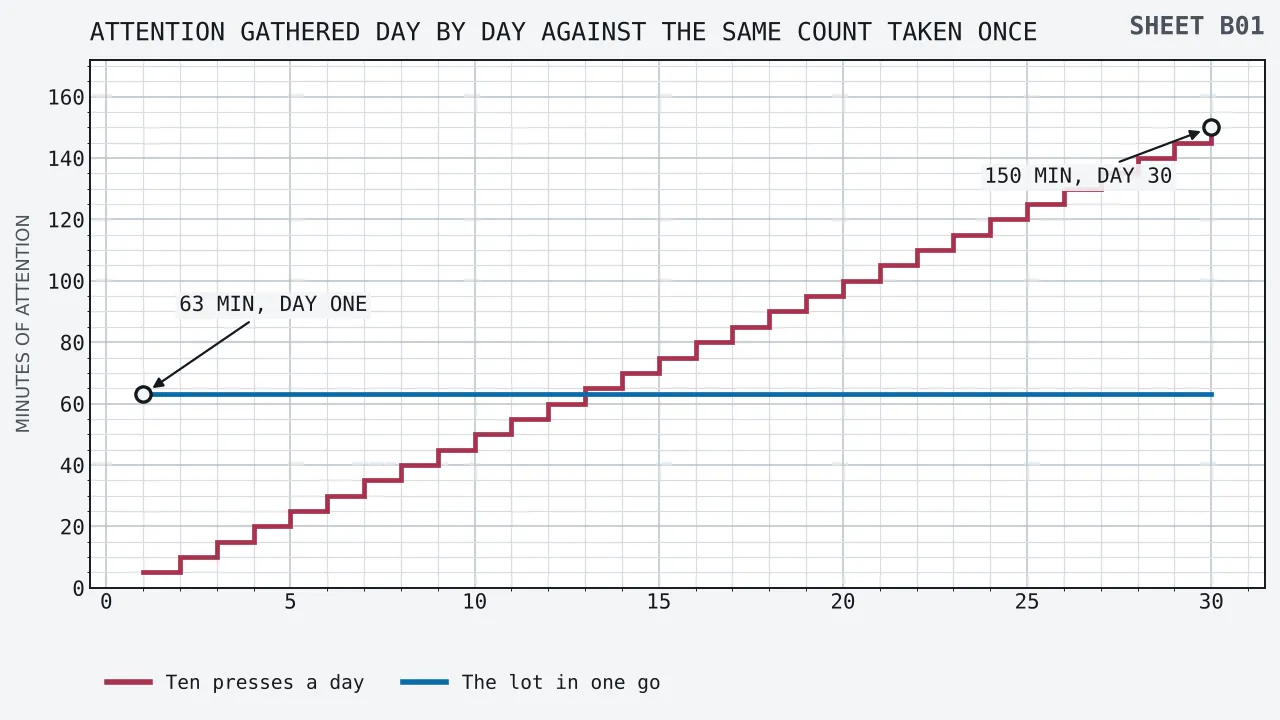
Five minutes a day is the step in that chart, and the height of a single step is the reason the arrangement works as a piece of selling. Nobody declines five minutes. Thirty refusals would be needed to decline the schedule, and each of them has to be made against a quantity too small to argue with, which is a far harder thing than declining an hour once.
Thirty sittings is what the schedule comes to if a part sitting is rounded up, as it is everywhere on this site, because five minutes on a given day occupies a pick-up of a handset whether or not it fills one. Three sittings is the corresponding figure for the single hour, since sixty-three minutes is two and nine tenths of a twenty-two minute pick-up. Ten pick-ups for every one is what the daily shape costs in the unit this site counts in.
| What is being compared | Ten a day for thirty days | Three hundred taken once |
|---|---|---|
| Presses credited | 300 | 300 |
| Staked | £30.00 | £30.00 |
| Residue expected | £28.80 | £28.80 |
| Pressing | 60 min | 60 min |
| Openings, at three assumed minutes each | 90 min | 3 min |
| Attention in total | 150 min | 63 min |
| Pick-ups of twenty-two minutes | 30 | 3 |
| Deadlines to keep | 30 | 1 |
Four rows of that table match exactly and four do not, which is the cleanest way of saying what a drip schedule is. Money, spins, residue and pressing are identical between the columns. Overhead, total attention, pick-ups and deadlines differ by factors between ten and thirty. A reader choosing between the two shapes is choosing nothing about the gambling and everything about the diary.
Nineteen pence of expected residue is what a minute of attention buys under the daily shape, being £28.80 across 150 minutes, against forty-six pence a minute under the single block. Neither figure survives the condition in section four, which turns both of them negative. The comparison is still worth making at this stage, because it isolates the cost of the shape from the cost of the clause.
4
The month added up: £1,152.00 and 38 h 24 min
Eleven hundred and fifty-two pounds is the turnover forty times fixes over £28.80, and that figure wants reading twice. Thirty pounds of staking across a month produces a residue, and the residue carries a demand thirty-eight times the size of the staking behind it. Chop £1,152.00 into ten-pence pieces and 11,520 of them appear.
Thirty-eight hours twenty-four minutes is how long those presses run at the modelled interval, which is 138,240 seconds. Over a twenty-two minute pick-up that divides into 104.7, and part pick-ups round up throughout this site, so the clause lands at 105 separate sittings. Finishing it inside the month would mean three and a half of them nightly, on top of the thirty openings the schedule asks for on its own account.
Seventeen pounds and twenty-eight pence, with a minus on the front, is where that run is expected to finish, forty bites of four pence in the pound coming to 160 per cent of whatever they are taken from. A reader who works the clause through exactly as modelled has pressed 11,520 times across 105 sittings and ends £17.28 below simply keeping the residue, which is itself not a thing on offer.
11,520 presses owed against the 300 the schedule gives
Twenty-four hours of pressing, on the interval modelled here, is where the residue is expected to arrive at nothing, being 7,200 presses of ten pence, and its landing on a round day is a useful accident. Four pence of each pound crossing the reels stays behind, so £28.80 supports £720.00 of turnover and not a penny further. Five eighths of the clause, which is 62.5 per cent, is as far as an average run reaches before the wallet behind it is bare.
Fourteen hours twenty-four minutes is the remainder on that same modelled interval, being 4,320 presses the clause demands and the residue cannot pay for. Those hours are not a hazard or a possibility. They fall out of setting a balance good for twenty-four hours against a requirement wanting thirty-eight, and only a run sustained well above the house rate across the whole month closes them.
Ninety-seven point five pence in the pound is what the reels would need to return across 11,520 results for the residue to last to the end, against the ninety-six this note works from. Put the £1,123.20 that must come back over the £1,152.00 going across and the figure falls out. A point and a half above a build’s own long-run average, sustained for eleven and a half thousand results, is the clause restated as a performance requirement.
5
The same month counted day by day, which is worse
Thirty-eight pounds forty is what forty times does to a single day’s 96p, and this is the reading most drip schedules actually carry. Credit arriving daily tends to bring its own daily clause with it, so the month is not one requirement of £1,152.00 but thirty requirements of £38.40, each opening and closing inside its own calendar day.
Three hundred and eighty-four presses is £38.40 counted out at ten pence, running 4,608 seconds on the twelve-second assumption, which reads as 1 h 17 min. Hold that against the two minutes the day handed over and the proportion is stark: seventy-seven minutes wanted from somebody given two. Thirty days of it reaches the same 11,520 presses and the same £1,152.00 as the monthly reading, which is precisely why the gap between the two goes unnoticed.
| The question | Month treated as one sum | Each day treated separately |
|---|---|---|
| What the condition applies to | £28.80 | £0.96, thirty times |
| Turnover demanded | £1,152.00 | £38.40 a day |
| Presses demanded | 11,520 | 384 a day |
| Pressing at the modelled interval | 38 h 24 min | 1 h 17 min a day |
| Pick-ups once part ones round up | 105 | 120 |
| Deadline on the pressing | One, at the month’s end | Thirty, one a night |
| What a part-finished run returns | Nothing, once | Nothing, up to thirty times |
Fifteen extra pick-ups is what the right-hand column costs through rounding alone, being 120 against 105, which puts five hours and thirty minutes of diary into nothing beyond the granularity of the demand. One hour and seventeen minutes is three and a half pick-ups, and nobody keeps half a pick-up, so each of the thirty days rounds up on its own account. Summed across a month, an arithmetic nicety turns into a real quantity.
Forty-eight minutes a day is as far as the day’s own residue stretches, 96p draining at 0.4p a press where four pence goes from every pound crossed. Two hundred and forty presses is what that pays for, against the 384 the clause wants. One hundred and forty-four presses, being 28.8 minutes, fall outside anything the day’s money can cover, and that happens on thirty consecutive nights instead of once at the close.
Sixty-two and a half per cent appears again here, as the share of each day’s clause the day’s own money can reach, and the agreement with section four is no accident. Both readings rest on the same two numbers, a margin of four pence and a multiple of forty, so both put the wallet’s exhaustion at the same fraction of the distance. What changes between them is not the fraction but how many times a reader arrives at it.
Ninety-six pence is the forfeit when a day runs out unfinished, and the size of that sum is precisely why the daily reading is the harsher one. Nobody disputes 96p. Nobody writes to a cashier about it, and nobody notices it going. Eight missed evenings across a month removes £7.68 of residue in parcels small enough that no single one would be queried, which is a materially different experience from losing £7.68 in one visible event.
6
Twenty-four hours of pressing, and what it buys
Four pence in each pound is the margin a return of ninety-six pence leaves behind. Stack twenty-five of those margins and a balance has gone entirely, which is why 25 is the multiple that divides one kind of clause from another: anything under it can finish with money standing, anything over it cannot.
Seven thousand two hundred presses is where that boundary falls on a residue of £28.80, being £720.00 of turnover, and 86,400 seconds is what they occupy at the modelled interval, which is twenty-four hours precisely. Sixty-six pick-ups of a handset is the same quantity in this site’s own unit. A full day of pressing to arrive at nothing is the cleanest statement of what a twenty-five times clause describes.
| The multiple applied | Turnover it fixes | Presses of 10p | Pick-ups of 22 minutes | Pressing at the modelled interval | Where the run should finish |
|---|---|---|---|---|---|
| Ten times, all a Great Britain licence permits | £288.00 | 2,880 presses | 27 pick-ups | 9 h 36 min | £17.28 left |
| Twenty times | £576.00 | 5,760 presses | 53 pick-ups | 19 h 12 min | £5.76 left |
| Twenty-five times, the dividing multiple | £720.00 | 7,200 presses | 66 pick-ups | 24 h | nothing left |
| Thirty times | £864.00 | 8,640 presses | 79 pick-ups | 28 h 48 min | minus £5.76 |
| Forty times, the figure costed here | £1,152.00 | 11,520 presses | 105 pick-ups | 38 h 24 min | minus £17.28 |
| Fifty times, at twice the dividing multiple | £1,440.00 | 14,400 presses | 131 pick-ups | 48 h | minus £28.80 |
Nine hours thirty-six minutes heads that ladder, and no kinder row is available on the regulated side, a wagering condition over bonus funds being barred from passing ten times wherever a Great Britain licence applies. Seventeen pounds twenty-eight is the residue that row expects to leave behind. Twenty-seven pick-ups is the price, which is still close to one a night across the month the schedule occupies.
Twenty-eight hours and forty-eight minutes separates the top row from the bottom, and that span is the whole of what one number in one document decides. Nothing else in the arrangement moves across those rows. The same thirty openings, the same three hundred presses, the same £30.00 of staking and the same £28.80 of residue sit behind every line, and the multiple alone carries the expected position from plus £17.28 to minus £28.80.
Fifty times has a property worth naming, in that twice the dividing multiple returns exactly minus the residue. That is as far as the expression can usefully travel, since a reader has only the £28.80 to lose and the clause has already accounted for all of it. Forty-eight hours of pressing to arrive at the loss of everything the month built is the plain reading of that row.
Nineteen hours and twelve minutes sits in the twenty times row with £5.76 expected beside it, and the pair illustrates why the dividing multiple is the only honest place to stand. Every hour of pressing between the twenty times row and the twenty-five times row is converting a positive expectation into a smaller one at a rate of about £1.20 an hour. Past twenty-five, the same hours convert nothing into less than nothing at the same rate.
7
Thirty deadlines where a single pile has one
One thousand four hundred and forty minutes is the window a daily credit lives in, and two minutes is what the credit needs of it. Stated that way the window is absurdly generous, at a tenth of one per cent of the day. Stated as a diary entry it is a requirement to be in a particular application on a particular calendar day, thirty times running, which is not generous at all.
Forty-three thousand two hundred minutes is the same month viewed as one window, which is what a single pile with a thirty day expiry would offer. Sixty minutes of pressing somewhere inside 43,200 is a demand nobody could fail. Two minutes inside each of thirty separate windows of 1,440 is the identical sixty minutes arranged so that twenty-nine of the thirty chances to fail are added rather than removed.
| Days missed out of thirty | Presses forfeited | Residue forfeited | Handout forfeited | How it is likely to feel at the time |
|---|---|---|---|---|
| 1 | 10 | £0.96 | 2 min | Not noticed |
| 3 | 30 | £2.88 | 6 min | Not worth a thought |
| 8 | 80 | £7.68 | 16 min | A quarter of the month gone unremarked |
| 15 | 150 | £14.40 | 30 min | Half the arrangement, in sums of 96p |
| 22 | 220 | £21.12 | 44 min | What a fortnight of ordinary life costs |
Seven pounds sixty-eight is the row to dwell on, because eight missed days in thirty is not carelessness. It is a work trip, a weekend away and a bad week. A pile credited once with a month to run through it loses nothing to any of those, and the daily shape loses a quarter of its face to them without ever presenting the reader with a loss large enough to resent.
Two clocks run on most of these schedules rather than one, and conflating them is the commonest mistake a reader makes here. A clock on the credited spins says they must be pressed inside the day they arrive. A clock on the residue says whatever those presses built must be put through its condition inside some further window. Missing the first forfeits the spins. Missing the second forfeits whatever was standing when it closed.
Thirty forfeits of 96p is also, read from the other end, thirty invitations to return tomorrow and make it up. Nothing in the arithmetic supports that reading, since yesterday’s lapsed credit does not accumulate anywhere and tomorrow’s ten presses are worth exactly 96p whatever happened the day before. The sense that ground can be recovered is produced by the schedule’s shape and not by any quantity in it.
One day in thirty is also the granularity at which a term sheet can change under a reader without anything appearing to change. A schedule running a month is a month of exposure to a revision, and the shorter each instalment’s life is, the less any single instalment is worth arguing about. That is a general property of paying something out in small pieces, and it is not peculiar to this market.
8
What thirty-eight hours is resting on, and the floor under it
Twelve seconds carries all of the 38 h 24 min above it, and a number doing that much work should be laid beside its neighbours rather than asserted. The press count does not move with the interval at all. Eleven thousand five hundred and twenty is fixed by the residue, the multiple and the ten-pence denomination, so a shorter interval shortens the hours and moves no pound anywhere on this page.
| Seconds to a press | Presses an hour | The month’s condition takes | Each day’s own clause takes | What the interval would describe |
|---|---|---|---|---|
| 6 | 600 | 19 h 12 min | 38 min | Animation off, nothing else competing |
| 9 | 400 | 28 h 48 min | 58 min | Unhurried, usually on a larger screen |
| 12 | 300 | 38 h 24 min | 1 h 17 min | The handset rate modelled throughout here |
| 15 | 240 | 48 h | 1 h 36 min | A build with features that play themselves out |
| 20 | 180 | 64 h | 2 h 8 min | Attention divided, messages arriving |
Nought point three one two five seconds a press is what the schedule’s own hour would need in order to hold the schedule’s own condition, being 3,600 seconds of credited pressing against 11,520 presses owed. Eight times longer than that is the shortest gap a licensed British build is allowed to leave behind a completed game cycle, so the hour cannot be made to do it by anybody at any speed. The sixty minutes a reader is given and the thirty-eight hours a reader is asked for are not the same kind of quantity, and no rate of pressing brings them into contact.
Eight hours is where 11,520 presses would land if that permitted floor could be held exactly, which no thumb on a handset manages. Thirty-eight hours twenty-four minutes is the modelled figure, running four point eight times the floor, and how far those two sit apart is the honest measure of how much here is assumed. Even the unreachable version is a working day of pressing without a break.
One hour and seventeen minutes a day sits in the middle of that table, and converting it into a share of the calendar flatters it badly. Five point three per cent of twenty-four hours sounds like nothing. Three and a half pick-ups of a handset every evening for a month, on top of the opening the schedule already asks for, is the same figure in the unit a person actually lives in, and it is an entirely different proposition.
Two hours and eight minutes is the bottom row’s daily figure, and intervals in that region are not unusual where a build runs long feature sequences. Sixty-four hours across the month is then the clause, which is 175 pick-ups. Residue, staking and expected position move by not a penny from the first row of that table to the last, and the one quantity changing is the count of evenings.
9
A schedule whose product is the opening, not the spin
Thirty openings is what this arrangement is actually buying, and saying so plainly is the most useful thing this note can do. Two minutes of pressing a day is cheap to give away. A reason to load a gambling application on thirty consecutive mornings is not cheap at all, and a schedule paying out daily is the one offer shape on this site whose design purpose is a repeated visit rather than a quantity of play.
Two rules on the advertising side name that purpose outright, which is worth having before the subject gets treated as a matter of taste. Frequent or repeated taking part is a thing the advertising regulator’s own published advice says a promotion ought not to push, and the same advice warns against pushing spending past what a person could stand to lose. Its casino guidance adds that a reward should stand in proportion to what a player has actually laid out in money and in hours, that offers ought not to accelerate as spending grows, and that regular gambling at a fixed frequency in substantial sums is not a thing to be promoted.
Outside the British licence is where a schedule of this shape sits, and the duty a reader forfeits here is the one that would have done the counting. Seventeenth of January 2025 is when an obligation landed on the licensed side to keep two figures live on screen while somebody plays, those being the money gone after returns and the time elapsed in play. Thirty visits of five minutes is precisely the pattern nobody adds up unaided: a pound a day is invisible, thirty pounds a month is not, and a running figure on the glass is the only thing joining them. Off the register neither figure has to appear anywhere, which leaves the sums above as the whole of a reader’s accounting.
One further licensed rule reads as though drafted for a drip schedule, and it may be the least known of the set. Reducing an incentive on the ground that the qualifying play finished before the period was out is forbidden to a licensee, and it is one of four things the incentives provision rules out flatly. Thirty days is such a period, and a reader who gets through early cannot be quietly repriced for it. Nothing resembling that appears in the offshore rulebook examined for this network.
Three things a gambling product here may not actively push a customer towards are chasing a loss, raising a stake and carrying on after saying they wish to stop. The guidance under that requirement goes on to say that somebody who has chosen to leave should not be tempted back, and it gives a free game as its own illustration. That is the exact mechanism a daily credit works by, and a rule stands against it wherever the licence applies.
| What the duty does | Where a Great Britain licence is held | Where none is held |
|---|---|---|
| Shows the money and the minutes as they go | Two live figures on screen from 17 January 2025: the money gone after returns, and the time elapsed in play | Neither figure has to appear at all |
| Caps the multiple over bonus funds | Ten times, binding since 19 January 2026 | No ceiling at any level |
| Protects a reader who gets through early | Repricing an incentive because the qualifying play finished inside the period is ruled out | Nothing resembling it appears |
| Stops a free game fetching somebody back | No active push to carry on past a stated wish to stop, with tempting a departed customer named in the guidance | Absent from the policy read for this network |
| Keeps a promotion away from somebody cooling off | Direct marketing by product and by channel is opt-in from 1 May 2025 | The offshore policy does rule out a bonus used to argue a player out of cooling off |
One row of that table runs the other way, and setting it down is more honest than pretending nothing at all is published offshore. A cooling-off period reachable by one press and effective at once sits on the Curaçao policy’s list of requirements, and the same document bars an operator from putting a player off taking one. Among the things named as off limits is the use of a bonus or a promotion as the inducement to carry on. A daily credit is exactly the instrument that rule has in view, and recording its presence serves a reader better than a blanket claim that offshore means unregulated.
Four tenths of a penny leaves on every press, which is the smallest unit in this whole note and the one that explains why a daily shape is hard to notice. Nobody feels 0.4p. A pound a day is below the threshold at which a bank statement invites a second look. Thirty pounds a month is above it, and 38 h 24 min of pressing is far above it, and the arrangement is built so that the first figure is the one a reader meets thirty times and the last two are figures a reader meets never.
Thirty is the number to hold on to at the end of this section, because it governs the care section below as much as it governs the arithmetic above. A daily appointment with a gambling application is a habit under construction whether or not anybody intended one. Anybody who finds the appointment harder to skip than it ought to be should ring the helpline GamCare runs, on 0808 8020 133, where nobody charges for the call and nobody closes, and five minutes spent that way beats five minutes spent on the schedule.
10
Whether thirty appointments are worth keeping
Two minutes a day given against seventy-seven minutes a day asked is the whole arrangement in one line, under the daily reading that most of these schedules actually carry. Nothing about that ratio improves at any multiple a reader is likely to meet. Even at ten times, the most a Great Britain licence will allow over bonus funds, nineteen minutes of clause stands against two minutes of handout, and that is nine and a half to one.
One hundred and fifty minutes of attention across the month is the figure to compare against the alternatives, and the comparison is not close. Sixty-three minutes buys the identical three hundred presses in one block. Eighty-seven minutes is the premium a reader pays for the word daily, and the premium is paid in the most awkward currency there is, being three-minute interruptions scattered across thirty days.
Seventeen pounds and twenty-eight pence, carrying a minus, is where a completed forty times condition is expected to finish. Forty hours and fifty-four minutes of total attention stands behind it, on the assumed interval and the assumed cost of an opening, once the thirty openings, the pressing and the clause are added up. Those two divide into a rate of roughly minus forty-two pence for every hour of attention the arrangement takes, which is the one rate this page would keep if it could keep only one.
Three questions decide whether a particular schedule is worth any of this, and none of them is the count on the banner. Whether the condition attaches to the day’s credit or to the month’s total, since that choice is worth fifteen pick-ups of a handset in rounding alone and thirty forfeits instead of one. What the multiple is, since it carries the expected position across a span of £46.08 between ten times and fifty. And how long a single press takes on whatever build the spins are locked to, since that alone moves the month’s condition between 19 h 12 min and sixty-four hours.
Thirty days is a long time to be given a pound, and that sentence is the one a reader should carry away. A reader already opening the application anyway, for reasons of their own, is being handed two minutes and 96p a day at no cost in attention whatever, and should take it. A reader who would not otherwise open it is being paid under four pence for each minute given over to building the habit of opening it, and the sums above are what that habit costs once the clause on the far side is counted in.
Questions
- What does a daily spins schedule actually hand over in a month?
- Ten presses a day for thirty days, which is 300 presses of 10p staking £30.00 and building an expected £28.80 at a ninety-six per cent return. Pressing runs to sixty minutes across the month on the twelve-second interval this site models, arriving two minutes at a time. Interval and pick-up length are assumptions declared here, and nothing on this site was measured.
- Why treat thirty daily instalments differently from one pile of 300 spins?
- Because the pressing is identical and everything around it is not. One pile asks for one opening and one deadline. Thirty instalments ask for thirty openings and thirty deadlines, and each day’s credit usually lapses at the end of its own day, so the sixty minutes cannot be collected in one go even by a reader who wants to.
- How much does opening the application thirty times cost?
- Ninety minutes on this note’s own assumption of three minutes an opening, split between forty seconds to load and sign in, seventy seconds to find where the day’s credit sits and seventy seconds to get back to whatever was interrupted. That is eighteen seconds of overhead attached to every twelve seconds of pressing. The three minutes is declared rather than observed, and halving it still leaves an hour of overhead across the month.
- What does a forty times condition on the month’s total come to?
- Eleven hundred and fifty-two pounds over the reels, which is 11,520 presses of 10p running 38 h 24 min at the modelled interval, or 105 pick-ups of a handset once part ones round up. Expected position at the foot is minus £17.28. The residue funds 7,200 of those presses, being twenty-four hours exactly, so 14 h 24 min of the clause has no money behind it.
- Is a daily condition on each day’s credit better or worse than one monthly condition?
- Worse, although the totals match. Forty times a day’s 96p is £38.40, being 384 presses, which run 1 h 17 min at the modelled interval, and thirty of those reach the same 11,520 presses and the same 38 h 24 min. What differs is that each day rounds up to four pick-ups, giving 120 across the month rather than 105, and that a part-finished day returns nothing up to thirty separate times instead of once.
- What happens when a day is missed?
- That day’s ten presses and the 96p they would have built are gone, and nothing carries over to the next day. Eight missed days out of thirty removes £7.68 of residue and sixteen minutes of handout, in parcels of 96p that no reader would think worth querying individually. A pile credited once with a month to use it loses nothing at all to the same eight days.
- At what multiple does a month’s £28.80 run out exactly?
- Twenty-five times, which is £720.00 of turnover, 7,200 presses and twenty-four hours of pressing to the minute at the modelled interval. Four pence of each pound crossing the reels stays behind, so twenty-five pounds of turnover uses up a pound of residue. At ten times, the most a Great Britain licence will allow over bonus funds, it is 9 h 36 min with £17.28 expected to be left.
- Could a reader simply press faster to get through it?
- No, and the arithmetic settles it rather than arguing it. Fitting 11,520 presses inside the sixty minutes the schedule itself hands over would need a press every 0.3125 seconds, and the shortest gap a licensed British build may leave behind a finished game cycle is eight times longer than that. Held at that permitted floor the condition would still take eight hours, against 38 h 24 min at the interval modelled here.
- Do schedules of this kind hold a Great Britain licence?
- They do not, and the duty forfeited on a page about thirty visits is the one that would have done the counting. Seventeenth of January 2025 is when an obligation landed on the licensed side to keep two figures live on screen during play, those being the money gone after returns and the time elapsed. Thirty visits of five minutes is precisely the pattern nobody adds up unaided, a pound a day being invisible where thirty pounds a month is not. Off the register neither figure has to appear anywhere.
- Is a daily schedule worth taking at all?
- By somebody already opening the application for their own reasons, yes, since they get two minutes and 96p a day at no cost in attention. For anybody else it is a poor arrangement: 150 minutes of attention across the month ahead of the clause, 38 h 24 min of clause behind it, and an expected minus £17.28 at the close, which comes out near minus forty-two pence for each hour the schedule takes.