Note D06 Revision 1 Terms read 17 October 2026
Ten pounds of credit, thirty-seven sittings of work, and the exchange rate between a printed day and a usable one
Seven days is not 168 hours of availability. On a handset it is a handful of sittings, and the clause on a ten pound credit wants 37 of them. This note builds the conversion table from days as printed to sittings as lived, states its own exchange rate out loud, and shows where every common period lands against the thirty-seven.
What lands £10.00 The run 37 sittings A week supplies 14
What a credit of this size asks in sittings
Advertising has been bought for every destination below. A fee reaches this site when a reader goes on to register, and no figure on this page moves one way or the other because of it.
-
01Mobile Free Spins
Betportal
Ceiling as a multiple
What lands€15.00150 spins at 10c, which is this site's figure and not the operator'sThe run17 h 30 minTurning over 525.00 at 10p means 5,250 presses, or about 48 phone sittings of 22 minutes. Timed at 10p a press and 12 seconds between presses, both of which this site assumes rather than measures.The wait to be paidNOT PUBLISHEDThis operator puts no withdrawal band in its own terms, so there is nothing honest to print here.Spins valued at this site's own 10p a spin
What lands
Spins, at a price15.00150 of them at 10c apiece, a figure belonging to this site rather than to the operatorMatch, and other creditno figure300% of three deposits, to a ceiling of €1,000. Not a sum until money of yours makes it one, so this row totals nothing and carries nothing downwardsThe run
Handed back on the spins(0.60)Each press stakes its own value and returns 96 per cent, which leaves this much with the house from the opening pressPlay-through 35x on the bonus(20.16)Taking 14.40 round 35 times over means 504.00 through the machines, of which 20.16 is the expected cost, and 17 h 30 min of pressing at the pace aboveWhat counts towards it100%Slots only, with no percentage published anywhere, so the row above assumes the whole of each stake countsWhat never clears
Limit on the winningsstated5x the bonusDeducted on the way outno figureNothing is published as a figure here, so this row removes nothingLeast that can leaveno figureNo figure is published, so nothing on this timer is pinned down by oneLeast deposit, and the rung over ityour own€20 a stage. Published in euros, so no rung is named at all: this site's ladder is a sterling oneThe window on the creditstated14 daysBiggest stake while it runsstated€5Removed outright by rulestatedNot publishedVerified before a payoutstatedDocuments before the first withdrawalNever clears€15.00Not a penny of it gets out, so the whole of what landed stands on this rowNo Great Britain licence
Licence held in Anjouan, Comoros, the company named is BetPortal Gaming Ltd, with Excite Ultra Media Ltd, quoted under ALSI-202601040-FI2.
Terms read 17 October 2026
Open the offer at Betportal, opens in a new window -
02Mobile Free Spins
WinBeast
Ceiling as a sum
What lands€50.00500 spins at 10c, which is this site's figure and not the operator'sThe run2 d 18 hTurning over 2,000.00 at 10p means 20,000 presses, or about 182 phone sittings of 22 minutes. Timed at 10p a press and 12 seconds between presses, both of which this site assumes rather than measures.The wait to be paidNOT PUBLISHEDThis operator puts no withdrawal band in its own terms, so there is nothing honest to print here.Spins valued at this site's own 10p a spin
What lands
Spins, at a price50.00500 of them at 10c apiece, a figure belonging to this site rather than to the operatorMatch, and other creditno figure50% to 100% of five deposits, each to a ceiling of €1,000, and a €650 free bet. Not a sum until money of yours makes it one, so this row totals nothing and carries nothing downwardsThe run
Handed back on the spins(2.00)Each press stakes its own value and returns 96 per cent, which leaves this much with the house from the opening pressPlay-through 40x on the bonus and the winnings from the spins(76.80)Taking 48.00 round 40 times over means 1,920.00 through the machines, of which 76.80 is the expected cost, and 2 d 18 h of pressing at the pace aboveWhat counts towards it100%Slots, titles vary by country, with no percentage published anywhere, so the row above assumes the whole of each stake countsWhat never clears
Limit on the winningsstated€100 a batch of spinsDeducted on the way outno figureNothing is published as a figure here, so this row removes nothingLeast that can leaveno figureNo figure is published, so nothing on this timer is pinned down by oneLeast deposit, and the rung over ityour own€20 a stage. Published in euros, so no rung is named at all: this site's ladder is a sterling oneThe window on the creditstated7 days, spins 1 dayBiggest stake while it runsstatedNot publishedRemoved outright by rulestatedNot publishedVerified before a payoutstatedDocuments before the first withdrawalNever clears€50.00Not a penny of it gets out, so the whole of what landed stands on this rowNo Great Britain licence
Licence held in Curaçao, no company named anywhere on the site.
Terms read 17 October 2026
Open the offer at WinBeast, opens in a new window -
03Mobile Free Spins
EliteSpin
Longest spin window
What lands£50.00500 spins at 10p, which is this site's figure and not the operator'sThe run2 d 18 hTurning over 2,000.00 at 10p means 20,000 presses, or about 182 phone sittings of 22 minutes. Timed at 10p a press and 12 seconds between presses, both of which this site assumes rather than measures.The wait to be paidNOT PUBLISHEDThis operator puts no withdrawal band in its own terms, so there is nothing honest to print here.Spins valued at this site's own 10p a spin
What lands
Spins, at a price50.00500 of them at 10p apiece, a figure belonging to this site rather than to the operatorMatch, and other creditno figure50% to 100% of five deposits, each to a ceiling of £1,000. Not a sum until money of yours makes it one, so this row totals nothing and carries nothing downwardsThe run
Handed back on the spins(2.00)Each press stakes its own value and returns 96 per cent, which leaves this much with the house from the opening pressPlay-through 40x on the bonus and the winnings from the spins(76.80)Taking 48.00 round 40 times over means 1,920.00 through the machines, of which 76.80 is the expected cost, and 2 d 18 h of pressing at the pace aboveWhat counts towards it100%Slots, with no percentage published anywhere, so the row above assumes the whole of each stake countsWhat never clears
Limit on the winningsstated5x the bonusDeducted on the way outno figureNothing is published as a figure here, so this row removes nothingLeast that can leaveno figureNo figure is published, so nothing on this timer is pinned down by oneLeast deposit, and the rung over ityour own£20 a stage. It lands square on the £20.00 rung, so none of yours is left perched on topThe window on the creditstated7 days, spins 3 daysBiggest stake while it runsstatedNot publishedRemoved outright by rulestatedNot publishedVerified before a payoutstatedDocuments before the first withdrawalNever clears£50.00Not a penny of it gets out, so the whole of what landed stands on this rowNo Great Britain licence
Licence held in Costa Rica, the company named is PrimeTier Limited.
Terms read 17 October 2026
Open the offer at EliteSpin, opens in a new window -
04Mobile Free Spins
Crown Jewelz
Multiple unpublished
What lands£15.00150 spins at 10p, which is this site's figure and not the operator'sThe runNOT TIMEDThis operator does not publish the play-through multiple in its own terms. The multiple is the one figure the clock cannot work around, so the run is left untimed.The wait to be paidNOT PUBLISHEDThis operator puts no withdrawal band in its own terms, so there is nothing honest to print here.Nothing reckoned
What lands
Spins, at a price15.00150 of them at 10p apiece, a figure belonging to this site rather than to the operatorMatch, and other creditno figure200% of the first deposit, then 150% twice, each to a ceiling of £1,000. Not a sum until money of yours makes it one, so this row totals nothing and carries nothing downwardsThe run
Play-throughno figure40x the bonus, reported rather than published by the operatorWhat counts towards itno figureSlots, with no percentage published anywhere, so the row above assumes the whole of each stake countsWhat never clears
Limit on the winningsstatedNot publishedDeducted on the way outno figureNothing is published as a figure here, so this row removes nothingLeast that can leaveno figureNo figure is published, so nothing on this timer is pinned down by oneLeast deposit, and the rung over ityour own£20. It lands square on the £20.00 rung, so none of yours is left perched on topThe window on the creditstatedNot publishedBiggest stake while it runsstatedNot publishedRemoved outright by rulestatedNot publishedVerified before a payoutstatedDocuments before the first withdrawalNever clearsNOT RECKONEDThis operator leaves the play-through multiple out of its own terms, so nothing below the fourth step can be worked out.No Great Britain licence
Licence held in Curaçao, number not verified, no company named anywhere on the site.
Terms read 17 October 2026
Open the offer at Crown Jewelz, opens in a new window
Only the middle reading comes out of arithmetic belonging to this site. The multiple laid against what lands gives the turnover asked for; dividing that by 10p a spin gives the presses; dividing those by 300 an hour gives the hours, a press on a handset being taken here at 12 seconds from the one before. Both figures are assumptions rather than measurements of anybody: nothing was played and nothing was held a stopwatch to. Anybody quicker should divide the press count by a rate of their own, which is why the presses are printed alongside the hours instead of being summarised away.
The first reading is what arrives before any condition is laid against it. Spins carry no unit of their own so one gets supplied: where an operator values its own spin that figure is used and attributed, and where it does not, this site's 10p a spin stands in and everything below moves with it. The third reading belongs to the operator entirely. It is a withdrawal band quoted from published terms, and a blank there means none was published rather than that nobody looked.
The total along the foot answers what the hours leave open, which is whether any of the running ends anywhere. It is what arrived, less whatever is still standing once the play-through has been paid for at 96 per cent return to player and once a published limit, a published deduction and a published floor beneath the least that can leave have each had a turn. It appears again in pence in the pound, the only fair way of holding a small offer up against a large one. It describes an offer rather than an evening, and where the conditions price out what arrived, a timer prints nothing getting out instead of a negative sum.
Cashiers on a handset take deposits off a row of preset buttons, so a least deposit given in pounds is raised to the next rung of the ladder used here, £10, £20, £25, £50, £75 and £100, and the timer shows what is left perched on it. That money is the reader's own and enters no sum at all. Given in euros it prints untouched, the ladder being sterling. Three words may occupy the figure column where no figure belongs. Stated is a published term that costs something while leaving no number to subtract. No figure is a term nobody has quantified, or a credit that is not a sum until money of yours makes it one. Your own is money of yours, which belongs in none of this.
None of the operators above is licensed in Great Britain, so not one duty that licence carries reaches any of them. Membership of Gamstop Online is compulsory for every online gambling company licensed in Great Britain, which means that shutting yourself out through the scheme shuts you out of none of these. The limit of ten times the bonus funds on a wagering requirement, running since 19 January 2026 under Social Responsibility Code 5.1.1, is a condition of the same licence and binds only whoever holds one. Off that licence, the Gambling Commission writes of consumers meeting unfair gaming practices, financial loss and no recourse when matters go wrong, and lists blocked payouts and withdrawal limits pitched too high to reach among the things it has seen. No account at any of them may be held by anybody under 18.
Every term on a timer is its operator's own and every timer carries the day somebody read it. The oldest of those readings is 17 October 2026. What binds a reader is an operator's full terms and never a line printed here.
1
Four thousand presses, cut into lengths a phone will hold
Ten pounds credited, with forty times written over it, has to send £400.00 across the reels. At ten pence a press that is 4,000 presses, and at twelve seconds a press, which is the interval this site posits and has never measured, it is 48,000 seconds, being 800 minutes, or 13 h 20 min.
Thirteen hours and twenty minutes is a true statement about the clause and a useless one about a phone. Nobody holds a handset for thirteen hours. A handset is picked up, used for a while and put down, and this site puts the length of one such spell at twenty-two minutes, which at the posited interval holds 110 presses. Four thousand presses divided by 110 is 36.36, which carries to 37 separate sittings.
Thirty-seven is the figure this whole note is about, and it is the figure a period in days has to be converted into before anybody can tell whether the period is long enough. Expected close on the credit, by the house formula, is minus £6.00, which is a separate question and the subject of other notes in this section.
| Unit the clause is read in | What it comes to |
|---|---|
| Money crossing the reels | £400.00 |
| Presses of ten pence | 4,000 |
| Clock time, interval posited | 13 h 20 min |
| Sittings of twenty-two posited minutes | 37 |
Only the fourth row stands in a unit a deadline can be weighed against, because only the last one is a count of occasions rather than a quantity of something. Deadlines are written in days. Days contain occasions. Hours do not sit anywhere in that chain, which is why a conversion from the third row to the fourth is the operation this note spends nine parts on.
Offers shaped like this one issue from desks carrying no Great Britain licence at all, and what a reader forgoes on a page about periods is itself measured in time. Several durations a British or an offshore rulebook writes down are the same lengths that appear beside a bonus, and part eight sets them side by side in sittings so that the comparison is done in one unit rather than two.
2
The number this note supplies, and why it is flagged as supplied
One figure on this page is not arithmetic and not a rule. It is how many sittings a day a reader has, and nothing published anywhere settles it. This note posits two, and says so in every sentence where two is carrying a result, because an assumption that quietly becomes a finding is the commonest way a page of this sort misleads somebody.
Two sittings a day is forty-four minutes of handset time given to one thing, which is a reasonable description of somebody who looks at an app on the way to work and again after the washing up. It is not a measurement of anybody. A reader who gives three sittings should run every figure below at three, and the tables carry the alternative columns so that they can.
Likewise the twenty-two minutes, which this site hands every sitting as a modelling convention, and the only honest claim attached to it is that it is held constant everywhere so that figures on different notes can be compared. Change it to fifteen minutes and a sitting holds 75 presses, so the clause takes 54 sittings instead of 37. Change it to half an hour and a sitting holds 150 presses, which puts the clause at 27.
Those three readings of the same clause, being 54 at fifteen minutes, 37 at twenty-two and 27 at half an hour, are worth keeping in view. They move the count by a factor of two, and no term sheet moves at all. The one thing the sheet settles is 4,000 presses; everything after that is a statement about the reader rather than about the offer.
What the assumption cannot do is change the direction of the answer, and that is the reason it is safe to use. At every plausible length of sitting and every plausible number of them a day, the count needed runs to dozens and the count a short period supplies runs to a handful. The arithmetic below is sensitive in its figures and robust in its conclusion.
3
Days on a term sheet changed into sittings with a handset
Here is the conversion, done once and then applied. One printed day, at the two sittings a day posited here, is 220 presses. Two hundred and twenty presses is £22.00 of staking. Twenty-two pounds of staking discharges fifty-five pence of credit under a forty times clause. So a day of a period is worth 55p of credit, and that single rate answers every question on this page.
Ten pounds divided by fifty-five pence is 18.18, which carries to 19 days. At one sitting a day the rate halves to 27.5 pence and the answer doubles to 37 days. At three sittings it rises to 82.5 pence and the answer falls to 13 days. Each of those agrees with dividing 37 sittings by the sittings a day, as it has to.
| Period as a sheet prints it | Sittings at one a day | Sittings at two a day | Sittings at three a day | Share of the thirty-seven at two a day | Does the clause finish at two a day |
|---|---|---|---|---|---|
| Twenty-four hours | 1 | 2 | 3 | 5.4% | No |
| Forty-eight hours | 2 | 4 | 6 | 10.8% | No |
| Seventy-two hours | 3 | 6 | 9 | 16.2% | No |
| Seven days | 7 | 14 | 21 | 37.8% | No |
| Fourteen days | 14 | 28 | 42 | 75.7% | No, and close |
| Twenty-one days | 21 | 42 | 63 | 113.5% | Yes, on day nineteen |
| Thirty days | 30 | 60 | 90 | 162.2% | Yes, with eleven days spare |
Three rows of that table describe periods under a week, and between them they supply between two and six sittings against a requirement of thirty-seven. That is the part of the market where the conversion matters most and where it is never printed. A period measured in hours sounds like a period; converted, it is two or three chances to pick up a phone.
Row six is where the ledger turns over. Twenty-one printed days is enough at two sittings a day, and the clause is finished on day nineteen with two days left. That does not make it comfortable, since nineteen consecutive days of two sittings each is a commitment most people break at least once, and a broken day pushes the finish past the period.
Reading the table the other way round is the useful habit. Rather than asking whether a period is long enough, convert the credit into sittings and look up the first row that reaches it. Thirty-seven sittings wants nineteen days at the rate posited here, and a sheet printing anything shorter than nineteen is a sheet printing a period that does not hold its own condition.
4
One hundred and sixty-eight hours, and the five that are usable
Seven days is 168 hours and the clause is 13 h 20 min, so a reader doing the obvious division gets 7.9 per cent and concludes there is plenty of room. That division is the mistake this whole note exists to correct, because the 168 hours are hours of calendar and the thirteen are hours of attention, and the two are not interchangeable at anything like par.
Convert the week properly. Two sittings a day at twenty-two minutes is forty-four minutes of handset time daily, which across seven days is 308 minutes, being 5 h 8 min. That is the usable quantity. Against the 800 minutes the clause wants, 308 minutes is 38.5 per cent, and against the 168 hours of calendar it is 3.06 per cent.
Three figures therefore describe the same week and they disagree wildly. The calendar says the period is 12.6 times the obligation. The posited availability says it is 0.385 of it. The gap between 12.6 and 0.385 is a factor of nearly thirty-three, and every reader who glances at a period and thinks it looks generous is reading the first figure and acting on the second.
5 h 8 min usable against 13 h 20 min demanded
Worth pressing on the arithmetic rather than the rhetoric. Three point zero six per cent of a week is not an unreasonable amount of life to give a phone game. It is about forty-four minutes a day, which is more than most people give to most things. The problem is not that the figure is small. The problem is that a clause built on 4,000 presses needs a figure close to twelve per cent of a week, which is nearly three hours a day, every day, with no exceptions.
Running the week at other rates fills the picture in. One sitting a day gives 154 minutes, which is 19.3 per cent of the clause. Three a day gives 462 minutes and 57.8 per cent. Five a day, which is almost two hours of handset time, gives 770 minutes and 96.3 per cent, finishing on day eight rather than day seven. Even at five sittings a day a week is short.
5
Twenty-three sittings a seven day period does not contain
Subtraction states the position in one line. Thirty-seven sittings are wanted and a week at two a day supplies fourteen, so twenty-three are missing. In presses the deficit is 2,460, which is £246.00 of staking still owed. In clock time it is 8 h 12 min, which is more than the whole of the week’s usable availability over again.
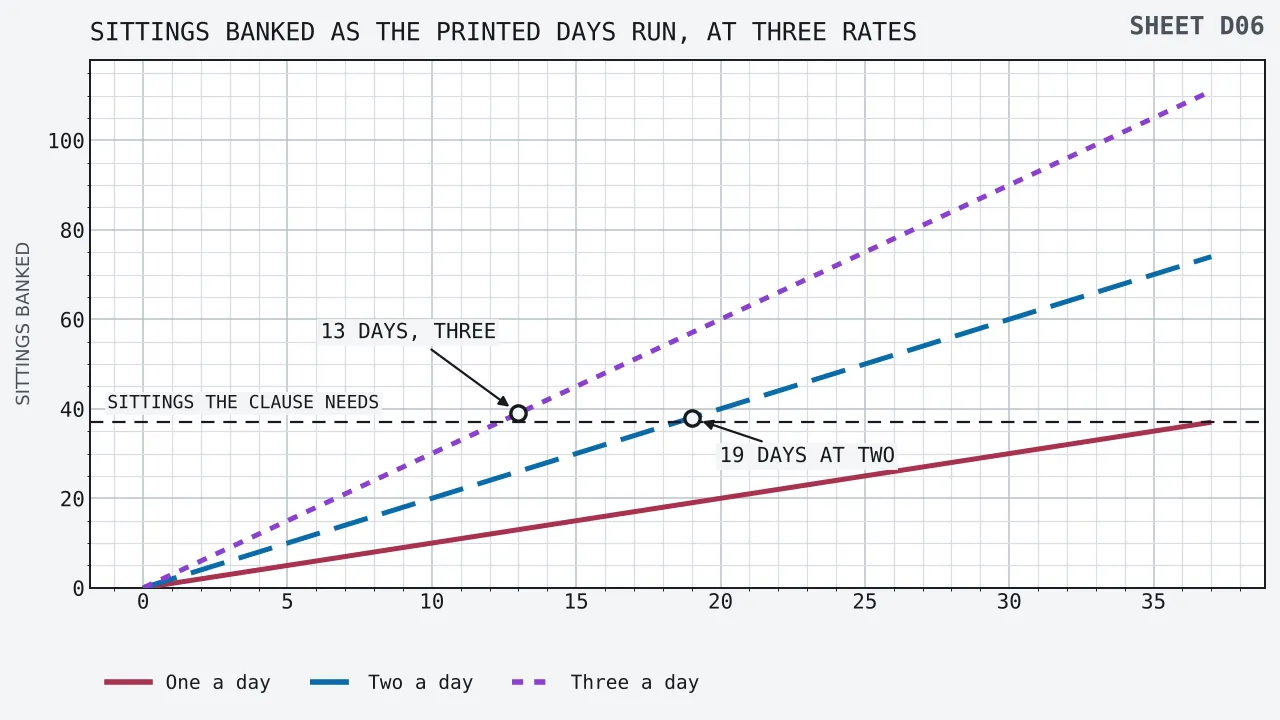
The lines on that plate are straight for a reason worth naming: a sitting is a unit of habit rather than of money, so it accumulates at a steady rate that has nothing to do with how the reels behave. Nothing about a good evening or a bad one bends any of the three lines. Where they cross the rule is settled entirely by the rate a reader keeps and the length of the period a sheet printed.
Reading day seven off the plate gives the headline of this note. At one a day the week banks seven sittings. At two a day it banks fourteen. At three a day it banks twenty-one. All three are a long way under the broken rule, and the gap at the rate posited here is the twenty-three the heading names.
Where a week does reach the rule is at a little over five sittings a day, which is 37 divided by 7 and comes to 5.29. Nobody plans their day in fifths of a sitting, so the practical statement is six sittings a day for seven consecutive days, being two hours and twelve minutes of handset time daily, to discharge ten pounds of credit with an expected close of minus six.
One more figure belongs here because it changes which constraint is binding. Ten pounds of credit stands behind £250.00 of staking once four pence a pound is charged against it, which is 2,500 presses and 23 sittings. At two sittings a day that balance is expected to be gone partway through day twelve, so on an average run the credit expires before any period of nineteen days or more could expire first.
6
Whole sittings, and what that does to the final day
Sittings are whole things, which makes the conversion lumpy at both ends and costs a reader twice. At the far end, 36 full sittings carry 3,960 presses, leaving 40 presses for the thirty-seventh. Forty presses at the posited interval is eight minutes of work inside a twenty-two minute slot, so fourteen minutes of the last booked sitting are never used.
That stub is not a rounding error in the arithmetic. It is a whole separate occasion on which a phone has to be unlocked, an app opened, a balance checked and a game found, for eight minutes of pressing. Whatever the overhead of starting a sitting is, the thirty-seventh pays all of it for roughly a third of a sitting’s output.
8 min of work booked into the 37th sitting
At the near end the lumpiness works the same way against short periods. A period of six days and a period of seven days both convert to whole sittings, and at two a day the difference between them is two sittings, being 220 presses and £22.00 of staking and fifty-five pence of credit. One printed day is worth 5.4 per cent of this clause, so the gap between a six day sheet and a seven day sheet is 5.4 per cent of the work.
Which gives a blunt way of valuing an extension. A desk that lengthens a period by three days has added 6.6 sittings at the posited rate, 726 presses and £1.65 of discharged credit. Against a requirement of thirty-seven sittings, three days is worth about a sixth of what a reader needs, and an extension of under a fortnight on this credit is cosmetic.
Reading the lumpiness across all the windows in part three, the useful general statement is that a period converts at two sittings per printed day and never at anything finer. Hours inside a day do not convert at all, which is why a sheet moving from seventy-two hours to ninety-six hours has given a reader two more sittings and nothing else.
7
Periods that do convert, counted in weeks rather than days
Turning the question round for the last time: what period would hold this clause? The answer depends only on the rate, and it is worth setting out in calendar language because days are how a sheet prints and weeks are how a person plans.
| Sittings a day the reader keeps | Presses banked daily | Credit discharged daily | Days to reach thirty-seven sittings | The same period as a calendar reads it |
|---|---|---|---|---|
| One | 110 | 27.5p | 37 | Five weeks and two days |
| Two | 220 | 55p | 19 | Two weeks and five days |
| Three | 330 | 82.5p | 13 | One week and six days |
| Four | 440 | £1.10 | 10 | One week and three days |
| Five | 550 | 137.5p | 8 | One week and one day |
Row two is the one to carry away, because two sittings a day is the rate this note has posited for an ordinary reader. Nineteen days is two weeks and five days, and that is the shortest period on which a ten pound credit at forty times is a real proposition rather than a lottery about whether the reels keep the balance alive.
Rows three to five describe a reader giving over an hour a day to one app for a week and a half. They finish, and the thing they finish has an expected close of minus six pounds, which puts the exercise at a cost of roughly forty-six pence for each hour of attention spent on it. That quotient is the honest price of the arrangement for somebody who does everything right.
Row one is the reader most periods are actually written against. Thirty-seven days at one sitting a day is five weeks and two days, and almost nothing in this market prints a period that long. So a sheet printing seven days has, in effect, restricted the offer to readers capable of six sittings daily, without saying so and quite possibly without anybody having worked it out.
The scaling is linear and worth stating for other sizes. Every pound of credit is 400 presses, which is 3.64 sittings, and at two a day that is 1.82 days. A five pound credit therefore wants ten days and a twenty pound credit wants thirty-seven, at the rate posited here, with the fractions carried upward in both cases.
8
Other durations printed in days, read in the same unit
Credits of this build come from desks outside the British register, and on a page about converting periods the duties to set down are the ones measured in time. Several exist, some British and some from the one offshore rulebook with published durations in it, and putting them through the same exchange rate as a bonus window makes the comparison a single-column affair.
| The duration | What it governs | Sittings at two a day | Presses it would carry |
|---|---|---|---|
| Twenty-four hours | The shortest break a Curaçao desk must offer | 2 | 220 |
| Twenty-four hours | The least a British system waits before a limit rises | 2 | 220 |
| Seven days | A break of a week on the same offshore menu | 14 | 1,540 |
| Seven days | The offshore wait before a deposit limit rises | 14 | 1,540 |
| One month | A break of thirty days, counted as thirty here | 60 | 6,600 |
| Three months | The longest break on that menu, counted as ninety | 180 | 19,800 |
| Six months | Between prompts to review a British account in use | 364 | 40,040 |
Rows one, three, five and six come from the responsible gaming policy a Curaçao licence holder works to, which requires a break to be available at any one of the lengths above, reachable by a single click without an e-mail and without the operator’s agreement, taking effect at once and selectable for one product rather than all. That policy also shuts off three ways of talking somebody round: querying why they want it, handing out reassurance so that it is put off, and dangling a promotion in front of them so that play continues.
Read that last clause against the subject of this note. A credit with a clock on it is precisely the instrument the prohibition names, and the prohibition exists in a rulebook that applies only where a desk actually holds the licence it refers to. A site citing a registration whose regulator publishes no rulebook that could be found is bound by none of it, and this note will not guess at what such a place requires.
Rows two and four are the same duty in two jurisdictions and they run in opposite directions, which is worth the space. A reduction in a self-set deposit limit takes effect immediately under both. A rise waits at least twenty-four hours under the British standard and seven days under the offshore policy, which in the unit of this page is two sittings against fourteen. On that one point the offshore rule is the slower and therefore the more protective of the two.
Row seven is a British requirement with nothing offshore beside it. A licensed system has to ask a customer to go through their own account and their own record of transactions no less often than twice a year, where that account has seen use inside a rolling twelve months, and has to prompt a customer holding no financial limit to revisit that at least once a year. Converted, those are 364 and 730 sittings, which makes them an order of magnitude longer than any period a bonus carries and explains why they protect a different thing entirely.
What a reader gives up, stated in this page’s own unit, is a published duration for anything. The one offshore rulebook with periods in it says two things about bonuses, being that terms must be put transparently and that aggressive promotion must not encourage excessive play, and neither of those is a number. So the thirty-seven sittings and the seven printed days sit beside each other with nothing in any rulebook obliged to reconcile them.
9
Which figure on a banner settles all the others
Convert before comparing, and the market reorders itself. The sum in pounds converts at 3.64 sittings for each pound credited. The period converts at two sittings for each printed day, on the rate this note posits and states openly. Put the two conversions beside each other and a reader can tell in one subtraction whether a thing is finishable.
For this credit the subtraction is thirty-seven against fourteen, and the answer is twenty-three sittings short. No arrangement of a single week closes that gap at two sittings a day, and closing it at all means either nineteen days of period or six sittings on every one of seven consecutive days.
Who should take it anyway is the same narrow group every note in this section arrives at. Somebody who was going to spend twenty evenings on reels in any case loses nothing by holding a credit that expires, because the sittings were going to happen and the credit simply funded some of them. The conversion matters only to a reader who means to reach the end.
For that reader the practical advice is a habit rather than a rule. Count the sittings before the pounds. Multiply the credit by 3.64 to get the sittings, divide the printed days by the sittings you actually manage, and compare. Both halves of that are arithmetic a person can do standing up, and neither appears anywhere on the offer.
One caution closes it, and it is about this note’s own figures. Two sittings a day is posited here and is not a measurement of anybody, so a reader who manages four should run the sums at four and will get ten days instead of nineteen. What does not change with the rate is the shape of the thing: a period written in days and a condition written in presses, with the exchange rate between them left for the reader to supply.
Questions
- How many sessions does a free £10 no deposit bonus actually take?
- Thirty-seven, at the length this note posits for one. The multiple sends £400.00 across the reels; ten pence a press divides it into 4,000 presses; a twenty-two minute sitting carries 110 of those at the twelve second interval posited here. Four thousand divided by 110 is 36.36, carried up to 37. Both the sitting length and the interval are modelling conventions and neither was measured.
- Is seven days long enough to clear a ten pound credit?
- Not at any ordinary rate. A week supplies seven sittings at one a day, fourteen at two and twenty-one at three, against the thirty-seven the clause needs. At two a day, which is what this note posits for an ordinary reader, the week covers 37.8 per cent of the requirement and leaves twenty-three sittings with nowhere to go. Reaching thirty-seven inside seven days wants six sittings on every one of the seven.
- How much of a printed day is actually usable on a handset?
- Forty-four minutes, on this note’s own posited rate of two sittings of twenty-two minutes. Across seven days that is 308 minutes, being 5 h 8 min, against the 800 minutes the clause asks for. The same week contains 168 hours of calendar, so the usable share is 3.06 per cent of the period and 38.5 per cent of the obligation.
- What is one day of a bonus window worth?
- Fifty-five pence of credit, at two sittings a day. A day at that rate is 220 presses and £22.00 of staking, and £22.00 of staking discharges fifty-five pence under a forty times clause. At one sitting a day the rate is 27.5 pence and at three it is 82.5 pence. Divide the credit by the rate and the period a sheet would have to print falls out.
- What period would hold the clause on a ten pound credit?
- Nineteen days at two sittings a day, which a calendar reads as two weeks and five days. At one sitting a day it is 37 days, at three it is 13, at four it is 10 and at five it is 8. Each of those is thirty-seven sittings divided by the rate, with the fraction carried upward, and the rate is the figure this note supplies rather than measures.
- Why does the last sitting only hold eight minutes of work?
- Because sittings are whole and 4,000 presses are not a multiple of 110. Thirty-six full sittings carry 3,960 presses, which leaves 40 for the thirty-seventh, and 40 presses at the posited interval is eight minutes. The remaining fourteen minutes of that booked sitting go unused, while the whole overhead of unlocking a phone and finding the game is paid for them.
- Does the credit or the window usually run out first?
- The credit, on an average run. Ten pounds funds £250.00 of staking at four pence in every pound, which is 2,500 presses and 23 sittings, and at two sittings a day that is reached partway through day twelve. Any period long enough to hold the clause is longer than twelve days, so on the modelled run the balance is gone before the clock has anything to take.
- How much difference does extending a window by a few days make?
- Less than most readers expect. Three extra days at two sittings a day is 6.6 sittings, 726 presses and £1.65 of discharged credit, against a requirement of thirty-seven sittings. One printed day is worth 5.4 per cent of this clause, so an extension of under a fortnight on a ten pound credit is cosmetic rather than material.
- Does a credit of this sort hold a British licence, and what duration rules go missing?
- It comes from a desk where no British licence is held, and what a page about periods should name are the losses measured in time. A Curaçao licence holder has to make a break available at a day, at a week, at a month or at a quarter, got by one click with no need of the operator’s agreement, biting straight away, and must not put a bonus in front of a player as a reason to keep going. A deposit limit falls immediately in both regimes, while a rise waits at least twenty-four hours in Great Britain and seven days offshore. A British system must also prompt a customer to review an account in use at least every six months. None of it reaches a desk whose regulator publishes no rulebook that could be read.
- How do the sittings scale for other sizes of credit?
- Linearly, at 3.64 sittings for each pound credited. One pound is 400 presses, which is 3.64 sittings at 110 presses each, and at two sittings a day that is 1.82 days. So a five pound credit wants ten days, a ten pound credit wants nineteen and a twenty pound credit wants thirty-seven, with every fraction carried upward.