Note U06 Revision 1 Terms read 17 October 2026
Ethereum casino withdrawals, priced by demand instead of by a schedule anybody prints
A tariff is a list somebody published before the decision was taken. What settles the cost of one movement across a public network is demand at the minute of asking, so the price arrives after the choice rather than before it. At the £2.40 this note assumes for a busy minute, a £10.00 balance lands 24 per cent lighter, and anything at or under that charge lands as nothing. Waiting for a quieter minute is the only lever, and six hours of it saves two pounds, which is 500 presses of expected cost.
A charge assumed here £2.40 What six hours saves 500 presses Nothing lands under £0.40
What a movement out asks in hours
Advertising has been bought for every destination below. A fee reaches this site when a reader goes on to register, and no figure on this page moves one way or the other because of it.
-
01Mobile Free Spins
Betportal
Ceiling as a multiple
What lands€15.00150 spins at 10c, which is this site's figure and not the operator'sThe run17 h 30 minTurning over 525.00 at 10p means 5,250 presses, or about 48 phone sittings of 22 minutes. Timed at 10p a press and 12 seconds between presses, both of which this site assumes rather than measures.The wait to be paidNOT PUBLISHEDThis operator puts no withdrawal band in its own terms, so there is nothing honest to print here.Spins valued at this site's own 10p a spin
What lands
Spins, at a price15.00150 of them at 10c apiece, a figure belonging to this site rather than to the operatorMatch, and other creditno figure300% of three deposits, to a ceiling of €1,000. Not a sum until money of yours makes it one, so this row totals nothing and carries nothing downwardsThe run
Handed back on the spins(0.60)Each press stakes its own value and returns 96 per cent, which leaves this much with the house from the opening pressPlay-through 35x on the bonus(20.16)Taking 14.40 round 35 times over means 504.00 through the machines, of which 20.16 is the expected cost, and 17 h 30 min of pressing at the pace aboveWhat counts towards it100%Slots only, with no percentage published anywhere, so the row above assumes the whole of each stake countsWhat never clears
Limit on the winningsstated5x the bonusDeducted on the way outno figureNothing is published as a figure here, so this row removes nothingLeast that can leaveno figureNo figure is published, so nothing on this timer is pinned down by oneLeast deposit, and the rung over ityour own€20 a stage. Published in euros, so no rung is named at all: this site's ladder is a sterling oneThe window on the creditstated14 daysBiggest stake while it runsstated€5Removed outright by rulestatedNot publishedVerified before a payoutstatedDocuments before the first withdrawalNever clears€15.00Not a penny of it gets out, so the whole of what landed stands on this rowNo Great Britain licence
Licence held in Anjouan, Comoros, the company named is BetPortal Gaming Ltd, with Excite Ultra Media Ltd, quoted under ALSI-202601040-FI2.
Terms read 17 October 2026
Open the offer at Betportal, opens in a new window -
02Mobile Free Spins
WinBeast
Ceiling as a sum
What lands€50.00500 spins at 10c, which is this site's figure and not the operator'sThe run2 d 18 hTurning over 2,000.00 at 10p means 20,000 presses, or about 182 phone sittings of 22 minutes. Timed at 10p a press and 12 seconds between presses, both of which this site assumes rather than measures.The wait to be paidNOT PUBLISHEDThis operator puts no withdrawal band in its own terms, so there is nothing honest to print here.Spins valued at this site's own 10p a spin
What lands
Spins, at a price50.00500 of them at 10c apiece, a figure belonging to this site rather than to the operatorMatch, and other creditno figure50% to 100% of five deposits, each to a ceiling of €1,000, and a €650 free bet. Not a sum until money of yours makes it one, so this row totals nothing and carries nothing downwardsThe run
Handed back on the spins(2.00)Each press stakes its own value and returns 96 per cent, which leaves this much with the house from the opening pressPlay-through 40x on the bonus and the winnings from the spins(76.80)Taking 48.00 round 40 times over means 1,920.00 through the machines, of which 76.80 is the expected cost, and 2 d 18 h of pressing at the pace aboveWhat counts towards it100%Slots, titles vary by country, with no percentage published anywhere, so the row above assumes the whole of each stake countsWhat never clears
Limit on the winningsstated€100 a batch of spinsDeducted on the way outno figureNothing is published as a figure here, so this row removes nothingLeast that can leaveno figureNo figure is published, so nothing on this timer is pinned down by oneLeast deposit, and the rung over ityour own€20 a stage. Published in euros, so no rung is named at all: this site's ladder is a sterling oneThe window on the creditstated7 days, spins 1 dayBiggest stake while it runsstatedNot publishedRemoved outright by rulestatedNot publishedVerified before a payoutstatedDocuments before the first withdrawalNever clears€50.00Not a penny of it gets out, so the whole of what landed stands on this rowNo Great Britain licence
Licence held in Curaçao, no company named anywhere on the site.
Terms read 17 October 2026
Open the offer at WinBeast, opens in a new window -
03Mobile Free Spins
EliteSpin
Longest spin window
What lands£50.00500 spins at 10p, which is this site's figure and not the operator'sThe run2 d 18 hTurning over 2,000.00 at 10p means 20,000 presses, or about 182 phone sittings of 22 minutes. Timed at 10p a press and 12 seconds between presses, both of which this site assumes rather than measures.The wait to be paidNOT PUBLISHEDThis operator puts no withdrawal band in its own terms, so there is nothing honest to print here.Spins valued at this site's own 10p a spin
What lands
Spins, at a price50.00500 of them at 10p apiece, a figure belonging to this site rather than to the operatorMatch, and other creditno figure50% to 100% of five deposits, each to a ceiling of £1,000. Not a sum until money of yours makes it one, so this row totals nothing and carries nothing downwardsThe run
Handed back on the spins(2.00)Each press stakes its own value and returns 96 per cent, which leaves this much with the house from the opening pressPlay-through 40x on the bonus and the winnings from the spins(76.80)Taking 48.00 round 40 times over means 1,920.00 through the machines, of which 76.80 is the expected cost, and 2 d 18 h of pressing at the pace aboveWhat counts towards it100%Slots, with no percentage published anywhere, so the row above assumes the whole of each stake countsWhat never clears
Limit on the winningsstated5x the bonusDeducted on the way outno figureNothing is published as a figure here, so this row removes nothingLeast that can leaveno figureNo figure is published, so nothing on this timer is pinned down by oneLeast deposit, and the rung over ityour own£20 a stage. It lands square on the £20.00 rung, so none of yours is left perched on topThe window on the creditstated7 days, spins 3 daysBiggest stake while it runsstatedNot publishedRemoved outright by rulestatedNot publishedVerified before a payoutstatedDocuments before the first withdrawalNever clears£50.00Not a penny of it gets out, so the whole of what landed stands on this rowNo Great Britain licence
Licence held in Costa Rica, the company named is PrimeTier Limited.
Terms read 17 October 2026
Open the offer at EliteSpin, opens in a new window -
04Mobile Free Spins
Crown Jewelz
Multiple unpublished
What lands£15.00150 spins at 10p, which is this site's figure and not the operator'sThe runNOT TIMEDThis operator does not publish the play-through multiple in its own terms. The multiple is the one figure the clock cannot work around, so the run is left untimed.The wait to be paidNOT PUBLISHEDThis operator puts no withdrawal band in its own terms, so there is nothing honest to print here.Nothing reckoned
What lands
Spins, at a price15.00150 of them at 10p apiece, a figure belonging to this site rather than to the operatorMatch, and other creditno figure200% of the first deposit, then 150% twice, each to a ceiling of £1,000. Not a sum until money of yours makes it one, so this row totals nothing and carries nothing downwardsThe run
Play-throughno figure40x the bonus, reported rather than published by the operatorWhat counts towards itno figureSlots, with no percentage published anywhere, so the row above assumes the whole of each stake countsWhat never clears
Limit on the winningsstatedNot publishedDeducted on the way outno figureNothing is published as a figure here, so this row removes nothingLeast that can leaveno figureNo figure is published, so nothing on this timer is pinned down by oneLeast deposit, and the rung over ityour own£20. It lands square on the £20.00 rung, so none of yours is left perched on topThe window on the creditstatedNot publishedBiggest stake while it runsstatedNot publishedRemoved outright by rulestatedNot publishedVerified before a payoutstatedDocuments before the first withdrawalNever clearsNOT RECKONEDThis operator leaves the play-through multiple out of its own terms, so nothing below the fourth step can be worked out.No Great Britain licence
Licence held in Curaçao, number not verified, no company named anywhere on the site.
Terms read 17 October 2026
Open the offer at Crown Jewelz, opens in a new window
Only the middle reading comes out of arithmetic belonging to this site. The multiple laid against what lands gives the turnover asked for; dividing that by 10p a spin gives the presses; dividing those by 300 an hour gives the hours, a press on a handset being taken here at 12 seconds from the one before. Both figures are assumptions rather than measurements of anybody: nothing was played and nothing was held a stopwatch to. Anybody quicker should divide the press count by a rate of their own, which is why the presses are printed alongside the hours instead of being summarised away.
The first reading is what arrives before any condition is laid against it. Spins carry no unit of their own so one gets supplied: where an operator values its own spin that figure is used and attributed, and where it does not, this site's 10p a spin stands in and everything below moves with it. The third reading belongs to the operator entirely. It is a withdrawal band quoted from published terms, and a blank there means none was published rather than that nobody looked.
The total along the foot answers what the hours leave open, which is whether any of the running ends anywhere. It is what arrived, less whatever is still standing once the play-through has been paid for at 96 per cent return to player and once a published limit, a published deduction and a published floor beneath the least that can leave have each had a turn. It appears again in pence in the pound, the only fair way of holding a small offer up against a large one. It describes an offer rather than an evening, and where the conditions price out what arrived, a timer prints nothing getting out instead of a negative sum.
Cashiers on a handset take deposits off a row of preset buttons, so a least deposit given in pounds is raised to the next rung of the ladder used here, £10, £20, £25, £50, £75 and £100, and the timer shows what is left perched on it. That money is the reader's own and enters no sum at all. Given in euros it prints untouched, the ladder being sterling. Three words may occupy the figure column where no figure belongs. Stated is a published term that costs something while leaving no number to subtract. No figure is a term nobody has quantified, or a credit that is not a sum until money of yours makes it one. Your own is money of yours, which belongs in none of this.
None of the operators above is licensed in Great Britain, so not one duty that licence carries reaches any of them. Membership of Gamstop Online is compulsory for every online gambling company licensed in Great Britain, which means that shutting yourself out through the scheme shuts you out of none of these. The limit of ten times the bonus funds on a wagering requirement, running since 19 January 2026 under Social Responsibility Code 5.1.1, is a condition of the same licence and binds only whoever holds one. Off that licence, the Gambling Commission writes of consumers meeting unfair gaming practices, financial loss and no recourse when matters go wrong, and lists blocked payouts and withdrawal limits pitched too high to reach among the things it has seen. No account at any of them may be held by anybody under 18.
Every term on a timer is its operator's own and every timer carries the day somebody read it. The oldest of those readings is 17 October 2026. What binds a reader is an operator's full terms and never a line printed here.
1
Two ways of pricing one act, and only one of them is a list
Two prices can attach to the same act and they behave nothing like each other. A tariff is drawn up beforehand, published, and identical for everybody reading it on a given day. The alternative is whatever demand settles on in the minute the act occurs. Movements across a public network take the second form, and that property governs every figure below.
Assistance in reaching a business of that description is absent by design, and the design was fixed before any sum was worked. Names, addresses, the paperwork a sign-up wants, the instruments that fund one and the way a household configures its connection are all missing on purpose. A bank’s stop on gambling payments sits in the same category, as does one from whoever supplies the broadband, and neither draws a sentence of help here.
A reader holding a Gamstop Online registration who has reached this page through a search of that shape is in the exact position the registration was taken out against. One telephone number is the whole of what gets recommended to such a reader: 0808 8020 133, answered by GamCare, costing nothing to dial and shutting on no day in the year. Sums occupy the rest of this note, and their job is to measure the trade rather than to make it.
Two charges carry the whole note and both are assumptions declared by this page. Two pounds forty is what it assumes a single movement out costs at a busy minute. Forty pence is what it assumes the same movement costs at a quiet one. Neither was observed and neither was looked up, because a cost settled by demand has no published value to look up, and the regulatory sheet behind this site carries no claim about any network, any charge or any confirmation time.
Six hours is the third assumption and the second half of this note turns on it. A quiet minute is taken to arrive six hours behind a busy one, with the charge easing along a straight line between them. Straightness is a modelling convenience and not a description of demand, earning its place by making the saving strictly proportional to the waiting, which is the least flattering shape the argument below could be given.
Nought is what consulting a published schedule costs, and that nought is the whole of what is being priced here. Printed prices put the decision and its cost in the reader’s hands at the same instant. Unprinted ones reverse the order, and parts two to seven measure what the reversal is worth on a balance of ordinary size.
More than one charge can ride on a single movement, and this note treats the lot as one sum. Whatever a cashier subtracts and whatever the network takes land in the same place, being the gap between the balance beforehand and the amount afterwards. No conclusion here turns on which component is the larger.
2
A fixed sum set against balances that are not fixed
Two pounds forty is a quantity and not a rate, and the difference between those two words is what does the damage on a small balance. A rate takes a constant share whatever the size. A quantity takes whatever share it happens to come to, which climbs as the balance shrinks and reaches the whole of it at the moment the two are equal.
Division produces the table below and nothing else is involved in it. Each row is one balance standing on an account before anybody asks for it, the two assumed charges subtracted from it, and the share each of those charges turns out to be. The last column is the difference between the two, which is what a reader buys by holding off.
| Standing before the move | Lands at £2.40 | Share it takes | Lands at £0.40 | Share it takes | Bought by holding off |
|---|---|---|---|---|---|
| £0.40 | nothing | the lot | nothing | the lot | nothing |
| £1.00 | nothing | the lot | £0.60 | 40.0% | £0.60 |
| £2.40 | nothing | the lot | £2.00 | 16.7% | £2.00 |
| £5.00 | £2.60 | 48.0% | £4.60 | 8.0% | £2.00 |
| £10.00 | £7.60 | 24.0% | £9.60 | 4.0% | £2.00 |
| £25.00 | £22.60 | 9.6% | £24.60 | 1.6% | £2.00 |
| £60.00 | £57.60 | 4.0% | £59.60 | 0.7% | £2.00 |
| £200.00 | £197.60 | 1.2% | £199.60 | 0.2% | £2.00 |
Twenty-four per cent sits in the fifth row and it is the figure worth carrying out of this part. A tenner on an account, moved at the busier of the two assumed charges, reaches its destination as £7.60. Nobody would read a condition promising that, and nobody has to, because the condition was never written down. It is produced by subtracting a quantity nobody knew in advance from a balance that happened to be small.
Rows one to three behave differently from the five beneath them, and the break is sharp. Up to the charge itself nothing whatever is delivered, the subtracted quantity being at least the size of what it comes off. Above the charge something always lands, improving from there without ever quite reaching the whole.
Two hundred pounds is in the bottom row to mark where the problem stops being one. Twelve pence in every ten pounds is an irritation and not a defect. Everything difficult about this page lives in the rows above that one, which is to say on the balances a phone sitting actually produces.
Nothing in that table rests on the £2.40 being correct. Halve it and every share in the third column halves too, so a tenner loses 12 per cent rather than 24 and the row where nothing lands drops to £1.20. The ordering comes out of a fixed sum meeting a variable balance, not out of the size of either.
3
Where the charge overtakes a whole pass across the reels
Fourpence in each pound crossing the reels is what this site’s standing figures expect the house to keep, being the gap left by a return of 96 per cent. One rate, and it turns a balance into an expected cost with no further apparatus, because a balance played once through stakes exactly itself.
Any balance funds ten presses for each pound of it at the ten pence staked throughout, and running all of them stakes the balance once. Four per cent of the balance is therefore the expected cost of one complete pass, whatever the size, and that proportion is the only honest yardstick here for saying whether a charge is large.
Sixty pounds is where the two meet at the busier assumed charge. Four per cent of £60.00 is £2.40, so a balance of that size would be expected to lose exactly the assumed charge by being run once across the reels. Ten pounds is where the quieter assumed charge meets the same test, four per cent of a tenner being forty pence. Both crossings are exact rather than approximate and neither needed rounding.
£60.00 is where an assumed £2.40 equals one whole pass across the reels
Nothing in that comparison argues for pressing a balance away instead of moving it. The expected cost of a pass is a yardstick and not a recommendation, since a pass also takes two hours of a person. What the crossing measures is scale: under £60.00 the assumed charge is larger than everything the house expects to take from a full run of the same money.
Two hours is that same £60.00 pass read as duration: 600 presses, each given the twelve seconds this note assumes, fill exactly that. So the busier assumed charge and two hours of pressing cost the same in expectation, which is a sentence worth sitting with before any of the rest of this note. One of the two takes an evening. The other takes however long a confirmation takes, and the reader does not choose it.
Both of the crossings move with the charge and neither moves with the balance, which is the useful property. Divide the assumed charge by four per cent and the answer is the balance at which the two match: £2.40 gives £60.00, forty pence gives £10.00, and a charge of a pound would give £25.00. A reader with a charge of their own can run that division and find their own crossing in one step.
4
Six hours bought for two pounds, drawn against the clock
Two pounds is the most that waiting can ever be worth on the pair of charges assumed here, being the whole distance between them. Spread that across the six hours this page assumes for the easing, and waiting pays at 33.3 pence an hour. That rate is the subject of this part and of the drawing inside it.
Thirty-three pence an hour is not nothing and it is not much, and which of those it resembles depends entirely on what the hours are doing otherwise. An hour spent asleep costs nobody anything and collects the full 33.3 pence. An hour spent with the balance still inside the cashier is a different object, and the next part prices it.
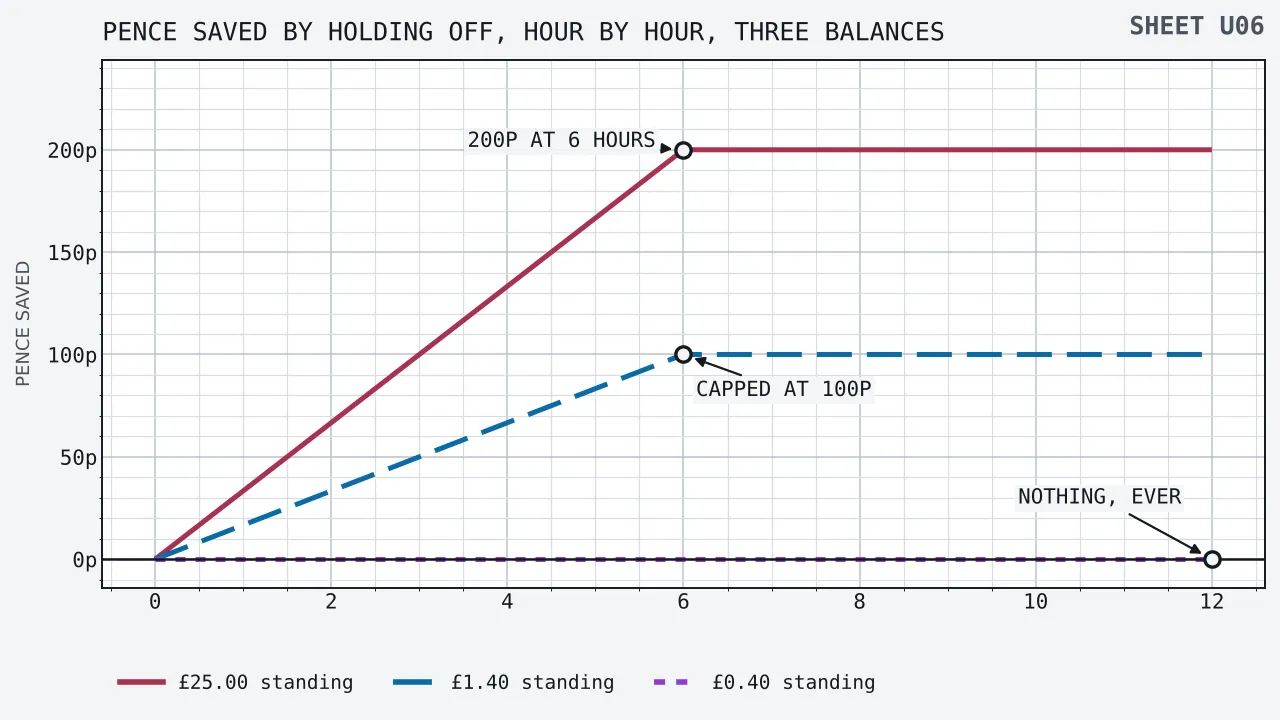
Three lines and three different answers is what the drawing holds. A balance of £25.00 collects the entire two pounds by the sixth hour and nothing after it, because the charge has stopped falling. A balance of £1.40 collects one pound, since forty pence still goes whatever happens and the busier charge would have taken the lot. A balance of forty pence collects nothing at any hour, which is the flat line and the subject of part five.
Flattening is the property the drawing exists to show. Waiting is worth something only while the charge is still moving, and the easing is assumed to stop at six hours. Hour seven collects nothing and hour twelve collects nothing, so a day of holding off buys exactly what a morning of it bought, at four times the cost in hours.
Nothing about the six hours is special and the shape does not depend on it. Make the easing take two hours and the lines reach their ceilings three times sooner at three times the rate, which is a pound an hour instead of 33.3 pence. Make it take a day and the rate drops to 8.3 pence an hour. What survives every version is the ceiling: two pounds is the whole prize, and no amount of waiting has ever bought more than the distance between the two charges.
One hundred pence is the middle line’s ceiling and the reason for drawing it. A small balance collects only what it holds above forty pence, so £1.40 keeps a pound by holding off while £25.00 keeps two, the second twice as good on a balance nearly eighteen times the size.
5
The balance beneath which waiting can never repay itself
Forty pence is the floor and the reasoning takes one line. At or under the quieter assumed charge, nothing survives the movement whichever minute it is made in, so the two outcomes are identical and the difference between them is nought. Waiting cannot improve an outcome that is already nothing, and no number of hours changes that.
Between forty pence and £2.40 the saving is whatever the balance holds above forty pence, climbing penny for penny. At £1.00 it is sixty pence. At £1.40 it is a pound. At £2.00 it is £1.60. From £2.40 upwards it stops climbing for good and sits at two pounds, however large the balance gets. Those three regimes are the whole behaviour of the thing, and a reader who knows which one they are in knows what the decision is worth.
Five hundred presses is the second answer and it is the one this site is built to give. Expected cost runs at 0.4 pence a press on the figures used throughout, so two pounds of saving is the expected cost of 500 of them. At twelve seconds a press, an assumption of this site rather than anything observed, that comes to 1 h 40 min of pressing, or four and a half sittings of twenty-two minutes apiece on the assumed rhythm.
A wait containing more than 500 presses has therefore cost more than it could possibly save, and the comparison needs no further apparatus than those two figures. Somebody who holds off for six hours and presses through four of them has staked £120.00 and given up an expected £4.80 to collect two pounds. The arithmetic is not close. It is out by a factor of 2.4, and every further hour of pressing widens it.
500 presses of expected cost is the whole of what holding off can save
One pound twenty an hour against 33.3 pence an hour is the same statement written as two rates, and the ratio between them is 3.6. Pressing while waiting costs 3.6 times what the waiting earns, on this site’s standing assumptions and this page’s own pair of charges. That ratio holds whatever the balance is, because both rates are independent of it, and it is the single most portable figure on this page.
Nothing here says a reader will press during a wait, and the finding has two halves. Hold off and do nothing else and it pays, at 33.3 pence an hour on any balance above forty pence. Hold off with the balance still where it can be staked and the arithmetic turns over, because 0.4 pence a press accumulates faster than the charge eases.
6
One charge read in presses rather than in pence
Two conversions exist for a sum of money on this site and confusing them flatters the smaller one. A charge can be read as staking, which is how many presses of ten pence it would fund. It can also be read as expected cost, which is how many presses the house would be expected to take it from. The second figure is always twenty-five times the first, because four pence comes off each pound rather than the whole pound.
Twenty-four presses of staking is the busier assumed charge read the first way, being £2.40 at ten pence a press, and at the twelve seconds assumed here that is 4 min 48 s of a person’s evening. Six hundred presses of expected cost is the same £2.40 read the second way, which is two hours of pressing. Both are true and they answer different questions, so this note prints which one it means every time it uses either.
| How the assumed charge is read | At £2.40 | At £0.40 |
|---|---|---|
| Presses of ten pence it would fund | 24 | 4 |
| Pressing those presses occupy | 4 min 48 s | 48 s |
| Presses whose expected cost it equals | 600 | 100 |
| Pressing of that expected cost | 2 h | 20 min |
The third row is where the charge begins to feel its real size. Six hundred presses is five and a half sittings on the twenty-two minute assumption, and a reader who has sat through that many has put £60.00 across the reels to lose, in expectation, exactly what one movement out was assumed to cost. Nobody describes a charge that way, and nobody prints it beside the balance either.
Four minutes forty-eight seconds in row two is the honest counterweight. Measured as staking, £2.40 is a trivial quantity: twenty-four presses, under a quarter of a sitting, spent inside the span of reading this paragraph twice. Printing only the two hours would be choosing the frightening conversion and hiding the other.
Both conversions move together when the charge moves, which keeps them easy to redo. Divide any charge by ten pence for the staking figure and by 0.4 pence for the expected-cost figure, then divide either by 300 for hours at the pace assumed here. A charge of a pound comes to ten presses of staking and 250 presses of expected cost, which is fifty minutes of pressing. No part of that needs this page’s own assumed £2.40 to be right.
Nothing was timed anywhere in the paragraphs above. The twelve-second press and the twenty-two minute sitting are modelling conventions this site adopted, declared wherever either carries a figure, and a quicker thumb shortens every duration while leaving every press count where it stands. Press counts are the durable half of this arithmetic and clock readings the readable half.
7
Paying it once set against paying it every single time
Once per movement is how a charge of this shape lands, so the count of movements sets the bill and the size of each barely matters. A percentage works the other way: split a sum in four and it costs what one movement costs. Here, splitting in four costs four times.
Ten pence in the pound is the busier assumed charge against a £24.00 balance moved in one go. The same charge against £240.00 is a penny in the pound. The same charge against £2.40 is the entire pound. Nothing changed except the size of the movement, and between the first case and the third the cost per pound moved spanned a hundredfold.
| How many movements it is taken in | Size of each | Charges paid in total | What reaches the far end | Share of the balance gone |
|---|---|---|---|---|
| One | £24.00 | £2.40 | £21.60 | 10% |
| Two | £12.00 | £4.80 | £19.20 | 20% |
| Three | £8.00 | £7.20 | £16.80 | 30% |
| Four | £6.00 | £9.60 | £14.40 | 40% |
| Six | £4.00 | £14.40 | £9.60 | 60% |
| Ten | £2.40 | £24.00 | nothing | 100% |
Ten is the row the table was built to reach. A balance divided into pieces the size of the charge disappears entirely on the way out, and the general form of that is the balance divided by the charge. Twenty-four pounds taken in bites of £2.40 is ten bites and nothing at the end of them. The same balance taken in bites of forty pence, at the quieter assumed charge, would survive sixty of them and arrive intact only if it were taken in one.
Nobody plans to take a balance out in ten pieces, and the table is not about planning. It is about a habit nobody decides on: collect a little when a sitting ends well, repeat it a fortnight later, and the count climbs unnoticed. Ten occasions in a year is nothing unusual, and ten is the number at which a £24.00 balance disappears into charges on the figure assumed here.
Inside the Great Britain licence a published rule addresses both the size of a withdrawal and the number of them, and part eight sets out what it says. The point that belongs here is the arithmetic rather than the rule: a per-movement charge converts a restriction on how often money may be taken out into a price, and a price does not have to be announced to work exactly like a restriction.
Four hundred and eighty presses of expected cost is the £1.92 by which four movements beat one, or 1 h 36 min of pressing at the pace assumed here. Framed as 20 pence a time nobody would think about it, and framed as an hour and a half of evenings somebody might.
8
Rules written over the act of taking money away
Four published rules are the ones whose absence can be costed on a note about the price of leaving, and a cashier reached by a search of this shape operates with no Great Britain licence behind it. Others are missing too, and this section’s other notes put figures on them. These four bear on the sums above.
Rule one sets the ceiling at none. No term in a consumer contract or notice may cap the sum a customer removes from their own deposit balance. A worked illustration from the regulator puts the prohibited shape at fifty pounds inside one day, five hundred inside one week. Winnings sit inside that balance, and the entitlement runs at any hour.
Rule two is the one that bites on part seven, because it reaches the count as well as the size: a limit on either has to be reasonable. A charge of £2.40 a movement is not drafted as a limit, and it does the same arithmetic, since ten movements empty a £24.00 balance as thoroughly as a term forbidding the tenth would. The page carrying that rule prints no date of publication, so this note attaches none.
A maximum on what may be won from a credit and a maximum on what may be taken from a deposit balance are different objects, and only the second is prohibited by the rule above. Both can be true of the same account at once. A note that merged them would be claiming more for the rule than the rule claims for itself.
Position is what rule three is about. A significant condition is meant to be visible in the advertisement and placed by the headline it qualifies, and where it is set too faintly the advertisement is treated as misleading. A charge settled by demand after the event is not a condition anybody could have printed in advance, so prominence is the wrong instrument for it and nothing on the British side is the right one. What a licence supplies here is a floor under the terms rather than a tariff.
Rule four concerns the plumbing instead of the terms. Trading with no Commission licence is illegal, and one consequence the regulator names is the loss of payment facilities, withdrawn by the large organisations that run the payment systems. On a note whose whole subject is the plumbing that lands squarely: the thing a reader is relying on to get money back out is the thing standing on the least secure footing of anything here.
9
What an unpublished price is worth, counted in hours
Twenty-four per cent of a tenner is what the first half leaves a reader holding, and subtraction produced it rather than anybody behaving badly. A quantity settled by demand meets a balance settled by an evening, and the division gives whatever it gives: roughly a quarter at £10.00, roughly a tenth at £25.00, and the whole of it at £2.40.
Two pounds is the whole of the lever, and the second half of this note is about how expensive a cheap lever can be. Six hours of holding off collects it at 33.3 pence an hour. Pressing through those hours costs an expected £1.20 each, which is 3.6 times the rate. The lever works only for a reader who can watch six hours pass without opening the account.
Five hundred presses is that same conclusion in the unit this site prefers, being the expected cost two pounds matches. Anybody unwilling to sit through 1 h 40 min of pressing for two pounds has already answered the question the second half asks.
Anybody who has read this far while looking for somewhere a registration does not reach should put the arithmetic down and ring 0808 8020 133. GamCare answers it at no charge, on the telephone, in live chat or by written message, and no date in the year is one it shuts on. A caller worried about someone else in the house has the same claim on it. That call is the one action urged anywhere in this note, and it takes less time than the movement this whole page has been pricing.
Questions
- Why can a cashier not simply publish what a movement out will cost?
- Because the figure is settled by demand at the minute of asking rather than drawn up in advance, so there is no number to publish. A tariff is a list prepared before the act and identical for everybody reading it that day. What governs a movement across a public network is whatever the network is charging while the movement is being made, which means the decision comes first and the bill arrives behind it. The regulatory sheet behind this site carries no claim about any network, any charge or any confirmation time, so every charge figure on this page is an assumption the page declares.
- How much of a small balance does a movement charge take?
- Whatever the division gives, which climbs as the balance falls. On the £2.40 this note assumes for a busy minute, £200.00 loses 1.2 per cent, £25.00 loses 9.6 per cent, £10.00 loses 24 per cent and £5.00 loses 48 per cent. At £2.40 the charge equals the balance and nothing lands at all. The shape comes from a fixed quantity meeting a variable balance, so halving the assumed charge halves every share without changing the ordering.
- At what balance does moving the money cost more than leaving it alone?
- Two answers, and they measure different things. Below the charge itself nothing arrives, so at or under an assumed £2.40 the movement delivers nought and the balance is worth more where it stands. The second answer is a yardstick: a balance played once through stakes exactly itself, and four per cent of it is the expected cost on the return this site holds fixed, so £60.00 is where an assumed £2.40 equals one complete pass across the reels, and £10.00 is where an assumed forty pence does. Neither crossing is a recommendation to press a balance away, because a pass also takes two hours of a person.
- Does waiting for a cheaper minute actually pay?
- It pays for a reader who can leave the account shut, and it stops paying for one who cannot. The whole distance between the two charges assumed here is two pounds, spread over the six hours this page assumes for the easing, which is 33.3 pence an hour. An hour of pressing on the same assumptions costs an expected £1.20, being 300 presses of ten pence at twelve seconds each with four pence coming off every pound staked. One pound twenty against 33.3 pence is a ratio of 3.6, so pressing through a wait costs 3.6 times what the wait earns.
- What is the longest a wait can usefully run?
- Six hours on the easing this note assumes, because the charge is assumed to stop falling there. Hour seven collects nothing and hour twelve collects nothing, so a reader who holds off for a whole day has bought what a reader who held off for a morning bought. The ceiling is the distance between the two charges and no amount of patience has ever purchased more than that distance.
- Is there a balance at which waiting can never be worth anything?
- Yes, and it is the quieter charge itself. At or under an assumed forty pence the movement delivers nothing whichever minute it is made in, so both outcomes are identical and the difference between them is nought. Between forty pence and £2.40 the saving is whatever the balance holds above forty pence, climbing penny for penny, so £1.00 saves sixty pence and £1.40 saves a pound. From £2.40 upwards the saving sits at two pounds however large the balance becomes.
- What does a movement charge come to in presses?
- Two different figures, and this note prints which one it means every time. Read as staking, £2.40 is 24 presses of ten pence and 4 min 48 s at the twelve seconds a press assumed here. Read as expected cost, the same £2.40 is 600 presses and two hours of pressing, because four pence rather than a whole pound comes off each pound staked. The second figure is always twenty-five times the first, and quoting only one of them would be choosing which impression to leave.
- Why does splitting a withdrawal into several cost so much more?
- Because the charge lands once per movement and not once per pound. A £24.00 balance taken in one movement loses an assumed £2.40, which is ten per cent of it. Taken in four movements of £6.00 it loses £9.60, which is forty per cent. Taken in ten movements of £2.40 it loses the whole thing. The general form is the balance divided by the charge, so ten is the number of bites a £24.00 balance survives, and nobody has to plan that in advance for it to happen across a year.
- What does a reader give up by using a cashier outside the British licence here?
- Four published rules about leaving, and about what must be said before anybody commits. No term in a consumer contract or notice may cap the sum a customer removes from their own deposit balance, the regulator’s illustration of a prohibited term setting a daily figure of £50 against a weekly one of £500. A limit on the count of withdrawals, or on their size, has to be reasonable, which is the limb a per-movement charge quietly does the work of. A significant condition has to be visible in the advertisement and set by the headline it qualifies, or the advertisement is treated as misleading. And trading with no Commission licence is illegal, one named consequence being the loss of payment facilities at the hands of the large organisations running the payment systems.
- Where should somebody go who is looking for a cashier their registration will not reach?
- To 0808 8020 133. GamCare keeps that line open on every date in the calendar and charges nothing for it, the call going by telephone, by live chat or in writing. Somebody ringing on behalf of another person in the house has exactly the same claim on it. GamCare publishes TalkBanStop as well, joining the helpline to software that blocks gambling sites and to the national scheme. Nothing on this page names such a cashier, links to one or sketches a route to one, and the silence is deliberate.