Note B05 Revision 1 Terms read 17 October 2026
Deposit 10 get 300 free spins, with the tenner priced apart from the spins
Ten pounds of real money and three hundred permissions to press a button are quoted side by side and behave nothing alike. The spins occupy 60 min and raise an expected £28.80 that is not money yet; the condition on that £28.80 occupies 38 h 24 min. Read as a purchase, the tenner buys the obligation at 26 pence an hour.
What lands 60 min The run 38 h 24 min The wait to be paid 48 h band
What offers of this size ask in hours
Advertising has been bought for every destination below. A fee reaches this site when a reader goes on to register, and no figure on this page moves one way or the other because of it.
-
01Mobile Free Spins
Betportal
Ceiling as a multiple
What lands€15.00150 spins at 10c, which is this site's figure and not the operator'sThe run17 h 30 minTurning over 525.00 at 10p means 5,250 presses, or about 48 phone sittings of 22 minutes. Timed at 10p a press and 12 seconds between presses, both of which this site assumes rather than measures.The wait to be paidNOT PUBLISHEDThis operator puts no withdrawal band in its own terms, so there is nothing honest to print here.Spins valued at this site's own 10p a spin
What lands
Spins, at a price15.00150 of them at 10c apiece, a figure belonging to this site rather than to the operatorMatch, and other creditno figure300% of three deposits, to a ceiling of €1,000. Not a sum until money of yours makes it one, so this row totals nothing and carries nothing downwardsThe run
Handed back on the spins(0.60)Each press stakes its own value and returns 96 per cent, which leaves this much with the house from the opening pressPlay-through 35x on the bonus(20.16)Taking 14.40 round 35 times over means 504.00 through the machines, of which 20.16 is the expected cost, and 17 h 30 min of pressing at the pace aboveWhat counts towards it100%Slots only, with no percentage published anywhere, so the row above assumes the whole of each stake countsWhat never clears
Limit on the winningsstated5x the bonusDeducted on the way outno figureNothing is published as a figure here, so this row removes nothingLeast that can leaveno figureNo figure is published, so nothing on this timer is pinned down by oneLeast deposit, and the rung over ityour own€20 a stage. Published in euros, so no rung is named at all: this site's ladder is a sterling oneThe window on the creditstated14 daysBiggest stake while it runsstated€5Removed outright by rulestatedNot publishedVerified before a payoutstatedDocuments before the first withdrawalNever clears€15.00Not a penny of it gets out, so the whole of what landed stands on this rowNo Great Britain licence
Licence held in Anjouan, Comoros, the company named is BetPortal Gaming Ltd, with Excite Ultra Media Ltd, quoted under ALSI-202601040-FI2.
Terms read 17 October 2026
Open the offer at Betportal, opens in a new window -
02Mobile Free Spins
WinBeast
Ceiling as a sum
What lands€50.00500 spins at 10c, which is this site's figure and not the operator'sThe run2 d 18 hTurning over 2,000.00 at 10p means 20,000 presses, or about 182 phone sittings of 22 minutes. Timed at 10p a press and 12 seconds between presses, both of which this site assumes rather than measures.The wait to be paidNOT PUBLISHEDThis operator puts no withdrawal band in its own terms, so there is nothing honest to print here.Spins valued at this site's own 10p a spin
What lands
Spins, at a price50.00500 of them at 10c apiece, a figure belonging to this site rather than to the operatorMatch, and other creditno figure50% to 100% of five deposits, each to a ceiling of €1,000, and a €650 free bet. Not a sum until money of yours makes it one, so this row totals nothing and carries nothing downwardsThe run
Handed back on the spins(2.00)Each press stakes its own value and returns 96 per cent, which leaves this much with the house from the opening pressPlay-through 40x on the bonus and the winnings from the spins(76.80)Taking 48.00 round 40 times over means 1,920.00 through the machines, of which 76.80 is the expected cost, and 2 d 18 h of pressing at the pace aboveWhat counts towards it100%Slots, titles vary by country, with no percentage published anywhere, so the row above assumes the whole of each stake countsWhat never clears
Limit on the winningsstated€100 a batch of spinsDeducted on the way outno figureNothing is published as a figure here, so this row removes nothingLeast that can leaveno figureNo figure is published, so nothing on this timer is pinned down by oneLeast deposit, and the rung over ityour own€20 a stage. Published in euros, so no rung is named at all: this site's ladder is a sterling oneThe window on the creditstated7 days, spins 1 dayBiggest stake while it runsstatedNot publishedRemoved outright by rulestatedNot publishedVerified before a payoutstatedDocuments before the first withdrawalNever clears€50.00Not a penny of it gets out, so the whole of what landed stands on this rowNo Great Britain licence
Licence held in Curaçao, no company named anywhere on the site.
Terms read 17 October 2026
Open the offer at WinBeast, opens in a new window -
03Mobile Free Spins
EliteSpin
Longest spin window
What lands£50.00500 spins at 10p, which is this site's figure and not the operator'sThe run2 d 18 hTurning over 2,000.00 at 10p means 20,000 presses, or about 182 phone sittings of 22 minutes. Timed at 10p a press and 12 seconds between presses, both of which this site assumes rather than measures.The wait to be paidNOT PUBLISHEDThis operator puts no withdrawal band in its own terms, so there is nothing honest to print here.Spins valued at this site's own 10p a spin
What lands
Spins, at a price50.00500 of them at 10p apiece, a figure belonging to this site rather than to the operatorMatch, and other creditno figure50% to 100% of five deposits, each to a ceiling of £1,000. Not a sum until money of yours makes it one, so this row totals nothing and carries nothing downwardsThe run
Handed back on the spins(2.00)Each press stakes its own value and returns 96 per cent, which leaves this much with the house from the opening pressPlay-through 40x on the bonus and the winnings from the spins(76.80)Taking 48.00 round 40 times over means 1,920.00 through the machines, of which 76.80 is the expected cost, and 2 d 18 h of pressing at the pace aboveWhat counts towards it100%Slots, with no percentage published anywhere, so the row above assumes the whole of each stake countsWhat never clears
Limit on the winningsstated5x the bonusDeducted on the way outno figureNothing is published as a figure here, so this row removes nothingLeast that can leaveno figureNo figure is published, so nothing on this timer is pinned down by oneLeast deposit, and the rung over ityour own£20 a stage. It lands square on the £20.00 rung, so none of yours is left perched on topThe window on the creditstated7 days, spins 3 daysBiggest stake while it runsstatedNot publishedRemoved outright by rulestatedNot publishedVerified before a payoutstatedDocuments before the first withdrawalNever clears£50.00Not a penny of it gets out, so the whole of what landed stands on this rowNo Great Britain licence
Licence held in Costa Rica, the company named is PrimeTier Limited.
Terms read 17 October 2026
Open the offer at EliteSpin, opens in a new window -
04Mobile Free Spins
Crown Jewelz
Multiple unpublished
What lands£15.00150 spins at 10p, which is this site's figure and not the operator'sThe runNOT TIMEDThis operator does not publish the play-through multiple in its own terms. The multiple is the one figure the clock cannot work around, so the run is left untimed.The wait to be paidNOT PUBLISHEDThis operator puts no withdrawal band in its own terms, so there is nothing honest to print here.Nothing reckoned
What lands
Spins, at a price15.00150 of them at 10p apiece, a figure belonging to this site rather than to the operatorMatch, and other creditno figure200% of the first deposit, then 150% twice, each to a ceiling of £1,000. Not a sum until money of yours makes it one, so this row totals nothing and carries nothing downwardsThe run
Play-throughno figure40x the bonus, reported rather than published by the operatorWhat counts towards itno figureSlots, with no percentage published anywhere, so the row above assumes the whole of each stake countsWhat never clears
Limit on the winningsstatedNot publishedDeducted on the way outno figureNothing is published as a figure here, so this row removes nothingLeast that can leaveno figureNo figure is published, so nothing on this timer is pinned down by oneLeast deposit, and the rung over ityour own£20. It lands square on the £20.00 rung, so none of yours is left perched on topThe window on the creditstatedNot publishedBiggest stake while it runsstatedNot publishedRemoved outright by rulestatedNot publishedVerified before a payoutstatedDocuments before the first withdrawalNever clearsNOT RECKONEDThis operator leaves the play-through multiple out of its own terms, so nothing below the fourth step can be worked out.No Great Britain licence
Licence held in Curaçao, number not verified, no company named anywhere on the site.
Terms read 17 October 2026
Open the offer at Crown Jewelz, opens in a new window
Only the middle reading comes out of arithmetic belonging to this site. The multiple laid against what lands gives the turnover asked for; dividing that by 10p a spin gives the presses; dividing those by 300 an hour gives the hours, a press on a handset being taken here at 12 seconds from the one before. Both figures are assumptions rather than measurements of anybody: nothing was played and nothing was held a stopwatch to. Anybody quicker should divide the press count by a rate of their own, which is why the presses are printed alongside the hours instead of being summarised away.
The first reading is what arrives before any condition is laid against it. Spins carry no unit of their own so one gets supplied: where an operator values its own spin that figure is used and attributed, and where it does not, this site's 10p a spin stands in and everything below moves with it. The third reading belongs to the operator entirely. It is a withdrawal band quoted from published terms, and a blank there means none was published rather than that nobody looked.
The total along the foot answers what the hours leave open, which is whether any of the running ends anywhere. It is what arrived, less whatever is still standing once the play-through has been paid for at 96 per cent return to player and once a published limit, a published deduction and a published floor beneath the least that can leave have each had a turn. It appears again in pence in the pound, the only fair way of holding a small offer up against a large one. It describes an offer rather than an evening, and where the conditions price out what arrived, a timer prints nothing getting out instead of a negative sum.
Cashiers on a handset take deposits off a row of preset buttons, so a least deposit given in pounds is raised to the next rung of the ladder used here, £10, £20, £25, £50, £75 and £100, and the timer shows what is left perched on it. That money is the reader's own and enters no sum at all. Given in euros it prints untouched, the ladder being sterling. Three words may occupy the figure column where no figure belongs. Stated is a published term that costs something while leaving no number to subtract. No figure is a term nobody has quantified, or a credit that is not a sum until money of yours makes it one. Your own is money of yours, which belongs in none of this.
None of the operators above is licensed in Great Britain, so not one duty that licence carries reaches any of them. Membership of Gamstop Online is compulsory for every online gambling company licensed in Great Britain, which means that shutting yourself out through the scheme shuts you out of none of these. The limit of ten times the bonus funds on a wagering requirement, running since 19 January 2026 under Social Responsibility Code 5.1.1, is a condition of the same licence and binds only whoever holds one. Off that licence, the Gambling Commission writes of consumers meeting unfair gaming practices, financial loss and no recourse when matters go wrong, and lists blocked payouts and withdrawal limits pitched too high to reach among the things it has seen. No account at any of them may be held by anybody under 18.
Every term on a timer is its operator's own and every timer carries the day somebody read it. The oldest of those readings is 17 October 2026. What binds a reader is an operator's full terms and never a line printed here.
1
Two sums added on a banner, one of them yours
Ten pounds and three hundred spins are sold as one proposition and they are two objects with two owners. The tenner is the reader’s before a reel touches it, sits in the account as cash, and can in principle be asked for back until it is staked. The spins belong to nobody. They are leave to press a button at somebody else’s expense, and leave to press is not a quantity until a stake and an interval are fixed to it.
Thirty pounds is what those presses send over the reels at the 10p costed throughout here, three times the payment, and the first figure to refuse to add to it. Staking is not value. A pound crossing a reel is a pound at hazard for one cycle, not a pound anybody now owns, and the muddle this note exists to undo begins with one banner printing a cash figure and a staking figure without labelling either.
Twenty-eight pounds and eighty pence is what £30.00 of staking expects to leave standing once a four-pence margin has gone out of every pound, and the residue lands in a shape the tenner never takes. Bonus funds is the form. A wagering condition grips it, a clock starts over it, and until the condition is discharged nobody may ask for it, which makes it the tenner’s opposite in every respect bearing on the decision.
| The line | £10.00 paid in | 300 spins credited |
|---|---|---|
| Whose it is at the outset | The reader’s | Nobody’s, pending a condition |
| Staking it sends over at 10p | £10.00 | £30.00 |
| Presses it funds | 100 | 300 |
| Clock it occupies, interval as assumed | 20 min | 60 min |
| Margin that pressing expects to cost | £0.40 | £1.20 |
| Expected to be left standing | £9.60 | £28.80 |
| Shape the remainder takes | Cash | Bonus funds |
| Requestable before the condition is met | In principle, yes | No |
One row there carries the argument, and it is the last. Everything above it can be disputed, since a return percentage is an input and an interval is an input and a reader may hold different ones. The final row is not an input. It is how the thing is built, and it means the two sums cannot be netted off against one another at any point in the sixty minutes a banner is describing.
An interval of twelve seconds and an occasion of twenty-two minutes underwrite every duration below, and each is adopted here by argument rather than read off a watch. Nothing was timed. Where a quantity comes out in hours it has been computed from a 10p press, a ninety-six per cent return and that twelve-second interval, and the sentence printing it says as much.
2
Pricing the tenner on its own account
Forty pence is what sending the payment over the reels once expects to cost, four per cent of £10.00, and that is the whole size of the tenner’s own hazard with nothing bolted to it. A hundred presses, twenty minutes at the assumed interval, £9.60 expected to survive. Somebody who paid in ten pounds, pressed a hundred times and stopped would have bought twenty minutes for forty pence, which most people would call a fair rate for an evening’s diversion.
Nought is the number of arrangements shaped like this that permit it. A payment here is not received as the purchase of twenty minutes. It is received as a qualifying act, and what it qualifies the reader for is the condition in part four, so the honest reading is that ten pounds buys an obligation and not a balance. What follows prices the obligation and then divides the payment into it.
Twenty-six pence an hour is the quotient. A thousand pence held against the 38.4 hours part four produces gives 26.04 pence for each hour of pressing demanded. No cheque is ever written in that unit, which is exactly the reason for building it: it restates a payment as the thing the payment procures.
11.52 presses bought by each penny deposited
Eleven point five two presses is the reciprocal of the same sum, 11,520 divided by a thousand pence, and at twelve seconds each those come to two minutes and eighteen seconds. Spend a pound of the payment and 1,152 presses follow it, three hours and fifty minutes of them. So the tenner is not merely small beside what it commits somebody to. It is smaller by a factor this note puts at 115.2, being £1,152.00 of demanded staking held against £10.00 of money actually handed over.
Under two per cent of the required turnover is what the payment itself comes to, and the proportion repays holding in mind wherever a cashier calls a deposit the thing that unlocks a package. What gets unlocked is a requirement, denominated in a currency the payment is not.
Thirty spins a pound is the rate a banner is implicitly quoting, three hundred over ten, and it is the only ratio printed in a form anybody can check. Hold it beside the one just derived and the two describe different trades. Thirty spins a pound sounds handsome. Two minutes and eighteen seconds of obligation per penny does not, and both sentences are about the identical offer.
Outside the British licence is where an arrangement of this build sits. What that costs somebody who has already handed money over is the subject of part nine, and the short form is this: the pot a payment lands in has no rule standing over it but the one the cashier wrote itself.
3
An hour of pressing, and the £28.80 it raises
Three thousand six hundred seconds is the handout entire, three hundred presses at the twelve charged to one, and 3,600 seconds reads as an hour to the second. Held beside the twenty-two minute occasion used for counting here, an hour is two whole occasions and a third of a further one, which rounds to three times the phone comes out. All three happen before any condition is touched.
Sixty minutes of free pressing for a ten pound qualifying payment is not in itself a poor swap, and nothing below says it is. An hour is more unconditional play than most arrangements in this bracket hand over, the payment remains the reader’s property while it elapses, and somebody who likes pressing a button has had an hour of it against a payment that nothing has yet consumed.
| The line | Figure |
|---|---|
| Presses credited | 300 |
| Staking at 10p to a press | £30.00 |
| Margin where ninety-six pence returns | £1.20 |
| Residue the three hundred expect to raise | £28.80 |
| Seconds consumed, twelve to a press | 3,600 |
| Which reads as | 60 min |
| Occasions of twenty-two minutes, rounded up | 3 |
| Residue bought per penny deposited | 2.88p |
A return of ninety-six per cent is an input for modelling and no reel is promised it. The real figure for a build sits in the panel inside the game, where a licensed product must make enough available beforehand for somebody to judge their chances. Four things satisfy that rule and they are alternatives: a panel offering a house edge, or the odds on a winning event, has met it and owes no percentage at all.
Twenty-eight pounds and eighty pence is the point where the payment stops being the subject and the condition takes over, since the condition measures itself against the residue rather than against what came in. Say it flatly. Somebody who pays £10.00 and is credited a residue of £28.80 has not turned ten pounds into twenty-eight. They have turned ten pounds into a requirement computed on twenty-eight, and the requirement is where the hours live.
Press number three hundred is the last unconditional thing on this page. Beyond it there is a residue of £28.80, a multiple of forty clamped to it, a clock already counting, and a payment whose availability now turns on which of the three shapes in part six the terms happen to use.
4
Three hundred presses credited, 11,520 owed
One thousand one hundred and fifty-two pounds must cross the reels before any slice of the residue may be requested, forty applied to £28.80. Cut £1,152.00 into 10p pieces and 11,520 appear. Give each piece twelve seconds and the sum reaches 138,240 seconds, which is 2,304 minutes, which is 38 h 24 min. Put 2,304 minutes over a twenty-two minute occasion and 104.7 comes out, settling at 105 once the fraction counts whole.
£1,152.00 of turnover against a £10.00 payment
Fifty-three days is 105 occasions taken two at a time, which puts forty-four minutes at the handset on each of those days, and a calendar is where an hour count begins to mean something. Four occasions daily brings it in at twenty-seven days. A single occasion each evening stretches it to 105 days, finishing in the fifteenth week after the payment cleared.
Luck has no entry in that calendar, which is why this note counts presses instead of pounds. The 11,520 is settled the moment the multiple and the denomination are. A good evening moves the figure on the balance and subtracts not one press from the count, because turnover accrues on a losing press exactly as it does on a winning one.
Thirty-eight point four later presses ride behind every credited one, 11,520 against 300, and that exchange is not peculiar to this count. Forty times at a 10p stake and a ninety-six per cent return yields it wherever it appears. All the count settles is the size of the product, and three hundred is where the product passes a full working week of thumb work.
Seven thousand two hundred presses is as far as the residue reaches. Each press is expected to shave 0.4p off it, a twenty-fifth of the 10p being sent over, so £28.80 funds 7,200 and no more, and 7,200 at twelve seconds apiece is 24 h to the minute. The condition wants 11,520. Four thousand three hundred and twenty presses, fourteen hours and twenty-four minutes of them, are owed by somebody whose bonus wallet the margin has already taken.
5
The multiple at which £28.80 is spent exactly
Four pence per pound is the house’s share when ninety-six come back. Twenty-five pounds crossed therefore cost one whole pound of balance, putting the break-even multiple at twenty-five and making anything above it a loss by arithmetic rather than by luck.
Seven hundred and twenty pounds is where the boundary lands on £28.80: 7,200 presses, twenty-four hours flat at the assumed interval, sixty-six occasions with the phone. Press 7,200 is the very press at which the residue emptied a section ago, and the agreement is structural. A residue lasts exactly the span a margin takes to consume it, which makes break-even and a drained wallet one occurrence reported twice.
Minus seventeen pounds and twenty-eight pence is where forty times is expected to finish. Forty helpings of four pence come to 160 pence charged against every hundred pence of residue, which is three fifths more than the residue contains, so the bracket turns over and the condition is discharged with nothing to collect. Fourteen hours and twenty-four minutes of the run are spent travelling from zero to minus £17.28.
| Multiple on the residue | Turnover demanded | Presses at 10p | Presses a penny buys | Clock, interval as assumed | Occasions | Expected at the close |
|---|---|---|---|---|---|---|
| Ten, as high as a licence lets one go | £288.00 | 2,880 | 2.88 | 9 h 36 min | 27 | £17.28 |
| Fifteen | £432.00 | 4,320 | 4.32 | 14 h 24 min | 40 | £11.52 |
| Twenty-five, the boundary | £720.00 | 7,200 | 7.20 | 24 h | 66 | £0.00 |
| Thirty | £864.00 | 8,640 | 8.64 | 28 h 48 min | 79 | minus £5.76 |
| Forty, costed throughout this note | £1,152.00 | 11,520 | 11.52 | 38 h 24 min | 105 | minus £17.28 |
| Forty-five | £1,296.00 | 12,960 | 12.96 | 43 h 12 min | 118 | minus £23.04 |
Thirty-three hours and thirty-six minutes is the distance between the first row and the last, with residue, denomination and payment unchanged from the top entry to the bottom. No reel is kinder at one end of that column than at the other. A multiple by itself carries somebody from a long afternoon to better than a working week, which is why it repays hunting out before anything else and is so reliably printed where it is hardest to spot.
Two point eight eight presses a penny against 12.96 is that ladder in the unit this note was built on, and the column earns its place by travelling. Divide demanded turnover by the qualifying payment, both in pence, and the quotient says how much obligation a penny is buying anywhere. On the row costed here a penny buys 11.52 presses. No banner states it and nothing prevents anybody working it out in ten seconds.
Eleven thousand five hundred and twenty results spread widely, so a minority who begin will discharge the condition with real money standing, and an average forecasts nobody’s fortnight. Minus £17.28 earns its keep on the other ground. It states what the thing returns once everybody who began has been tallied, and no other statistic exists before press number one.
Two thousand three hundred and four pounds is what the identical multiple demands where only half of a staked pound is credited towards it, which happens where spins are tied to builds counting at a reduced fraction. Presses go to 23,040, the clock to 76 h 48 min, and not a penny of the residue, the payment or the expected close moves. Hours are therefore not the scarce commodity in this arrangement, and a fraction buried four screens under the multiple can double them without touching it.
6
Three ways a term sheet keeps hold of the ten pounds
Three shapes cover nearly everything a reader meets, and which one applies settles whether the payment is merely immobilised or is itself consumed. None is announced on a banner. All three live in the same paragraph of the terms, filed under qualifying deposits rather than under withdrawals, which is why they are read last or not at all.
One is the payment left untouched and released once the bonus clears. Ten pounds is not staked, not wagered and not forfeited, and it is also not available across 38 h 24 min of pressing spread over however many weeks that takes. Money held is not money gone, and treating the two alike would be an exaggeration. What it costs is the use of ten pounds across 105 occasions with a handset, a nuisance rather than an injury.
Two is the payment required over the reels once before anything is released. Ten pounds of turnover joins the £1,152.00, taking the requirement to £1,162.00, which is 11,620 presses and 38 h 44 min, or 106 occasions. Twenty minutes and forty pence of expected cost is the whole addition, which on this count makes it much the mildest of the three.
Three is the payment and the residue put under one multiple together, and here the character of the sum changes. Forty applied to £38.80 demands £1,552.00 over the reels: 15,520 presses and 51 h 44 min, or 142 occasions. Four per cent of £1,552.00 is £62.08 of expected cost against a pooled pot holding £38.80, so the pot is expected to reach nothing at press 9,700, which falls at thirty-two hours and twenty minutes with 5,820 presses outstanding.
| How the terms treat the £10.00 | Turnover demanded | Presses at 10p | Clock, interval as assumed | Occasions | Where the payment ends up |
|---|---|---|---|---|---|
| Held, released when the bonus clears | £1,152.00 | 11,520 | 38 h 24 min | 105 | Whole, and unreachable throughout |
| Over the reels once, first | £1,162.00 | 11,620 | 38 h 44 min | 106 | Expected back at £9.60 |
| Pooled with the residue, one multiple | £1,552.00 | 15,520 | 51 h 44 min | 142 | Expected gone by press 9,700 |
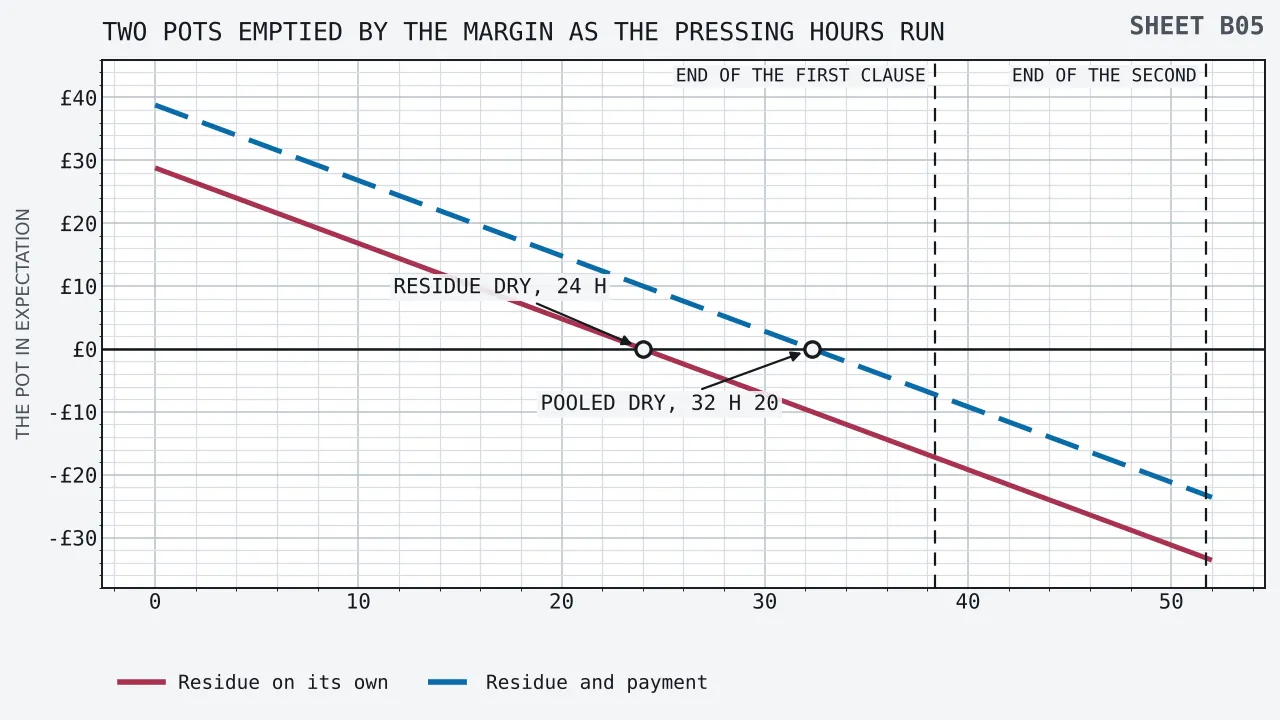
Nineteen hours and twenty-four minutes is the gap the plate draws on the upper slope, from press 9,700 where the pooled pot empties to press 15,520 where the requirement would be satisfied. That stretch is the clearest thing on this page. Pressing carries on, the requirement keeps counting down, and the stake feeding it has already been written off by the margin.
Thirteen hours and twenty minutes is what the third shape adds over the first, 51 h 44 min against 38 h 24 min, and it is added by a clause that never reaches a headline and rarely runs past one line. Nobody weighing two arrangements at this count and this multiple is comparing like with like until that line has been found in both.
7
What 2,304 minutes is resting on
Twelve seconds supports all 2,304 of those minutes, and a figure under that much load belongs out in the open beside its alternatives. The relation is a straight line. A count of 11,520 falls out of the multiple and the denomination and out of nothing else, so halving the interval halves the clock and leaves the rest of the page where it is.
| Interval given to a press | Clock on 11,520 | Presses in an hour | Occasions | What the rate describes |
|---|---|---|---|---|
| 2.5 seconds | 8 h | 1,440 | 22 | The floor under a licensed build, no thumb involved |
| 6 seconds | 19 h 12 min | 600 | 53 | Quick, animation off, one app running |
| 9 seconds | 28 h 48 min | 400 | 79 | Unhurried, and more usual away from a handset |
| 12 seconds | 38 h 24 min | 300 | 105 | The handset rate every figure here computes from |
| 20 seconds | 64 h | 180 | 175 | Attention split, lobby open between presses |
Eight hours flat is the entry worth dwelling on, being 28,800 seconds and what 11,520 presses come to at the quickest interval a British build may be driven at. The floor fences this argument from both ends. Four fifths of the run disappears at machine rate and a working day of pressing is still standing afterwards, so no rule is what makes an evening long. What the rule forbids is a lobby quietly folding better than a working week of obligation into one shift.
Seven and a half seconds is the interval a one-day window would demand of this condition, 86,400 seconds over 11,520 presses, and nothing bars a build from running at it. The conclusion runs opposite to the one a reader might expect. Twenty-four hours is not an arithmetical refusal at this count. It merely asks for the whole twenty-four, without sleep, at two thirds of the interval costed here.
Two figures sit still through every rate in the table. The press count holds at 11,520, settled by multiple and denomination and deaf to speed. The expected close holds at minus £17.28, no term for seconds appearing in the arithmetic behind it. Speed decides only how many weeks go by before a reader reaches a number the terms had already fixed.
8
Which of the two sums an expiry can take
Thirty-eight hours and twenty-four minutes is an hour and twenty-four minutes past a day and a half, and that comparison sorts the windows on this arrangement into the demanding and the decorative. Over seven days the condition asks five hours and twenty-nine minutes daily, fifteen occasions with no day missed. Over fourteen it asks two hours and forty-five, and over thirty an hour and seventeen.
| Window stamped on the residue | Pressing implied daily | Occasions daily | The demand in plain terms |
|---|---|---|---|
| One day | 38 h 24 min | 105 | Past the hours a day holds |
| Three days | 12 h 48 min | 35 | A full shift of it, three times over |
| Seven days | 5 h 29 min | 15 | Longer than an evening, seven nights running |
| Fourteen days | 2 h 45 min | 8 | Punishing, and inside what somebody could do |
| Thirty days | 1 h 17 min | 4 | A nightly routine lasting a month |
| Sixty days | 38 min | 2 | Roughly what a handset soaks up anyway |
Five hours and twenty-nine minutes a day for a week deserves the second reading, a week being the window most often stamped on a residue at this count and sounding roomy until it is divided. Fifteen separate pick-ups of a handset on each of seven consecutive days is a second job, undertaken for £28.80 expected to close at minus £17.28, with the tenner out of reach the whole time.
Forty times is satisfied or it is not, and there is no fraction of it that pays anything. Press 11,519 leaves a reader exactly where press one does with respect to the residue. That is how these terms ordinarily read, and on a page separating two sums it is worth naming which sum the rule reaches: it reaches the residue, and thirty-eight hours of pressing are written off the instant a window closes.
Ten pounds is the sum the same rule does not reach under the first and second shapes in part six, and that distinction is the most practically useful thing here. An expiry that confiscates a residue leaves a payment which was merely held. Somebody who kept the two apart has lost the hours and the bonus and not the money they paid in. Somebody who treated them as one sum believes ten pounds has gone, and may never ask for it.
A separate clock usually sits on the three hundred presses themselves, often one day long, counted apart from the clock over the residue. Sixty minutes fits inside it without strain. Keep the pair distinct when reading a sheet, because one dates the use of the spins and the other dates the clearing of £28.80, and all 11,520 presses of obligation hang from the second.
9
Money paid in, and the duties governing its way out
Ten pounds of somebody’s own money is what this part is about, because the duties a British licence lays over a deposit balance are the sharpest subset of what an arrangement off the register is not carrying. Losses of other kinds are real and are costed elsewhere on this site. These attach to a payment the reader has already made, which is the position anybody reading this page is in.
Nought is the ceiling a licensee here may set on money leaving the pot a customer paid into. A worked specimen of the forbidden clause is published, rationing payouts by the day and by the week at £50 and £500, and a term of that construction may not be imposed, enforced or leaned on. Drawing from the pot, winnings included, is to be open at any hour, and any rationing of how large or how frequent a payment may be has to be reasonable before it binds.
One button is barred outright beside it: the one inviting a customer to call back a withdrawal already requested. The technical standards forbid offering it across all gambling, and the guidance under them presses the opposite way, asking that the route out be made easy rather than obstructed. Hold that against a run of 38 h 24 min and the reason is plain. The moment a payment is asked for is the moment a balance is most easily talked back onto the reels.
Two clauses can both stand on one sheet and a reader should know which pot each is written over. A ceiling on what the residue may win is not struck down by the duty above, which concerns the money paid in. So a capped bonus and an uncapped right to draw the payment back can coexist, and the sentence that matters is the one naming which of the two it governs.
Ten is the highest multiple a British licence permits over bonus funds. Code 5.1.1 sets it in the third of its four prohibitions, binding from 19 January 2026 on every operating licence bar the technical and the software ones. Ten applied to £28.80 asks £288.00 over the reels, 2,880 presses and 9 h 36 min. Hold that against 38 h 24 min and one licence is worth twenty-eight hours and forty-eight minutes of pressing on this one arrangement.
The ceiling is written over bonus funds and over nothing else, which leaves the question part six raised standing open. No published example addresses a condition reaching a payment as well, so this note costs the third shape as arithmetic and asserts nothing about how the ceiling would treat it. Stating the published wording and stopping is the only honest course where a regulator has not spoken.
Under a licence, a customer has six months from the incident to bring a complaint, and once the operator’s own stage is finished an approved adjudicator must be reachable for nothing. Off the register neither duty applies.
Ten pounds happens to be the order of sum that makes those two duties worth having and makes their absence cheap. A dispute about a confiscated payment of that size, carrying 105 occasions with a handset behind it that count for nothing in anybody’s reckoning, costs more to pursue than it could return. That disproportion is the corner a small qualifying payment puts somebody in, and it is a corner the party writing the terms can see as clearly as the party reading them.
10
Who should pay ten pounds for an hour of reels
Sixty minutes of pressing for a ten pound qualifying payment is a fair trade on its own terms, and nothing above disputes it. Three pick-ups of a handset, £30.00 of staking funded by somebody else, £1.20 of expected margin met on a reader’s behalf, and a payment still sitting in the account while all of it happens.
Thirty-eight hours and twenty-four minutes is the return demand, and the two quantities are not of one order. A hundred and five occasions, 11,520 deliberate presses, better than a working week of attention, against a residue of £28.80 the condition expects to swallow with £17.28 to spare.
Twenty-six pence an hour is what the payment comes to read as the purchase of that obligation, and it is the sentence this note was written to reach. Nobody paying in ten pounds thinks of themselves as buying 38.4 hours of thumb work at 26p each. The transaction is nonetheless that, and it survives any sensible change of assumption: press at six seconds and the tenner buys 19.2 hours at 52p, press at twenty and it buys sixty-four hours at 16p.
One kind of reader is unharmed by any of it. Somebody with evenings of phone pressing ahead of them anyway, who counts the hour of handout as a genuine addition and never intends to attempt the condition, pays ten pounds, presses three hundred times and asks for the payment back where the terms allow that before the bonus lapses. The rest of this note is a warning they do not need.
Three questions settle it for everybody else, and the order of asking matters more than usual where a reader’s own money is in the pot. Which of the three shapes applies, since pooling adds thirteen hours and twenty minutes and puts the tenner itself at hazard. Then the multiple, twenty-five being where a residue stops being worth chasing. Then the window, because a seven-day clock is asking for five hours and twenty-nine minutes on each of its seven days.
Sixty minutes against 38 h 24 min is the honest summary of three hundred spins bought with a tenner. A banner prints the count, the payment and nothing else. It omits the second duration, omits the 26 pence an hour, and never says which of its two headline sums belongs to the reader and which never will.
Questions
- How long does a deposit 10 get 300 free spins offer take to clear?
- Thirty-eight hours and twenty-four minutes of thumb work, with an hour on top for the three hundred credited presses. Forty times a residue of £28.80 is £1,152.00 of demanded turnover, 11,520 presses at 10p, and 138,240 seconds at twelve to a press. Against an occasion of twenty-two minutes, rounded upward, that is 105 times a handset comes out. Interval and occasion are stated assumptions and neither was timed.
- Is the £10 deposit part of the bonus or separate from it?
- Separate, and keeping them so is the whole point of this note. The tenner is the reader’s cash, requestable in principle until a reel takes it. The spins are leave to press a button; they send £30.00 over at 10p and expect to raise £28.80, which arrives as bonus funds with a condition clamped to it. Different owners, different shapes, different rules, so the two will not add.
- What is the ten pounds actually buying?
- The obligation, at 26 pence an hour. A thousand pence held against 38.4 hours gives 26.04 pence for each one, and read backwards a penny buys 11.52 presses, which is two minutes and eighteen seconds. Demanded turnover of £1,152.00 against a payment of £10.00 is a factor of 115.2, so the payment is smaller than the thing it commits somebody to by two orders of magnitude.
- Must the ten pounds be wagered as well as the bonus?
- That turns on which of three shapes the terms use. Held and released when the bonus clears, the tenner stays whole and unreachable across 38 h 24 min. Sent over the reels once, it adds £10.00 of turnover, twenty minutes and forty pence of expected cost. Pooled under one multiple, forty applied to £38.80 demands £1,552.00, which is 15,520 presses and 51 h 44 min, and the pot is expected to empty at press 9,700 with 5,820 still outstanding.
- What makes twenty-five the multiple everything turns on?
- The margin is a twenty-fifth of every pound sent over, so twenty-five pounds of turnover accounts for a whole pound of residue. On £28.80 the line lands at £720.00: 7,200 presses, twenty-four hours flat at the assumed interval, sixty-six occasions. That is also the press at which the residue empties, the two being one occurrence reported twice, and forty times carries somebody fourteen hours and twenty-four minutes further to an expected minus £17.28.
- Can a twenty-four hour window on this offer be met?
- Not by a person. The 86,400 seconds of a day over 11,520 presses gives seven and a half seconds each, which nothing stops a build from running at, so a one-day clock here is not the flat impossibility it becomes at bigger counts. What it wants is the whole twenty-four hours at two thirds of the interval costed here, with no sleep and no pause, and one press short forfeits the residue.
- Does the offer hold a Great Britain licence, and what does that cost on the deposit?
- Outside the British licence is where an arrangement of this build sits. Read through the money a reader hands over, the duties absent are those covering the pot it lands in: a licensee here may set no ceiling on money leaving that pot, a worked specimen of the forbidden clause being published at £50 by the day and £500 by the week; the button inviting somebody to call back a withdrawal is barred; and ten is the highest multiple permitted over bonus funds, which on £28.80 would be 2,880 presses and 9 h 36 min in place of 11,520 and 38 h 24 min.
- Is three hundred spins for ten pounds worth taking?
- The hour is, the condition is not. Three pick-ups of a handset, £30.00 of staking funded elsewhere and a payment still sitting in the account is a fair trade for somebody who wanted an hour of reels. Treating £28.80 as a sum to extract means 105 occasions, 11,520 presses, an expected minus £17.28, and a tenner immobilised or pooled throughout, which prices the payment at 26 pence for every hour of obligation it bought.