Note U01 Revision 1 Terms read 17 October 2026
The search phrase best non gamstop casinos, weighed against the clock it would switch off
One day is the longest a licensed British cashier may leave its whole customer base uncompared against the national register. Past that licence the comparison never happens at all, so a clock a reader set for themselves has nothing to tick against. Six months of it stands in front of 66 h 44 min of pressing at an evening apiece, a rhythm this note assumes and did not observe. Minutes deferred at a sign-up are the currency it gets traded for.
What lands 5 min deferred The run 66 h 44 min The wait to be paid No comparison
What offers of this size ask in hours
Advertising has been bought for every destination below. A fee reaches this site when a reader goes on to register, and no figure on this page moves one way or the other because of it.
-
01Mobile Free Spins
Betportal
Ceiling as a multiple
What lands€15.00150 spins at 10c, which is this site's figure and not the operator'sThe run17 h 30 minTurning over 525.00 at 10p means 5,250 presses, or about 48 phone sittings of 22 minutes. Timed at 10p a press and 12 seconds between presses, both of which this site assumes rather than measures.The wait to be paidNOT PUBLISHEDThis operator puts no withdrawal band in its own terms, so there is nothing honest to print here.Spins valued at this site's own 10p a spin
What lands
Spins, at a price15.00150 of them at 10c apiece, a figure belonging to this site rather than to the operatorMatch, and other creditno figure300% of three deposits, to a ceiling of €1,000. Not a sum until money of yours makes it one, so this row totals nothing and carries nothing downwardsThe run
Handed back on the spins(0.60)Each press stakes its own value and returns 96 per cent, which leaves this much with the house from the opening pressPlay-through 35x on the bonus(20.16)Taking 14.40 round 35 times over means 504.00 through the machines, of which 20.16 is the expected cost, and 17 h 30 min of pressing at the pace aboveWhat counts towards it100%Slots only, with no percentage published anywhere, so the row above assumes the whole of each stake countsWhat never clears
Limit on the winningsstated5x the bonusDeducted on the way outno figureNothing is published as a figure here, so this row removes nothingLeast that can leaveno figureNo figure is published, so nothing on this timer is pinned down by oneLeast deposit, and the rung over ityour own€20 a stage. Published in euros, so no rung is named at all: this site's ladder is a sterling oneThe window on the creditstated14 daysBiggest stake while it runsstated€5Removed outright by rulestatedNot publishedVerified before a payoutstatedDocuments before the first withdrawalNever clears€15.00Not a penny of it gets out, so the whole of what landed stands on this rowNo Great Britain licence
Licence held in Anjouan, Comoros, the company named is BetPortal Gaming Ltd, with Excite Ultra Media Ltd, quoted under ALSI-202601040-FI2.
Terms read 17 October 2026
Open the offer at Betportal, opens in a new window -
02Mobile Free Spins
WinBeast
Ceiling as a sum
What lands€50.00500 spins at 10c, which is this site's figure and not the operator'sThe run2 d 18 hTurning over 2,000.00 at 10p means 20,000 presses, or about 182 phone sittings of 22 minutes. Timed at 10p a press and 12 seconds between presses, both of which this site assumes rather than measures.The wait to be paidNOT PUBLISHEDThis operator puts no withdrawal band in its own terms, so there is nothing honest to print here.Spins valued at this site's own 10p a spin
What lands
Spins, at a price50.00500 of them at 10c apiece, a figure belonging to this site rather than to the operatorMatch, and other creditno figure50% to 100% of five deposits, each to a ceiling of €1,000, and a €650 free bet. Not a sum until money of yours makes it one, so this row totals nothing and carries nothing downwardsThe run
Handed back on the spins(2.00)Each press stakes its own value and returns 96 per cent, which leaves this much with the house from the opening pressPlay-through 40x on the bonus and the winnings from the spins(76.80)Taking 48.00 round 40 times over means 1,920.00 through the machines, of which 76.80 is the expected cost, and 2 d 18 h of pressing at the pace aboveWhat counts towards it100%Slots, titles vary by country, with no percentage published anywhere, so the row above assumes the whole of each stake countsWhat never clears
Limit on the winningsstated€100 a batch of spinsDeducted on the way outno figureNothing is published as a figure here, so this row removes nothingLeast that can leaveno figureNo figure is published, so nothing on this timer is pinned down by oneLeast deposit, and the rung over ityour own€20 a stage. Published in euros, so no rung is named at all: this site's ladder is a sterling oneThe window on the creditstated7 days, spins 1 dayBiggest stake while it runsstatedNot publishedRemoved outright by rulestatedNot publishedVerified before a payoutstatedDocuments before the first withdrawalNever clears€50.00Not a penny of it gets out, so the whole of what landed stands on this rowNo Great Britain licence
Licence held in Curaçao, no company named anywhere on the site.
Terms read 17 October 2026
Open the offer at WinBeast, opens in a new window -
03Mobile Free Spins
EliteSpin
Longest spin window
What lands£50.00500 spins at 10p, which is this site's figure and not the operator'sThe run2 d 18 hTurning over 2,000.00 at 10p means 20,000 presses, or about 182 phone sittings of 22 minutes. Timed at 10p a press and 12 seconds between presses, both of which this site assumes rather than measures.The wait to be paidNOT PUBLISHEDThis operator puts no withdrawal band in its own terms, so there is nothing honest to print here.Spins valued at this site's own 10p a spin
What lands
Spins, at a price50.00500 of them at 10p apiece, a figure belonging to this site rather than to the operatorMatch, and other creditno figure50% to 100% of five deposits, each to a ceiling of £1,000. Not a sum until money of yours makes it one, so this row totals nothing and carries nothing downwardsThe run
Handed back on the spins(2.00)Each press stakes its own value and returns 96 per cent, which leaves this much with the house from the opening pressPlay-through 40x on the bonus and the winnings from the spins(76.80)Taking 48.00 round 40 times over means 1,920.00 through the machines, of which 76.80 is the expected cost, and 2 d 18 h of pressing at the pace aboveWhat counts towards it100%Slots, with no percentage published anywhere, so the row above assumes the whole of each stake countsWhat never clears
Limit on the winningsstated5x the bonusDeducted on the way outno figureNothing is published as a figure here, so this row removes nothingLeast that can leaveno figureNo figure is published, so nothing on this timer is pinned down by oneLeast deposit, and the rung over ityour own£20 a stage. It lands square on the £20.00 rung, so none of yours is left perched on topThe window on the creditstated7 days, spins 3 daysBiggest stake while it runsstatedNot publishedRemoved outright by rulestatedNot publishedVerified before a payoutstatedDocuments before the first withdrawalNever clears£50.00Not a penny of it gets out, so the whole of what landed stands on this rowNo Great Britain licence
Licence held in Costa Rica, the company named is PrimeTier Limited.
Terms read 17 October 2026
Open the offer at EliteSpin, opens in a new window -
04Mobile Free Spins
Crown Jewelz
Multiple unpublished
What lands£15.00150 spins at 10p, which is this site's figure and not the operator'sThe runNOT TIMEDThis operator does not publish the play-through multiple in its own terms. The multiple is the one figure the clock cannot work around, so the run is left untimed.The wait to be paidNOT PUBLISHEDThis operator puts no withdrawal band in its own terms, so there is nothing honest to print here.Nothing reckoned
What lands
Spins, at a price15.00150 of them at 10p apiece, a figure belonging to this site rather than to the operatorMatch, and other creditno figure200% of the first deposit, then 150% twice, each to a ceiling of £1,000. Not a sum until money of yours makes it one, so this row totals nothing and carries nothing downwardsThe run
Play-throughno figure40x the bonus, reported rather than published by the operatorWhat counts towards itno figureSlots, with no percentage published anywhere, so the row above assumes the whole of each stake countsWhat never clears
Limit on the winningsstatedNot publishedDeducted on the way outno figureNothing is published as a figure here, so this row removes nothingLeast that can leaveno figureNo figure is published, so nothing on this timer is pinned down by oneLeast deposit, and the rung over ityour own£20. It lands square on the £20.00 rung, so none of yours is left perched on topThe window on the creditstatedNot publishedBiggest stake while it runsstatedNot publishedRemoved outright by rulestatedNot publishedVerified before a payoutstatedDocuments before the first withdrawalNever clearsNOT RECKONEDThis operator leaves the play-through multiple out of its own terms, so nothing below the fourth step can be worked out.No Great Britain licence
Licence held in Curaçao, number not verified, no company named anywhere on the site.
Terms read 17 October 2026
Open the offer at Crown Jewelz, opens in a new window
Only the middle reading comes out of arithmetic belonging to this site. The multiple laid against what lands gives the turnover asked for; dividing that by 10p a spin gives the presses; dividing those by 300 an hour gives the hours, a press on a handset being taken here at 12 seconds from the one before. Both figures are assumptions rather than measurements of anybody: nothing was played and nothing was held a stopwatch to. Anybody quicker should divide the press count by a rate of their own, which is why the presses are printed alongside the hours instead of being summarised away.
The first reading is what arrives before any condition is laid against it. Spins carry no unit of their own so one gets supplied: where an operator values its own spin that figure is used and attributed, and where it does not, this site's 10p a spin stands in and everything below moves with it. The third reading belongs to the operator entirely. It is a withdrawal band quoted from published terms, and a blank there means none was published rather than that nobody looked.
The total along the foot answers what the hours leave open, which is whether any of the running ends anywhere. It is what arrived, less whatever is still standing once the play-through has been paid for at 96 per cent return to player and once a published limit, a published deduction and a published floor beneath the least that can leave have each had a turn. It appears again in pence in the pound, the only fair way of holding a small offer up against a large one. It describes an offer rather than an evening, and where the conditions price out what arrived, a timer prints nothing getting out instead of a negative sum.
Cashiers on a handset take deposits off a row of preset buttons, so a least deposit given in pounds is raised to the next rung of the ladder used here, £10, £20, £25, £50, £75 and £100, and the timer shows what is left perched on it. That money is the reader's own and enters no sum at all. Given in euros it prints untouched, the ladder being sterling. Three words may occupy the figure column where no figure belongs. Stated is a published term that costs something while leaving no number to subtract. No figure is a term nobody has quantified, or a credit that is not a sum until money of yours makes it one. Your own is money of yours, which belongs in none of this.
None of the operators above is licensed in Great Britain, so not one duty that licence carries reaches any of them. Membership of Gamstop Online is compulsory for every online gambling company licensed in Great Britain, which means that shutting yourself out through the scheme shuts you out of none of these. The limit of ten times the bonus funds on a wagering requirement, running since 19 January 2026 under Social Responsibility Code 5.1.1, is a condition of the same licence and binds only whoever holds one. Off that licence, the Gambling Commission writes of consumers meeting unfair gaming practices, financial loss and no recourse when matters go wrong, and lists blocked payouts and withdrawal limits pitched too high to reach among the things it has seen. No account at any of them may be held by anybody under 18.
Every term on a timer is its operator's own and every timer carries the day somebody read it. The oldest of those readings is 17 October 2026. What binds a reader is an operator's full terms and never a line printed here.
1
What four words ask for, and the answer given instead
Four words form the phrase at the top of this note, and the opening one asks for an ordering. No ordering of that sort gets published on this site. Nothing further down is called better than anything else, no name appears, no address appears, and the three readings above are durations rather than a verdict.
Nothing here assists anybody in reaching a business of that description, and the refusal runs wider than it may look. Documents, payment routes, handsets and the way a home connection is arranged are all missing from the ten parts below, and the absence was settled before the first sentence was drafted. Blocking arranged by a bank, and blocking arranged by whoever supplies the household connection, fall under that identical rule and meet that identical quiet.
One instruction is given on this page and this is it. Anybody who registered with Gamstop Online and has since typed that phrase into a search box is feeling the precise pressure that registration exists to absorb, and the thing worth doing with it is to ring 0808 8020 133, which GamCare keeps staffed round the clock and charges nothing to call. Everything after this paragraph is arithmetic, and the arithmetic is there to show the size of what a registration is holding.
Two quantities carry the whole note between them. A day is the first, being the longest a licensed British cashier may go without reading its entire customer base against the national register. A sign-up is the second, which on the handset this site writes about is a matter of minutes. Those sit on opposite sides of an exchange, and parts five and six price it.
The register carried 614,738 names at the scheme’s half-yearly release of 16 July 2026, and a single month inside it repays a sum of its own. May 2026 brought in 12,236 sign-ups, which the scheme records as its heaviest month. Spread over 31 days that is 394.7 a day, or roughly one every three minutes and thirty-nine seconds, right round the clock, for a month.
Two schemes sit under one group and neither covers the other. Online accounts are handled by the national online scheme. Shops are handled by a sister service, which started in 2016 as a multi-operator arrangement for premises and came into the group during July 2023. Joining the online one leaves the other untouched, and nothing in this note should be read as suggesting otherwise.
2
One register, and a customer base read against it daily
Twenty-four hours is the interval the whole mechanism turns on, and it is a ceiling rather than a target. From April 2020 a British licensee has had to put its entire customer base against the national register at that frequency or better. Membership became a licence condition a month before, in March 2020, layered over whatever in-house arrangement an operator was already running. The scheme itself dates from June 2017.
One hundred and eighty-two readings of a customer base is therefore what six months attracts, taking the period at 182 days and the cycle at its slowest permitted. None of that counting is work the registered person performs. A decision taken once, on one evening, gets re-applied by other people every day for as long as the period runs, and that property is the whole of why the mechanism is worth having at a bad moment.
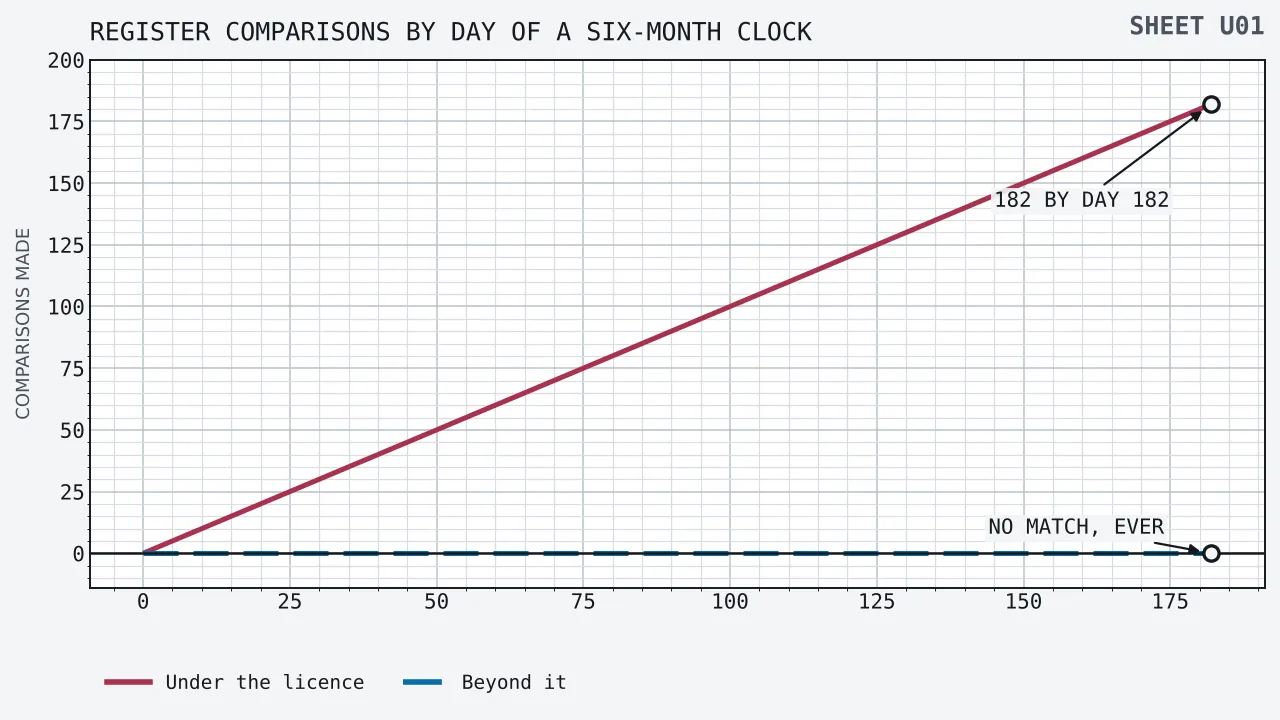
Nought is the second line on that chart and it lies flat because nothing drives it. Outside the licensed market there is no participation, no copy of the register, and no obligation to put one thing against another. What separates the two lines is not diligence. It is a duty on one side and its absence on the other.
Four thousand three hundred and sixty-eight hours is that same six months in the unit this site prefers, and the two intervals belong side by side in it. Within the licence, the longest any registration sits unread at a given cashier is 24 hours, which comes to 0.55 per cent of the period. Beyond it the figure is the entire 4,368, because a first reading never arrives and so the gap never shuts.
Three minutes and thirty-nine seconds was the average spacing between sign-ups in the scheme’s heaviest recorded month, from the sum in part one. Put that next to the daily cycle and the pair describe one machine. People join at one rate; the licensed market re-reads its lists at another; and nobody has to act in between for the two to meet.
Seven years is the tail on the arrangement and it is easily mistaken for more than it is. Once a registration has been deactivated, gambling businesses go on being told for a further seven years that the person was registered before. What that notice does not do is require anybody to keep that person out, and the scheme is explicit about it. Information passed along is not a barrier still standing, and treating the two as one would overstate the clock.
3
Four settings, each priced at an evening apiece
Four settings are offered at sign-up and they are easiest held in months. Six is the shortest. Twelve comes next, then sixty, then sixty that renew on their own unless somebody stops them. Stopping that renewal is possible only inside the closing six months of a sixty-month run. Each sits in terms the scheme revised on 20 May 2026, which also shut off every route to ending a registration ahead of its minimum.
A sitting on this site runs to 22 minutes and holds 110 presses at ten pence, worked on the twelve-second interval used everywhere here. One sitting an evening is the rhythm behind the table below. Both of those are conventions declared here and not findings about any person, so a reader who manages two evenings in one should double every figure, and a reader who plays every other night should halve them.
| Setting taken at sign-up | Days it holds | Presses of 10p declined | Staking kept back | Pressing declined | Expected cost avoided | What brings it to an end |
|---|---|---|---|---|---|---|
| Six months | 182 | 20,020 | £2,002.00 | 66 h 44 min | £80.08 | An act by the person, never before day 182 |
| Twelve months | 365 | 40,150 | £4,015.00 | 133 h 50 min | £160.60 | An act by the person, never before day 365 |
| Sixty months | 1,826 | 200,860 | £20,086.00 | 669 h 32 min | £803.44 | An act by the person, never before day 1,826 |
| Sixty months, plus the eighty-four that follow silence | 4,383 | 482,130 | £48,213.00 | 1,607 h 6 min | £1,928.52 | Nothing at all, if nobody acts |
Eighty pounds and eight pence is the honest size of what six months keeps back on these conventions, and it is deliberately undramatic. Two thousand and two pounds would have crossed the reels across that period at an evening apiece, and the house retains 4p from each pound of it. The figure worth sitting with in that row is not the money. It is the 66 h 44 min, because hours are the one item on this site that nobody is ever handed back.
One thousand nine hundred and twenty-eight pounds fifty-two heads the bottom row, and that row is there because the clock does not switch itself off. No registration gets lifted automatically at the close of its minimum. Someone who does nothing whatever keeps it for as much as seven further years, which carries the span to about 4,383 days and 1,607 hours of evenings at the rhythm assumed.
25 presses deferred at a sign-up against 20,020 declined by six months
Six, twelve or sixty more months may be added rather than letting a period lapse, and adding is the usual thing done with a clock of this shape. Six more is another 20,020 presses and another 66 h 44 min on the same conventions. Nothing in this note pushes any reader towards a particular setting, because the arithmetic prices periods and knows nobody.
Twenty-four hours stands in front of a deactivation as well as behind a comparison, and the symmetry is worth marking. Ending a registration begins at the scheme’s contact centre, and 24 hours at minimum then elapse with the exclusion fully live. Every awkward feature of the design runs the same direction: on is quick and off is slow.
4
Why the cover stops precisely where the licence stops
Participation binds each online gambling company holding a British licence, and that single rule draws the boundary. Cover is therefore an attribute of the licence rather than a decision taken in a boardroom. Standing outside the scheme and standing outside the British register are consequently the same condition, described twice.
The scheme’s own terms then print the limit without softening it. Exclusion can be assisted with in respect of gambling services supplied by participating gambling operators. Services supplied by organisations that stay out are beyond what the scheme is able to prevent anybody reaching. Written down as the outer wall of a protection, that is exactly the ground the heading’s own wording points into.
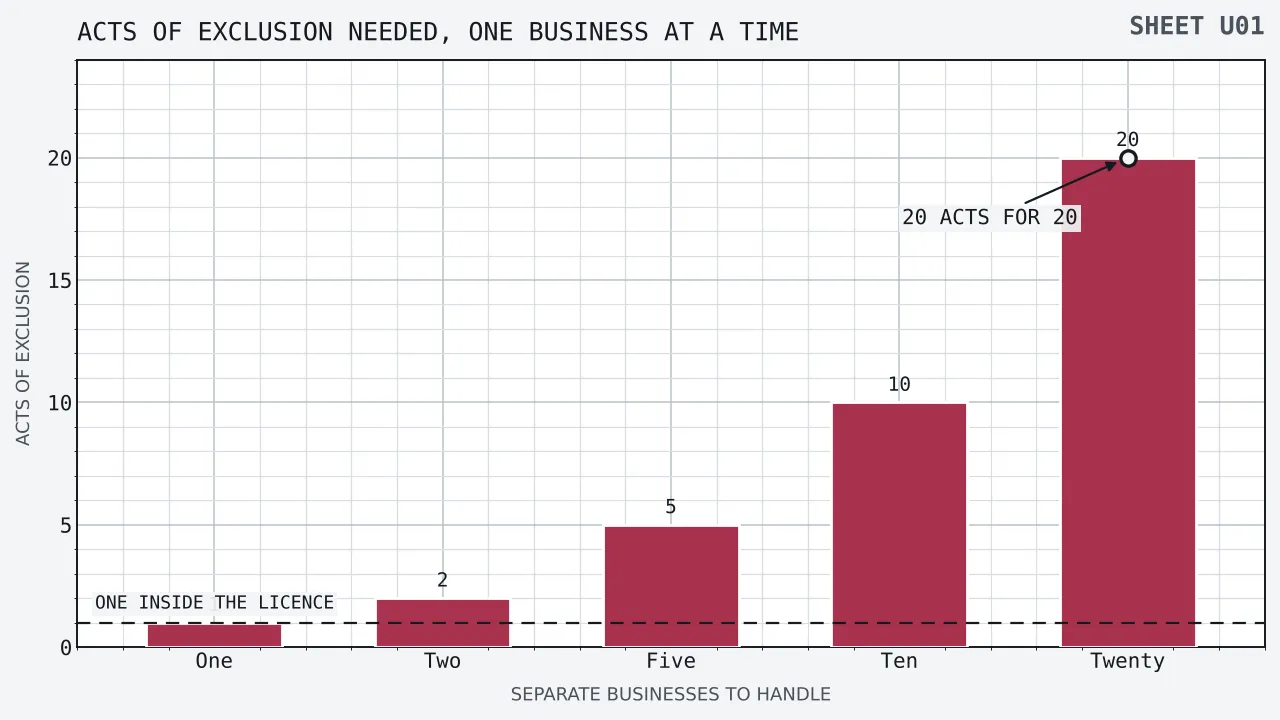
One act against twenty is how that chart reads, and the shape of the comparison matters more than any particular bar in it. Inside the boundary the count never budges: the same single registration reaches the entire licensed online market today and on every remaining day of the period. Beyond it the count climbs with the number of separate businesses, and each climb is a fresh decision asked of somebody who may be tired of deciding.
Nought is what the person has to do to hold the inside figure at one, and that is what makes it a protection rather than a resolution. Resolutions need renewing by whoever made them. A clock kept by other people does not, and the daily reading set out in part two is the machinery by which that happens.
Four thousand three hundred and sixty-eight hours is six months again, and the boundary states as cleanly in hours as in anything else. Within it the protection is live across all 4,368 of them with no further input. Beyond it the protection is live across none of them, because there is nothing out there for it to be live inside. No gradient joins the two, and describing a step as a slope would be a misdescription of the only kind that matters here.
5
Minutes deferred at a sign-up, and months handed over for them
Five minutes is what this note puts on the identity step at a sign-up, and it is a convention declared here rather than anything watched. Nobody was timed. A reader with documents already to hand should halve it, and a reader hunting for a household bill should double it, since every comparison below runs as a straight line through that one figure.
Under a British licence the check comes first. Name, home address and birth date have to be obtained and verified before a customer is allowed to gamble at all, and the rule bites on a free bet and on bonus funds alike. Age checks reach even versions of games that pay no prize. That check is also the moment a registration gets caught, which makes the identity step and the register two faces of one machine rather than two separate nuisances.
Eighteen and over is as far as the Curaçao rulebook pushes at the equivalent moment. No deposit and no wager may happen until an operator has satisfied itself that the person is at least 18, and what it specifies then is confirmation of the birth date, with an over-18 tick box and confirmation of a payment method named as further possibilities. A government-issued identity document is attached instead to the operator’s later anti-money-laundering milestones, pulled earlier only where doubt about age arises first.
Two hundred and sixty-two thousand and eighty minutes is six months counted in the unit the identity step is measured in, being 182 days of 1,440 minutes each. Set the assumed five against it and the ratio comes to 52,416 to one. Every single minute of deferred checking is therefore exchanged for a little over thirty-six days of the period, or 36 days and about nine and a half hours if an assumption deserves that much precision.
Twenty-five presses is those same five minutes in this site’s own unit, at the twelve seconds a press modelled throughout, worth £2.50 of staking and ten pence of expected cost. Twenty thousand and twenty presses is what six months turns away at an evening apiece. Eight hundred to one, near enough, is the ratio between pressing deferred and pressing surrendered, and it is the plainest form the exchange can be put in.
Nothing in that comparison leans on the five minutes being accurate. Cut it to two and a half and the ratio doubles to 1,602 presses surrendered for every press deferred. Stretch it to ten and the ratio falls to 400, which is still four hundred evenings of pressing against one modest errand. An input that can be moved by a factor of four without touching the conclusion is an input doing very little work.
6
That trade written as a rate, running both ways
Two rates fall out of part five and they face opposite directions. Forwards, a minute spared at the cashier costs about 36 days of a six-month registration. Backwards, a day of that registration is bought for 1.65 seconds of the identity step, being five minutes spread across 182 days. Both describe the same exchange, and the second is the one that sounds ridiculous, which is the reason for printing it.
| Minutes assumed for the identity step | Presses it amounts to | Days of six months per minute | Presses surrendered per press deferred | Pressing surrendered per minute |
|---|---|---|---|---|
| Two and a half | 13 | 72.8 | 1,602 | 26 h 42 min |
| Five, the figure assumed here | 25 | 36.4 | 801 | 13 h 21 min |
| Ten | 50 | 18.2 | 400 | 6 h 40 min |
| Twenty | 100 | 9.1 | 200 | 3 h 20 min |
Thirteen hours and twenty-one minutes occupies the middle row, and it is the number to leave this part holding. A single minute of identity work put off at the cashier stands against thirteen hours of pressing that six months would otherwise have turned away, at an evening apiece. Nobody presents the matter in those terms, because nobody presents it as a trade in the first place.
Three hours and twenty minutes is the least favourable row for the argument, allowing a generous twenty minutes at the sign-up, and it remains three hours against one minute. The ratio survives every assumption this note will entertain. That is the test a figure resting on an assumption has to clear before it earns a place, and this one clears it four ways over.
Sixty months in place of six multiplies every right-hand figure by ten and a little, 1,826 days being 10.03 times 182. One minute deferred then sits against 133 h 54 min of pressing turned away, at the five-minute step assumed. Lengthening the period does not improve the exchange. It worsens it by precisely the factor the period grew by.
Nothing in this part claims how long any particular sign-up takes anywhere, and the arithmetic was built so that it would not need to. Its only input is a span of minutes wide enough to hold any sensible answer. What the table demonstrates is that no value inside that span makes the exchange look reasonable, which is a firmer result than choosing one value and defending it.
7
What the offshore rulebook does require, reported as published
One business at a time is the shape self-exclusion takes in the Curaçao policy, and setting out what that policy contains is more honest than calling the offshore side unregulated. A player voluntarily shuts themselves out of some or all online gaming with one named operator. Every domain that operator runs has to be covered by the same shutting-out. For the rest of the internet, its answer is that the person ought to be urged to do the same again elsewhere.
Twelve months is the shortest long-term period an operator licensed there has to put on the table, and three years, five, ten and a setting without any end date stand above it on the same list. Once a player confirms one, no power to lift it early remains with that player. Two of those features run stronger than the British arrangement, the minimum being twice the six months the national scheme opens with, and a never-ending setting having no British counterpart.
| The question asked | Within the British licence | Under the Curaçao policy read for this network |
|---|---|---|
| What one act of exclusion reaches | Every holder of a British online gambling licence, simultaneously | A single named business, together with the domains it runs |
| How often a customer base is read against a register | No less than daily, a duty running since April 2020 | No register spanning businesses exists for it to be read against |
| Shortest setting a person may pick | Six months | Twelve months, for a long-term exclusion |
| Longest setting a person may pick | Sixty months, renewing unless halted | A setting with no end date |
| Lifting it early | Barred until the minimum has gone by | Barred once confirmed, until the period expires |
| What the rulebook says about elsewhere | Nothing needs saying, one act having covered it | The person ought to be urged to exclude at each |
One row of that table does all the work and it is the second. Period lengths are a drafting matter and either side may draft them generously. A register read daily is a piece of infrastructure, and the Curaçao policy describes nothing of the sort. An exclusion with no register under it reaches the business holding it and travels no further, whatever length it has been set to.
Nought is the number of cross-business registers that rulebook provides for, and its own remedy for the gap is encouragement. Encouragement has to be acted on by the person. The entire value of the machinery in parts two and four is that it works on the days when that person is acting on nothing, and encouragement by its nature cannot do that.
Two further requirements in the same policy belong here because they cut the other way. A cooling-off period of a day, a week, a month or a quarter has to be reachable by one press, without an email and without approval, taking hold at once. Putting a player off taking one is barred, and the barred list includes a bonus dangled to keep somebody playing.
Nothing above should be read as a recommendation, for structural reasons rather than rhetorical ones. A published requirement is worth whatever the route to enforce it is worth, and the self-exclusion half of that rulebook has no register underneath. A page that recited the strong clauses and skipped the missing infrastructure would be describing a document instead of a protection.
8
Duties travelling with a licence, read through one registration
Operations reached by that search carry no Great Britain licence. On a note about an exclusion clock the losses worth naming are the four the clock is actually made out of. Scheme membership is the first, attaching to the licence and to nothing else. Daily reading of a customer base is the second, being the mechanism that turns membership into an effect. Identity settled ahead of any gambling is the third, that being when the reading takes place. Seven years of notice after a deactivation is the fourth, and alone among them it is information rather than a barrier.
Four absences, then, instead of a general shortage of regulation, and a clock sits inside each. The first runs at no frequency, there being no scheme to belong to. The second runs at no interval, there being no list to read. The third runs to no deadline, identity work being free to sit behind a later milestone. The fourth has no tail, there having been no registration to end.
Traffic was assessed across 160 websites after enforcement action had been taken against them, and the regulator reports a drop of 32 per cent. The same post adds that the ecosystem is unlikely ever to be dismantled in full, given the revenue standing behind it. Both halves belong on this page, because a reader is owed the limits of enforcement alongside the fact of it.
What such a site typically lacks is published in the regulator’s own words, and one item on that short list is the subject of this note. Responsible gambling tools are named in that list, alongside age verification and payment systems that are secure. A self-exclusion facility is a responsible gambling tool, and a scheme reaching an entire licensed market at once is the strongest version of one available anywhere in Great Britain.
Vulnerable customers are often the target of operations like that, says a notice dated 20 January 2025 and addressed by the regulator to licensed suppliers, whose illustration of that category is a person registered with the national scheme. Anybody arriving here by typing that phrase has had their own position set down in print, by the regulator supervising the licensed market.
Nothing above argues that the offshore side is lawless, and arguing it would be inaccurate in the opposite direction. Part seven sets out genuine published requirements with genuine periods inside them. This part makes a narrower and harder point: the particular clock under discussion is built from a licence condition and a daily reading, and neither of those crosses the edge of the register.
9
Four things available this minute, and what each asks
Nothing whatever is what the first route costs, and it is a telephone call. GamCare operates the National Gambling Helpline; dial 0808 8020 133 and somebody answers, at no charge and at any point in the calendar. Live chat and a messaging route sit beside the telephone. A person uneasy about somebody else in the household is as welcome on it as a person uneasy about their own gambling, and a professional may put somebody forward where that somebody has agreed.
Twenty-two minutes is the second route, in the sense that one sitting of the length this site assumes is more than enough to lengthen a registration. Six, twelve or sixty further months may be added. On the arithmetic in part three six further months turn away 20,020 presses and 66 h 44 min of evenings, and it is one decision instead of a nightly one.
Three bodies stand behind the third route, which GamCare publishes as TalkBanStop. Talk is the helpline above. Ban is the blocking software, reaching the devices a household owns. Stop is the national scheme. GamCare’s own page puts that software at no charge for people reaching it through the helpline, or through its support and its treatment.
A seven-day trial is the only free thing advertised on the software publisher’s own pages, and no free British route is advertised on them. GamCare’s statement about the no-charge route sits in an article carrying 12 April 2021, which puts no period on how long that access lasts. Both are reported here as published, and neither is given a duration this note cannot source.
One decision makes the fourth route and it has no form to fill in. A reader who has got this far and simply shuts the page has declined whatever evening was in prospect, which on the conventions in part three comes to 110 presses, £11.00 crossing the reels and 44 pence of expected cost. That is a small quantity and the size is correct. Six months is 182 of those evenings, and the machinery exists so that only one of them ever has to be decided.
The number above appears in one piece deliberately. Elsewhere in this network a helpline number was broken across a line and shipped that way, which is a defect nobody notices until somebody dials. It reads 0808 8020 133, the call is free, and somebody picks it up whatever the hour and whatever the date.
10
What a clock somebody else keeps is worth
Twenty-four hours against nought is the shortest form this note can take. Within the boundary a registration is read against a whole customer base no less than daily, by people paid to do it, on every day of the period. Beyond it the reading occurs at no frequency at all, so a clock the reader set has nothing to run against and therefore does not run.
Six months covers 66 h 44 min at an evening apiece, twelve months covers 133 h 50 min, and sixty months covers 669 h 32 min. Those are the durations this site usually prints against a play-through, enlarged and reversed. A play-through takes hours away from a reader. A registration is the one clock here pointed the reader’s way.
Five minutes sits on the other side of the exchange, as a convention, and part six showed that no plausible value for it alters the answer. Thirteen hours and twenty-one minutes of surrendered pressing stands against each deferred minute at the figure assumed, and three hours and twenty minutes stands against it even at a generous twenty. The exchange is poor across the whole range anybody reasonable would argue over.
Nothing here instructs a particular reader about a registration they already hold, and the silence is deliberate. Periods get priced on this site; people do not. What can be said is that the figures in parts three and six measure the thing waiting on the far side of that decision, and they run past the largest figure printed on anything this site has priced.
Better than half of the 614,738 names standing on the register at the last published count had chosen the sixty-month setting. Nobody picks sixty months lightly. Each was somebody concluding that a clock other people keep beats a judgement made fresh every evening, and anything written to loosen one of those conclusions would be pulling against the single clock on this whole site that favours the person reading it.
Questions
- What does the phrase best non gamstop casinos actually describe?
- A gambling business taking no part in the national online self-exclusion scheme, which in practice is a business carrying no Great Britain licence, participation being an attribute of that licence and of nothing else. The opening word of the phrase asks for an ordering, and this site publishes no ordering of that sort. Nothing here names such a business, links to one, or sets out a route to one.
- How often does the licensed market read a registration?
- No less than once a day against the whole customer base, a duty running from April 2020, with participation itself becoming a licence condition in March 2020 and the scheme dating from June 2017. Across six months that is 182 readings, none of which the registered person does anything to trigger. Beyond the licence the reading happens at no frequency whatever.
- How long do the settings run, and can one be lifted early?
- Six months, twelve months, sixty months, or sixty months renewing on their own, with the renewal stoppable only inside the closing six months of a sixty-month run. All of that sits in terms the scheme revised on 20 May 2026. Lifting one before its minimum has elapsed is not available, and nothing removes a registration by itself once that minimum passes.
- What does six months hold back, counted in pressing?
- Sixty-six hours and forty-four minutes at one sitting an evening, a sitting being 22 minutes and 110 presses at ten pence on the twelve-second interval modelled here. That comes to 20,020 presses, £2,002.00 crossing the reels and £80.08 of expected cost at the ninety-six per cent return used throughout. Both the evening rhythm and the press interval are conventions declared by this note, and neither was measured.
- What happens if nobody acts when a period runs out?
- The registration simply continues, for up to seven more years, because nothing lifts one by itself. Added to a sixty-month setting that is about 4,383 days, which at an evening apiece is 1,607 h 6 min of pressing, 482,130 presses and £1,928.52 of expected cost avoided. Deactivating instead starts at the contact centre and then stands still for at least 24 hours with the exclusion fully live.
- Why does a registration fail to reach a business outside the scheme?
- Because participation binds licensed British operators and nobody else, so the licence is what draws the boundary. The scheme’s own terms say exclusion can be assisted with in respect of services supplied by participating gambling operators, and that services from organisations staying out are beyond what it can prevent anybody reaching. That wall is published, and nothing on this page helps anybody over it.
- What is bought with minutes spared at a sign-up?
- On this note’s convention of five minutes for the identity step, one deferred minute stands against 36.4 days of a six-month registration, or 13 h 21 min of pressing turned away at an evening apiece. Twenty-five presses deferred against 20,020 surrendered is the same exchange in this site’s own unit, near enough eight hundred to one. The five minutes is a stated convention and not a measurement, and moving it up or down leaves the answer where it stood.
- Does the offshore rulebook cover self-exclusion at all?
- It does, and a page saying otherwise would be inaccurate. Under the Curaçao policy a player shuts themselves out of some or all online gaming with one named business, every domain that business runs has to be covered, and the long-term settings open at twelve months before running on to three years, five, ten and an option with no end date. What it describes nowhere is a register spanning businesses, and its own answer for anywhere else is that the person ought to be urged to exclude again there.
- What does the regulator say about sites of this description?
- That responsible gambling tools go missing often, along with age verification and payment systems that are secure, and that consumers meet increased risks from unfair gaming practices and from financial loss. A notice dated 20 January 2025, addressed by the regulator to licensed suppliers, puts it that such sites often aim at vulnerable customers, illustrating that category with a person registered through the national scheme. The same body puts the fall in traffic at 32 per cent across the 160 websites it acted against, while saying the ecosystem is unlikely ever to be dismantled in full.
- Where should somebody go who has read this far and is still looking?
- To 0808 8020 133, which reaches the National Gambling Helpline that GamCare answers, free, by telephone, live chat or message, with no hour and no date on which it shuts, and open to a person uneasy about somebody else as readily as to a person uneasy about themselves. TalkBanStop, which GamCare also publishes, sets that helpline beside blocking software and beside the national scheme. Six, twelve or sixty further months may be added to a registration that is already running.