Note L05 Revision 1 Terms read 17 October 2026
Best gambling sites: a method for the five quantities that will bear a comparison
Almost everything placed in order on a page of this kind cannot be measured, and the handful of things that can are durations and rates. How long a payout takes, how long a complaint takes, how long a clause takes to work off, how long a window stays open, and what an hour costs. That last one is £1.20 at 10p a press on this site’s assumed twelve second interval, and it is the only one of the five a reader can produce without anybody’s help.
Quantities that compare 5 The one a reader can derive alone £1.20 an hour Longest published complaint clock 8 weeks
What offers of this kind publish in days
Advertising has been bought for every destination below. A fee reaches this site when a reader goes on to register, and no figure on this page moves one way or the other because of it.
-
01Mobile Free Spins
Betportal
Ceiling as a multiple
What lands€15.00150 spins at 10c, which is this site's figure and not the operator'sThe run17 h 30 minTurning over 525.00 at 10p means 5,250 presses, or about 48 phone sittings of 22 minutes. Timed at 10p a press and 12 seconds between presses, both of which this site assumes rather than measures.The wait to be paidNOT PUBLISHEDThis operator puts no withdrawal band in its own terms, so there is nothing honest to print here.Spins valued at this site's own 10p a spin
What lands
Spins, at a price15.00150 of them at 10c apiece, a figure belonging to this site rather than to the operatorMatch, and other creditno figure300% of three deposits, to a ceiling of €1,000. Not a sum until money of yours makes it one, so this row totals nothing and carries nothing downwardsThe run
Handed back on the spins(0.60)Each press stakes its own value and returns 96 per cent, which leaves this much with the house from the opening pressPlay-through 35x on the bonus(20.16)Taking 14.40 round 35 times over means 504.00 through the machines, of which 20.16 is the expected cost, and 17 h 30 min of pressing at the pace aboveWhat counts towards it100%Slots only, with no percentage published anywhere, so the row above assumes the whole of each stake countsWhat never clears
Limit on the winningsstated5x the bonusDeducted on the way outno figureNothing is published as a figure here, so this row removes nothingLeast that can leaveno figureNo figure is published, so nothing on this timer is pinned down by oneLeast deposit, and the rung over ityour own€20 a stage. Published in euros, so no rung is named at all: this site's ladder is a sterling oneThe window on the creditstated14 daysBiggest stake while it runsstated€5Removed outright by rulestatedNot publishedVerified before a payoutstatedDocuments before the first withdrawalNever clears€15.00Not a penny of it gets out, so the whole of what landed stands on this rowNo Great Britain licence
Licence held in Anjouan, Comoros, the company named is BetPortal Gaming Ltd, with Excite Ultra Media Ltd, quoted under ALSI-202601040-FI2.
Terms read 17 October 2026
Open the offer at Betportal, opens in a new window -
02Mobile Free Spins
WinBeast
Ceiling as a sum
What lands€50.00500 spins at 10c, which is this site's figure and not the operator'sThe run2 d 18 hTurning over 2,000.00 at 10p means 20,000 presses, or about 182 phone sittings of 22 minutes. Timed at 10p a press and 12 seconds between presses, both of which this site assumes rather than measures.The wait to be paidNOT PUBLISHEDThis operator puts no withdrawal band in its own terms, so there is nothing honest to print here.Spins valued at this site's own 10p a spin
What lands
Spins, at a price50.00500 of them at 10c apiece, a figure belonging to this site rather than to the operatorMatch, and other creditno figure50% to 100% of five deposits, each to a ceiling of €1,000, and a €650 free bet. Not a sum until money of yours makes it one, so this row totals nothing and carries nothing downwardsThe run
Handed back on the spins(2.00)Each press stakes its own value and returns 96 per cent, which leaves this much with the house from the opening pressPlay-through 40x on the bonus and the winnings from the spins(76.80)Taking 48.00 round 40 times over means 1,920.00 through the machines, of which 76.80 is the expected cost, and 2 d 18 h of pressing at the pace aboveWhat counts towards it100%Slots, titles vary by country, with no percentage published anywhere, so the row above assumes the whole of each stake countsWhat never clears
Limit on the winningsstated€100 a batch of spinsDeducted on the way outno figureNothing is published as a figure here, so this row removes nothingLeast that can leaveno figureNo figure is published, so nothing on this timer is pinned down by oneLeast deposit, and the rung over ityour own€20 a stage. Published in euros, so no rung is named at all: this site's ladder is a sterling oneThe window on the creditstated7 days, spins 1 dayBiggest stake while it runsstatedNot publishedRemoved outright by rulestatedNot publishedVerified before a payoutstatedDocuments before the first withdrawalNever clears€50.00Not a penny of it gets out, so the whole of what landed stands on this rowNo Great Britain licence
Licence held in Curaçao, no company named anywhere on the site.
Terms read 17 October 2026
Open the offer at WinBeast, opens in a new window -
03Mobile Free Spins
EliteSpin
Longest spin window
What lands£50.00500 spins at 10p, which is this site's figure and not the operator'sThe run2 d 18 hTurning over 2,000.00 at 10p means 20,000 presses, or about 182 phone sittings of 22 minutes. Timed at 10p a press and 12 seconds between presses, both of which this site assumes rather than measures.The wait to be paidNOT PUBLISHEDThis operator puts no withdrawal band in its own terms, so there is nothing honest to print here.Spins valued at this site's own 10p a spin
What lands
Spins, at a price50.00500 of them at 10p apiece, a figure belonging to this site rather than to the operatorMatch, and other creditno figure50% to 100% of five deposits, each to a ceiling of £1,000. Not a sum until money of yours makes it one, so this row totals nothing and carries nothing downwardsThe run
Handed back on the spins(2.00)Each press stakes its own value and returns 96 per cent, which leaves this much with the house from the opening pressPlay-through 40x on the bonus and the winnings from the spins(76.80)Taking 48.00 round 40 times over means 1,920.00 through the machines, of which 76.80 is the expected cost, and 2 d 18 h of pressing at the pace aboveWhat counts towards it100%Slots, with no percentage published anywhere, so the row above assumes the whole of each stake countsWhat never clears
Limit on the winningsstated5x the bonusDeducted on the way outno figureNothing is published as a figure here, so this row removes nothingLeast that can leaveno figureNo figure is published, so nothing on this timer is pinned down by oneLeast deposit, and the rung over ityour own£20 a stage. It lands square on the £20.00 rung, so none of yours is left perched on topThe window on the creditstated7 days, spins 3 daysBiggest stake while it runsstatedNot publishedRemoved outright by rulestatedNot publishedVerified before a payoutstatedDocuments before the first withdrawalNever clears£50.00Not a penny of it gets out, so the whole of what landed stands on this rowNo Great Britain licence
Licence held in Costa Rica, the company named is PrimeTier Limited.
Terms read 17 October 2026
Open the offer at EliteSpin, opens in a new window -
04Mobile Free Spins
Crown Jewelz
Multiple unpublished
What lands£15.00150 spins at 10p, which is this site's figure and not the operator'sThe runNOT TIMEDThis operator does not publish the play-through multiple in its own terms. The multiple is the one figure the clock cannot work around, so the run is left untimed.The wait to be paidNOT PUBLISHEDThis operator puts no withdrawal band in its own terms, so there is nothing honest to print here.Nothing reckoned
What lands
Spins, at a price15.00150 of them at 10p apiece, a figure belonging to this site rather than to the operatorMatch, and other creditno figure200% of the first deposit, then 150% twice, each to a ceiling of £1,000. Not a sum until money of yours makes it one, so this row totals nothing and carries nothing downwardsThe run
Play-throughno figure40x the bonus, reported rather than published by the operatorWhat counts towards itno figureSlots, with no percentage published anywhere, so the row above assumes the whole of each stake countsWhat never clears
Limit on the winningsstatedNot publishedDeducted on the way outno figureNothing is published as a figure here, so this row removes nothingLeast that can leaveno figureNo figure is published, so nothing on this timer is pinned down by oneLeast deposit, and the rung over ityour own£20. It lands square on the £20.00 rung, so none of yours is left perched on topThe window on the creditstatedNot publishedBiggest stake while it runsstatedNot publishedRemoved outright by rulestatedNot publishedVerified before a payoutstatedDocuments before the first withdrawalNever clearsNOT RECKONEDThis operator leaves the play-through multiple out of its own terms, so nothing below the fourth step can be worked out.No Great Britain licence
Licence held in Curaçao, number not verified, no company named anywhere on the site.
Terms read 17 October 2026
Open the offer at Crown Jewelz, opens in a new window
Only the middle reading comes out of arithmetic belonging to this site. The multiple laid against what lands gives the turnover asked for; dividing that by 10p a spin gives the presses; dividing those by 300 an hour gives the hours, a press on a handset being taken here at 12 seconds from the one before. Both figures are assumptions rather than measurements of anybody: nothing was played and nothing was held a stopwatch to. Anybody quicker should divide the press count by a rate of their own, which is why the presses are printed alongside the hours instead of being summarised away.
The first reading is what arrives before any condition is laid against it. Spins carry no unit of their own so one gets supplied: where an operator values its own spin that figure is used and attributed, and where it does not, this site's 10p a spin stands in and everything below moves with it. The third reading belongs to the operator entirely. It is a withdrawal band quoted from published terms, and a blank there means none was published rather than that nobody looked.
The total along the foot answers what the hours leave open, which is whether any of the running ends anywhere. It is what arrived, less whatever is still standing once the play-through has been paid for at 96 per cent return to player and once a published limit, a published deduction and a published floor beneath the least that can leave have each had a turn. It appears again in pence in the pound, the only fair way of holding a small offer up against a large one. It describes an offer rather than an evening, and where the conditions price out what arrived, a timer prints nothing getting out instead of a negative sum.
Cashiers on a handset take deposits off a row of preset buttons, so a least deposit given in pounds is raised to the next rung of the ladder used here, £10, £20, £25, £50, £75 and £100, and the timer shows what is left perched on it. That money is the reader's own and enters no sum at all. Given in euros it prints untouched, the ladder being sterling. Three words may occupy the figure column where no figure belongs. Stated is a published term that costs something while leaving no number to subtract. No figure is a term nobody has quantified, or a credit that is not a sum until money of yours makes it one. Your own is money of yours, which belongs in none of this.
None of the operators above is licensed in Great Britain, so not one duty that licence carries reaches any of them. Membership of Gamstop Online is compulsory for every online gambling company licensed in Great Britain, which means that shutting yourself out through the scheme shuts you out of none of these. The limit of ten times the bonus funds on a wagering requirement, running since 19 January 2026 under Social Responsibility Code 5.1.1, is a condition of the same licence and binds only whoever holds one. Off that licence, the Gambling Commission writes of consumers meeting unfair gaming practices, financial loss and no recourse when matters go wrong, and lists blocked payouts and withdrawal limits pitched too high to reach among the things it has seen. No account at any of them may be held by anybody under 18.
Every term on a timer is its operator's own and every timer carries the day somebody read it. The oldest of those readings is 17 October 2026. What binds a reader is an operator's full terms and never a line printed here.
1
What a comparison needs before it is a comparison
Three things have to exist before two arrangements can be set side by side: a quantity, a unit the quantity is expressed in, and a method by which anybody else could arrive at the same figure. Remove any one of the three and what remains is a preference written in the grammar of a measurement, which is the form most of this subject takes.
Run the test over the things ordinary guides place in order. Game selection has no unit. Interface quality has no unit. Customer service has no unit unless it is expressed as a duration, at which point it has one and becomes useful. Reliability has no method, because nobody outside the business can observe it. Each of those can be discussed and none of them can be ranked.
What survives the test is a short list and it is all clocks and rates. A duration has a unit built into it, the unit is the same everywhere, and the method is subtraction between two moments. A rate has a unit and a method too, and both are arithmetic that a reader can do without permission from anybody.
| What gets placed in order | Unit | Method anybody could repeat |
|---|---|---|
| How enjoyable the games are | None | None |
| How good the support is | None, unless restated as hours | None, unless restated as hours |
| How trustworthy the business is | None | None available from outside it |
| How generous the offer is | Pounds, but of what | Only once the hours behind it are worked out |
| How many days the money takes to arrive | Days | Subtraction between two moments |
| What an hour of play costs | Pounds an hour | Three multiplications, set out in part three |
Nothing in the top half of that table is worthless. A reader who enjoys one lobby more than another has a real experience and is entitled to act on it. The objection is narrower: an experience of that kind cannot be put in an order that means the same thing to two different people, and printing it as a position in a list implies that it can.
Which leaves the bottom half, and the bottom half is this whole page. Five quantities have a unit and a method. Two of them a reader can compute alone. Two are published as duties rather than as outcomes. One is not published anywhere at all by anybody, and that cell is better left empty with a note saying why.
2
Five durations, and where each of them has to come from
Set out as a list with their sources attached, the comparable quantities stop looking like a shortlist and start looking like an audit. Each one has a unit, a method and a place it has to be obtained from, and the places differ enormously in how reachable they are.
| The quantity | Unit | Where it has to come from | Published anywhere | What this site’s assumptions give |
|---|---|---|---|---|
| The price of an hour of play | Pounds an hour | Press size, interval and return, multiplied | The return sometimes, the rest never | £1.20 at 10p |
| The hours a stated condition takes to work off | Hours | The multiple in the terms, divided by a press size and an interval | The multiple is, the hours are not | 13 h 20 min for £10.00 at 40 times |
| Days from a request for money to its arrival | Working days | The cashier terms, then the rail | As a band in the terms, never as an outcome | Not derivable here |
| Days to an answer on a complaint | Days, then weeks | The regulator’s own requirements on a licensee | As a duty, not as a performance | 3 working days, then 8 weeks |
| Days a window stays open before a forfeiture | Days | The clause itself | Yes, in the terms | Read it off the sheet |
Thirteen hours twenty minutes in the second row is worth a line of working, because it is the conversion no offer page performs. A credit of £10.00 carrying a multiple of forty asks for £400.00 of staking. At 10p that is 4,000 presses. Give each one the twelve seconds this site assumes without claiming to have measured it, and 48,000 seconds follow, which is 13 h 20 min and 37 of the twenty-two minute sittings also assumed here.
Row three is the row that breaks most rankings. Nobody publishes an outcome for it. What a cashier prints is a band, and a band announces an intention rather than recording an event, and the only honest way to fill the cell is to leave it blank or to record the band with the word band attached. Part six returns to that and part seven prices what it does to a position.
Rows four and five are the pleasant surprises. Both are genuinely published, both are in days, and both are the same for every holder of a British licence, which makes them useless for separating one licensed business from another and extremely useful for separating the licensed world from everything outside it.
2 of the 5 a reader can compute without asking anybody
The two a reader can compute alone are the first and the second, and they are computed from the same three inputs: the size of a press, the seconds given to a press, and the share of each staked pound that comes back. Everything else on the list has to be obtained from somebody who may or may not have written it down.
3
The one quantity nobody has to supply you with
Pounds an hour is the only figure on the list that requires no cooperation at all, and it is produced in three multiplications. Press size by presses an hour gives turnover an hour. Turnover by the share of each pound that stays behind gives the price of an hour. Price of an hour by hours gives the bill.
Fill it in with this site’s assumptions. Ten pence a press, 300 presses in an hour from an assumed twelve second interval, and ninety-six pence returning in each pound. Thirty pounds of turnover, four pence kept from each of those pounds, £1.20 an hour, and 0.4p from each individual press. An assumed twenty-two minute sitting is 110 presses and 44p.
| Which input moves | Low setting | The setting used here | High setting | Spread between the ends |
|---|---|---|---|---|
| Press size, at 300 presses an hour | £1.20 at 10p | £1.20 at 10p | £60.00 at £5.00 | 50 times |
| Seconds given to a press, at 10p | 48p at 30 s | £1.20 at 12 s | £5.76 at 2.5 s | 12 times |
| Share coming back, at 10p and 12 s | 30p at 99 per cent | £1.20 at 96 per cent | £3.00 at 90 per cent | 10 times |
Fifty times in the first row is the widest spread anywhere here, and the input carrying it is the one a reader sets with a single tap. Twelve times in the second belongs to an input the reader sets with a thumb, bounded below by the shortest gap a British licensed reel is permitted between cycles. Ten times in the third belongs to an input the reader does not set at all and cannot always discover.
Read those three spreads together and the shape of an honest comparison appears. Two of the three largest determinants of what an evening costs are settled by the person holding the handset, before any question about where they are holding it. A page that places businesses in order while leaving those two unstated has ordered the smallest term in the product.
One qualification belongs with the third row. A British licensed game must keep information within a customer’s reach before any commitment to gamble is made, sufficient to form a view about the chances of winning. A return percentage is one way to satisfy that. The size of the margin, or the frequency with which a winning event arrives, does just as well, so no licensed game has to print a percentage and a reader may be working from one of the alternatives.
4
A complaint, measured in days rather than in adjectives
How a business handles a complaint is the thing readers most want ranked and the thing least often expressed as a number. Under a British licence it has a number, several in fact, and they are the sharpest published durations in this whole subject. Each is a requirement on the licensee rather than a record of what the licensee did.
Three working days is the longest a complaint may sit before an acknowledgement goes back, and the acknowledgement is owed sooner wherever sooner is reasonably possible. A business running gambling that never shuts gets one day rather than three.
Fifty-six days is the outer limit on the whole of it, eight weeks counted from the day a complaint lands, with any internal escalation fitted inside that figure rather than added behind it. One hundred and eighty-two days runs the other way: six months at the least after an incident, a complaint may still be opened, and no term is allowed to shorten that.
Seven days is the pause. A reasonable request for information left hanging that long lets the fifty-six days stop where it is, and a reply starts it moving again from the same point rather than from nought. At the finish a closing letter says the internal process is over and points to an independent body that settles disputes.
| What the clock measures | How long it runs | The habit priced here, across it |
|---|---|---|
| Acknowledgement, round-the-clock gambling | 24 hours | 88p |
| Acknowledgement, otherwise | 3 working days | £2.64 |
| Pause available where a customer goes quiet | 7 days, then restart | £6.16 |
| The whole process, escalation included | 8 weeks | £49.28 |
| Window in which a complaint may be brought | 6 months at the least | £160.16 |
Forty-nine pounds twenty-eight in the fourth row is this page’s own arithmetic rather than anybody’s rule, and it is what gives the eight weeks a size. Two assumed sittings a day across 56 days is 112 sittings, 41 h 4 min at the reels, £1,232.00 of turnover and an expected £49.28 of price. A reader who keeps playing while a complaint runs spends more on the waiting than most complaints are about.
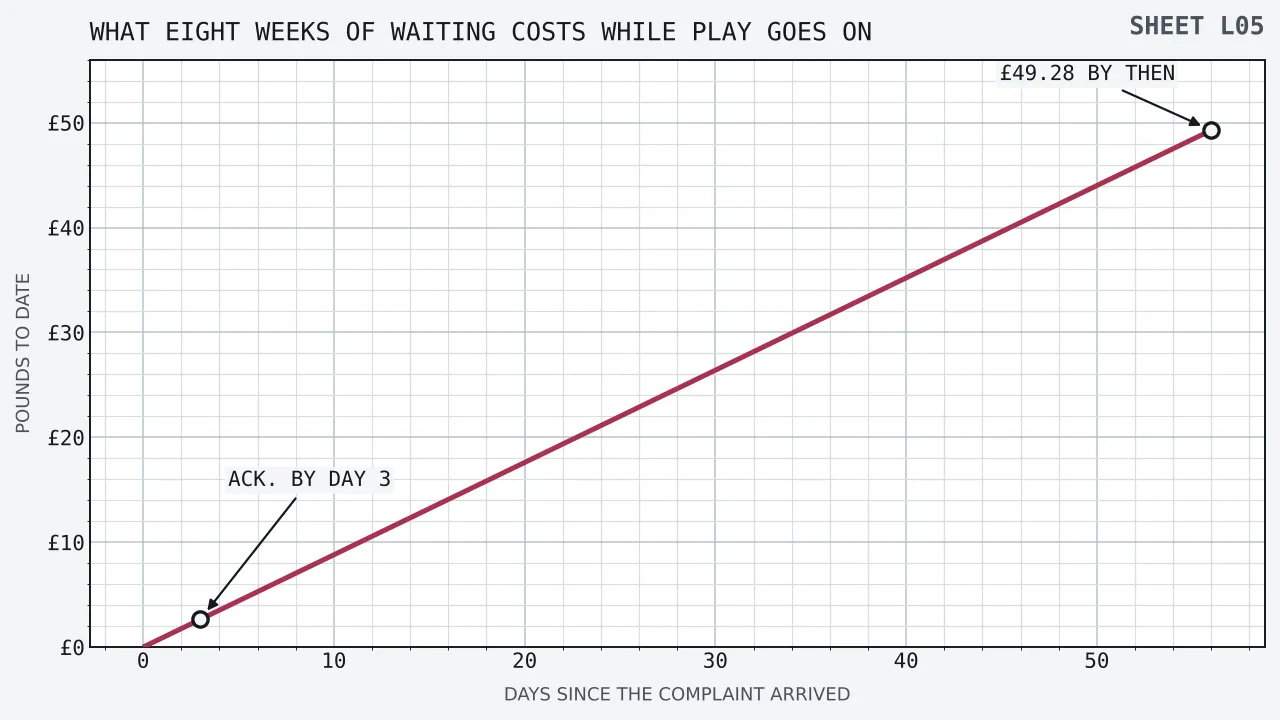
Two things about that line matter more than its slope. It starts at nought on the day the complaint goes in, which is a day the reader chooses, and it does not pause when the clock pauses. A seven day gap while the business waits for information stops the eight weeks and does not stop the 88p a day.
One hundred and sixty pounds sixteen in the bottom row is the quietest figure in the table and perhaps the most useful. The window for bringing a complaint is six months, which at this habit is 182 days and £160.16 of expected price. Anybody deciding whether an incident six months old is worth raising is weighing it against roughly what the six months of play itself cost.
Which body that can be is itself published. Approval of the dispute bodies sits with the Commission, a licensee may only go to one that has been approved, and eight appear on the published roll, five of them covering remote business in every sector. That is a published fact about a route, and facts of that shape are what a comparison is built from.
5
Four named ratings, and the half-year clock attached to two of them
One genuinely ordinal published scale exists in this subject and almost no guide uses it, which is remarkable given how much effort goes into inventing scales that are not published. Where a licensee holds money belonging to customers, its terms have to state whether that money survives the business going under, how far it is protected and by what mechanism, on a rating system the regulator lays down.
The scale has four steps with fixed names, and two of them begin identically: “Not protected – No segregation” first, then “Not protected – Segregation of customer funds”, then “Medium protection”, and at the top “High protection”. The regulator has not at this stage settled the precise words an operator must use to explain where it sits, so the explanation shifts from one set of terms to the next while the rating itself does not.
The disclosure has a timing of its own. It goes to the customer in writing, wants an acknowledgement before any of the money is gambled with, and lands on the first deposit, then again on the first deposit following a change to the protection terms. Money held for customers means, for this purpose, the aggregate standing to their credit: cleared deposits waiting to be played, winnings left where they are, and bonuses that have crystallised without being paid.
Then the clock that makes it a duration rather than a label. On either of the two ratings beginning “Not protected”, a reminder is owed twice a year: that the money would not survive an insolvency, what value is being held for that customer, and an acknowledgement before the funds go into play. 31 October 2025 is the date that paragraph took effect, and the response settling it picked the option carrying no threshold, so the reminder reaches a customer holding any balance at all.
| Feature of the disclosure | What is fixed | What this page can do with it |
|---|---|---|
| The scale | Four steps, named identically everywhere | Compare two businesses on the same axis |
| The wording of the explanation | Not specified by the regulator | Read it, but do not compare the prose |
| When it first arrives | On the first deposit, in writing | Date it, which makes it a clock |
| When it arrives again | On the first deposit after the terms change | Treat a fresh one as notice of a change |
| The reminder on a “not protected” rating | Every six months, in force since 31 October 2025 | Price the six months at £160.16 of play |
| Who receives the reminder | Every customer, with no balance threshold | Expect it whatever is held |
Businesses behind the offers this site follows hold no Great Britain licence, and that settles more about this sheet than anything else on it. Neither of the published clocks above attaches to such a business. There is no acknowledgement inside three working days, no eight week ceiling on a process, no obligation to name an approved dispute body at the end of it, and no four step rating arriving in writing with a six monthly reminder behind it.
That is a loss of comparability before it is a loss of protection, which is the particular point of this page. A reader setting two British licensed businesses side by side already knows both answer within the same eight weeks and both disclose on the same four step scale. A reader setting an offshore arrangement beside either of them has two cells that cannot be filled and no way to fill them.
Saying none of it attaches is not the same as saying nothing exists. Lodging a complaint under the Curaçao policy consulted here costs a player nothing and stays open for six months after an incident. One week is the limit on confirming receipt in writing. Four weeks is the operator’s own assessment period, stretchable once by a further four where written notice precedes it, so fifty-six days again. Missing is an approved roll to pick from, because that policy leaves the operator to write the route’s parameters, down to whether an outcome binds the player.
So the comparison that can honestly be made is a comparison of published commitments rather than of observed behaviour, and that is already far more than a position in a list conveys. Eight weeks against eight weeks is a genuine match. An approved list against a route whose parameters the other party sets is a genuine difference. Both statements can be checked by anybody, which is the whole test from part one.
6
The cells that stay empty however long a reader looks
Some quantities are not published, cannot be derived and should be left blank. Writing them down as blanks is a more useful act than filling them, because a blank is information and a guess is not. There are five of them on this subject and each has a reason.
How quickly a particular business actually pays is the first and the largest. What a cashier prints is a band, and a band announces an intention. An outcome would want a record of requests going in against money arriving, which nobody publishes, and a figure built out of anecdote is not a measurement however many anecdotes went into it. No payout speed for a named business appears on this site.
The spread of wagering multiples away from the British licence is the second. A distribution of multiples, of withdrawal ceilings or of press values out there is published by no primary source at all. What remains available is structural rather than numerical: a play-through on bonus money tops out at a multiple of ten for a British licensee, a limit that began on 19 January 2026, while the Curaçao policy consulted here carries no ceiling of that shape at all.
Complaint volumes are the third. Twice a year, on 15 January and again on 15 June, operators under that policy hand the regulator their numbers, the earliest such report having fallen due in January 2026, and the figures cover totals, outcomes, categories and referrals. Nothing aggregating them could be found in published form, so this site prints no complaint volume for that jurisdiction.
A Costa Rican rulebook is the fourth, since no gambling regulator’s own site for that country could be located at all. The absence is the fact and it is the whole of what can be written down. What such a rulebook might require belongs nowhere on a page built from primary sources, because none was read.
The fifth is narrower and worth naming precisely. One offshore body advertises both a route for player complaints and a roll of dispute providers, and the page setting out that route returned an error when it was fetched. So the route can be said to exist and nothing inside it can: no time limit, no statement that a decision binds, no list of remedies.
| What a reader wants | Why the cell stays empty |
|---|---|
| How fast a named business pays | No outcome record is published by anybody |
| Typical multiples outside the British licence | No primary source publishes a distribution |
| How many complaints a jurisdiction receives | Reports are required, no aggregate was found |
| What one named jurisdiction’s law requires | No regulator’s own site could be located |
| What a particular complaint route contains | The page describing it could not be read |
Five blanks across a sheet of ten or so cells is not research that fell short. It is the result. Any page presenting all ten filled has obtained five of them from somewhere, and the places such figures come from are trade write-ups, marketing and other guides, not one of which is a source in the sense this site uses the word.
7
What a position is made of when an input is missing
Suppose a position in an ordered list is built from five inputs carrying equal weight, so each input decides twenty per cent of where a business lands. The arithmetic of a blank input is then immediate: every input that is not published contributes twenty per cent of the position from nothing at all.
Two blanks and forty per cent of the position is unsourced. Three blanks and sixty per cent is. At five blanks the position is entirely a construction, and the striking thing about the list in part six is that five is the count of blanks actually available on this subject. A page can be built from nothing but blanks without a reader being able to tell.
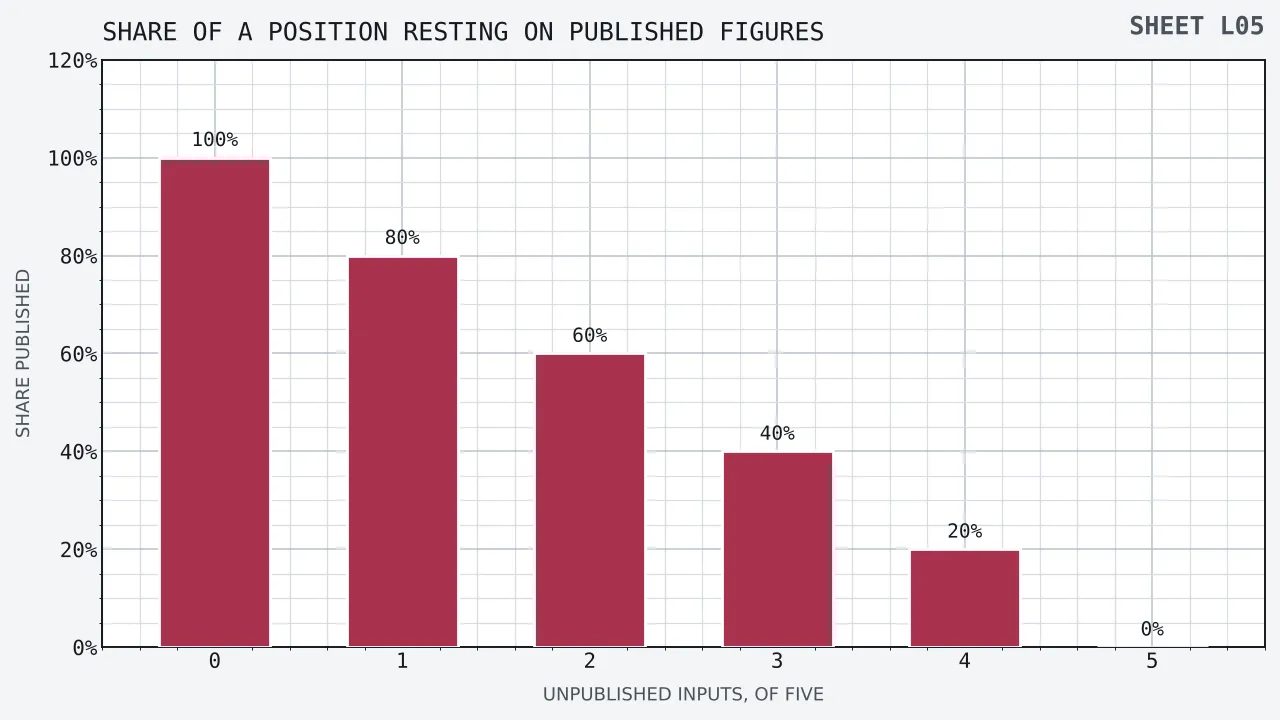
Resolution is the second half of the argument and it is the half that settles it. A figure printed to one decimal place implies the inputs behind it are known to roughly one part in a hundred. Take the payout input, commonly stated as a band of one to five working days. That band runs four days from end to end and sits two days either side of a middle of three, an uncertainty of about sixty-seven per cent on the input.
Carry that through a twenty per cent weight and the input alone shifts the position by about thirteen points in a hundred. On a figure that runs to ten, one decimal place is a hundredth of the range. So what a decimal place distinguishes comes to roughly a thirteenth of the uncertainty carried by one input of the five, with the other four carrying uncertainties of their own. The decimal place is not a fine distinction. It is noise printed to a precision the inputs cannot support.
| Unpublished inputs, of five | Share of the position that is sourced | Share constructed | What the figure is then describing |
|---|---|---|---|
| None | 100% | 0% | Five published quantities, weighted |
| One | 80% | 20% | Four published quantities and an assumption |
| Two | 60% | 40% | A majority published, a large minority not |
| Three | 40% | 60% | Mostly construction with figures attached |
| Four | 20% | 80% | One published quantity carrying a whole list |
| All five | 0% | 100% | An ordering with figures printed beside it |
The weights themselves are the part nobody publishes either, which compounds the problem rather than sitting alongside it. Twenty per cent each is an assumption made in this part purely so the arithmetic can be shown. Where a real set of weights is not stated, a reader cannot reconstruct a position even from inputs that were published, and a position that cannot be reconstructed cannot be checked.
So the test for any ordered list is short, and whether the order looks sensible forms no part of it. Are the inputs named. Are the weights named. Can each input be reached by a reader who goes looking. Where the third answer is no for even one input, the list is reporting a figure nobody can derive, and a figure nobody can derive tells a reader nothing whatever.
13 points in a hundred, moved by one banded input
8
The cheapest hour belongs to the reader, not to a lobby
One superlative survives everything above, and the surprise is where it lives. The cheapest hour of play is not a property of any business. It is a property of three settings, two of which the reader controls, and the same three settings produce the same hourly price wherever they are applied.
Hold the three still and nothing differs. A ten pence press, a twelve second interval and ninety-six pence back in the pound produce £1.20 an hour in any lobby anywhere, because not one of the three terms in the product knows or cares where it is being applied. Put two accounts on one game at one press size and one pace and the hour costs the same in both, to the penny.
Move the settings and everything differs. Thirty seconds a press instead of twelve takes the hour to 48p. A pound a press instead of ten pence takes it to £12.00. Both changes are made by the person playing, in about two seconds, and neither has anything to do with which name is at the top of the screen.
| Term in the product | Who sets it | Spread it carries here |
|---|---|---|
| Size of one press | The reader, on the screen | 10p to £5.00, a factor of 50 |
| Seconds given to one press | The reader, with a thumb, above a floor | 2.5 s to 30 s, a factor of 12 |
| Share coming back in each pound | Whoever built the game | 99 to 90 per cent, a factor of 10 |
| Hours spent | The reader entirely | Unbounded in both directions |
Three of the four rows belong to the reader, and the one that does not is the one with the smallest spread. That is the single most useful thing a page about placing businesses in order can tell somebody: the largest determinants of the bill are settings, not sites, and no ordering of businesses will move them.
Which is why this site prints no judgement of any business under the word best. It prints an hourly rate, a method for producing one, and a list of the cells that cannot be filled. A reader who wants the cheapest hour available to them has the whole answer in part three and does not need a position in a list to reach it.
There is one genuine exception and it is worth stating so the argument is not overstated. The share coming back in each pound does differ between games, it is set by whoever built the game rather than by the reader, and it carries a tenfold spread in the price. Where that figure is published it is worth having, and part six explains why it is often the only one of the five that can be obtained at all.
9
Building the comparison yourself in one evening
A reader with an evening and a sheet of paper can build something better than any ordered list, and the method is five rows long. Write the five quantities down the left. Write each candidate across the top. Fill what can be filled, mark what cannot, and then look at how many marks there are.
Row one, the price of an hour, is filled by the reader for the reader. Decide the press size, decide roughly how often a press will be made, find the share coming back if the game publishes it, and multiply. At ten pence and twelve seconds and ninety-six pence in the pound it is £1.20 an hour, and the figure travels with the reader rather than with the candidate.
Row two, the hours a condition takes, is filled from the terms. Take the multiple, take the credit, multiply for the staking, divide by the press size for the presses, multiply by the interval for the seconds. Ten pounds at forty times works out at 4,000 presses, which on this site’s assumed interval is 13 h 20 min and 37 assumed sittings.
Row three, days to be paid, is filled with a band and the word band, or left blank. Nobody publishes an outcome and no honest cell claims one.
Row four, the complaint clocks, is filled from the regulator’s requirements where a British licence is held, and marked where one is not. Three working days or twenty-four hours for an acknowledgement; fifty-six days as the outer limit; six months within which one may be opened; and an approved dispute body named at the end.
Row five, the days a window stays open, is read straight off the clause and is the easiest cell on the sheet. It is also the cell most likely to decide the outcome, because a window shorter than the hours in row two makes the rest of the sheet academic.
Rows two and five together are worth checking against each other before anything else on the sheet. Where row two says 13 h 20 min of pressing and row five says seven days, the condition needs 1 h 54 min a day without a day missed, which is five assumed sittings every day for a week. Where row five says three days it needs 4 h 27 min a day, which is twelve sittings a day.
What the finished sheet gives a reader is not an order. It is a count of blanks per candidate, and that count is itself the most comparable thing on the page. A candidate with two blanks has published more than a candidate with four, and published more is a statement that can be checked by anybody who repeats the exercise.
Five rows, two of them computed by the reader, two of them published as duties, one of them usually blank. That is the honest shape of this subject, and it fits on a single side of paper, which is rather less than most pages on the topic manage to say in several thousand words.
10
What a superlative is worth once the blanks are marked
A superlative is a claim that one thing exceeds all others on a stated measure, and almost every superlative in this subject omits the measure. Once the measure is supplied the claim usually collapses, not because the answer is different but because the answer belongs to the reader’s own settings rather than to anybody’s lobby.
Cheapest hour belongs to the press size and the interval, and part eight shows that both sit under a thumb. Fastest payout cannot be established, because no outcome is published and part six says so. Most generous offer converts into the most hours of obligation, which part two prices at 13 h 20 min for a ten pound credit at forty times. Best protected is the one with a published four step answer, and it is about insolvency rather than about quality.
Which leaves a short and rather unglamorous conclusion. The useful output of comparing gambling businesses is a table with blanks marked, a duration in every filled cell, and no order at the end of it. An order implies a single axis, and five quantities in different units do not have one.
£1.20 an hour, the figure a reader owns outright
Three figures carry the whole page and they are worth repeating without their working. An hour at ten pence a press costs an expected £1.20 on this site’s assumed interval. Eight weeks is the longest published complaint clock under a British licence. And every six months a customer on a rating that begins “Not protected” has to be reminded of it and told the value being held, a requirement in force since 31 October 2025.
None of the three is a judgement about anybody. All three can be checked, the first by multiplication and the other two against the regulator’s own requirements, and a reader who holds all three is better equipped than a reader holding a position in a list, because a position cannot be checked at all.
And the blanks are the finding rather than the gap. Where a page prints a figure for something nobody publishes, the figure came from somewhere, and the places it can have come from are not sources. A marked cell is a smaller claim than a filled one and a considerably more honest piece of work.
Questions
- Which things about a gambling business can actually be compared?
- Durations and rates, and there are five of them. The price of an hour of play in pounds, the hours a stated condition takes to work off, the days from a request for money to its arrival, the days and weeks a complaint may take, and the days a window stays open before something is forfeited. Each has a unit and a method anybody could repeat. Game quality, interface and trustworthiness have neither, which is why they can be discussed and cannot be placed in an order.
- Which of the five can a reader work out without help?
- The first two. Both come from the same three inputs: the size of a press, the seconds given to a press, and the share of each staked pound that comes back. At ten pence, twelve seconds and ninety-six pence in the pound, an hour costs an expected £1.20 and a twenty-two minute sitting costs 44p. The interval and the sitting are this site’s assumptions and nothing was measured to fix either.
- How long does a complaint take under a British licence?
- Fifty-six days at the outside, counted from the day it lands and covering any internal escalation. Three working days is the longest it may sit before an acknowledgement goes back, and a business whose gambling runs at every hour gets one day rather than three. For six months at the least after an incident a complaint may still be opened. And a customer who leaves a reasonable information request alone for seven days lets the fifty-six stop where they are, to move again from the same point once a reply arrives.
- What does eight weeks of waiting cost somebody still playing?
- An expected £49.28 on a ten pence press. Across 56 days, two assumed sittings of twenty-two minutes each day give 112 sittings, 41 h 4 min at the reels and £1,232.00 of turnover, out of which a twenty-fifth stays behind. The pause available while a customer stays silent halts the eight weeks and does nothing at all to the 88p a day.
- Is there any published scale for comparing one business with another?
- One, and it is about insolvency rather than quality. Where a licensee holds money belonging to customers, its terms have to state whether that money survives the business going under, how far it is protected and by what mechanism, on a rating system the regulator lays down. Four steps carry fixed names, two of them beginning identically: “Not protected – No segregation” first, then “Not protected – Segregation of customer funds”, then “Medium protection”, and at the top “High protection”. The explanation beside a rating is drafted by the operator, the precise words never having been settled at this stage.
- What is the six monthly reminder about customer money?
- On either rating that begins “Not protected”, a reminder is owed twice a year: that the money would not survive an insolvency, what value is being held for that customer, and an acknowledgement before the funds go into play. 31 October 2025 is the date that paragraph took effect, and the option picked carried no balance threshold, so it reaches a customer holding anything at all. Six months of two assumed sittings a day is 182 days and about £160.16 of expected price.
- Do these offers hold a British licence, and what does that do to a comparison?
- Businesses behind the offers this site follows hold no Great Britain licence, and two whole columns come off any sheet as a result. No acknowledgement is owed inside three working days, no eight week ceiling sits over a process, no approved dispute body has to be named at the end, and no four step funds rating arrives in writing with a half-yearly reminder behind it. A route does exist: the Curaçao policy consulted here sets six months as the window for lodging one at no charge, one week as the limit on confirming receipt in writing, and four weeks for the operator’s own assessment, stretchable once by four more. Missing is an approved roll to pick from, since that policy leaves the operator to write the route’s parameters.
- Why will no payout speed appear here for a named business?
- Because nobody publishes an outcome for it. What a cashier prints is a band, and a band announces an intention rather than recording an event. An outcome would want a register of requests going in against money arriving, which no primary source carries, and a figure built out of anecdote is not a measurement whatever its volume. The cell stays blank, and a blank carries more information than a cell filled from somewhere unciteable.
- What is wrong with an ordered list built on a figure nobody publishes?
- Each unpublished input contributes its whole weight from nothing. On five inputs carrying equal weight, one blank makes twenty per cent of the position a construction, three blanks make sixty per cent, and five make the whole thing an ordering with figures printed beside it. The weights are usually unpublished too, so a reader cannot rebuild the position even from the inputs that were published, and a position that cannot be rebuilt cannot be checked.
- Why is a decimal place in such a figure not a fine distinction?
- Because the inputs cannot support that precision. A payout input commonly arrives as a band of one to five working days, which runs four days from end to end and sits two days either side of a middle of three, so it is uncertain by about sixty-seven per cent. Carried through a twenty per cent weight that shifts the position by roughly thirteen points in a hundred. On a figure that runs to ten, one decimal place is a hundredth of the range, so what the decimal place distinguishes is about a thirteenth of the uncertainty in one input alone.
- Is one lobby cheaper per hour than another?
- Not from anything the lobby decides. Multiply press size by presses an hour by the share of each pound kept and the price appears, and not one of those three terms knows where it is being applied. Put two accounts on one game at one press size and one pace and the hour costs the same in both, to the penny. The single genuine exception is the share coming back, set by whoever built the game, which carries a tenfold spread in the price wherever it is published at all.
- What should a reader build instead of looking for an order?
- A sheet with the five quantities down the left and the candidates across the top. Two rows the reader fills by multiplication, two rows come from the regulator’s requirements where a British licence is held, and one row is usually a band or a blank. The output is not an order but a count of blanks per candidate, and that count can be checked by anybody who repeats the exercise, which is more than a position in a list can offer.