Note P10 Revision 1 Terms read 17 October 2026
Eighty-seven seconds saved at one end of a chain whose other end runs to a hundred and sixty-eight hours
Authorising a deposit with a face or a thumb removes the typing of a card number, which this note posits at 87 s of saving. Payment in the other direction does not travel back along the token; it lands on whatever card or account the token was standing in for, and the posited queue to get there is 168 h. The saving is 0.0144 per cent of the wait, which is one part in 6,952.
To authorise 8 s To be paid 168 h Share the speed buys 0.0144%
What a device deposit asks in hours
Advertising has been bought for every destination below. A fee reaches this site when a reader goes on to register, and no figure on this page moves one way or the other because of it.
-
01Mobile Free Spins
Betportal
Ceiling as a multiple
What lands€15.00150 spins at 10c, which is this site's figure and not the operator'sThe run17 h 30 minTurning over 525.00 at 10p means 5,250 presses, or about 48 phone sittings of 22 minutes. Timed at 10p a press and 12 seconds between presses, both of which this site assumes rather than measures.The wait to be paidNOT PUBLISHEDThis operator puts no withdrawal band in its own terms, so there is nothing honest to print here.Spins valued at this site's own 10p a spin
What lands
Spins, at a price15.00150 of them at 10c apiece, a figure belonging to this site rather than to the operatorMatch, and other creditno figure300% of three deposits, to a ceiling of €1,000. Not a sum until money of yours makes it one, so this row totals nothing and carries nothing downwardsThe run
Handed back on the spins(0.60)Each press stakes its own value and returns 96 per cent, which leaves this much with the house from the opening pressPlay-through 35x on the bonus(20.16)Taking 14.40 round 35 times over means 504.00 through the machines, of which 20.16 is the expected cost, and 17 h 30 min of pressing at the pace aboveWhat counts towards it100%Slots only, with no percentage published anywhere, so the row above assumes the whole of each stake countsWhat never clears
Limit on the winningsstated5x the bonusDeducted on the way outno figureNothing is published as a figure here, so this row removes nothingLeast that can leaveno figureNo figure is published, so nothing on this timer is pinned down by oneLeast deposit, and the rung over ityour own€20 a stage. Published in euros, so no rung is named at all: this site's ladder is a sterling oneThe window on the creditstated14 daysBiggest stake while it runsstated€5Removed outright by rulestatedNot publishedVerified before a payoutstatedDocuments before the first withdrawalNever clears€15.00Not a penny of it gets out, so the whole of what landed stands on this rowNo Great Britain licence
Licence held in Anjouan, Comoros, the company named is BetPortal Gaming Ltd, with Excite Ultra Media Ltd, quoted under ALSI-202601040-FI2.
Terms read 17 October 2026
Open the offer at Betportal, opens in a new window -
02Mobile Free Spins
WinBeast
Ceiling as a sum
What lands€50.00500 spins at 10c, which is this site's figure and not the operator'sThe run2 d 18 hTurning over 2,000.00 at 10p means 20,000 presses, or about 182 phone sittings of 22 minutes. Timed at 10p a press and 12 seconds between presses, both of which this site assumes rather than measures.The wait to be paidNOT PUBLISHEDThis operator puts no withdrawal band in its own terms, so there is nothing honest to print here.Spins valued at this site's own 10p a spin
What lands
Spins, at a price50.00500 of them at 10c apiece, a figure belonging to this site rather than to the operatorMatch, and other creditno figure50% to 100% of five deposits, each to a ceiling of €1,000, and a €650 free bet. Not a sum until money of yours makes it one, so this row totals nothing and carries nothing downwardsThe run
Handed back on the spins(2.00)Each press stakes its own value and returns 96 per cent, which leaves this much with the house from the opening pressPlay-through 40x on the bonus and the winnings from the spins(76.80)Taking 48.00 round 40 times over means 1,920.00 through the machines, of which 76.80 is the expected cost, and 2 d 18 h of pressing at the pace aboveWhat counts towards it100%Slots, titles vary by country, with no percentage published anywhere, so the row above assumes the whole of each stake countsWhat never clears
Limit on the winningsstated€100 a batch of spinsDeducted on the way outno figureNothing is published as a figure here, so this row removes nothingLeast that can leaveno figureNo figure is published, so nothing on this timer is pinned down by oneLeast deposit, and the rung over ityour own€20 a stage. Published in euros, so no rung is named at all: this site's ladder is a sterling oneThe window on the creditstated7 days, spins 1 dayBiggest stake while it runsstatedNot publishedRemoved outright by rulestatedNot publishedVerified before a payoutstatedDocuments before the first withdrawalNever clears€50.00Not a penny of it gets out, so the whole of what landed stands on this rowNo Great Britain licence
Licence held in Curaçao, no company named anywhere on the site.
Terms read 17 October 2026
Open the offer at WinBeast, opens in a new window -
03Mobile Free Spins
EliteSpin
Longest spin window
What lands£50.00500 spins at 10p, which is this site's figure and not the operator'sThe run2 d 18 hTurning over 2,000.00 at 10p means 20,000 presses, or about 182 phone sittings of 22 minutes. Timed at 10p a press and 12 seconds between presses, both of which this site assumes rather than measures.The wait to be paidNOT PUBLISHEDThis operator puts no withdrawal band in its own terms, so there is nothing honest to print here.Spins valued at this site's own 10p a spin
What lands
Spins, at a price50.00500 of them at 10p apiece, a figure belonging to this site rather than to the operatorMatch, and other creditno figure50% to 100% of five deposits, each to a ceiling of £1,000. Not a sum until money of yours makes it one, so this row totals nothing and carries nothing downwardsThe run
Handed back on the spins(2.00)Each press stakes its own value and returns 96 per cent, which leaves this much with the house from the opening pressPlay-through 40x on the bonus and the winnings from the spins(76.80)Taking 48.00 round 40 times over means 1,920.00 through the machines, of which 76.80 is the expected cost, and 2 d 18 h of pressing at the pace aboveWhat counts towards it100%Slots, with no percentage published anywhere, so the row above assumes the whole of each stake countsWhat never clears
Limit on the winningsstated5x the bonusDeducted on the way outno figureNothing is published as a figure here, so this row removes nothingLeast that can leaveno figureNo figure is published, so nothing on this timer is pinned down by oneLeast deposit, and the rung over ityour own£20 a stage. It lands square on the £20.00 rung, so none of yours is left perched on topThe window on the creditstated7 days, spins 3 daysBiggest stake while it runsstatedNot publishedRemoved outright by rulestatedNot publishedVerified before a payoutstatedDocuments before the first withdrawalNever clears£50.00Not a penny of it gets out, so the whole of what landed stands on this rowNo Great Britain licence
Licence held in Costa Rica, the company named is PrimeTier Limited.
Terms read 17 October 2026
Open the offer at EliteSpin, opens in a new window -
04Mobile Free Spins
Crown Jewelz
Multiple unpublished
What lands£15.00150 spins at 10p, which is this site's figure and not the operator'sThe runNOT TIMEDThis operator does not publish the play-through multiple in its own terms. The multiple is the one figure the clock cannot work around, so the run is left untimed.The wait to be paidNOT PUBLISHEDThis operator puts no withdrawal band in its own terms, so there is nothing honest to print here.Nothing reckoned
What lands
Spins, at a price15.00150 of them at 10p apiece, a figure belonging to this site rather than to the operatorMatch, and other creditno figure200% of the first deposit, then 150% twice, each to a ceiling of £1,000. Not a sum until money of yours makes it one, so this row totals nothing and carries nothing downwardsThe run
Play-throughno figure40x the bonus, reported rather than published by the operatorWhat counts towards itno figureSlots, with no percentage published anywhere, so the row above assumes the whole of each stake countsWhat never clears
Limit on the winningsstatedNot publishedDeducted on the way outno figureNothing is published as a figure here, so this row removes nothingLeast that can leaveno figureNo figure is published, so nothing on this timer is pinned down by oneLeast deposit, and the rung over ityour own£20. It lands square on the £20.00 rung, so none of yours is left perched on topThe window on the creditstatedNot publishedBiggest stake while it runsstatedNot publishedRemoved outright by rulestatedNot publishedVerified before a payoutstatedDocuments before the first withdrawalNever clearsNOT RECKONEDThis operator leaves the play-through multiple out of its own terms, so nothing below the fourth step can be worked out.No Great Britain licence
Licence held in Curaçao, number not verified, no company named anywhere on the site.
Terms read 17 October 2026
Open the offer at Crown Jewelz, opens in a new window
Only the middle reading comes out of arithmetic belonging to this site. The multiple laid against what lands gives the turnover asked for; dividing that by 10p a spin gives the presses; dividing those by 300 an hour gives the hours, a press on a handset being taken here at 12 seconds from the one before. Both figures are assumptions rather than measurements of anybody: nothing was played and nothing was held a stopwatch to. Anybody quicker should divide the press count by a rate of their own, which is why the presses are printed alongside the hours instead of being summarised away.
The first reading is what arrives before any condition is laid against it. Spins carry no unit of their own so one gets supplied: where an operator values its own spin that figure is used and attributed, and where it does not, this site's 10p a spin stands in and everything below moves with it. The third reading belongs to the operator entirely. It is a withdrawal band quoted from published terms, and a blank there means none was published rather than that nobody looked.
The total along the foot answers what the hours leave open, which is whether any of the running ends anywhere. It is what arrived, less whatever is still standing once the play-through has been paid for at 96 per cent return to player and once a published limit, a published deduction and a published floor beneath the least that can leave have each had a turn. It appears again in pence in the pound, the only fair way of holding a small offer up against a large one. It describes an offer rather than an evening, and where the conditions price out what arrived, a timer prints nothing getting out instead of a negative sum.
Cashiers on a handset take deposits off a row of preset buttons, so a least deposit given in pounds is raised to the next rung of the ladder used here, £10, £20, £25, £50, £75 and £100, and the timer shows what is left perched on it. That money is the reader's own and enters no sum at all. Given in euros it prints untouched, the ladder being sterling. Three words may occupy the figure column where no figure belongs. Stated is a published term that costs something while leaving no number to subtract. No figure is a term nobody has quantified, or a credit that is not a sum until money of yours makes it one. Your own is money of yours, which belongs in none of this.
None of the operators above is licensed in Great Britain, so not one duty that licence carries reaches any of them. Membership of Gamstop Online is compulsory for every online gambling company licensed in Great Britain, which means that shutting yourself out through the scheme shuts you out of none of these. The limit of ten times the bonus funds on a wagering requirement, running since 19 January 2026 under Social Responsibility Code 5.1.1, is a condition of the same licence and binds only whoever holds one. Off that licence, the Gambling Commission writes of consumers meeting unfair gaming practices, financial loss and no recourse when matters go wrong, and lists blocked payouts and withdrawal limits pitched too high to reach among the things it has seen. No account at any of them may be held by anybody under 18.
Every term on a timer is its operator's own and every timer carries the day somebody read it. The oldest of those readings is 17 October 2026. What binds a reader is an operator's full terms and never a line printed here.
1
Eight seconds at the door, and the ninety-five they replace
Eight seconds is what this note posits for a deposit authorised by a device: the sheet appears, a face or a thumb is presented, the panel closes. Ninety-five seconds is what it posits for the same deposit typed out, being sixteen digits, an expiry pair, three more digits on the back and a billing address that is usually wrong the first time. Neither figure was taken off a watch.
Eighty-seven seconds is the difference and it is a genuine difference. Apple Pay really does remove the typing, really does remove the mistyping, and really does remove the moment where a reader goes to find a card in another room. Nothing in the rest of this note disputes the saving. The whole of the argument is about what share of anything it represents.
Eighty-seven seconds at the twelve seconds a press posited across this site is seven presses and a quarter. Set beside one go with a handset, reckoned here at twenty-two minutes, it is 6.6 per cent of one such go. Those are the two units in which the saving is largest, and they are the honest best case for it.
87 posited seconds, which is 7.25 presses of saving
Ten pounds funded in eight seconds buys a hundred presses of ten pence, twenty posited minutes of pressing. So the authorisation is 0.67 per cent of the play it pays for, and typing the card instead would have made it 7.3 per cent. Both of those ratios are small, and the one on the way out, which part three reaches, is smaller still by three orders of magnitude.
2
Why nothing comes back the way it went in
A device payment is an instruction wrapped in a substitute number. The substitute stands in for a card or an account and the device authorises its use, which is what makes the eight seconds possible. Money travelling the other way does not use the substitute at all. It is sent to the card or the account underneath, by whatever means that card or account is ordinarily paid.
So the authorisation is a feature of one direction only, and it is a feature of the direction that was never slow. Nobody has ever complained that funding a balance took too long. The complaint is always about the other end, and the other end is reached by a route the device has no part in.
Four terms make up that other end and this note posits a length for each. Eighteen hours for a desk to look at the request. Thirty hours for an identity examination, which lands here rather than earlier because a substitute number carries no name a desk can check. Three working days for the leg onto the underlying card. And whatever the calendar inserts between those, which is the term nobody budgets for.
Forty-eight hours is the first two added, and they run continuously through nights and Sundays because an examination is not a bank transfer. One hundred and twenty hours is what the last two come to on a request made at ten on a Monday morning, giving 168 h altogether, which is seven days to the minute.
Nothing here is a service level, a published figure or an observation. Four declared lengths, set down only so that shares can be worked out, and the shares are what this page exists for. A reader who thinks thirty hours generous for an identity examination should halve it and watch what happens to the percentage in part four, which is almost nothing: the saving is 0.0144 per cent of 168 hours and 0.0176 per cent of 153.
3
Where the hours actually sit, as shares of a week
Four terms and one week between them, divided as the table divides them. The column that matters is the last, because the question this page asks is not how long each part takes but which part is worth attacking.
| Term | Posited length | In seconds | Share of 168 h | Can the device touch it |
|---|---|---|---|---|
| Authorising the deposit | 8 s | 8 | 0.0013% | It is the device |
| The desk looking at the request | 18 h | 64,800 | 10.71% | No |
| The identity examination | 30 h | 108,000 | 17.86% | No |
| The leg and the calendar together | 120 h | 432,000 | 71.43% | No |
| The wait, added up | 168 h | 604,800 | 100% |
Seventy-one and four sevenths per cent of the week is the last row before the total, and it is the one term the reader has no handle on whatever. The leg is a property of the card underneath and the calendar is a property of the country. Neither notices which wallet the deposit came from.
Seventeen point eight six per cent is the identity examination, and it is the only term with a lever attached. Supplying documents at the point of registration instead of at the point of collection takes thirty hours out of a hundred and sixty-eight, leaving 138. Thirty hours is 108,000 seconds, which is 1,241 times the eighty-seven seconds the device saved.
One thousand two hundred and forty-one to one is the comparison this page exists to print. A reader who spends nine minutes uploading a passport at registration has done something worth 1,241 authorisations, and no amount of thumbprints gets anywhere near it. The fast end is fast and the fast end is not where the hours are.
4
One part in 6,952, written out as a percentage
Six hundred and four thousand eight hundred seconds is a week. Dividing it by the 87 posited seconds gives 6,951.7, so the saving is one part in 6,952 of the wait, which is 0.0144 per cent. Written the other way, the slow end would have to shed fourteen thousandths of one per cent of itself to cancel everything the device did.
Two further ratios belong beside it. The authorisation itself, at eight posited seconds against 604,800, is one part in 75,600. And the saving measured against the mean across a week of request mornings, which part five puts at exactly 144 hours or 518,400 seconds, is one part in 5,959, or 0.0168 per cent.
87 posited seconds in 604,800, one part in 6,952
Two hundred and twenty pounds held for seven days, at an assumed six per cent a year, costs the reader 25.3 pence. The same arithmetic applied to 87 seconds gives 0.0036 of a penny. A reader would need to make roughly 7,000 device deposits before the saving added up to the cost of one week of waiting, and a reader making 7,000 deposits has problems this page cannot help with.
Percentages of this size invite a shrug, and the shrug is the wrong response. The point is not that 0.0144 per cent is small. The point is that it is the figure which answers the question a reader is actually asking, and the figure they are offered instead is the eight seconds, which answers a question nobody asked.
5
Three mornings at a hundred and sixty-eight hours
Forty-eight hours of continuous holding happens whatever morning the request goes in. Where it finishes decides everything else, because a leg of three working days cannot begin on a Saturday and cannot be counted on one either. Seven identical requests, all at ten in the morning, therefore land at three distinct totals.
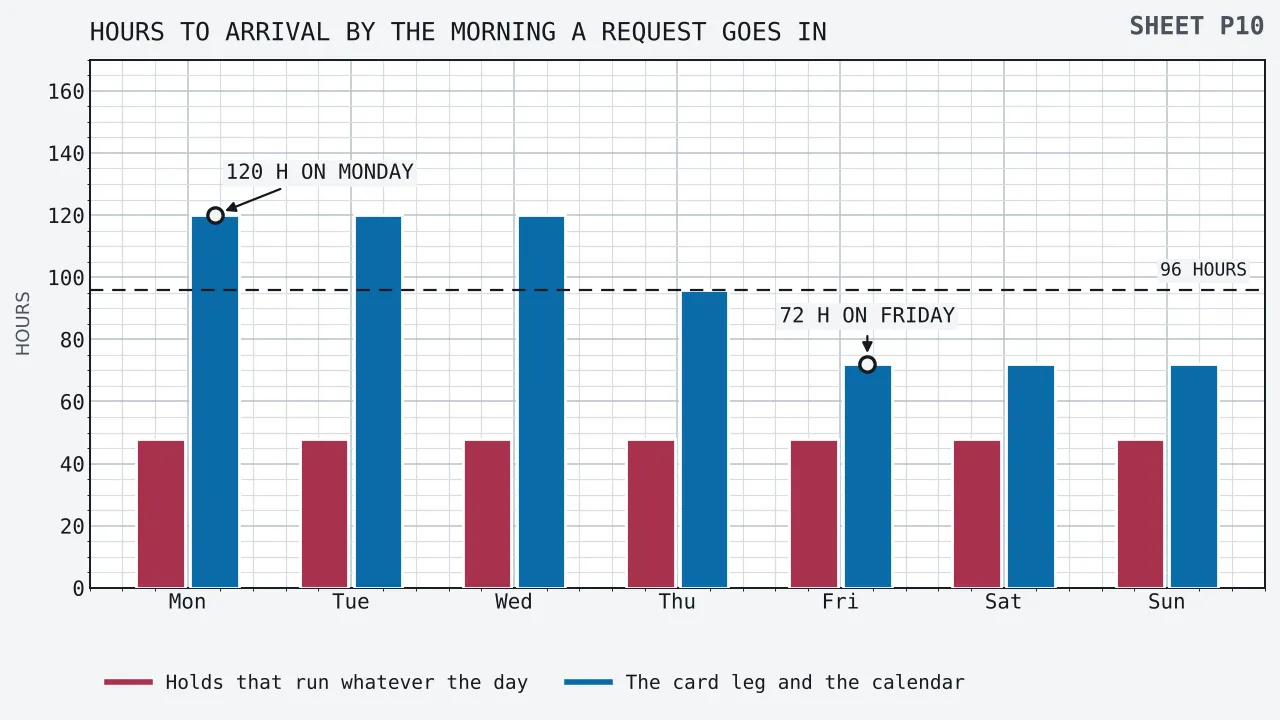
One hundred and sixty-eight hours on Monday, Tuesday and Wednesday. One hundred and forty-four on Thursday. One hundred and twenty on Friday, Saturday and Sunday. The mean of those seven is 1,008 divided by seven, which is 144 hours exactly, and the spread between best and worst is 48.
Friday morning being the best moment of the week to ask is the result nobody expects. It happens because forty-eight hours from Friday at ten finishes on Sunday at ten, the weekend is spent inside the holds rather than inside the leg, and the leg then gets three clean working days from Monday. Asking on Monday morning puts the weekend in the leg instead, where it costs two days rather than nothing.
| Request at ten on | Holds | Leg and calendar | Total |
|---|---|---|---|
| Monday | 48 | 120 | 168 |
| Tuesday | 48 | 120 | 168 |
| Wednesday | 48 | 120 | 168 |
| Thursday | 48 | 96 | 144 |
| Friday | 48 | 72 | 120 |
| Saturday | 48 | 72 | 120 |
| Sunday | 48 | 72 | 120 |
Forty-eight hours is the spread and 172,800 seconds is the same spread written for comparison. Dividing by 87 gives 1,986, so choosing a morning is worth 1,986 times what the device is worth, and it takes no equipment, no account and no decision beyond waiting four days before pressing a button.
6
Two days inside a seven day total on which nobody worked
Forty-eight of the 168 hours in the worked Monday case are a Saturday and a Sunday, and that is 28.57 per cent of the whole wait spent on days when the leg could not advance. Nothing is being done wrong by anybody during those two days. They are simply inside the bracket, and a reader counting days off a calendar will count them.
Where a weekend falls decides how much it costs, and the three possible positions give three different answers. Inside the continuous holds it costs nothing at all, because an examination carries on through it. Inside the leg it costs the full forty-eight hours. Straddling the boundary it costs whatever portion of itself lands on the leg side.
Thursday morning is the straddling case and the table in part five shows it: 96 hours of leg and calendar rather than 120 or 72, which is one weekend day absorbed by the holds and one spent in the leg. Twenty-four hours of difference, decided by nothing except that a request went in on a Thursday rather than a Wednesday.
28.57% of a Monday request is Saturday and Sunday
One hundred and twenty hours of leg and calendar on a Monday contains 72 hours of working day and 48 of weekend, so three fifths of it is work and two fifths is the calendar. A reader told that payment takes three working days and hearing three days has misread it by 48 hours, and the misreading is entirely reasonable, because the word working is doing all of the labour in that phrase.
Two bank holidays falling inside the leg would push the Monday case from 168 hours to 216, on the same posited lengths, which is nine days. Nothing in this note models a holiday calendar, and a reader asking in late December should add their own days before planning anything around the answer.
7
A year of deposits set against a year of waiting
One deposit saves 87 posited seconds and one payout costs 168 posited hours, which is the comparison parts one to six have been making. Aggregating both over a year is the fairer test, because deposits are frequent and payouts are not, and frequency is the strongest argument the fast end has.
Three deposits a week is 156 in a year, and 156 times 87 seconds is 13,572 seconds, which is 3 h 46 min 12 s. Twelve payouts a year at 168 hours apiece is 2,016 hours. Dividing the first into the second gives 0.187 per cent, so even on a year of heavy use the saving is under a fifth of one per cent of the waiting.
| Deposits a week | Saved in a year | Against 2,016 h waited |
|---|---|---|
| One | 1 h 15 min | 0.062% |
| Three | 3 h 46 min | 0.187% |
| Seven | 8 h 48 min | 0.436% |
| Fourteen | 17 h 36 min | 0.873% |
Fourteen deposits a week gets the saving to 0.873 per cent and no further, and the bottom row is in the table to show how hard it has to be pushed. Seven hundred and twenty-eight authorisations in a year, two a day every day, buys back seventeen and a half hours against two thousand and sixteen spent waiting.
Two thousand and sixteen hours is eighty-four days, which is twenty-three per cent of a year during which money a reader has already asked for is in somebody else’s hands. Twelve payouts is not an extravagant habit. One a month is what an ordinary user of any cashier does, and the figure is the right one to be frightened by rather than the eight seconds.
Moving every one of those twelve requests to a Friday morning takes each from 168 hours to 120, which is 576 hours across the year, or twenty-four days. Doing the identity examination once at registration takes another 360 hours out, being thirty hours times twelve. Together those two habits are worth 936 hours a year, against 3 h 46 min for the thumbprint.
8
What the regulator states it cannot do about a payment
One hundred and sixty-eight hours models a payment that works. Where one does not work the question stops being arithmetic and turns into a question about who answers the telephone, and a device wallet reaches cashiers holding no British licence whatever. Three losses belong on a payment page and the rest of this site takes the others.
Not an ombudsman is how the British regulator describes itself, and it spells that out in three ways of its own. Powers to settle a gambling complaint or recover somebody’s money are ones it says it has not got. Disputes over gambling transactions, with trouble over a withdrawal and a game going wrong given as the two examples, are ones it says it is unable to settle. Accounts are something it has no sight of, which leaves the events inside one invisible to it as well. Its instruction is that the business itself is the first place to go. The page carrying all of that went up on 11 December 2023, with a revision dated 4 June 2024.
Read against a 168 hour model, those three statements describe a gap rather than a failing. Every chain ends somewhere, and at a licensed cashier that somewhere has deadlines written on it. Which body stands at the end matters more on a payment page than on any other, since a payment is precisely the thing the regulator has put in writing that it will not fix.
Adjudicators carry that end, and the list is thinner than it looks for somebody playing casino games on a phone. Approval of the bodies a licensee may send a dispute to rests with the regulator, which publishes which sectors each of them is down for, and the rows are not all the same. Members clubs, public houses, family entertainment centres, bingo away from a screen and adult gaming centres are the sectors one approved row names, and remote casino is absent from it. Establishing that a route exists is therefore not the check. The check is whether the route covers this product.
Two failure modes have been published by the regulator about sites running without its licence and neither of them is a queue. Payouts being blocked is the first. Withdrawal limits pitched at a height nobody reaches is the second. A ceiling set above any balance a reader will ever hold is not 168 hours, and it is not 400 either; it is an unbounded wait wearing the clothes of a term, and no decomposition in parts one to seven can model it.
None of that apparatus follows a cashier off the register, and every figure above stays where it was: 48 hours of hold, 120 of leg and calendar, 87 seconds at the door. Gone is the body with a published deadline standing at the end of the chain, which is the one thing an eight second authorisation was never going to supply.
9
Who should care that a deposit takes eight seconds
Somebody who dislikes typing card numbers into a phone should care, and should go on using the thing. Eighty-seven posited seconds a deposit is real, the security case for not spreading a card number around is real, and nothing in parts one to eight argues against either.
Anybody choosing a cashier because the deposit is quick has made a decision on 0.0144 per cent of the evidence. The authorisation touches one term of four and it is the term that was already measured in seconds. The other three are measured in days and the device cannot reach any of them, because the money goes home by a different road.
Two habits are worth more than the wallet and both are free. Asking on a Friday morning rather than a Monday is worth 48 hours, which is 1,986 times the saving. Having the identity examination done at registration rather than at the exit is worth 30 hours, which is 1,241 times it. Across twelve payments in a year the pair come to 936 hours against 3 h 46 min.
Three questions settle it before a first deposit. Which card or account sits underneath the token, since that is what the money will be sent to and its leg is 71 per cent of the wait. Whether the identity examination can be completed now rather than later. And which morning the request is going in on, since the calendar is free and it is worth two days.
One hundred and sixty-eight hours is the number to carry away, not eight seconds. Seven days is the honest reading of the posited chain, 144 hours is the mean across a week of mornings, and a device that saves 87 seconds at the only point where seconds were ever the unit has not touched either of them.
Questions
- How long does an Apple Pay casino withdrawal take?
- Seven days to the minute on the lengths posited here, which is 168 hours from a request at ten on a Monday morning. That breaks into 18 hours while a desk considers the request, 30 hours of identity examination, and 120 hours of card leg and calendar together. Across the seven mornings of a week the totals are 168, 168, 168, 144, 120, 120 and 120, a mean of exactly 144 hours. None of the four lengths was measured.
- Can winnings be paid back to the device wallet?
- No, because the wallet is a substitute number standing in for something else. The device authorises the use of that substitute, which is what makes an eight second deposit possible, and money travelling the other way is sent to the card or account underneath by whatever means that card or account is ordinarily paid. The speed therefore exists in one direction only, and it is the direction nobody ever complained about.
- How much time does the authorisation actually save?
- Eighty-seven posited seconds a deposit, being eight seconds to present a face or a thumb against ninety-five to type sixteen digits, an expiry pair, three digits on the back and a billing address. Measured against a 168 hour wait, which is 604,800 seconds, that is one part in 6,952, or 0.0144 per cent. Measured against the 144 hour mean it is one part in 5,959, or 0.0168 per cent.
- Which part of the wait is worth attacking?
- The identity examination, because it is the only term with a lever on it. Thirty posited hours is 108,000 seconds, which is 1,241 times the 87 seconds the device saves, and supplying documents at registration rather than at the exit removes the whole of it, taking 168 hours down to 138. The leg and the calendar are 71.43 per cent of the wait and the reader has no handle on either.
- Which morning of the week is best for asking?
- Friday, by 48 hours. Forty-eight hours of continuous holding from Friday at ten finishes on Sunday at ten, so the weekend is spent inside the holds instead of inside the leg, and the leg then gets three clean working days from Monday. Asking on Monday morning puts the weekend into the leg, where it costs two days. The spread across the seven mornings is 48 hours, which is 1,986 times what the device saves.
- How much of a seven day wait is the weekend?
- Forty-eight hours of the 168 in the worked Monday case, which is 28.57 per cent. The 120 hours of leg and calendar divide into 72 hours of working day and 48 of weekend, so three fifths of that stretch is work and two fifths is the calendar. Anybody told three working days and hearing three days has misread it by 48 hours, and two bank holidays inside the leg would take the same case to 216 hours.
- Does the saving add up over a year?
- Barely. Three deposits a week is 156 a year, which at 87 seconds apiece is 3 hours 46 minutes and 12 seconds. Twelve payouts a year at 168 hours is 2,016 hours, so the saving is 0.187 per cent of the waiting. Pushed to fourteen deposits a week it reaches 0.873 per cent and stops. Moving those twelve requests to Friday mornings and doing the identity examination at registration is worth 936 hours a year by comparison.
- If a payment goes wrong, who is there to settle it?
- Nobody a reader can lean on, where the cashier holds no British licence. The regulator describes itself as not an ombudsman and sets out three limits in its own terms: powers to settle a gambling complaint or recover somebody’s money are ones it has not got, disputes over gambling transactions are ones it is unable to settle, with trouble over a withdrawal and a game going wrong given as the examples, and accounts are something it has no sight of. It says the business itself is the first place to go, on a page dated 11 December 2023 and revised 4 June 2024. Behind that sit adjudicators the regulator approves, whose published rows differ by sector, one of them naming members clubs, public houses, family entertainment centres, bingo away from a screen and adult gaming centres while leaving remote casino off. And two failure modes have been published about sites running without that licence: payouts being blocked, and withdrawal limits pitched at a height nobody reaches.