Note D03 Revision 1 Terms read 17 October 2026
Seventy spins governed by two separate dates, and the gap between them is where the money goes
Seventy presses at ten pence send £7.00 over the reels and are expected to hand back £6.72, which occupies 14 min at the twelve seconds this note puts on one press. Two dates then govern that £6.72, and they are rarely the same length. A reader pacing the spins across a week watches £3.84 of the expectation lapse before the final press lands.
Expected off the spins £6.72 Taken by the shorter clock £3.84 Play the lot takes 14 min
What a credit of this size asks in hours
Advertising has been bought for every destination below. A fee reaches this site when a reader goes on to register, and no figure on this page moves one way or the other because of it.
-
01Mobile Free Spins
Betportal
Ceiling as a multiple
What lands€15.00150 spins at 10c, which is this site's figure and not the operator'sThe run17 h 30 minTurning over 525.00 at 10p means 5,250 presses, or about 48 phone sittings of 22 minutes. Timed at 10p a press and 12 seconds between presses, both of which this site assumes rather than measures.The wait to be paidNOT PUBLISHEDThis operator puts no withdrawal band in its own terms, so there is nothing honest to print here.Spins valued at this site's own 10p a spin
What lands
Spins, at a price15.00150 of them at 10c apiece, a figure belonging to this site rather than to the operatorMatch, and other creditno figure300% of three deposits, to a ceiling of €1,000. Not a sum until money of yours makes it one, so this row totals nothing and carries nothing downwardsThe run
Handed back on the spins(0.60)Each press stakes its own value and returns 96 per cent, which leaves this much with the house from the opening pressPlay-through 35x on the bonus(20.16)Taking 14.40 round 35 times over means 504.00 through the machines, of which 20.16 is the expected cost, and 17 h 30 min of pressing at the pace aboveWhat counts towards it100%Slots only, with no percentage published anywhere, so the row above assumes the whole of each stake countsWhat never clears
Limit on the winningsstated5x the bonusDeducted on the way outno figureNothing is published as a figure here, so this row removes nothingLeast that can leaveno figureNo figure is published, so nothing on this timer is pinned down by oneLeast deposit, and the rung over ityour own€20 a stage. Published in euros, so no rung is named at all: this site's ladder is a sterling oneThe window on the creditstated14 daysBiggest stake while it runsstated€5Removed outright by rulestatedNot publishedVerified before a payoutstatedDocuments before the first withdrawalNever clears€15.00Not a penny of it gets out, so the whole of what landed stands on this rowNo Great Britain licence
Licence held in Anjouan, Comoros, the company named is BetPortal Gaming Ltd, with Excite Ultra Media Ltd, quoted under ALSI-202601040-FI2.
Terms read 17 October 2026
Open the offer at Betportal, opens in a new window -
02Mobile Free Spins
WinBeast
Ceiling as a sum
What lands€50.00500 spins at 10c, which is this site's figure and not the operator'sThe run2 d 18 hTurning over 2,000.00 at 10p means 20,000 presses, or about 182 phone sittings of 22 minutes. Timed at 10p a press and 12 seconds between presses, both of which this site assumes rather than measures.The wait to be paidNOT PUBLISHEDThis operator puts no withdrawal band in its own terms, so there is nothing honest to print here.Spins valued at this site's own 10p a spin
What lands
Spins, at a price50.00500 of them at 10c apiece, a figure belonging to this site rather than to the operatorMatch, and other creditno figure50% to 100% of five deposits, each to a ceiling of €1,000, and a €650 free bet. Not a sum until money of yours makes it one, so this row totals nothing and carries nothing downwardsThe run
Handed back on the spins(2.00)Each press stakes its own value and returns 96 per cent, which leaves this much with the house from the opening pressPlay-through 40x on the bonus and the winnings from the spins(76.80)Taking 48.00 round 40 times over means 1,920.00 through the machines, of which 76.80 is the expected cost, and 2 d 18 h of pressing at the pace aboveWhat counts towards it100%Slots, titles vary by country, with no percentage published anywhere, so the row above assumes the whole of each stake countsWhat never clears
Limit on the winningsstated€100 a batch of spinsDeducted on the way outno figureNothing is published as a figure here, so this row removes nothingLeast that can leaveno figureNo figure is published, so nothing on this timer is pinned down by oneLeast deposit, and the rung over ityour own€20 a stage. Published in euros, so no rung is named at all: this site's ladder is a sterling oneThe window on the creditstated7 days, spins 1 dayBiggest stake while it runsstatedNot publishedRemoved outright by rulestatedNot publishedVerified before a payoutstatedDocuments before the first withdrawalNever clears€50.00Not a penny of it gets out, so the whole of what landed stands on this rowNo Great Britain licence
Licence held in Curaçao, no company named anywhere on the site.
Terms read 17 October 2026
Open the offer at WinBeast, opens in a new window -
03Mobile Free Spins
EliteSpin
Longest spin window
What lands£50.00500 spins at 10p, which is this site's figure and not the operator'sThe run2 d 18 hTurning over 2,000.00 at 10p means 20,000 presses, or about 182 phone sittings of 22 minutes. Timed at 10p a press and 12 seconds between presses, both of which this site assumes rather than measures.The wait to be paidNOT PUBLISHEDThis operator puts no withdrawal band in its own terms, so there is nothing honest to print here.Spins valued at this site's own 10p a spin
What lands
Spins, at a price50.00500 of them at 10p apiece, a figure belonging to this site rather than to the operatorMatch, and other creditno figure50% to 100% of five deposits, each to a ceiling of £1,000. Not a sum until money of yours makes it one, so this row totals nothing and carries nothing downwardsThe run
Handed back on the spins(2.00)Each press stakes its own value and returns 96 per cent, which leaves this much with the house from the opening pressPlay-through 40x on the bonus and the winnings from the spins(76.80)Taking 48.00 round 40 times over means 1,920.00 through the machines, of which 76.80 is the expected cost, and 2 d 18 h of pressing at the pace aboveWhat counts towards it100%Slots, with no percentage published anywhere, so the row above assumes the whole of each stake countsWhat never clears
Limit on the winningsstated5x the bonusDeducted on the way outno figureNothing is published as a figure here, so this row removes nothingLeast that can leaveno figureNo figure is published, so nothing on this timer is pinned down by oneLeast deposit, and the rung over ityour own£20 a stage. It lands square on the £20.00 rung, so none of yours is left perched on topThe window on the creditstated7 days, spins 3 daysBiggest stake while it runsstatedNot publishedRemoved outright by rulestatedNot publishedVerified before a payoutstatedDocuments before the first withdrawalNever clears£50.00Not a penny of it gets out, so the whole of what landed stands on this rowNo Great Britain licence
Licence held in Costa Rica, the company named is PrimeTier Limited.
Terms read 17 October 2026
Open the offer at EliteSpin, opens in a new window -
04Mobile Free Spins
Crown Jewelz
Multiple unpublished
What lands£15.00150 spins at 10p, which is this site's figure and not the operator'sThe runNOT TIMEDThis operator does not publish the play-through multiple in its own terms. The multiple is the one figure the clock cannot work around, so the run is left untimed.The wait to be paidNOT PUBLISHEDThis operator puts no withdrawal band in its own terms, so there is nothing honest to print here.Nothing reckoned
What lands
Spins, at a price15.00150 of them at 10p apiece, a figure belonging to this site rather than to the operatorMatch, and other creditno figure200% of the first deposit, then 150% twice, each to a ceiling of £1,000. Not a sum until money of yours makes it one, so this row totals nothing and carries nothing downwardsThe run
Play-throughno figure40x the bonus, reported rather than published by the operatorWhat counts towards itno figureSlots, with no percentage published anywhere, so the row above assumes the whole of each stake countsWhat never clears
Limit on the winningsstatedNot publishedDeducted on the way outno figureNothing is published as a figure here, so this row removes nothingLeast that can leaveno figureNo figure is published, so nothing on this timer is pinned down by oneLeast deposit, and the rung over ityour own£20. It lands square on the £20.00 rung, so none of yours is left perched on topThe window on the creditstatedNot publishedBiggest stake while it runsstatedNot publishedRemoved outright by rulestatedNot publishedVerified before a payoutstatedDocuments before the first withdrawalNever clearsNOT RECKONEDThis operator leaves the play-through multiple out of its own terms, so nothing below the fourth step can be worked out.No Great Britain licence
Licence held in Curaçao, number not verified, no company named anywhere on the site.
Terms read 17 October 2026
Open the offer at Crown Jewelz, opens in a new window
Only the middle reading comes out of arithmetic belonging to this site. The multiple laid against what lands gives the turnover asked for; dividing that by 10p a spin gives the presses; dividing those by 300 an hour gives the hours, a press on a handset being taken here at 12 seconds from the one before. Both figures are assumptions rather than measurements of anybody: nothing was played and nothing was held a stopwatch to. Anybody quicker should divide the press count by a rate of their own, which is why the presses are printed alongside the hours instead of being summarised away.
The first reading is what arrives before any condition is laid against it. Spins carry no unit of their own so one gets supplied: where an operator values its own spin that figure is used and attributed, and where it does not, this site's 10p a spin stands in and everything below moves with it. The third reading belongs to the operator entirely. It is a withdrawal band quoted from published terms, and a blank there means none was published rather than that nobody looked.
The total along the foot answers what the hours leave open, which is whether any of the running ends anywhere. It is what arrived, less whatever is still standing once the play-through has been paid for at 96 per cent return to player and once a published limit, a published deduction and a published floor beneath the least that can leave have each had a turn. It appears again in pence in the pound, the only fair way of holding a small offer up against a large one. It describes an offer rather than an evening, and where the conditions price out what arrived, a timer prints nothing getting out instead of a negative sum.
Cashiers on a handset take deposits off a row of preset buttons, so a least deposit given in pounds is raised to the next rung of the ladder used here, £10, £20, £25, £50, £75 and £100, and the timer shows what is left perched on it. That money is the reader's own and enters no sum at all. Given in euros it prints untouched, the ladder being sterling. Three words may occupy the figure column where no figure belongs. Stated is a published term that costs something while leaving no number to subtract. No figure is a term nobody has quantified, or a credit that is not a sum until money of yours makes it one. Your own is money of yours, which belongs in none of this.
None of the operators above is licensed in Great Britain, so not one duty that licence carries reaches any of them. Membership of Gamstop Online is compulsory for every online gambling company licensed in Great Britain, which means that shutting yourself out through the scheme shuts you out of none of these. The limit of ten times the bonus funds on a wagering requirement, running since 19 January 2026 under Social Responsibility Code 5.1.1, is a condition of the same licence and binds only whoever holds one. Off that licence, the Gambling Commission writes of consumers meeting unfair gaming practices, financial loss and no recourse when matters go wrong, and lists blocked payouts and withdrawal limits pitched too high to reach among the things it has seen. No account at any of them may be held by anybody under 18.
Every term on a timer is its operator's own and every timer carries the day somebody read it. The oldest of those readings is 17 October 2026. What binds a reader is an operator's full terms and never a line printed here.
1
One arrangement, two expiries, and a reader reading one
Two dates govern a credit of this family and almost every reader finds one of them. The date on the spins is the one printed near the headline, because it is the date that makes the offer sound urgent. The date on whatever the spins return is a separate sentence somewhere further down, carrying a different length, and it is the one that takes the money.
Six pounds seventy-two is the expectation under discussion. Seventy presses at ten pence send £7.00 to the reels, and at the ninety-six per cent return applied here wherever a title publishes no figure of its own, twenty-eight pence is expected to remain with the house. Everything after this paragraph concerns what two dates do to that £6.72.
Fourteen minutes is what the pressing costs. Seventy presses at the twelve seconds this note puts on one of them come to 840 seconds, which is under two thirds of an occasion at the twenty-two minutes put on a sitting here. Neither interval was observed and both are conventions this note adopts in order to compute anything at all.
One hundred and sixty-eight hours and seventy-two hours are the two lengths this page works with, adopted openly as working figures rather than published ones, since neither clock has a published length standing anywhere, and inventing one would mean inventing the figure the whole page turns on. Seven days on the spins, three days on the proceeds, and every figure below rests on that pair.
168 h on the spins, 72 h on the proceeds, 14 min of pressing between them
Ninety-six hours is the distance between those two clocks measured as lengths, and the distance matters less than the fact that they start at different moments. One starts when the credit lands. The other starts when a press pays something, which is a moment the reader chooses and the sheet does not. Part three is about that difference and it is the whole mechanism of the page.
2
Fourteen minutes of play inside 168 hours of permission
Three quantities belong in one unit before anything else can be said about them, and the unit this site uses is the press. A press costs ten pence and takes twelve seconds on the interval adopted here, so three hundred of them fill an hour, and any stretch of time can be written as the number of presses that would fit inside it.
| What is being measured | Length adopted | Presses that would fit |
|---|---|---|
| The window on seventy unused spins | 168 h | 50,400 |
| The window on whatever a press returns | 72 h | 21,600 |
| One occasion as this note puts it | 22 min | 110 |
| The pressing the arrangement contains | 14 min | 70 |
Seven hundred and twenty presses of window for every press of play is what the first row sets against the last. Fifty thousand four hundred would fit inside the spins window at the pace adopted here, and the arrangement holds seventy. A window that long is not a constraint on pressing. It is a constraint on remembering, and those are different problems with different failure rates.
Three hundred and twenty-one of them stand around each press of value in the second row, which is the same comparison worked against money. Six pounds seventy-two is 67.2 presses of value at ten pence, and 21,600 presses of time stand around it. So the shorter clock is still vastly longer than anything it governs, which is precisely why it gets overlooked.
Nought point one four per cent is the share of the spins window that the pressing actually occupies, fourteen minutes inside 10,080. A reader who fails here has not failed to find the time. Fourteen minutes is available to almost anybody across seven days, and the failure is of a different sort entirely.
An arrangement reached through a search reading 70 free spins no deposit no wager advertises the removal of a multiple, and the removal is genuine. What takes the multiple’s place is not one clause but two, running at different lengths from different starting moments, and the pair is harder to satisfy than a single long one would be.
3
Where the shorter clock actually begins
Credit lands at one moment and proceeds arrive at another, and the second clock hangs off the second moment rather than the first. That single structural fact is what makes two dates behave unlike one long date, and it is almost never set out in the sentence that announces either of them.
Hour nought is when the spins arrive and the 168 hours start running. A press made at hour nought that returns something starts a fresh 72 hours there and then, so the proceeds of an eager reader die at hour 72, which is four days before the date printed on the spins. Pressing early does not buy safety. It buys an earlier funeral.
Hour 168 is the opposite end. A press made in the final hour of the spins window starts its own 72 hours at that point, so proceeds generated then survive until hour 240. The arrangement therefore has a life of ten days, not seven, and the extra three days are invisible on the face of it.
Hour 72 at the earliest, hour 240 at the latest, from one printed date
Ninety-six hours early or seventy-two hours late is how wrong the printed date can be, depending only on when a reader presses. Nothing about the sheet changes between those two readers. One pressed on the first morning and one pressed on the last, and the date they were both watching described neither of them.
Seventy presses do not have to be made together, and that is the trap. A reader is free to use ten today and ten tomorrow, and each tenth of the credit starts a clock of its own on the day it pays. Seven separate 72-hour clocks, started on seven separate days, is the arrangement a casual pace actually creates, and part five prices it.
4
Three days of proceeds is all that can stand together
Three days is the ceiling on what can ever be standing at one time, whatever pace a reader keeps. Proceeds live 72 hours on the length adopted here, so at any chosen moment the only money alive is whatever was generated inside the preceding three days. Everything older has gone and everything newer has not happened.
Two pounds eighty-eight is what that ceiling comes to on a seven-day pace. Ten presses a day is £0.96 of expectation daily, three days of it stand together, and three lots of ninety-six pence make £2.88. No arrangement of effort raises that figure while the pace stays at ten a day, because the ceiling is set by the clock and not by the pressing.
Six pounds seventy-two is reachable only by compressing. Seventy presses inside one 72-hour block put the whole expectation under a single clock, and fourteen minutes of pressing fits inside 72 hours with 4,306 minutes to spare. The compression costs nothing and it is the single most valuable decision available on an arrangement of this build.
| Presses made a day | Days it takes | Most alive at once |
|---|---|---|
| Seventy, in one go | 1 | £6.72 |
| Thirty-five | 2 | £6.72 |
| Twenty-four, then twenty-three twice | 3 | £6.72 |
| Fourteen | 5 | £4.03 |
| Ten | 7 | £2.88 |
Row three is the last safe row and it is worth knowing where the edge sits. Any pace finishing inside three days keeps the whole £6.72 under one roof, because nothing has had time to lapse. From four days onward the earliest proceeds begin dropping off the back while the newest are still arriving, and the standing total stops growing.
Four pounds and three pence in row four is three fifths of the expectation, since fourteen presses a day for five days puts three days of the five under one live clock. The arithmetic is three over five multiplied by £6.72, which is £4.032 and rounds to £4.03. Slowing from three days to five therefore costs £2.69 of expectation for nothing at all.
5
A week paced out, and the £3.84 that does not survive it
Ten presses a day across seven days is the pace a reader falls into without deciding anything, because it treats the credit as a daily visit rather than as a task. Two minutes of pressing a day, 120 seconds at the interval put here, and the whole arrangement is done by the date on the spins with nothing wasted. It looks tidy and it is the most expensive way to proceed.
| Day of the last press | Presses made | Expectation generated | Still alive that day | Already lapsed |
|---|---|---|---|---|
| Day one | 10 | £0.96 | £0.96 | £0.00 |
| Day two | 20 | £1.92 | £1.92 | £0.00 |
| Day three | 30 | £2.88 | £2.88 | £0.00 |
| Day four | 40 | £3.84 | £2.88 | £0.96 |
| Day five | 50 | £4.80 | £2.88 | £1.92 |
| Day six | 60 | £5.76 | £2.88 | £2.88 |
| Day seven | 70 | £6.72 | £2.88 | £3.84 |
Column four stops climbing after day three and that is the whole finding of this page. Columns three and five move apart by ninety-six pence every further day, while the money actually reachable sits still at £2.88. A reader watching the third column is watching a total that no longer describes anything they hold.
Three pounds eighty-four is the loss at the end of the week, which is four sevenths of the expectation and rather more than half. Nothing went wrong to produce it. No date was missed, no term was breached, and the spins were all used inside the window printed on them. The loss is produced entirely by pacing, which is the one variable nobody thinks of as a term.
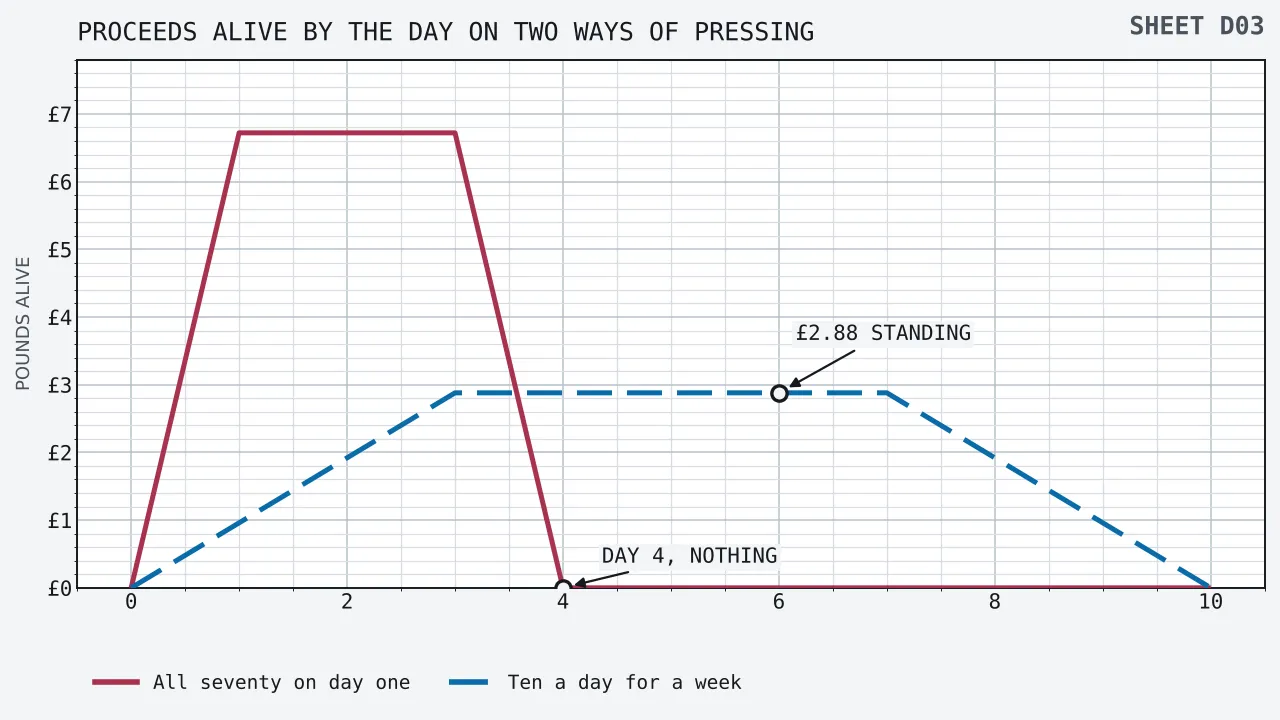
Day four is where the two lines cross for the first time and it is the only day on which the patient reader is ahead. One line falls from £6.72 to nothing on that morning. The other has reached £2.88 and holds there, which looks like stability and is actually a queue in which each day’s arrival is matched by a departure.
Ten days is where the slower line finally reaches nothing, three days past the date printed on the spins, and that tail is the part a reader is least likely to be watching. Ninety-six pence sits in it on day eight and another ninety-six on day nine, and both are collectable by anybody who remembers that the arrangement has not actually ended.
6
The far edge of an arrangement is not the date on its spins
Two hundred and forty hours is the outer edge, and no sentence anywhere in the terms says so. It is 168 plus 72, the spins window followed by a proceeds window hung off its final hour, and it exists only as the sum of two clauses written in different paragraphs.
Forty-three per cent longer than the printed date is what that outer edge amounts to, being 72 hours added to 168. A reader who treats the spins date as the end of the matter walks away from three days during which money generated in the last hours is still collectable, and this is the one error on the page that costs a reader something they already had.
| When the pressing happens | Proceeds clock starts | Proceeds clock ends | How that sits against the printed date |
|---|---|---|---|
| The first hour | Hour 0 | Hour 72 | Four days before it |
| The third day | Hour 48 | Hour 120 | Two days before it |
| The fifth day | Hour 96 | Hour 168 | Level with it exactly |
| The final hour | Hour 168 | Hour 240 | Three days after it |
Row three is the only row where the two dates coincide, and a reader pressing on the fifth day gets the tidy arrangement everybody assumes they have. Hour 96 plus 72 lands exactly on hour 168. Every other row has the clocks finishing at different moments, and the reader’s own choice of day decides by how much.
Four days before and three days after are the two extremes in that table, and between them they span a week. One printed date, one arrangement, and a true finishing moment that can fall anywhere across seven days depending on a decision the reader made without knowing it was a decision.
No part of this is an argument for pressing late. Pressing late pushes the outer edge outward and leaves the credit exposed to every other clause in the meantime, and the arrangement can be withdrawn, the account can be queried and the terms can be rewritten while a reader waits. Pressing the lot early and asking for the proceeds at once is the move the arithmetic supports.
7
Which of the two dates does the taking
One clock takes unused spins and the other takes money, and they are not comparable losses. A lapsed spin costs a reader the expectation it would have produced, which is 9.6 pence apiece at ten pence a press and ninety-six per cent back. A lapsed proceed costs the reader a balance they have already watched appear on a screen.
Six pounds seventy-two is the maximum the first clock can take, being every spin unused. Nine pence sixty is what one unused spin takes. Thirty unused spins take £2.88, which happens to be the same figure the seven-day pace leaves standing, and the coincidence is a useful way to remember both.
| What lapses | What it costs | What the reader saw first |
|---|---|---|
| One unused spin | £0.096 | A count that never became a balance |
| All seventy unused | £6.72 | A headline and nothing after it |
| One day’s proceeds at ten a day | £0.96 | A figure that stood in the account |
| Four days of proceeds in a week | £3.84 | Four separate balances, all seen |
Rows three and four are the ones that sting, and the difference is psychological rather than arithmetical. Money that appeared in a balance and then left feels like a theft, while a spin that was never pressed feels like an opportunity declined. Both are the same ninety-six pence a day on this pace, and only one of them will be remembered.
Nine point six pence a spin is the cleanest number to carry away from this part, because it converts any count of unused spins into pounds immediately. Twenty left over is £1.92. Forty left over is £3.84. The conversion holds at any count because the expectation is linear in the number of presses, and nothing about the window changes it.
Nothing is returned for partial use, and no clause anywhere credits a reader for having pressed most of the spins. A balance standing at the moment a clock expires goes in full, and a count of spins standing at the moment its own clock expires goes in full as well. Two full forfeits, run on two schedules, with no proportional relief in either.
8
Conditions a reader is entitled to find beside a headline
Spins of this family reach a reader with no Great Britain licence standing anywhere behind them. Where a page turns on two dates printed in two places, the duties worth naming are the advertising ones, since each of them governs where a condition turns up rather than what it says once found. Losses of other kinds are real, and they get priced elsewhere under this heading.
Misleading by omission is the test the advertising code sets for a condition kept out of promotional material, and a clause heavy enough to decide £3.84 of a £6.72 expectation will not pass it as a detail. Prominence is the remedy asked for, and prominence is a question about position on a screen rather than about wording.
Time limits sit on the advertising regulator’s own inventory of what weighs enough to count in a gambling promotion, and they sit there in the plural, which is the word doing the work where two of them exist. Eligibility rules and any requirement to wager or to pay in sit on the same inventory, so a sheet that shows one date and buries the second is not half way towards anything.
| Named as a significant condition | What it amounts to on this arrangement | Where a reader usually meets it |
|---|---|---|
| A time limit for using the offer | 168 hours on seventy unused presses | Beside the headline, in the usual way |
| A time limit of the second kind | 72 hours on whatever a press returns | Further down, in a separate sentence |
| A wagering requirement | None at all, which is the selling point | Beside the headline, in large type |
| An eligibility restriction | New accounts, an age, a location | In the small print under everything |
Row two is the row this page exists to move upward. A full sheet put online is expected to stand one tap away from the advertisement mentioning it, rather than behind a line of grey type at the foot of a page, and fourteen minutes of pressing ought to need less reading than that. The reading is nonetheless where £3.84 is kept or surrendered.
Weak prominence carries a stated consequence on the British side, and the consequence lands on the advertisement rather than on the term. A clause of this weight belongs within the advertisement and inside reach of the headline, both on the page a reader lands upon and on the one where an account gets opened, and falling short of that makes the whole advertisement misleading rather than merely untidy.
None of that machinery reaches an arrangement run beyond the British register. What a reader gives up here is not the dates themselves, which would exist on either side of it, but any obligation on anybody to set the second one beside the first. Part five’s arithmetic survives the loss untouched. The odds of a reader seeing it coming do not.
9
Who should press the lot in a single go
Fourteen minutes in one sitting is the whole of the advice this page produces, and it is worth stating as plainly as that. Seventy presses taken together put the entire expected £6.72 under one 72-hour clock, and a request made the same evening settles the matter before either date is relevant.
Three pounds eighty-four is what the alternative costs, and the alternative is not laziness. It is the perfectly reasonable instinct to spread a treat across a week. Ten a day for seven days uses every spin inside its window, breaches nothing, and arrives at a standing balance of £2.88 where £6.72 was generated.
Two questions settle an arrangement of this family before a reader presses anything, and neither is about the count of spins. How long the proceeds live, measured from when they are credited rather than from when the account was opened. And whether that length is stated at all, since a sheet silent on the second clock is a sheet where the second clock is whatever the lobby decides later.
One further figure belongs in the same breath as the £6.72, and it is the smallest sum the cashier will move. An expected £6.72 sits beneath a good many of them, and a proceeds clock running for 72 hours does not pause while a reader works out whether the balance is large enough to request. Where the balance is below the floor, the shorter clock finishes the matter on its own.
Nobody should collect arrangements of this family in quantity on the strength of the arithmetic above. Six pounds seventy-two in expectation, in exchange for fourteen minutes and whatever personal particulars a sign-up form asks for, at a business that never appears on the British register, is a defensible trade on one occasion. Repeated weekly it is a habit with an expected value that stays small and a count of accounts that does not.
Questions
- Do 70 free spins with no wagering still have an expiry?
- Two of them, running at different lengths from different moments. The spins carry one window and anything they return carries another, usually shorter. This note adopts 168 hours and 72 hours as working lengths and labels them as such, since neither has a published length to be copied from.
- When does the clock on the winnings start?
- At the moment a press pays something, not at the moment the credit arrives. A reader who presses in the first hour sees proceeds die at hour 72, four days before the date printed on the spins. A reader who presses in the final permitted hour sees them survive to hour 240, three days after it. The same sheet, the same two clauses, and a seven-day spread in the true finishing moment.
- What are seventy spins expected to return?
- Six pounds seventy-two. Seventy presses at ten pence carry £7.00 to the reels. Ninety-six per cent is the return applied here wherever a title publishes no figure of its own, and twenty-eight pence is expected to stay with the house. That works out at 9.6 pence of expectation for each individual spin, which converts any count of unused ones into pounds.
- How long does it take to use seventy free spins?
- Fourteen minutes. Seventy presses at the twelve seconds this note puts on one come to 840 seconds, which is under two thirds of an occasion at the twenty-two minutes put on a sitting here. Both intervals are working conventions adopted for the arithmetic and neither was observed. Fourteen minutes inside a 168 hour window is 0.14 per cent of it.
- Why does spreading the spins across the week cost money?
- Because only three days of proceeds can ever stand together. Ten presses a day generates ninety-six pence of expectation daily, and each day’s lot lapses 72 hours later, so the standing balance climbs to £2.88 by day three and then stops. By day seven the reader has generated £6.72 and can reach £2.88, with £3.84 already lapsed. No term was breached and no date was missed.
- What is the longest an offer of this shape can live?
- Two hundred and forty hours, and no sentence in the terms says so. It is 168 hours on the spins followed by 72 hours hung off the final permitted press, and it exists only as the sum of two clauses written in separate paragraphs. That is 43 per cent longer than the date most readers are watching, and the extra three days hold anything generated right at the end.
- Is anything given back for using most of the spins?
- No, and that holds on both clocks. A balance standing when its clock expires goes whole, and a count of unused spins standing when its own clock expires goes whole as well. Twenty spins left unpressed is £1.92 of expectation gone, forty is £3.84, and there is no proportional relief written into either clause.
- What protection is missing on offers of this kind?
- Any obligation to set the second date beside the first. Spins of this family reach a reader with no Great Britain licence standing anywhere behind them, and the advertising rules that would otherwise bite ask for conditions of real weight to be put plainly and visibly, on a test of whether keeping one out would mislead. Time limits sit on the advertising regulator’s own inventory of what weighs enough to count, and they sit there in the plural, so an arrangement carrying two qualifies twice over. A full sheet put online is expected to stand one tap from the advertisement, and on the British side a clause of that weight falling short of prominence makes the advertisement itself misleading.
- What is the best way to handle an offer with two clocks?
- Press the lot in one sitting and ask for the proceeds the same evening. Fourteen minutes puts the whole expected £6.72 under a single 72 hour clock, which is 4,306 minutes longer than the pressing needs. Check the smallest sum the cashier will move before starting, because an expected £6.72 sits beneath a good many of those floors and the shorter clock does not pause while a reader works that out.